Research + the Libraries
Key skills and resources for Summer Scholars
S3P 07-14-2025
Andrea Baruzzi (she/her)
STEM Librarian
Christina Bush (she/her)
Research & Instruction Librarian
+ Get to know each other
+ Introduction to the Swarthmore libraries
+ What is research?
+ How do we find it?
What are we doing here?
Introductions
- Part One:
- Share your name, pronouns if you want, hometown, and favorite dessert
- Part Two
- Break into groups of 4
-
Chat within your group about an experience or associations you have with libraries. This can be with a public library, a school library, etc.

Materials
People & Expertise
Programs
Spaces
{books, articles, streaming media, collections, databases}
{ library staff, research librarians, RIAs }
Internships, Events, Exhibit
Swarthmore Library Resources
{study, collaboration, viewing}
Subject Librarians
Also: librarian@swarthmore.edu


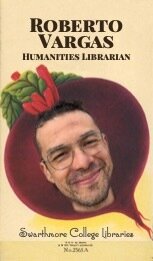

Science, Math, Engineering
Educational Studies, Black Studies, Psychology
Art & Art History, Classics, Latin American & Latino Studies, Linguistics, Philosophy, Religion, Spanish, English
Economics, Gender & Sexuality Studies, Peace & Conflict Studies, Political Science, Sociology & Anthropology
Dance, Music, Theater

Modern Languages & Literatures

Digital Scholarship
Liz Waltman
What is Research?
process
(something you do)
stuff
(something you find)
"I’m studying drosophila to determine whether odor changes mating behavior."
"I'm looking for articles on
olfactory response in the mating behavior of drosophila."
Speaking of research as stuff, what kinds of materials could you use?
- Print books
- Print journals
- eBooks
- Online journals
- Articles
- Book chapters
- Data and Statistics
- Maps
- Magazines and Newspapers
- DVDs and streaming video
Where can you find it?


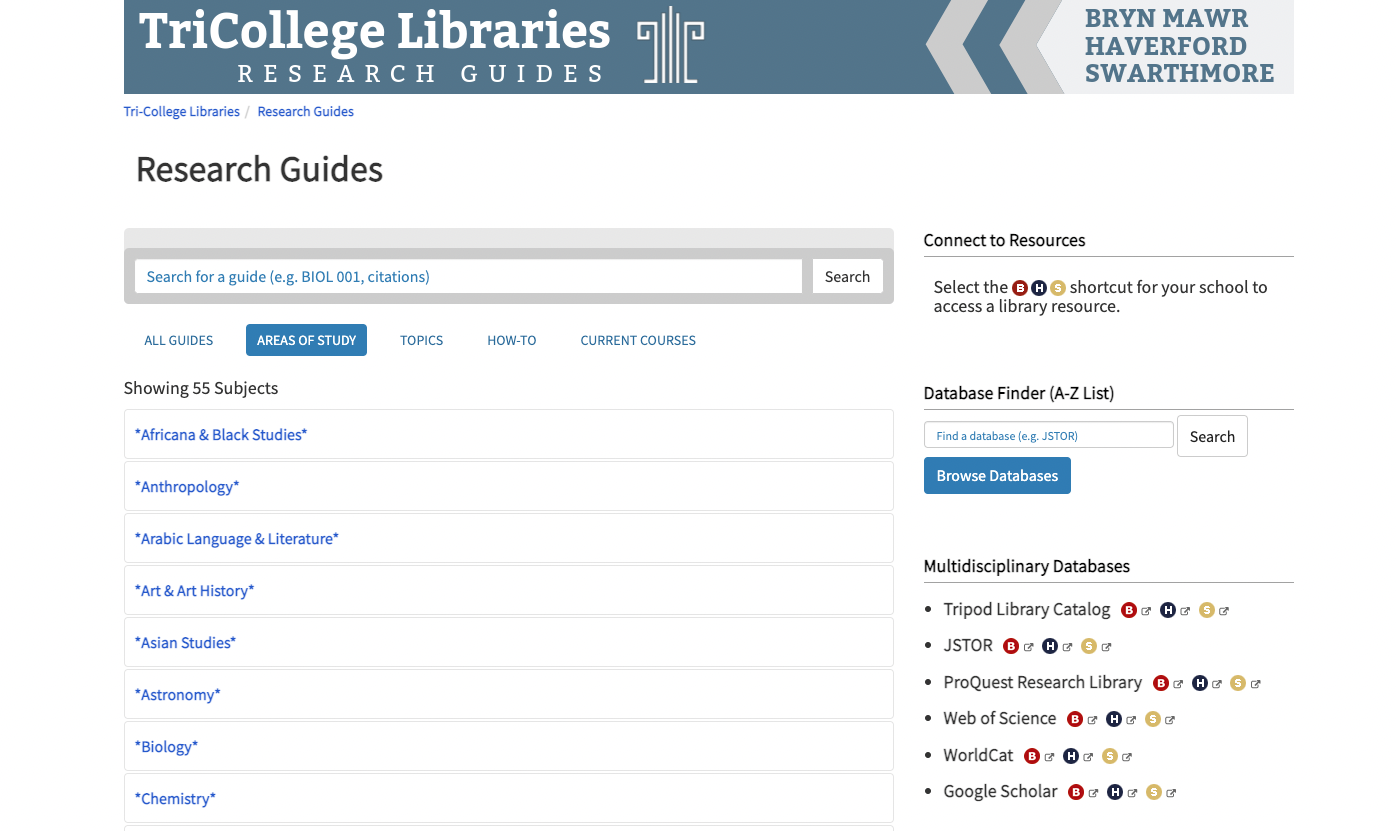
Developing strategies for
doing research
Today, we'll practice:
-
Finding a specific source
-
Following leads in other scholars' works
-
Recognizing different types of sources
-
Finding research articles about a topic of interest
-
Evaluating whether a source may be useful for you
Finding a specific source
Let's say that you're writing a paper and your professor gives you this citation for a book chapter by Niobe Way and Joseph Nelson.
How would you find it?
Way, N., & Nelson, J. (2018). The listening project: Fostering curiosity and connection in middle schools. In N. Way, A. Ali, C. Gilligan, & P. Noguera (Eds.), The crisis of connection: Its roots, consequences, and the solutions (pp. 274–298). New York University Press.
Finding a specific source
You can look it up in Tripod (tripod.swarthmore.edu) which searches materials available from the libraries.
Often, searching for the book title (not the chapter title) will work better.
Way, N., & Nelson, J. (2018). The listening project: Fostering curiosity and connection in middle schools. In N. Way, A. Ali, C. Gilligan, & P. Noguera (Eds.), The crisis of connection: Its roots, consequences, and the solutions (pp. 274–298). New York University Press.
Look up the book in Tripod.
Follow the link to ProQuest Ebook Central.
Navigate to the chapter, which starts on page 274.
Following leads in other scholars' works
When you're exploring a topic, you can often find helpful leads by looking at the articles, books, and other sources cited by other scholars.
Let's say you want to read more about transformative interviewing:
1. Turn/scroll to page 288 and look at note 30.
2. Then to actually read note 30, navigate to page 297.

Journal Article
Book
To follow these leads, it's helpful to recognize what kind of sources are being cited. You can learn to recognize these patterns.
Following leads: recognizing different types of sources
Journal Articles
Author, A. A. (Year). Title of Article. Title of Journal, Volume # (Issue #), Page #s, doi:xx.xxxx/xxxxxx
Carol Gilligan, (2015) "The Listening Guide Method of Psychological Inquiry," Qualitative Psychology 2, no. 1, 69-77
Alisha Ali, (2006) "A Framework for Emancipatory Inquiry in Psychology: Lessons from Feminist Methodology," Race, Gender, and Class 13, nos 1-2,1-14.
Author, A. A. (Year). Title of Article. Title of Journal, Volume # (Issue #), Page #s, doi:xx.xxxx/xxxxxx
Following leads: recognizing different types of sources
Carol Gilligan, Joining the Resistance (Cambridge: Polity Press, 2011).
Book Chapters
Author, A. (Year). "Title of chapter," in Title of book, ed. Editor(s). Location: Publisher, pages.
Books
Author, A. (Year). Title of work. Location: Publisher.
Other common source types: Conference Presentations, Videos
Niobe Way and Leoandra Rogers, “Resistance to Dehumanization during Childhood and Adolescence: A Developmental and Contextual Process,” in New Perspectives on Human Development, ed. Nancy Budwig, Elliot Turiel, and Philip David Zelazo (Cambridge: Cambridge University Press, 2017), 209–228.
To read an article or book, search Tripod (unless you'd rather pay for it!)
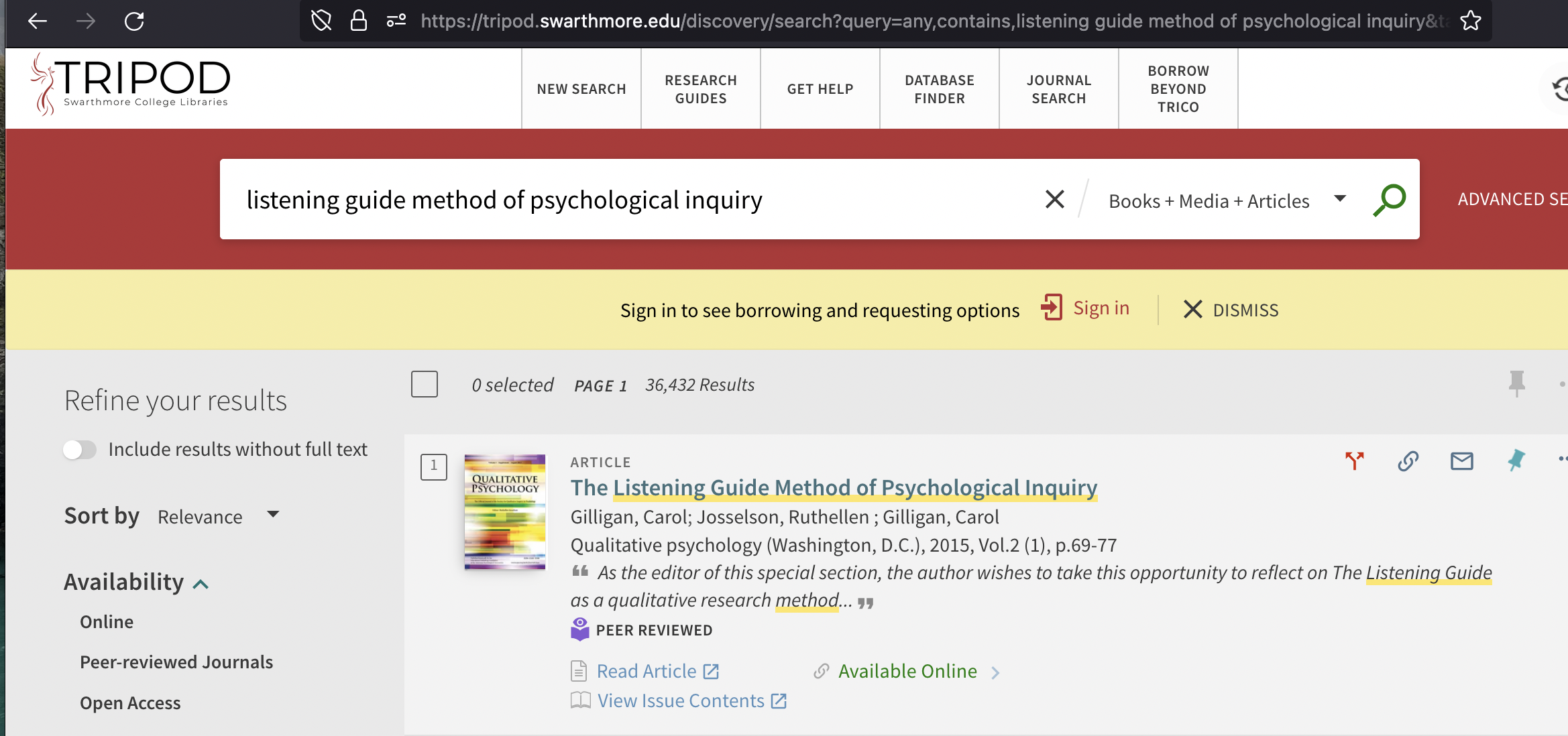
So how would you go about citing this article in your own work?
- You can get a quick automatically-generated citation in Tripod - but you'll need to verify that it's accurate.
-
ZoteroBib is a citation generator that lets you generate and change styles for multiple citations at once. (Let's try citing
- You can find the official style guides on the Libraries' Citation Guide: bit.ly/trico-citations
Recap -- so far, we've looked at:
-
Finding a specific source
-
Following leads in other scholars' works
-
Recognizing different types of sources
When do you imagine it could be helpful to look at the sources an author cites?
Additional strategies for
doing research:
-
Finding research articles about a topic of interest
-
Evaluating whether a source may be useful for you
Finding research articles about
a topic of interest
Some useful tools
for finding research:
-
Databases (Web of Science, JSTOR, PubMed)
-
Google Scholar (scholar.google.com)
Librarians can help you learn to navigate the different resources available to you.
Finding research articles about
a topic of interest
-
Go to the database Web of Science.
(see shortcut on Tripod - tripod.swarthmore.edu)
3. Skim over your search results. What do you observe? How can you use filters and adjust your query to get more relevant results?
- What happens if you filter results by date?
- Look for Web of Science Categories - what do you notice about the subjects represented here?
2. Search for the following:
“middle school” OR “junior high”
AND listening
Evaluating if a source
will be useful to you
What do you look for when you're finding sources for a paper or academic project?
Relevance
- Is it on topic?
- Search within the article
- What are you looking for?
- Background information
-
Evidence / exhibits
- Texts to analyze
-
Arguments
- Other scholars' points that you can critique and build on
- Methods
Quality
- Is it scholarly?
- Advantage of using Web of Science
-
Author
- Author/contributor bios
- Can look them up
-
Publisher
- _____ University Press
- Routledge, Springer/Palgrave
- Citations
- How often is this article or author cited?
How do you know if a source is any good?
B / E / A / M
Writers rely on background sources, interpret or analyze exhibits, engage arguments, and follow methods.
Bizup (2008)
Exhibit (Evidence)
Background
Materials used to establish facts. Implies membership in a community based on shared references
The materials to be analyzed, examined or interpreted
Argument
Sources you engage with or respond to directly by countering, extending or refining the claims made
Method (Model)
Using a source's way of analyzing an issue to apply to your own issue
B/E/A/M examples
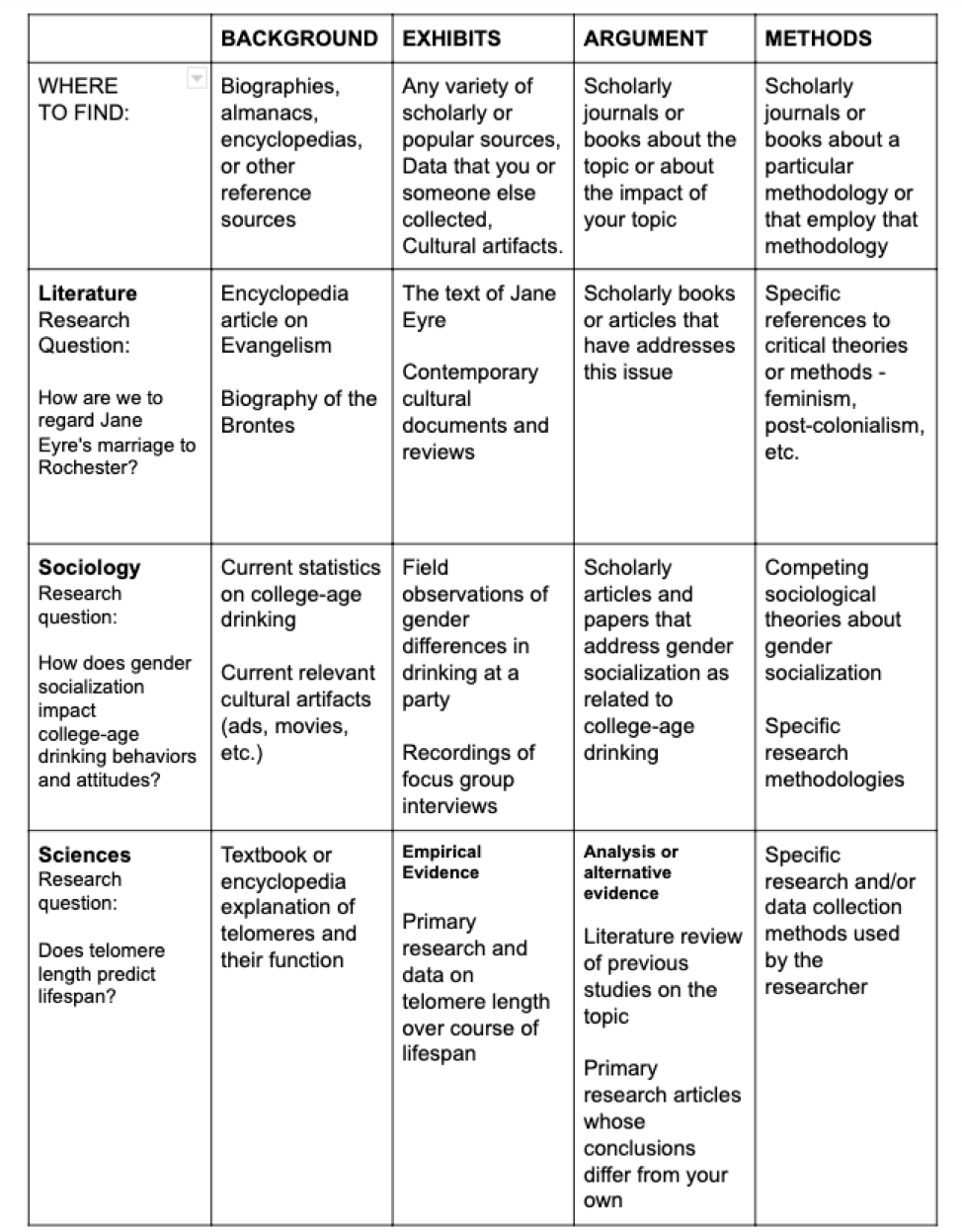
Open the handout: bit.ly/beam-swat
BEAM your research
The BEAM framework can help you clarify your goals while looking for sources and reading, and can inform your next steps.
Library Help
Reach out and ask! We're here to help.
- Your research projects
- Questions about library services
How?
- Email us (librarian@swarthmore.edu)
- Make an appointment with a subject librarian
- Research Guides
-
During the school year, you can use
chat in Tripod to get help.
Thank you!
Christina Bush (cbush1)
Research and Instruction Librarian
Andrea Baruzzi (abaruzz1)
STEM Librarian