Optimal transport
transport maps and constrained gradient flows
Théo Dumont
D., Lacombe, Vialard. Learning Monge maps with constrained drifting models, preprint, 2026.


slides available at https://slides.com/theodumont/bezout
1. Introduction to optimal transport: transport maps and transport plans
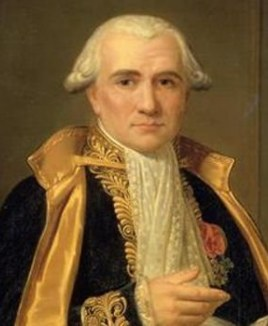
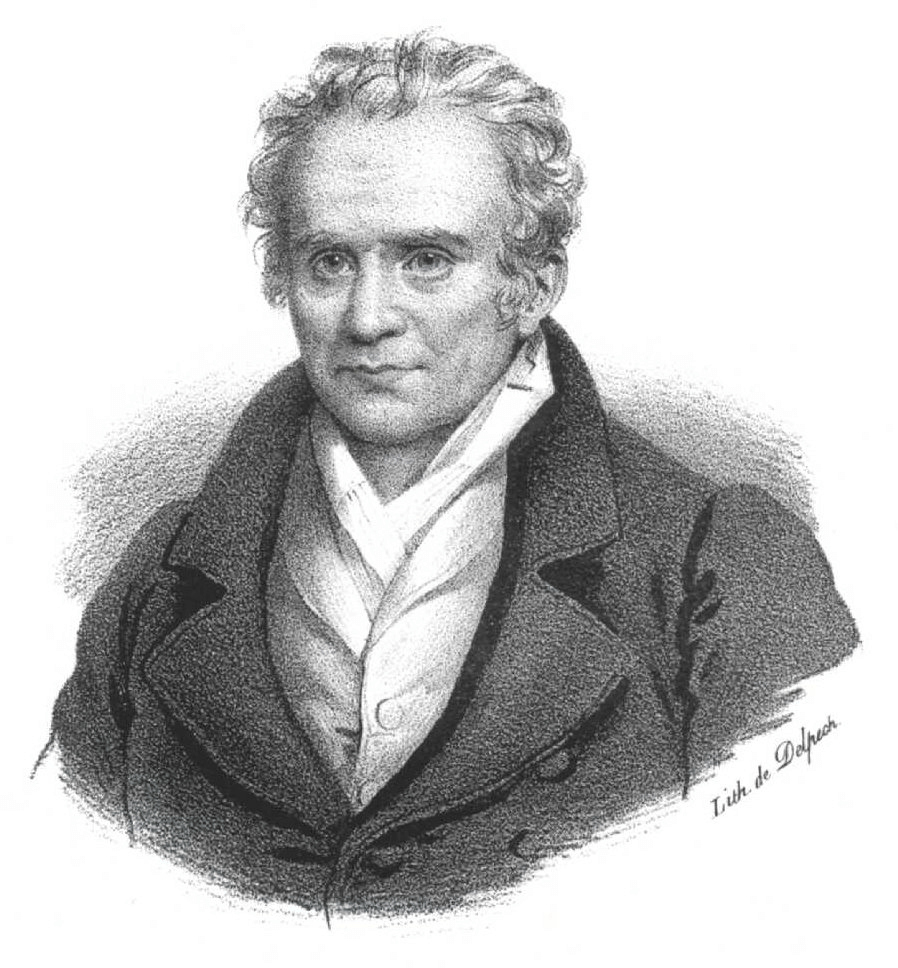
Gaspard Monge
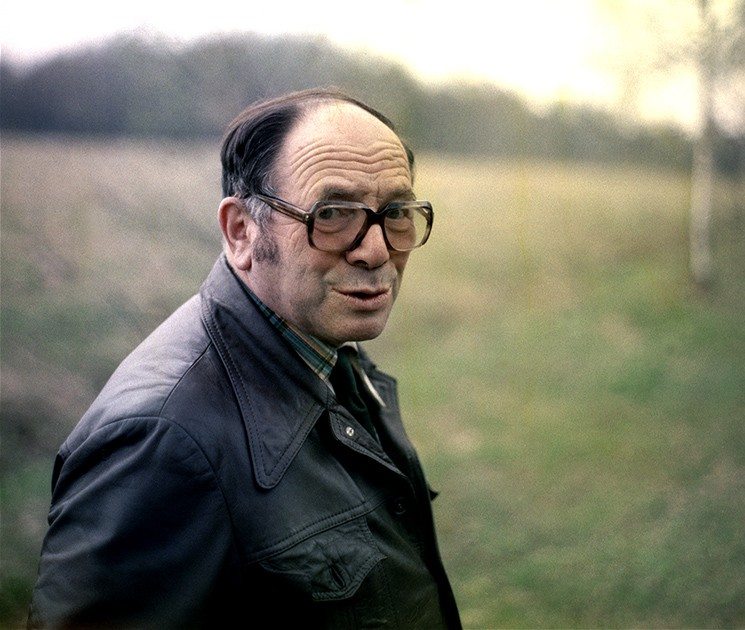
Leonid Kantorovitch
[Monge, 1781], [Kantorovitch, 1942]
- a measure over a set \(\mathcal X\): a function \(\mu:\Sigma_{\mathcal X}\to\mathbb R\) that satisfies
- \(\mu(B)\geq0\) for all \(B\in\Sigma_{\mathcal X}\)
- \(\mu(\varnothing)=0\)
- countable additivity
- a probability measure: \(\mu(\mathcal X)=1\)
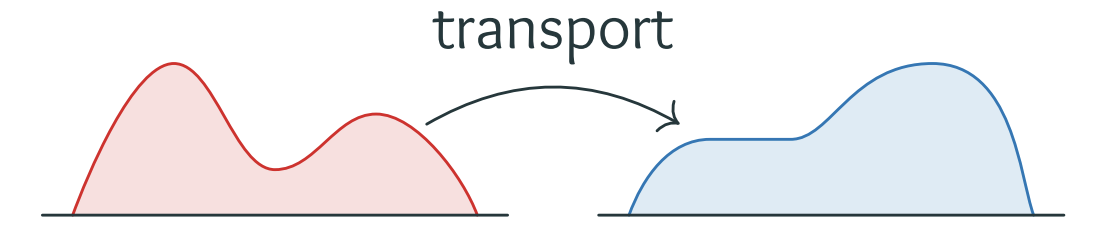
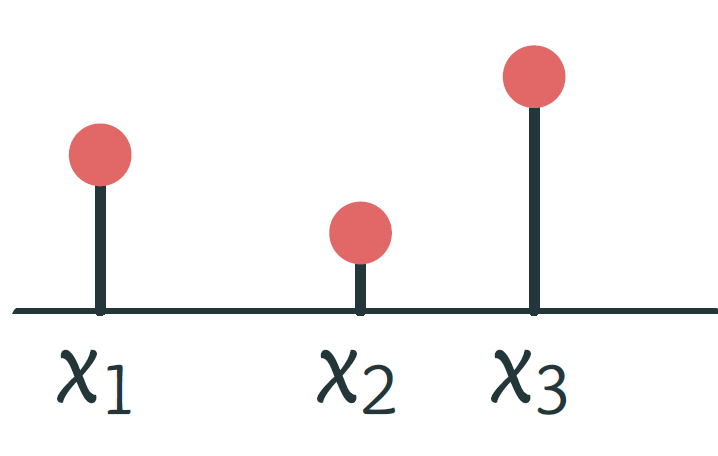
A "continuous" measure \(\mathrm d\mu(x)=f(x)\mathrm dx\).
(has a density w.r.t. the Lebesgue measure \(\mathrm dx\)).
A discrete measure \(\mu=\sum_{i=1}^n a_i\delta_{x_i}\).
Introduction
- measures can represent anything
Introduction
- measures can represent anything:
point clouds, histograms, 2D images, 3D images, densities of a fluid...
A "continuous" measure \(\mathrm d\mu(x)=f(x)\mathrm dx\).
(has a density w.r.t. the Lebesgue measure \(\mathrm dx\))
A discrete measure \(\mu=\sum_{i=1}^n a_i\delta_{x_i}\).
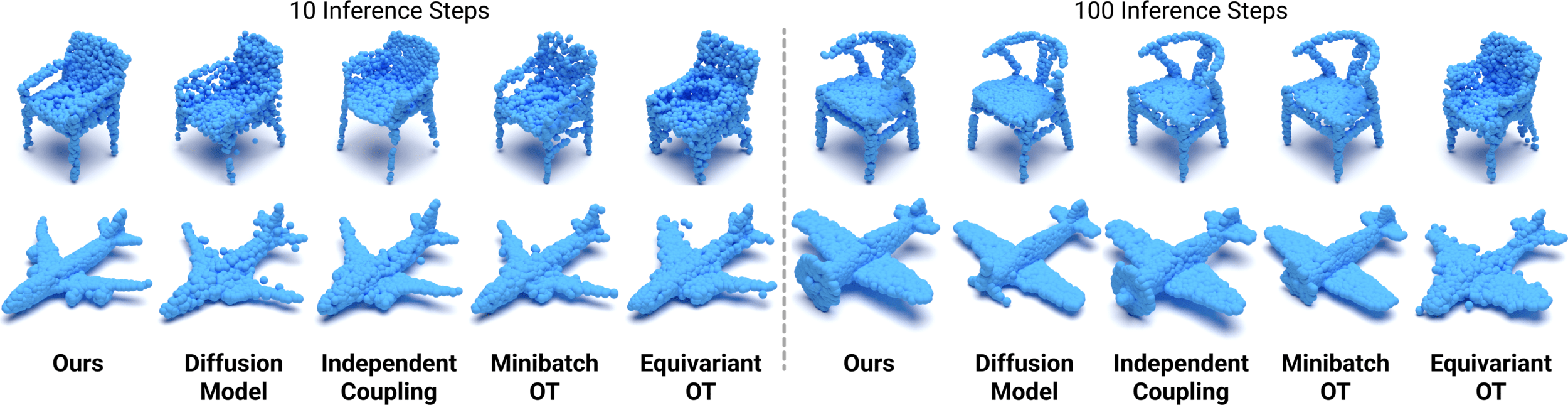
3D point cloud
[Hui, Liu, Zeng, Fu, Vahdat, 2025]

2D image
[Ibáñez, Darras, 1964]
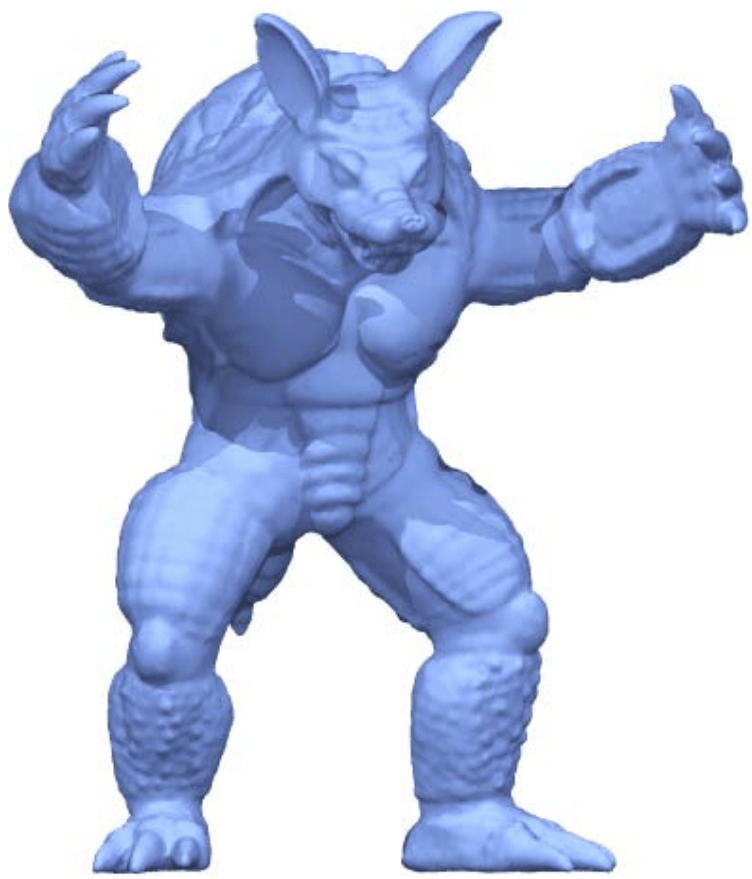
3D image
[Kilian, Mitra, Pottmann, 2007]
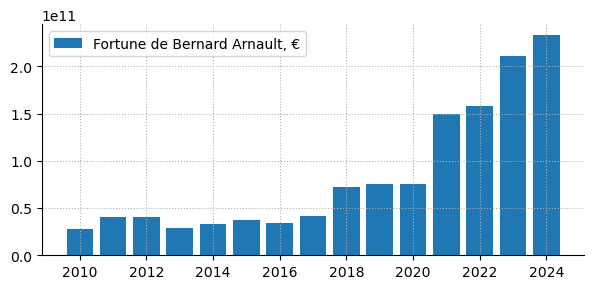
histogram
[Dumont, 2026]
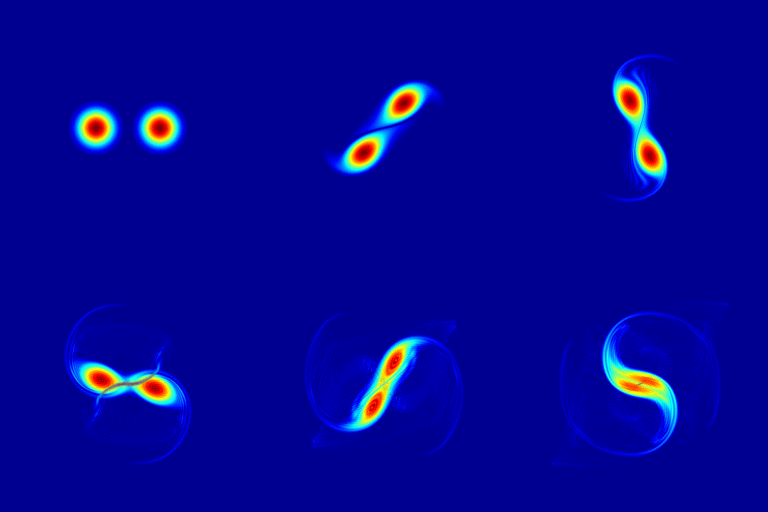
density of a 2D fluid
[Yanovsky]
[Monge, 1781], [Kantorovitch, 1942]
- transforming measures: for \(T:\mathcal X\to\mathcal Y\), pushforward measure \(T_*\mu\), defined as \(T_*\mu(B)\coloneqq \mu(T^{-1}(B))\)
for a continuous measure:

for a discrete measure:
Introduction
A "continuous" measure \(\mathrm d\mu(x)=f(x)\mathrm dx\).
(has a density w.r.t. the Lebesgue measure \(\mathrm dx\))
A discrete measure \(\mu=\sum_{i=1}^n a_i\delta_{x_i}\).
[Monge, 1781], [Kantorovitch, 1942]
- probability measures \(\mu_0,\gamma\in \mathcal P(\mathbb R^d)\)
- piles of sand: find strategy \(T\)
OT problem (Monge)
- find the best strategy: cost function \(c:\mathbb R^d\times\mathbb R^d\to\mathbb R\) (e.g. \(\|x-y\|^2\))
Optimal transport
OT problem (Monge)
[Monge, 1781], [Kantorovitch, 1942]
- \(\mathcal X\) and \(\mathcal Y\) Polish spaces
- \(\mu_0\in\mathcal P(\mathcal X),\, \gamma\in\mathcal P(\mathcal Y)\)
- cost function \(c:\mathcal X\times\mathcal Y\to\mathbb R\)
Optimal transport
graph of \(T\): \[\big\{(x,T(x))\mid x\in\mathcal X\big\}\subset \mathcal X\times\mathcal Y\]
OT problem (Monge)
OT problem (Kantorovitch)
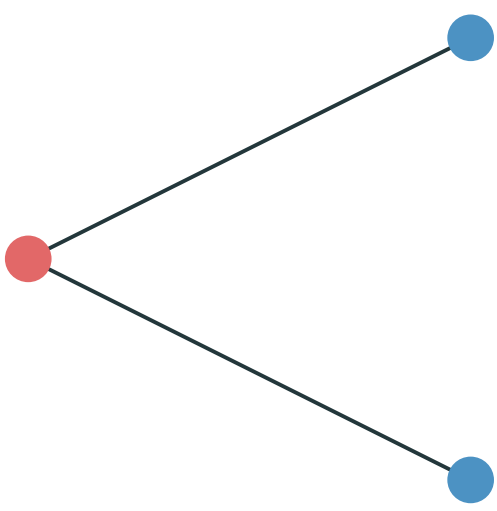
not feasible by a map!
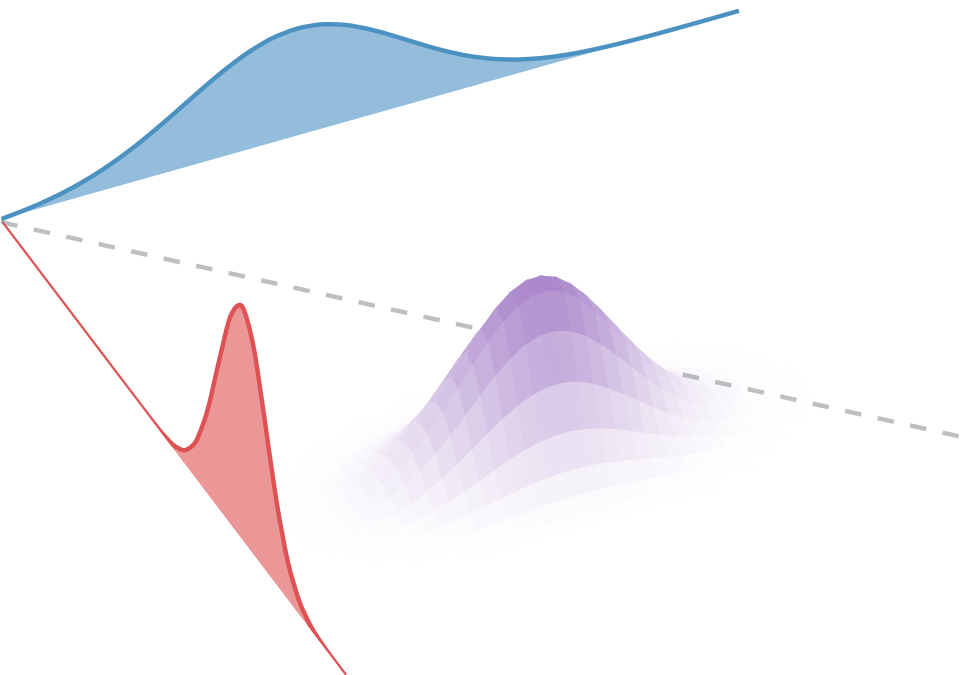
\(\pi\) is induced by a transport map \(T\)
\(\pi\) is a transport plan
relaxation
[Monge, 1781], [Kantorovitch, 1942]
Optimal transport
- \(\mathcal X\) and \(\mathcal Y\) Polish spaces
- \(\mu_0\in\mathcal P(\mathcal X),\, \gamma\in\mathcal P(\mathcal Y)\)
- cost function \(c:\mathcal X\times\mathcal Y\to\mathbb R\)
OT problem (Kantorovitch)
[Monge, 1781], [Kantorovitch, 1942]
- \(\mathcal X\) and \(\mathcal Y\) Polish spaces
- \(\mu_0\in\mathcal P(\mathcal X),\, \gamma\in\mathcal P(\mathcal Y)\)
- cost function \(c:\mathcal X\times\mathcal Y\to\mathbb R\)
- the set of transport plans is non-empty (always \(\mu_0\otimes\gamma\)), so existence of minimizers!
- linear program in \(\pi\): easy to solve!
- if \(c(x,y)=\|x-y\|^p_2\) in \(\mathbb R^d\): \(p\)-Wasserstein distance (sometimes Earth Mover Distance)
Optimal transport
relaxation
\(\pi\) is induced by a transport map \(T\)
\(\pi\) is a transport plan
Monge (maps)
Kantorovitch (plans)
[Brenier, 1987]
Can we say that the solution of (KP) is a map?
?
Optimal transport
Brenier's theorem
When \(\mathcal X=\mathcal Y=\mathbb R^d\) and \(c(x,y)=\|x-y\|^2\), if \(\mu_0\ll\mathrm dx\), then there is a unique solution to (KP), and it is the unique map pushing \(\mu_0\) onto \(\gamma\) that writes \(T^\star=\nabla \phi\) with \(\phi:\mathbb R^d\to\mathbb R\) convex.
[Brenier, 1987]
Examples
In the rest of the talk, \(\mathcal X=\mathcal Y=\mathbb R^d\), \(c(x,y)=\|x-y\|^2\), and \(\mu_0\ll\mathrm dx\).
Brenier's theorem
When \(\mathcal X=\mathcal Y=\mathbb R^d\) and \(c(x,y)=\|x-y\|^2\), if \(\mu_0\ll\mathrm dx\), then there is a unique solution to (KP), and it is the unique map pushing \(\mu_0\) onto \(\gamma\) that writes \(T^\star=\nabla \phi\) with \(\phi:\mathbb R^d\to\mathbb R\) convex.
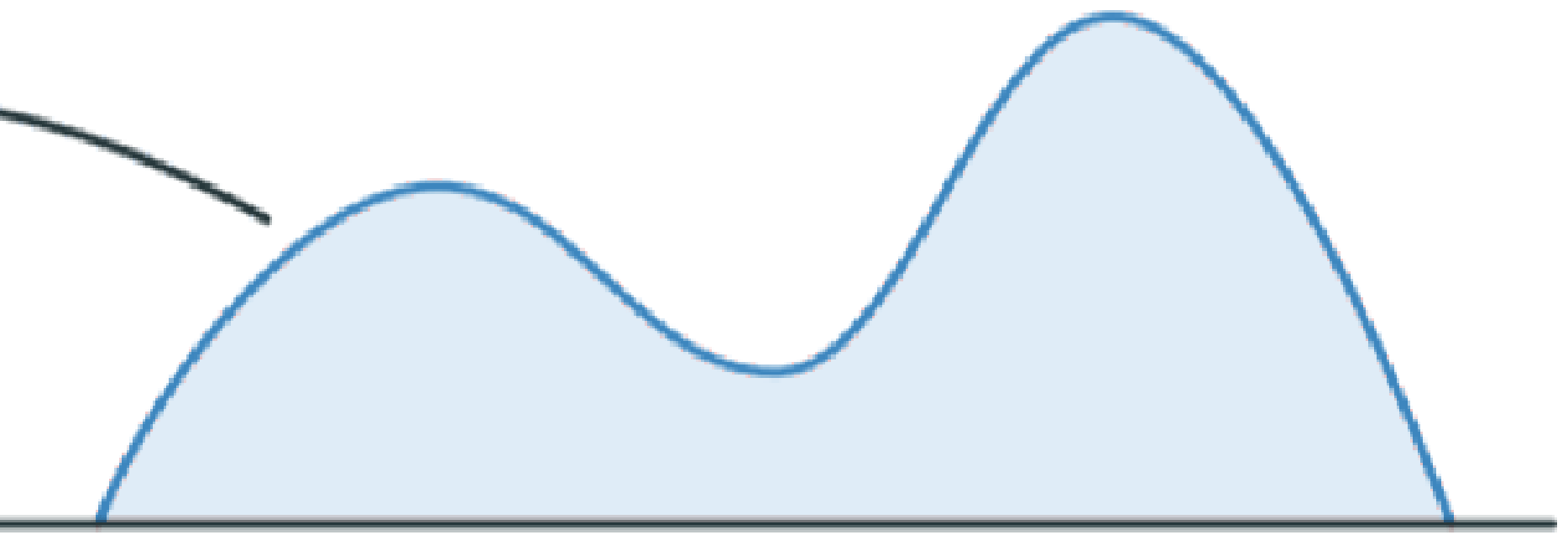
- \(\ \)
\(0\)
\(-x\)
\(x\)
\(T(x)=-x\)?
\(T(x)=\nabla\phi(x)\),
with \(\phi(x)=-\frac12\|x\|^2\), not convex
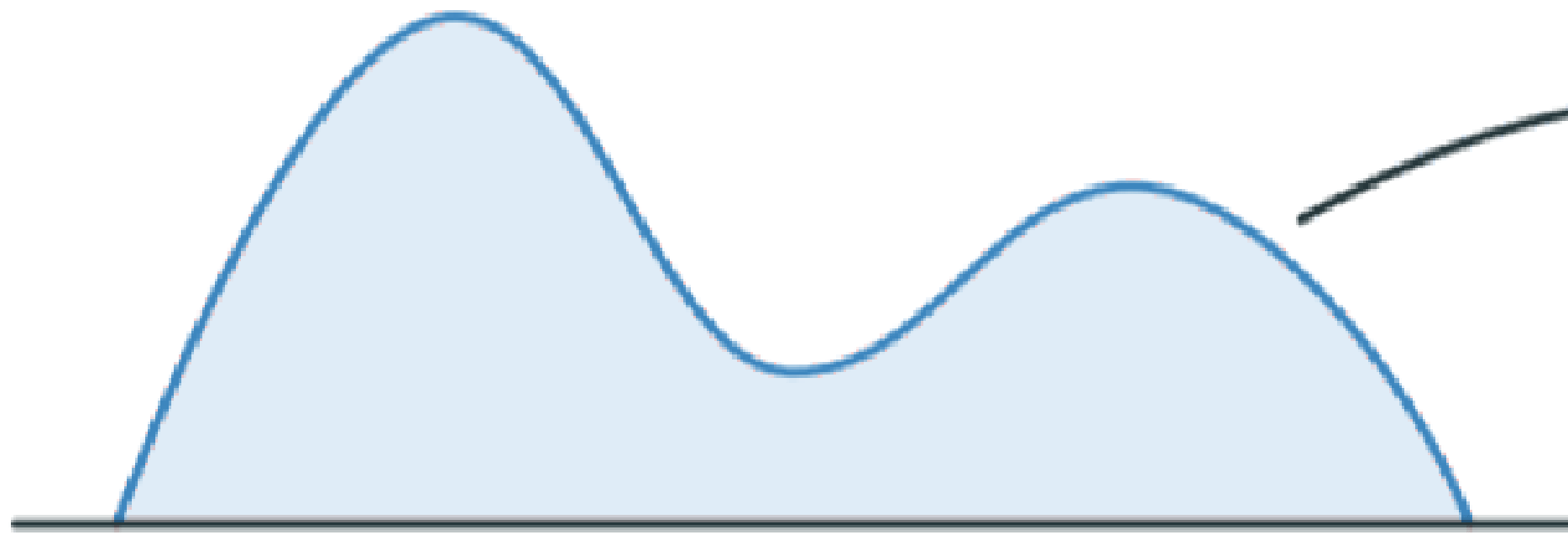
\(T^\star(x)=x+L\)
\(T^\star(x)=\nabla\phi(x)\),
with \(\phi(x)=\frac12\|x\|^2+Lx\) convex
- \(\ \)
\(L\)
How to find this OT map?
?
2. Finding the OT map with constrained gradient flows
[D, Lacombe, Vialard, 2026]
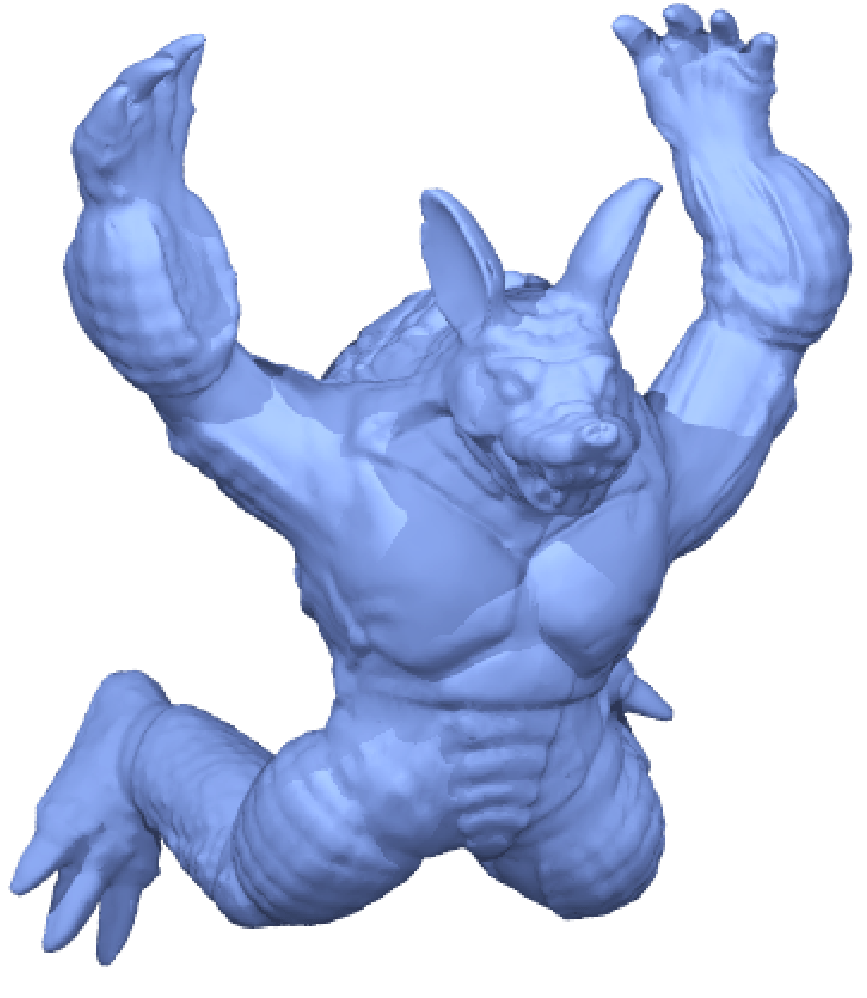
[Kilian, Mitra, Pottmann, 2007]
OT problem (Monge)
OT problem (Monge)
Let \(\mu_0,\gamma\in\mathcal P(\mathbb R^d)\) with finite 2nd-order moment.
Brenier's theorem
\(T^\star\) is the gradient of a convex function.

Then any map \(T\) such that \(T_*\mu_0=\gamma\) belongs to \(L^2_{\mu_0}(\mathbb R^d,\mathbb R^d)\).
Finding the OT map
[D, Lacombe, Vialard, 2026]
\(T^\star\in\)
Proof.
(it is a convex cone)
\(T^\star_*\mu_0=\gamma\)
Let \(D:\mathcal P(\mathbb R^d)\times \mathcal P(\mathbb R^d)\to\mathbb R_+\) such that
\(D(\mu,\nu)=0\iff\mu=\nu\).
Finding the OT map
[D, Lacombe, Vialard, 2026]
not very practical: can we see it differently?
\(D(T^\star_*\mu_0,\gamma)=0\)
and
\(T^\star\in\)
Our new problem
How to solve this?
?
Let \(H\) be some Hilbert space and let \(F:H\to \mathbb R\).
Say I want to find
Gradient flows in Hilbert spaces
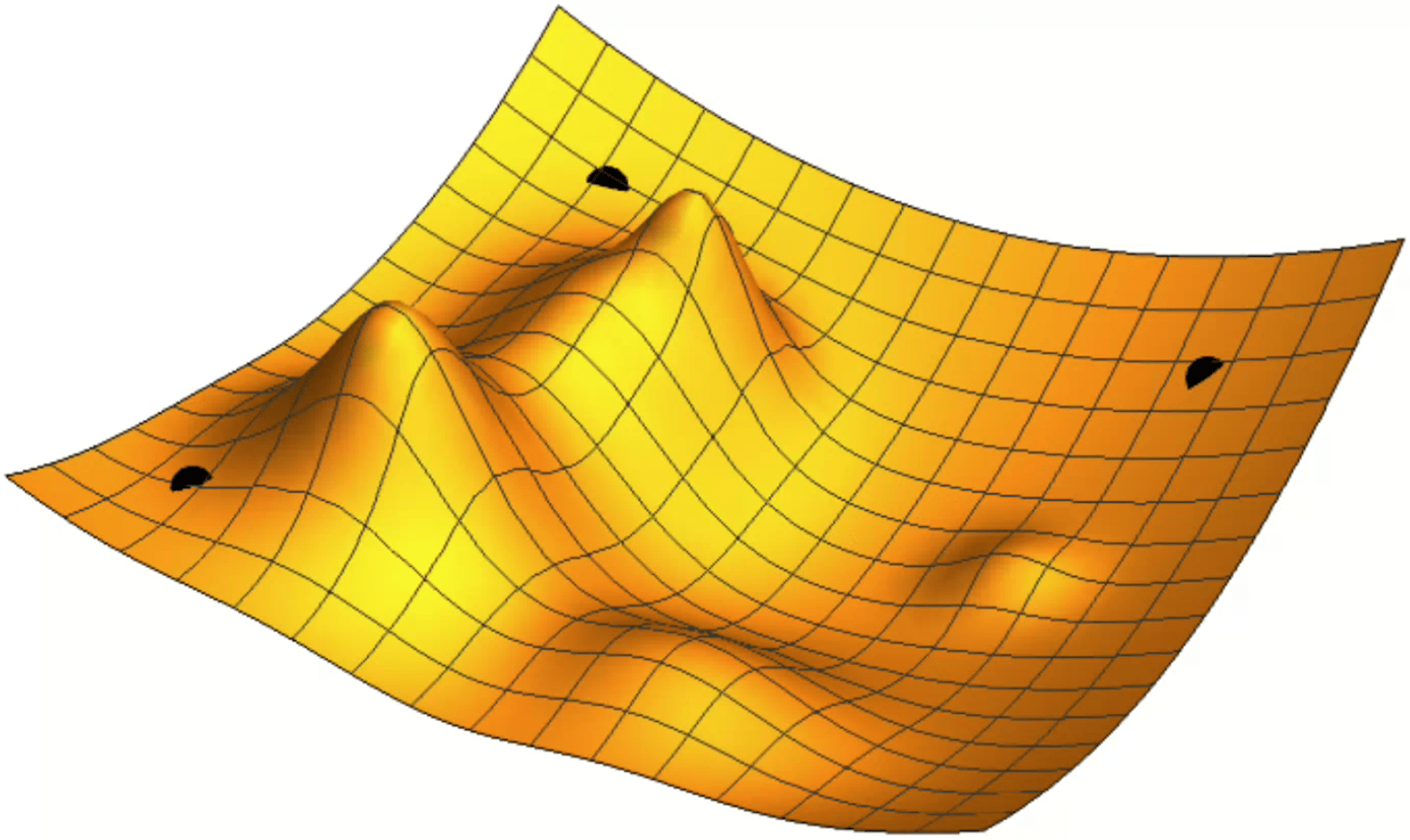

Let \(H\) be some Hilbert space and let \(F:H\to \mathbb R\).
Say I want to find
Gradient flow
The gradient flow of some function \(F:H\to\mathbb R\) is a solution \(x_t\) of
starting at some \(x_0\in H\), for all \(t\geq0\).
Does it converge to \(x^\star\)?
?
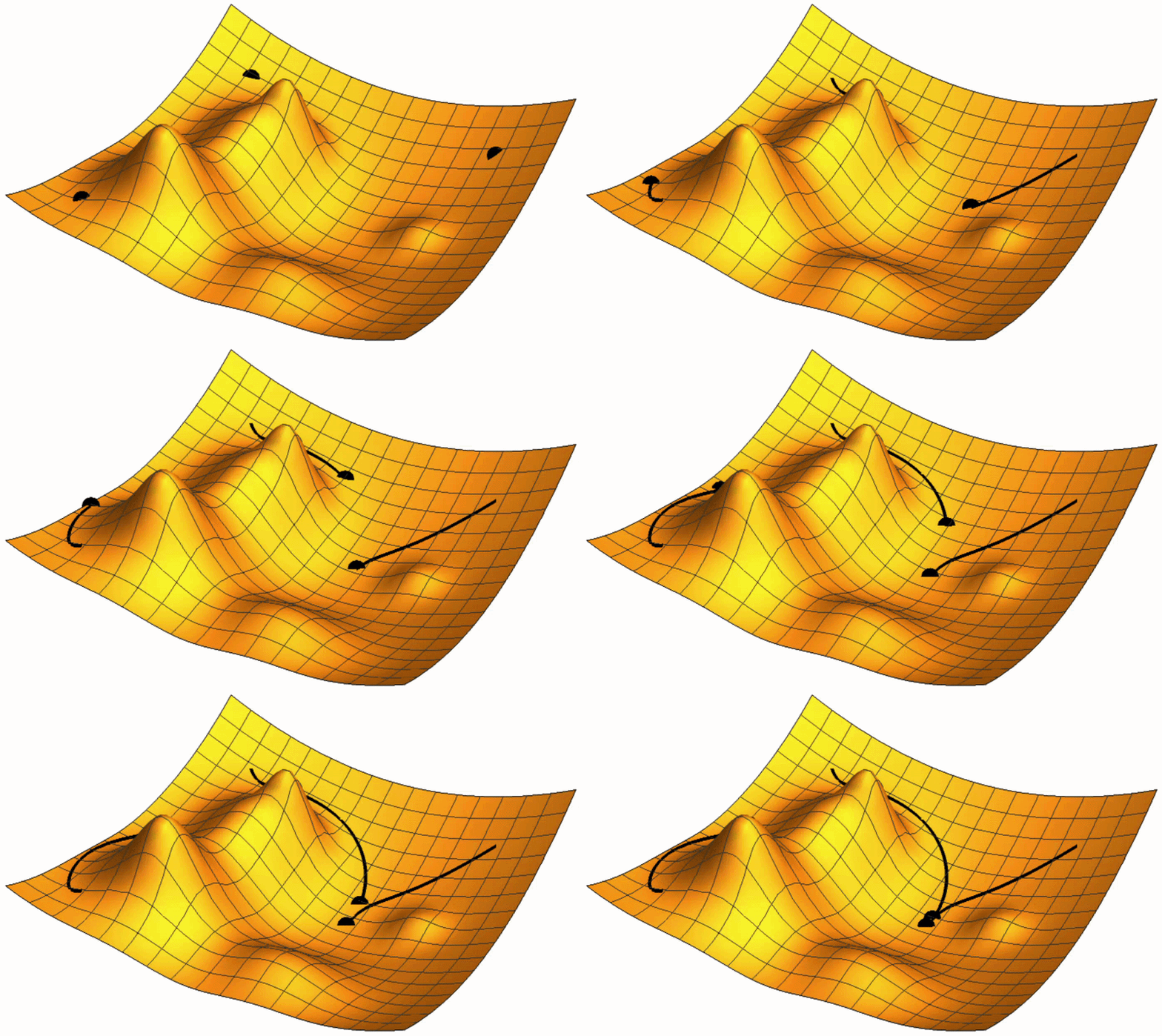
Gradient flows in Hilbert spaces
Theorem
Assume that \(F\) is \(\lambda\)-convex around its unique minimizer \(x^\star\), with \(\lambda>0\). Then \(x_t\) converges to \(x^\star\) at an exponential rate: \[\|x_t-x^\star\|^2\leq e^{-\lambda t}\|x_0-x^\star\|^2.\]
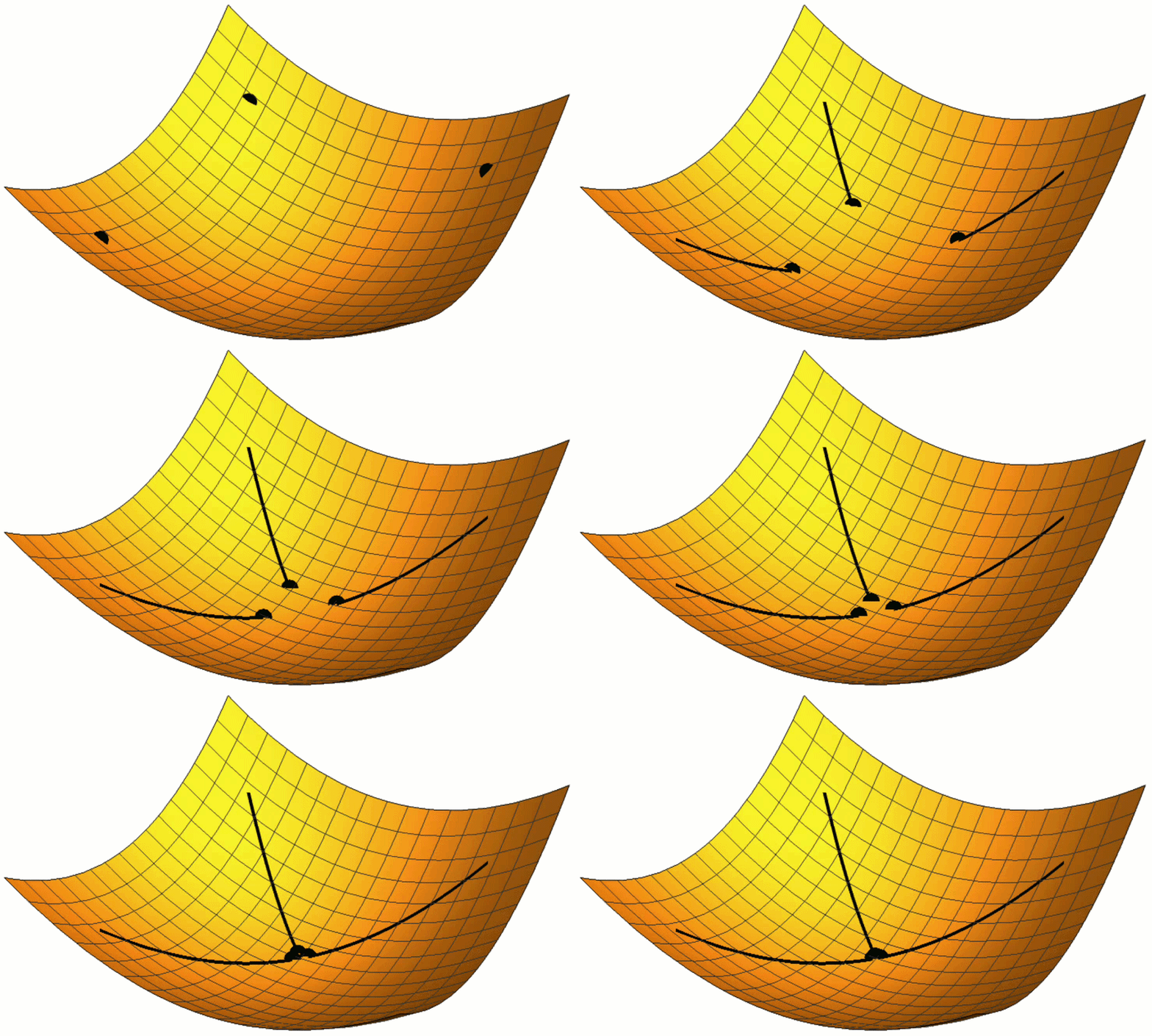
Let \(H\) be some Hilbert space and let \(F:H\to \mathbb R\).
Say I want to find
Gradient flows in Hilbert spaces
Proof.
If \(F\) is \(\lambda\)-convex around \(x^\star\) with \(\lambda>0\), then the gradient flow of \(F\) converges to
Let \(H\) be some Hilbert space and let \(F:H\to \mathbb R\).
Gradient flows in Hilbert spaces
Takeaway
Constrained gradient flows in the set of transport maps
[D, Lacombe, Vialard, 2026]
\(T^\star\in\)
We need to stay in \(K\)!
!
starting at \(T_0=\operatorname{id}\), for all \(t\geq0\).
If \(F_\gamma:T\mapsto D(T_*\mu_0,\gamma)\) is \(\lambda\)-convex around \(T^\star\) with \(\lambda>0\), then the gradient flow of \(F_\gamma\)
converges to
Takeaway
constrained
- Find a functional \(F_\gamma:T\mapsto D(T_*\mu_0,\gamma)\) that is \(\lambda\)-convex around \(T^\star\).
- Show (rigorously this time) that the constrained gradient flow of \(F_\gamma\) converges to \(T^\star\).
constrained gradient flow
[D, Lacombe, Vialard, 2026]
Constrained gradient flows in the set of transport maps
starting at \(T_0=\operatorname{id}\), for all \(t\geq0\).
If \(F_\gamma:T\mapsto D(T_*\mu_0,\gamma)\) is \(\lambda\)-convex around \(T^\star\) with \(\lambda>0\), then the gradient flow of \(F_\gamma\)
converges to
Takeaway
- Find a functional \(F_\gamma:T\mapsto D(T_*\mu_0,\gamma)\) that is \(\lambda\)-convex around \(T^\star\).
\(\displaystyle D(\mu,\gamma)\coloneqq\int_{\mathbb R^d}\mu\log\frac\mu\gamma=\int_{\mathbb R^d} V\mu+\int_{\mathbb R^d}\mu\log\mu \)
entropy
potential
Write \(\gamma=e^{-V}\,\mathrm dx\) and let \(D\) be the relative entropy. If \(V\) is \(\lambda\)-convex on \(\mathbb R^d\), then \(F_\gamma\) is \(\lambda\)-convex around \(T^\star\) on \(L^2_{\mu_0}(\mathbb R^d,\mathbb R^d)\).
Proposition. [D, Lacombe, Vialard, 2026]
Write \(\gamma=e^{-V}\,\mathrm dx\). Define the relative entropy (or KL divergence):
(this comes quite easily from the very nice convexity properties of the relative entropy on \(\mathcal P(\mathbb R^d)\))
We found our functional \(F_\gamma\)!
:)
Constrained gradient flows in the set of transport maps
[D, Lacombe, Vialard, 2026]
Constrained gradient flows in the set of transport maps
2. Show (rigorously this time) that the constrained gradient flow of \(F_\gamma\) converges to \(T^\star\).
Theorem. [D, Lacombe, Vialard, 2026]
Let \(\mu_0\in\mathcal P(\mathbb R^d)\) be some absolutely continuous probability measure, let \(\gamma=e^{-V}\in\mathcal P(\mathbb R^d)\) be some probability measure with \(V\) \(\lambda\)-convex, \(\lambda>0\).
Then the constrained gradient flow:
\(\circ\) admits a solution of time-regularity \(H^1\)
\(\circ\) and converges exponentially fast to the optimal
transport map between \(\mu_0\) and \(\gamma\): \[\|T_t-T^\star\|^2_{\mu_0}\leq Ce^{-2\lambda t}\|\operatorname{id}-T^\star\|^2_{\mu_0}.\]
[D, Lacombe, Vialard, 2026], [Ambrosio, Gigli, Savaré, 2005]
approximate the time-continuous flow by a discrete implicit scheme [AGS, 2005]
proceed similarly as in the non-constrained case
Recap
[D, Lacombe, Vialard, 2026]
OT problem (Monge)
Our new problem
constrained gradient flow
starting at \(T_0=\operatorname{id}\), for all \(t\geq0\).
What's more?
- computationally:
- how to compute this constrained gradient flow that converges to \(T^\star\)?
- parameterize the set \(K\) as \(\theta\mapsto \nabla\phi_\theta\), where \(\phi_\theta\) is an ICNN (input convex neural network)
- compute this:
for that, we need to- know/compute \(\nabla F_\gamma\): \(\nabla F_\gamma(T)=(\nabla\log(T_*\mu_0)+\nabla V)\circ T\)
- compute the projection \(\operatorname{proj}_C[v]=\argmin_{w\in C}\|w-v\|\) (we solve this using gradient descent)
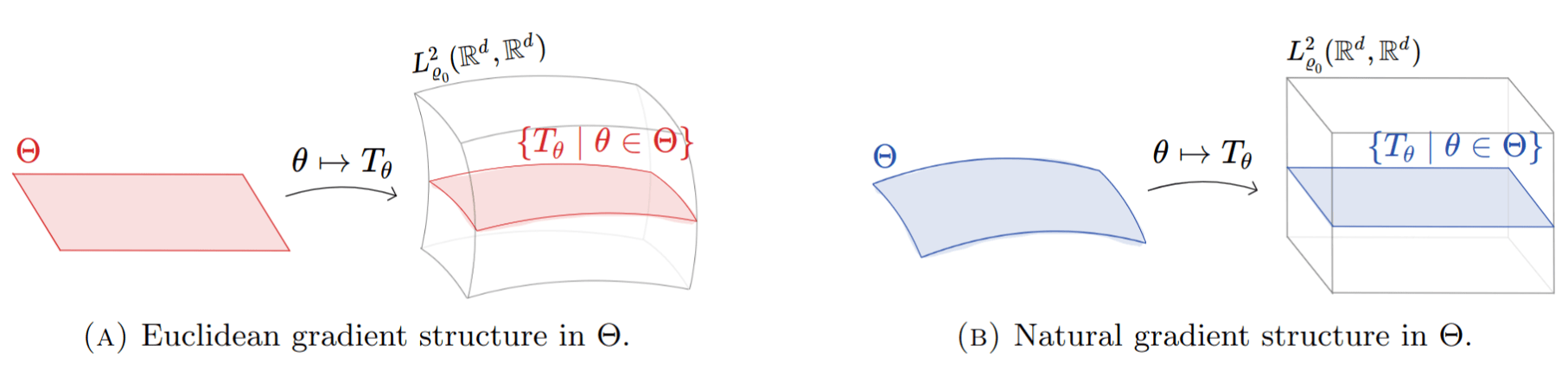
- connection with natural gradient flow/descent
- the induced evolution in parameter space is a natural gradient flow
[D, Lacombe, Vialard, 2026]
Ambrosio, Gigli, Savaré (2005). Gradient flows: in metric spaces and in the space of probability measures
Brenier, Y. (1987). Décomposition polaire et réarrangement monotone des champs de vecteurs
Dumont, T., Lacombe, T., and Vialard, F.-X. (2026). Learning Monge maps with constrained drifting models.
Kantorovich, L. (1942). On the translocation of masses.
Monge, G. (1781). Mémoire sur la théorie des déblais et des remblais
Villani, C. (2008). Optimal transport: old and new.
slides available at https://slides.com/theodumont/bezout
•
•
•
•
•
•
References
Thank you!