Contributions around the Boltzmann equation and some of its variants
Thomas Borsoni
supervised by
Laurent Boudin & Laurent Desvillettes

Mesoscopic
Microscopic
Macroscopic

(statistical)

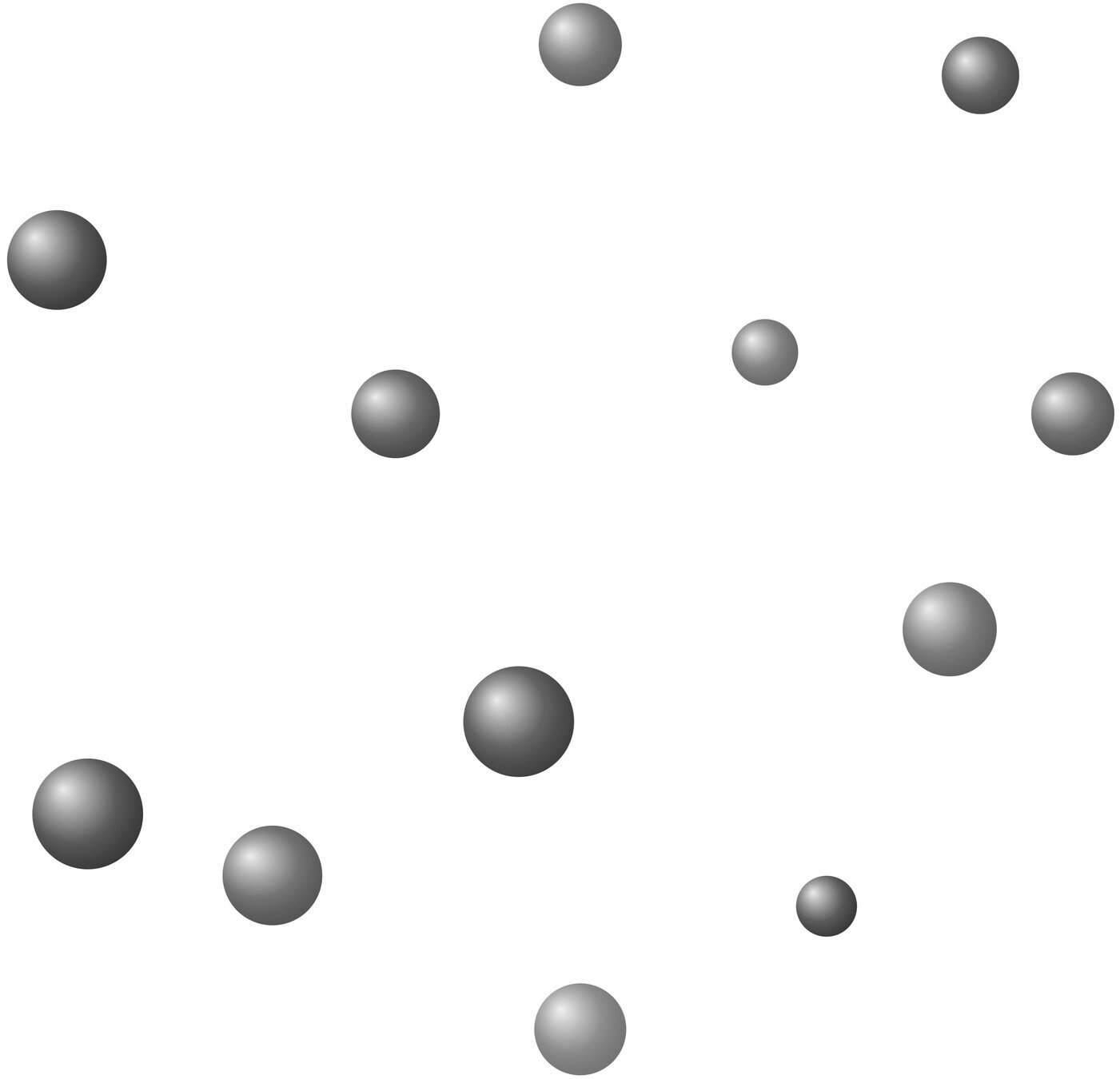
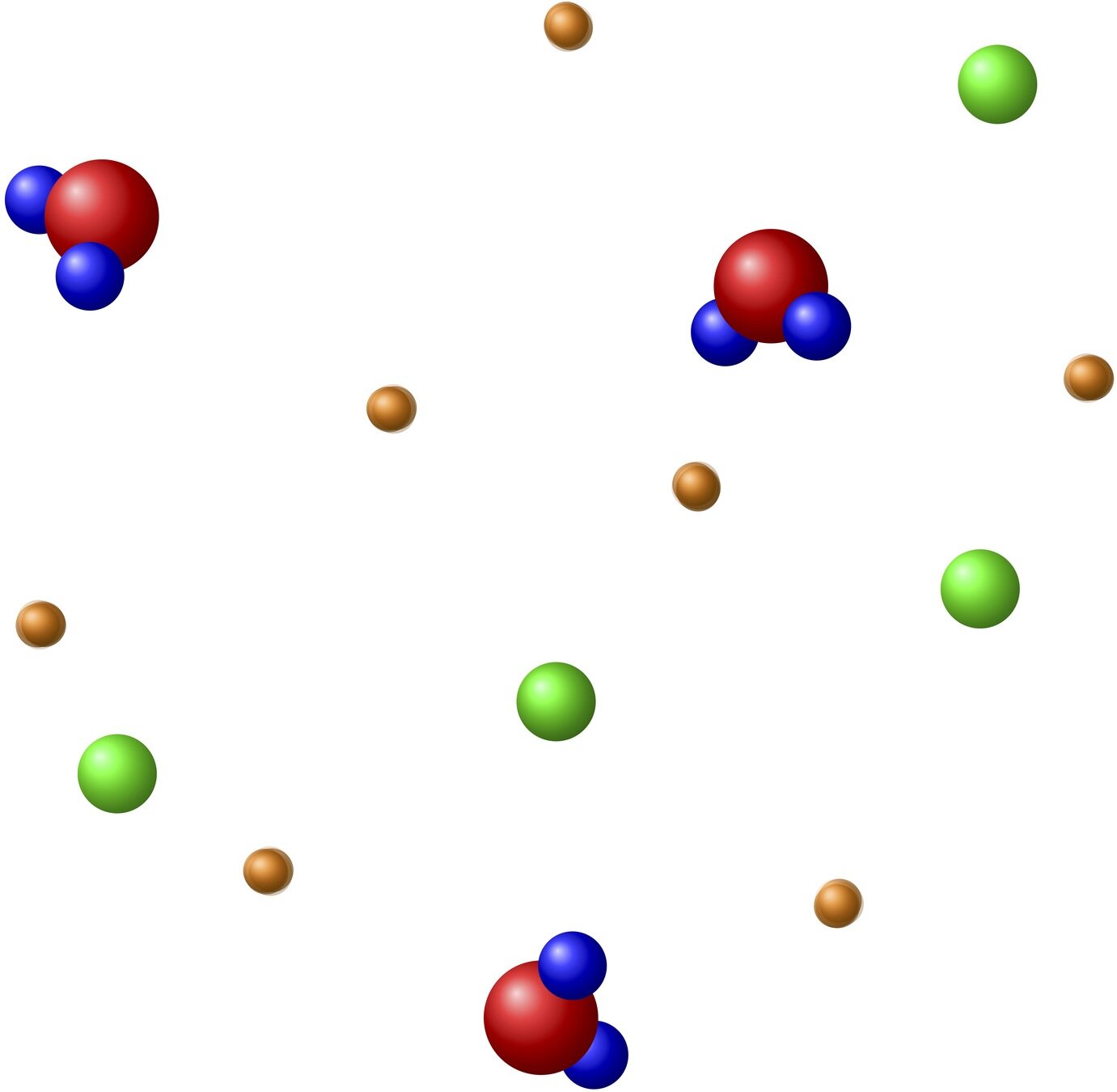
description of gases
introduction:
original Boltzmann equation
Density of molecules: \(f \equiv f_{t,x}(v)\)
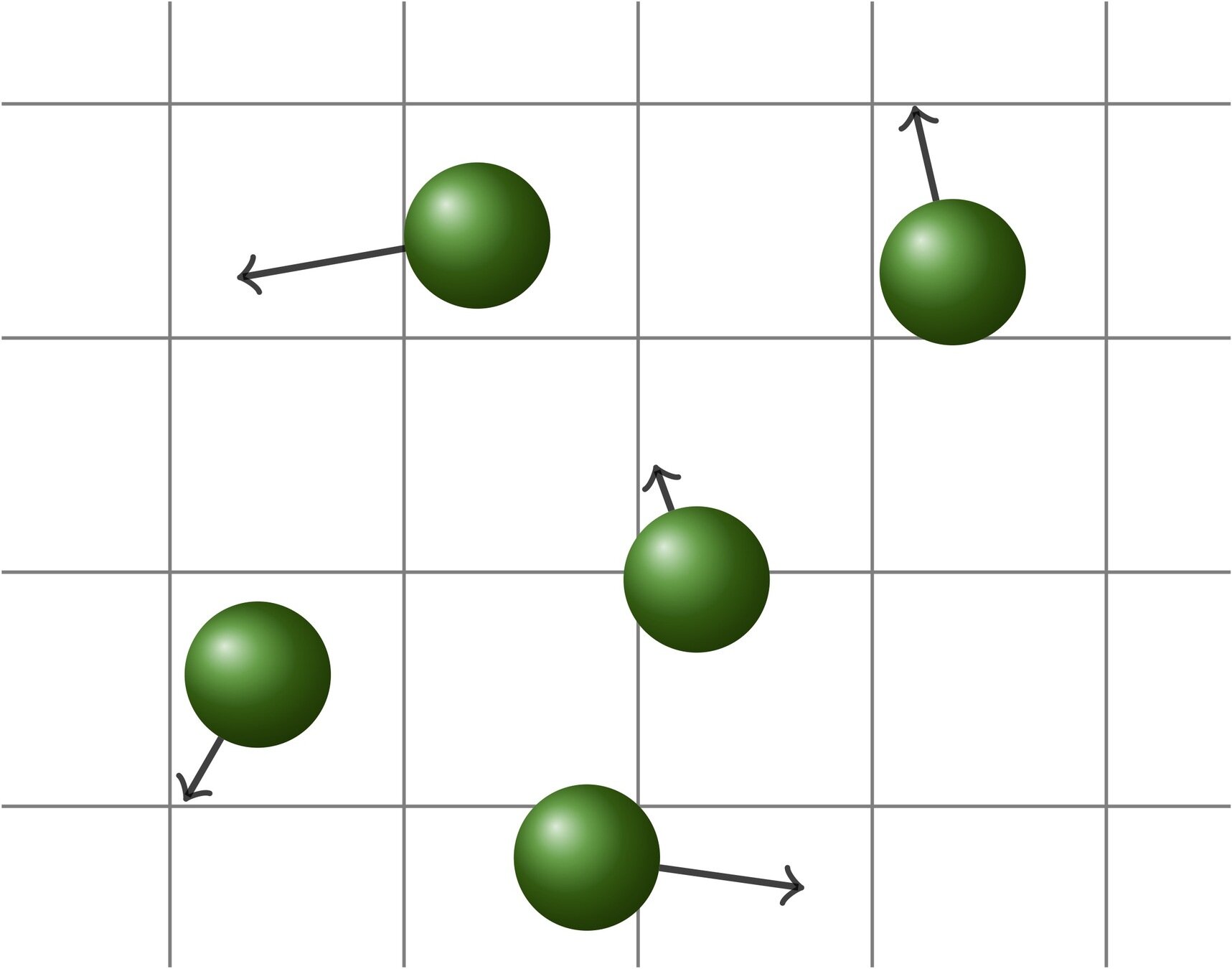
The original Boltzmann equation
Statistical description of a monoatomic gas
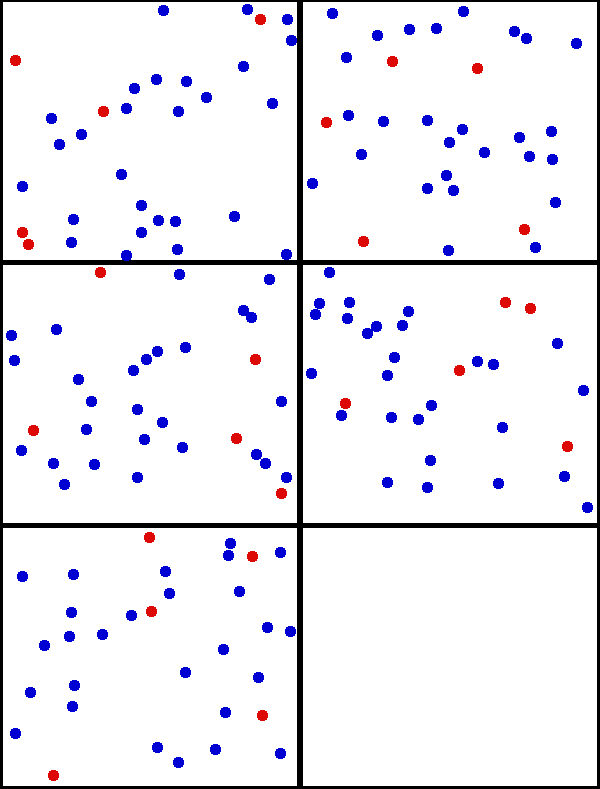
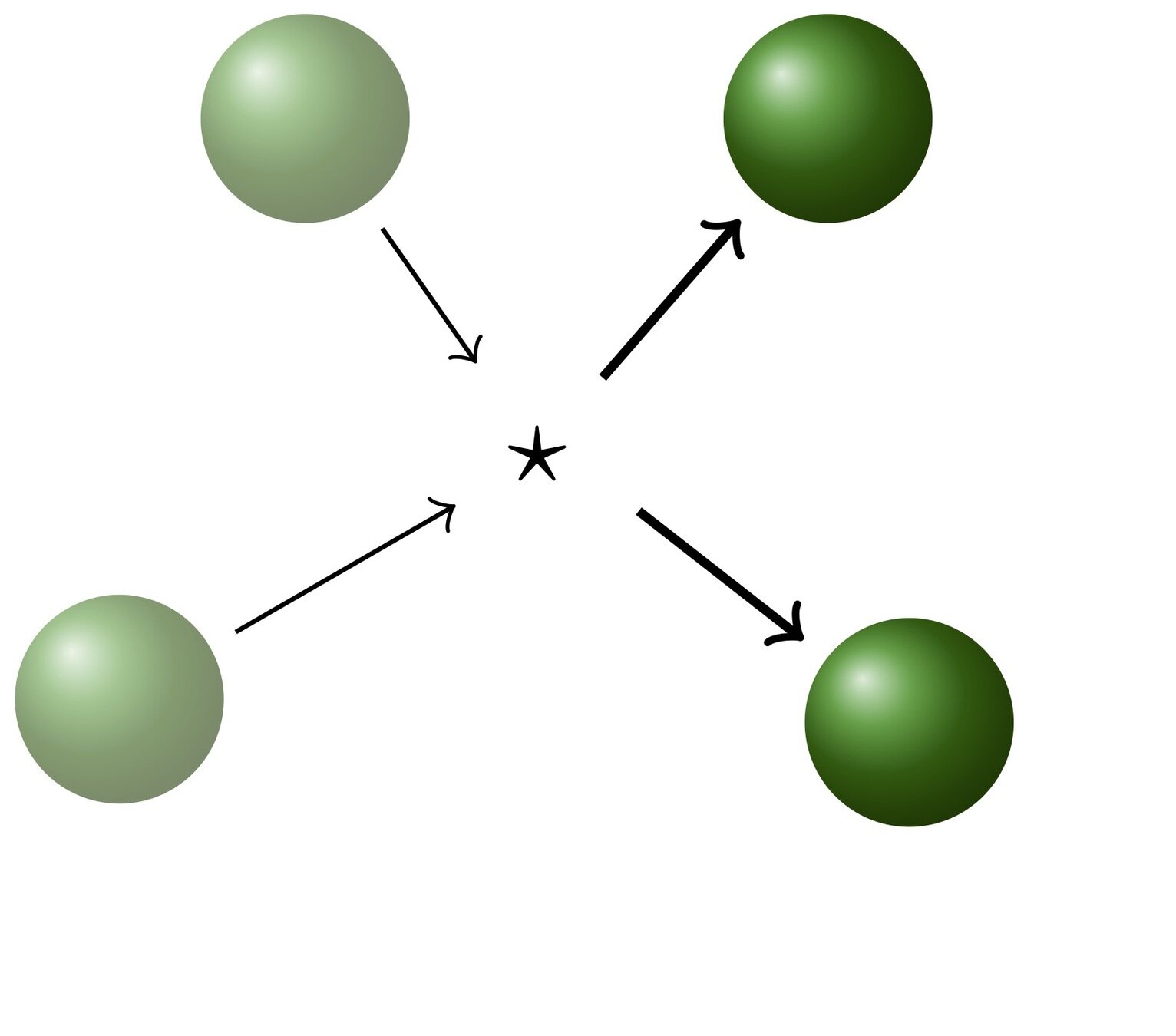
[A. Greg: Kinetic theory of gases, wikipedia.]

advection
collisions
(e.g. \(\mathrm{Ar} \) )
the collision operator
" "
General form
Conserved quantities
mass, momentum & energy
\(B\) satisfies symmetry & reversibility
sub-manifold of \((\R^3)^3\)
Density of molecules: \(f \equiv f_{t,x}(v)\)
The Boltzmann equation
Statistical description of a monoatomic gas
[A. Greg: Kinetic theory of gases, wikipedia.]
advection
collisions
[A. Greg: Kinetic theory of gases, wikipedia.]
Focus on collisions
the Homogeneous Boltzmann equation
Density of molecules: \(f_t(v)\)
\(x \)
advection
\(+ \, v \cdot \nabla_x f\)
Entropy and equilibrium
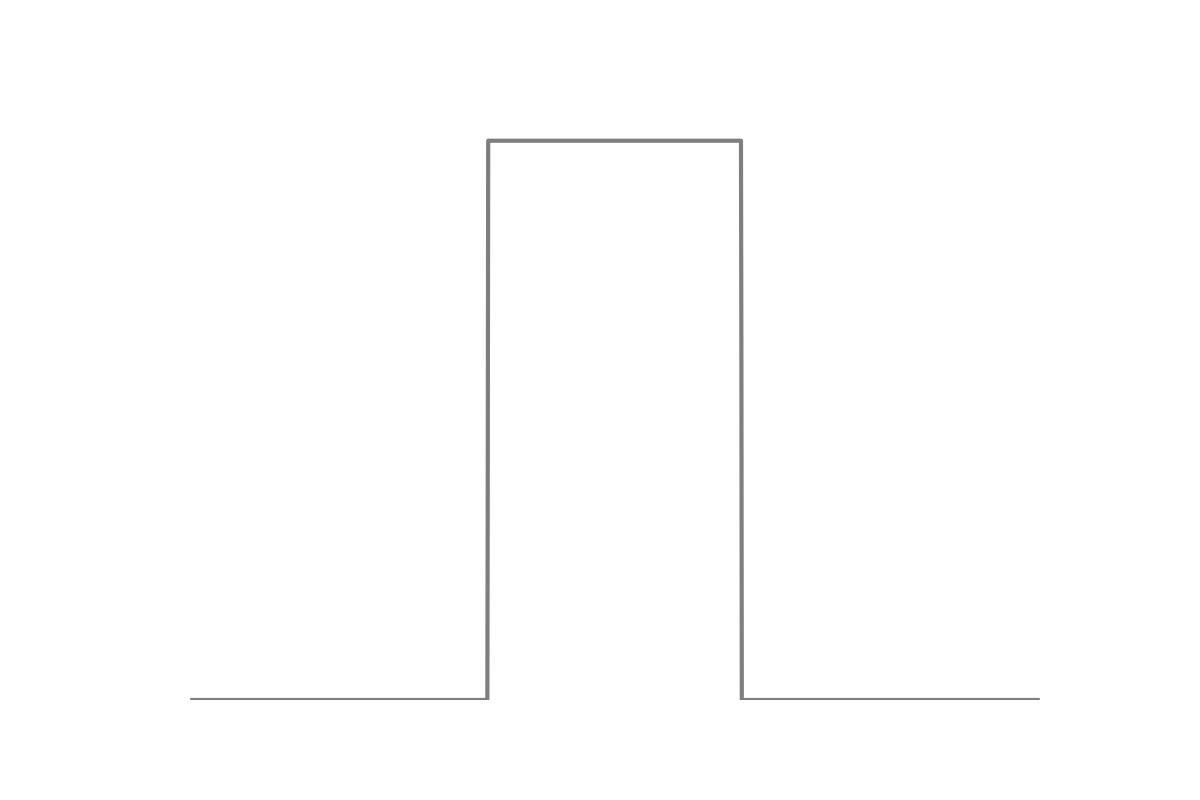
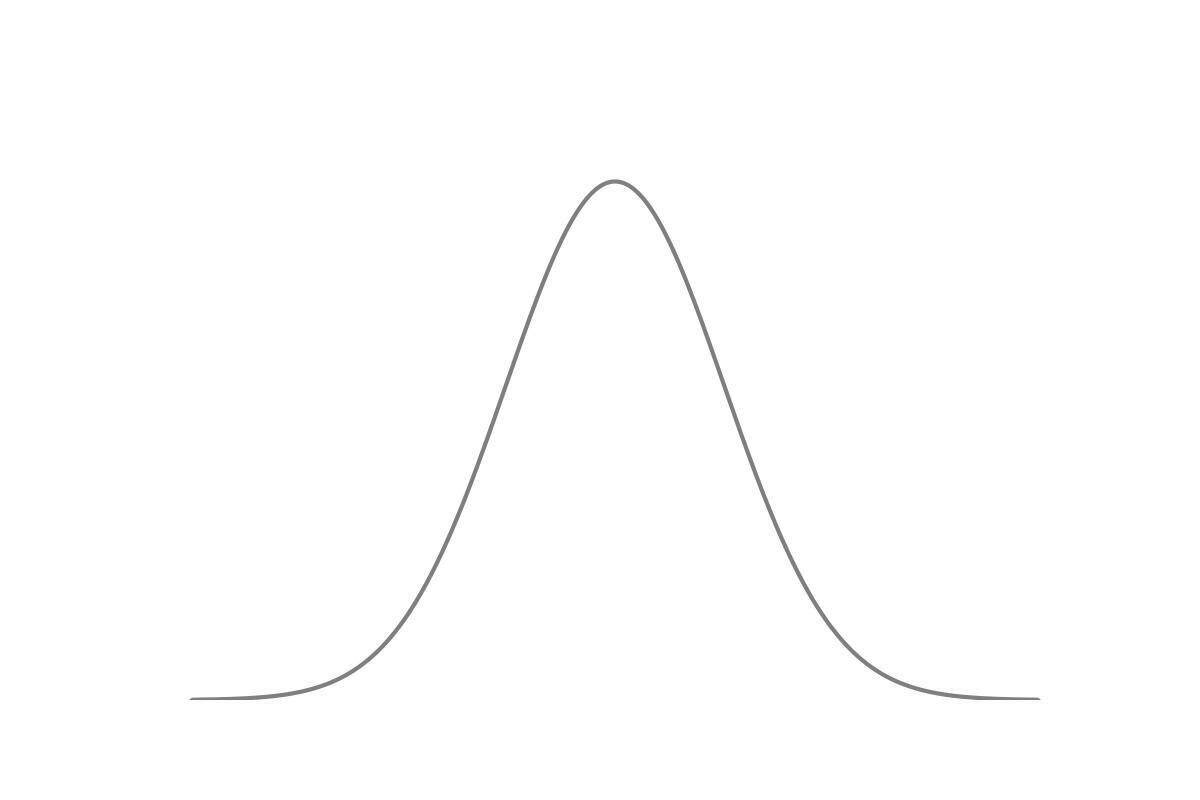
The Boltzmann entropy:
2. \(D(g) = 0 \iff g =M \) a Maxwellian:
characterization of equilibria
Boltzmann's H Theorem
1. If \(f \equiv f_t(v)\) solves
\(2^{\rm nd}\) principle of thermodynamics
\((HB)\)
then
Illustration of the expected behaviour
Three linked concepts
Conserved quantities during collisions
(mass, momentum & energy)
Entropy functional
Equilibrium distribution
(collision rules)
variants to the original model
original
monoatomic molecules
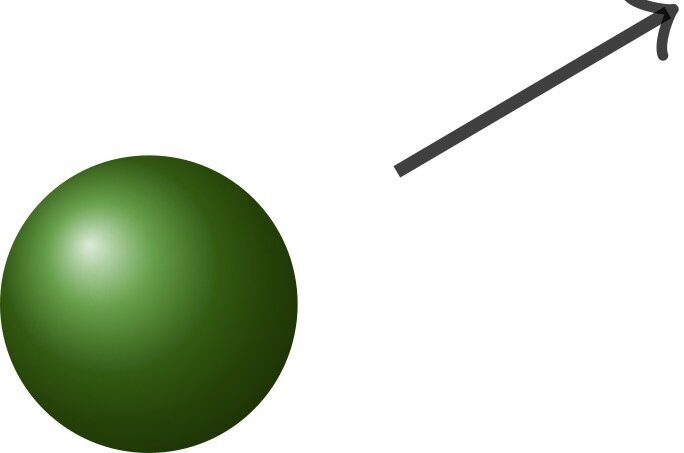
polyatomic
molecules
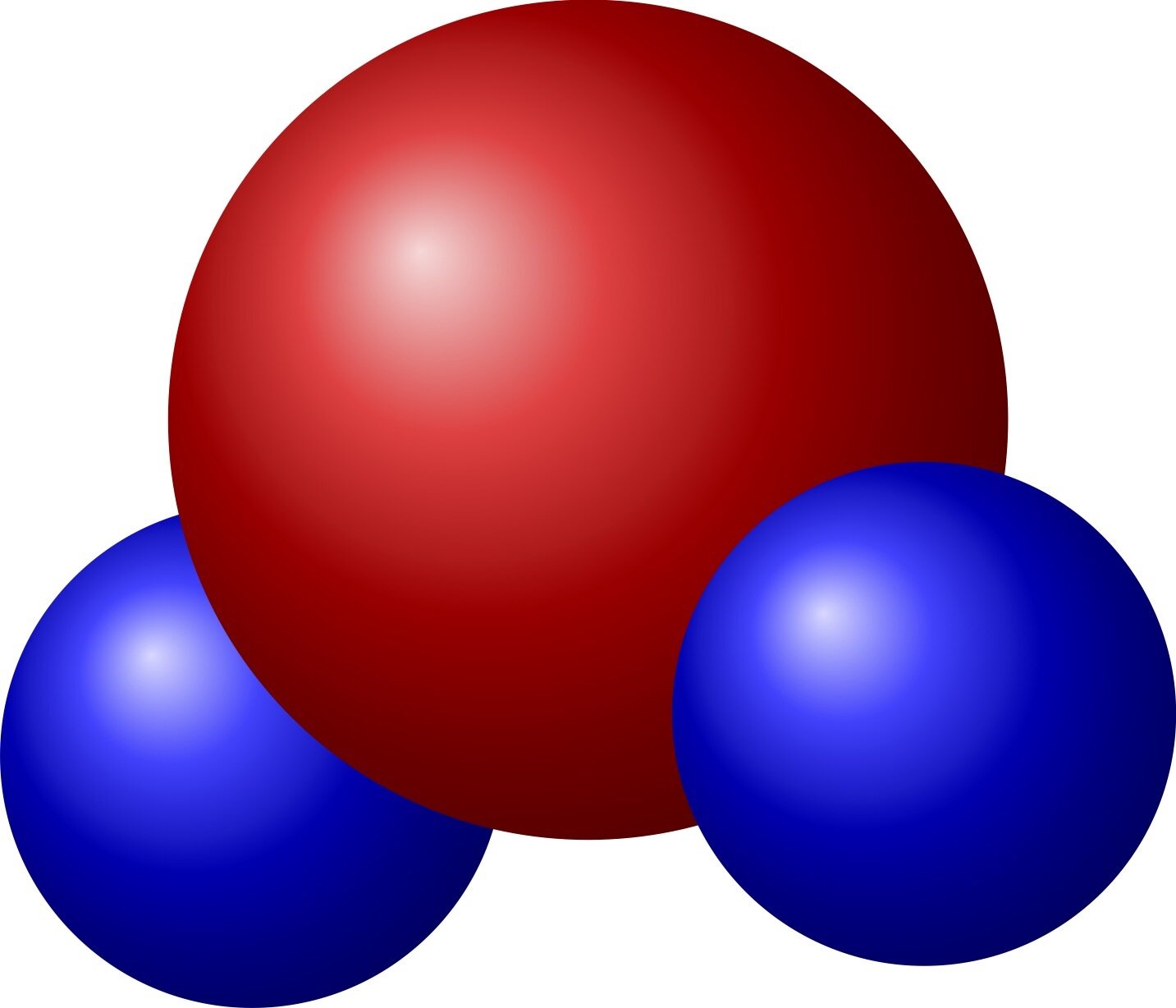
Part \(\mathrm{I}\)
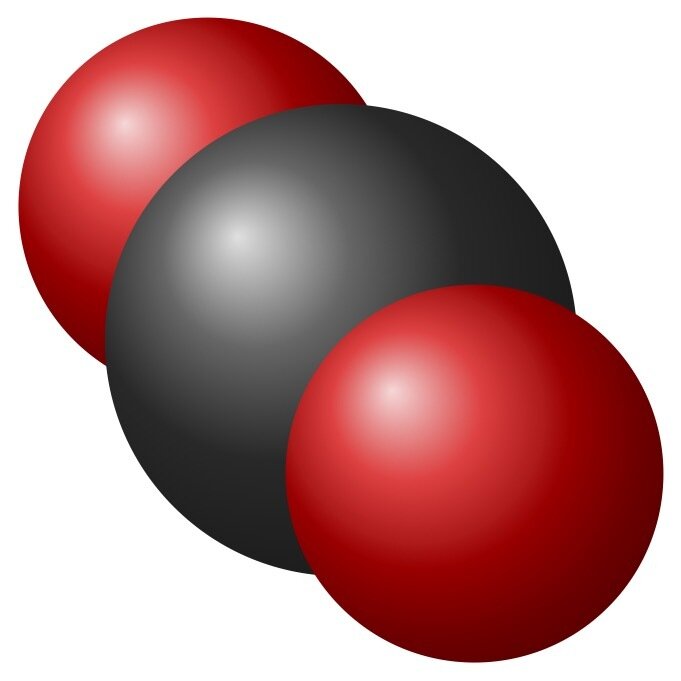
Part \(\mathrm{I I}\)
polyatomic molecules
resonant collisions
fermions

Part \(\mathrm{III}\)
e.g. \(\mathrm{Ar}\)
e.g. \(\mathrm{H_2O}, \mathrm{N_2}\)
e.g. \(\mathrm{CO_2}\)
e.g. \(\mathrm{e^-}\)

outline
\(\mathrm{I}\). Boltzmann equation for polyatomic gases
\(\mathrm{II}\). Boltzmann equation for polyatomic gases with (quasi-)resonant collisions
\(\mathrm{III}\). Boltzmann-Fermi-Dirac equation
& contributions
- General modeling framework
- Relationships between models
- Compactness result in resonant setting
- Modelling & study of quasi-resonant Boltzmann
- Entropy/entropy production inequalities via a transfer method
- Relaxation to equilibrium with explicit rate
w/ Lods
w/ Boudin, Mathiaud, Salvarani
w/ Bisi, Groppi
[1,2]
[4]
[5]
[3]
[1] T. B., M. Bisi, M. Groppi: "A general framework for the kinetic modelling of polyatomic gases", Commun. Math. Phys., 2022.
[2] M. Bisi, T. B., M. Groppi: "An internal state kinetic model for chemically reacting mixtures of monatomic and polyatomic gases", Kinet. Relat. Models, 2024.
[3] T. B., L. Boudin, F. Salvarani: "Compactness property of the linearized Boltzmann operator for a polyatomic gas undergoing resonant collisions", J. Mat. Anal. Appl., 2023.
[4] T. B.: "Extending Cercignani's conjecture results from Boltzmann to Boltzmann-Fermi-Dirac equation", J. Stat. Phys., 2024.
[5] T. B., B. Lods: "Quantitative relaxation towards equilibrium for solutions to the Boltzmann-Fermi-Dirac equation with cutoff hard potentials", preprint, 2024.
Part \(\mathrm{I}\).
Boltzmann equation for polyatomic gases
Pre-existing polyatomic models
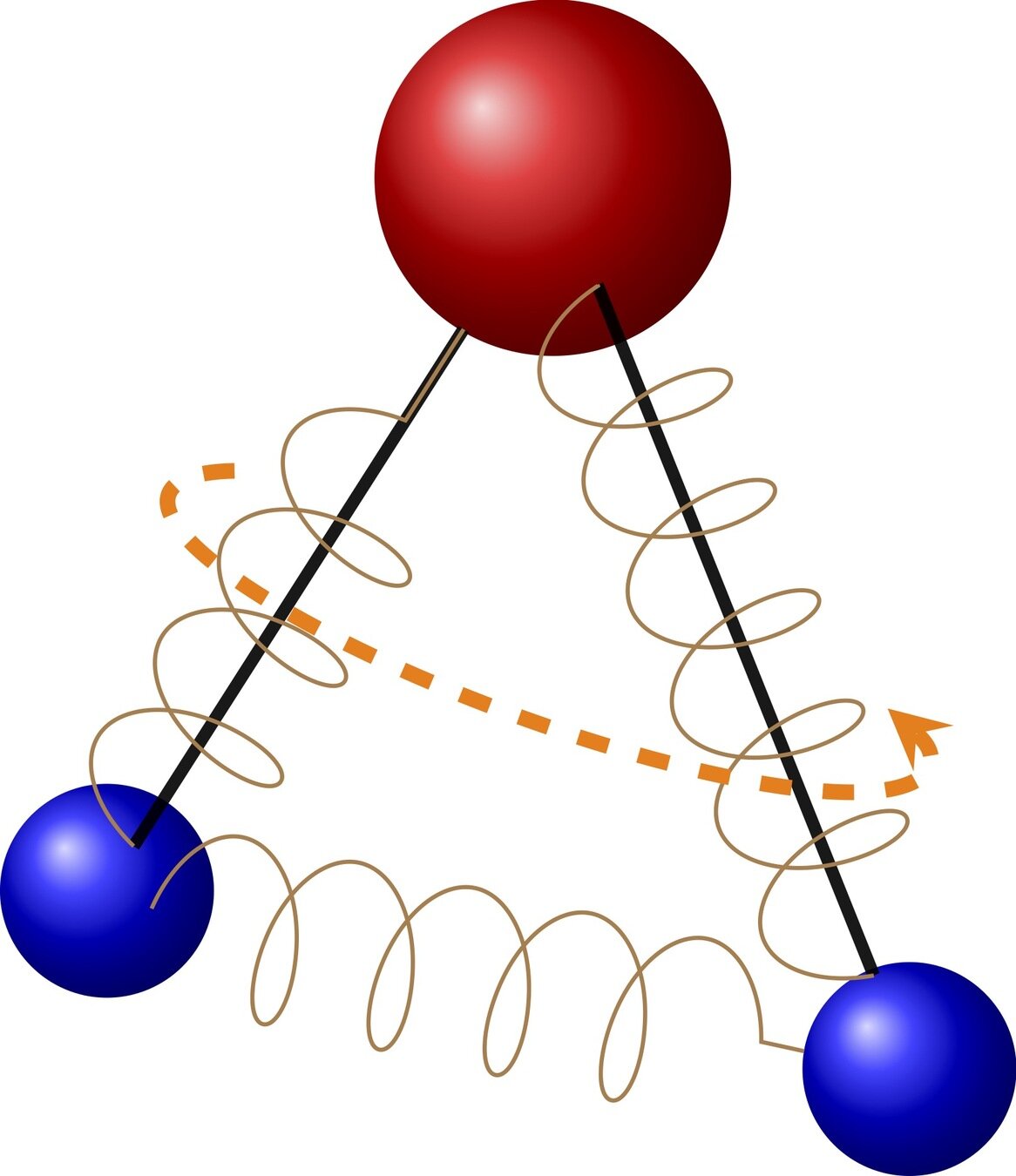
2. Model with continuous
energy levels
[Borgnakke, Larsen, Desvillettes...]
1. Model with discrete
energy levels
[Bisi, Groppi, Spiga,...]
Internal energy
(rotation, vibration,...)
\(\{\epsilon_n\}_n\) energy levels
\(I \in \R_+\) energy level
integrate w.r.t. \(\varphi(I) \, \mathrm{d}I\)
rotation
vibration
rotation & vibration
rotation
rotation & vibration
vibration
integrate w.r.t. \(\varphi \textcolor{black}{(I) \, \mathrm{d} I}\)
Means
General modeling framework
Motivation
Provide a kinetic model taking rotation and vibration into account
with M. Bisi & M. Groppi
[1]
[2]
[1] T. B., M. Bisi, M. Groppi: "A general framework for the kinetic modelling of polyatomic gases", Commun. Math. Phys., 2022.
[2] M. Bisi, T. B., M. Groppi: "An internal state kinetic model for chemically reacting mixtures of monatomic and polyatomic gases", Kinet. Relat. Models, 2024.
General framework
- setting
- various paradigms
extension to Mixtures
- validity for a mixture
- chemical reactions
outline of part \(\mathrm{I}\)
A. General internal states framework
B. Probability theory interpretation & links between approaches
C. Extension to mixtures
general framework
\(\R^3 \times \textcolor{orange}{\R^3 \times \N \times \N \times \N}\)
internal structure of polyatomic molecules: rotation, vibration,...
state of the molecule
space of states
energy of the molecule
An example:
\(\R^3 \times \textcolor{orange}{\mathcal{E}}\)
internal structure of polyatomic molecules: general setting
state of the molecule
space of states
energy of the molecule
measured space \((\mathcal{E}, \mu)\)
General framework's setting
1. Microscopic state of the molecule:
Total energy of the molecule with state \((v, \zeta)\):
velocity \(v \in \R^3\) and internal state \(\zeta \in \mathcal{E}\)
2. Space of internal states:
\(\varepsilon : \mathcal{E} \to \R\)
3. Internal energy function:
Assumptions
\(\varepsilon^0 := \text{inf ess}_{\mu} \;\varepsilon\) \(> -\infty\),
existence of fundamental energy level
finiteness of the partition function
\(\displaystyle \int_{\mathcal{E}} e^{-\beta \, \bar{\varepsilon}(\zeta)} \, \mathrm{d} \mu(\zeta)\) \(< +\infty\),
\(\forall \beta>0\)
\(\bar{\varepsilon} := \varepsilon - \varepsilon^0\) (\( : \mathcal{E} \to \R_+\))
\(f \equiv f_{t,x}(v, \textcolor{orange}{\zeta})\) density of molecules
the polyatomic Boltzmann equation
Boltzmann equation:
Collision operator:

Conserved quantities
mass, momentum & energy
Boltzmann polyatomic: H Theorem
[Bisi, B., Groppi]
2. \(D(g) = 0 \iff g = \mathcal{M} \), a generalized Maxwellian:
characterization of equilibria
Gibbs
Polyatomic (general setting) H Theorem
1. If \(f \equiv f_t(v,\zeta)\) solves
\(2^{\rm nd}\) principle of thermodynamics
then
Boltzmann entropy:
various Approaches and relationships
a parallel with probability theory
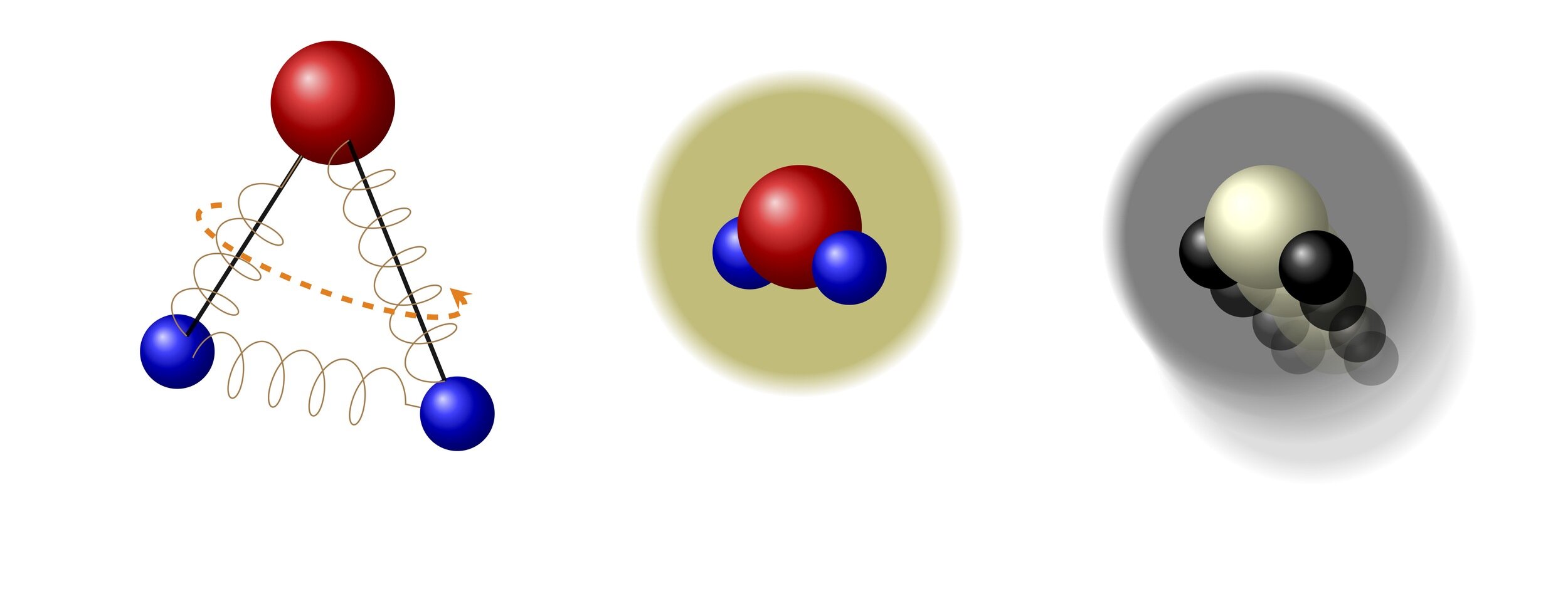
polyatomic internal structure
probability theory setting
\( (\Omega, \; \mathbb{P}) \) space of events
\( X : \Omega \to \R \) real random var.
\( (\mathcal{E}, \; \mu) \) space of internal states
\( \bar{\varepsilon} : \mathcal{E} \to \R_+ \) energy function
\( \bar{\varepsilon} = \varepsilon - \inf \varepsilon \)
\( (\R, \, \mathbb{P}_X)\) space of outcomes
\( \mathbb{P}_X\) on \(\R\) law of \(X\)
\( (\R_+, \, \mu_{\bar{\varepsilon}}) \) space of energy levels
\( \mu_{\bar{\varepsilon}}\) on \(\R_+\) energy law
\( ((0,1), \, \mathrm{Leb}) \) space of quantiles
\( F^{-1}_{\mathbb{P}_X}: (0,1) \to \R\) quantile function
\( ((0,\mu(\mathcal{E})), \, \mathrm{Leb}) \) space of energy quantiles
\( F^{-1}_{\mu_{\bar{\varepsilon}}}: (0,\mu(\mathcal{E})) \to \R_+\) energy quantile func.
Link with pre-existing models
\(\varphi\) can then be computed "ab initio"
\( (\R_+, \, \mu_{\bar{\varepsilon}}) \) space of energy levels
\( \mu_{\bar{\varepsilon}}\) on \(\R_+\) energy law
1. \(\mu_{\bar{\varepsilon}}\) is a discrete measure
supported on \(\{\epsilon_n\}_n\)
model with discrete energy levels
[Bisi, Groppi, Spiga,...]
with energy levels \(\{\epsilon_n\}_n\)
2. \(\mu_{\bar{\varepsilon}}\) has a density \(\varphi\) w.r.t.
Lebesgue measure
model with continuous energy levels
[Borgnakke, Larsen, Desvillettes...]
internal state
internal energy level
internal energy quantile
Paradigms and their use
\(\zeta \in \mathcal{E}\)
\(\mu\)
\(\varepsilon\)
\( I \in \R_+\)
\(\mu_{\bar{\varepsilon}}\)
\( q \in \R_+\)
\(\mathrm{Id}_{\R_+}\)
\(F_{\mu_{\bar{\varepsilon}}}^{-1}\)
Lebesgue
variable
measure
energy function
- Physical modeling
- General proofs
Explicit computations
Numerical simulations
(particle-based)
internal state
internal energy level
internal energy quantile
Paradigms and their use
Construct
Analyse
Simulate
mixtures with chemical reactions
2. Characterization of equilibria
H Theorem
1. \(2^{nd}\) principle of thermodynamics
3. Mass-action law
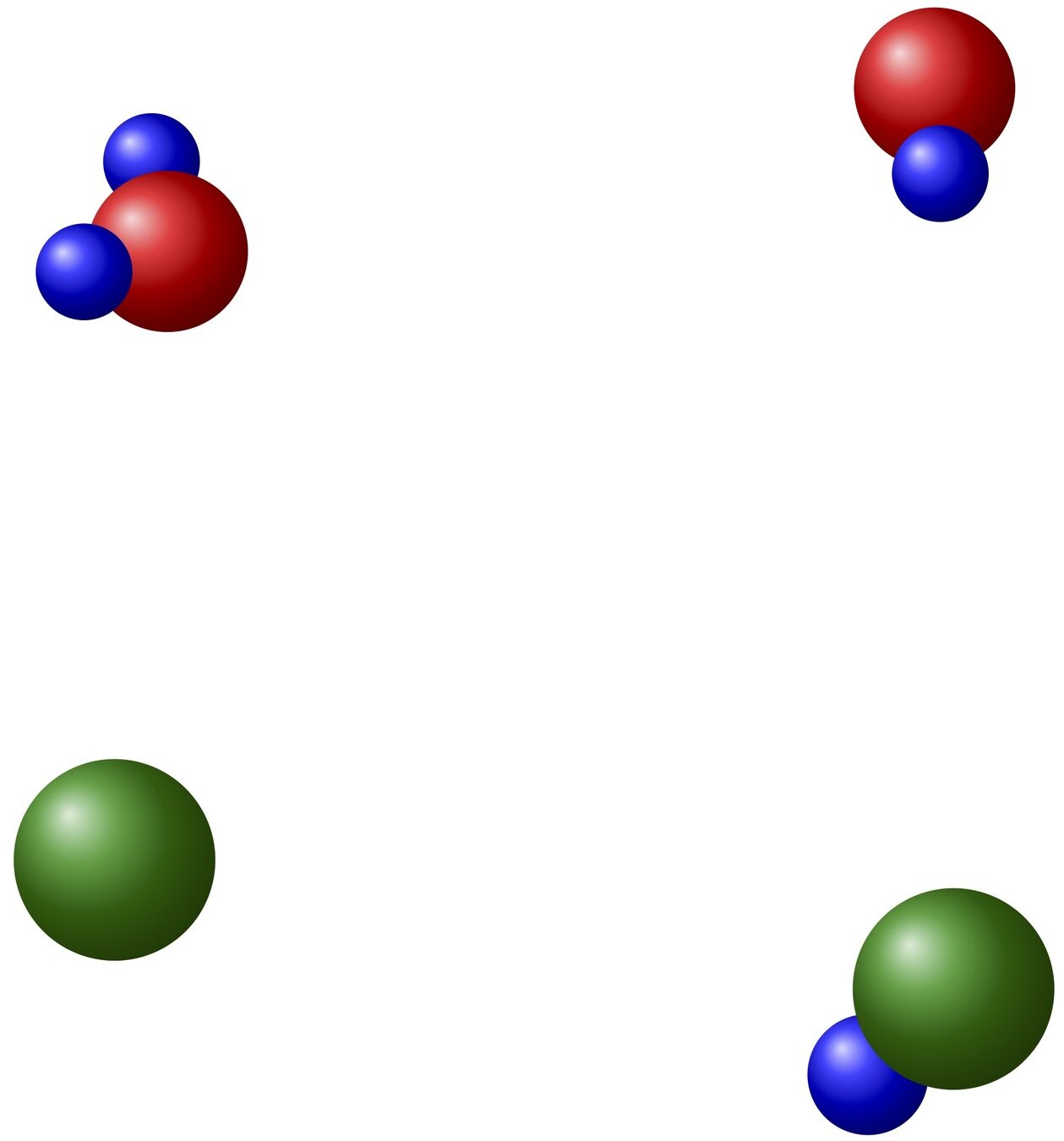
extension to mixtures with chemical reactions
\(\bullet\) models \((\mathcal{E_i},\mu_i)\) and \(\varepsilon_i\) for \(i = 1, \dots, N \)
\(\bullet\) study \(f \equiv (f_i)_i\), with \( f_i : \R^3 \times \mathcal{E}_i \to \R_+ \)
\(\bullet\) system of Boltzmann equations
collisions &
chemical reactions
Energy of reaction:
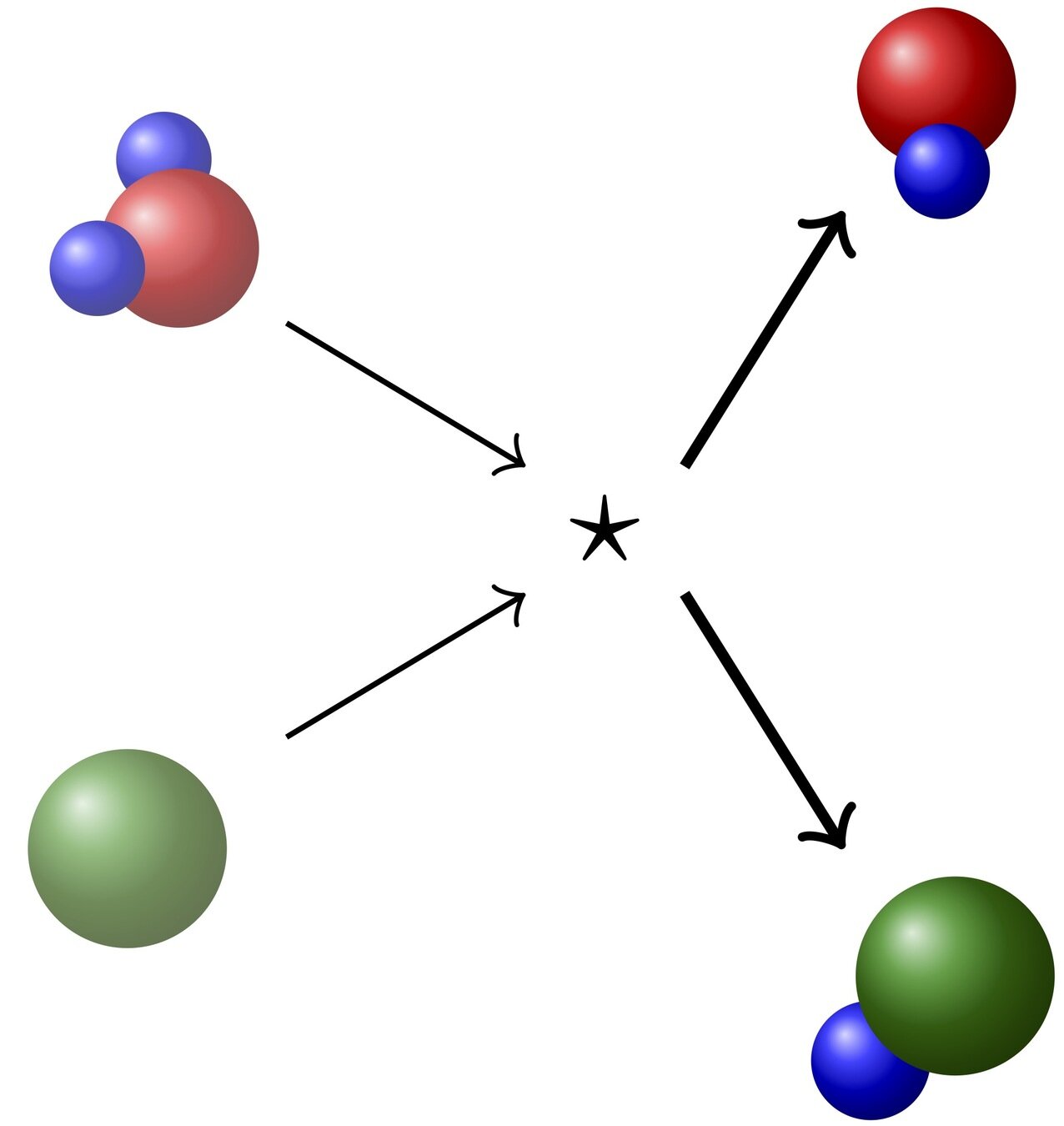
[Bisi, B., Groppi]
\(\varepsilon^0 := \text{inf ess}_{\mu} \;\varepsilon\)
Part \(\mathrm{II}\).
Boltzmann equation for polyatomic gases with
(quasi-)resonant collisions
Context
Resonant collisions for some polyatomic molecules (e.g. CO\(_2\) )
compactness result
[3]
[3] T. B., L. Boudin, F. Salvarani: "Compactness property of the linearized Boltzmann operator for a polyatomic gas undergoing resonant collisions", J. Mat. Anal. Appl., 2023.
with Boudin, Mathiaud, Salvarani
with Boudin, Salvarani

Lines of work
- Near-equilibrium for resonant polyatomic gas
- Model & study quasi-resonant gas
Near Equilibrium
resonant
linearized Boltzmann operator
quasi-resonant
- model quasi-resonance
- behavior of the dynamic
- numerical validation
A. Boltzmann model with resonant collisions
B. Boltzmann model with quasi-resonant collisions
outline of part \(\mathrm{II}\)

C. Relaxation of temperatures and Landau-Teller equations
A. Boltzmann with resonant collisions
Boltzmann model with resonant collisions (1)
continuous internal energy levels model
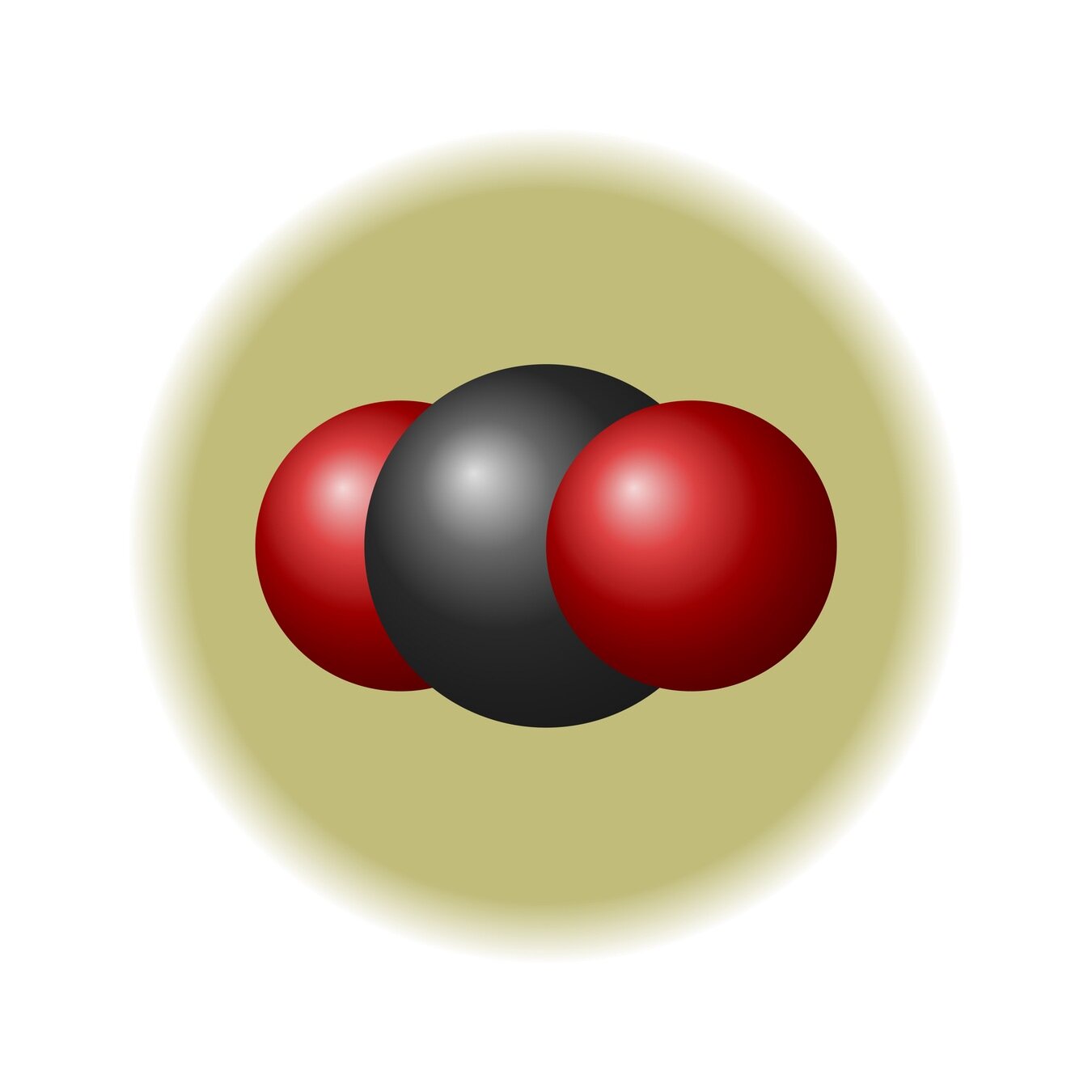
conservations for a resonant collision
separate conservation of kinetic and internal energies
uncoupling of \(v\) and \(I\)
Resonant collision operator
Boltzmann with resonant collisions: H Theorem
[Boudin, Rossi, Salvarani]
2. \(D^{\rm res}(g) = 0 \iff g = M^{\rm res} \), a two-temperature Maxwellian:
characterization of equilibria
Polyatomic resonant H Theorem
1. If \(f \equiv f_t(v,I)\) solves
\(2^{\rm nd}\) principle of thermodynamics
then
Boltzmann entropy:
compactness result of the linearized resonant Boltzmann operator
resonant collision operator \(Q(f)\)
linearize around equilibrium
resonant linearized operator \(\mathcal{L}f\)
[T.B., Boudin, Salvarani]
Theorem. \(K\) compact operator of \(L^2(\R^3 \times \R_+, \mathrm{d} v \, \varphi(I) \, \mathrm{d}I)\)
useful for
- existence & uniqueness close-to-equilibrium
- study of the spectrum
Proof strategy:
- split the study into kinetic & internal parts
- kinetic part \(\leftrightarrow\) monoatomic (+improvement)
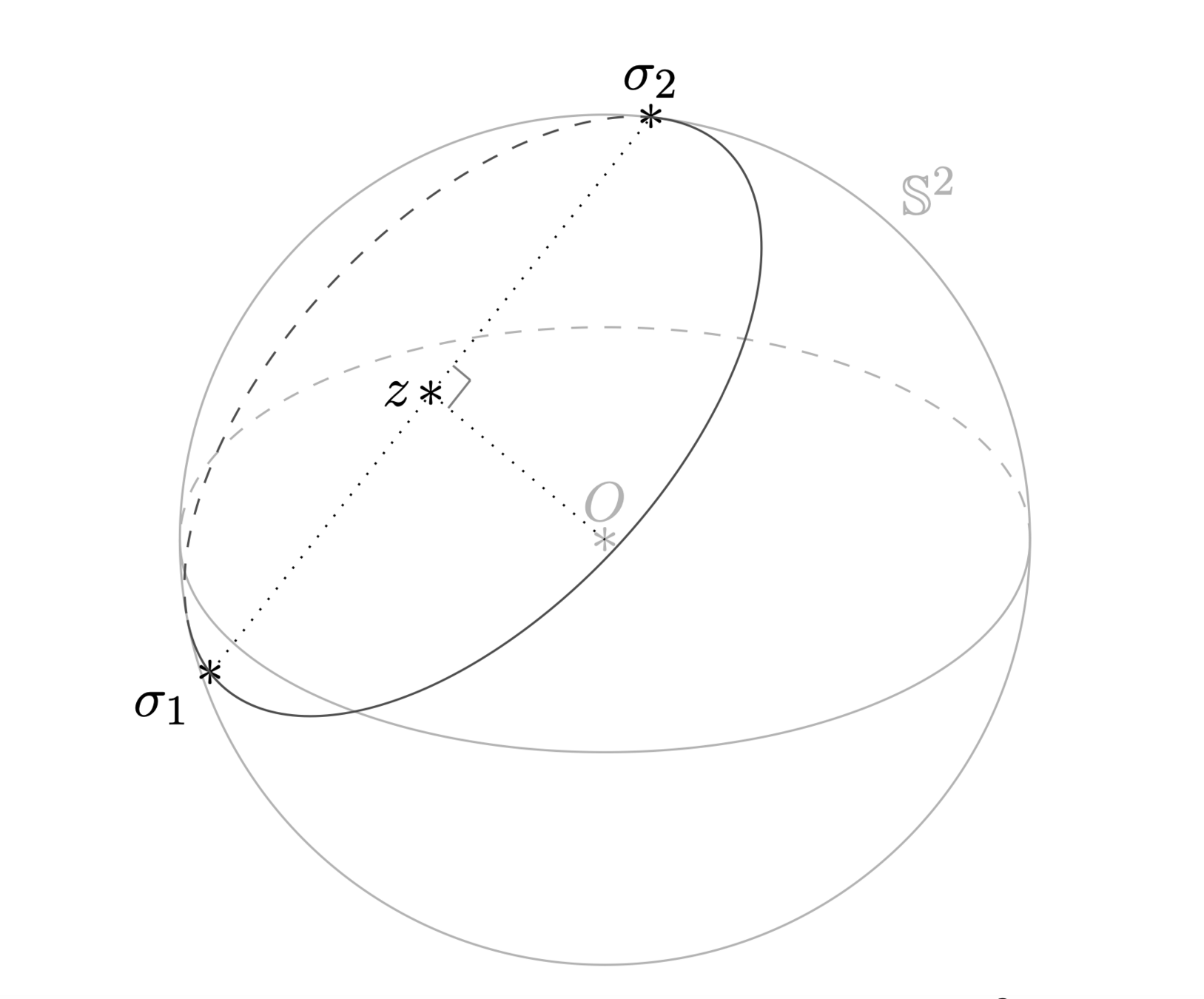
BONUS: a nice change of variables in the sphere (variant to Grad's proof / compactness monoatomic)
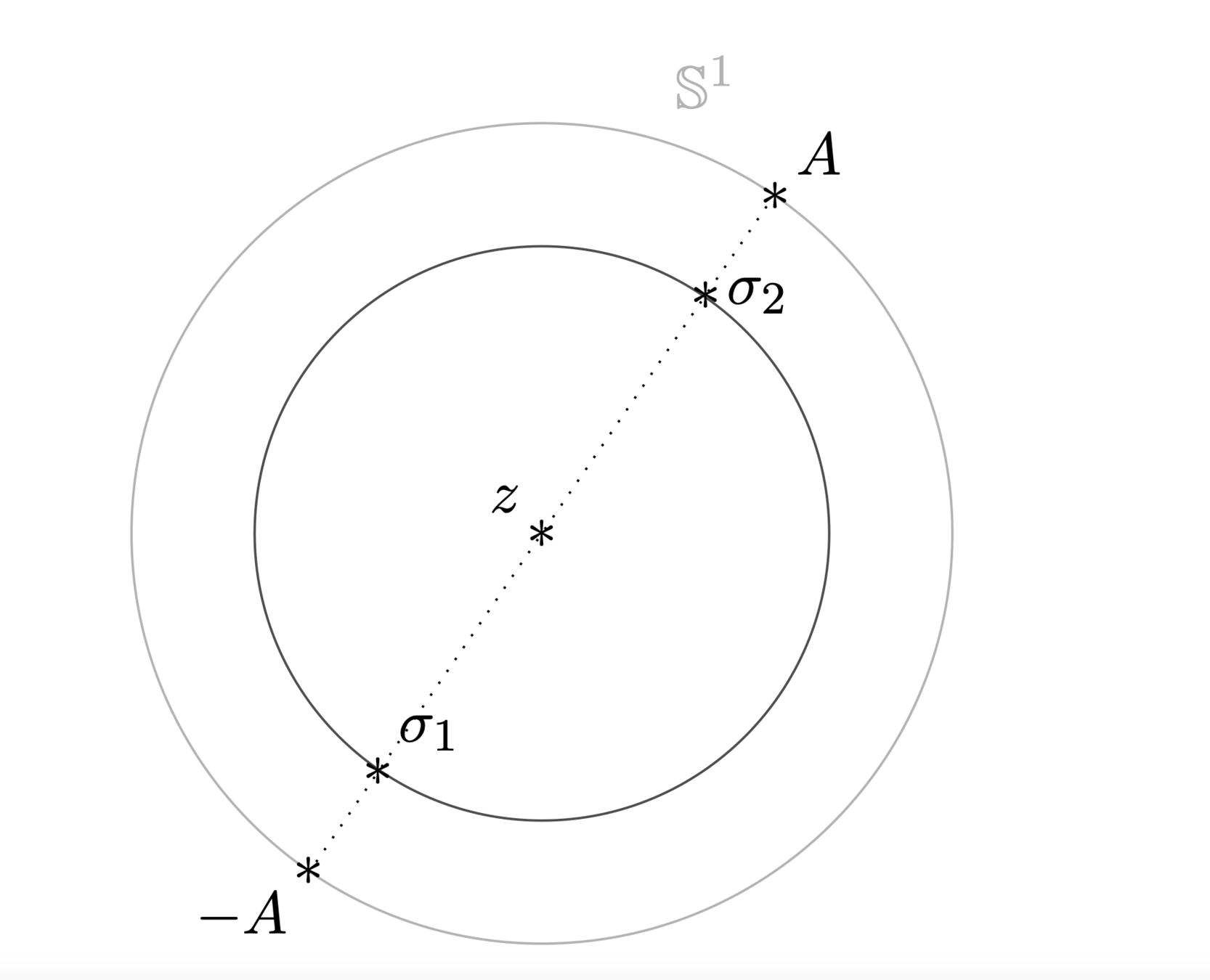
Recap Features of the resonant model
\(\bullet\) Separation of kinetic and internal energies
\(\bullet\) Two temperatures (kinetic & internal) at equilibrium
B. Boltzmann with quasi-resonant collisions
Notion of quasi-resonant collisions
conservations for a quasi-resonant collision
how to make this rigorous?
Set of allowed collisions in the
resonant polyatomic case
our model for quasi-resonant collisions
sub-manifold \(\mathcal{V}_0\) with 1 dimension less than \(\mathcal{V}\)
Resonant collision kernel
manifold \(\mathcal{V} \subset (\mathbb{R}^3)^4 \times (\mathbb{R}_+)^4\)
Set of allowed collisions in the
quasi-resonant case
manifold \(\mathcal{V} \subset (\mathbb{R}^3)^4 \times (\mathbb{R}_+)^4\)
sub-manifold \(\mathcal{V}_{\lambda}\) with same dimension as \(\mathcal{V}\)
our model for quasi-resonant collisions
Quasi-resonance encoded in the collision kernel
\(\lambda > 0\) quasi-resonance parameter
our model for quasi-resonant collisions
Family of collision kernels:
Family of collision operators:
Resonant asymptotics
associated resonant model
2. Equilibria: one-temperature Maxwellian:
1. \(2^{nd}\) principle of thermodynamics
Quasi-resonant H Theorem
H Theorem for quasi-resonant collisions
same as standard polyatomic
Boltzmann with quasi-resonant collisions: properties
Conjecture
If \(f\) solution to the quasi-resonant Boltzmann equation with parameter \(\lambda\) "small" enough, then
time
\(T_i\) & \(T_k\) relax to each other
\(f\) (almost) stays a two-temperature Maxwellian (\(T_i\) & \(T_k\))
\(f\) relaxes to a two-temperature Maxwellian
short-time
long-time
derivation of explicit ODE:
Landau-Teller
Two main properties:
1. Quasi-resonant dynamic \(\sim\) resonant dynamic /
2. Quasi-resonant equilibrium : one temperature
resonant equilibrium: two temperatures
LANdau-Teller and numerical validation
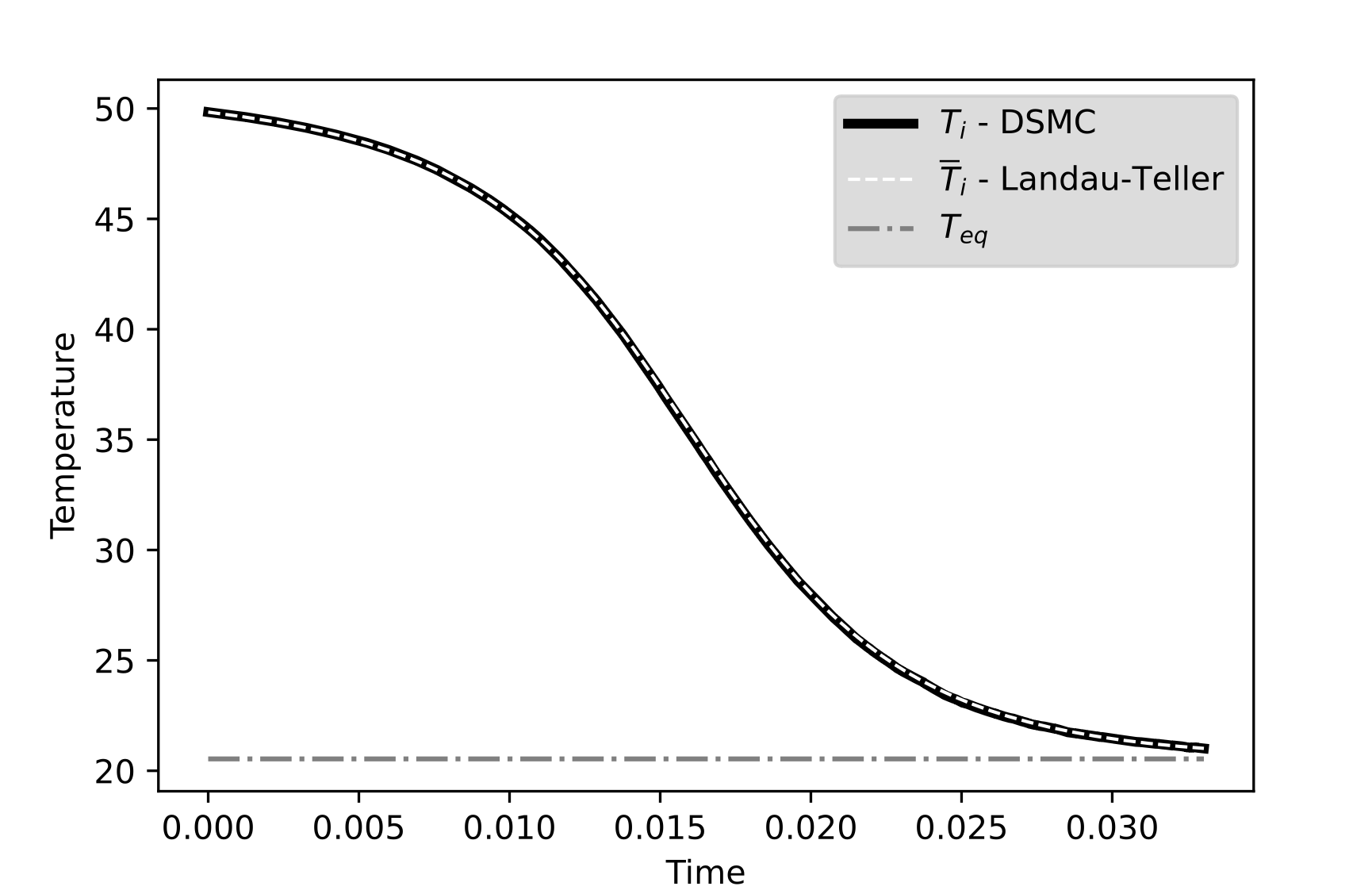
parameters: \(\lambda = 0.1\), \(T_i^0 = 50\), \(T_k^0 = 1\), \(T_{eq} = 20.6\)
relative \(L^2\) error \(\sim 10^{-3}\)
Numerical experiment
- Simulate Boltzmann with DSMC : \(T_i\)
- Solve Landau-Teller : \(\overline{T}_i\)
Landau-Teller equations:
For a quasi-resonant dynamic:
with \(\lambda\) "small"
for a certain class of collision kernels
perspective
Asymptotic-Preserving (AP) scheme
To simulate the quasi-resonant Boltzmann equation with parameter \(\lambda\) "small",
time
\(t_0\)
\(\mathcal{O}(\lambda^{-2})\)
Get \(T_i\) & \(T_k\) by solving the corresponding Landau-Teller system
Take the solution to be a two-temperature Maxwellian (\(T_i\) & \(T_k\))
Simulate the corresponding resonant Boltzmann equation
numerically cheap
numerically expensive
Sources of error:
- Shape of the distribution (not exactly a two-temperature Maxwellian)
- Higher order terms in \(\lambda\) (Taylor expansion) for Landau-Teller equation
- Finite number of numerical particles
theoretical
numerical
Part \(\mathrm{III}\).
Boltzmann-Fermi-Dirac equation
Means
Entropy methods: functional inequalities
known
new!
Motivation
Explicit rate of relaxation to equilibrium for solutions to the Boltzmann-Fermi-Dirac equation
entropy inequality
classic Boltzmann
entropy inequality
Boltzmann-Fermi-Dirac
explicit rate of relaxation to equilibrium
with B. Lods
[5]
[4]
[4] T. B.: "Extending Cercignani's conjecture results from Boltzmann to Boltzmann-Fermi-Dirac equation", J. Stat. Phys., 2024.
[5] T. B., B. Lods: "Quantitative relaxation towards equilibrium for solutions to the Boltzmann-Fermi-Dirac equation with cutoff hard potentials", preprint, 2024.
Entropies
to equilibrium
A. The Boltzmann-Fermi-Dirac equation
C. Transfer of entropy inequalities
B. Entropy methods and relaxation to equilibrium
outline of part \(\mathrm{III}\)
D. Relaxation to equilibrium for Boltzmann-Fermi-Dirac
a. the Boltzmann-fermi-dirac equation
\(f \equiv f_{t,x}(v)\) density of fermions
BFD equation:
the Boltzmann-Fermi-Dirac equation
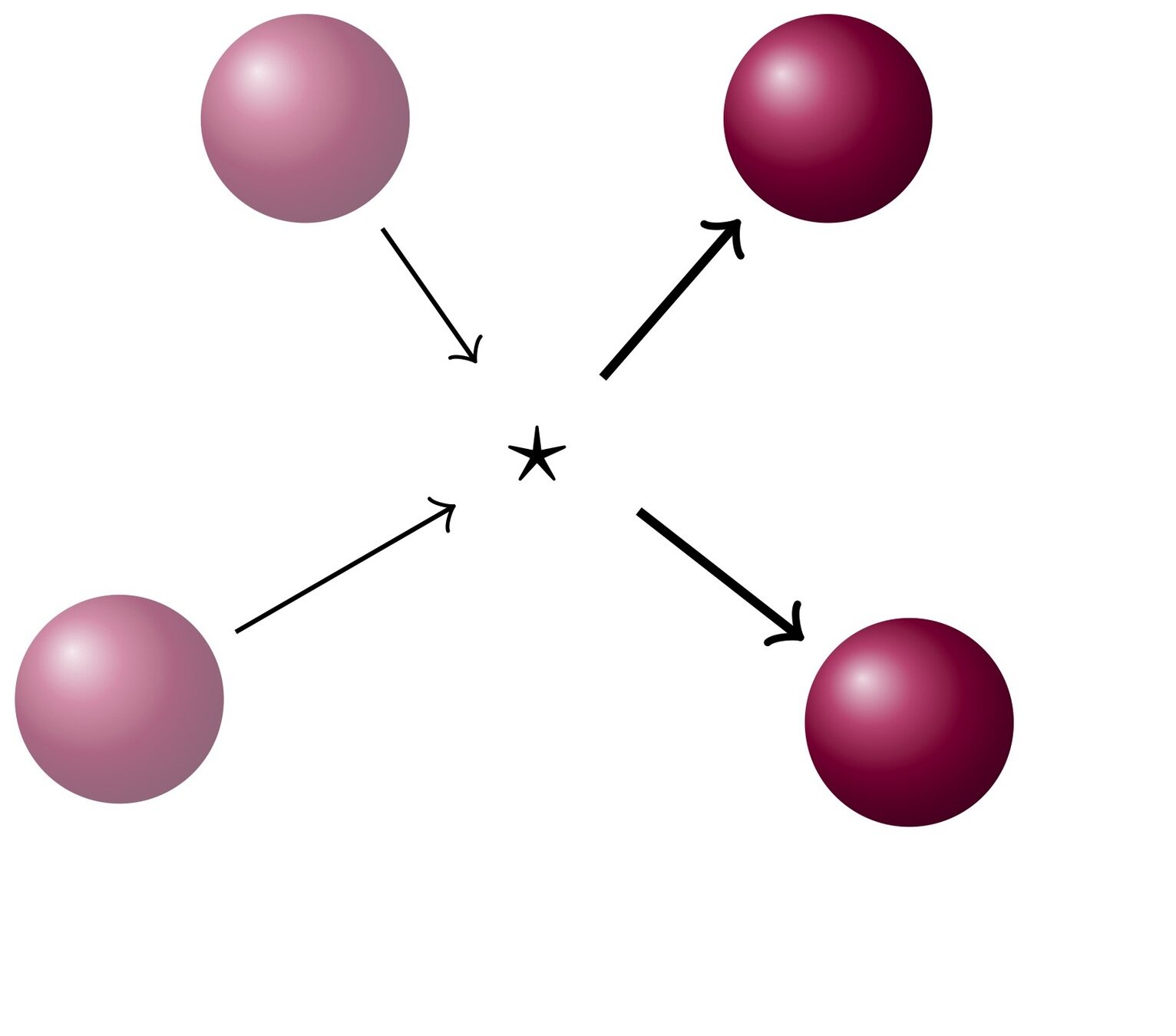
Collision operator:
Conserved quantities
mass, momentum & energy
Pauli exclusion principle
quantum parameter \(\textcolor{purple}{\delta} > 0\)
2 fermions cannot occupy the same state
:
Boltzmann-fermi-dirac: H Theorem
2. \(D_{\textcolor{purple}{\delta}}(g) = 0 \iff g = M_{\textcolor{purple}{\delta}} \), a Fermi-Dirac statistics:
characterization of equilibria
Boltzmann-Fermi-Dirac H Theorem
1. If \(f \equiv f_t(v)\) solves
\(2^{\rm nd}\) principle of thermodynamics
then
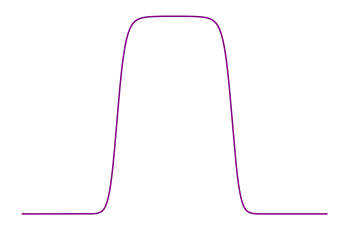
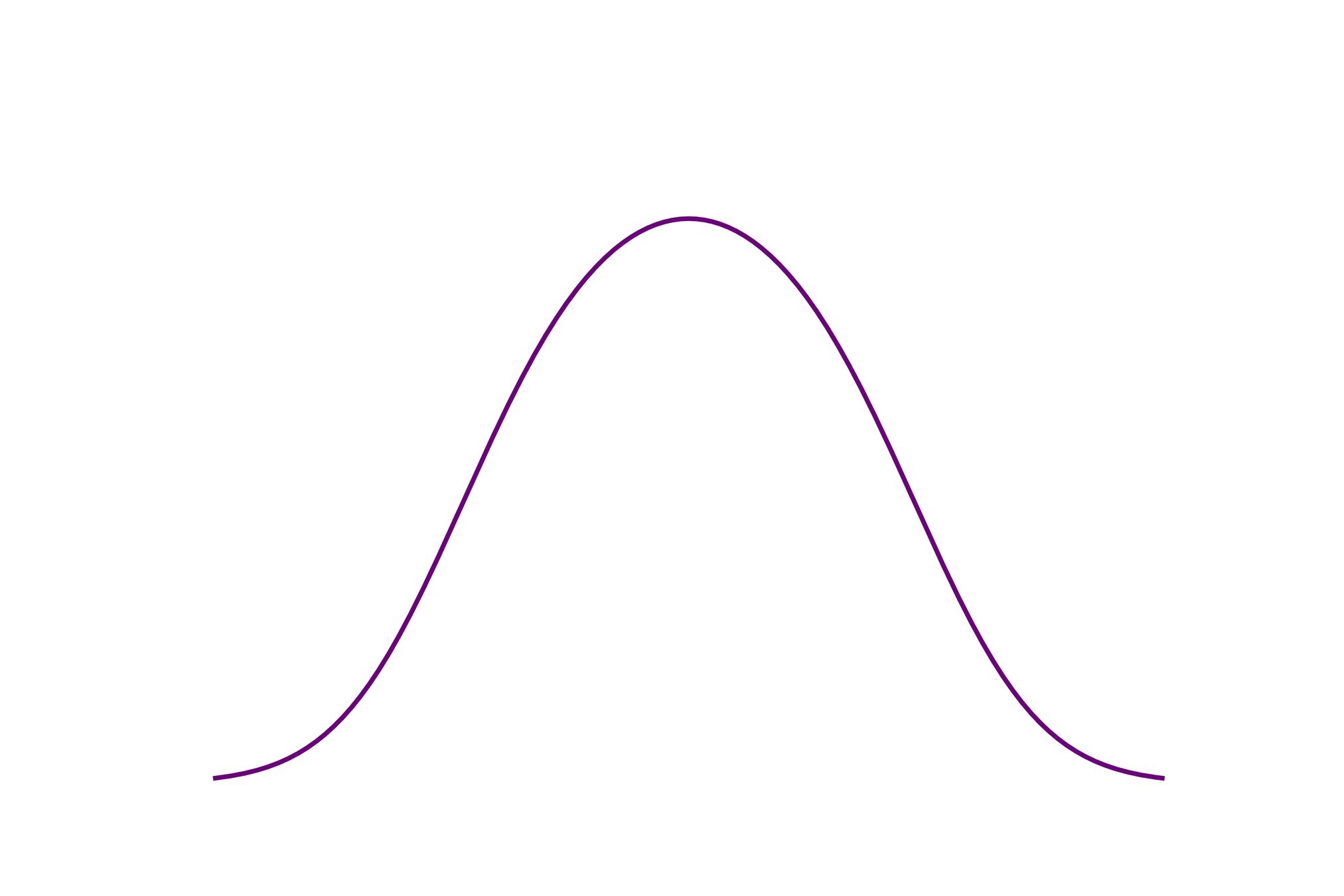

\(\searrow T°\)
\( T°=T_{\min}\)
or saturated state
Fermi-Dirac entropy:
- Existence & stability of solutions to homogeneous BFD for cutoff hard potentials
[Lu, Wennberg]
Existence and uniqueness of solutions to inhomogeneous BFD for cutoff kernels
[Dolbeault]
- Relaxation to equilibrium of such solutions:
either \(f_0 =\) or \(f_t \; \underset{t \to \infty}{\overset{L^1}{\rightharpoonup}}\)
Derivation of the equation from particles system (partially formal)
[Benedetto, Castella, Esposito, Pulvirenti]
at which rate?
some results on bfd
saturated state
Fermi-Dirac stat.
B. relaxation to equilibrium and entropy methods
entropy and equilibrium
entropy : \(\displaystyle H\)
equilibrium associated to \(f\): \(M^f\)
\(M^f = \argmin H \)
relative entropy to equilibrium
( of \(f\) )
"distance" to equilibrium
\(t \mapsto H(f_t) \; \searrow \)
Entropy dissipation \(D\)
\(D \) non-negative operator
Try to prove \(D(g) \gtrsim {H(g|M^g)}^{1+\alpha}\)
(functional inequality)
Entropy / entropy production inequality
To obtain \(H(f_t|M^{f_0}) \lesssim t^{-1/\alpha}\)
Try to prove \(D(g) \gtrsim H(g|M^g)\)
To obtain \(H(f_t|M^{f_0}) \lesssim e^{-Ct} \)
(Grönwall)
Csiszar-Kullback-Pinsker
entropy method
Fermi-Dirac entropy
Boltzmann entropy
Equilibrium: Fermi-Dirac statistics
Equilibrium: Maxwellian
entropies and equilibria
Boltzmann
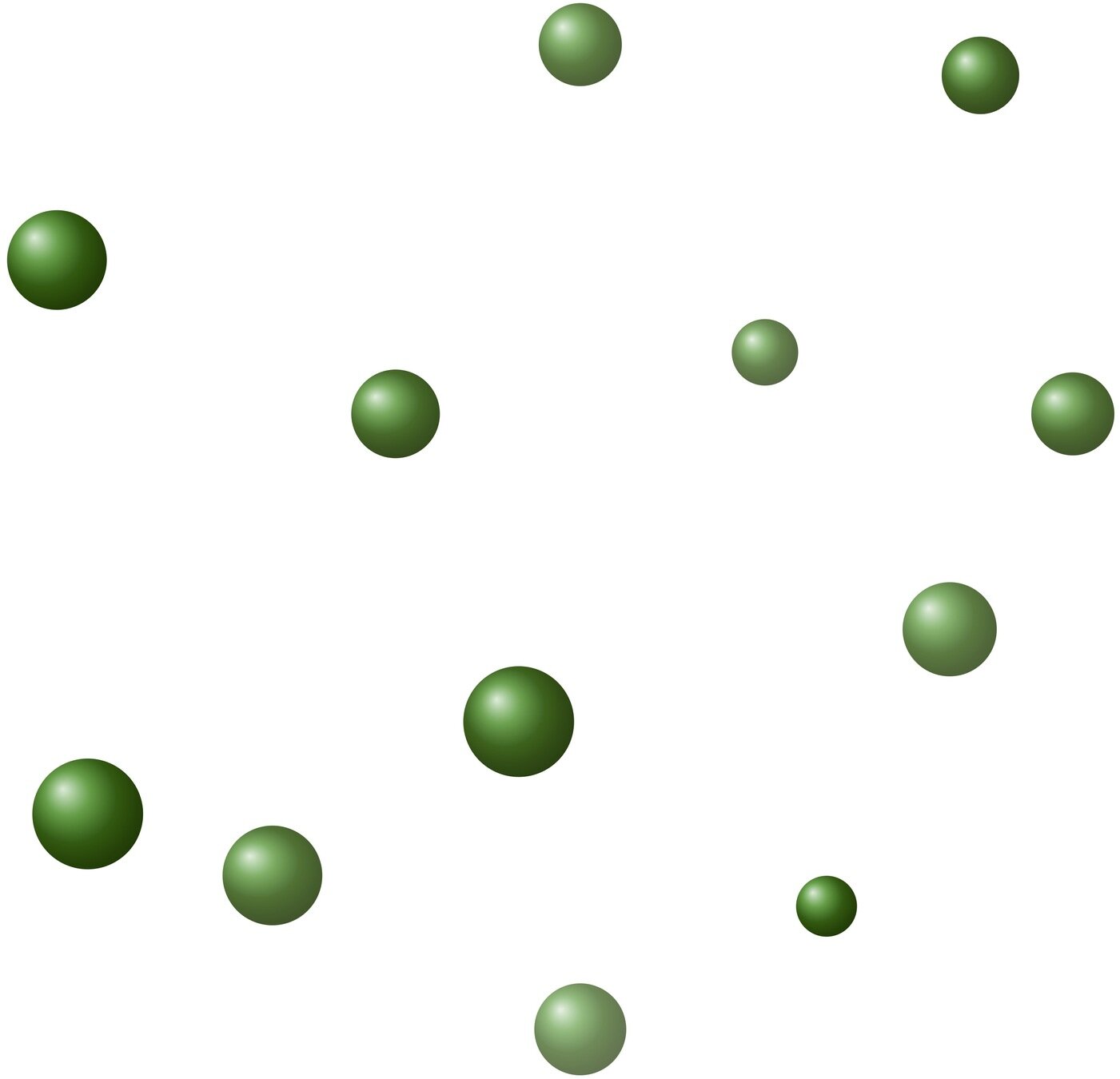
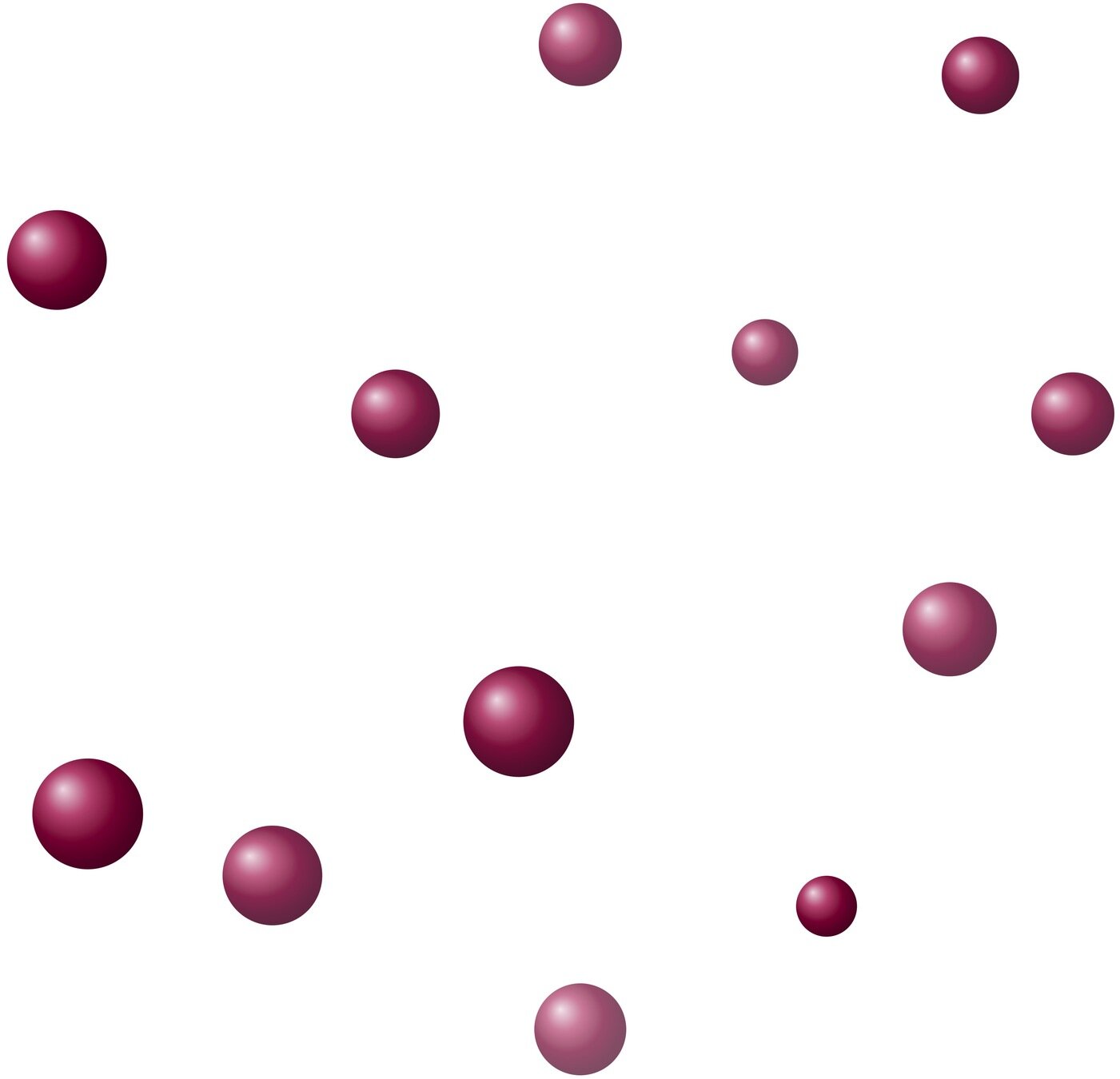
Boltzmann-Fermi-Dirac
Fermi-Dirac entropy
Equilibrium: Fermi-Dirac statistics
Equilibrium: Maxwellian
entropies and equilibria
Boltzmann
Boltzmann-Fermi-Dirac
entropy \(\displaystyle H : h \mapsto \int \Phi(h)\) \(\Phi\) \(\mathcal{C}^2\) st. convex
equilibrium
Boltzmann entropy
Boltzmann
Toscani, Villani
Landau
LAndau-Fermi-Dirac
Desvillettes, Villani
Alonso, Bagland Desvillettes, Lods
Boltzmann-FERMI-DIRAC
?
known entropy inequalities
C. transfer of inequalities
entropy inequality for classical Boltzmann
entropy inequality for Boltzmann-Fermi-Dirac
known
new!
(Toscani, Villani)
transfer of inequalities
transfer of inequalities
we know:
?
entropy inequality for Boltzmann
Fermi-Dirac dissipation of \(f\)
entropy inequality for Boltzmann-Fermi-Dirac
If
we want:
Boltzmann dissipation of \( \displaystyle \frac{f}{1-\delta f} \)
\( \gtrsim\)
whenever all terms make sense,
Boltzmann relative entropy to equilibrium of \(\displaystyle \frac{f}{1-\textcolor{purple}{\delta} f}\)
Fermi-Dirac relative entropy to equilibrium of \(f\)
Theorem.
[B.]
For all
such that
and
and
comparison of relative entropies
Let
Then \(R_g\) is decreasing on \(\R_+\).
Proposition.
take
then
and
Proof of the theorem
proof of the proposition
Key elements:
- Taylor representation of the relative entropy to eq.
- differentiation of \(R_g\) in \(\delta\)
- general link between entropy and equilibrium
- fact that \(x \mapsto -\left(\frac{x}{1+\delta x} \right)^2\) is decreasing
Other technicalities:
- differentiability on \(\R_+^*\)
- continuity at \(\delta = 0\)
general considerations
specific use of Fermi-Dirac features
\(\displaystyle H(f) = \int \Phi(f) \, \mathrm{d} v\) with \(\Phi\) \(\mathcal{C}^2\) s.t. convex
Remark: suited to obtain general Cszisar-Kullback inequalities
Link between entropy and equilibrium
Taylor representation of relative entropy to equilibrium
entropy:
Let
Then \(R_g\) is decreasing on \(\R_+\).
Proposition.
and
- Taylor representation of the relative entropy to eq.
- differentiation of \(R_g\) in \(\delta\)
- general link between entropy and equilibrium
- fact that \(x \mapsto -\left(\frac{x}{1+\delta x} \right)^2\) is decreasing
<proof on the blackboard>
Proposition.
[B.]
For all
such that
and
Classical / Fermi-Dirac equivalence
For Boltzmann (& Landau) equation:
entropy inequality for classical Boltzmann
entropy inequality for Boltzmann-Fermi-Dirac
with
Perspective
conjecture:
If
then
Let \(\displaystyle H_0(f) = \int \Phi_0(f) \), \(\displaystyle H_1(f) = \int \Phi_1(f) \) with \(\Phi_0,\Phi_1\) \(\mathcal{C}^2\) s.t. convex.
D. Relaxation to equilibrium for Boltzmann-Fermi-Dirac
\(p \in [1,\infty), \, k \geq 0\), and with \(C,\eta\) explicit and uniform in \(\delta\).
Relaxation to equilibrium for Boltzmann-fermi-dirac
Theorem 1.
[B., Lods]
Let \(0\leqslant f^{\rm in} \in L^1_3(\R^3)\). Then \(\exists \delta^{\rm in} > 0\) such that \(\forall \delta \in (0,\delta^{\rm in})\), if \(f^{\delta} \) sol. to Boltzmann-Fermi-Dirac w/ cut-off hard potentials,
(\(\delta\) is the quantum parameter)
Proof's core ingredients:
- \(L^{\infty}\)-bound on \(f^{\delta}\) independent of \(\delta\)
- Entropy/entropy production inequality
- Control of moments
- Maxwellian lower-bound
- Csiszar-Kullback-Pinsker inequality
then
Proof's strategy:
the \(L^{\infty}\)-bound
Theorem 2.
[B., Lods]
Let \(0\leqslant f^{\rm in} \in L^1_3(\R^3)\). Then \(\exists \,\mathbf{C}^{\rm in} > 0\) such that \(\forall \delta> 0\), if \(f^{\delta} \) sol. to Boltzmann-Fermi-Dirac with cut-off hard potentials,
independent of \(\delta \)
\(f_t^{\delta}\) "sub-solution" to an eq. resembling classical Boltzmann
\(\widetilde{Q}^+_0\) "adjoint" to \(Q^+_0\)
(almost) copycat proof of same fact for classical Boltzmann
[Alonso, Gamba]
then
overall recap
Monoatomic
Polyatomic
Resonant
Fermions
Entropy
Conserved quantities
Equilibrium
Entropy
Equilibrium
Conserved quantities
st. convex
general link
Lagrange multipliers
Functional to minimize
constraints
Minimizer
perspectives
BONUS: general weighted \(L^p\) Csiszár-Kullback-Pinsker
General weighted \(L^p\) Csiszár-Kullback-Pinsker
Proposition.
(general entropy)
with \(\displaystyle H(f) = \int\Phi(f)\), \(\Phi \; \; \mathcal{C}^2\) st. convex, \(M^f\) equilibrium, and
For any \(f\), any \(p \in [1,2]\) and \(\varpi\) weight \(\geqslant 0\),
Corollary.
For any \(0\leq f \in L^1_2\cap L \log L(\R^3)\), \(p \in [1,2]\) and \(\varpi : \R^3 \to \R_+\),
(Boltzmann entropy)
with \(\displaystyle H_0(f) = \int f \log f\) and \(M_0^f\) Maxwellian.
[simplified]
[T. B.]
\(\mathrm{I}\). Boltzmann equation for polyatomic gases
\(\mathrm{II}\). Boltzmann equation for polyatomic gases with (quasi-)resonant collisions
\(\mathrm{III}\). Boltzmann-Fermi-Dirac equation
Bonus: weighted \(L^p\) Csiszar-Kullback-Pinsker inequalities
- General modelling framework
- Relationships between models
- Compactness result in resonant setting
- Modelling & study of quasi-resonant Boltzmann
- Entropy/entropy production inequalities via a transfer method
- Relaxation to equilibrium with explicit rate
w/ Lods
(Desvillettes)
w/ Bisi, Groppi
w/ Boudin, Mathiaud, Salvarani
(Boudin)
Thank you for your attention!