Competition in Health Care
BE 608
Homework assignments
Nice job on homework - almost exactly 9/10 average
You can view comments on assignment tab in Canvas
How have your states dealt with issues about insurance markets/adverse selection/moral hazard?
History of Hospital Anti-trust Action
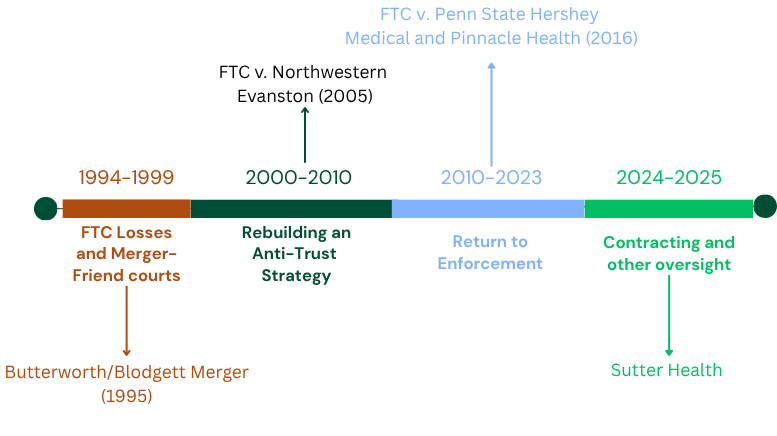
Evanston Northwestern/Highland Park Merger
Evanston Northwestern Healthcare
- Evanston Hospital (400 beds)
- Glenbrook Hospital, Glenview IL (125 beds)
Highland Park Hospital (200 beds)
- 14 miles north of Evanston
Merger in 2000 was not challenged by anti-trust agencies.
FTC Retrospective Review
Prospective analysis of mergers is difficult
•Research is limited by a dearth of data on transaction prices.
•Merger effects must be predicted based on theory and simulation models
•Even when models are not sensitive to assumptions, they can be disputed
FTC Retrospective Review
2002: FTC decided to review the results of past mergers
•Analysis could be done using actual transaction prices
•Provides direct evidence on price effects
•Provides a test of the econometric models
Results show large price increases after Evanston/Highland Park and other consummated mergers.
FTC Retrospective Review
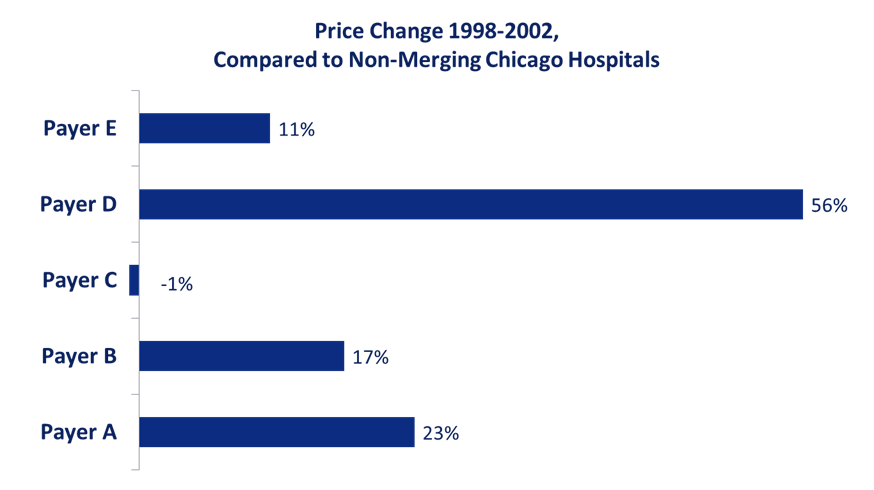
Evanston/Highland Park Merger
In 2005, FTC staff challenged the merger.
Their analysis of actual prices showed that average prices paid by managed care companies increased by nearly 50%.
Internal documents and testimony corroborated this.
- Highland Park CEO: “it would be real tough for any of the Fortune 40 companies in this area whose CEOs either use this place or that place to walk from Evanston, Highland Park, Glenbrook and 1,700 of their doctors.”
- Testimony from MCOs: prior to merger, plans could play one hospital off against the other to get lower prices.
Evanston/Highland Park
•Court ruled in favor of the FTC. But, several years after the merger the “eggs could not be unscrambled.”
•Key result: Court accepted FTC’s argument that the relevant market definition is based on Stage 1 negotiations between payers and hospitals, not patients’ choice of hospitals.
•Instead of divestiture, the two hospitals were required to negotiate separately with insurers.
Sutter Health Anti-Trust Action
Sutter had dominant position in Northern California. California attorney general brought class-action lawsuit alleging anti-competitive behavior:
"All or nothing" contracts
- insurance companies couldn't steer patients to lower cost hospitals
- Made it difficult for insurance companies to tier hospitals in their plans
Two large settlements out of court ($800M+)
Is there enough hospital anti-trust?
- From 2002-2020 there were 1000 hospital mergers.
- The FTC blocked 13.
- 90 percent of hospital markets are considered "highly concentrated."
In a typical merger year between 2010 and 2015, the mergers increased spending by $204 million (Brot et al 2025).
The entire budget for enforcement for the FTC is $136 million.
Vertical Consolidation in Health Care
Vertical consolidation is consolidation along the supply chain.
What does that mean in health care?
Potential Effects of Vertical Integration
Possible Benefits? Possible Costs?
Potential Effects of Vertical Integration
Benefits:
•Better care coordination
•Administrative scale economies
•Facilitates investment in IT
•Reduced admin burden on providers
- Reduced double marginalization
Better health outcomes at lower cost
Double Marginalization
Monopolies are bad. But multiple monopolies along the supply chain are worse!
Imagine physician and hospital, both with market power.
Physician "marks up" (above cost) her services, which she sells to the hospital.
Hospital "marks up" cost of visit.
Consumer ends up paying double mark-ups--resulting in high prices and low quantities.
Potential Effects of Vertical Integration
Potential Costs:
•Higher private prices
•Patients diverted to higher-cost hospitals
•Increased Medicare spending due to facility fees
- "Foreclosure"
- Ability to get around regulations
Higher spending without necessarily producing health gains
Medicare Spending by Location
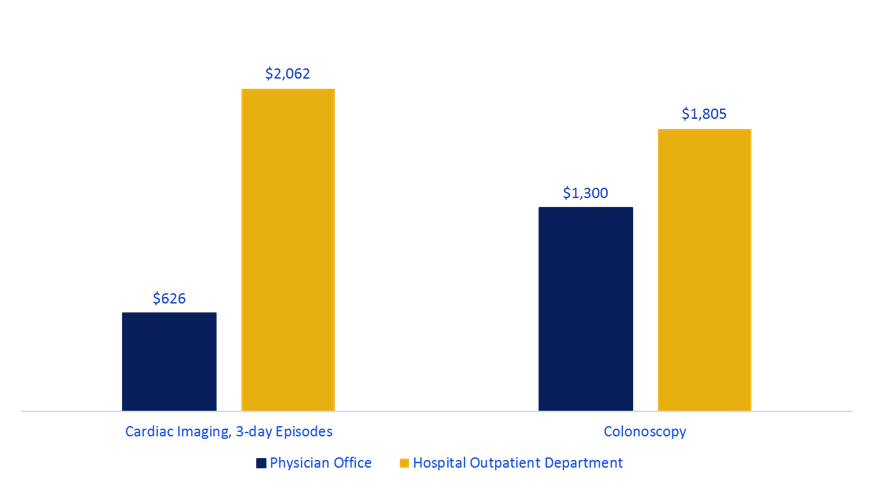
Source: Avalere Health, “Medicare Payment Differentials Across Outpatient Settings of Care," Feb. 2016
What happens after hospital acquires a patient's primary care physician?
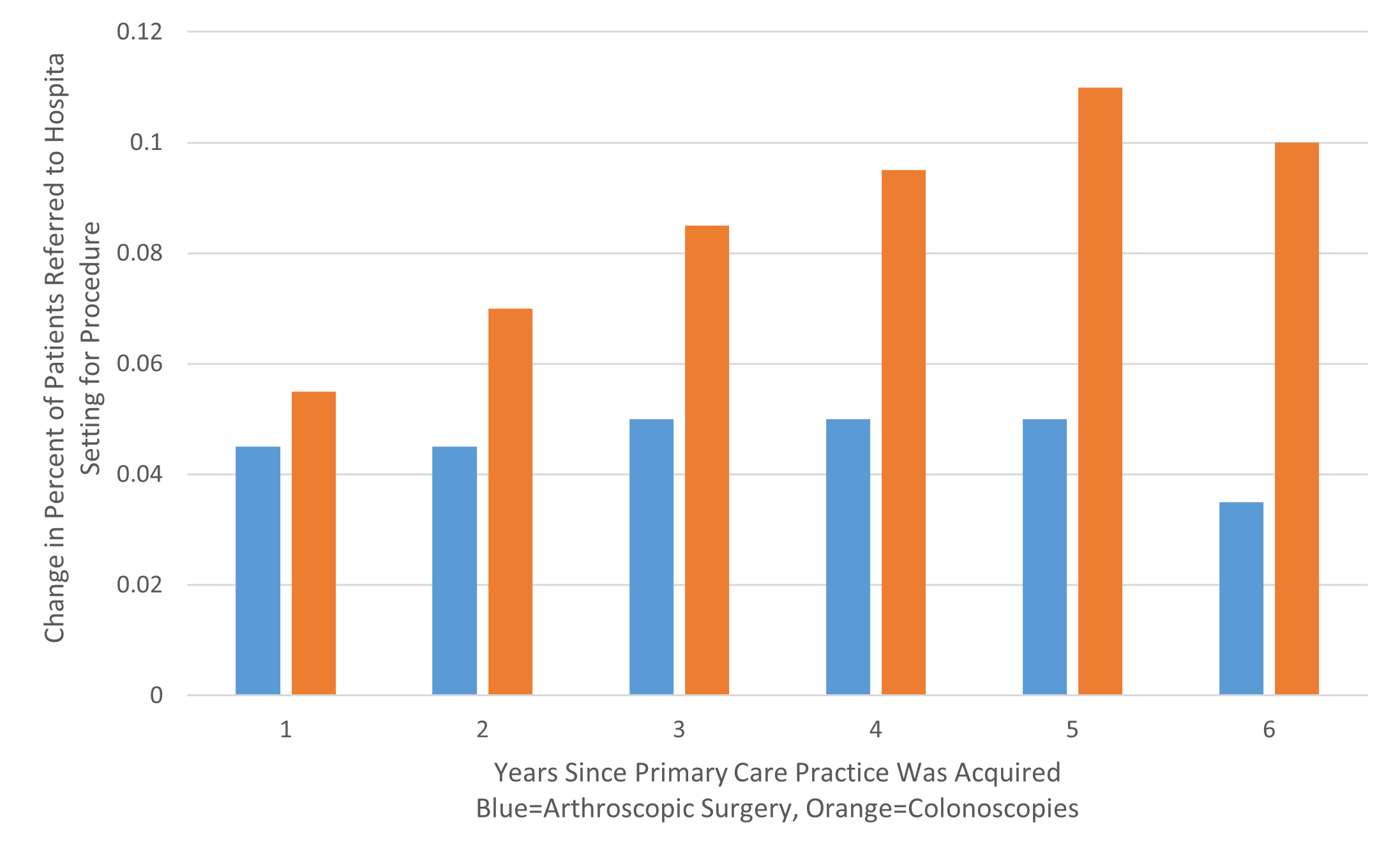
Chance of having procedure in a more expensive setting goes up (Whaley et al JPubE 2024). Increase travel times. Total increased cost to Medicare ~$300M and to patients $60M
What about the insurer side?
Just four insurance companies--United Healthcare, Aetna, Cigna, and the Blues (Blue Cross and Blue Shield Association)--control almost 90% of the market share of private insurance.
What is good and bad about market concentration in insurance markets?
Insurer Mergers
In 2015, Anthem struck a deal to acquire Cigna.
- This merger would create the largest health insurance company in the United States.
Challenged by DOJ as anti-competitive
Anthem/Cigna
Strongest argument from defense:
- Larger insurance companies needed to compete with ever growing providers.
- Merger will allow Anthem/Cigna to negotiate more favorable rates, that would be passed on to customers.
- Analysis from Anthem showed that merger would allow the new entity to reap $2.4 billion in reduced provider payments--lowering health care costs.
Anthem/Cigna
Government's argument:
- New entity would have substantial market power--making it unlikely that the company would "pass the savings on" to customers.
- Previous merger of Aetna and Prudential in 1999 did result in lower payments from providers--but also led to higher premiums for patients.
Ultimately the court blocked the merger, which was abandoned (after appeal) in 2018.
Humana/Aetna $34 billion merger deal also blocked by courts in 2017.
Payer-side Vertical Integration
Insurance companies are not just concerned about negotiating with hospitals. Drug prices have been an increasing portion of medical spending and are likely to increase over time.
A new type of vertical integration proposed between health insurance companies and pharmaceutical benefits management companies (PBMs) :
- $69 billion purchase of Aetna by CVS
- $52 billion Cigna-ExpressScripts merger.
Both passed regulatory hurdles and completed acquisitions in 2018.
Insurance and pharmacy mergers
Most large companies keep prescription drug coverage separate from medical coverage.
- Use larger company, like CVS or ExpressScripts, to negotiate with pharmaceutical companies who naturally have more market power.
- But CVS also gets a cut of the drugs they sell--maybe they don't have an incentive to negotiate that hard? Do they really pass on all of the savings to the insurer?
- Merger hopes to align these incentives.
However: CVS just announced it is splitting off its retail pharmacy business. When would it make sense (or not make sense) to have CVS retail bundled with its payer/PBM arm?
Insurance and pharmacy mergers
Why split?
- Limits of the firm. Not every input benefits from common ownership. Some of the benefits of integration can be had simply through normal contracting!
- Make CVS Pharmacy a more attractive partner. CVS pharmacy may benefit from working closely with some of Aetna/Caremark's competitors. These competitors may feel more comfortable working with an independent CVS.
- There are costs to integration. More regulatory oversight, two very different businesses so accountability/investment priority may be easier as two separate entities.
- CVS doesn't need market power. Retail pharmacy is extremely concentrated already (duopoly).
State Question for next time
What do hospital and insurer markets look like in your state?
Has there been a change (e.g. a big merger)?
Was there a policy response (FTC or DOJ law suit or other action by the state)?