
Mechanical Engineering, Carnegie Mellon University
Agenda
- Motivation: PDE Solvers
- Polynomial Interpolation
- Orthogonal Polynomials
- Properties
- Generating polynomials
PDEs solvers are needed for predictive modeling
Navier-Stokes Equations
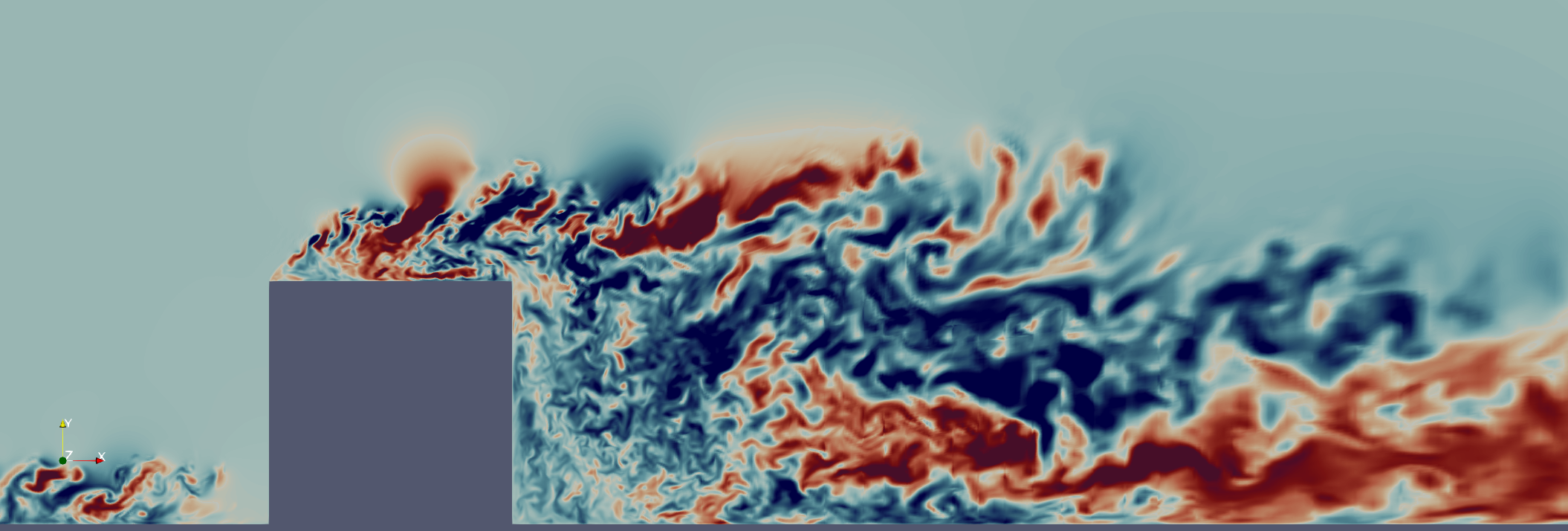
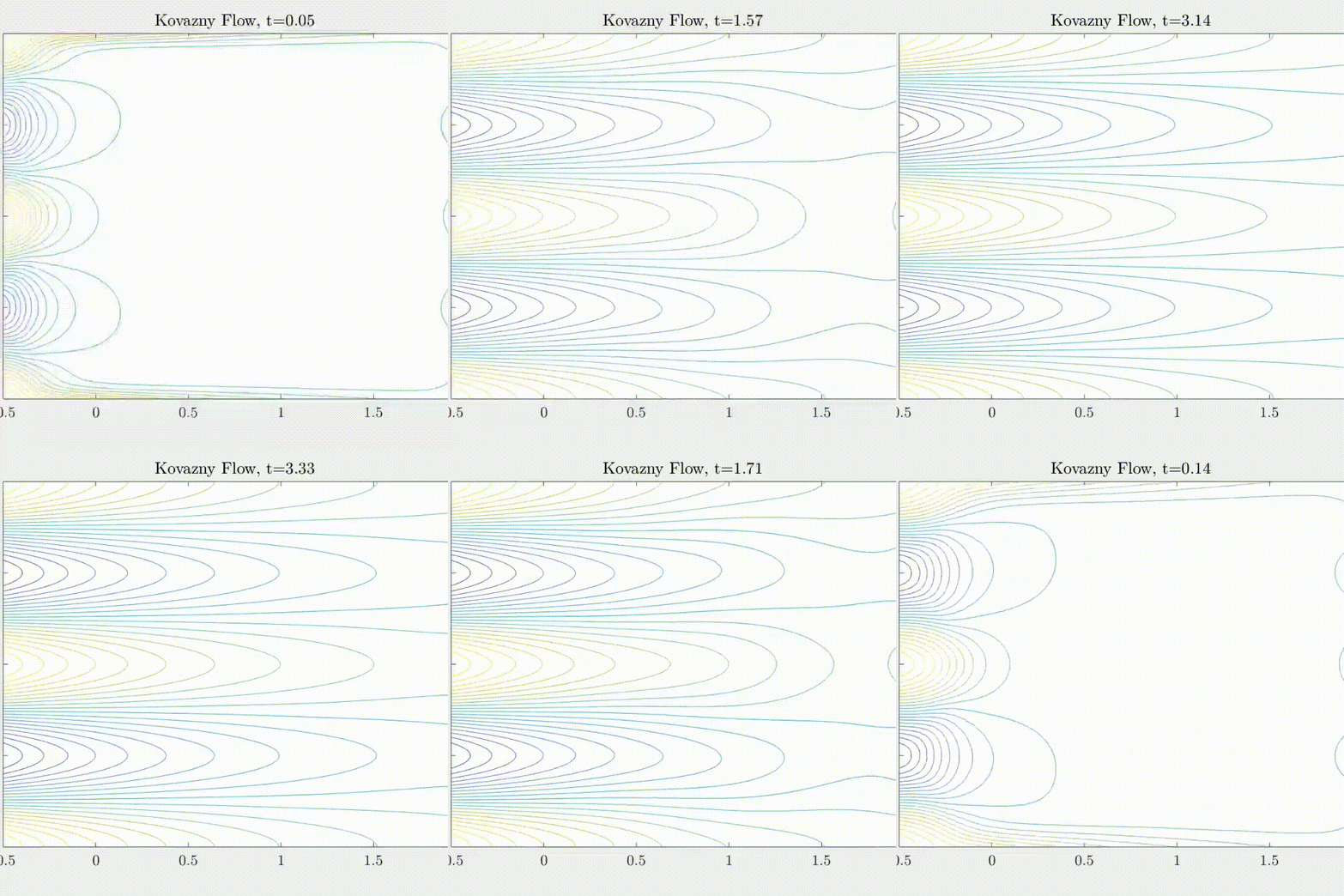
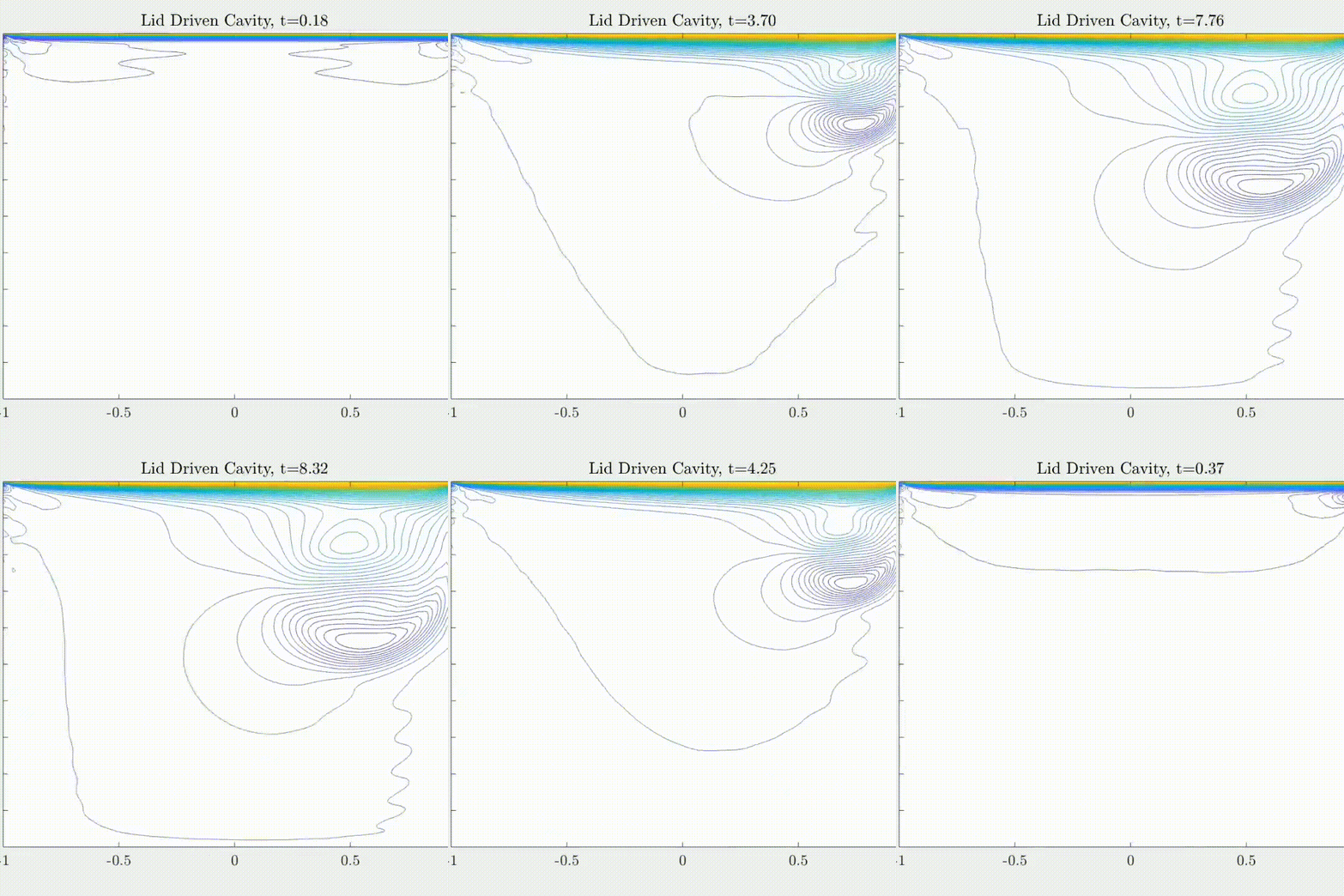
(Flow past bluff body \( Re = 3900 \))
Need high quality function representation over (complex) geometry.
Main operations: \(\nabla, \, \int_\Omega\)
High-order interpolation is the underlying technology
With a basis over \(\Omega\),
Functions can be written as expansions
\(\nabla, \, \int\) can be done on the basis
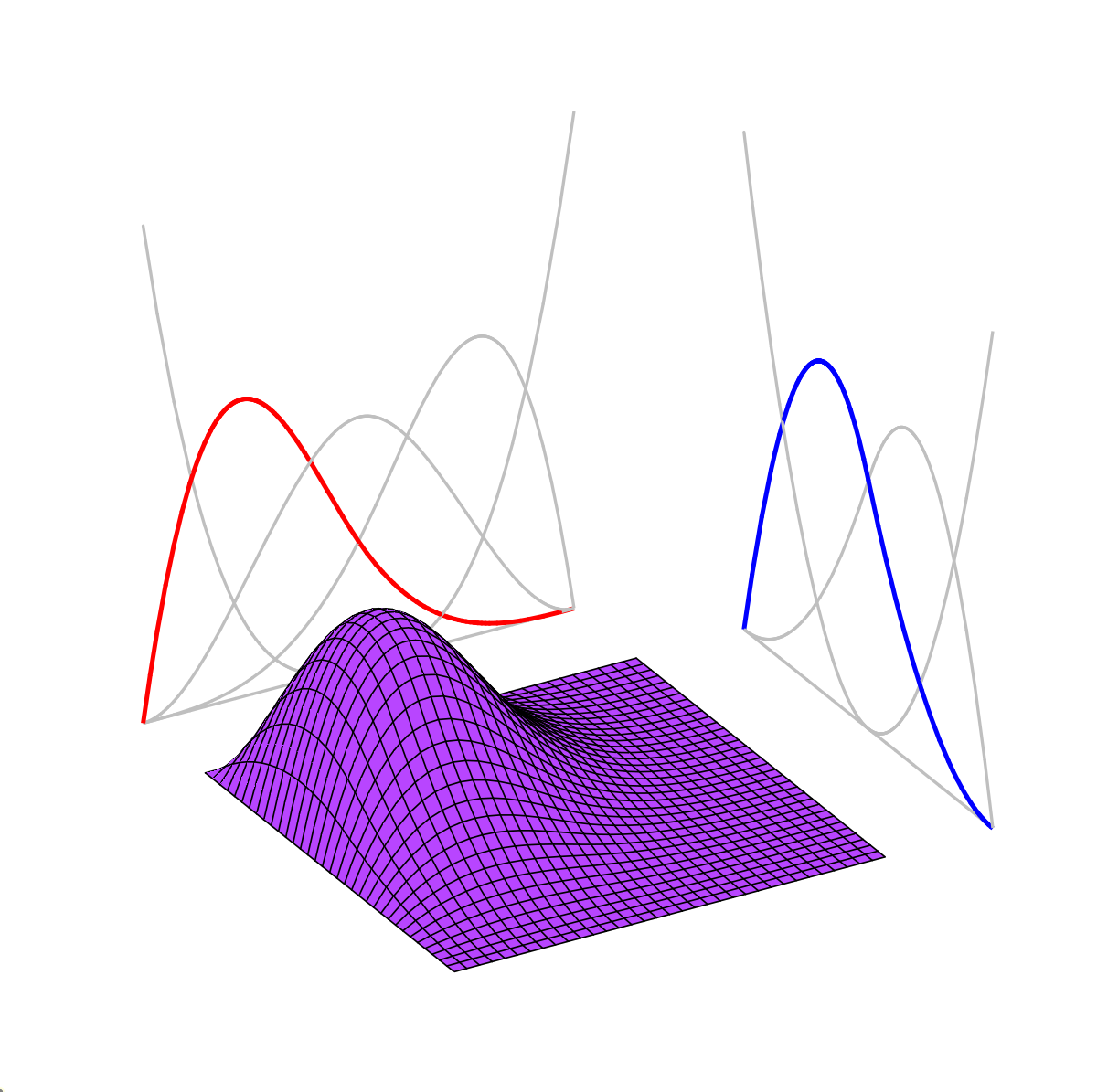
(Tensor-product basis)
(Linear Finite Element basis functions)
Exact
Fast
Properties of the basis are endowed on to the function
Well-conditioned
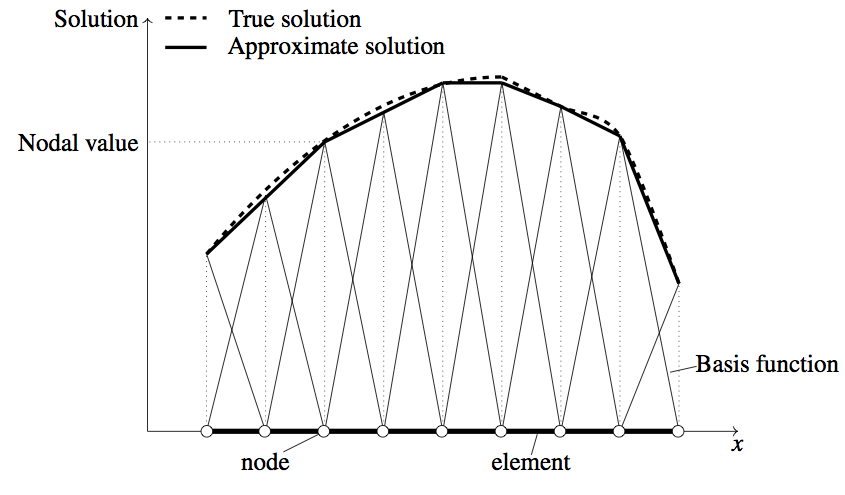
Lagrange interpolants and Gauss Quadrature are all we need
For a set of nodes
Lagrange Polynomials can be defined
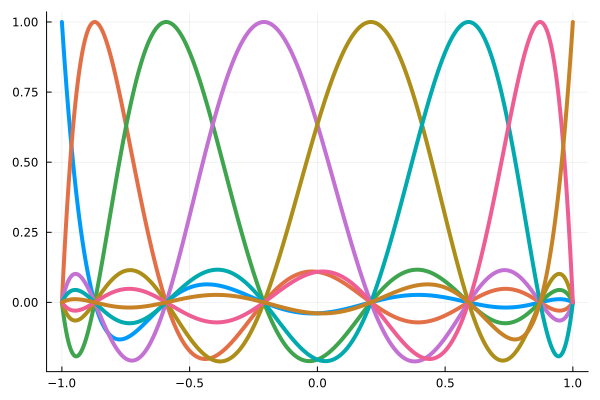
(Lagrange Polynomials over Gauss-Lobatto-Legendre nodes)
Differentiation
Interpolation

What about integration?
For a special set of nodes
Integration
Gauss Quadrature
\(\{x_n\}_n\) are roots of the \(n^\text{th}\) orthogonal polynomial generated by \(w(x)\) in \(\Omega\).
Conditioning
Orthogonal Polynomials
Orthogonalization
(Gram-Schmidt)
Start with the monomials
Orthogonal WRT inner product on \( C(\mathbb{R}) \)
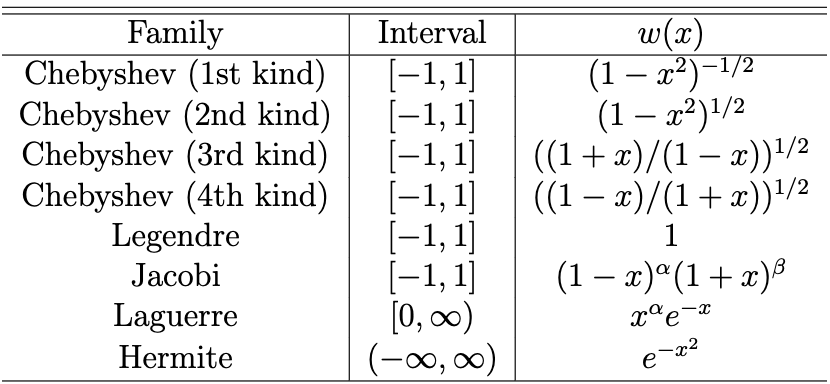
\(w(x)\) generates a unique family of orthogonal polynomials (up to normalization)
(Classical Orthogonal Polynomials)
Sturm-Louisville Theory
Classical Orthogonal Polynomials emerge as solutions to the Sturm-Louisville problem
Example: Fourier (trigonometric) polynomials are the eigenfunctions of the Laplace equation
But boundary condition is embedded in the interpolants. So they are not general purpose.
Trigonometric polynomials have fast transforms: \( \mathcal{O}(N\log(N)) \)
GOAL: Finding orthogonal polynomials is arbitrary geometries
Want to do calculus in arbitrary geometries
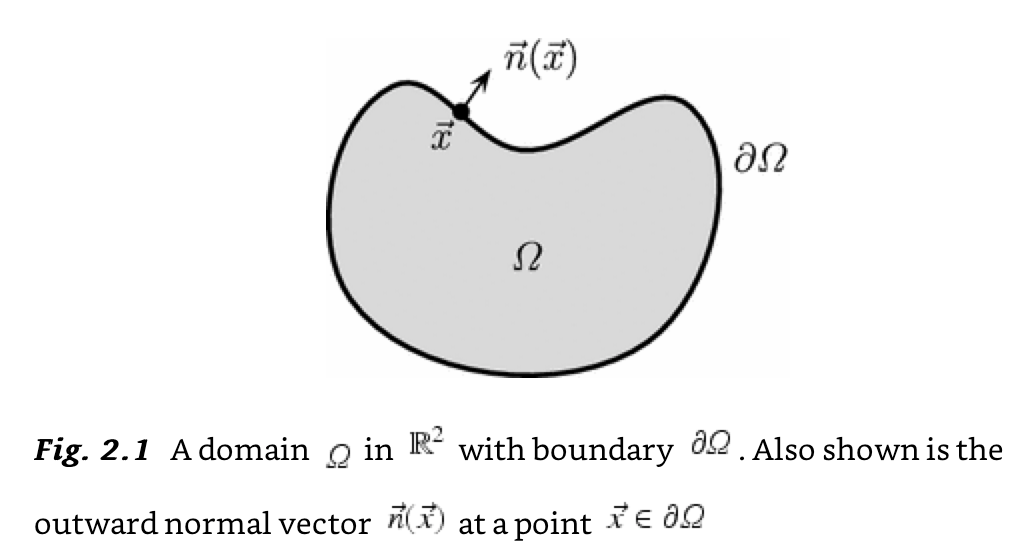
Need orthogonal basis over \(\Omega\):
- Gauss quadrature nodes and weights
- Interpolation, differentiation operators
- Matrices should be sparse, well-conditioned
- Method to impose boundary condition
Aim
- Develop method to generate orthogonal polynomials in 1 dimension
- Extend to multiple dimensions
Problems
- High-order polynomials (except in special cases) are nasty for numerical computation
- No known recurrence relation in 2D/3D
The three-term recurrence relation
(Favad, 1935) All families of orthogonal polynomials follow a 3-term recurrence relation
Example: Chevyshev polynomials (first kind)
In general, for \( \{p_n\}_{n=0}^{N-1} \)
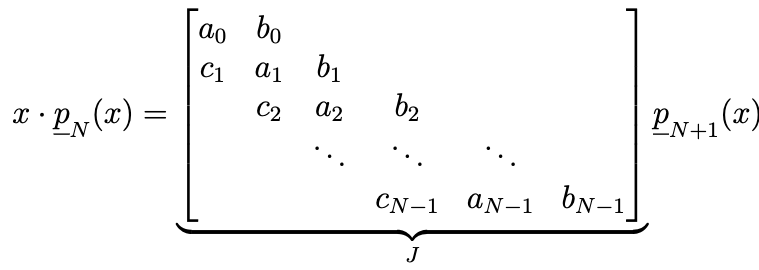
In matrix form, we have a tridiagonal system
(Golub & Welsch, 1968) eigenvalues of \(J\) correspond to zeros of \(p_n(x)\).
(Mysovskih, Gautschi) \(J\) is uniquely determined by \(w(x)\)
Graphs Corresponding to Orthogonal Polynomials
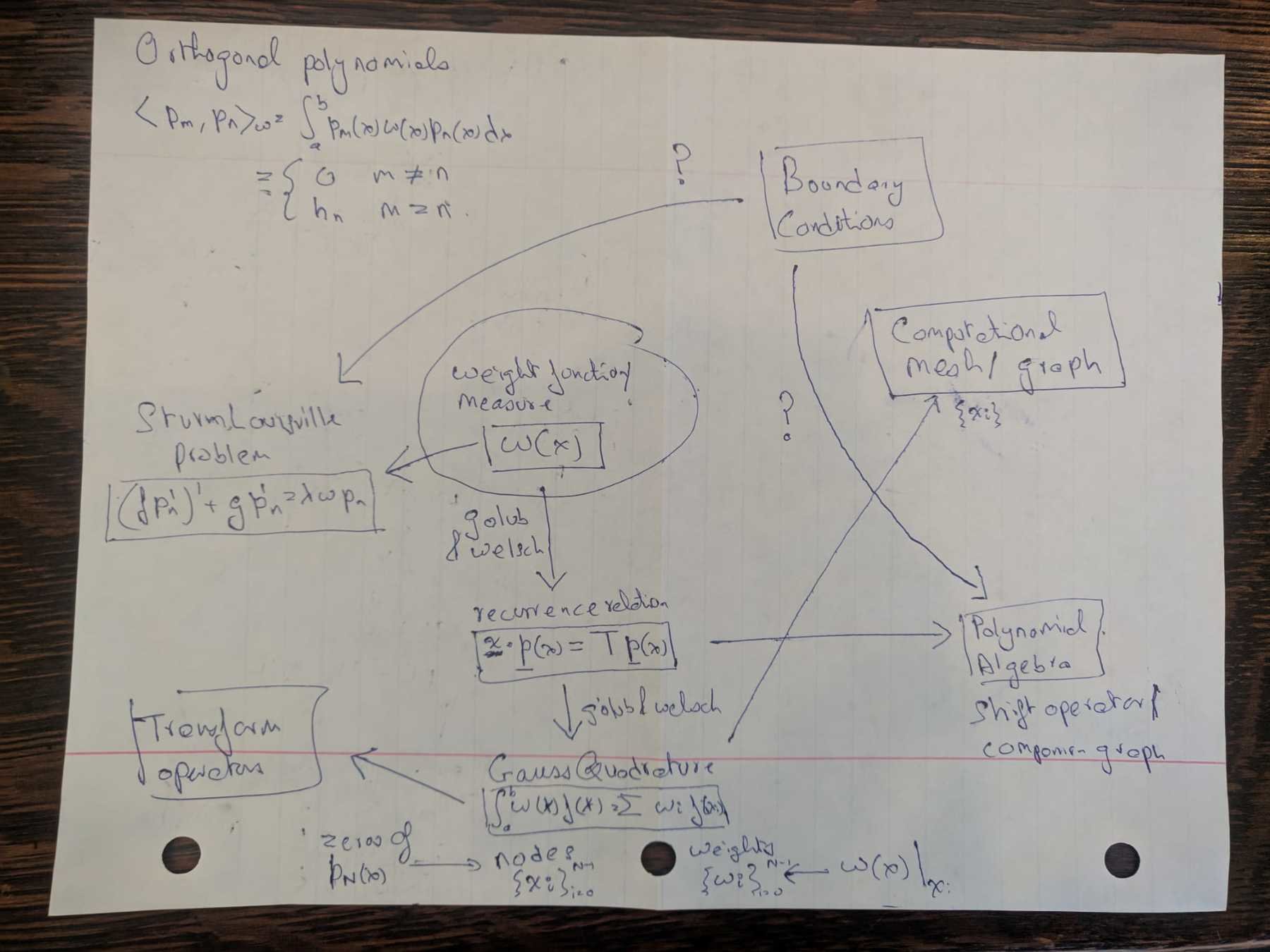
Method
Recurrence relation
Gauss Quadrature
Calculus
Conclusions
Implementation Problems
- Implementation
- High-order polynomials are notoriously ill-conditioned
- Gram-Schmidt failing for N > 20
- There are methods to get past numerical instability
- No guarantee on conditioning of interpolation, differentiation matrix
-
Mysovskih, Gautschi - algorithm requires moments computation
Chicken and egg problem - to get Gauss quadrature for integration, you have to do integration