Neural Representations for Computational Physics:
from Reduced Order Models to Scalable Transformers
Vedant Puri
AUG 19, 2026

Committee:
Levent Burak Kara, Yongjie Jessica Zhang, Amir Barati Farimani, Krishna Garikipati
L = MSE(u_true - u_pred)
u_pred = NN(x) <-- current situation
u_pred = NN(x) + u_linear_approx
u_linear_approx_{x,y} = 0
u_linear_approx_x = XXX
NN: [N, D] -> [N, Do]
final hidden states h [N, C=128]
u_pred = h * W [C, Do] --> [N, Do]
u_sca_pred = pool(h) * W [C, 1]
L = MSE(u_pred, u_true) + lambda * MSE(u_pred_sca, u_sca)
pool: [N, C] -> [1, C] # mean pooling, class-pooling
Computer simulations are critical for industrial applications
1
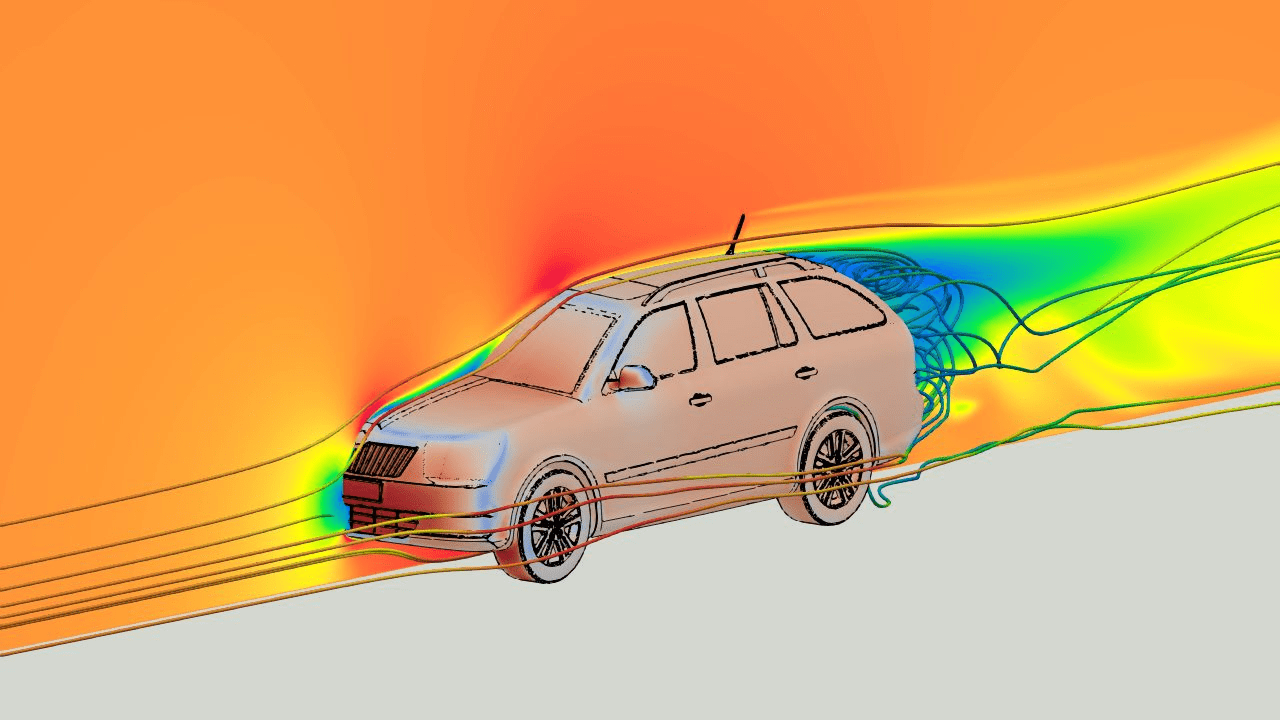
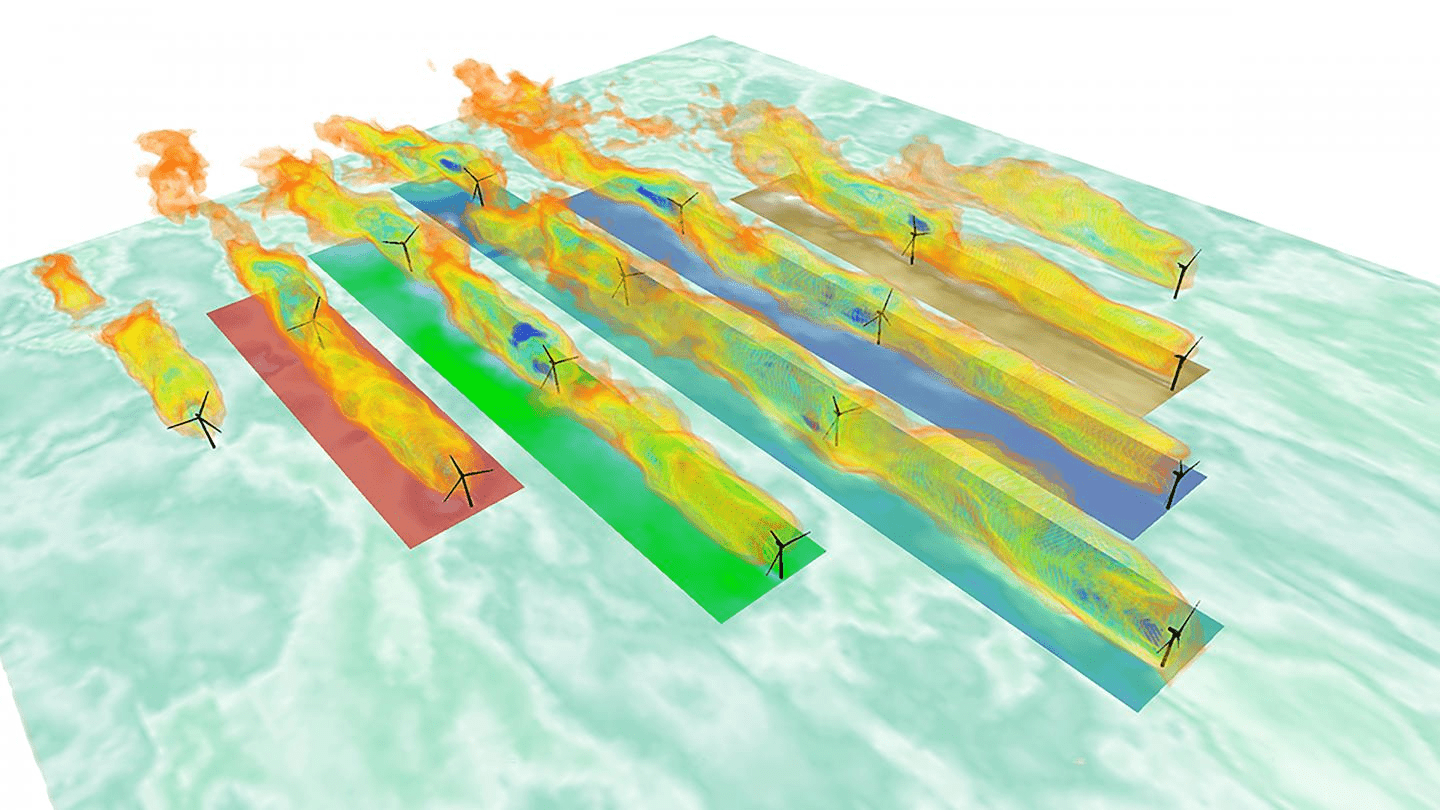
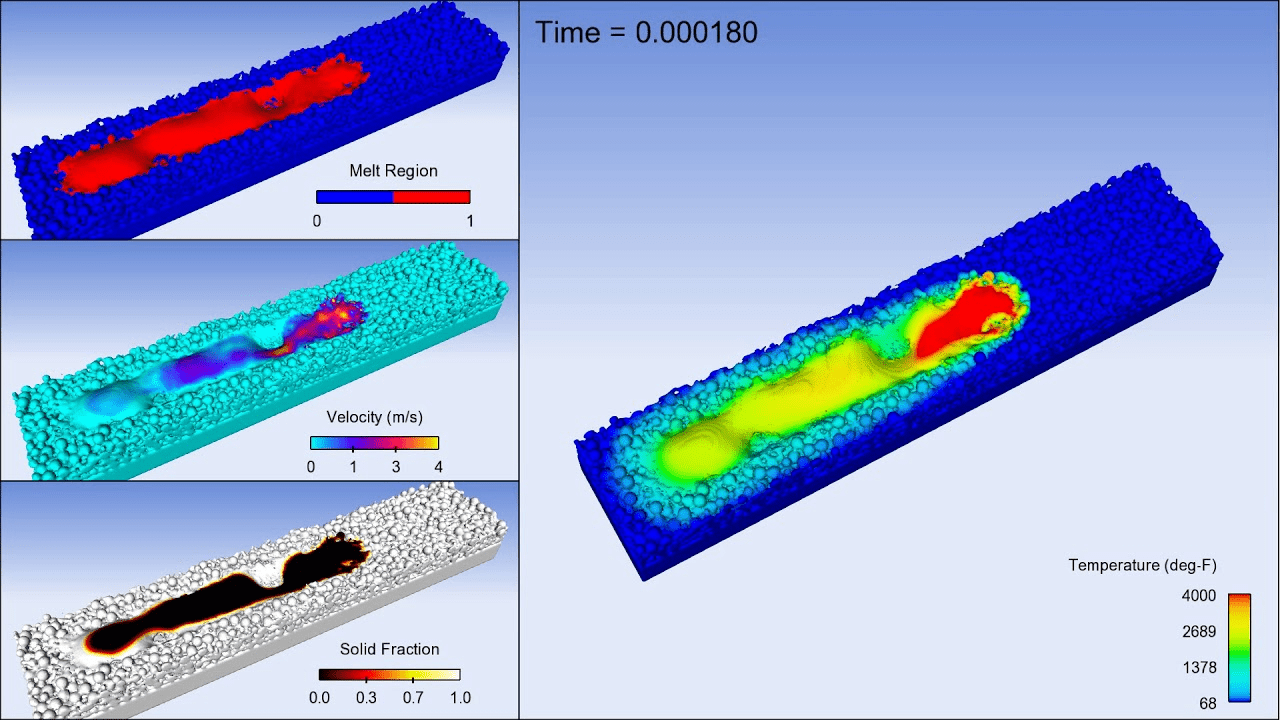
Modern engineering is reliant on computer simulations
Predictive maintenance
Design space exploration
[2]
[1]
[3]
[1] CFD Direct / OpenFOAM – “OpenFOAM HPC on AWS with EFA”, cfd.direct
[2] EurekAlert — “New concrete system may reduce wind-turbine costs”
[3] Flow-3D, “FLOW-3D AM” product page, flow3d.com
Process optimization
Automotive engineering
Civil engineering
Advanced manufacturing
[1]
2
Physics-based simulations bottleneck many engineering workflows
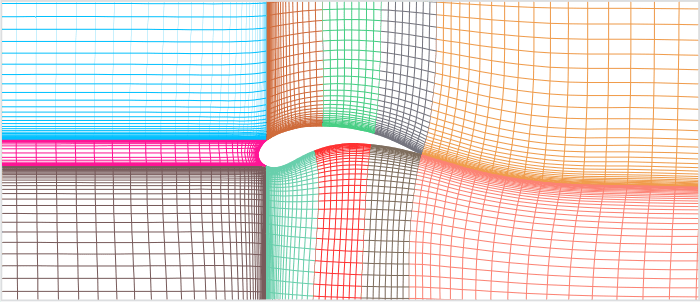
[1] GridPro Blog — “The Art and Science of Meshing Airfoil”
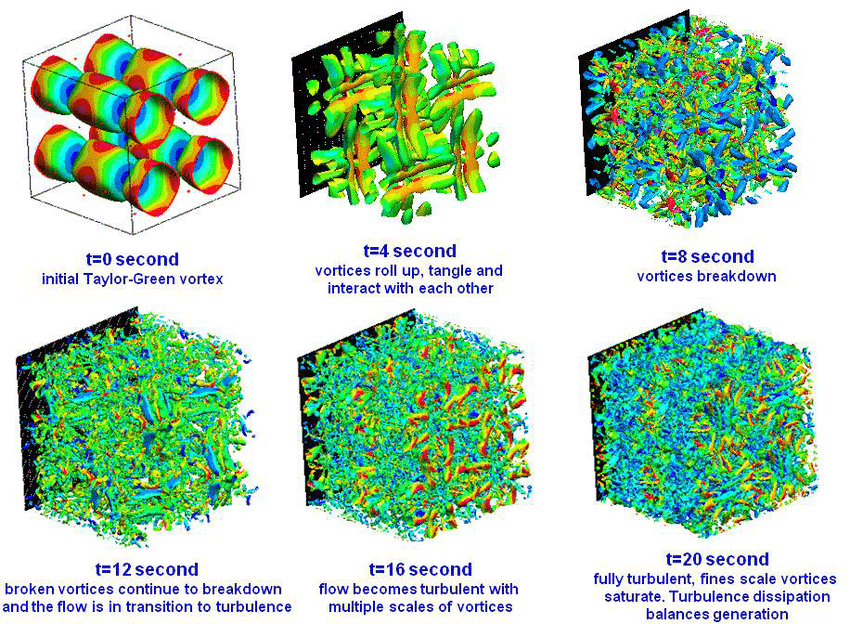
[2] ResearchGate — “Transition to turbulence of Taylor-Green Vortex at different time (DNS)” (figure)
[3] ORNL / U.S. Department of Energy — “DOE and Cray deliver record-setting Frontier supercomputer at ORNL”
Numerical simulations are expensive because
[1]
Complex geometry \(\implies\) many DoFs
Multiscale physics \(\implies\) small \(\Delta t\)
[2]
Repeated large system solves

[3]
Neural signal representations learn to emulate physics from data
3
(Explicit) Weighted sum of polynomial interpolants
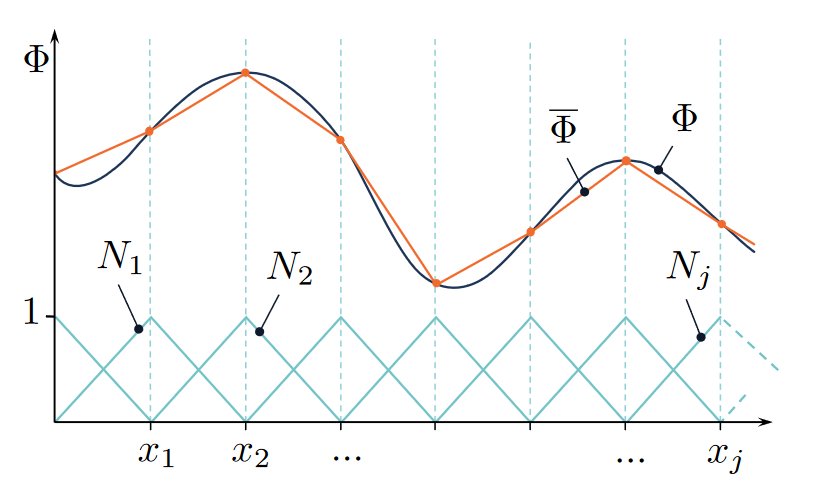
Finite Elements
[1]
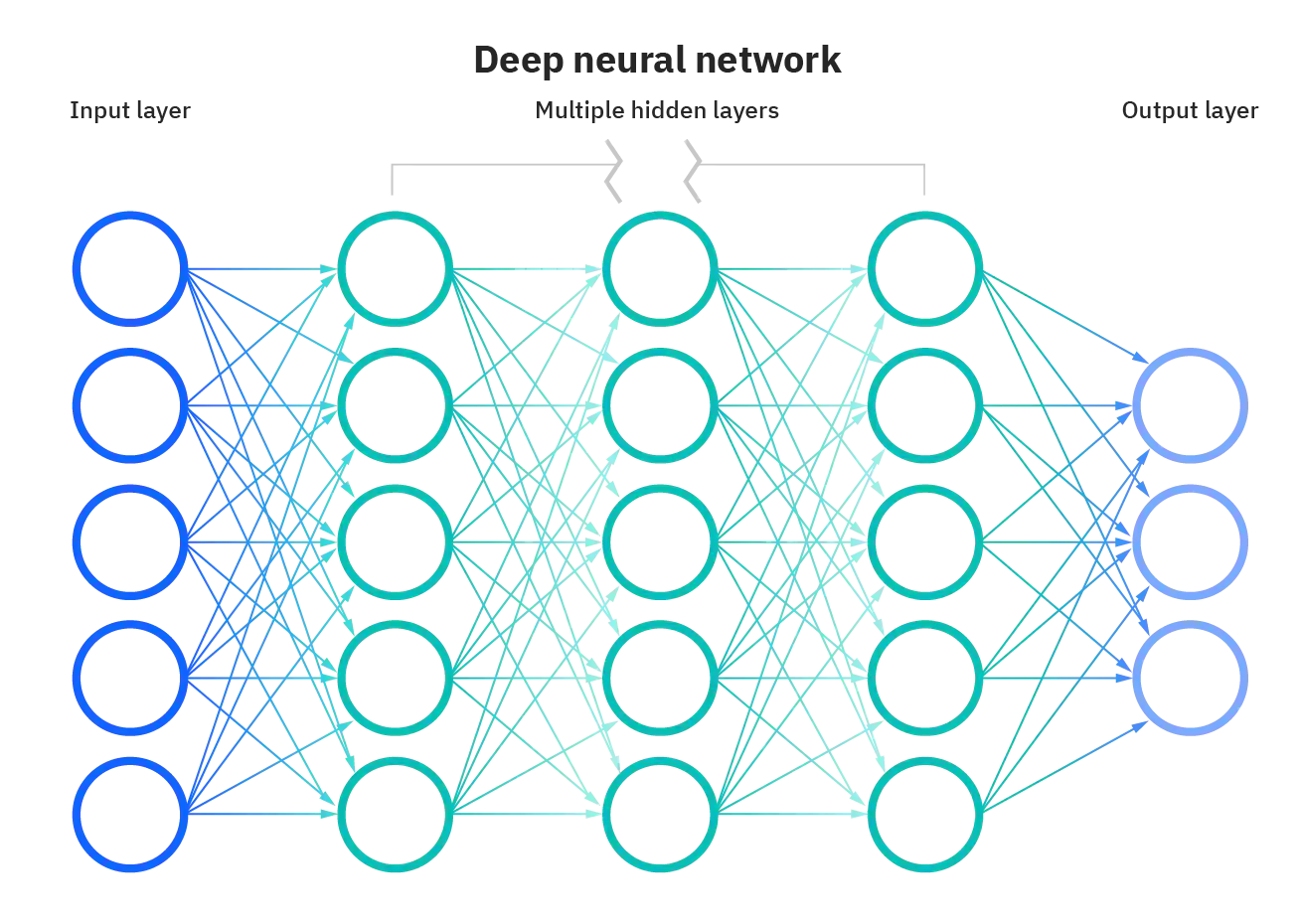
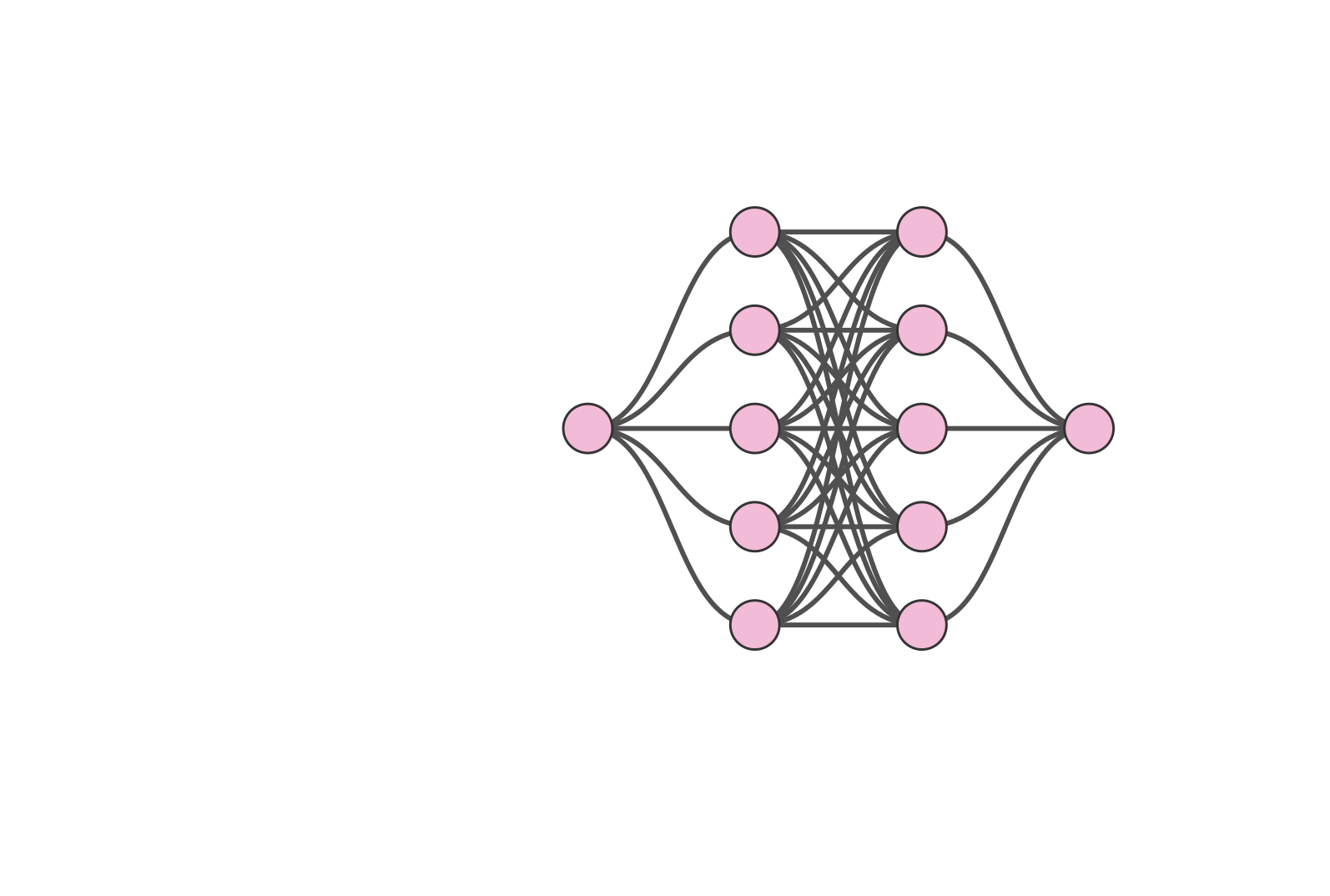
(Implicit) High-dim nonlinear feature learners
Neural Networks
[2]
Cannot learn from data
Can learn from data
Large cost per simulation
Cheap evaluation after training
High-accuracy
Problem-specific
Robust
Up to \(0.1\%\) accuracy
[1] Math StackExchange — “Interpolation in Finite Element Method”
[2] ResearchGate — “Structure of a Deep Neural Network” (figure)
\(\text{Mesh ansatz}\)
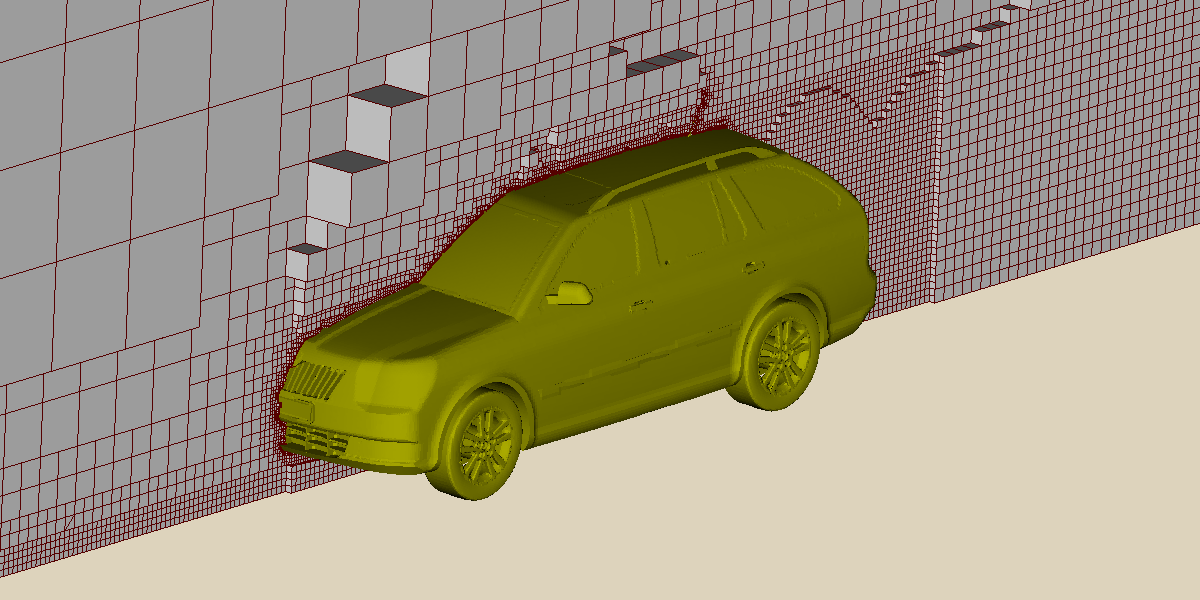
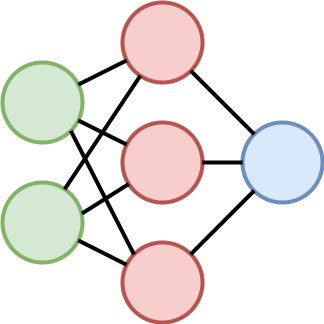
\({u}(x)=\)
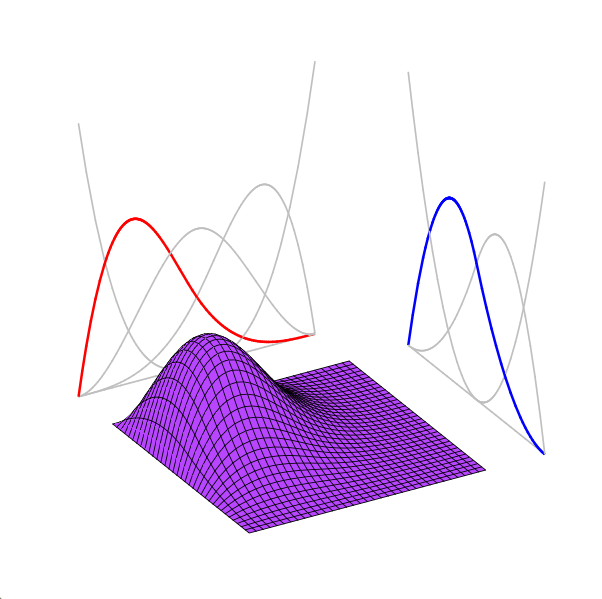
\(u(x) = \)
\(\text{Neural ansatz}\)
\(\text{Physics-based}\)
\(\text{Data-driven}\)
\(\text{Numerical simulation}\)
\(\text{Reduced Order Modeling}\)
\(\text{Neural ROMs}\)
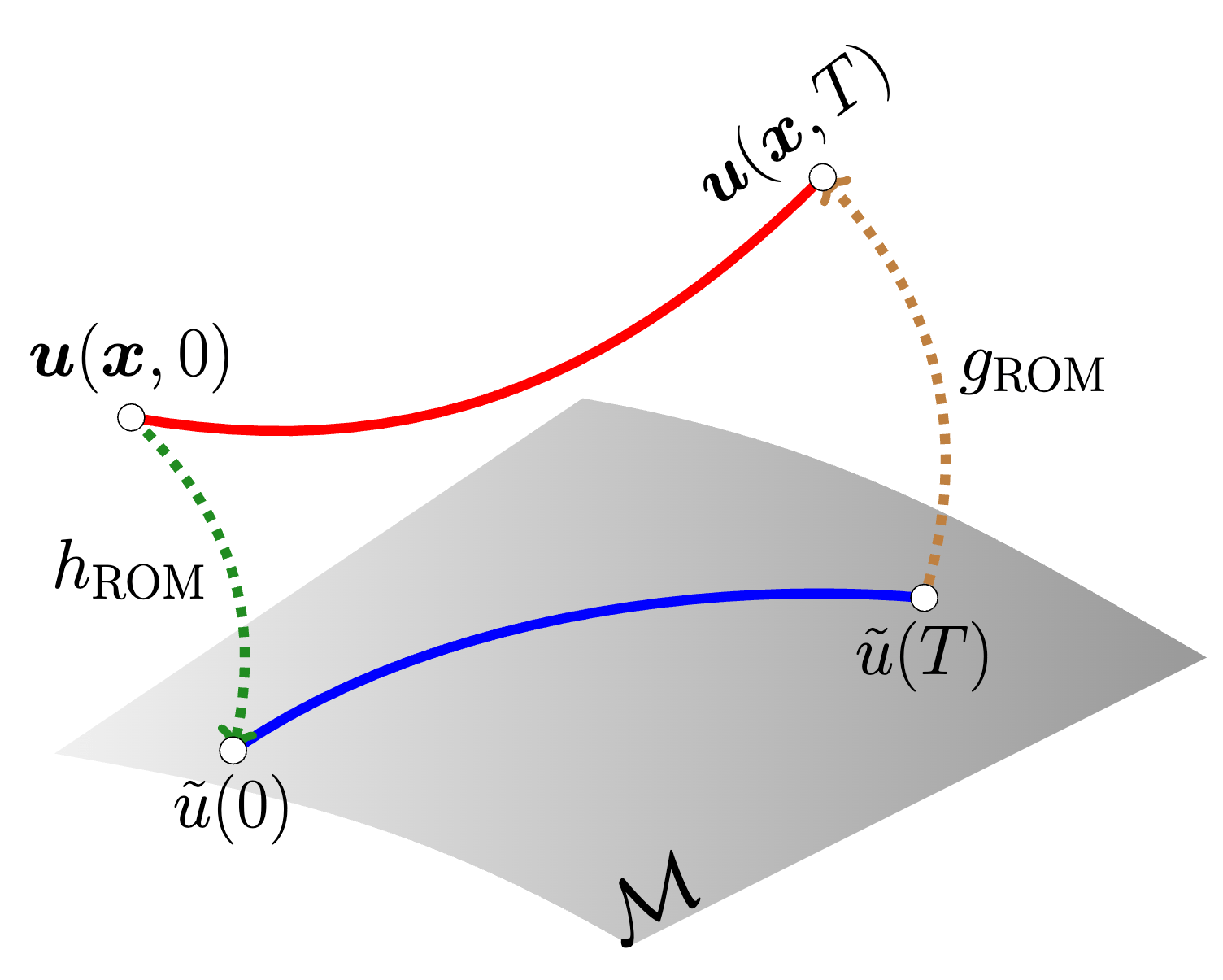
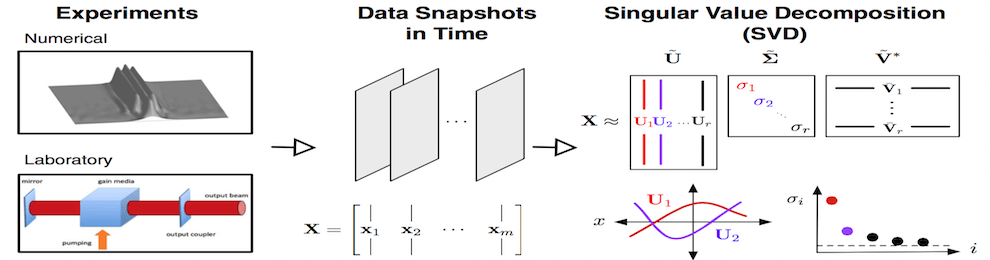
\(\text{Surrogate learning}\)
\(\text{Transformers}\)
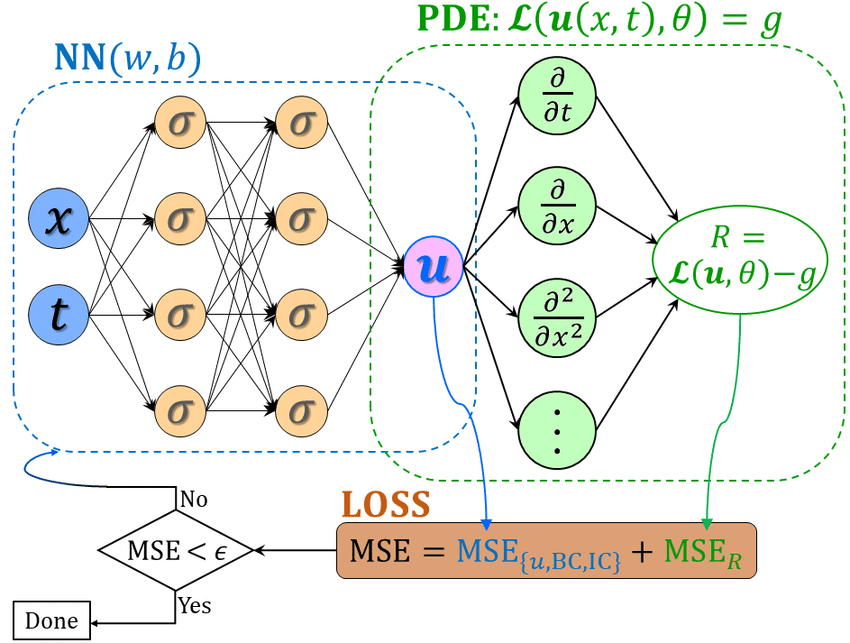
\(\text{PINNs}\)
\(\text{Finite Elements}\)
\(\text{PCA/POD}\)
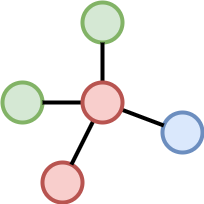
\(\text{Graph Networks}\)
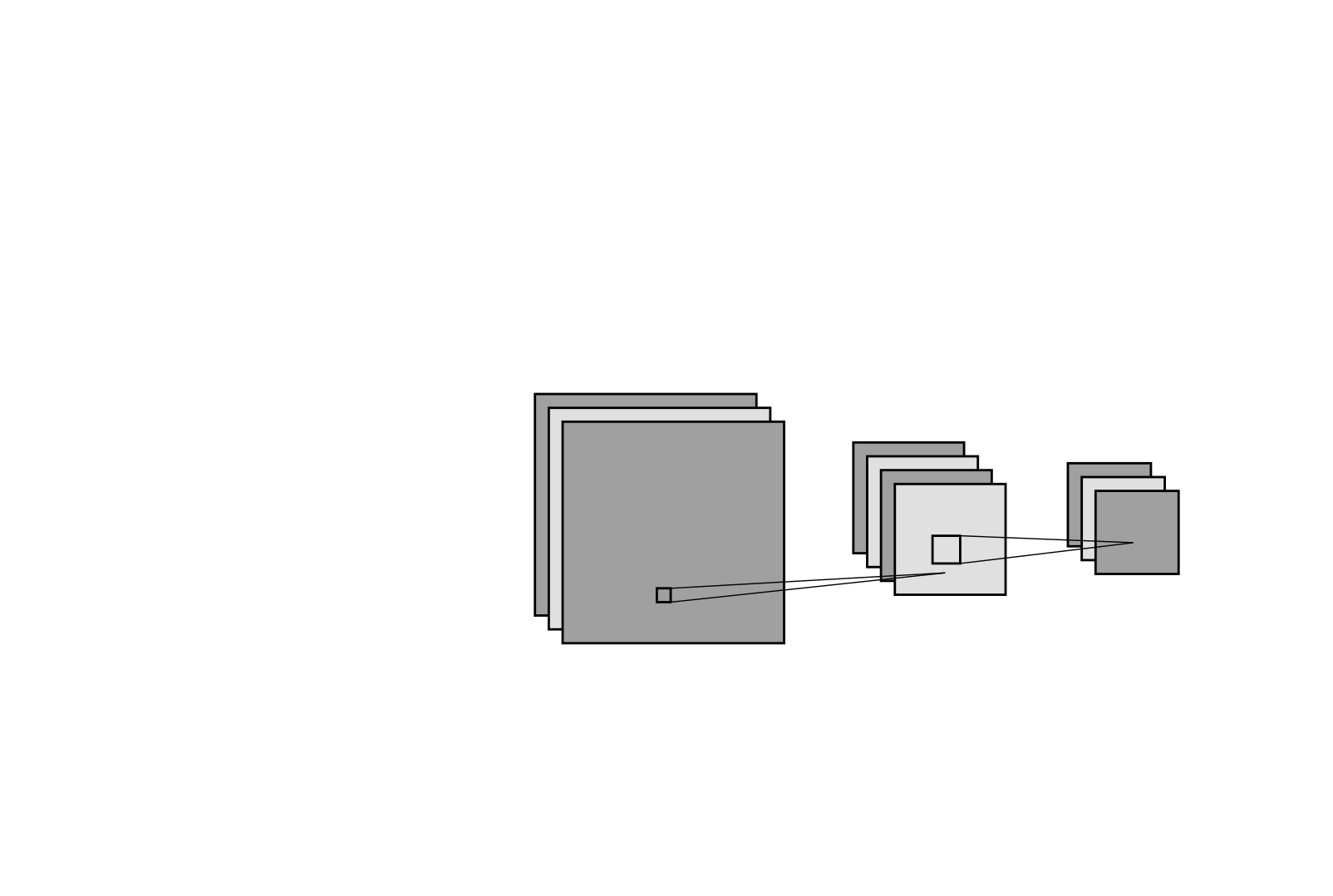
Landscape of data-driven methods in computational physics
Accelerate numerical solvers with neural ROMs
4
Efficient attention models for large-scale surrogate learning
[1]
[3]
[2]
[1] CFD Direct / OpenFOAM, “Introduction to Computational Fluid Dynamics”
[3] Kutz, J. N. “Data-Driven Modeling & Dynamical Systems” (UW)
[2] ResearchGate, “Schematic of a Vanilla Physics-Informed Neural Network”
Outline
Scalable low-rank attention for PDE surrogates
Neural Reduced Order Modeling
Low-rank attention with dynamic routing
5
Accelerate PDE solves with structure learned from data.
Replace simulation with solution operator learned from data.
Improved accuracy with smarter compression.
Neural Reduced Order Modeling
Accelerate simulations with structure learned from data.

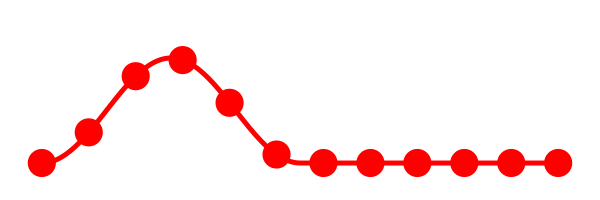
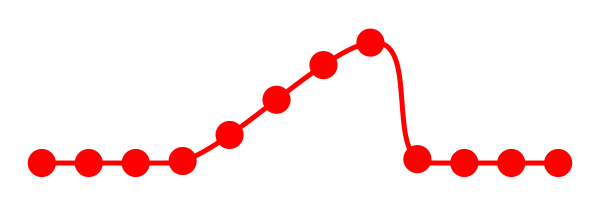
Background on model order reduction
6
Learn low-dimensional spatial representation with data + evolve with physics.
High-dimensional simulation data
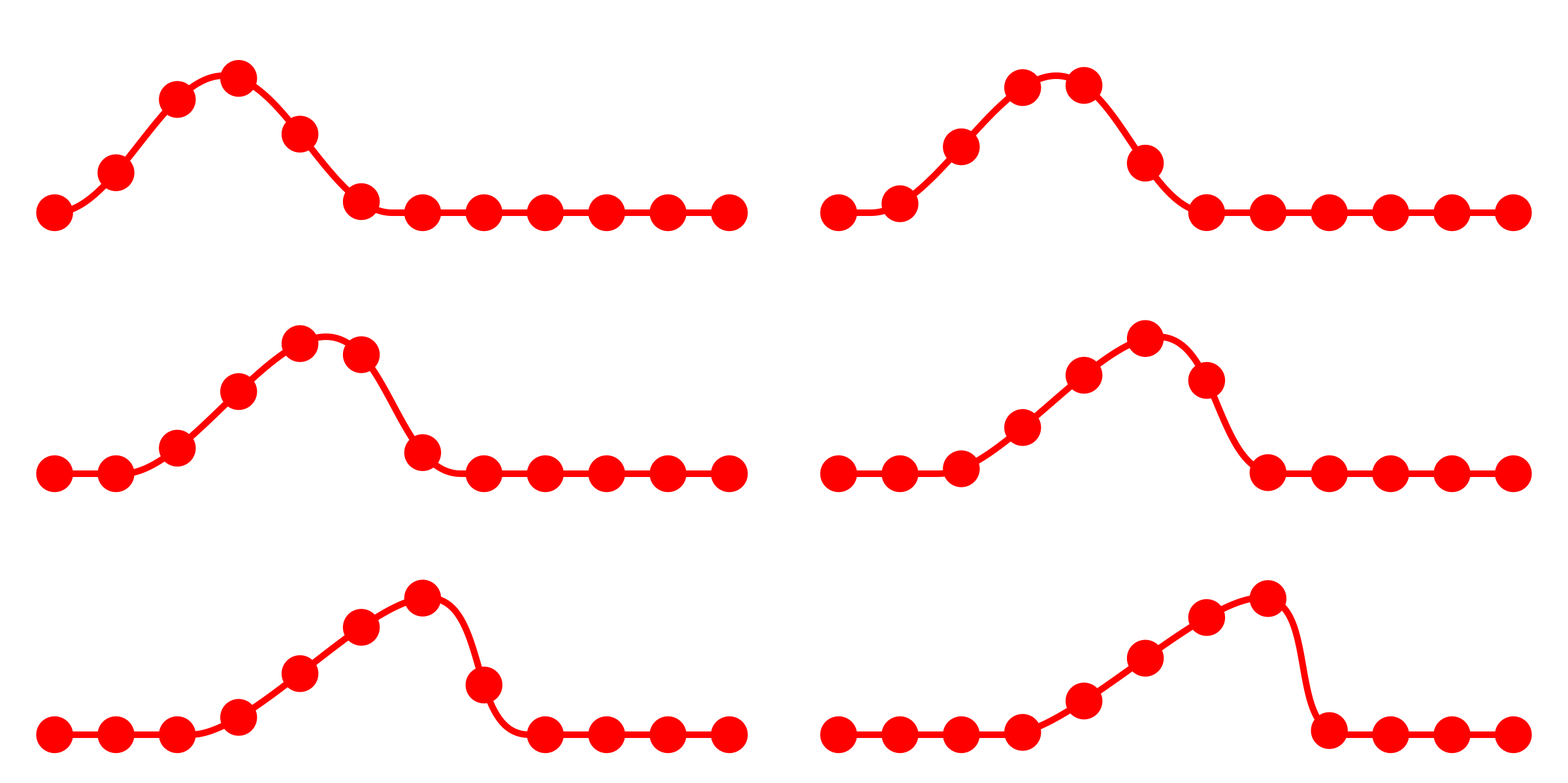
Collect and compress data
Evolve ODE on low-dim manifold
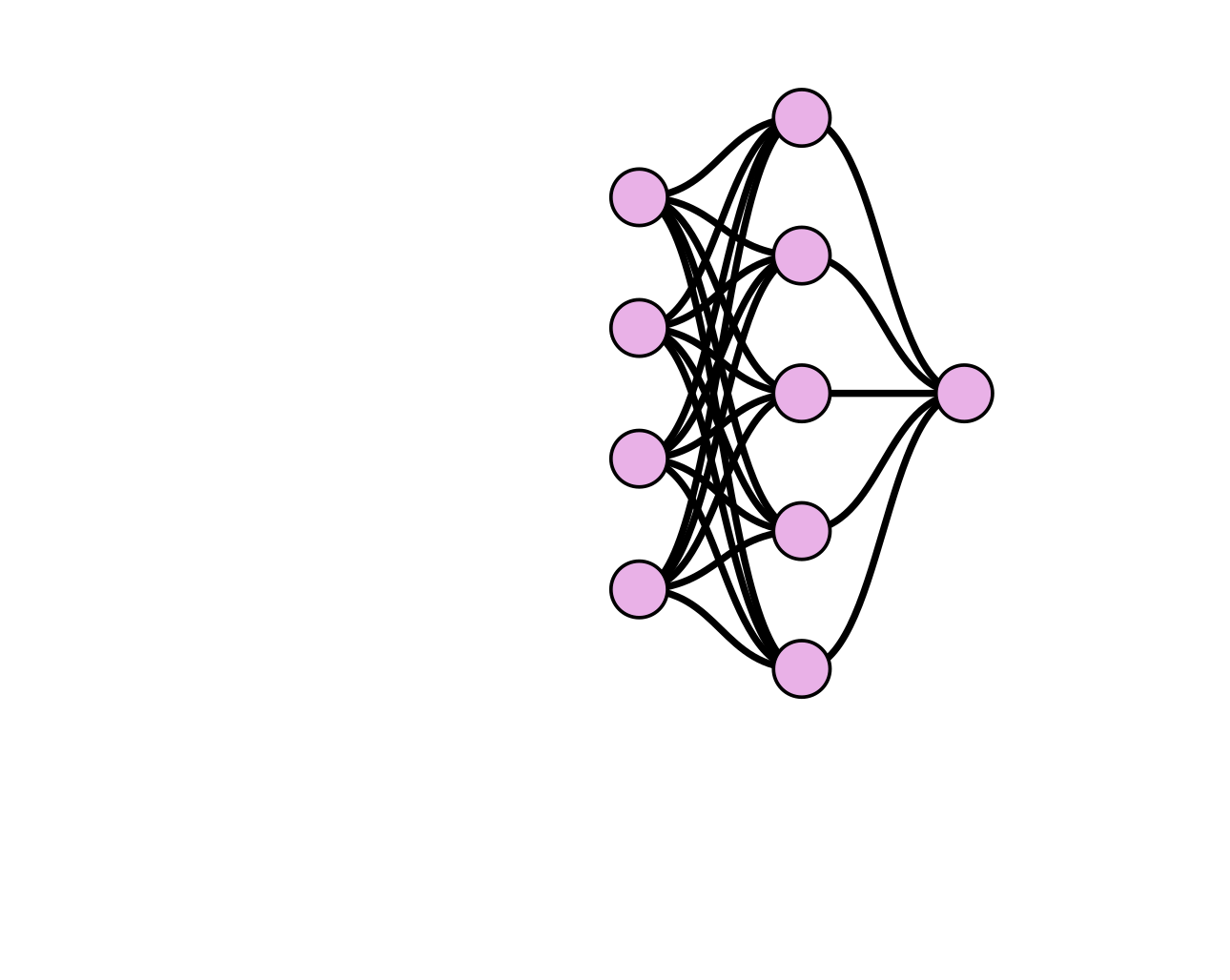
Cost savings from solving smaller ODE system.
We accelerate traveling shock problems with SNF-ROM
7
2D Viscous Burgers problem \( (\mathit{Re} = 1\text{k})\)
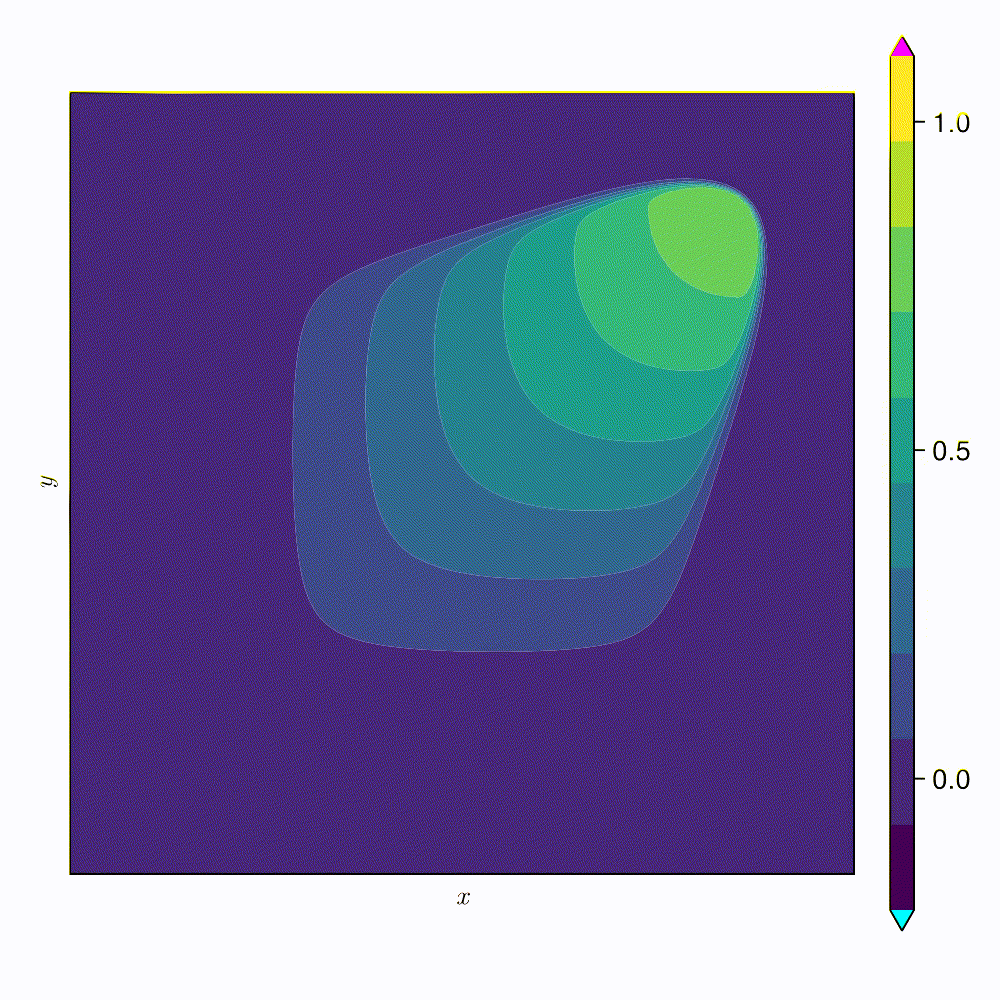
\(\text{Relative error: }0.37\%\)
\(\text{DoFs: }524~k \to 2\)
\(\text{Wall-time: }13.4~\text{s} \to 0.068~\text{s}\)
Large deviations!
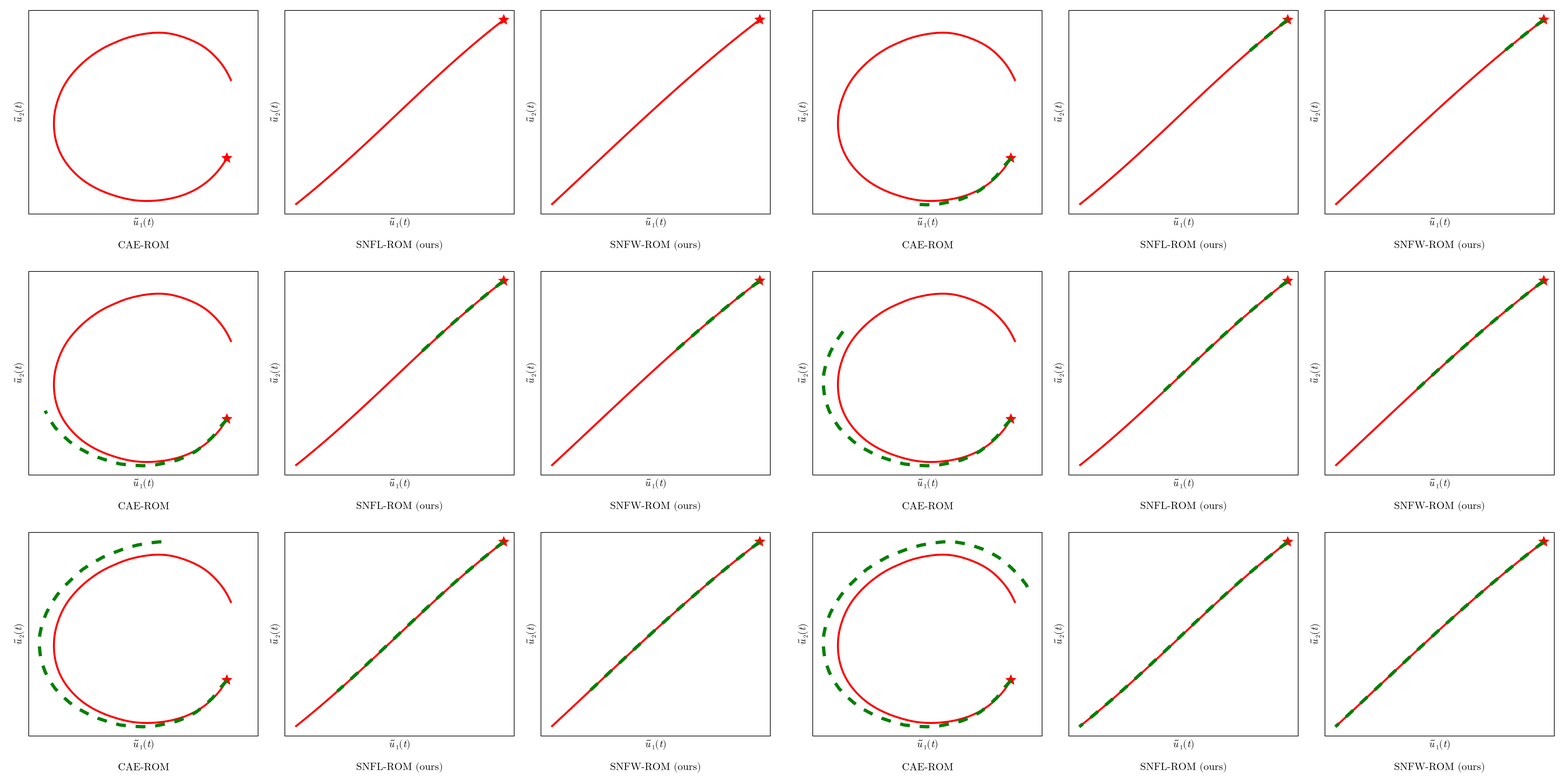
Learning smooth latent space trajectories
\(\text{Autoencoder ROM}\)
Evolution of ROM states (intrinsic perspective)
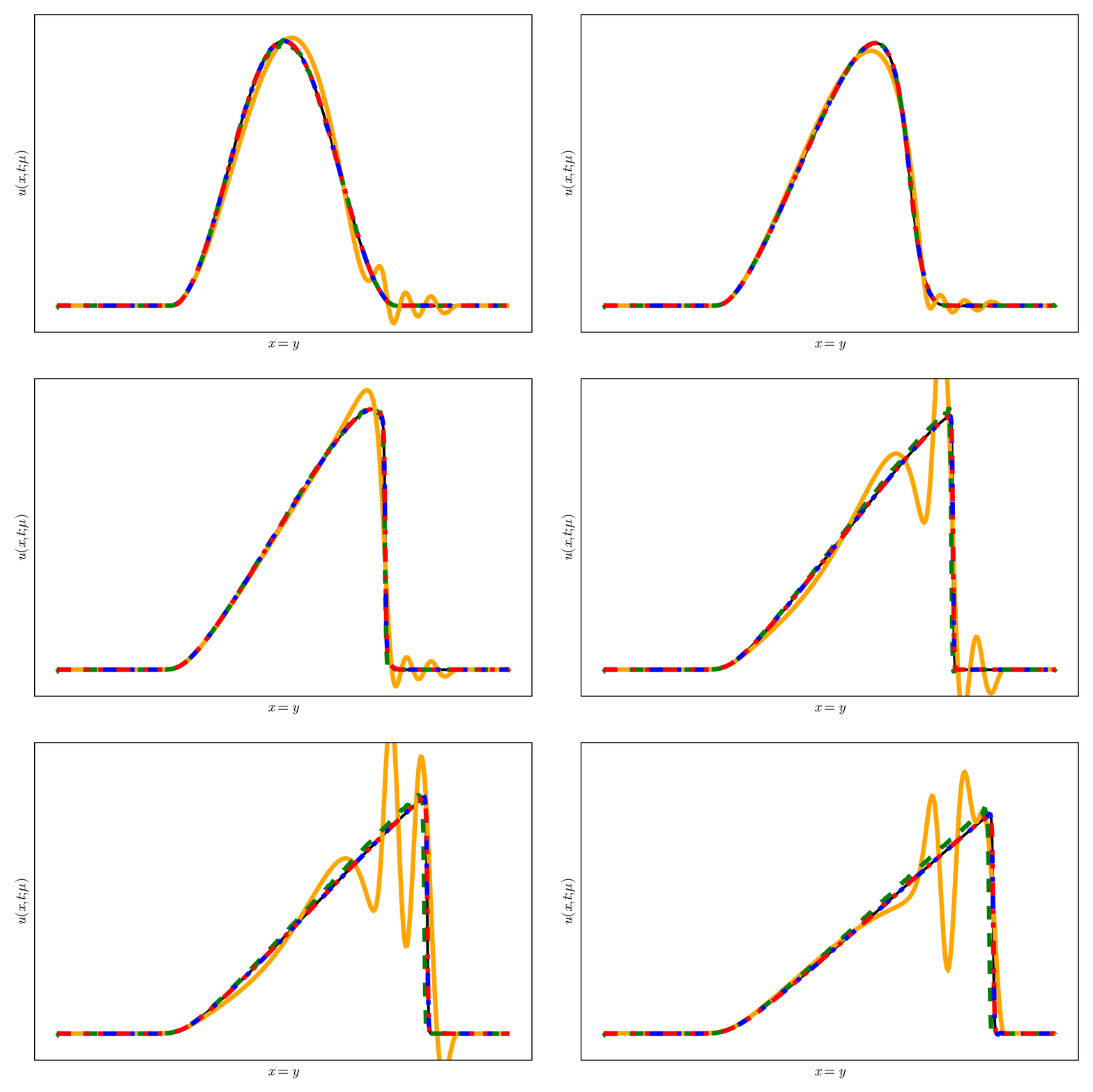
SNF-ROM ensures accurate online dynamics evaluation.
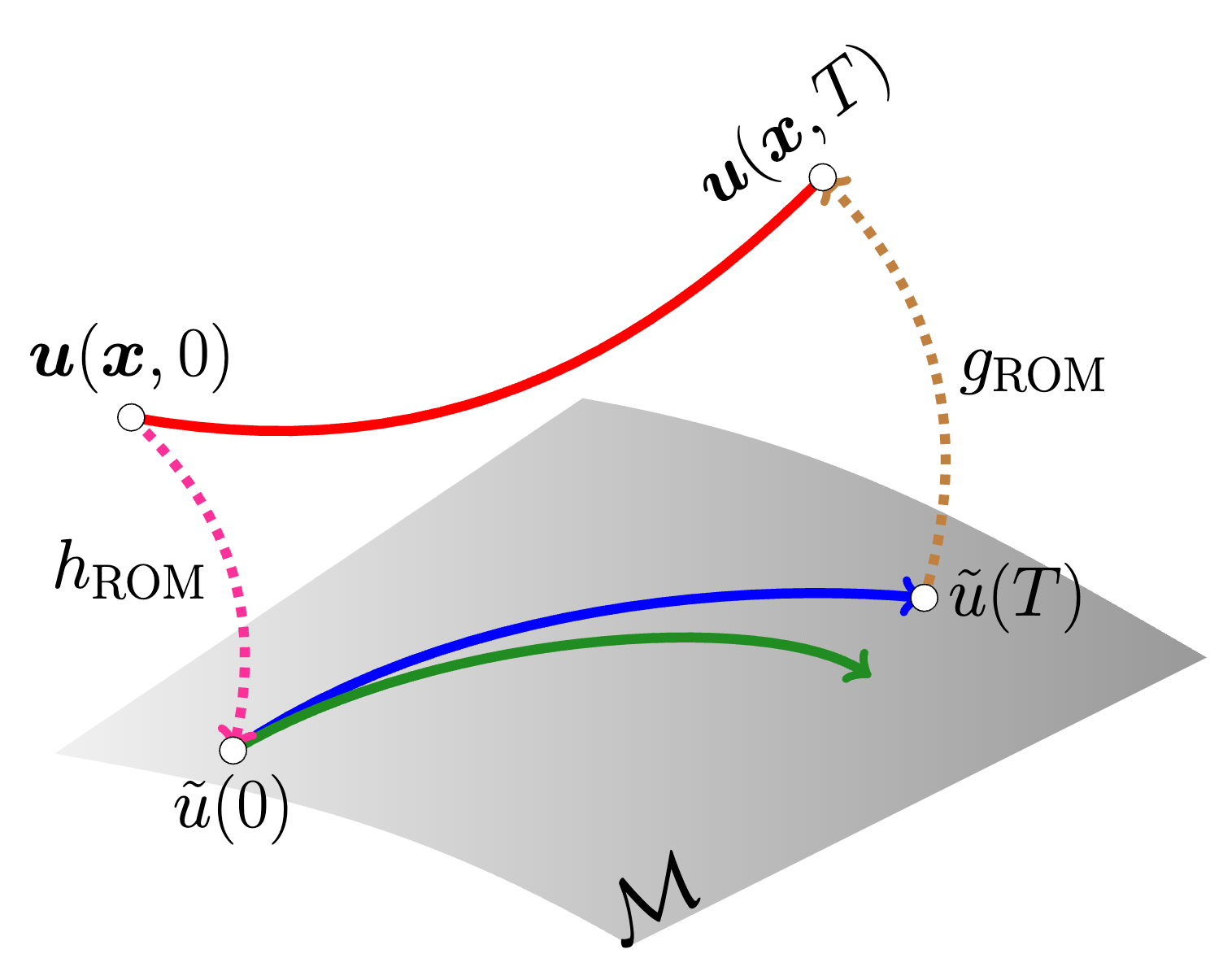
Smooth neural field ROM (SNF-ROM)
- Robust & non-intrusive online evaluation
- Grid-independent ROM: \(\partial_x\) through autodiff
- Speedup through extreme hyper-reduction
We accelerate traveling shock problems with SNF-ROM
7
2D Viscous Burgers problem \( (\mathit{Re} = 1\text{k})\)
\(\text{Relative error: }0.37\%\)
\(\text{DoFs: }524~k \to 2\)
\(\text{Wall-time: }13.4~\text{s} \to 0.068~\text{s}\)
High freq. noise
Non-differentiable!
Accurately capture of dynamics with smooth neural fields
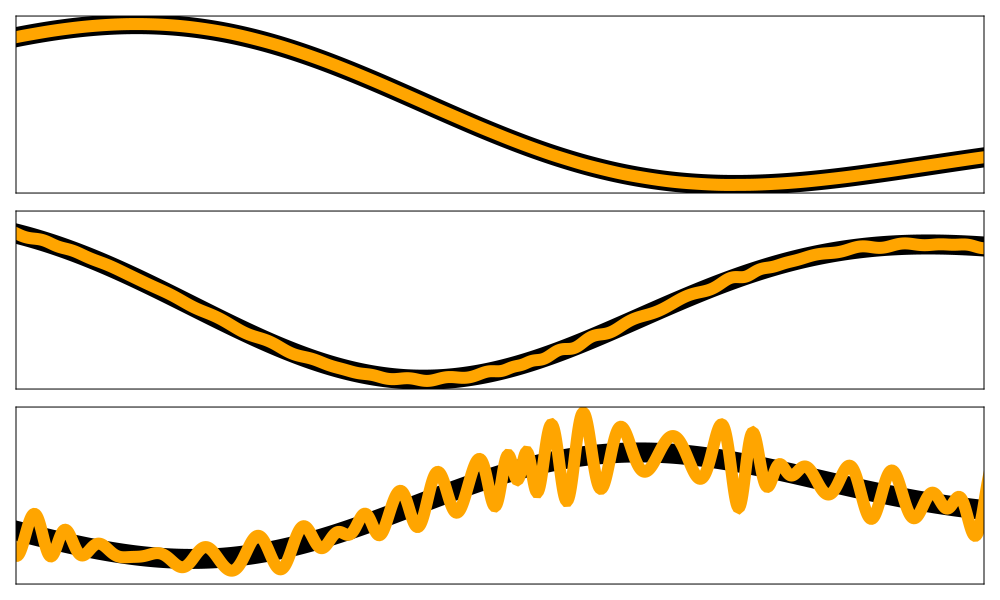
Large deviations!
Learning smooth latent space trajectories
\(\text{Autoencoder ROM}\)
\(\text{SNF-ROM}\)
Evolution of ROM states (intrinsic perspective)
No deviation
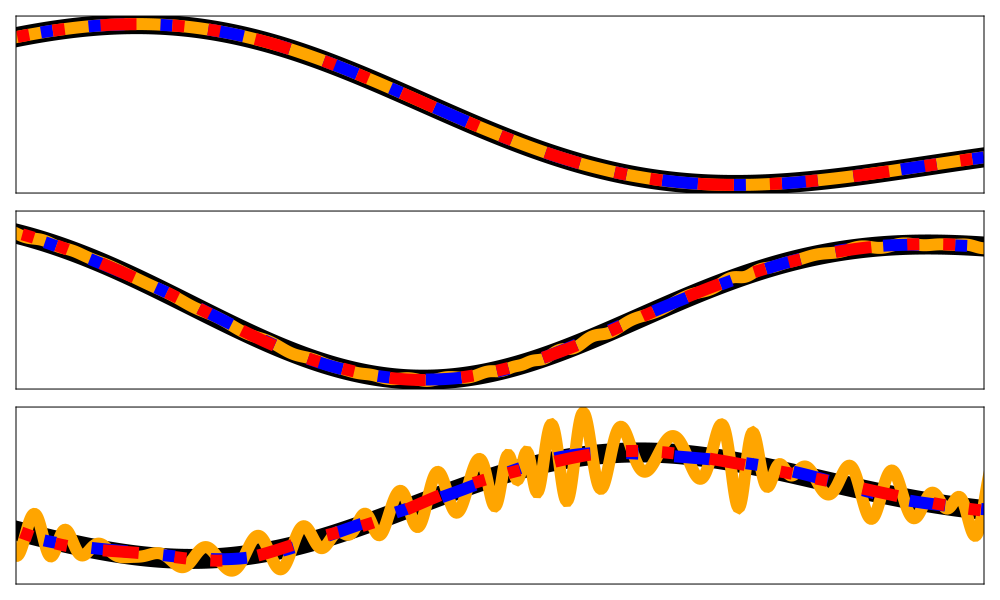
SNF-ROM ensures accurate online dynamics evaluation.
Accurate capture of dynamics
Smooth neural field ROM (SNF-ROM)
- Robust & non-intrusive online evaluation
- Grid-independent ROM: \(\partial_x\) through autodiff
- Speedup through extreme hyper-reduction
Our contributions
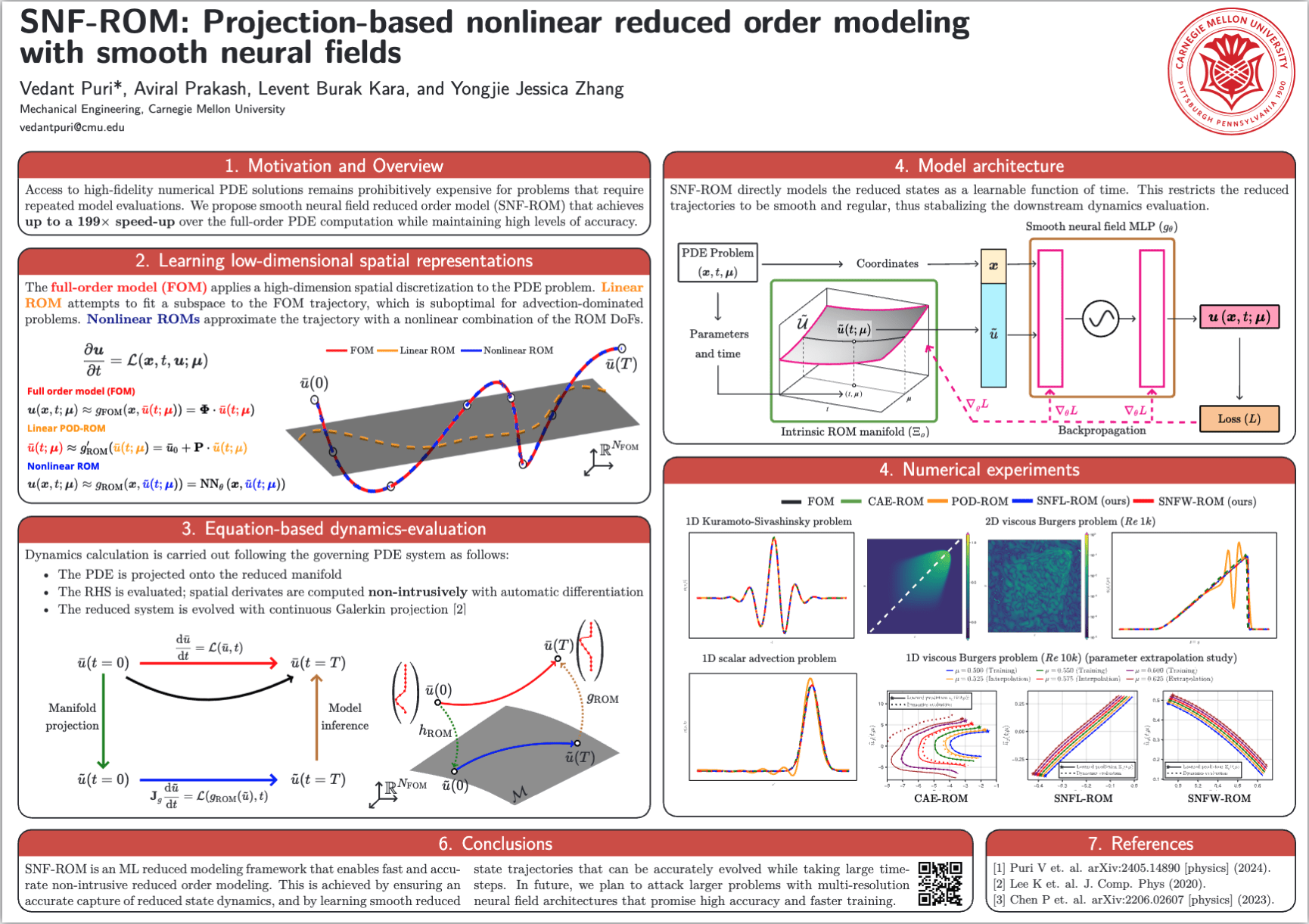
We demonstrate numerical simulation with neural ansatz
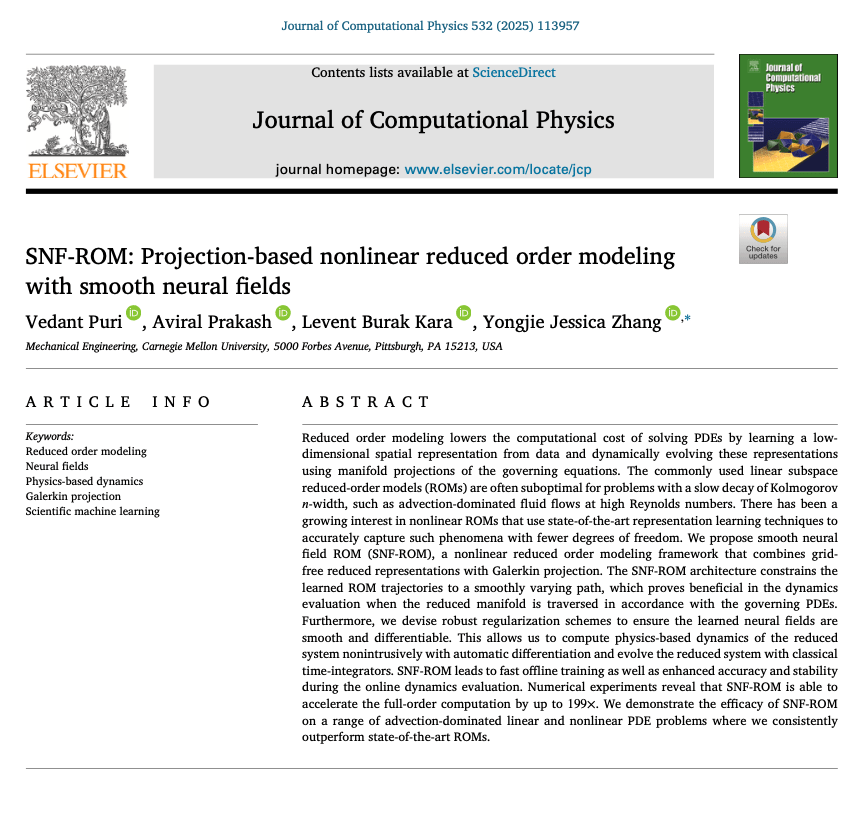
Won poster award at World Conf. Comp. Mech. 2024
Published in Journal of Comp. Phys.
8
- Non-intrusive
- Grid-free ROM
- Compatible with hyper-reduction
- Maintains accuracy with large \(\Delta t\)
Scalable low-rank attention for PDE surrogates
Surrogate models learn PDE solution operator from data
9
Solution operator: dense, global
Forward operator: sparse, local
Every point depends on every other
Transformers enable global communication
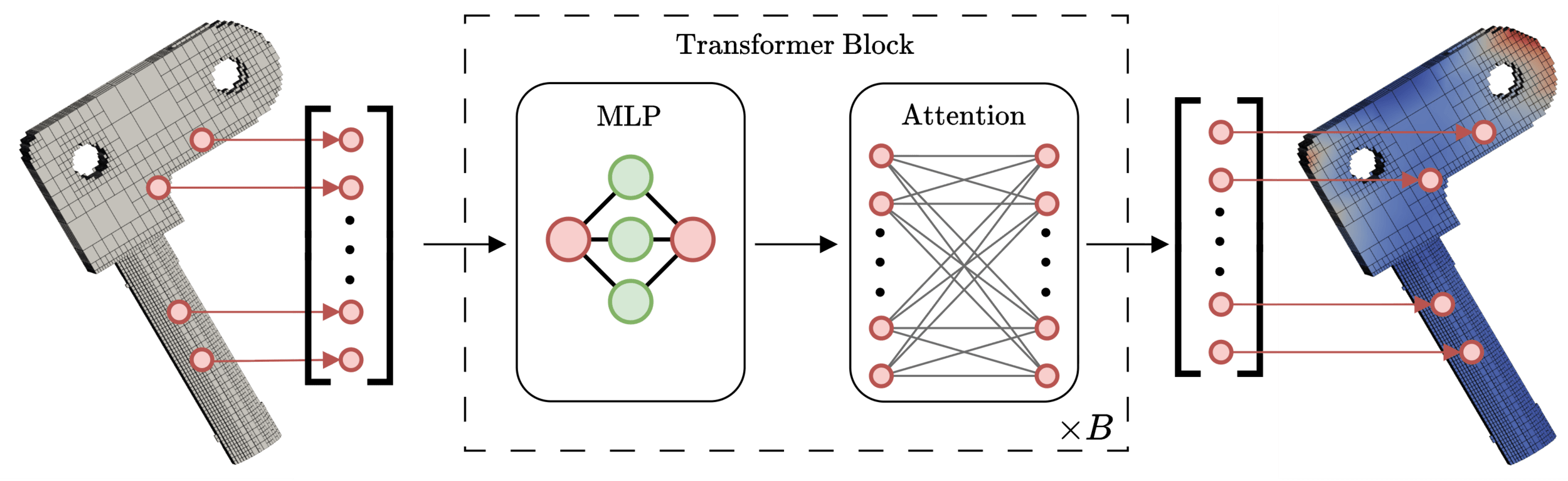
Message-passing on a dynamic all-to-all graph
[1] Vaswani et al. — “Attention Is All You Need”, NeurIPS 2017
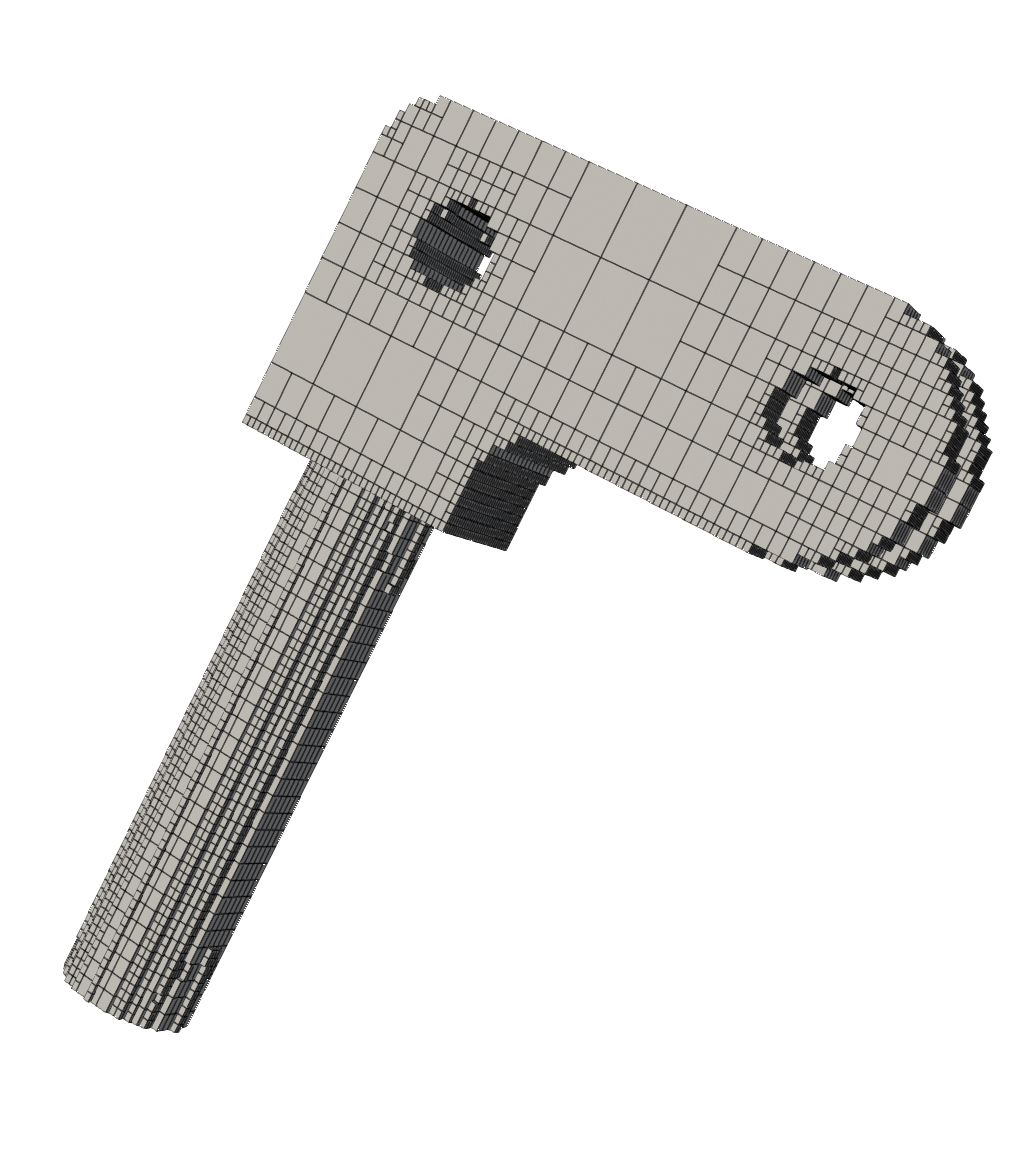
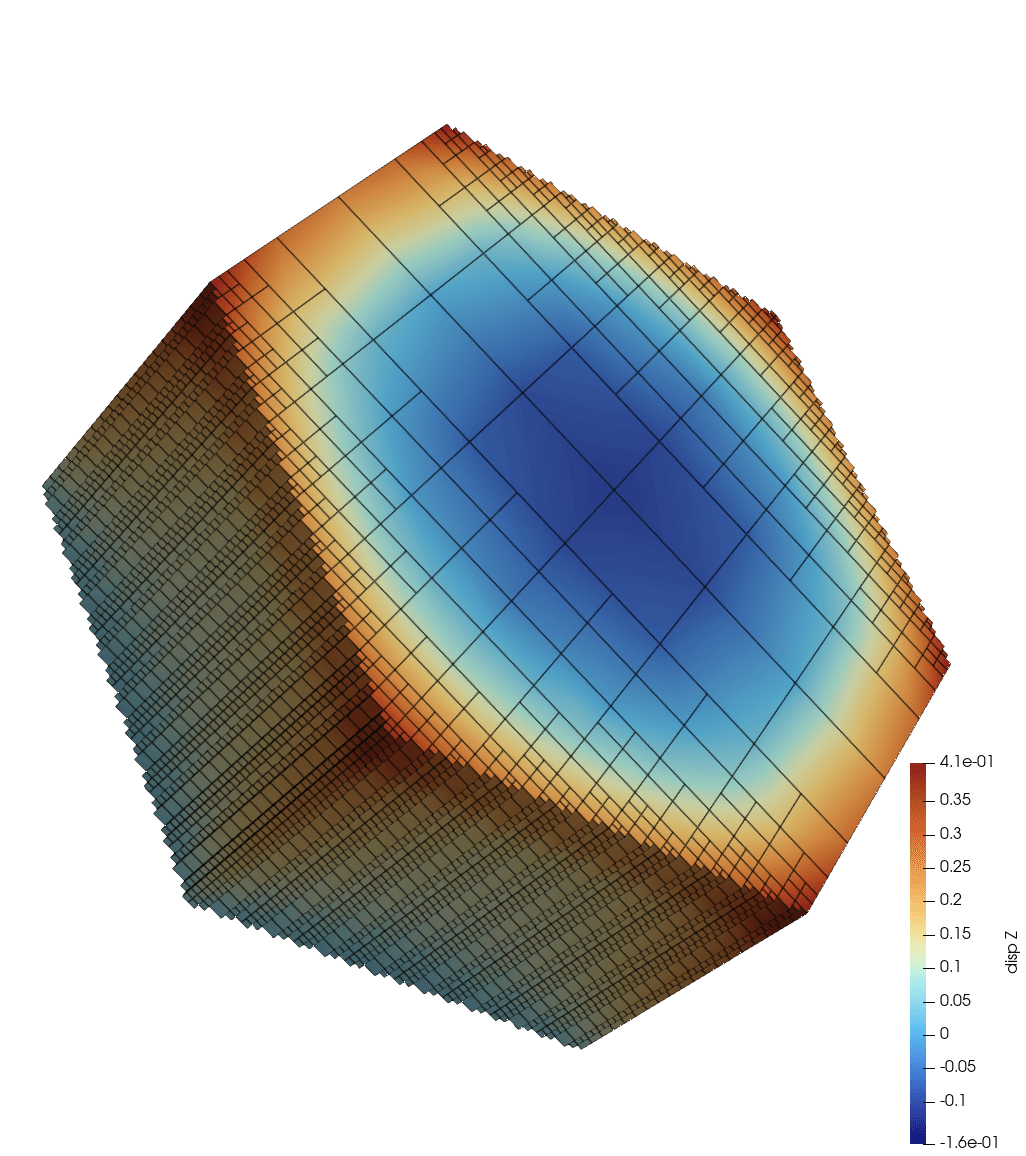
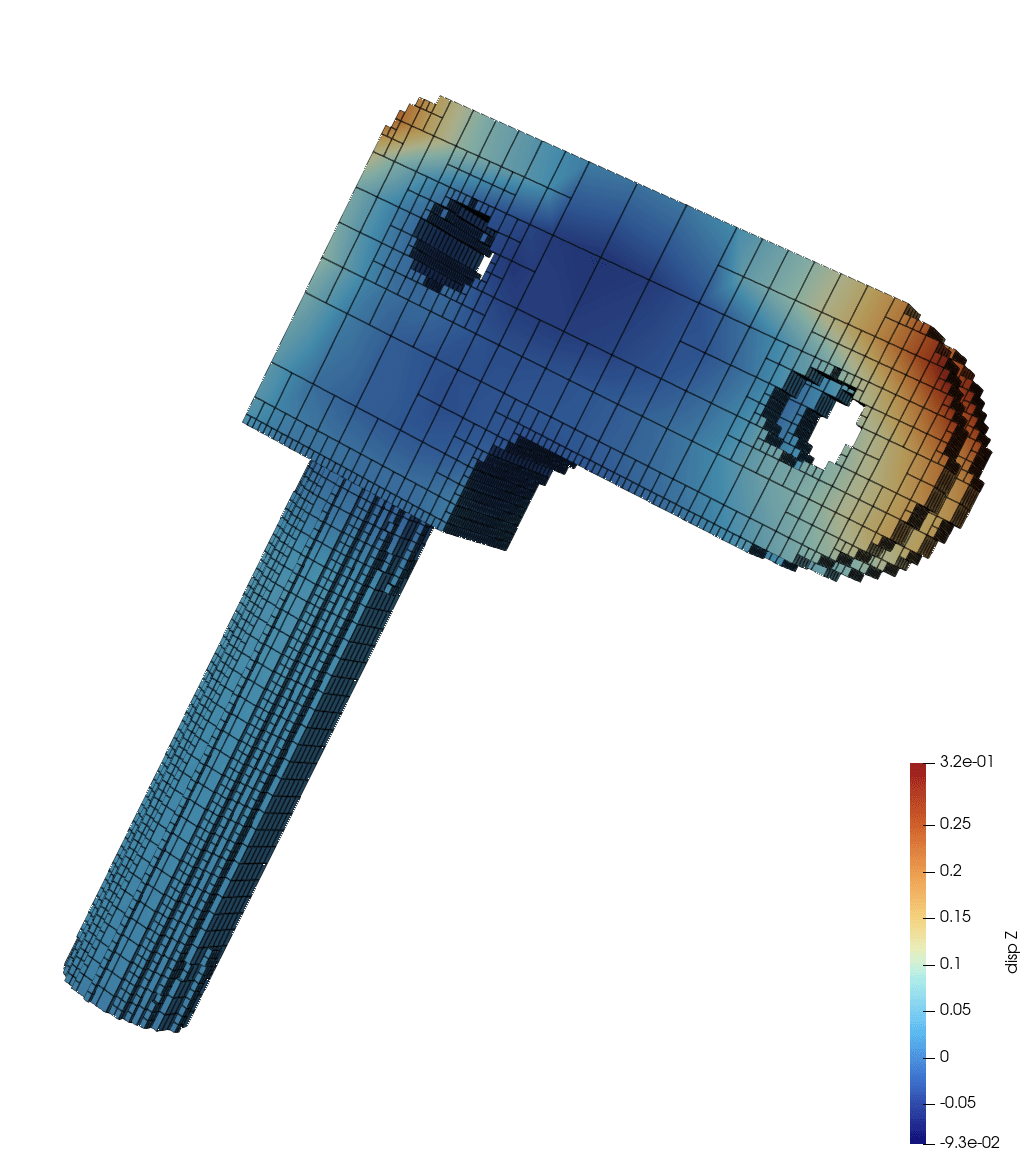
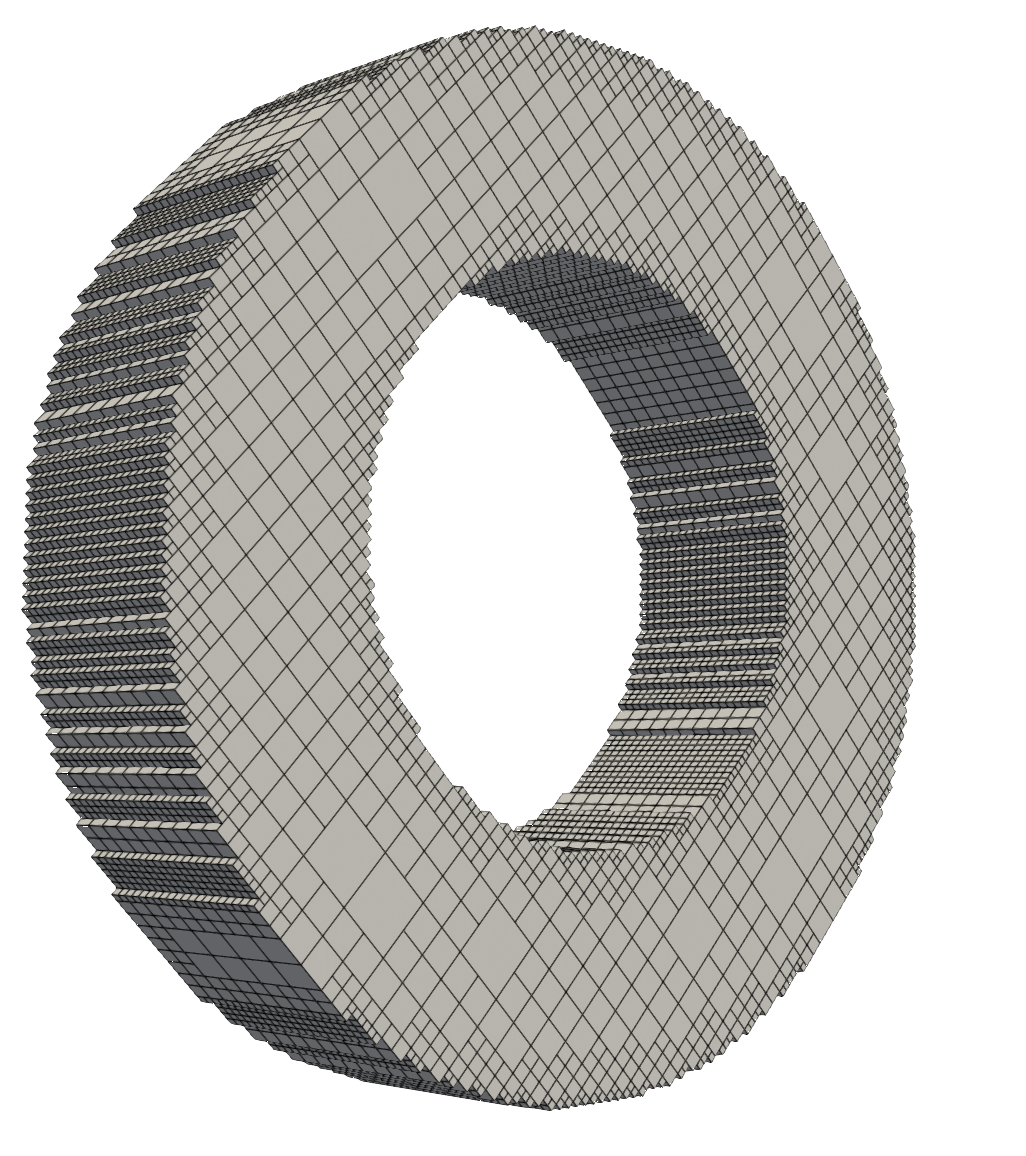
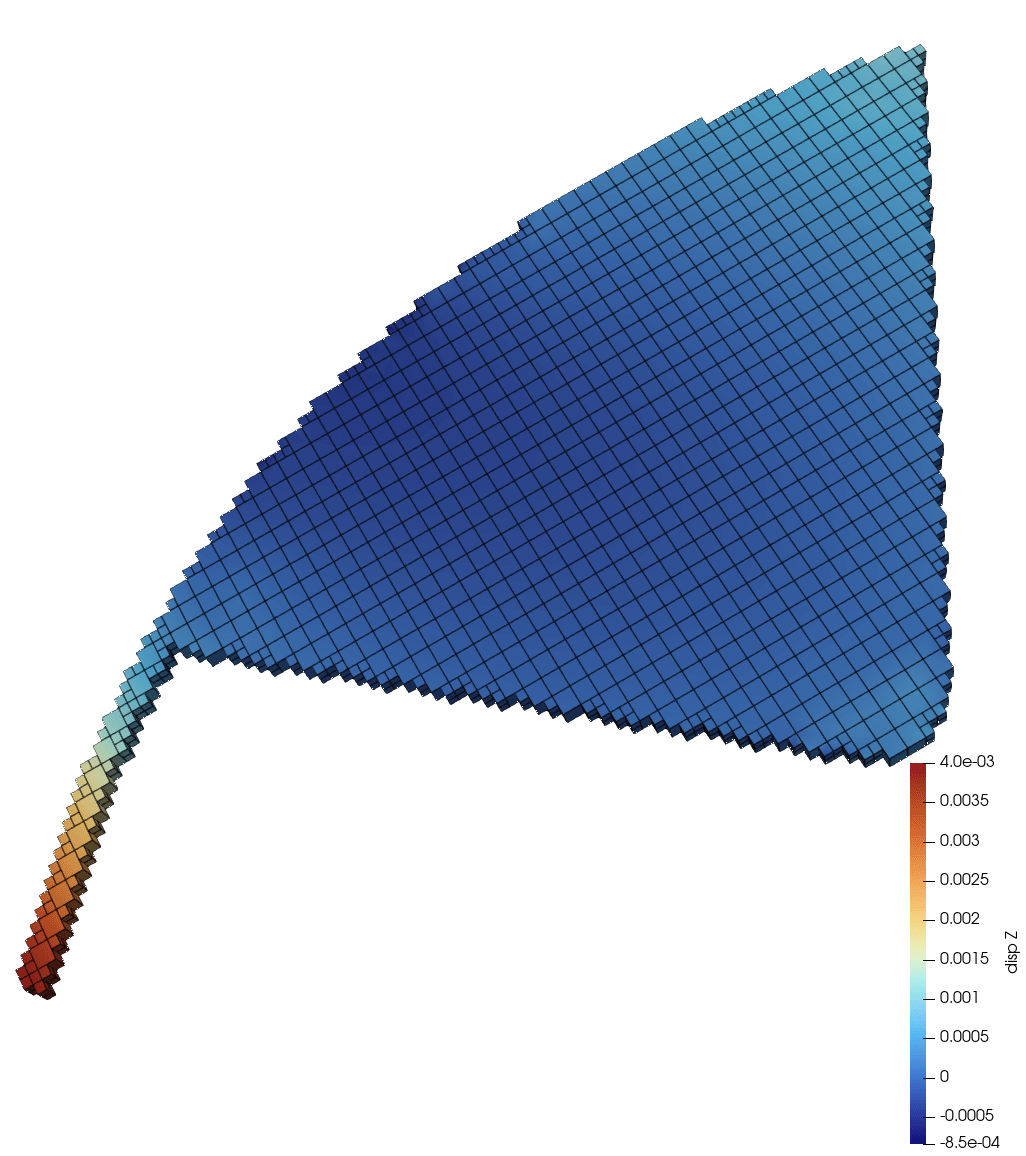
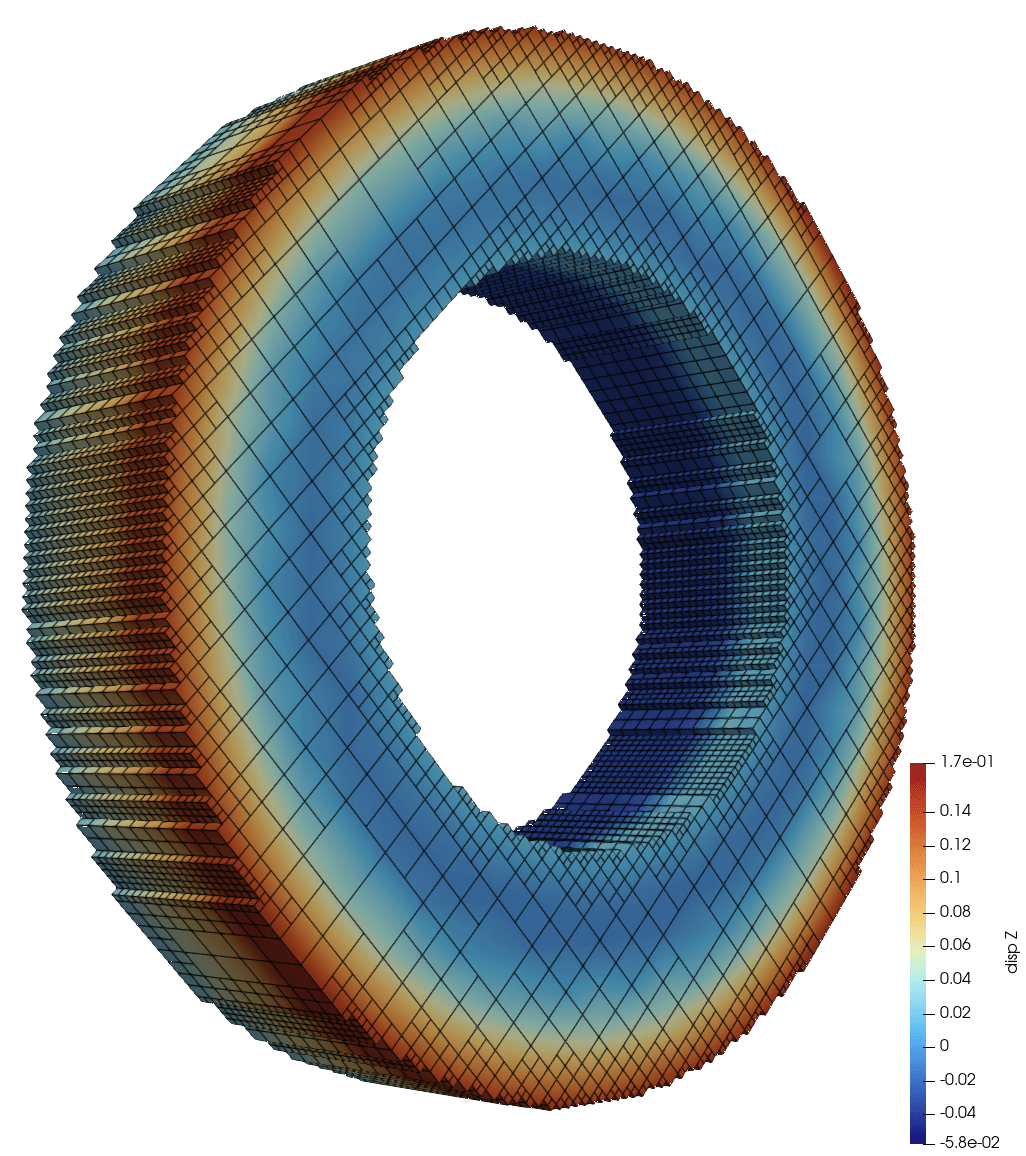
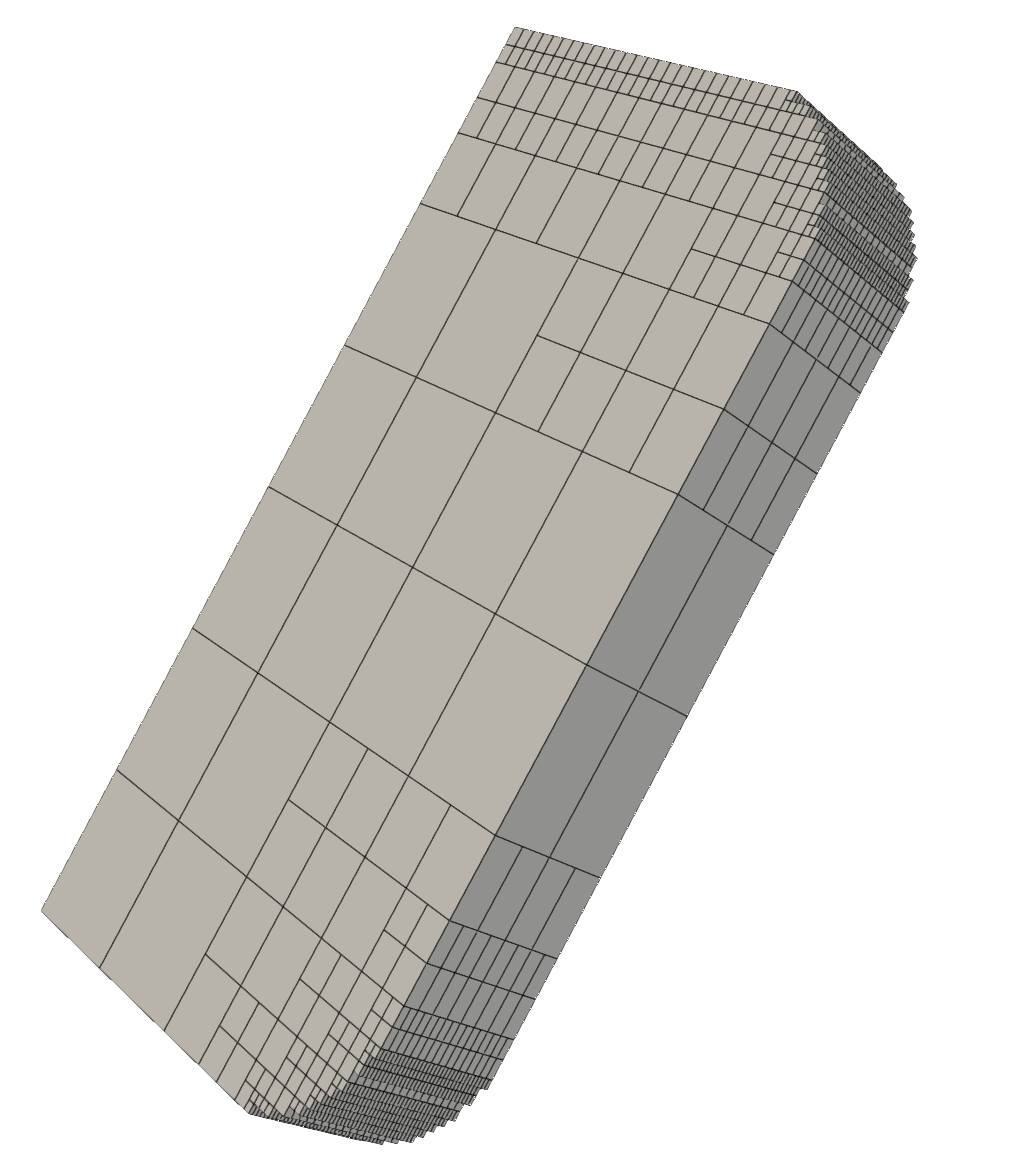
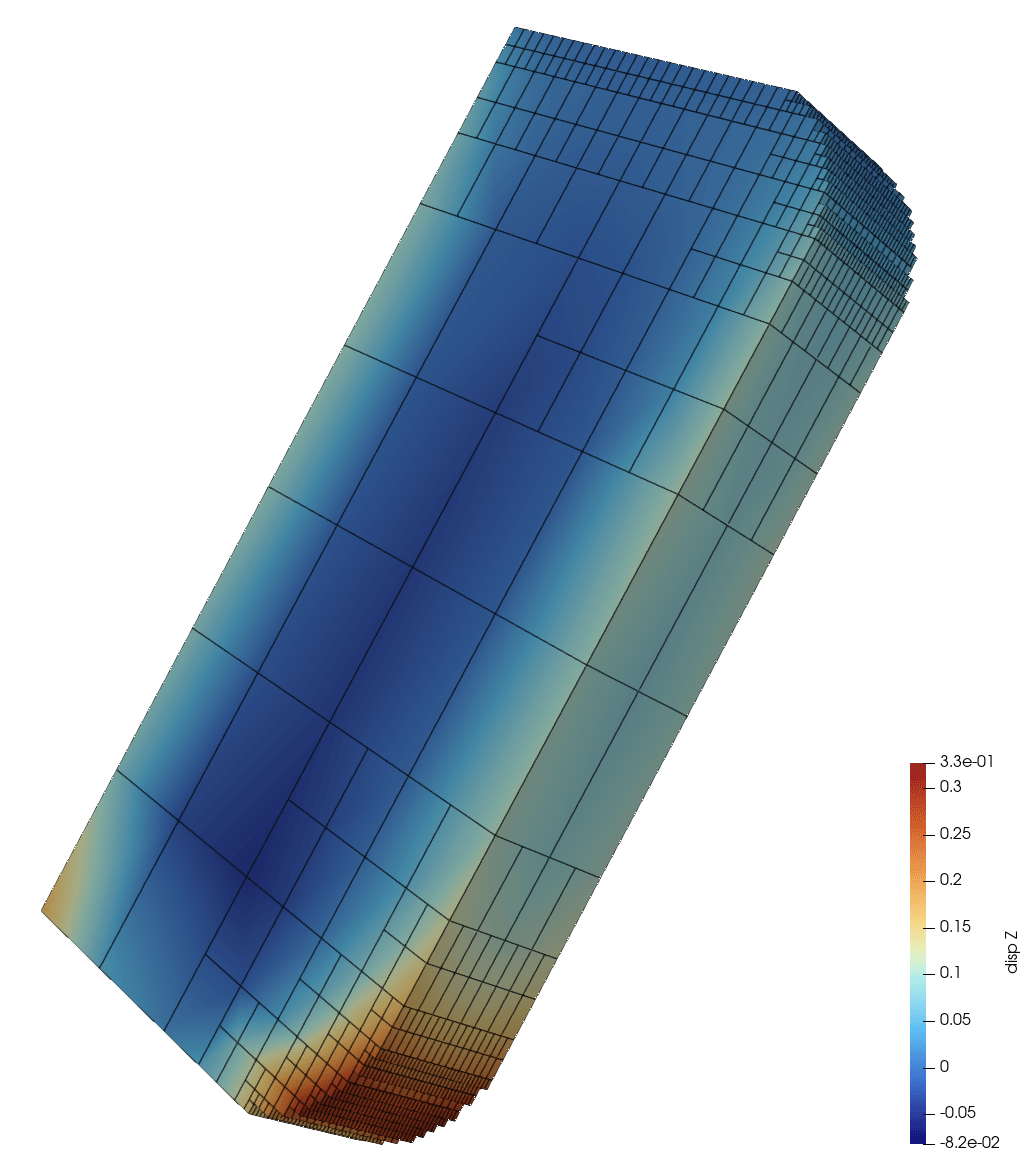
What are the communication requirements of solution operators?
Surrogate models learn PDE solution operator from data
9
[1] Vaswani et al. — “Attention Is All You Need”, NeurIPS 2017
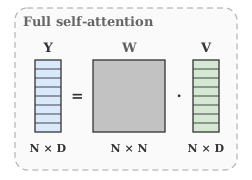
A_{NxN} * u_{Nx1} = f_{Nx1}
u = A ^{-1}_{NxN} * f
u_{Nx1} = NN(f_{Nx1})
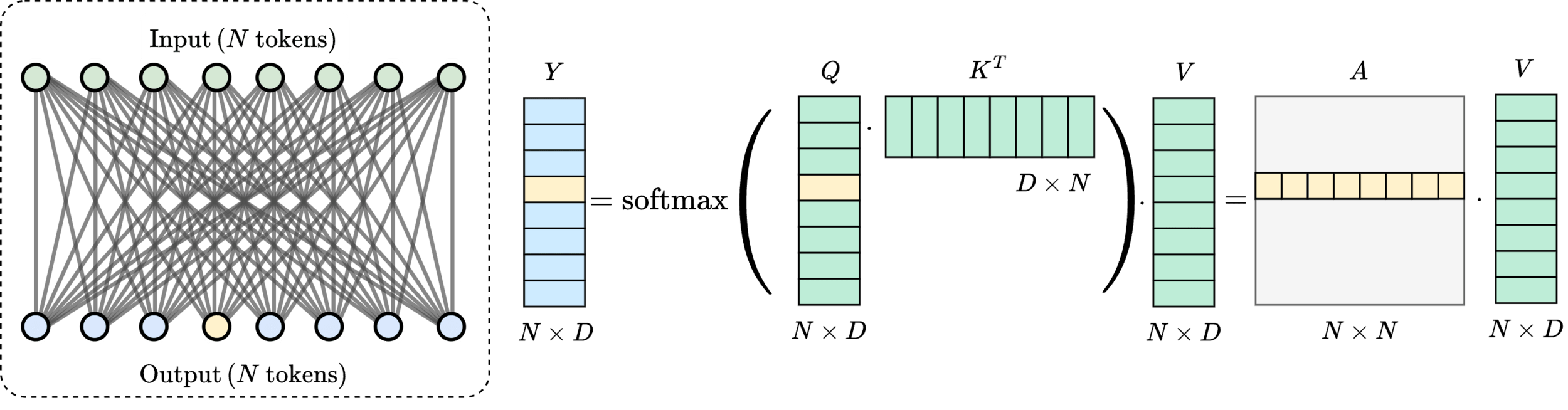
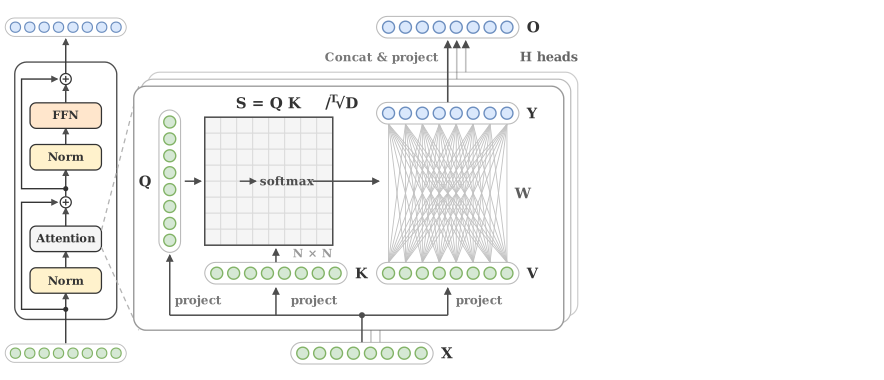
(Q(f)_{Nx1} * K(f)_{Nx1}^T)_{NxN} * V(f)_{Nx1}
Attention produces a dynamic all-to-all graph
10
Infeasible for large problems
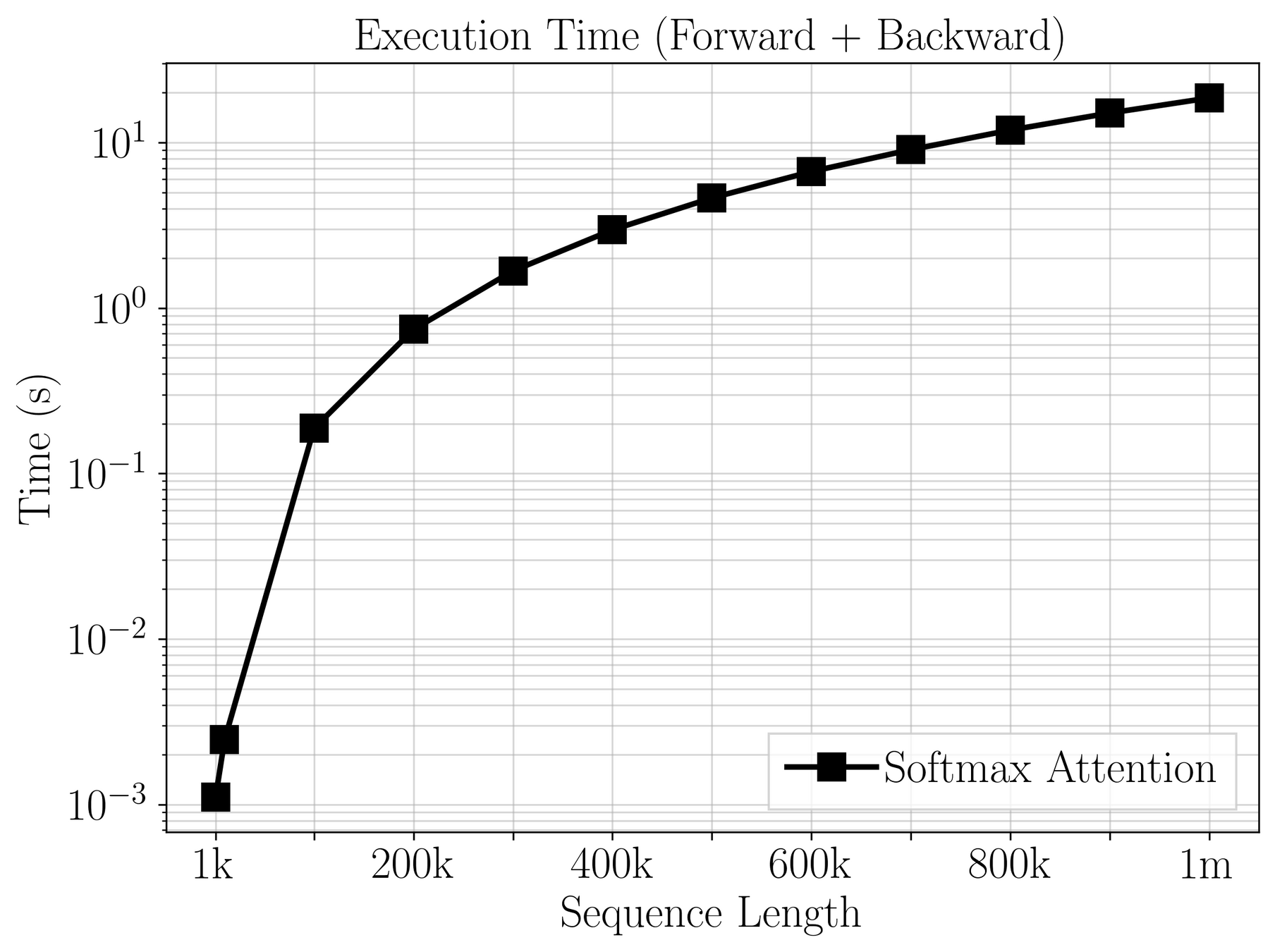
Over \(20~\text{s}\) per gradient step on 1M points!
Graph weights determined by dot-product scores \(S_{m,n}=q_m^T \cdot k_n\).
Every \(\textcolor{blue}{\text{output token}}\) produces a probability distribution over \(\textcolor{green}{\text{inputs}}\).
[1] Vaswani et al. — “Attention Is All You Need”, NeurIPS 2017
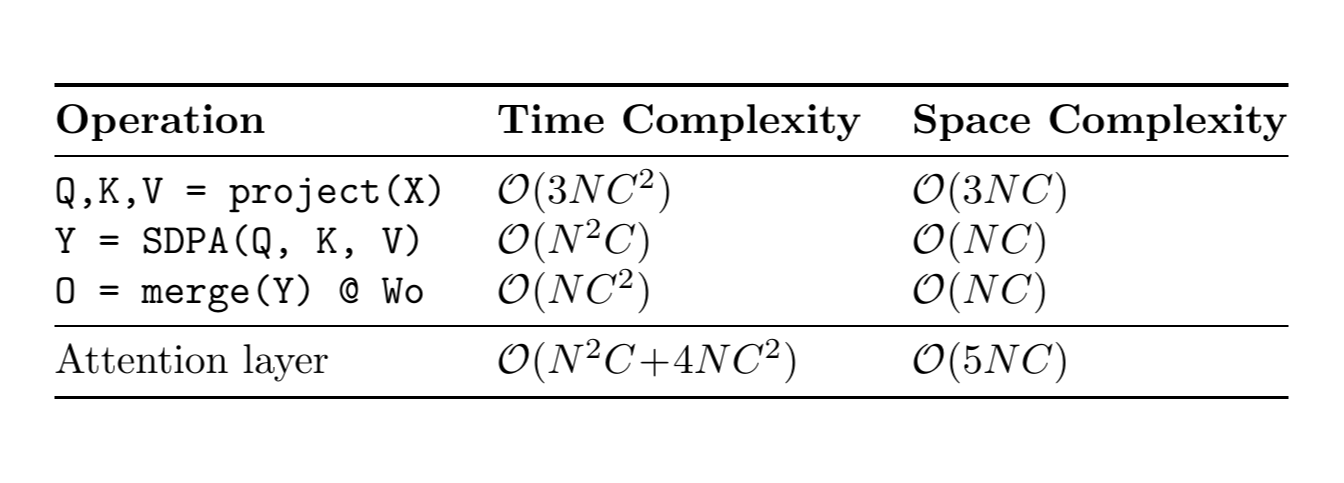
\(\mathcal{O}(N^2)\) cost of attention limits scalability
Motivation behind latent space attention
11
Smoothness implies redundancy in communication
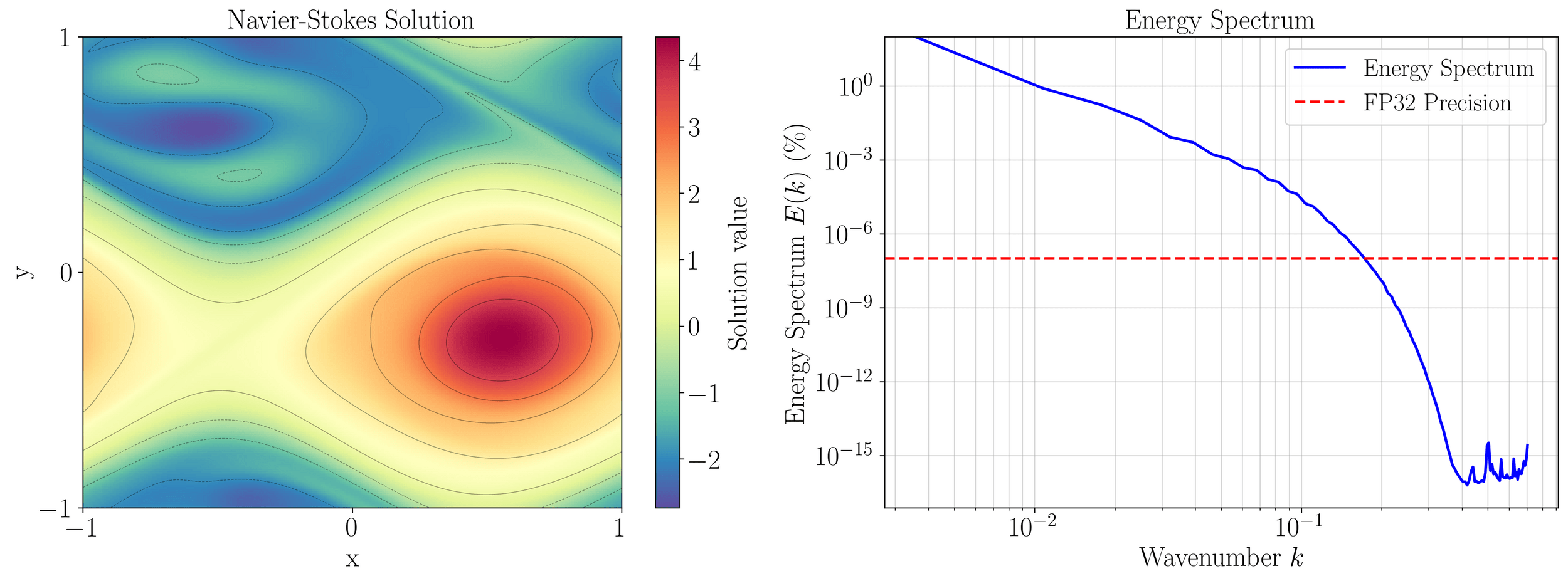
\(\text{Fully-resolved flow-field}\)
Motivation behind latent space attention
11
Smoothness implies redundancy in communication
\(\text{Fully-resolved flow-field}\)
Motivation behind latent space attention
11
Smoothness implies redundancy in communication
Method: club matching points to one cluster and communicate together
\(\text{Fully-resolved flow-field}\)
\(\mathcal{O}(2MN) \ll \mathcal{O}(N^2)\)
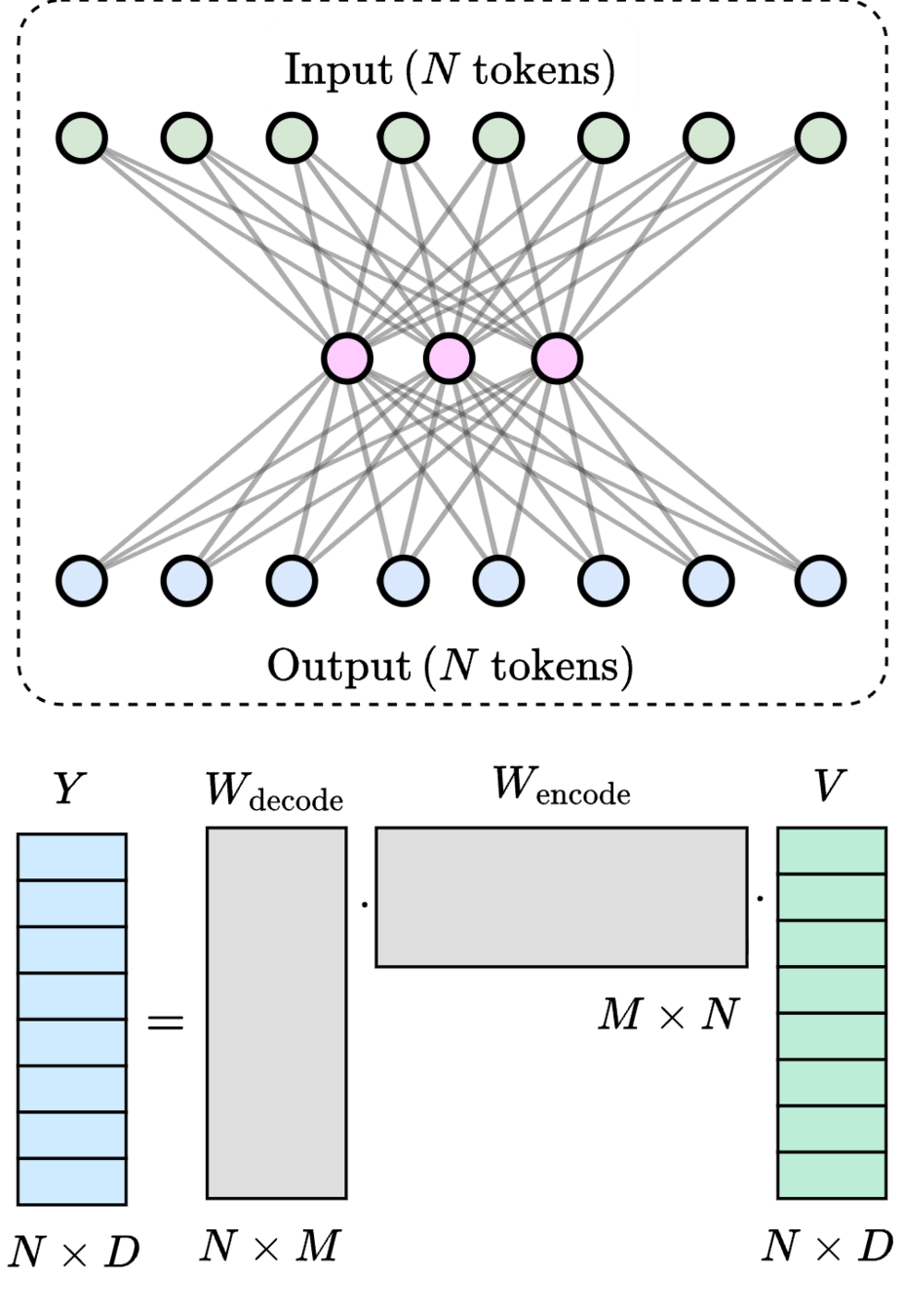
Our approach: Identify matching tokens with dot-product similarity against learned latents
12
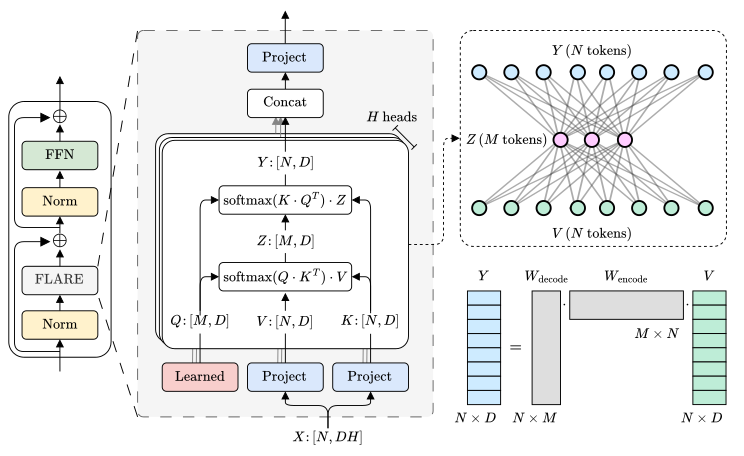
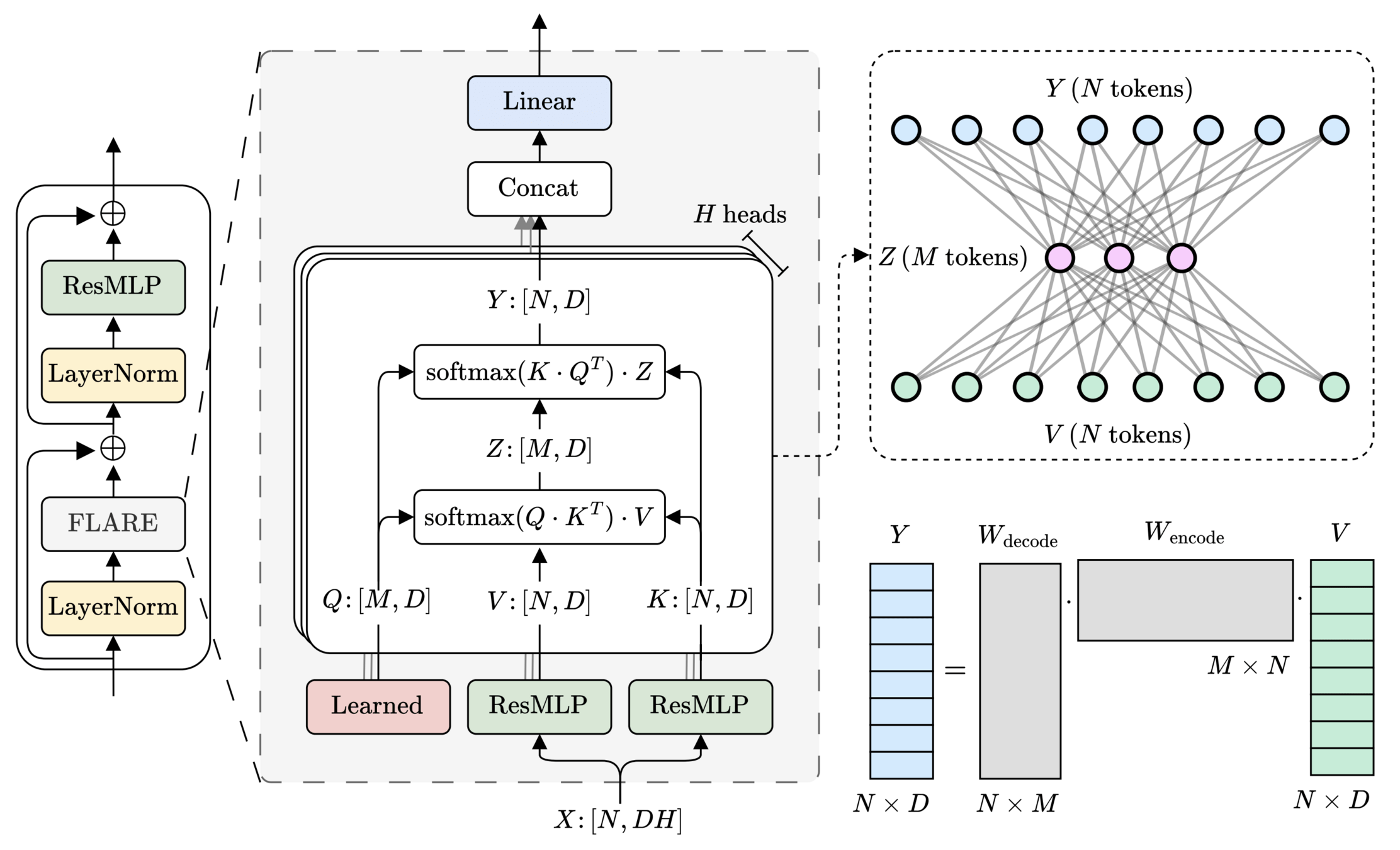
Encoding: introduce \(M\) latent clusters to pool messages from matching tokens
\(M\) learned queries
Decoding: map pooled messages to matching output tokens
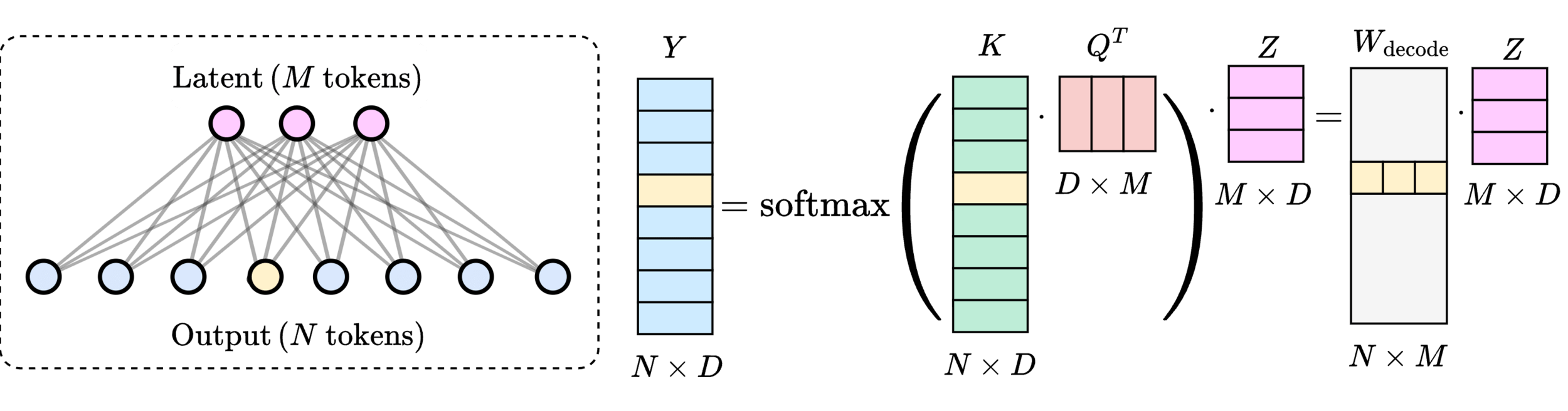
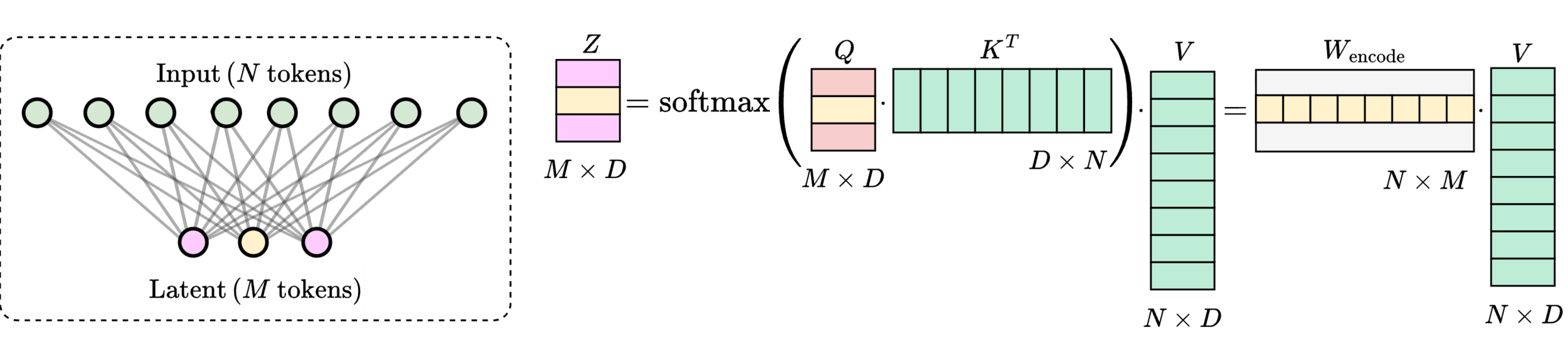
Our model: FLARE (Fast Low-rank Attention Routing Engine)
13
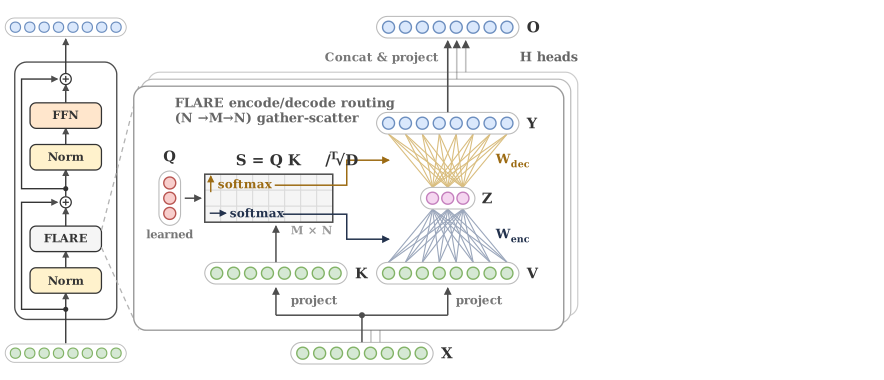
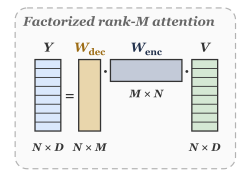
Encoding/decoding through dot-product scores against learned latents.
We use fused attention kernels.
Score matrix never truly materialized.
FLARE is an encode/decode
latent-space attention mechanism.
Latent-space-attention can effect factorized low-rank self-attention.
Background on latent-space attention methods
14
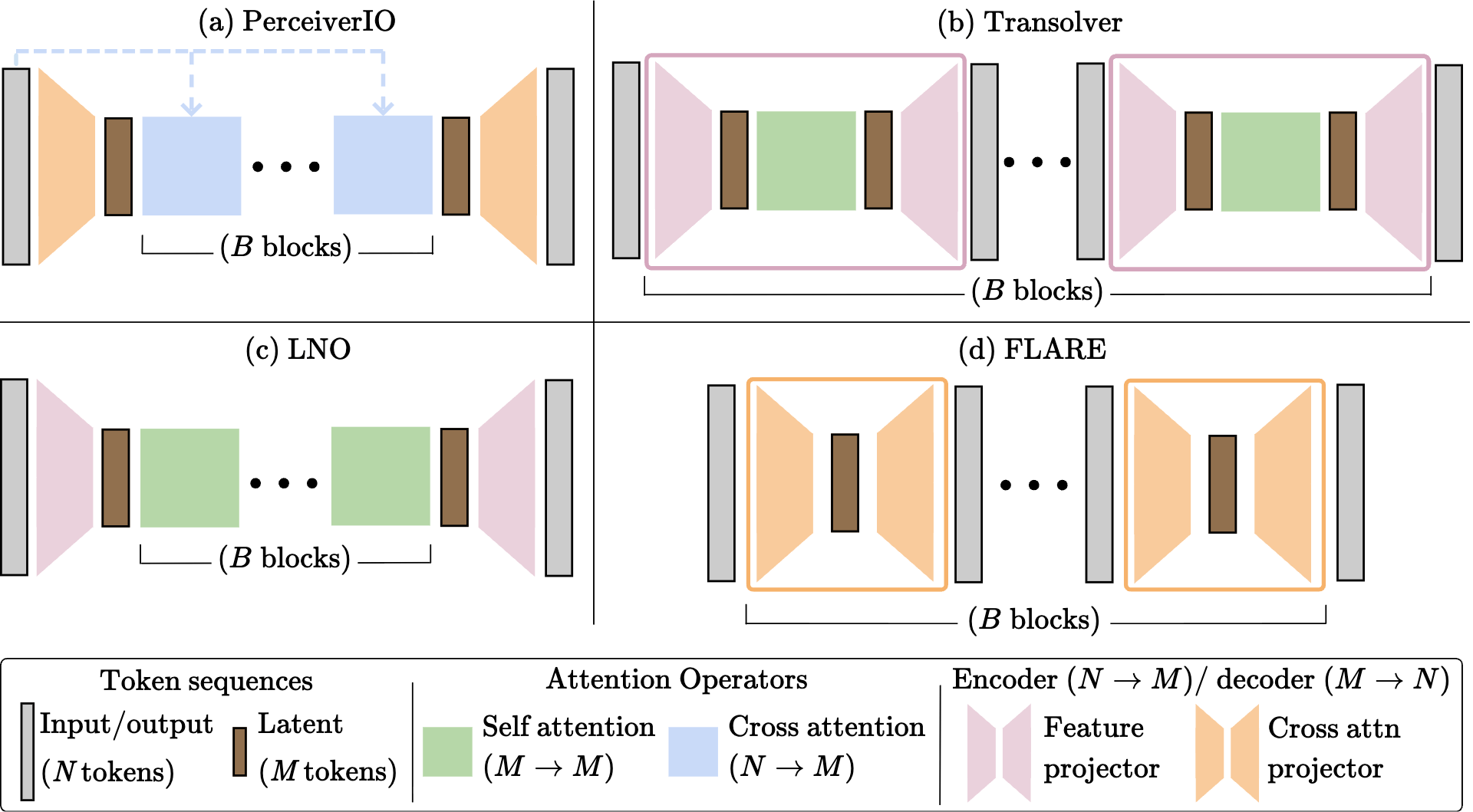
Simplify and connect latent-attention to low-rank self-attention
Isolate gather/scatter routing as a load-bearing primitive
Multihead gather-scatter as parallel low-rank pathways
Each attention head learns independent latent queries
FLARE scales to extremely large problems on a single GPU
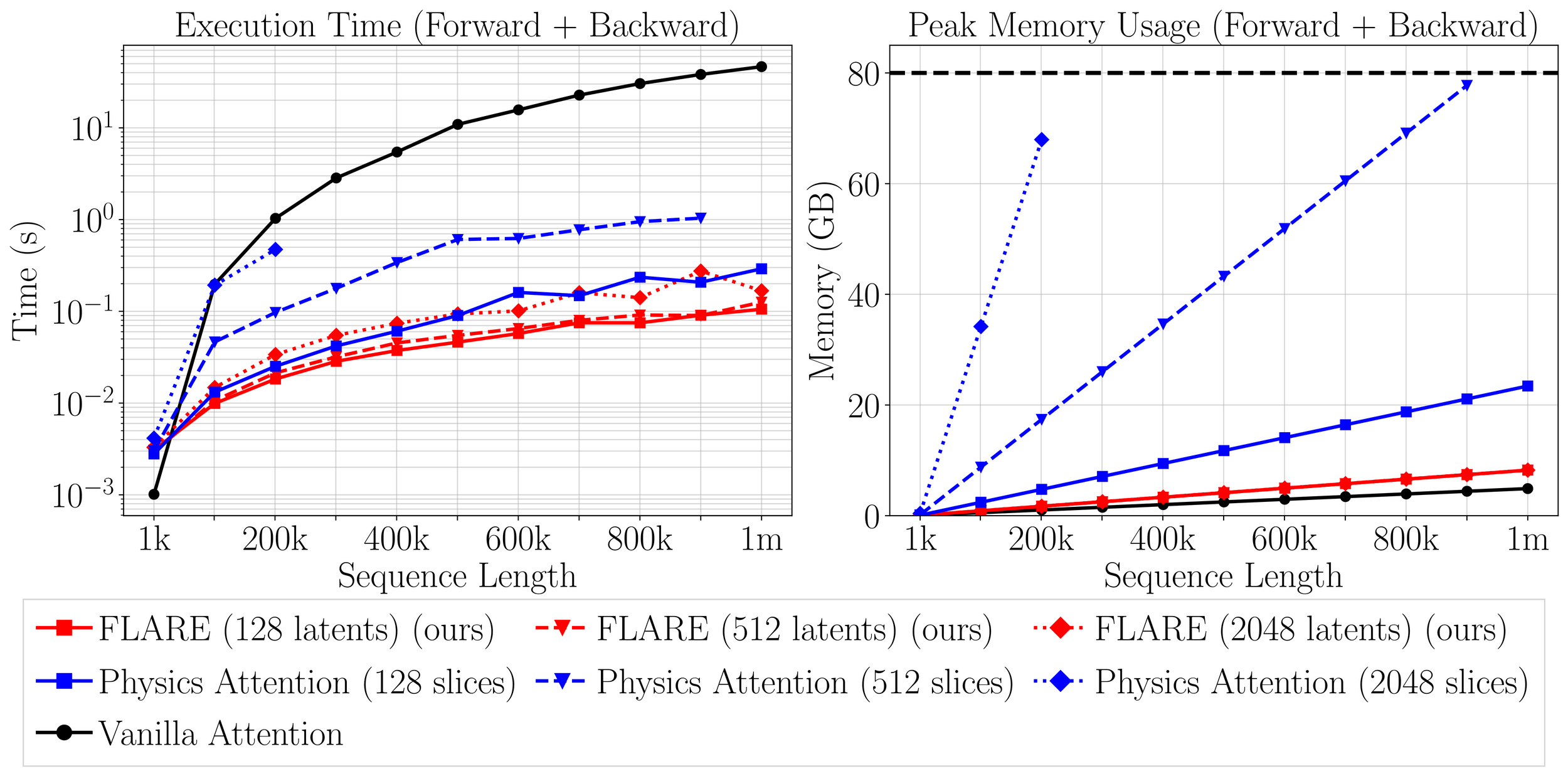
\(>200\times\) speedup over full self-attention
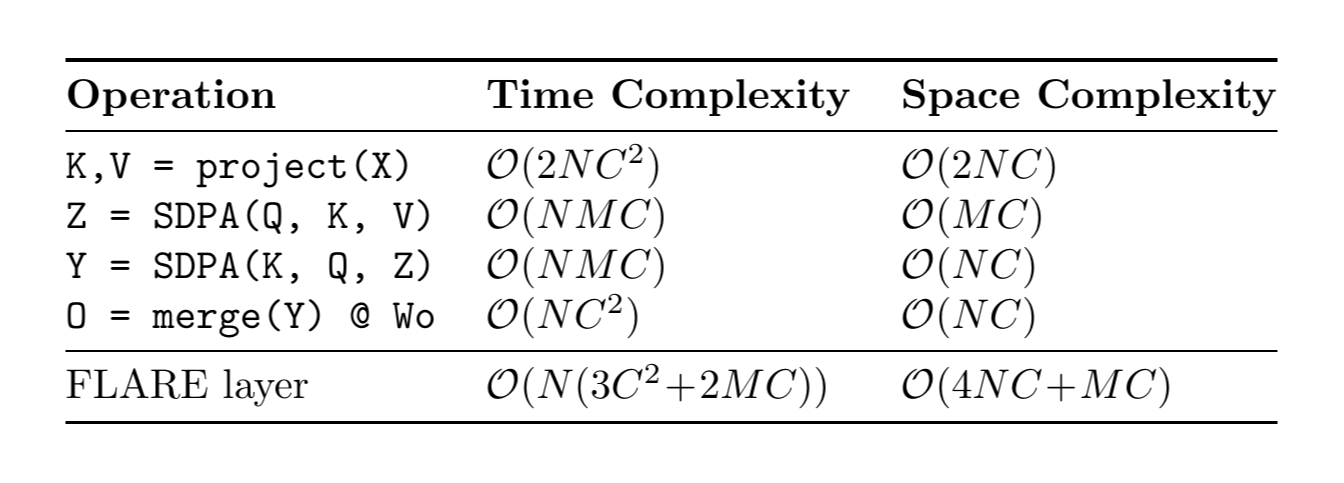
Extreme scalability with fused kernel implementations
Memory efficiency makes large problems tractable
15
Evaluation time increases with \(M\) (\(\mathcal{O}(NMC)\))
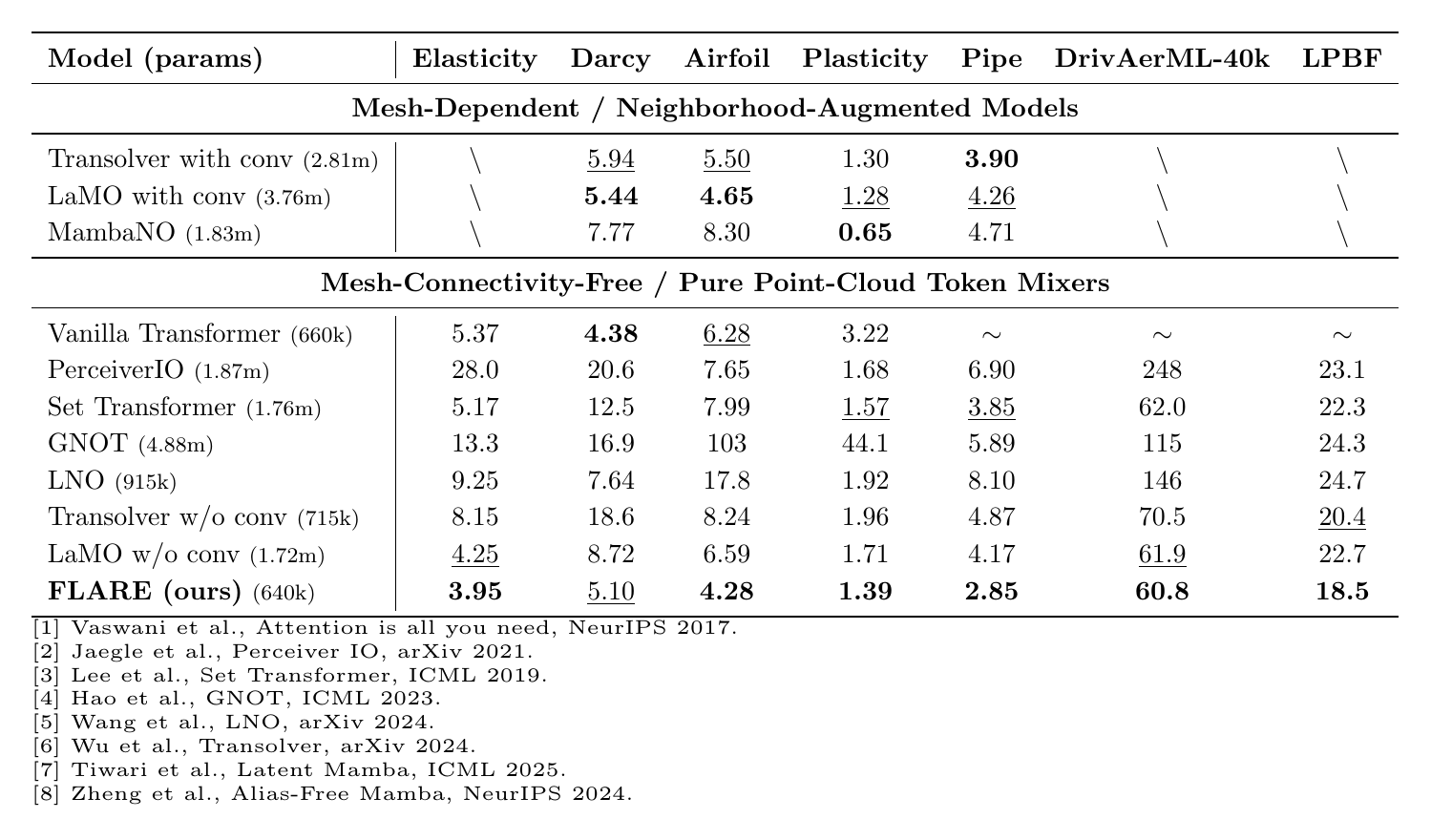
Low-rank attention is strong across PDE benchmarks
Relative \(L_2\) error \( (\times 10^{-3})\) (lower is better)
16
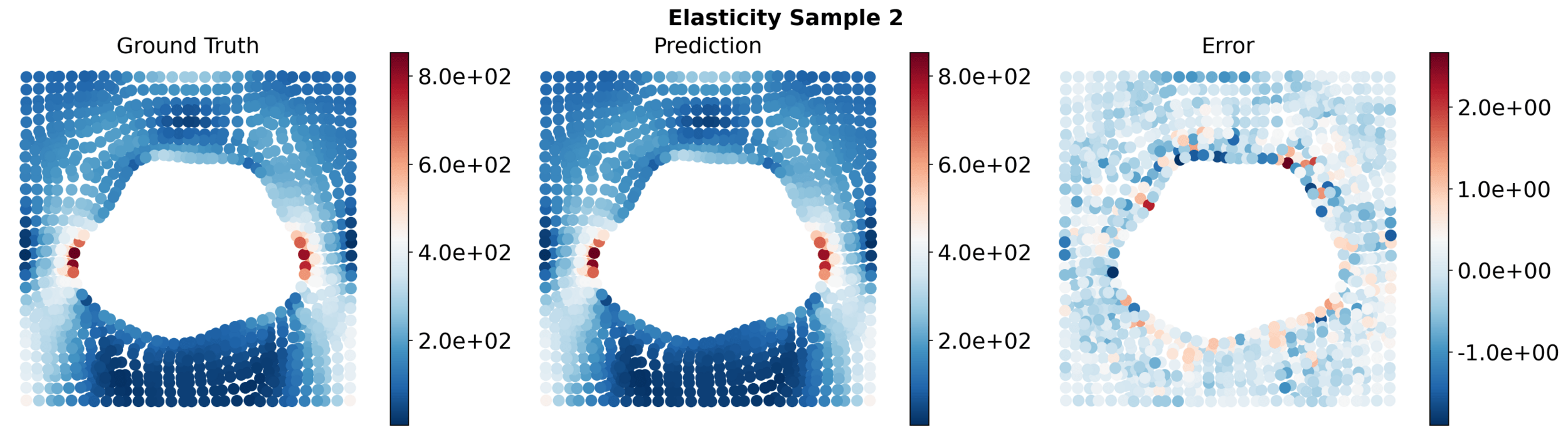
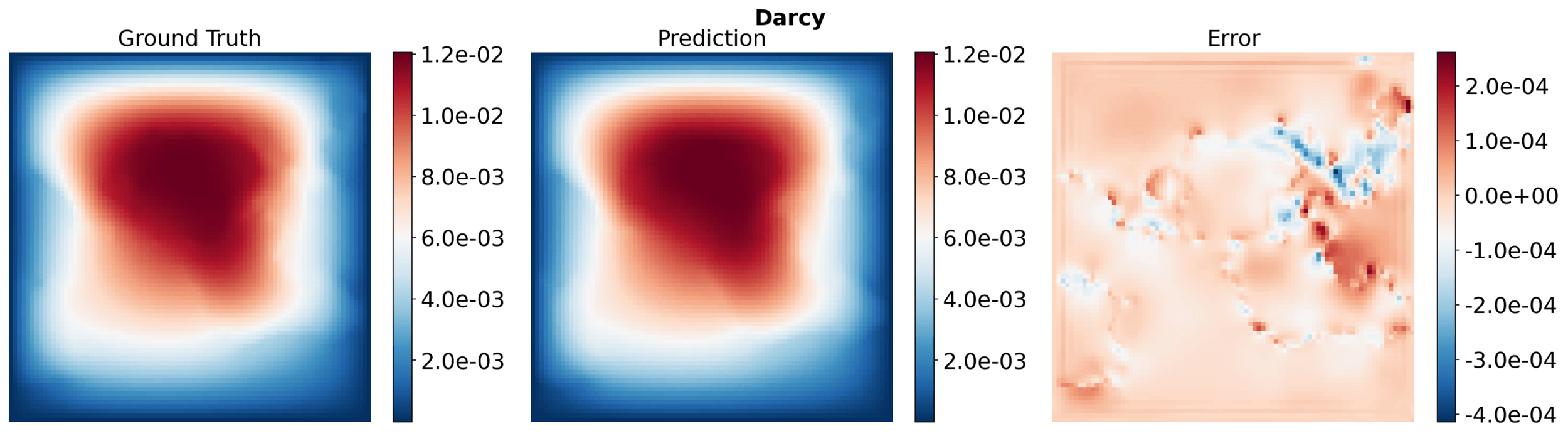
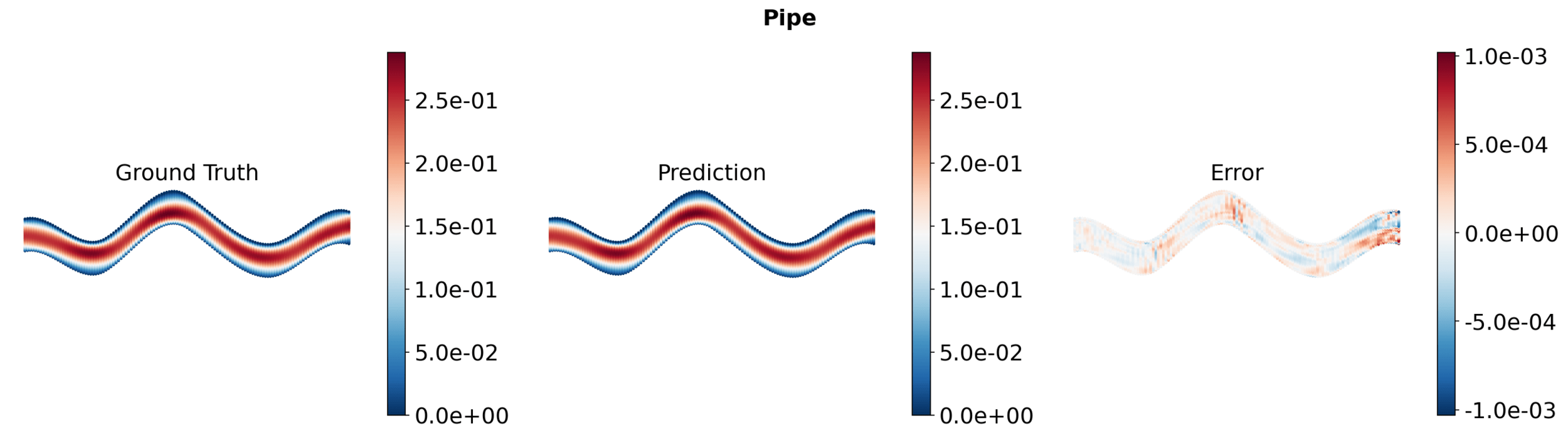
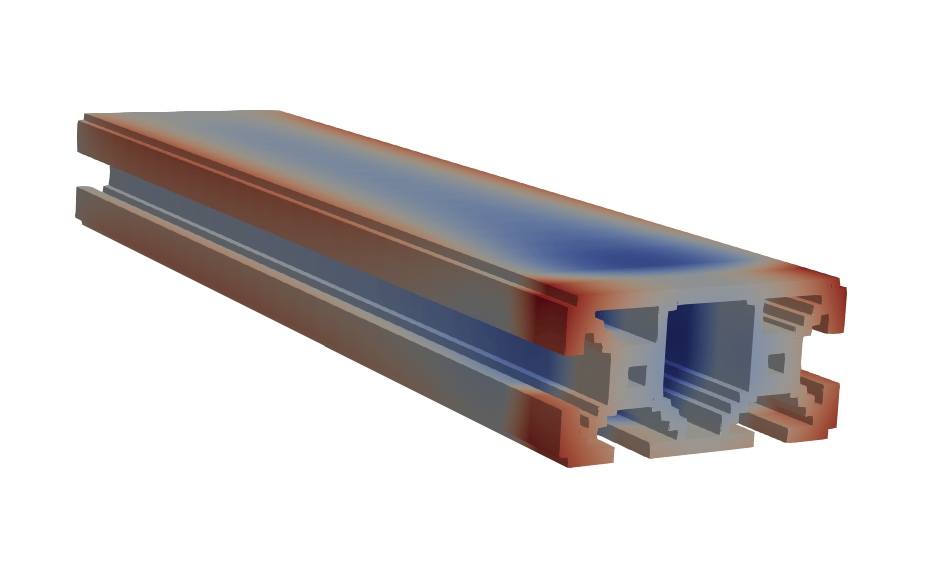
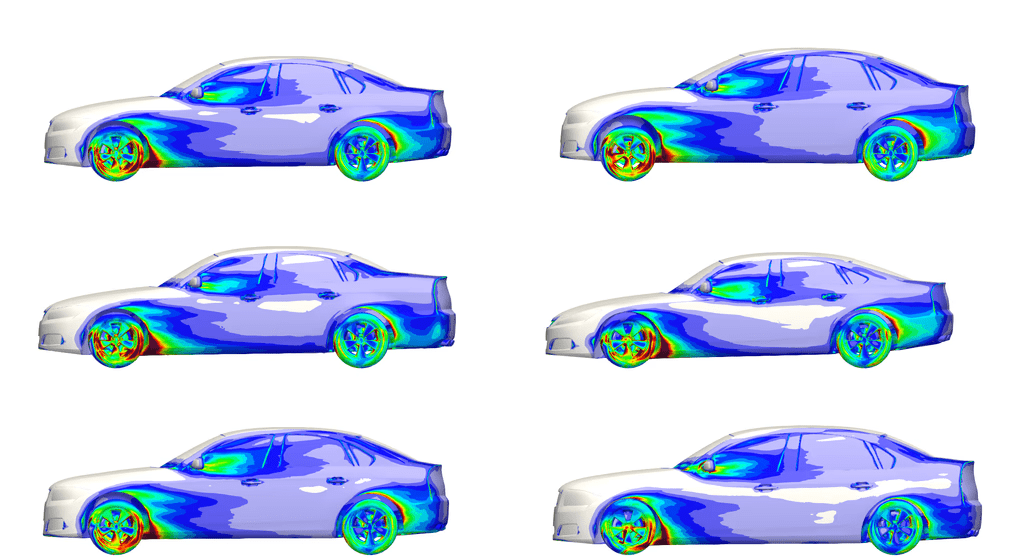
Pipe
Darcy
Elasticity
LPBF
DrivAerML
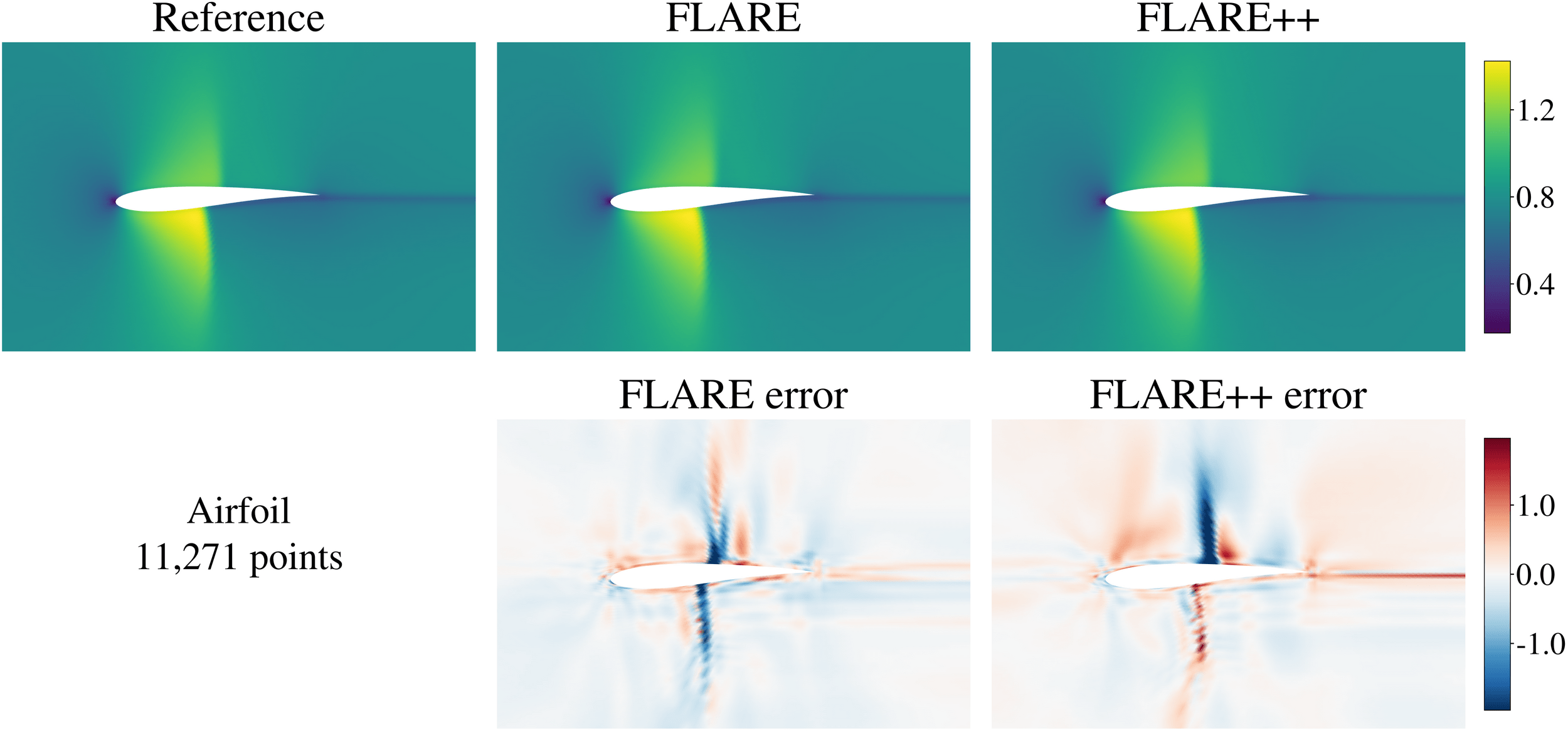
Airfoil
Competitive with full self-attention
Significant gains over Transolver
\(\implies\) PDE problems ok with low-rank comm.
Low-rank attention scales favorably on PDE surrogate problems
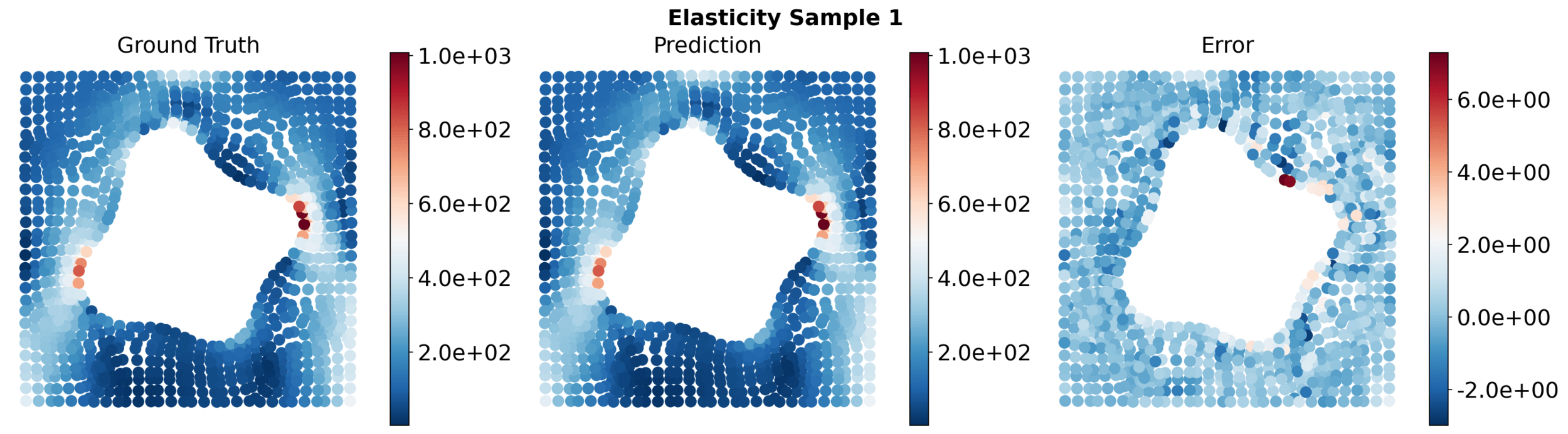
17
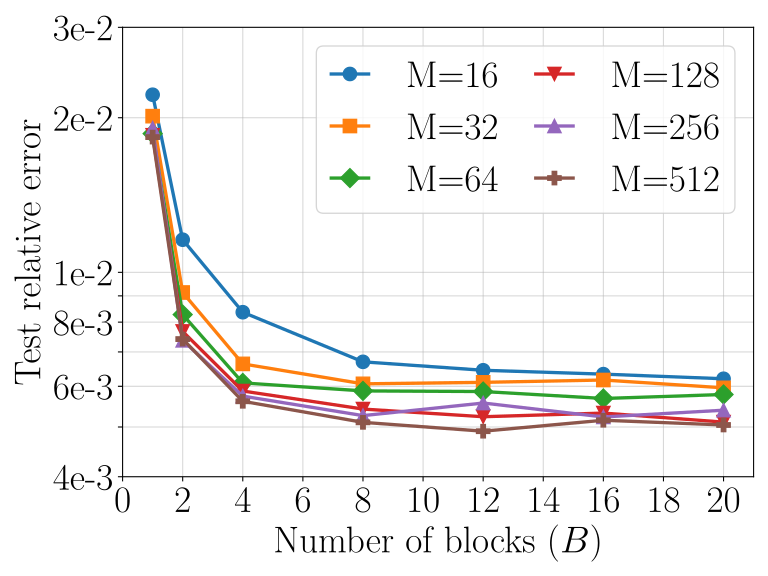
Darcy flow problem
Elasticity problem
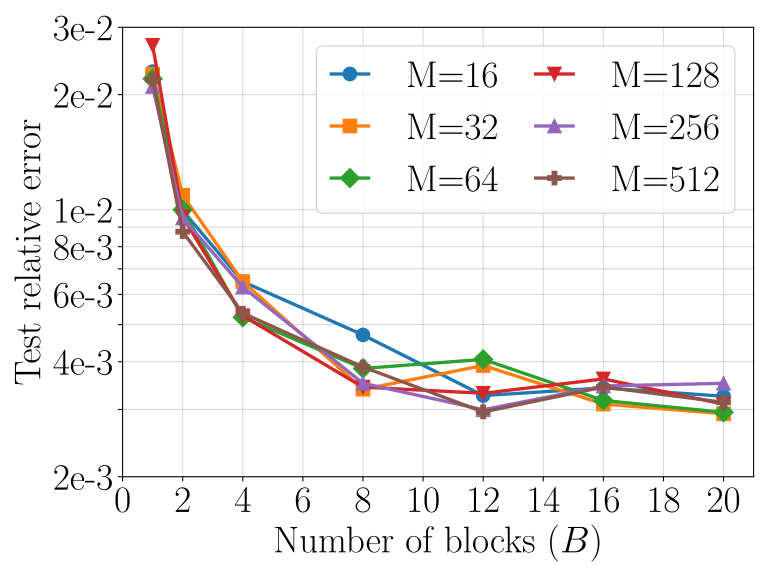
Accuracy improves with depth
Accuracy improves with \(M\) and depth!
Long Range Arena benchmarks on general attention problems
18
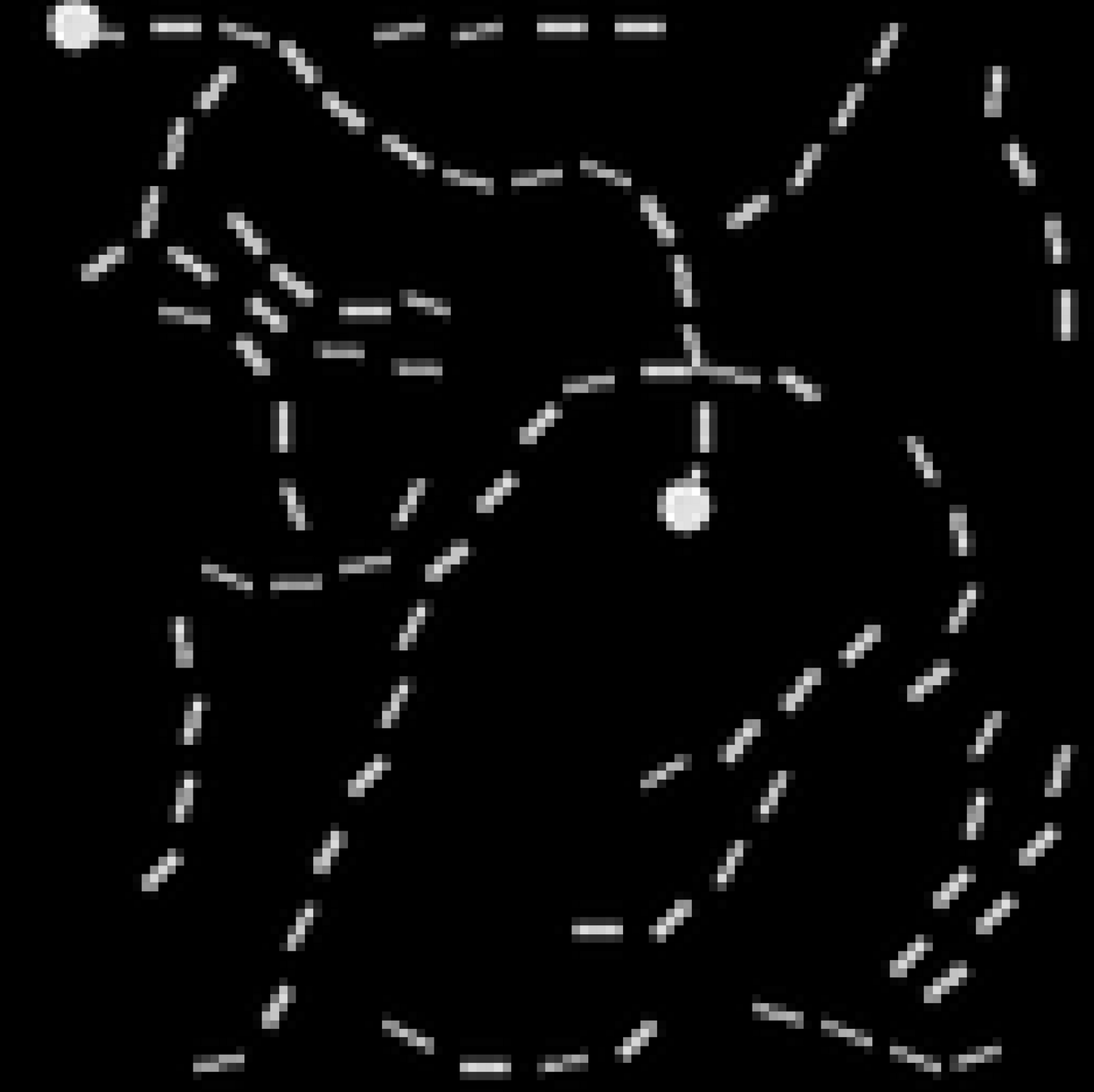
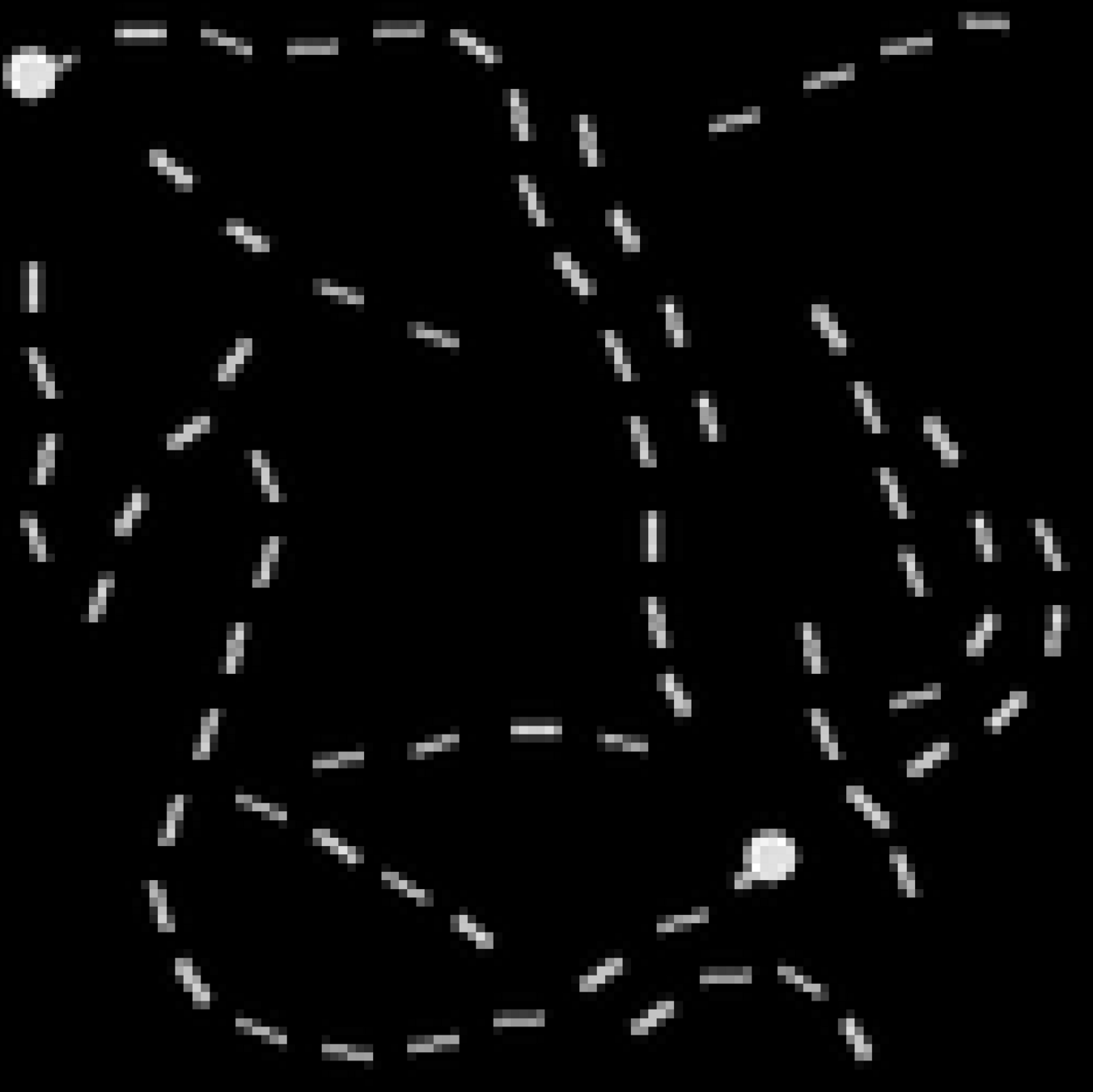
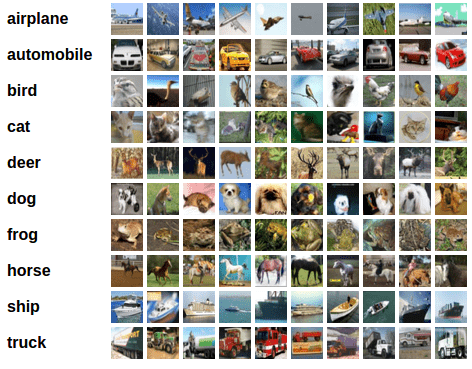

\(\text{Accuracy (\%)}\)
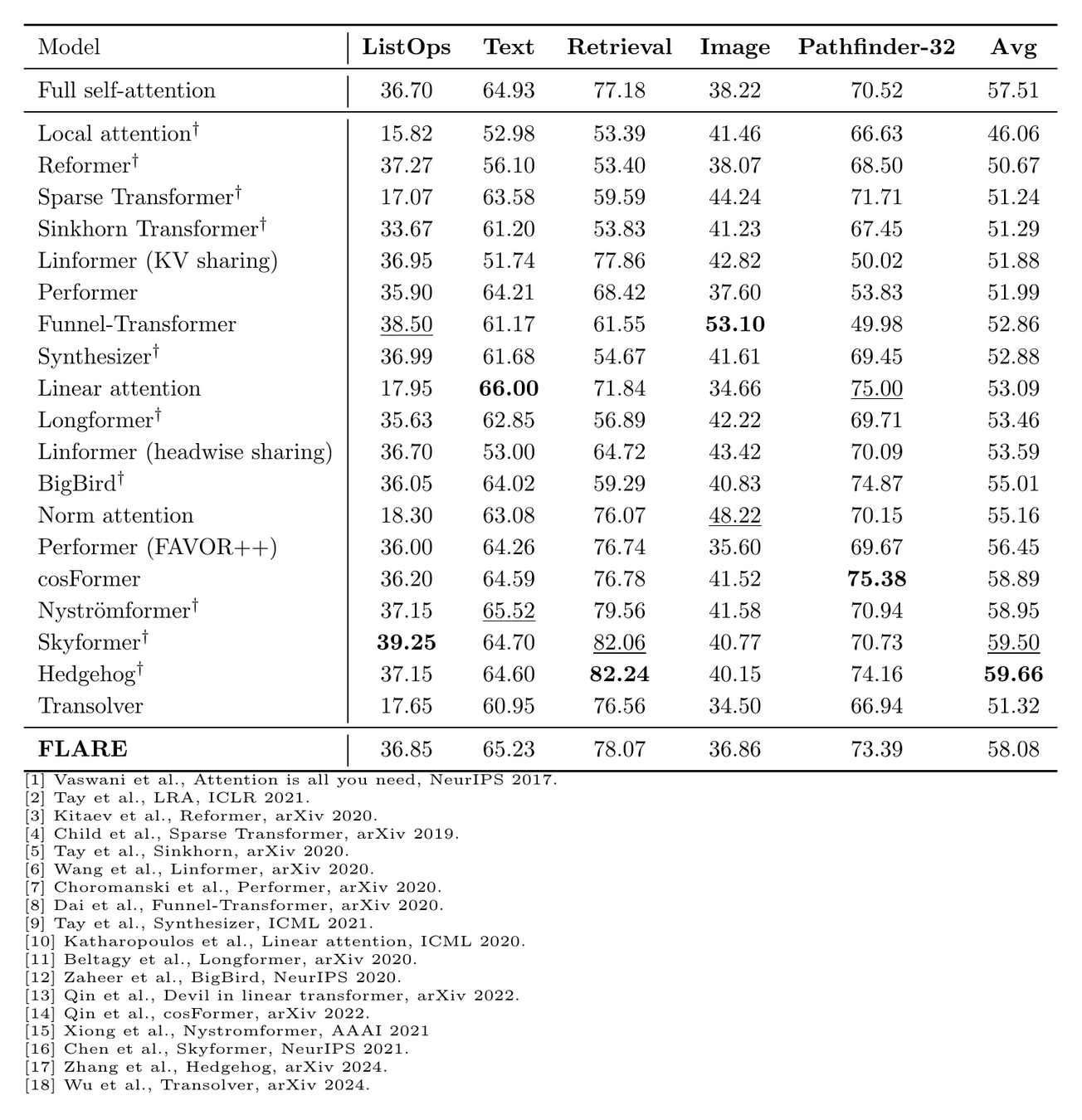
Low-rank attention generalized beyond PDE tasks
Our contributions
19
[2] Akhare et al. “High-Fidelity Industrial- Crash Dynamics”, arXiv:2605:27758
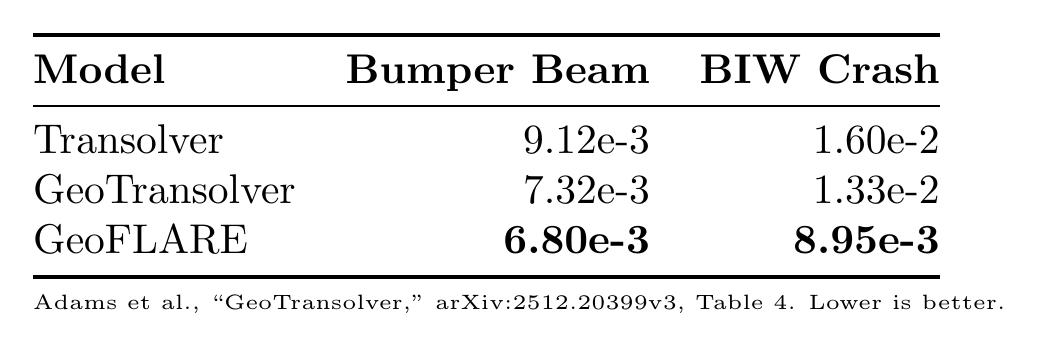
[1] Adams et al. “GeoTransolver”, arXiv:2512:20399
[3] Curtosi, et al. "Crash Assessment via Physics-Aware Attention", arxiv:2605:11784
Expose communication-rank as an axis of scaling
Robust and highly scalable low-rank attention model
Manuscript under review at TMLR
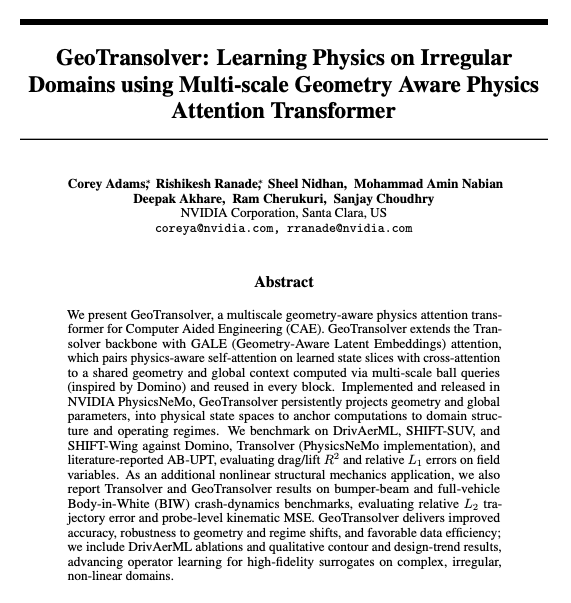
[1]
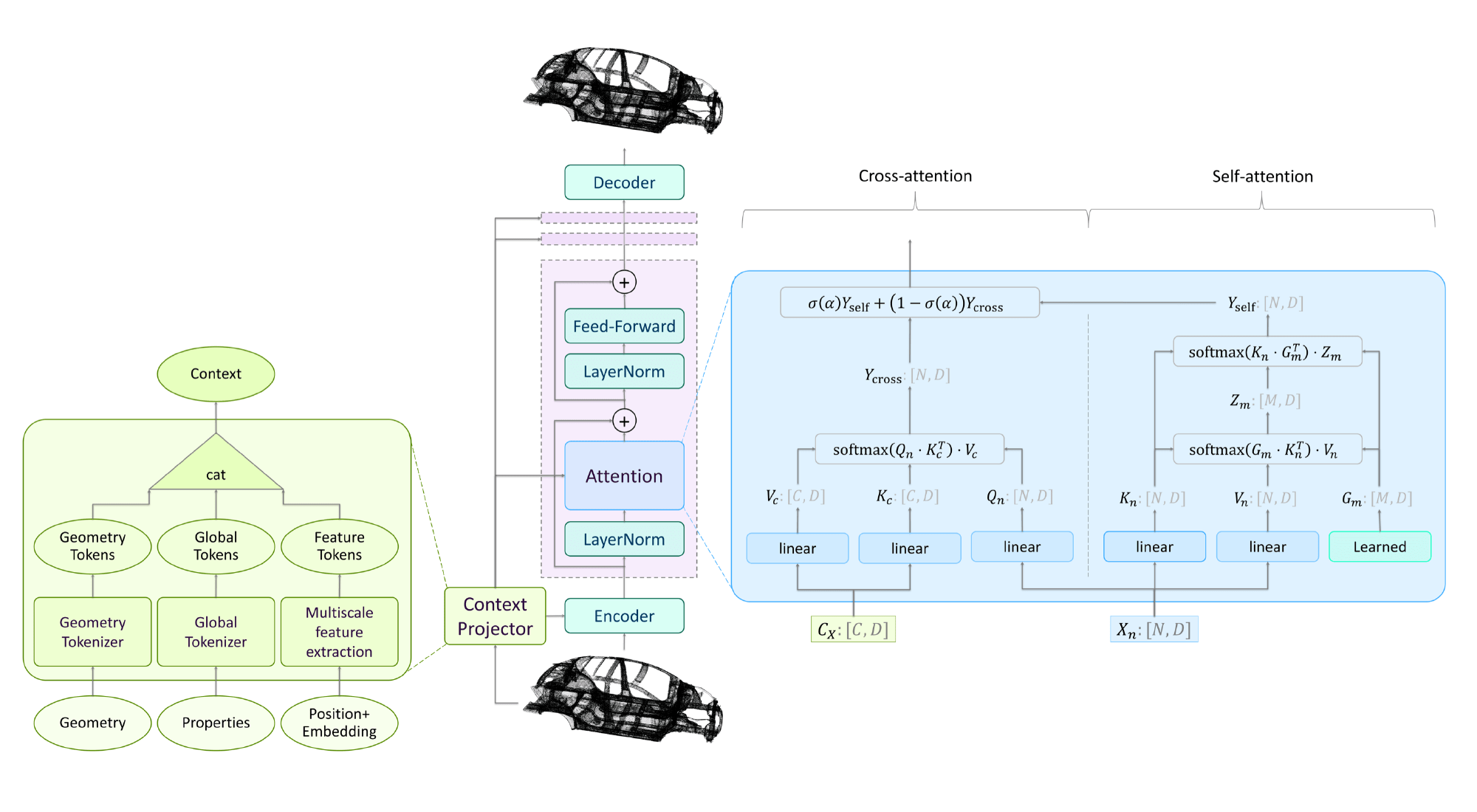
GeoFLARE: FLARE backbone + multiscale geometry feature extractor
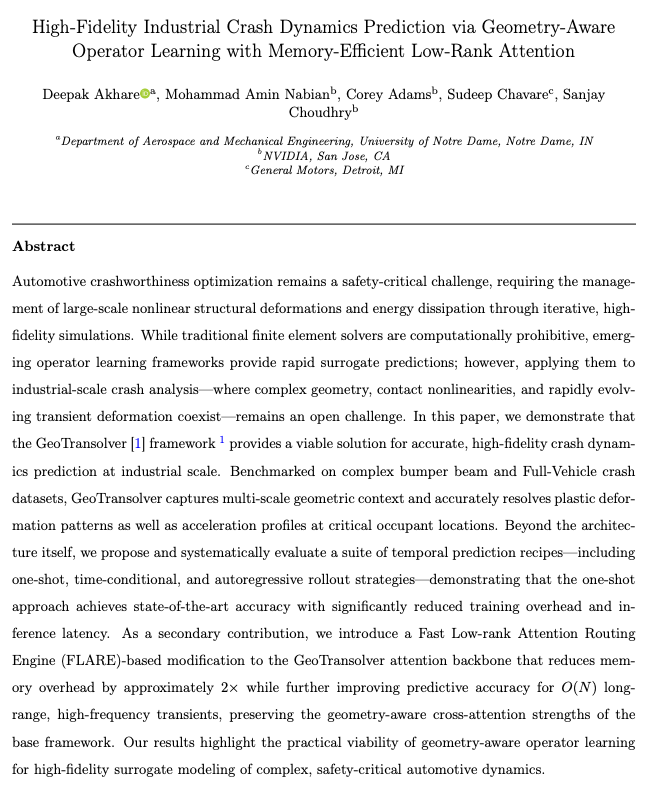
[2]
NVIDIA
Norte Dame, GM
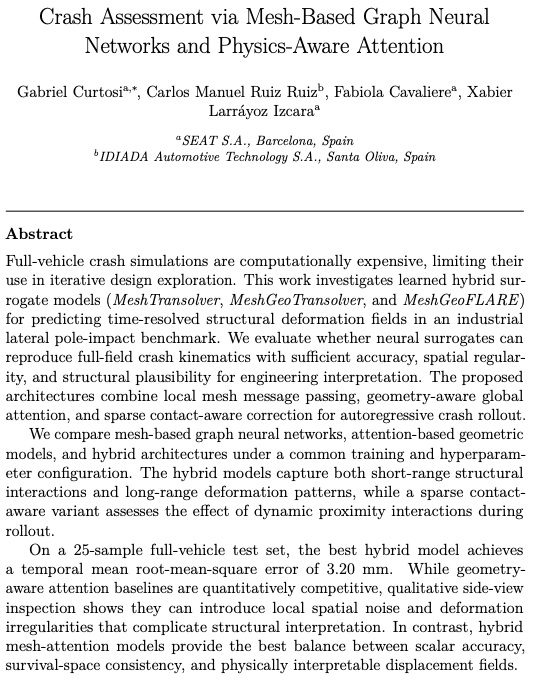
SEAT, IDIADA (Spain)
[3]
GeoFLARE on crash-dynamics problem
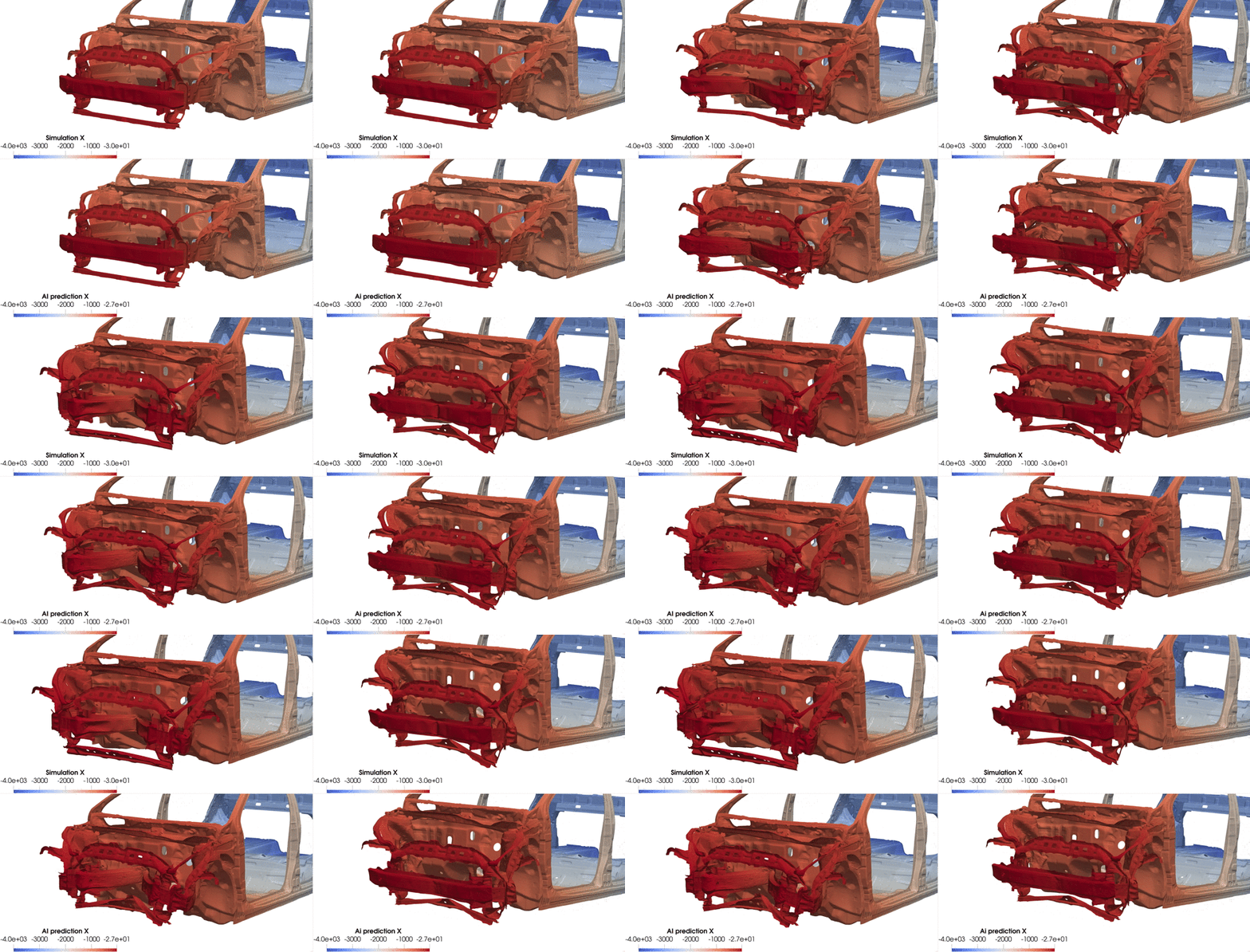
FLARE has been independently extended to complex geometries.
[2]
Low-rank attention with dynamic routing
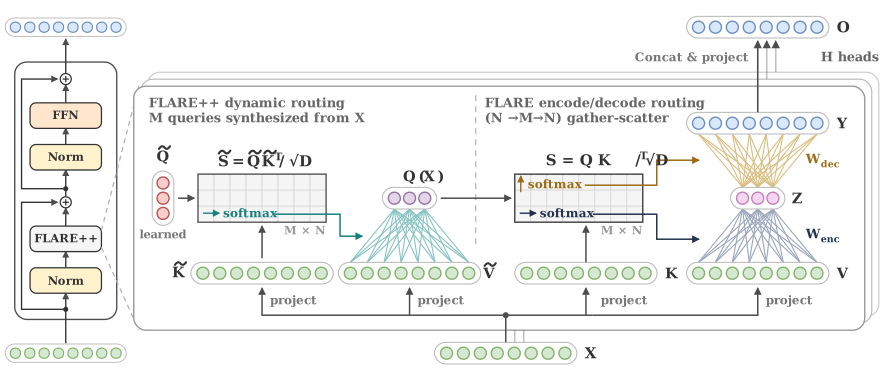
Low-rank attention in FLARE is constrained to static routing
20
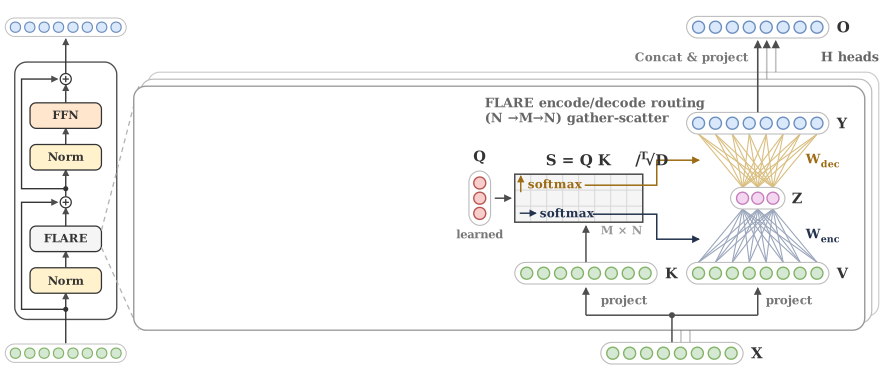
fixed, static queries.
Encode/decode weights are obtained by outer-product of input-projection with
Hypothesis: input-dependent queries can improve accuracy
\(S_{m,n}(X) = q_m^T \cdot k_n(X)\)
Low-rank attention in FLARE is constrained to static routing
20
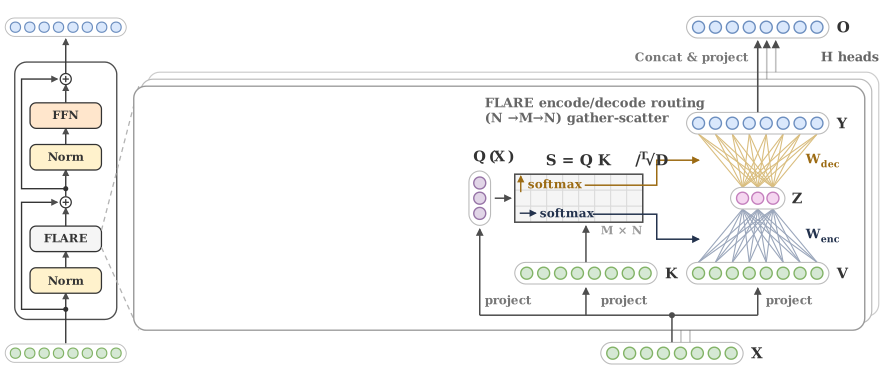
How to produce \(M\) latents from \(N\) inputs?
fixed, static queries.
Hypothesis: more expressive scores can improve accuracy
Encode/decode weights are obtained by outer-product of input-projection with
\(S_{m,n}(X) = q_m^T \cdot k_n(X)\)
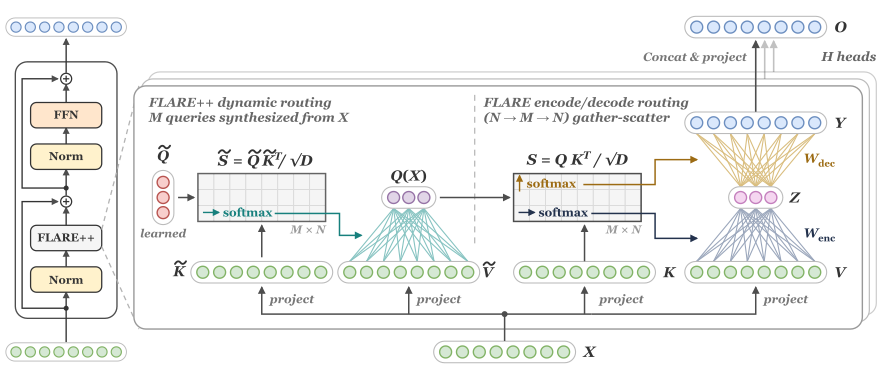
Our model: FLARE++: Low-rank attention with dynamic routing
20
input-dependent queries.
Dynamic query synthesis
via FLARE encoder
FLARE++ has \(30\%\) more params.
The output stream is intact.
All gains from improved routing.
Hypothesis: more expressive scores can improve accuracy
Encode/decode weights are obtained by outer-product of input-projection with
\(S_{m,n}(X) = q_m^T(X) \cdot k_n(X)\)
Dynamic routing improves accuracy on PDE benchmarks
Relative \(L_2\) error \( (\%)\) (lower is better)
21
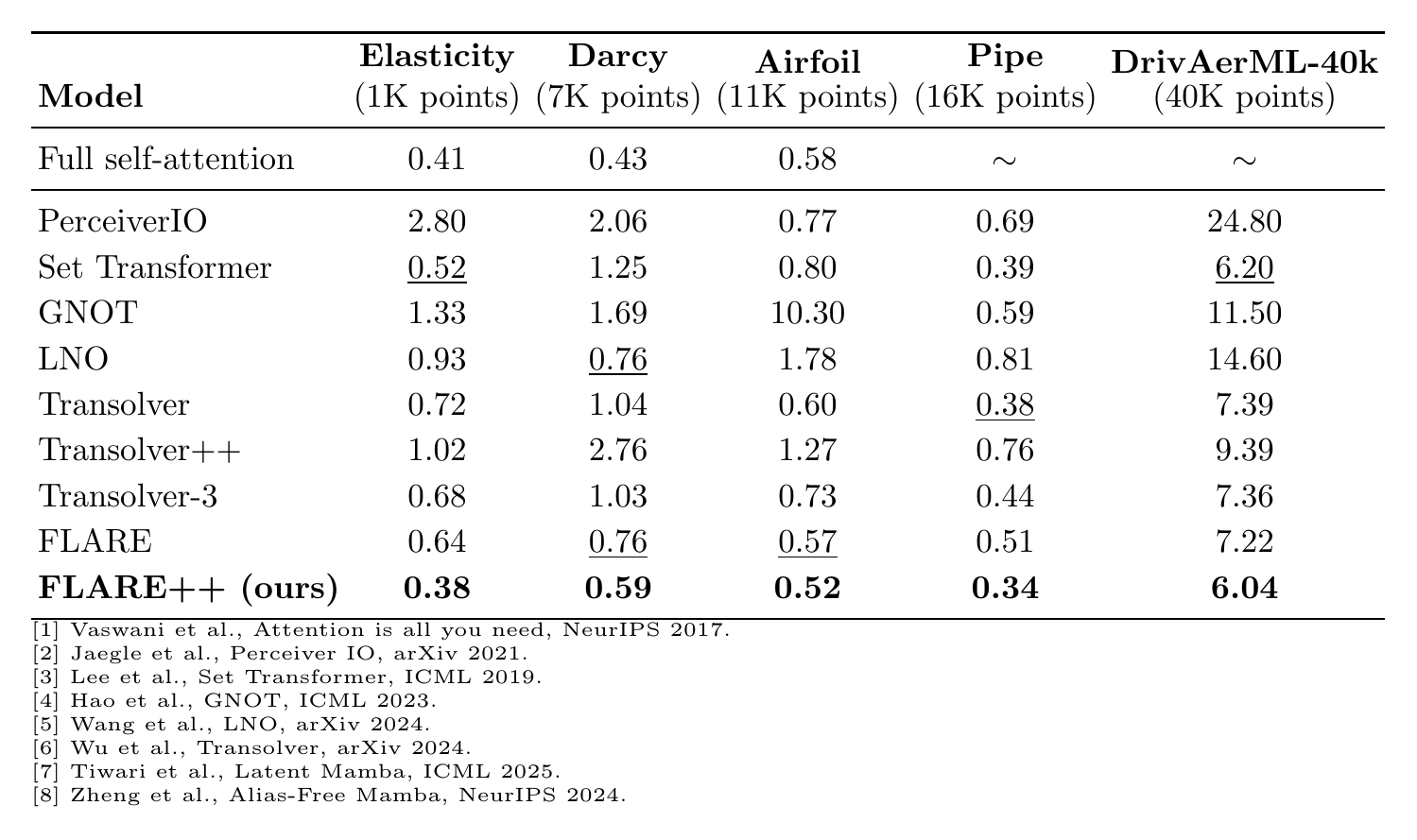
Pipe
Darcy
Elasticity
DrivAerML
Airfoil
Substantial gains from dynamic routing
Dominant over Transolver family
Dynamic routing improves accuracy on Elasticity
22
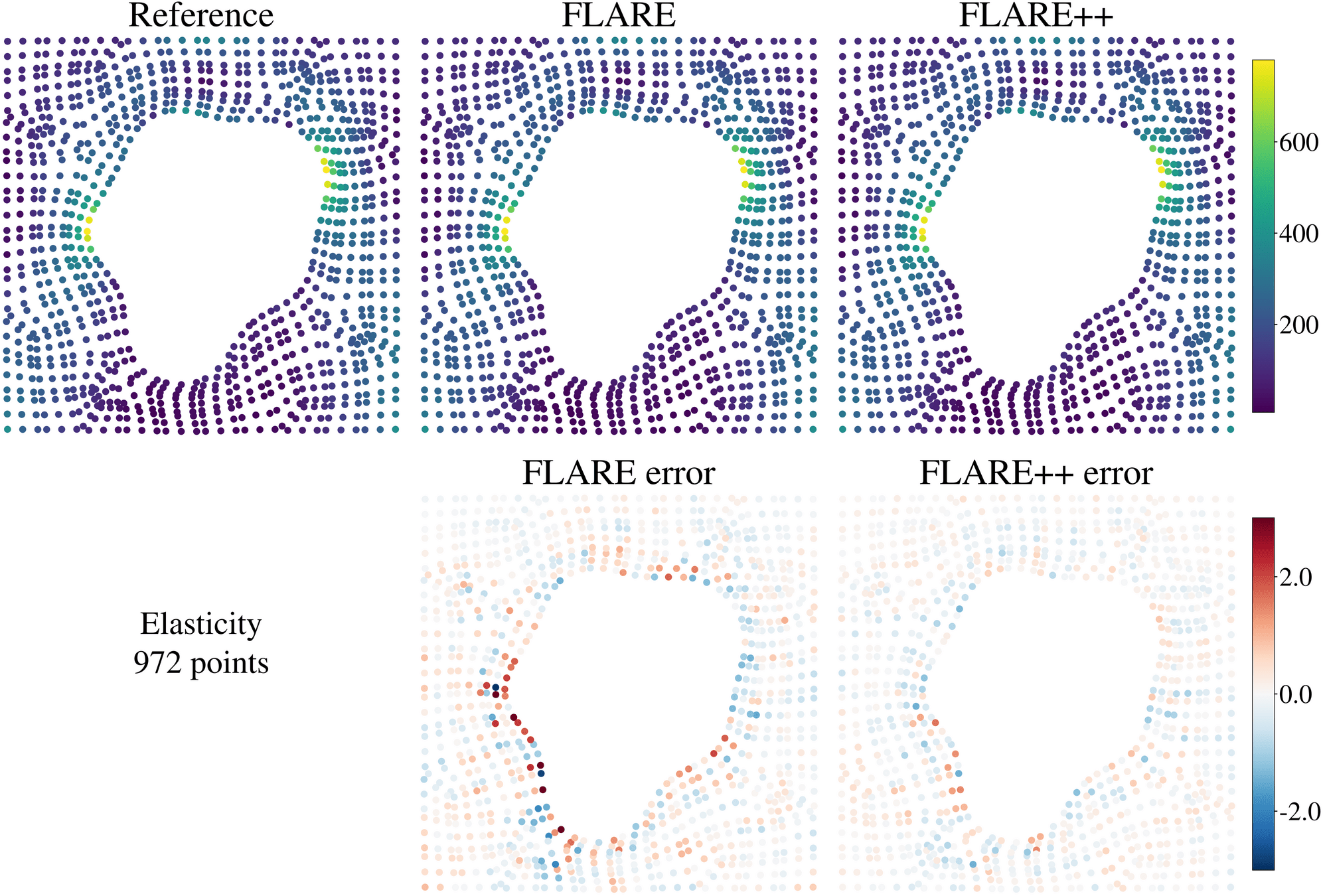
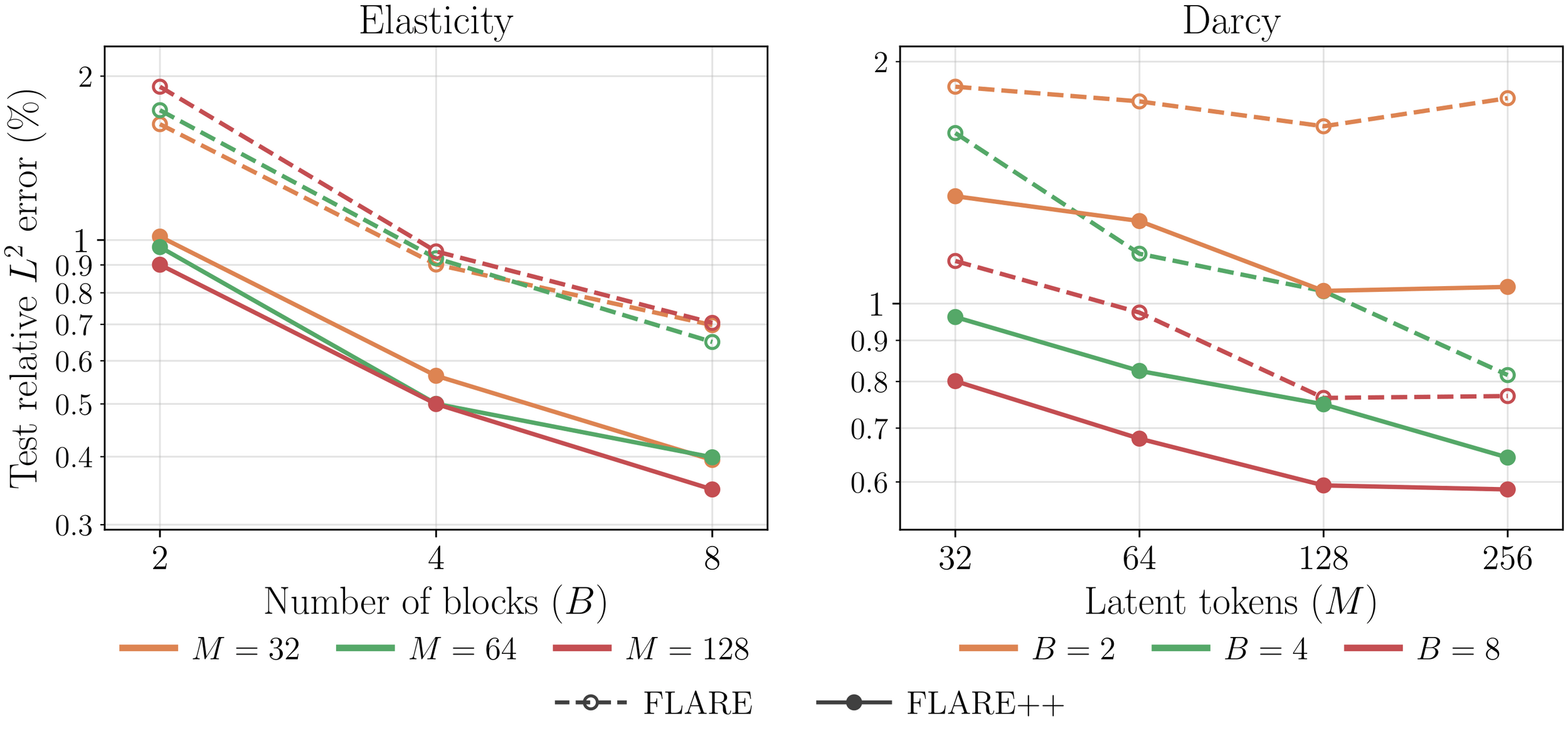
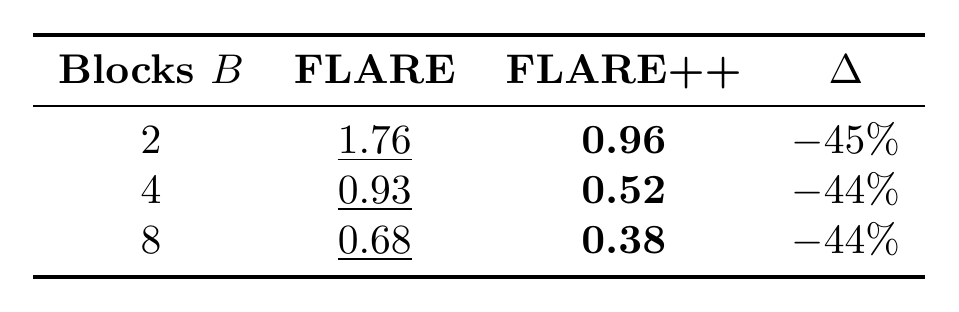
Improved routing substitutes for depth
Dynamic routing improves accuracy on Darcy flow
23
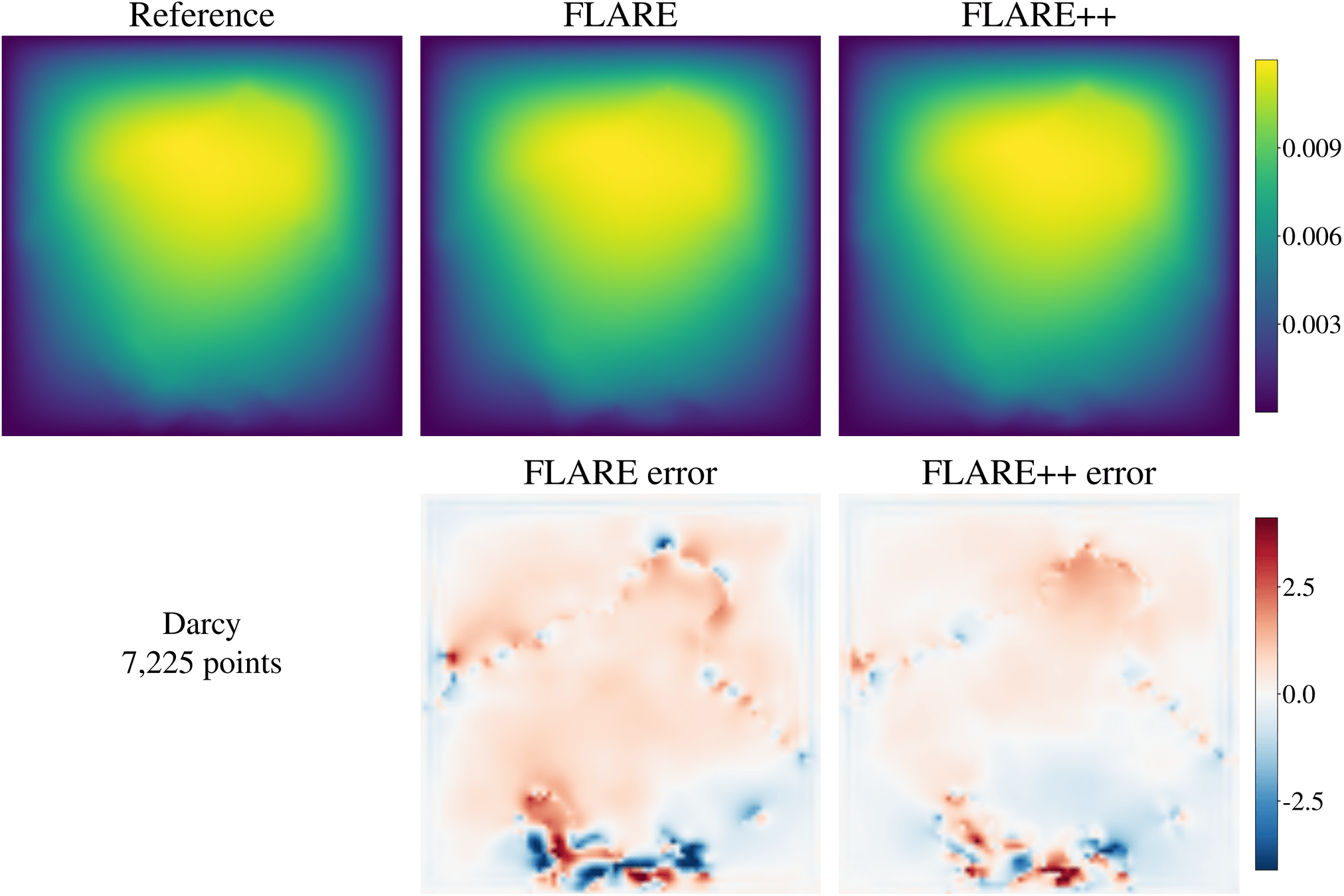
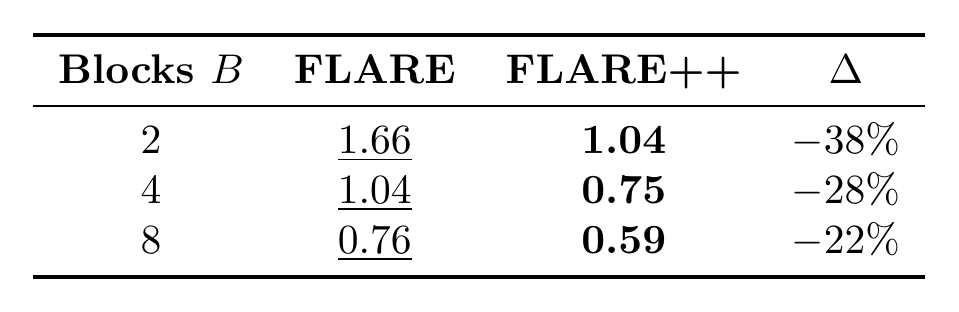
Improved routing substitutes for depth
Continued improvement with \(M\)
24
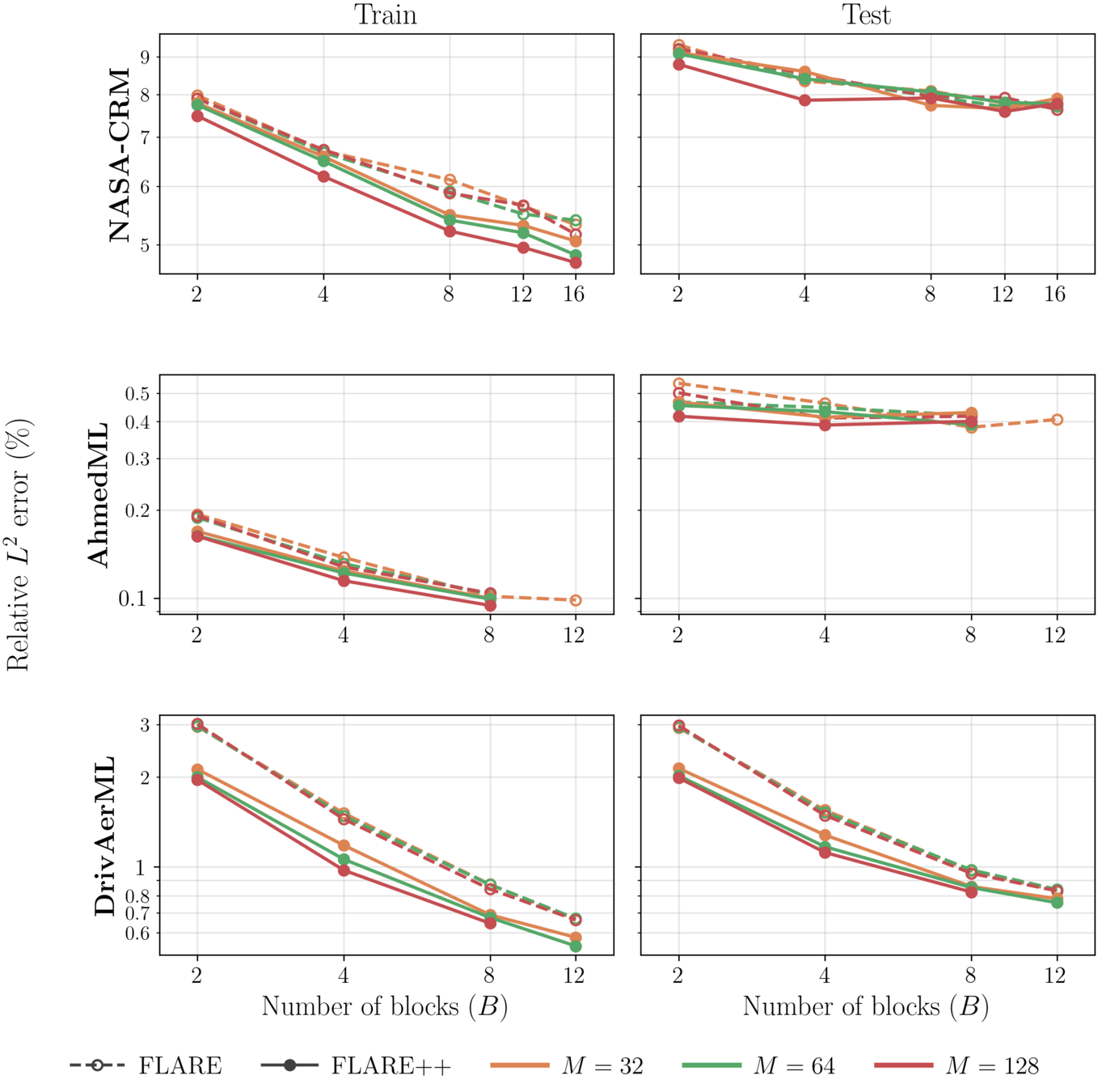
FLARE++ scales extremely well on large problems
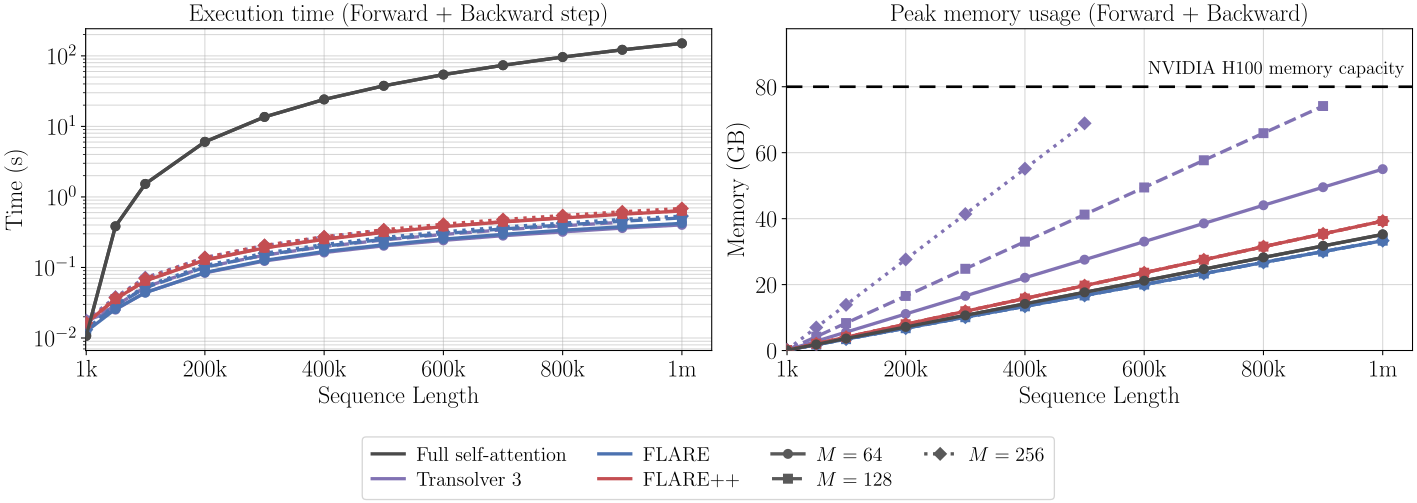
\(\approx1.2-1.3\times\) slower than FLARE
Inherits FLARE's extreme memory efficiency
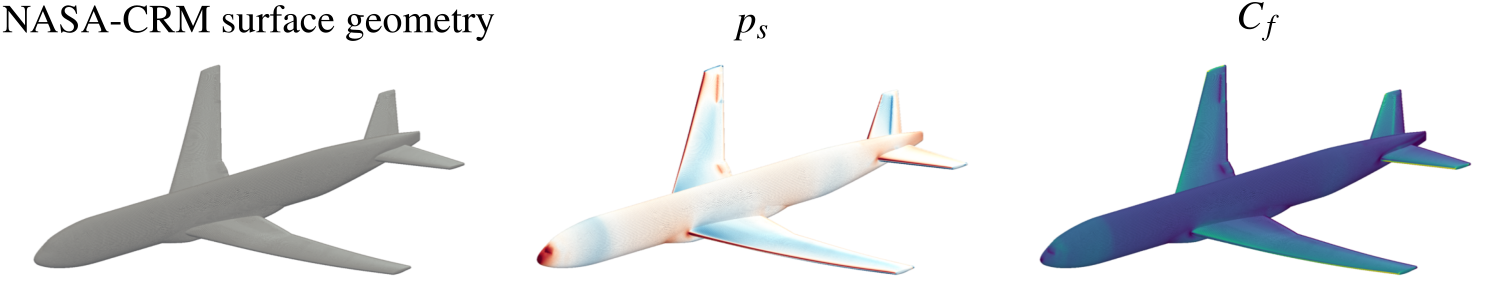
NASA-CRM: Large-scale external aerodynamics problem
25
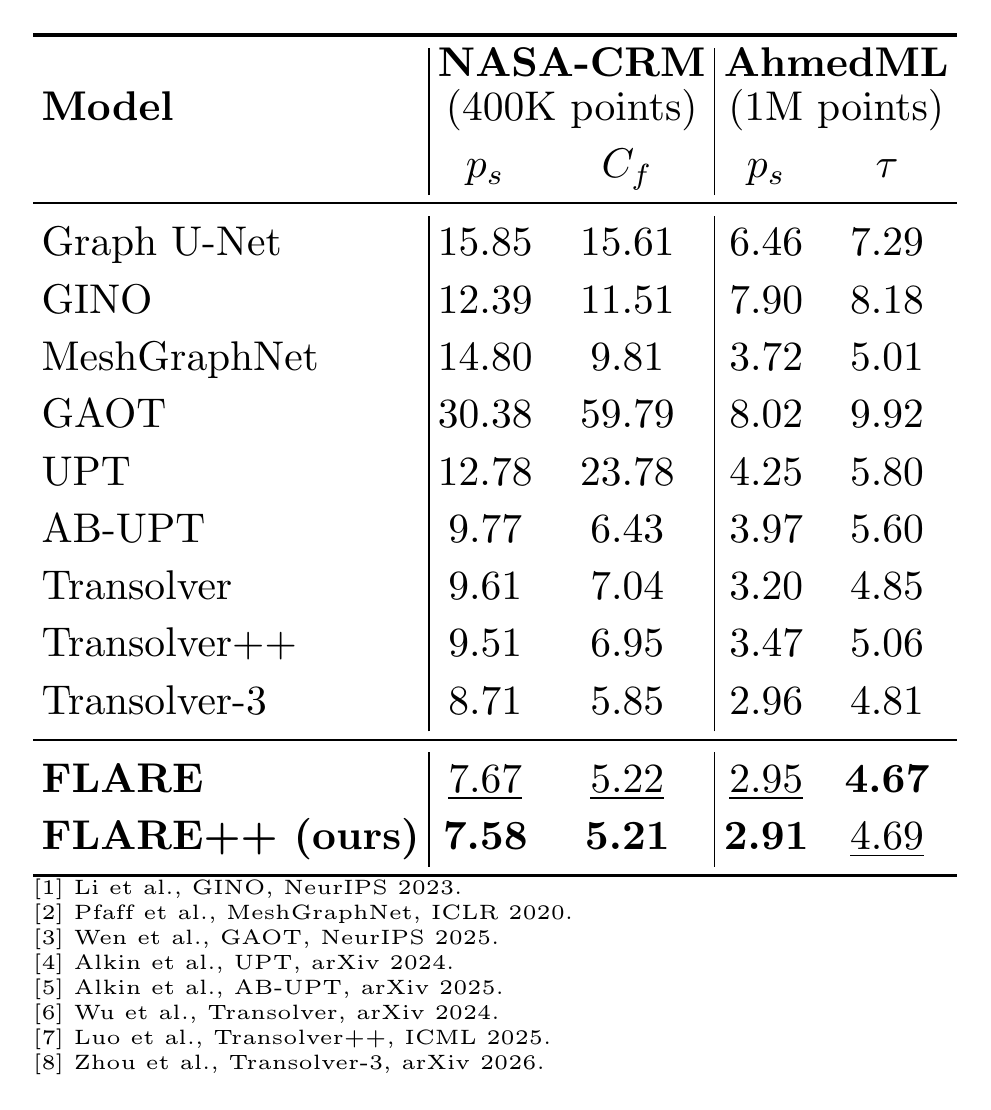
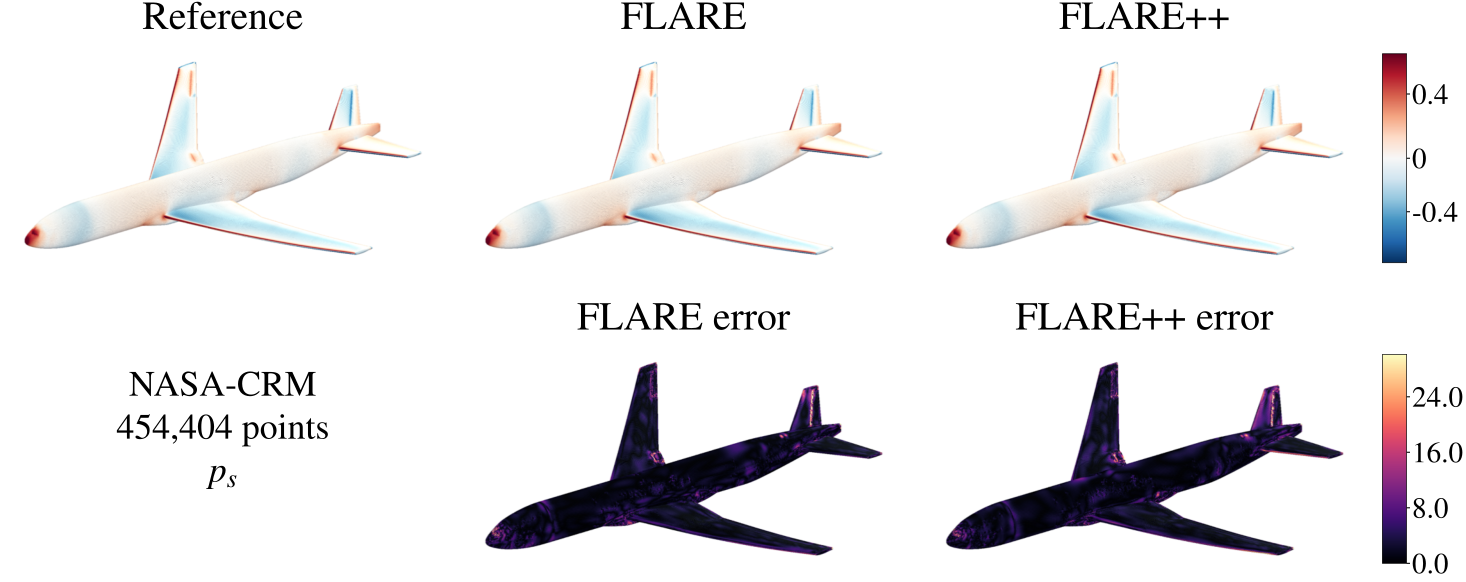
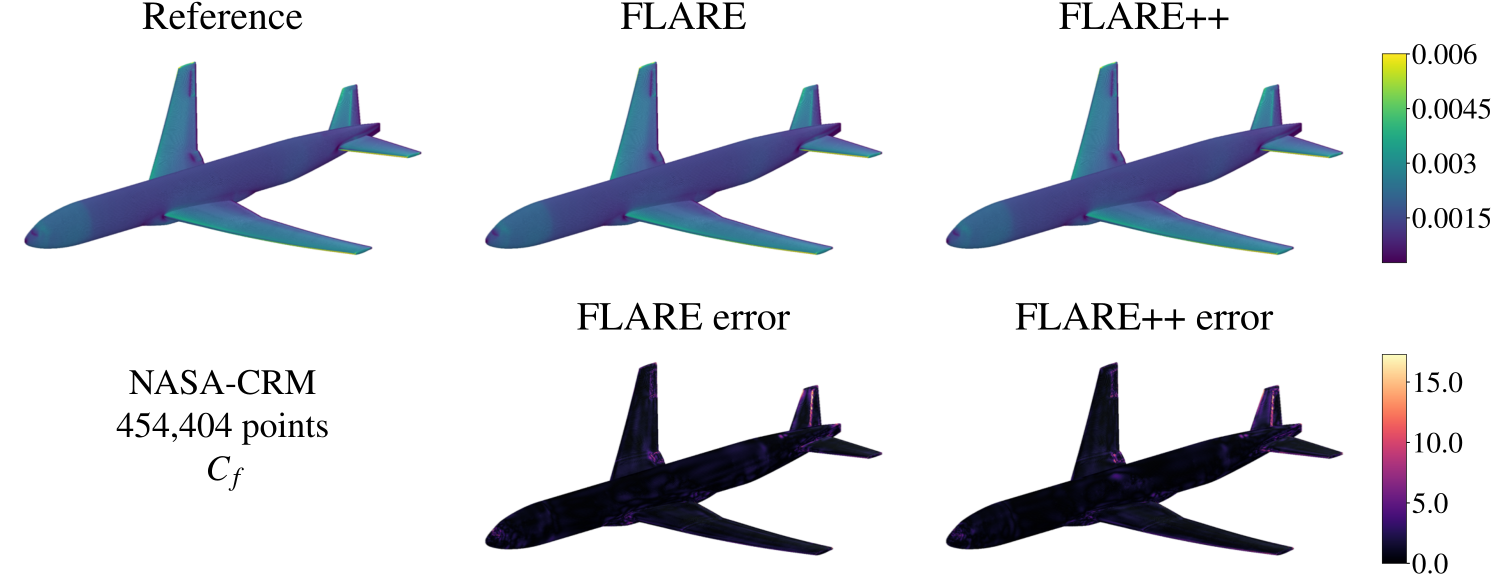
FLARE family is dominant on this problem.
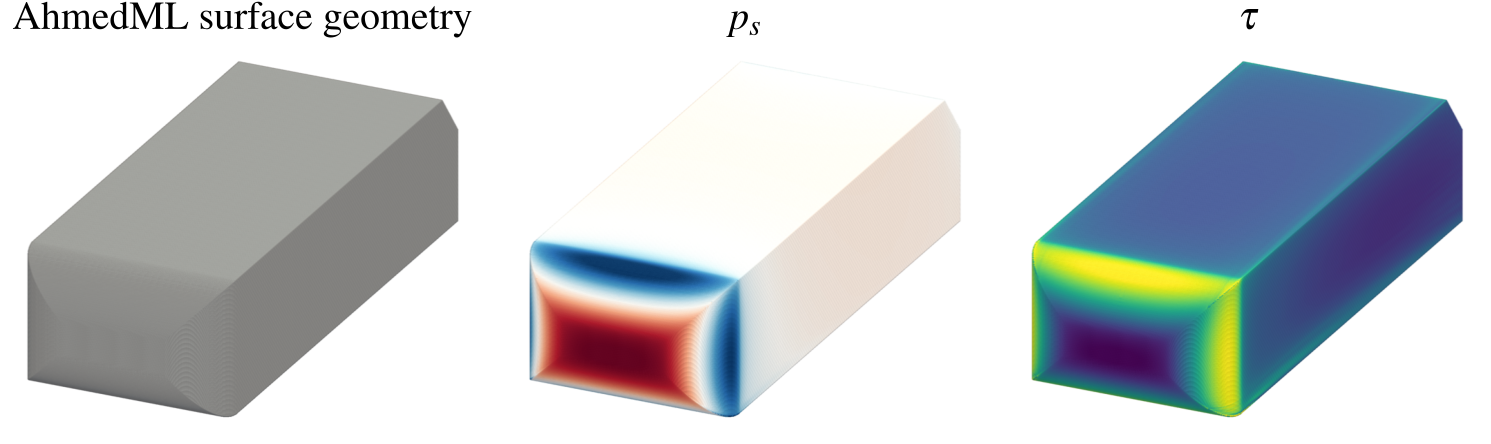
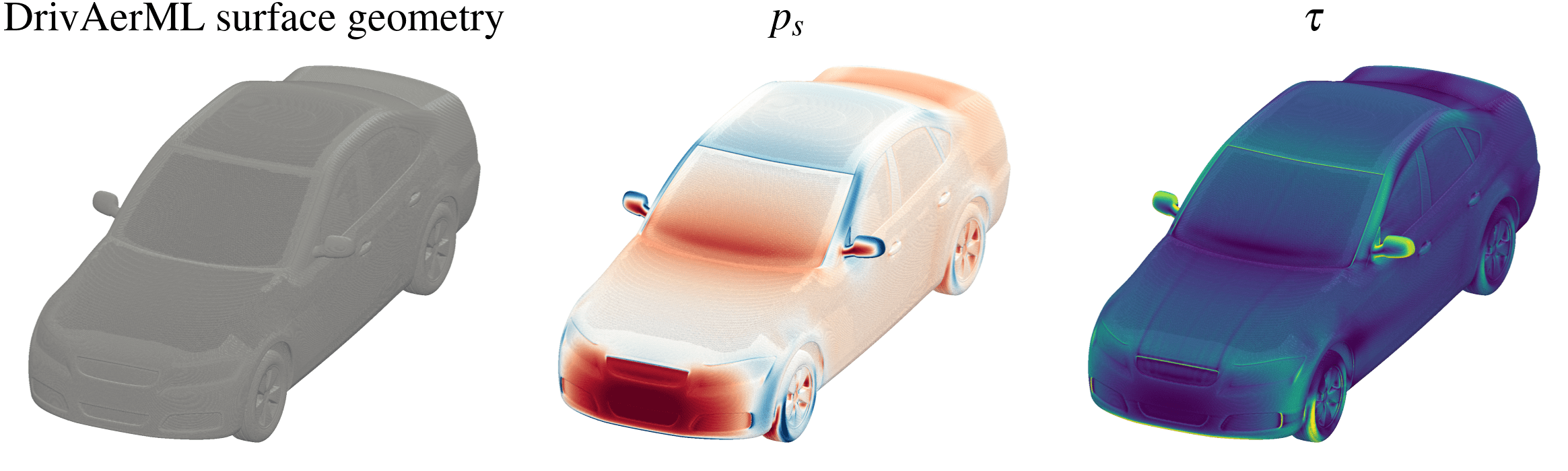
DrivAerML industrial scale benchmark (9M points)
26
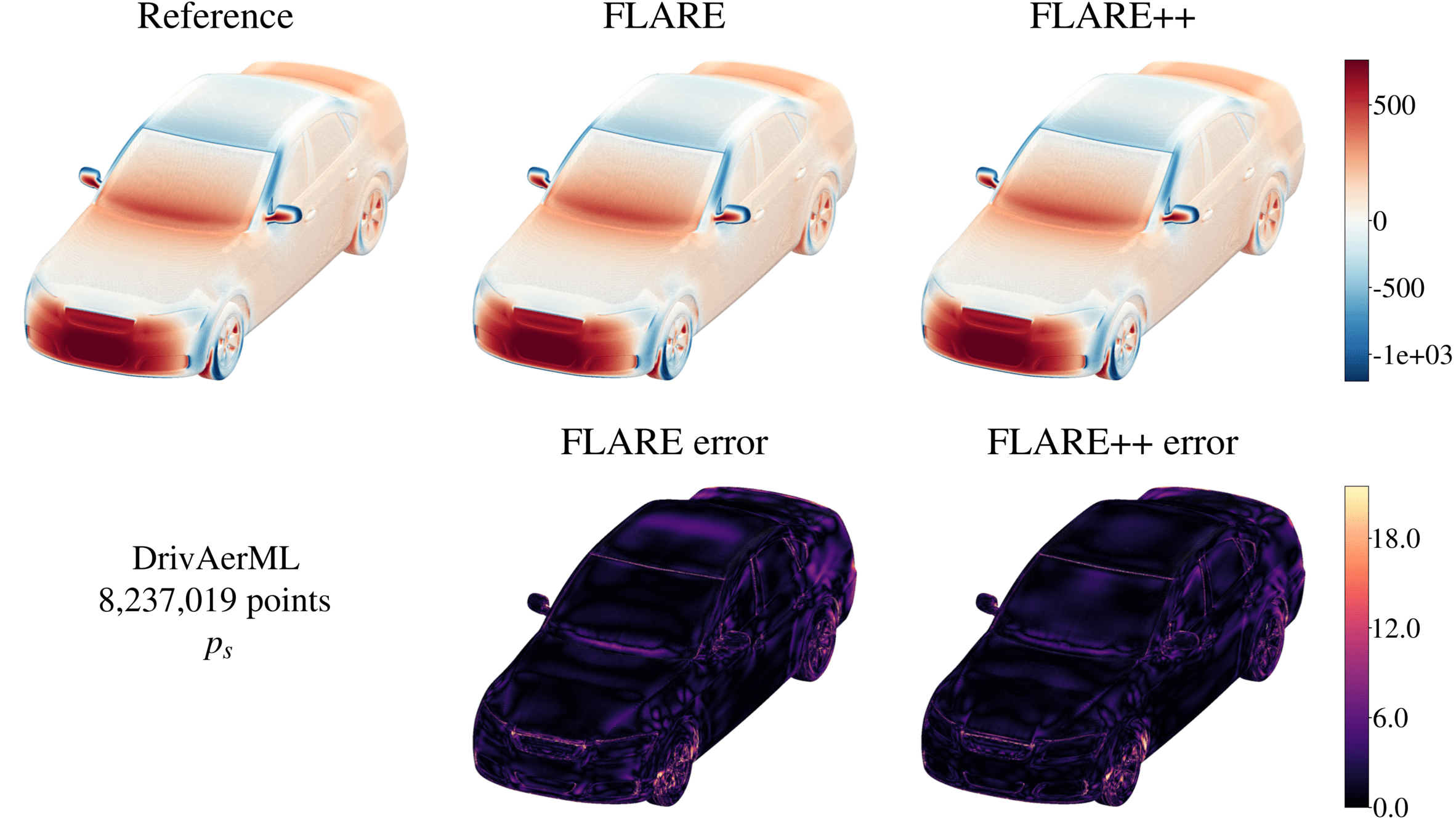
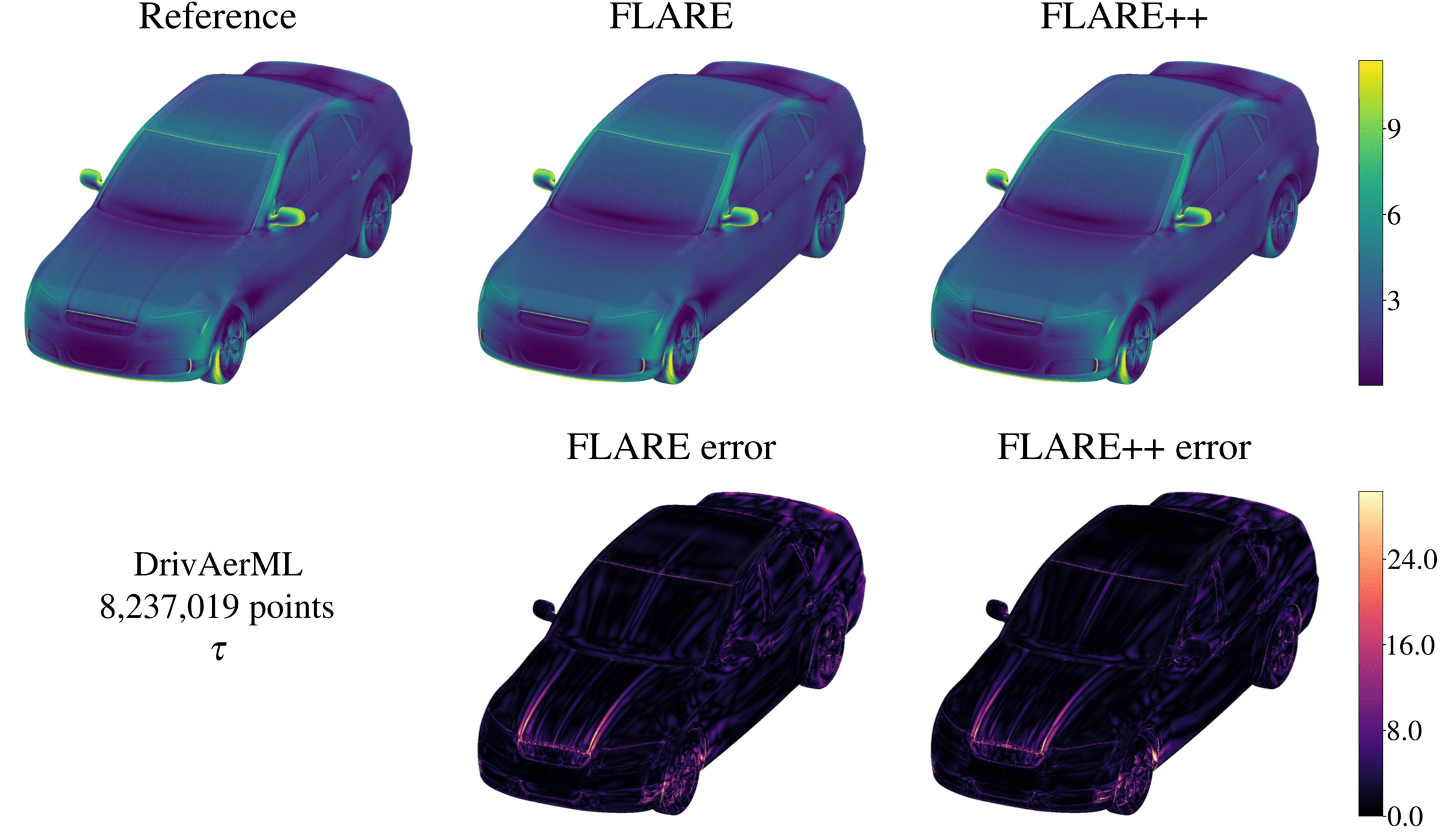
Faster convergence with improved routing
\(\approx30\%\) improvement at \(B=2\)
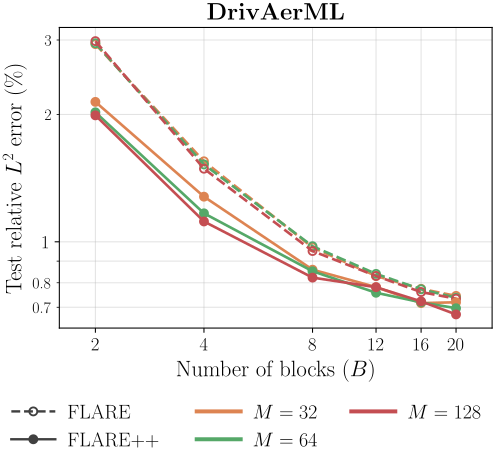
Continued improvement even at \(B=20\)
Dynamic routing improves low-rank attention on LRA
27
\(\text{Accuracy (\%)}\)
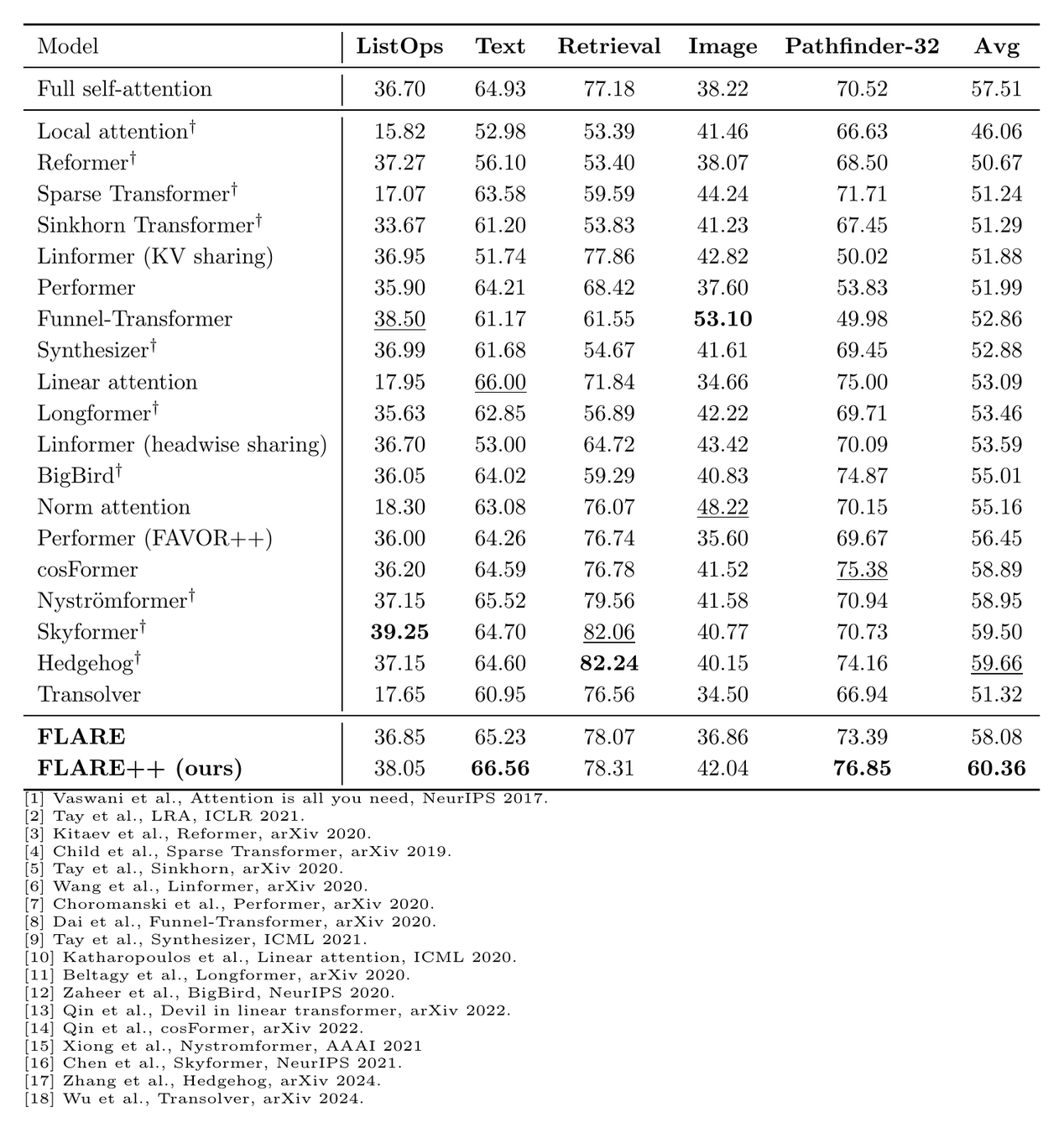
FLARE++ has highest average accuracy!
Our contributions
28
Future work
Substantial accuracy gains with shorter models
Low-rank attention with dynamic routing
Preprint out on arXiv. Will submit to ICLR
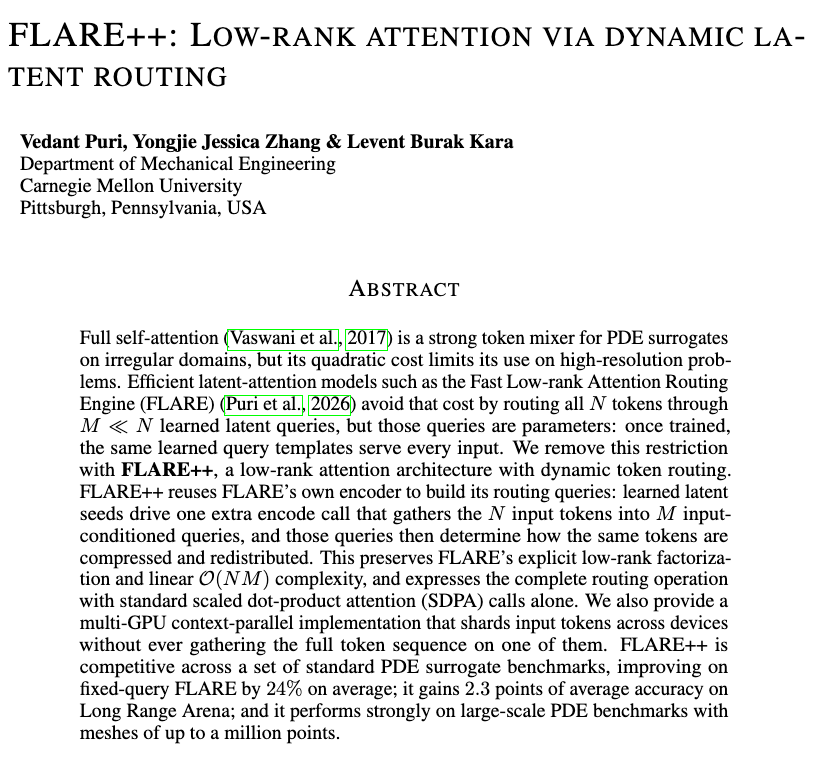
Extend to complex geometries: GeoFLARE++
Consider time-series PDE problems
Summary of this dissertation
Neural Reduced Order Modeling
Demonstrated numerical simulation with neural ansatz
Make attention-based PDE surrogate modeling feasible on large scale meshes
Improve accuracy with smarter compression
Scalable low-rank attention for PDE surrogates
Low-rank attention with dynamic routing
Publications
-
Puri, Vedant, Yongjie Jessica Zhang, and Levent Burak Kara. "FLARE++: Low-rank attention with dynamic token routing." arXiv preprint arXiv:2608.11519 (2026).
-
Puri, Vedant, Aditya Joglekar, Kevin Ferguson, Yu-hsuan Chen, Yongjie Jessica Zhang, and Levent Burak Kara. "FLARE: Fast Low-rank Attention Routing Engine." arXiv preprint arXiv:2508.12594 (2025).
-
Puri, Vedant, Aviral Prakash, Levent Burak Kara, and Yongjie Jessica Zhang. "SNF-ROM: Projection-based nonlinear reduced order modeling with smooth neural fields." Journal of Computational Physics 532 (2025): 113957.
- Shankar, Varun, Vedant Puri, Ramesh Balakrishnan, Romit Maulik, and Venkatasubramanian Viswanathan. "Differentiable physics-enabled closure modeling for Burgers’ turbulence." Machine Learning: Science and Technology 4, no. 1 (2023): 015017.
Acknowledgements
Thank you to CBML, VDEL for support and guidance over the years.
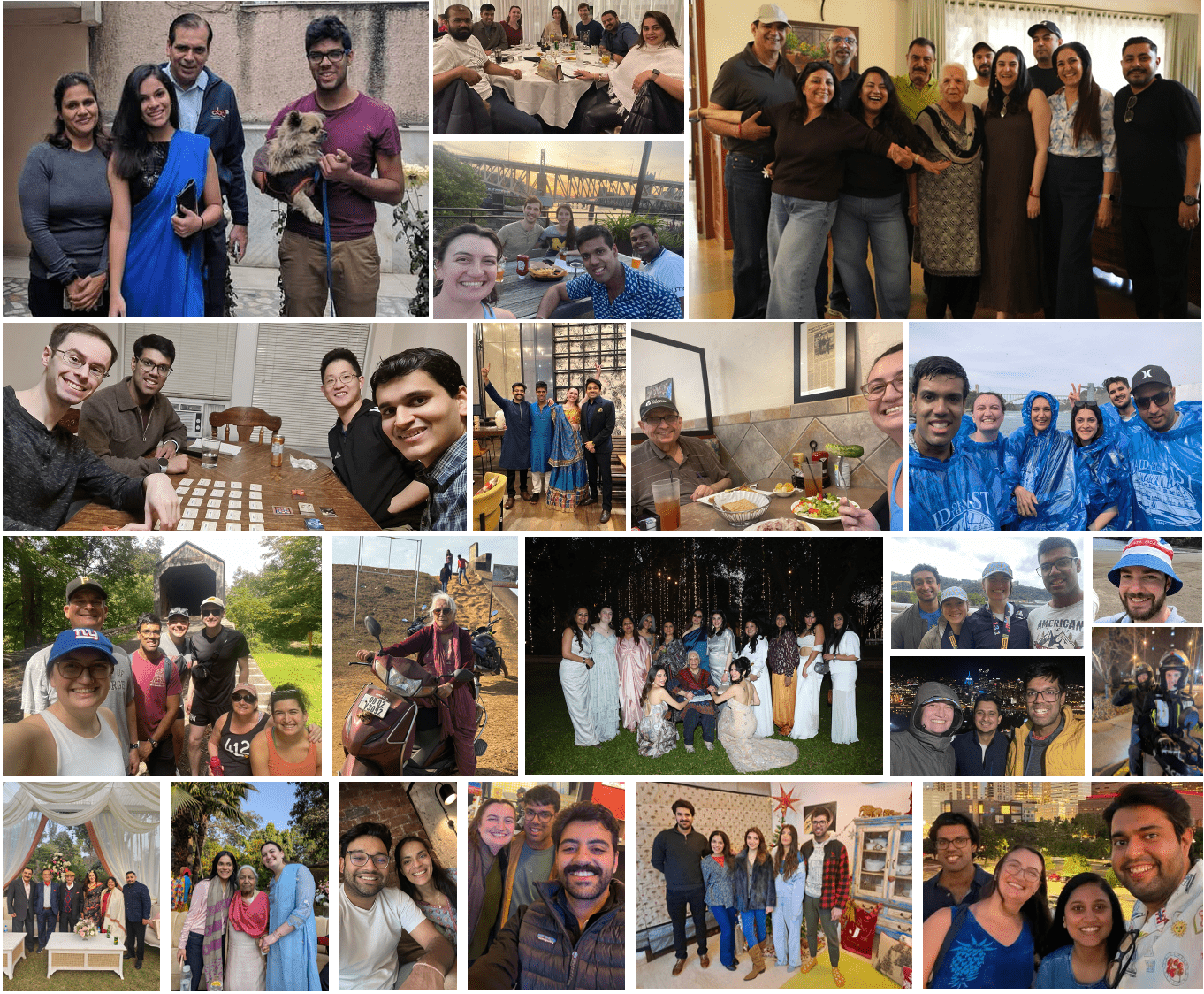
Committee Members
Dr. Levent Burak Kara
Dr. Yonjie Jessica Zhang
Dr. Amir Barati Farimani
Dr. Krishna Garikipati
Dr. Varun Shankar
Dr. Ramesh Balakrishnan
Dr. Romit Maulik
Dr. Venkatsubramanium Viswanathan
Dr. Aviral Prakash
Dr. Aditya Joglekar
Dr. Kevin Ferguson
Dr. Y-hsuan Chen
Sri Datta Ganesh Bandreddi
Collaborators
Thank you
Questions?
ROMs
Manifold learning
7
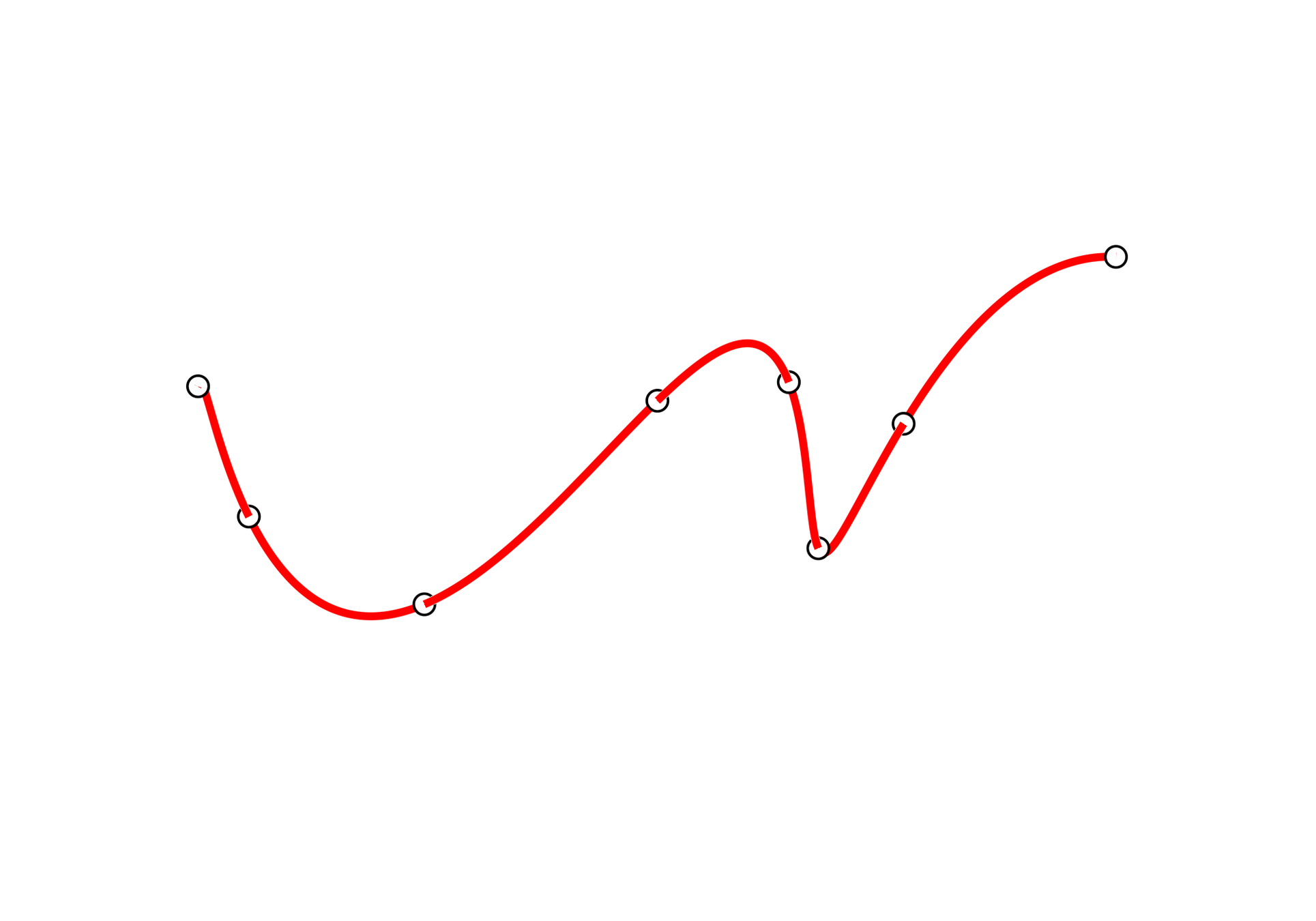
Full order model (FOM)
Manifold learning
7
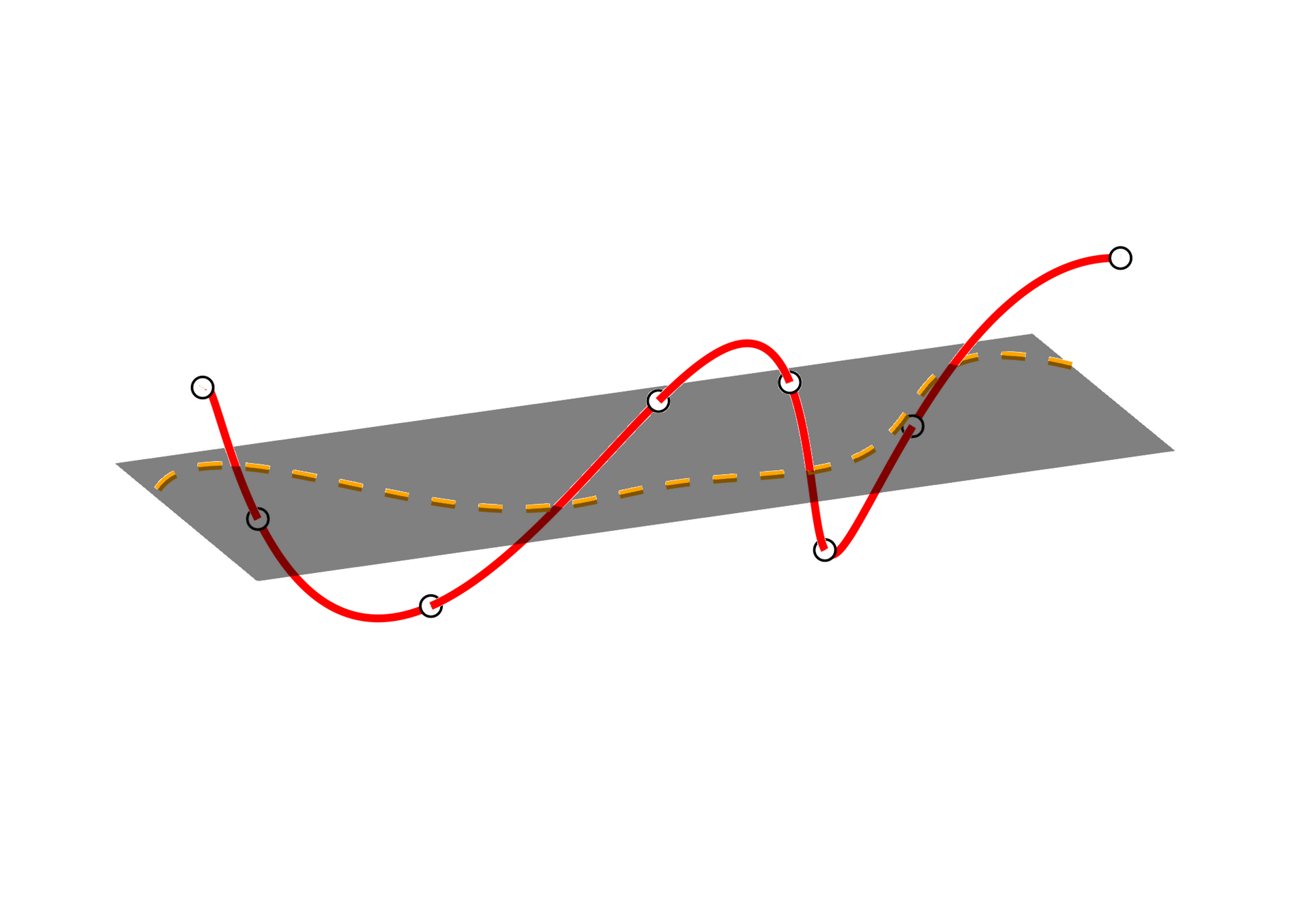
Full order model (FOM)
Linear POD-ROM
Large Kolmogorov \(N\)-width
in advection problems
Manifold learning
7
Full order model (FOM)
Linear POD-ROM
Nonlinear ROM
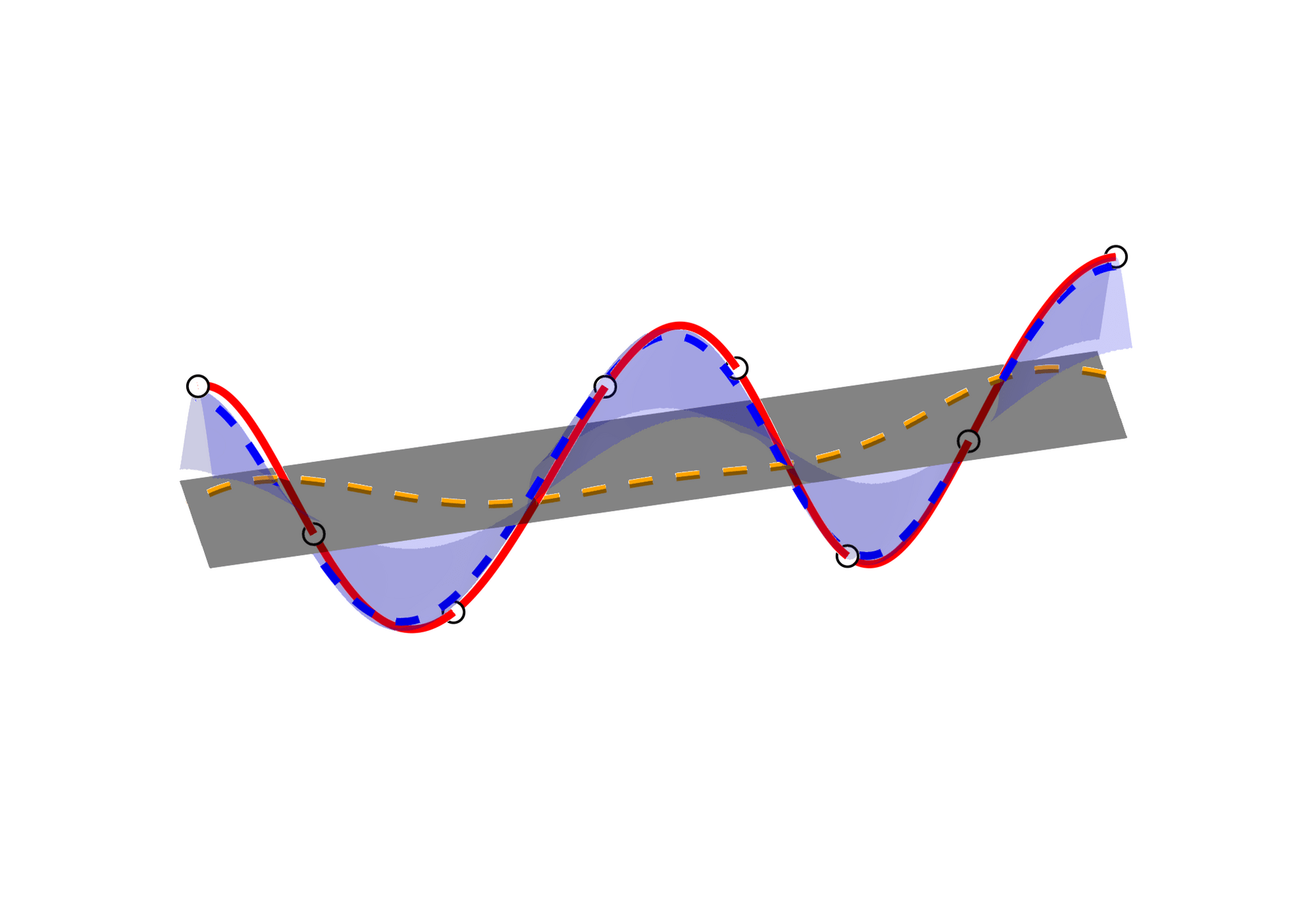
\({u}(x)=\)
Large Kolmogorov \(N\)-width
in advection problems
Background on model order reduction
6
Learn low-dimensional solution representation with data + evolve with physics.
High-dimensional simulation data
Collect and compress data
Evolve ODE on low-dim manifold
Cost savings from solving smaller ODE system.
Large Kolmogorov \(N\)-width in advection problems
Manifold learning via autoenoders cause deviations in physics solve
7
[1] Lee & Carlberg — Nonlinear manifold ROM via CNN autoencoders (JCP 2020)
\(\text{Encoder}\)
\(\text{Decoder}\)
Deviation in latent physics solve
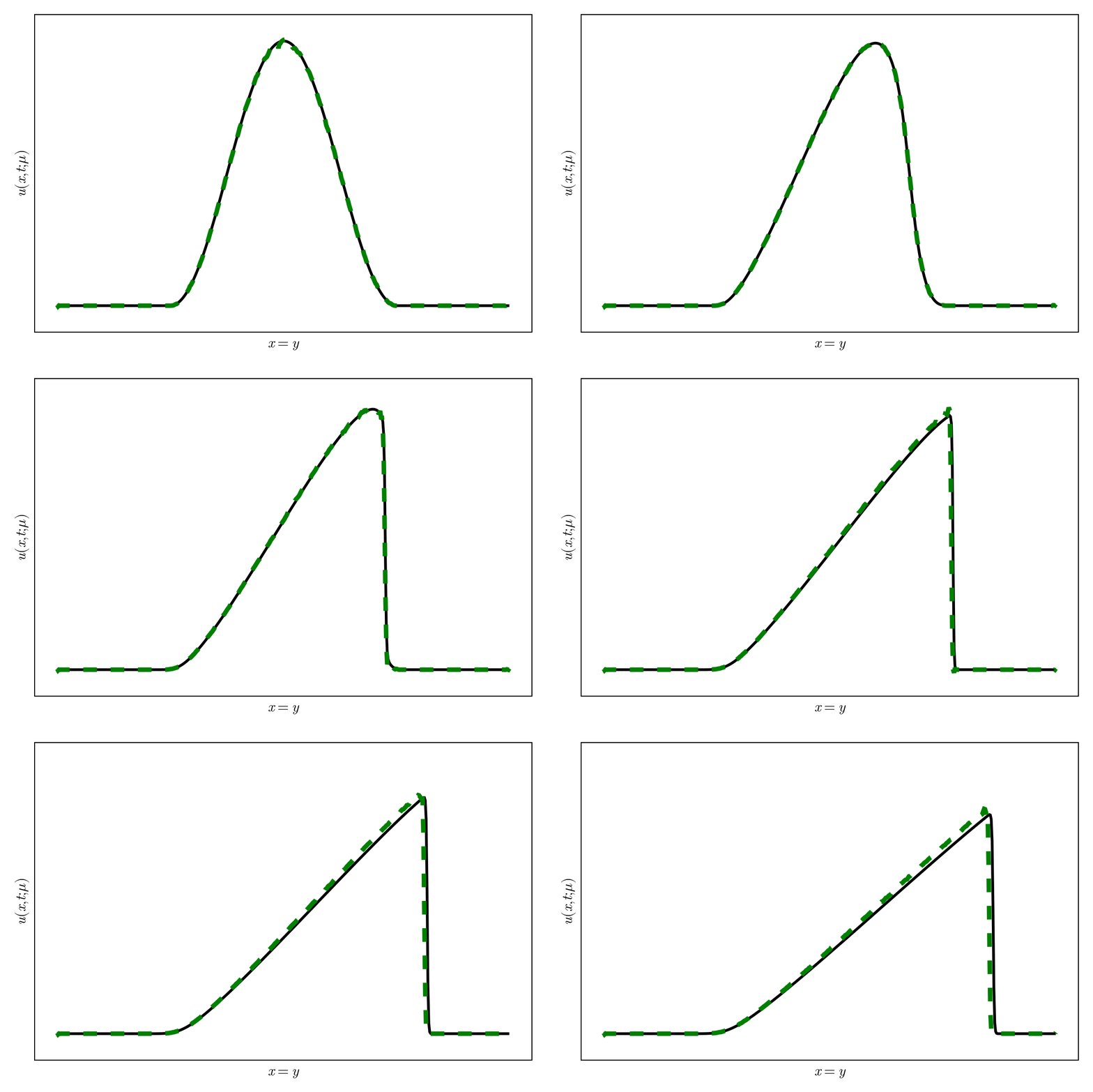
2D Burgers \(\mathit{Re}=1\mathit{k}\)
Grid-dependent inference-cost
Not amenable to hyper-reduction
Smooth Neural Field ROMs (SNF-ROM)
8
Change the solution representation to coordinate neural fields.
\(\text{PDE Problem}\)
\((\boldsymbol{x}, t, \boldsymbol{\mu})\)
\(\text{Coordinates}\)
\(\text{Neural field MLP }(g_\theta)\)

\(\boldsymbol{x}\)
\(\boldsymbol{u}\left( \boldsymbol{x}, t; \boldsymbol{\mu} \right)\)
\(\text{ Parameters}\)
\( \text{and time}\)
\(\tilde{u}\)
Grid-independent
Supports \(\partial_x\) through autodiff
Smooth Neural Field ROMs (SNF-ROM)
8
\(\text{Loss } (L)\)
\(\text{Backpropagation}\)
\(\nabla_\theta L\)
\(\nabla_\varrho L\)
\(\nabla_\theta L\)
Change the solution representation to coordinate neural fields.
\(\tilde{u}\)
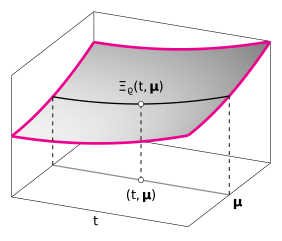
\(\text{PDE Problem}\)
\((\boldsymbol{x}, t, \boldsymbol{\mu})\)
\(\text{ Parameters}\)
\( \text{and time}\)
\(\text{ Intrinsic ROM manifold}\)
\(\text{Coordinates}\)
\(\text{Neural field MLP }(g_\theta)\)
\(\boldsymbol{x}\)
\(\boldsymbol{u}\left( \boldsymbol{x}, t; \boldsymbol{\mu} \right)\)
Grid-independent
Supports \(\partial_x\) through autodiff
Direct control over the complexity of latent trajecories
11
Experiment: 1D Viscous Burgers problem \( (\mathit{Re} = 10~{k})\)
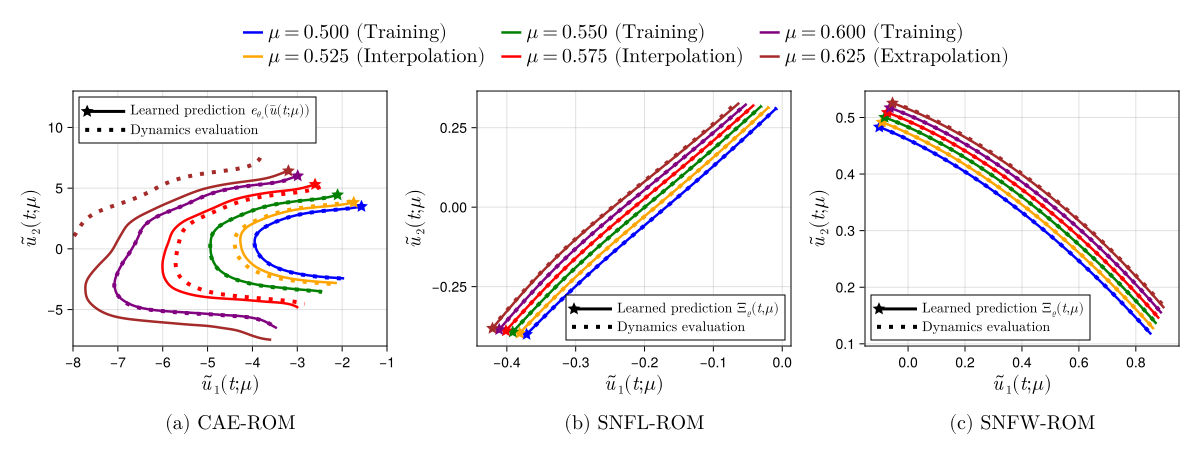
\(\text{CAE-ROM}\) [1]
\(\text{SNFL-ROM (ours)}\)
\(\text{SNFW-ROM (ours)}\)
Online dynamics solve matches learned trajectories
Online evaluation deviates!
Distribution of reduced states \((\tilde{u})\)
[1] Lee & Carlberg — Nonlinear manifold ROM via CNN autoencoders (JCP 2020)
Experiment: 2D Viscous Burgers problem \( (\mathit{Re} = 1~{k})\)
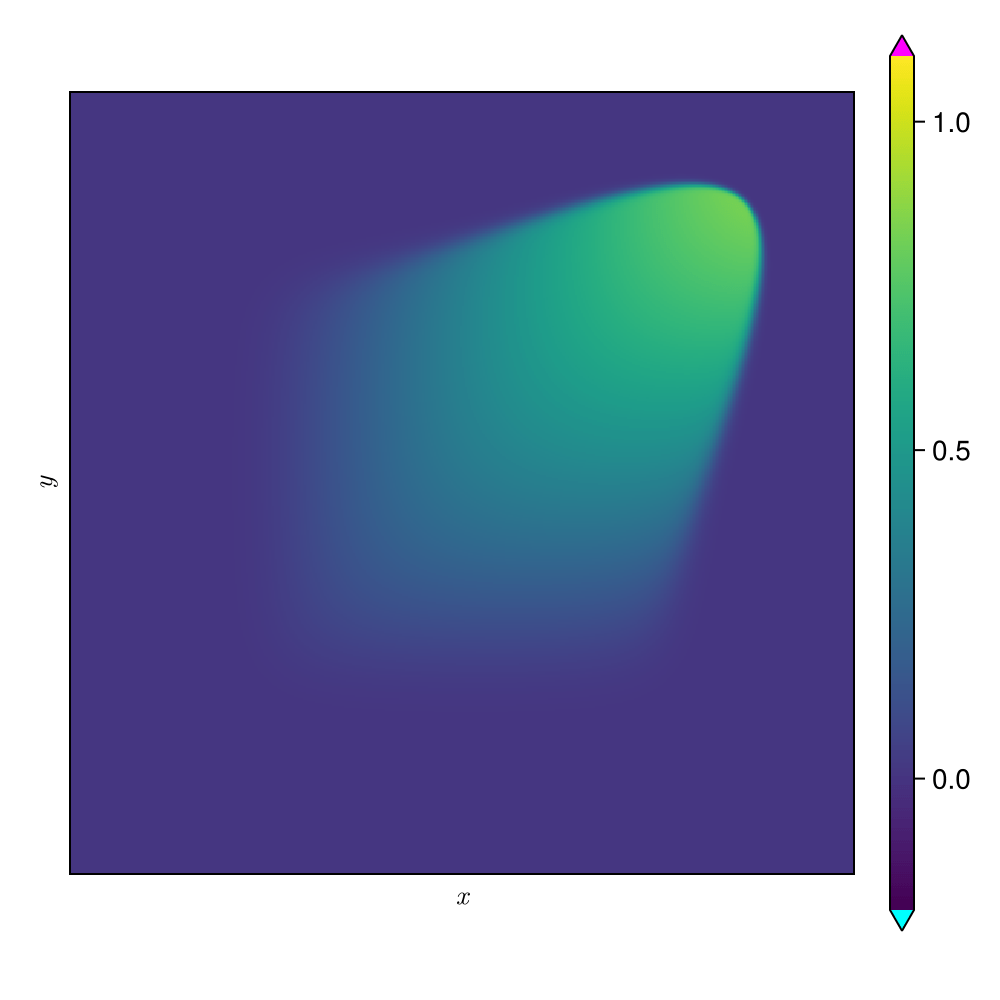
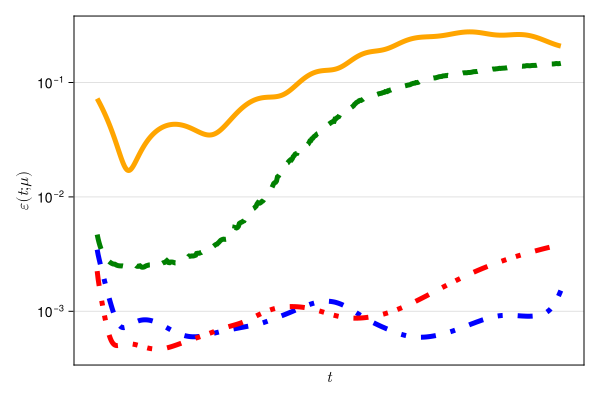
9
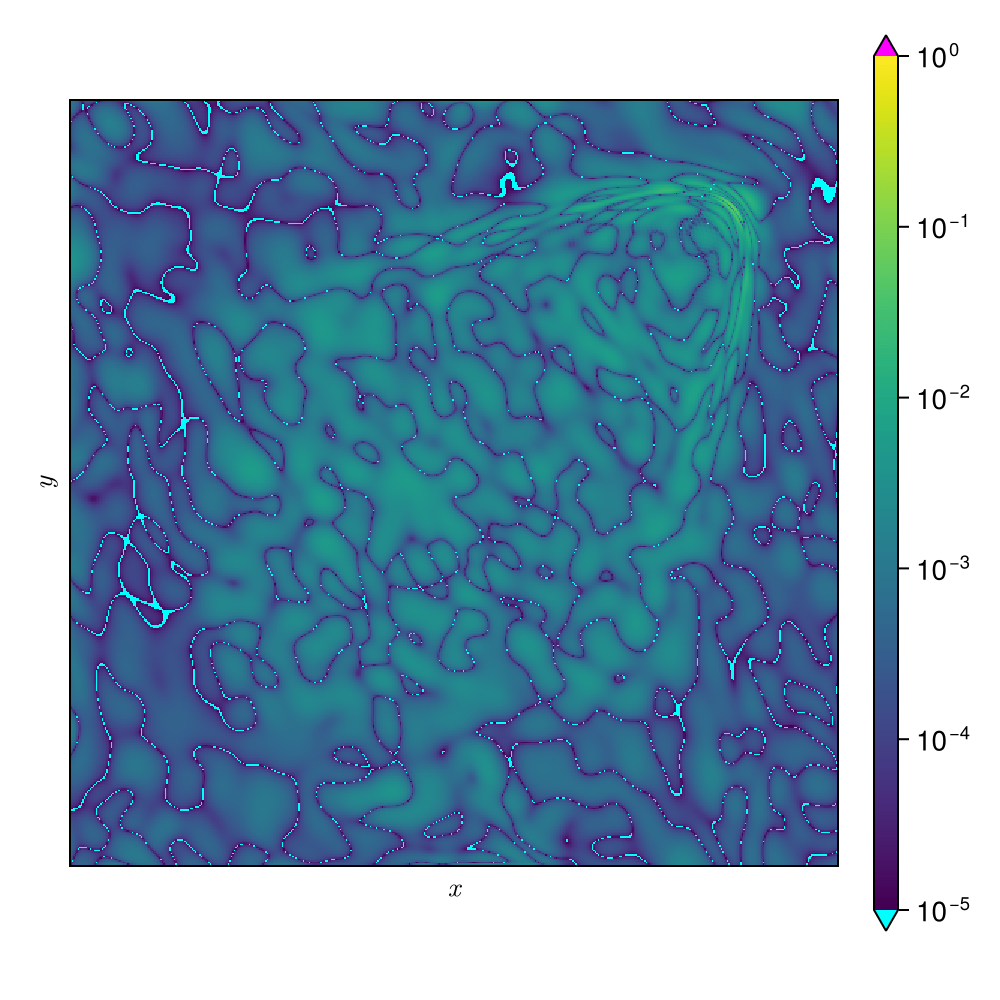
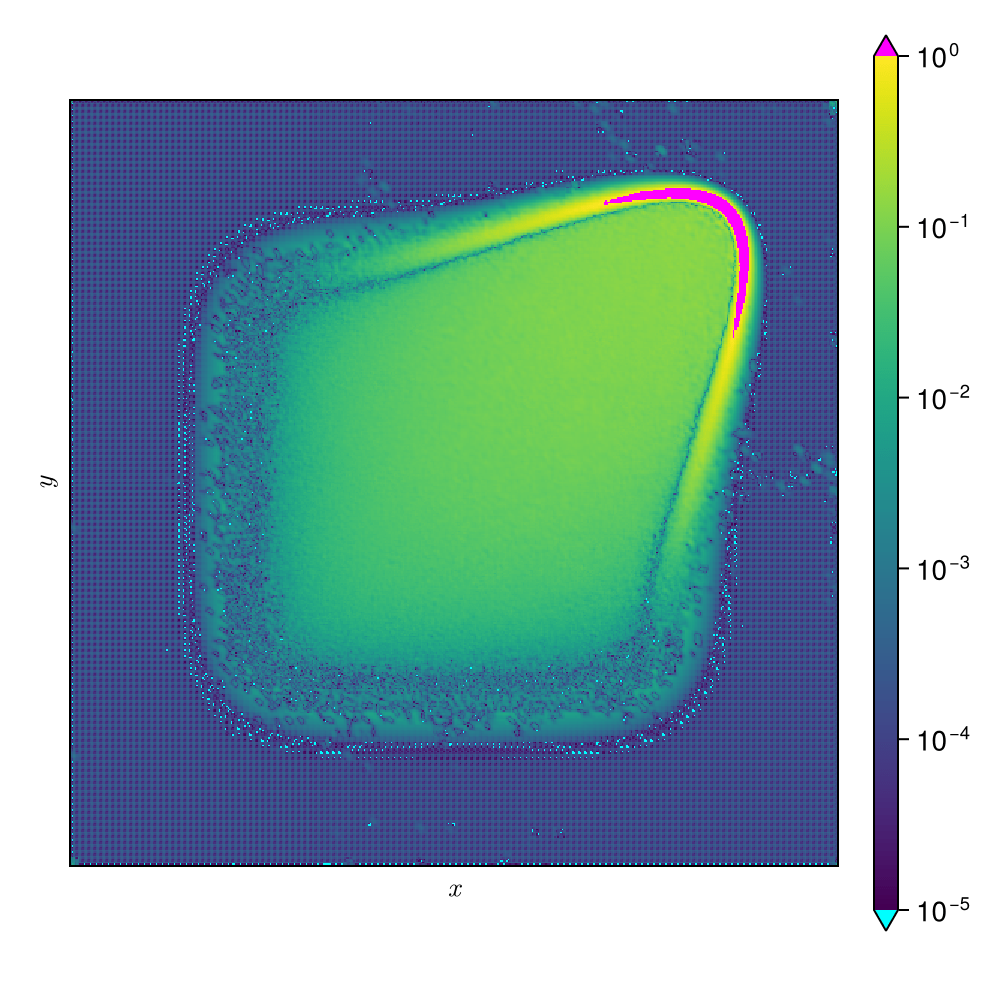
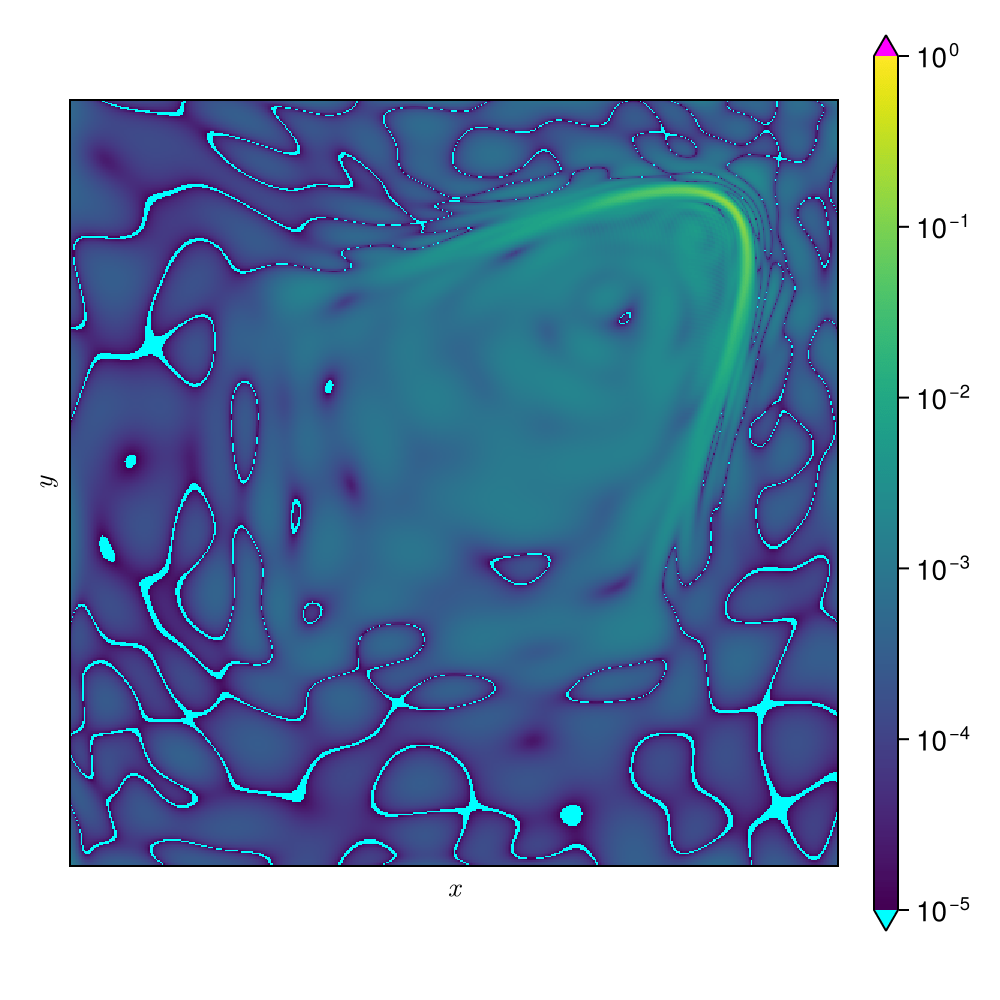
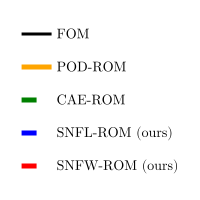
\(\text{CAE-ROM}\) [1]
\(\text{SNFL-ROM (ours)}\)
\(\text{SNFW-ROM (ours)}\)
Relative error
[1] Lee & Carlberg — Nonlinear manifold ROM via CNN autoencoders (JCP 2020)
\([1]\)
\(\text{DoFs: }500\text{k} \to 2\)
\(\text{Time }(t)\)
\(\text{Relative Error}(t)\)
\(199\times\) speed-up
Smooth Neural Field ROM directly controls latent trajectories
9
Supervised learning problem jointly learns latent trajectories and data manifold.
\(\text{Loss } (L)\)
\(\text{Backpropagation}\)
\(\nabla_\theta L\)
\(\nabla_\varrho L\)
\(\nabla_\theta L\)
\(\text{PDE Problem}\)
\((\boldsymbol{x}, t, \boldsymbol{\mu})\)
\(\text{ Parameters}\)
\( \text{and time}\)
\(\text{ Intrinsic ROM manifold}\)
\(\text{Coordinates}\)
\(\text{Smooth neural field MLP }(g_\theta)\)
\(\tilde{u}\)
\(\boldsymbol{x}\)
\(\boldsymbol{u}\left( \boldsymbol{x}, t; \boldsymbol{\mu} \right)\)
Force \( t \mapsto \tilde{u}(t) \) to be simple, e.g., shallow MLP.
Coordinate MLPs with sinusoidal activations offers grid-independence.
Replace autoencoder with a direct prediction workflow.
Accurate derivatives require smooth neural field representations
10
SNF-ROM with Lipschitz regularization (SNFL-ROM)
\(\text{Penalize the \textcolor{blue}{Lipschitz constant} of the MLP [arXiv:2202.08345]}\)
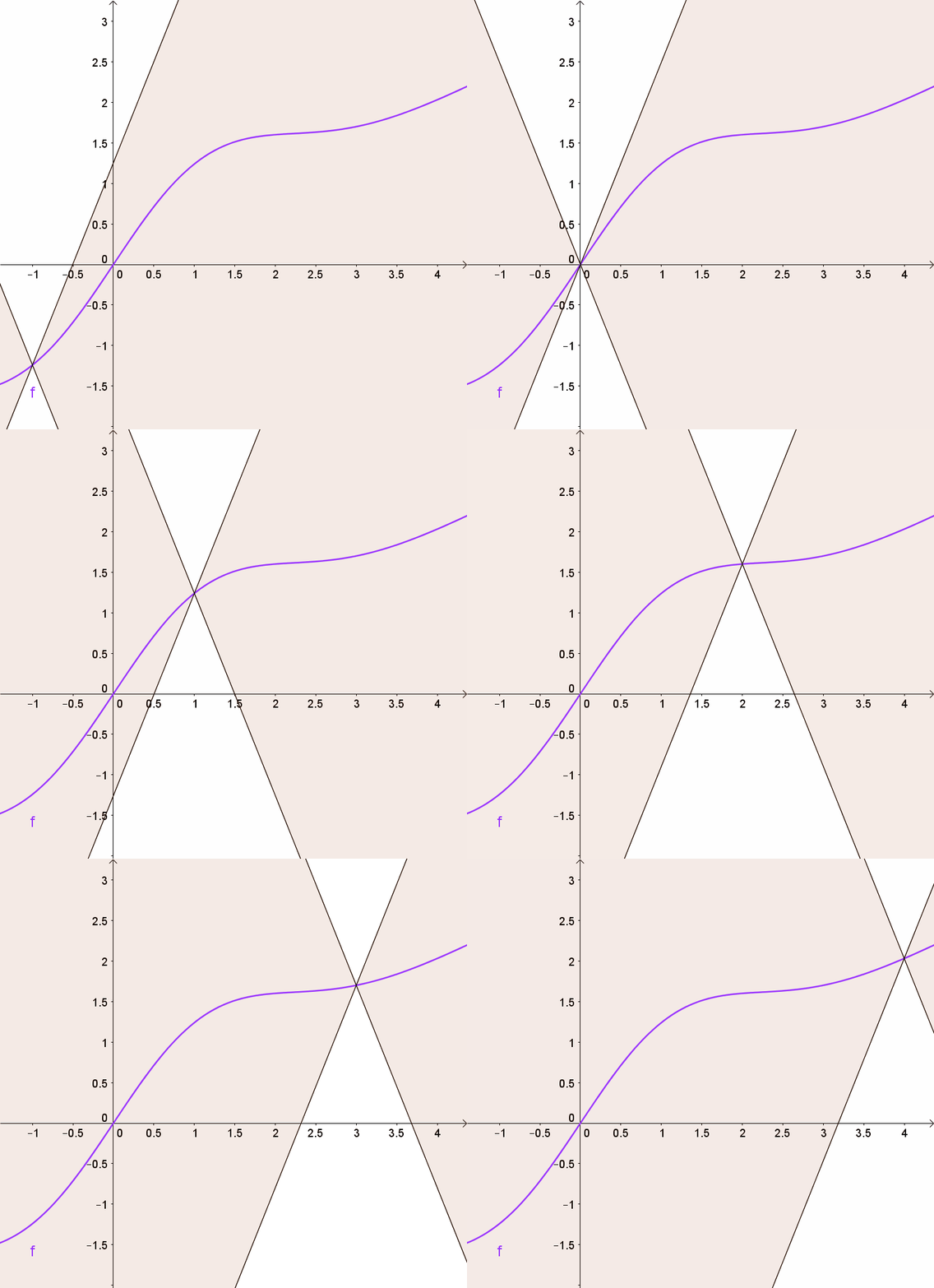
\(\text{[enwiki:1230354413]}\)
SNF-ROM with Weight regularization (SNFW-ROM)
\(\text{Directly penalize \textcolor{red}{high-frequency components} in }\dfrac{\text{d}}{\text{d} x}\text{NN}_\theta(x)\)
We present two approaches to learn inherently smooth and accurately differentiable neural field MLPs.
\({x}\)
\({u(x)}\)
High freq. noise
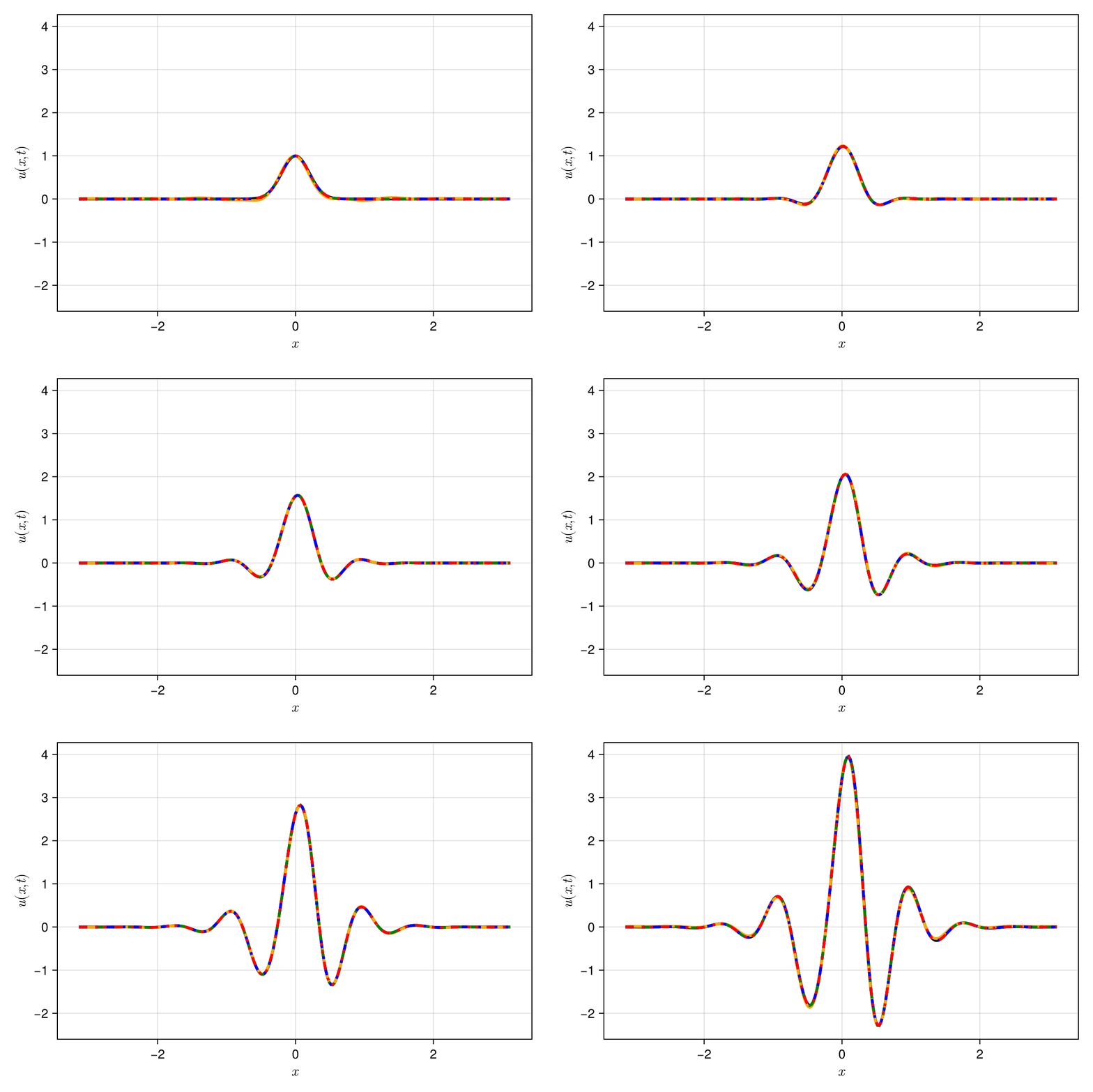
Experiment: 1D Kuramoto-Sivashinsky problem
12
SNF-ROM maintains high accuracy even with larger time-steps.
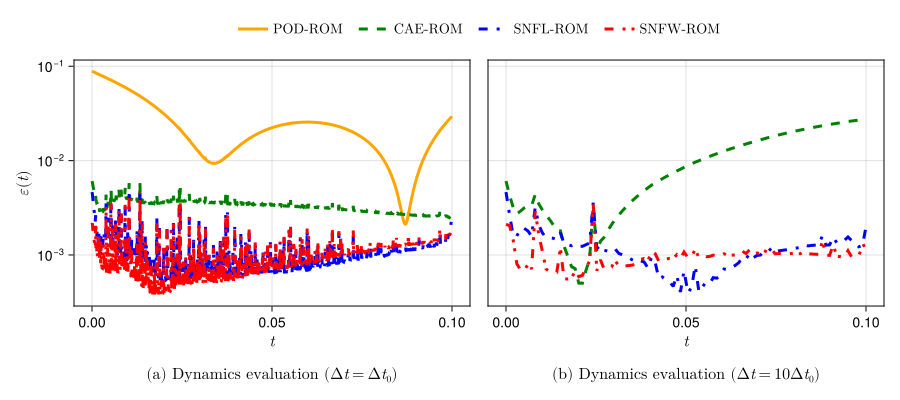
\(\text{Relative error vs time } (\Delta t = \Delta t_0)\)
\(\text{Relative error vs time } (\Delta t = 10\Delta t_0)\)

[1] Lee & Carlberg — Nonlinear manifold ROM via CNN autoencoders (JCP 2020)
Experiment: 2D Viscous Burgers problem \( (\mathit{Re} = 1~{k})\)
13
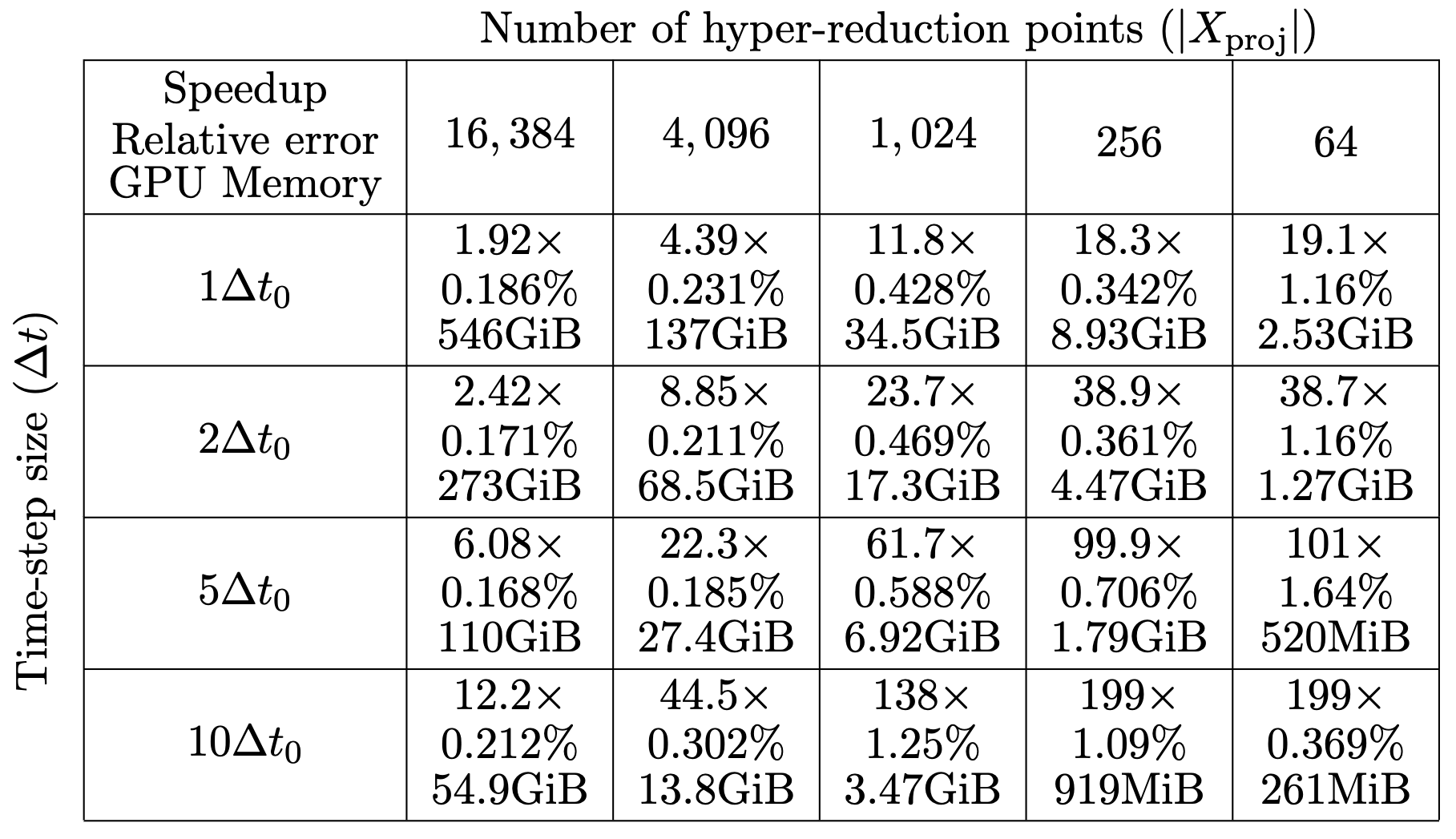
\(\text{CAE-ROM}\) [1]
\(\text{SNFL-ROM (ours)}\)
\(\text{SNFW-ROM (ours)}\)
\(\text{Relative error }\)
[1] Lee & Carlberg — Nonlinear manifold ROM via CNN autoencoders (JCP 2020)
\([1]\)
FLARE
Quadratic \((\mathcal{O}(N^2))\) cost of attention limits scalability
17
Over \(20~\text{s}\) per gradient step on a mesh of 1m poins!
[1] Vaswani et al. — “Attention Is All You Need”, NeurIPS 2017
Situating FLARE in the space of latent attention methods
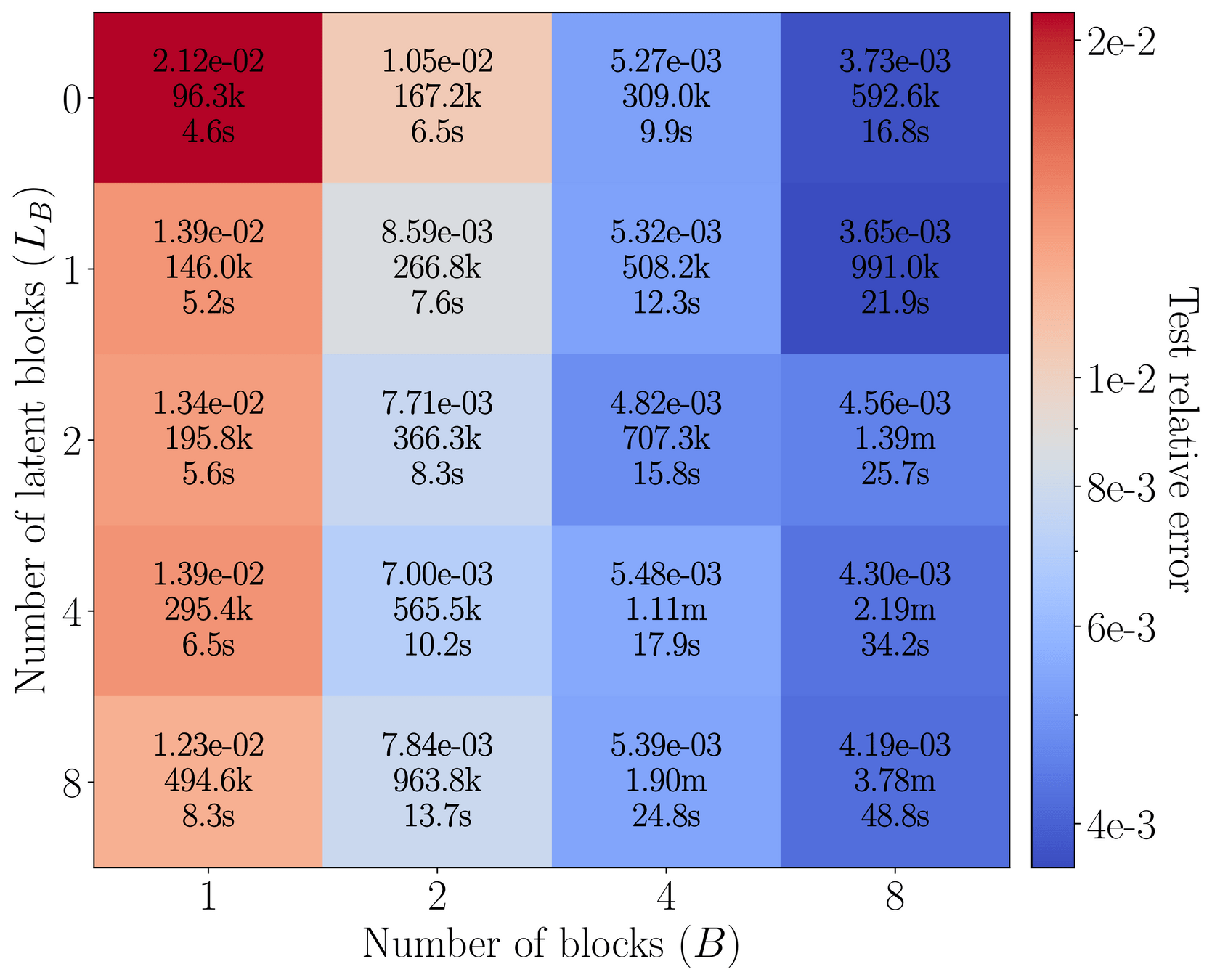
Multiple parallel low-rank pathways
Multi-head cross-attention encoder/decoder
Eliminate latent-space self-attention
Simplify and connect latent attention to low-rank
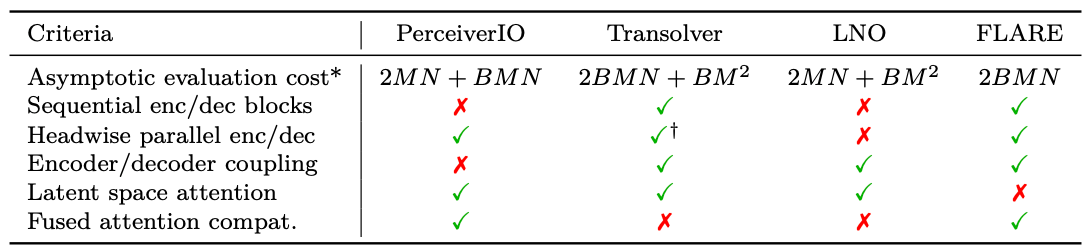
+Transolver has same nn.Linear(D,M) proj for all heads.
Isolate attention routing as the load-bearing pirmitive
Extreme scalability thanks to SDPA compatibility
Laser powder bed fusion benchmark problem
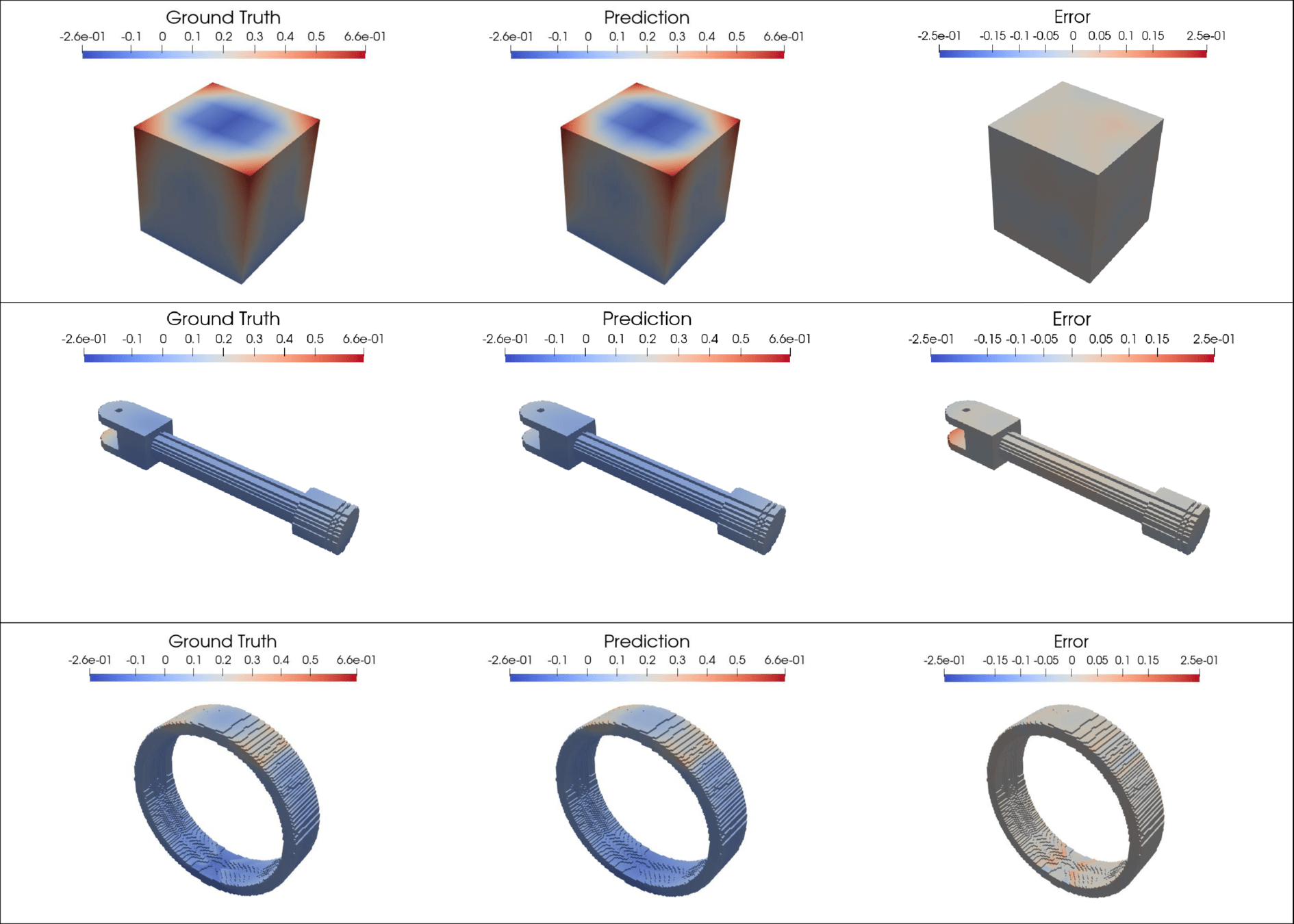
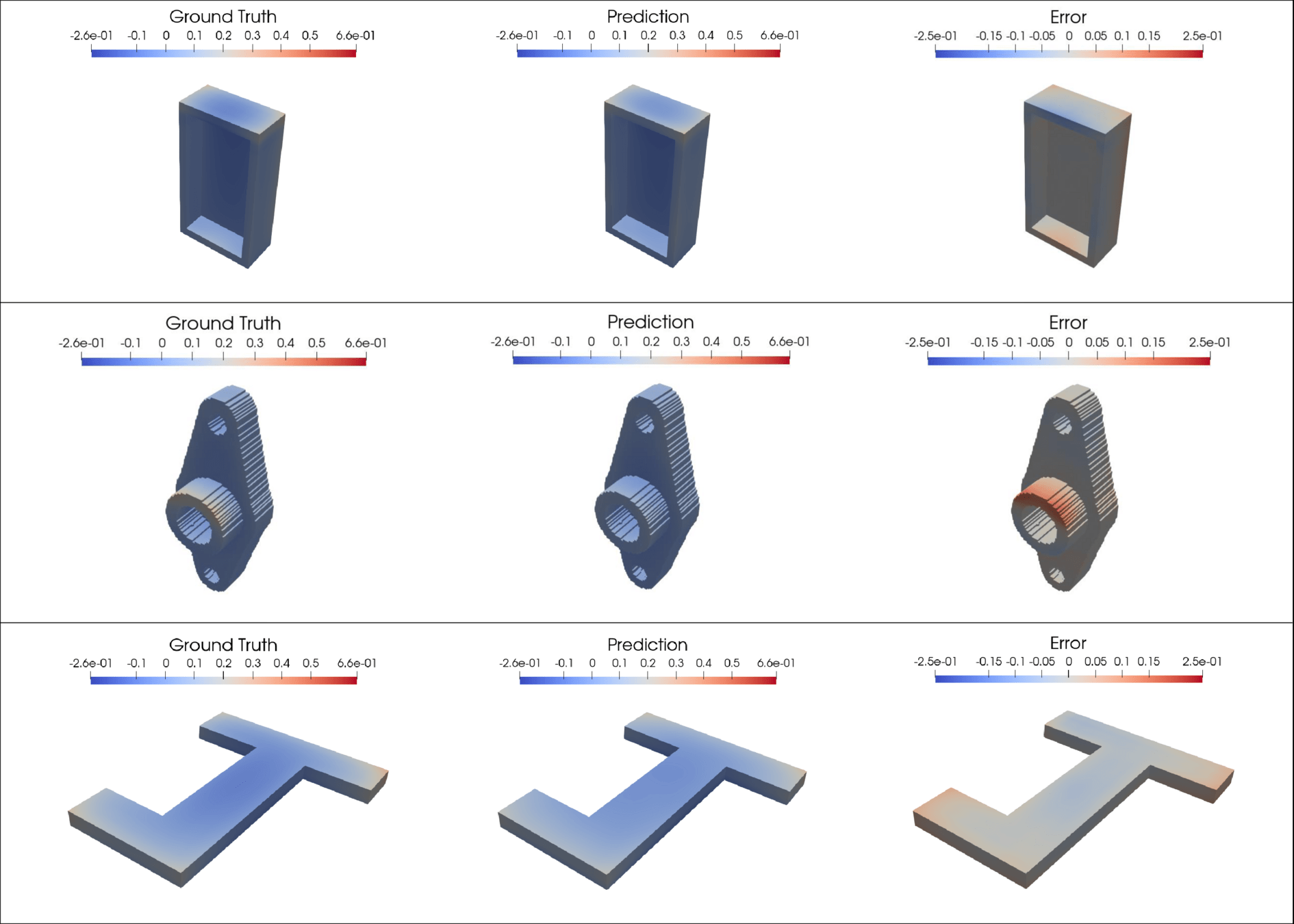
16
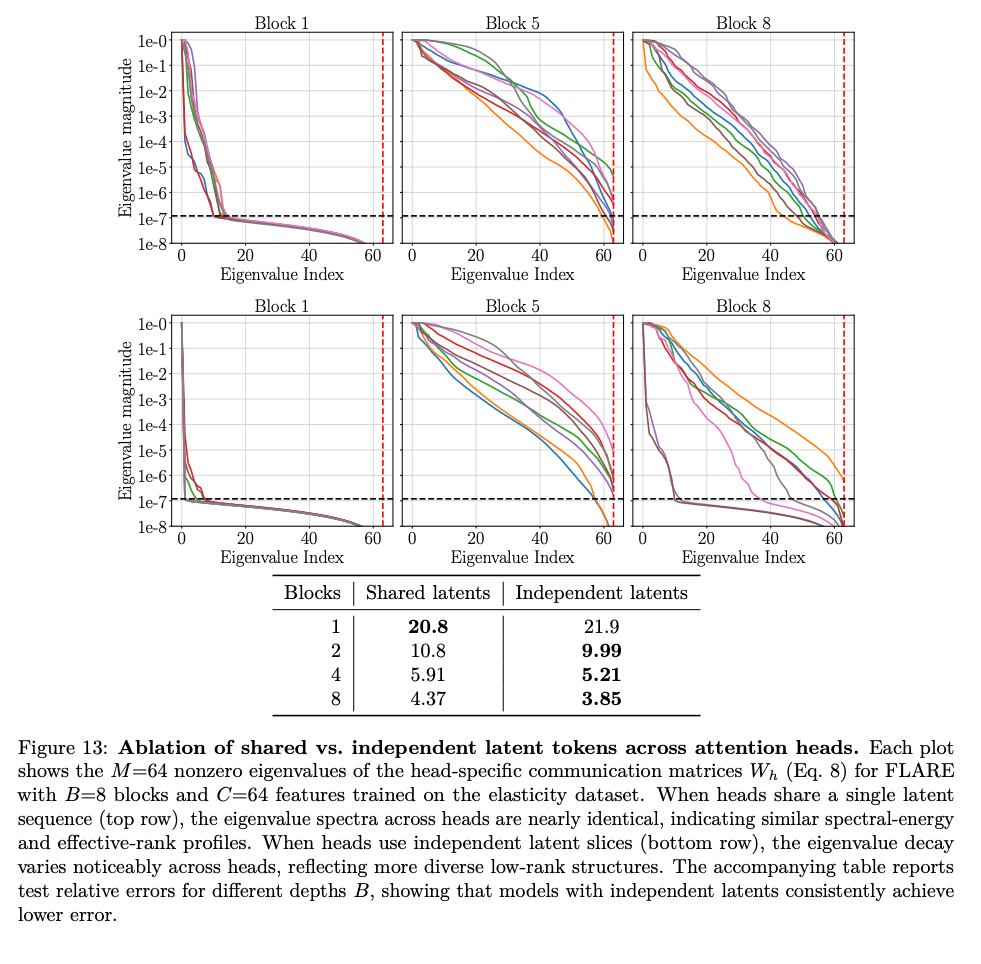
FLARE Spectral analysis
FLARE++
FLARE++ performs equally well in mixed-precision
25
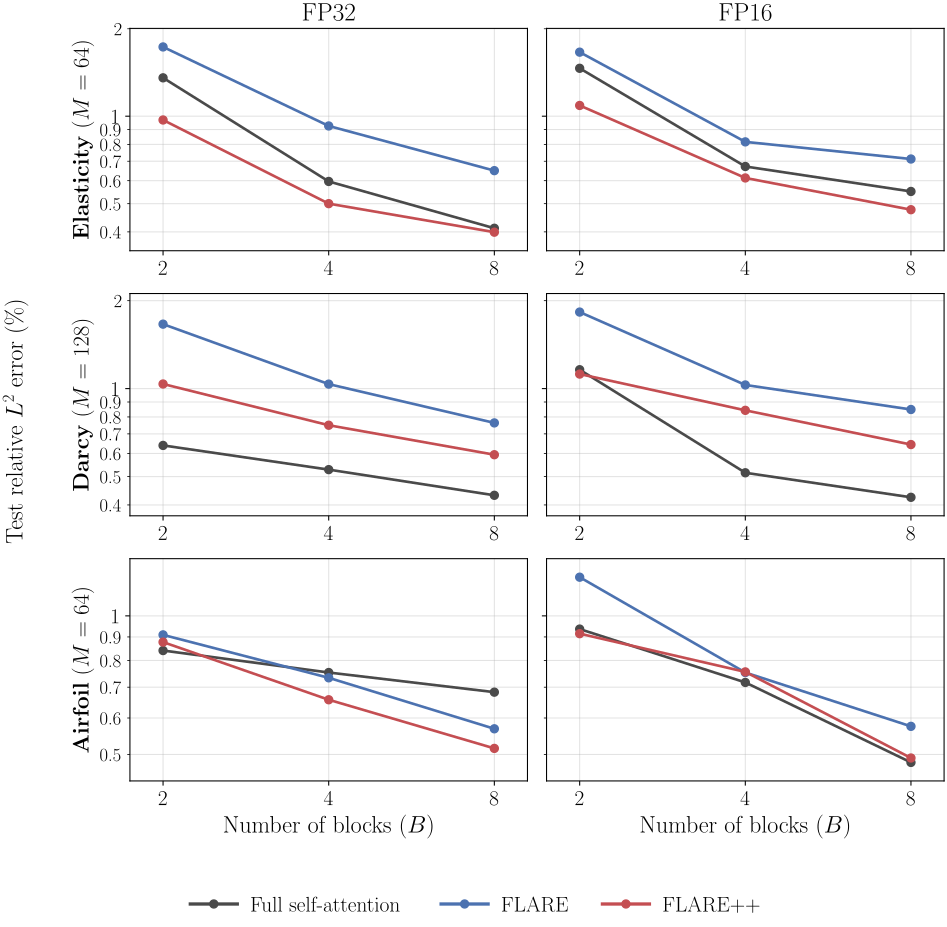
Darcy
Elasticity
Airfoil
FLARE++ improves on FLARE!
Maintains accuracy in FP16
Competitive with full self-attention
11
FLARE++ External Aerodynamics
Aim 2: background on next-token prediction transformers [1]
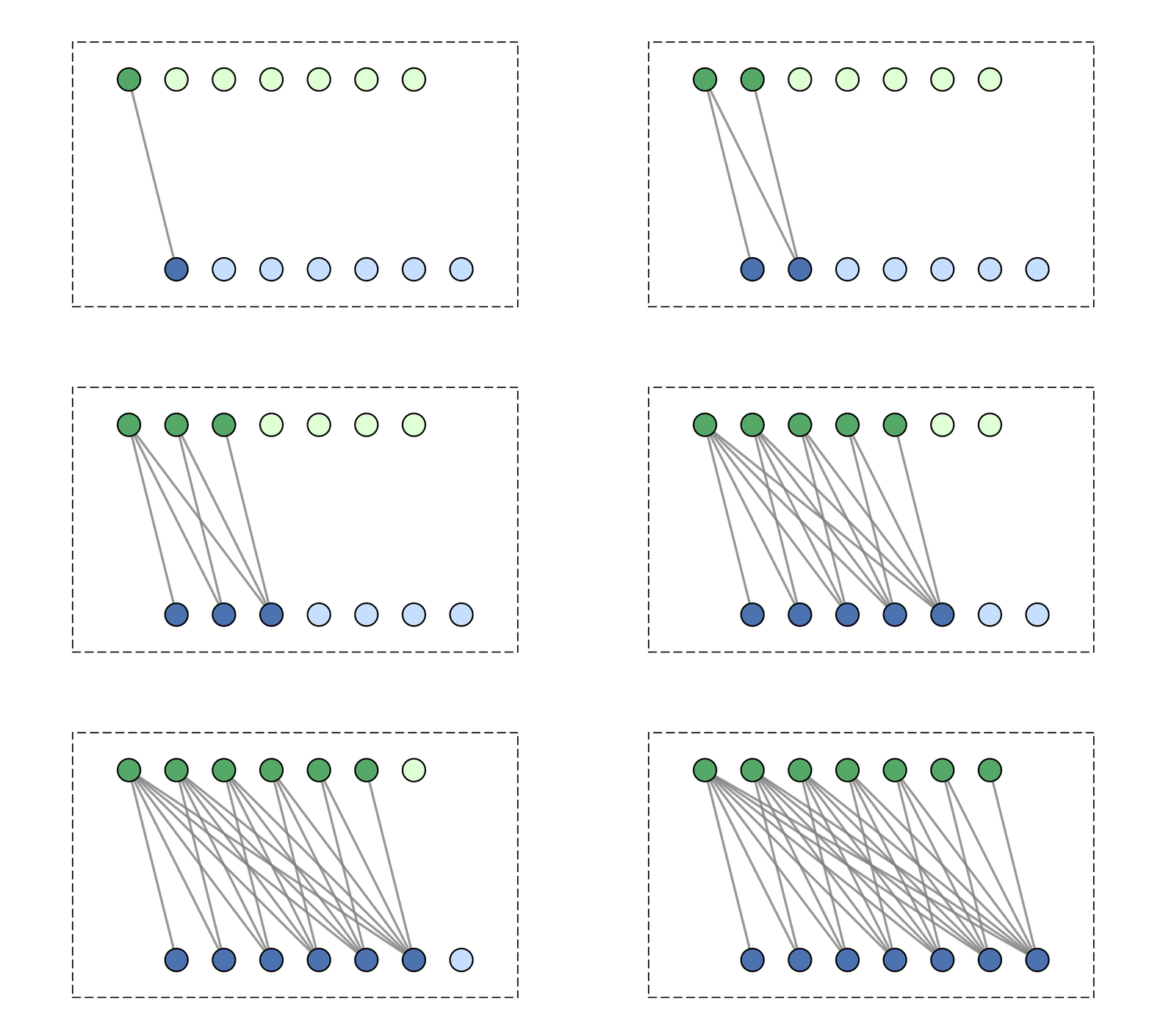
All previous key/value \(\{k_\tau, v_\tau \}_{\tau \leq t}\) must be cached on the GPU.
Major memory and latency bottleneck!
33
[1] Vaswani et al. — “Attention Is All You Need”, NeurIPS 2017
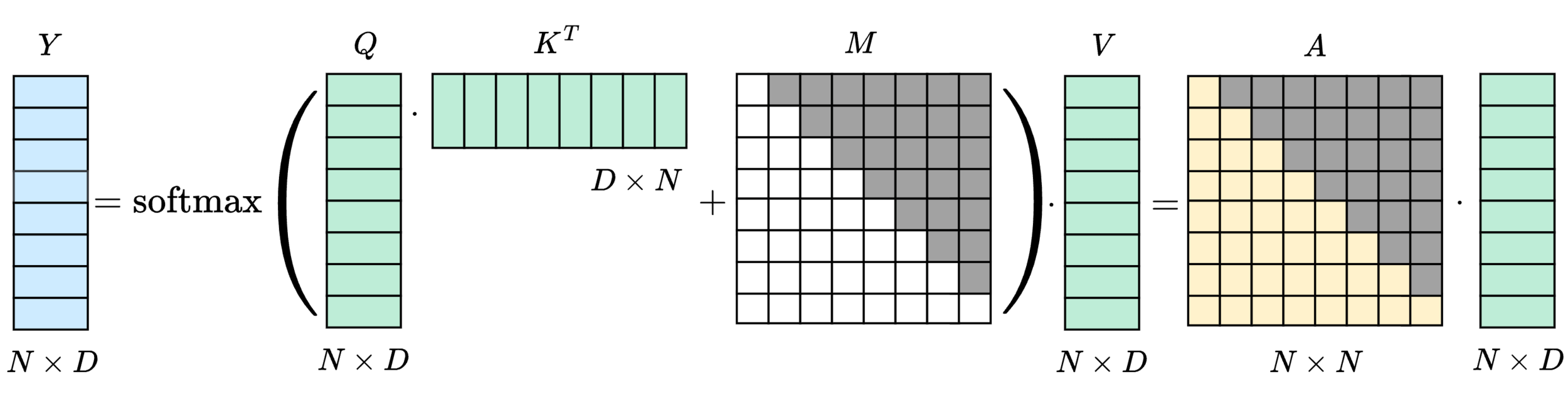
Training algorithm (causal masking)
Inference algorithm (recurrence relation)
Dot-products need to be recomputed for every \(q_t\).
\(\mathcal{O}(N^2)\) complexity.
Aim 2: Develop decoder version of FLARE
Linear time auto-regressive attention.
Fixed memory footprint (only store \(\mathcal{O}(M)\) cache).
Flexible latent capacity.
Advantages
Required components
Fused GPU kernels for training and inference.
Bespoke training algorithm for causal FLARE.
Extensive benchmarking and evaluation.
34
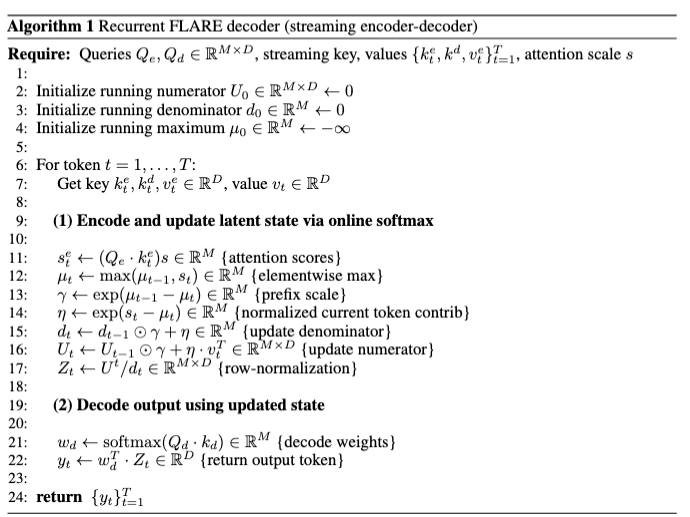
Inference algorithm (recurrence rule)
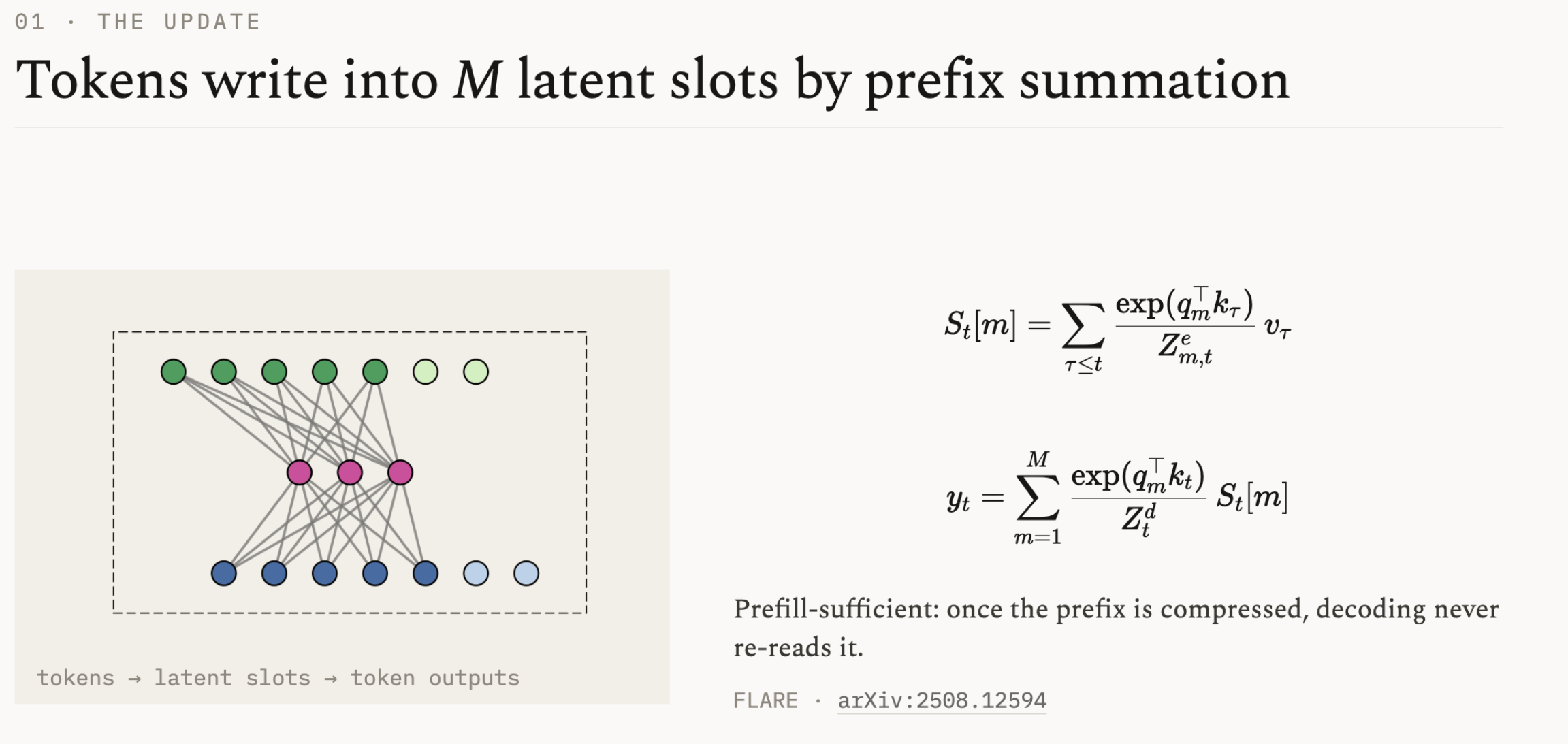
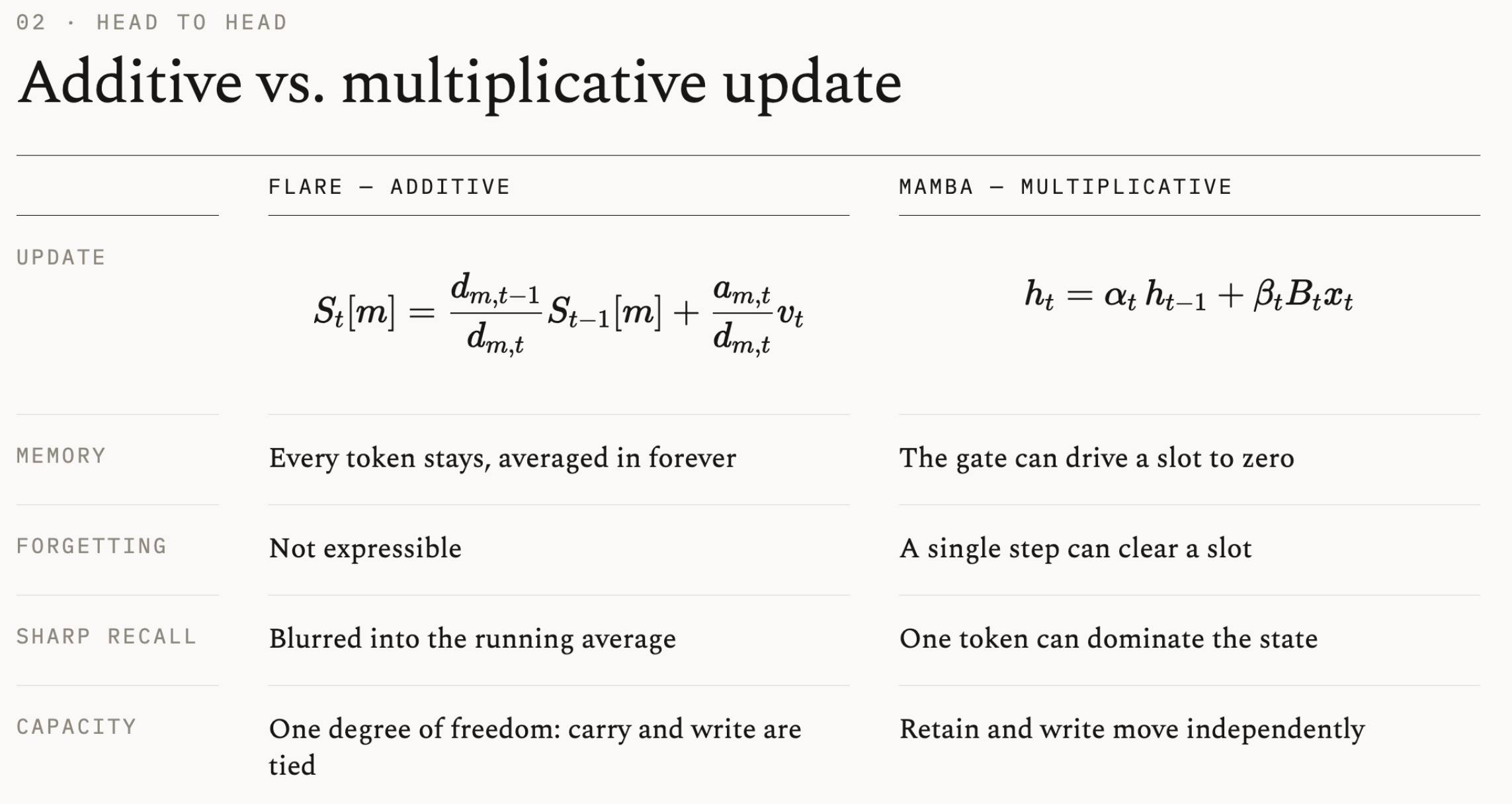
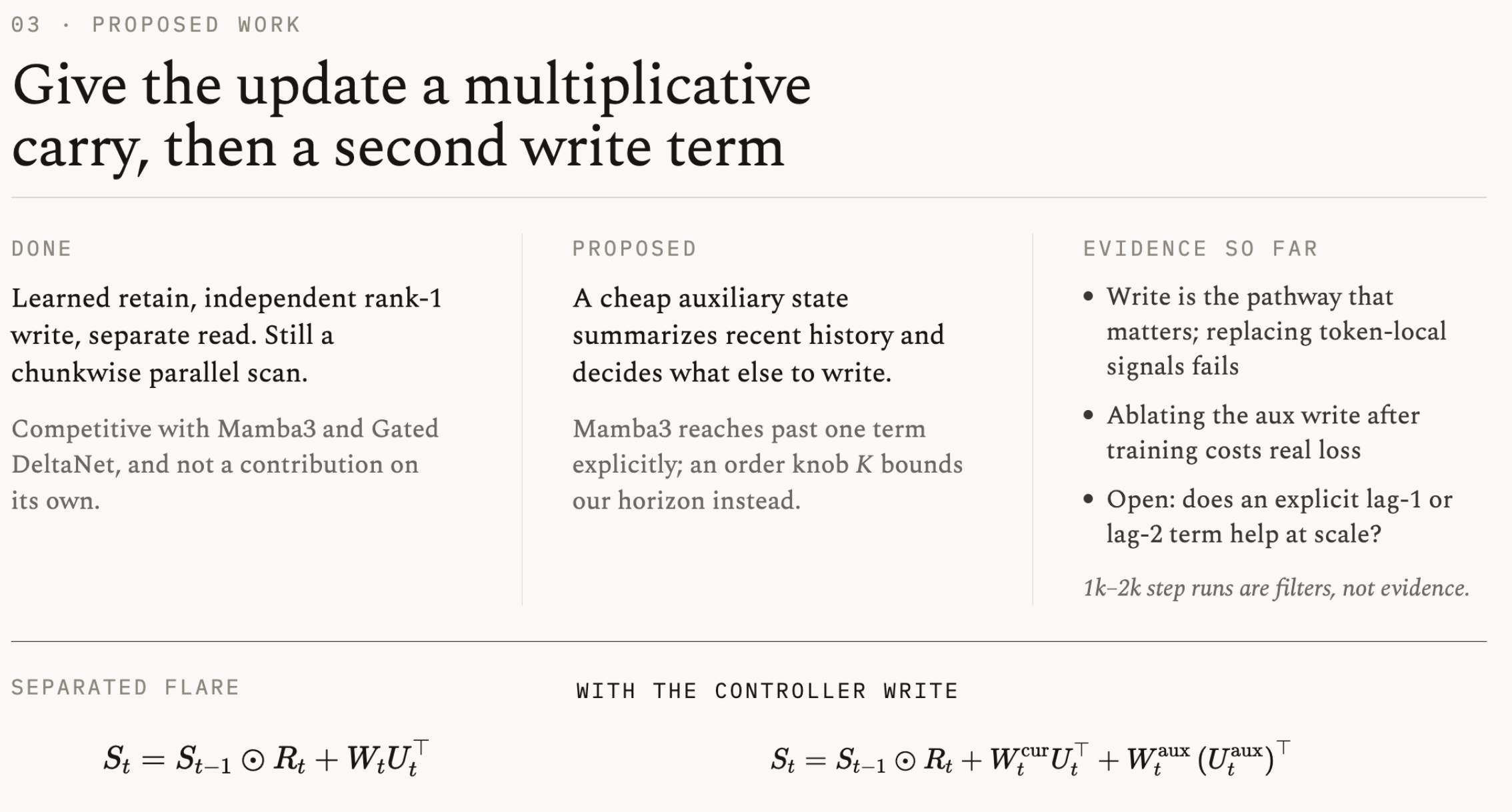
Next-token prediction with FLARE
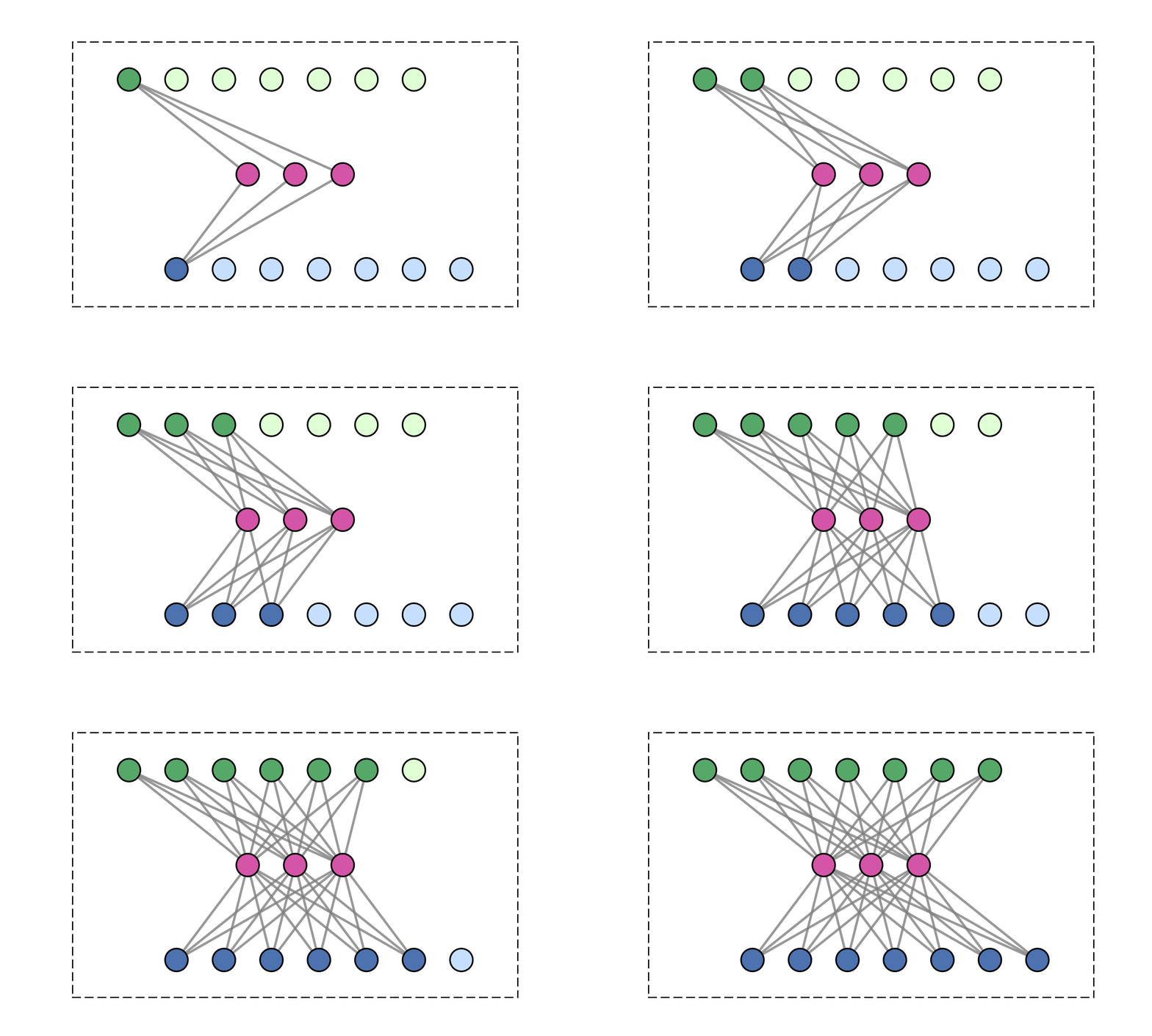
FLARE decoder recurrence
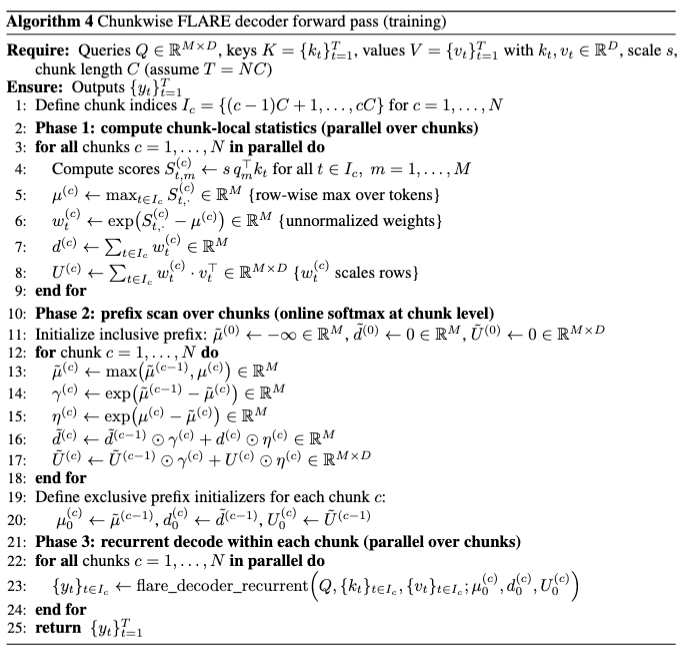
FLARE decoder recurrence
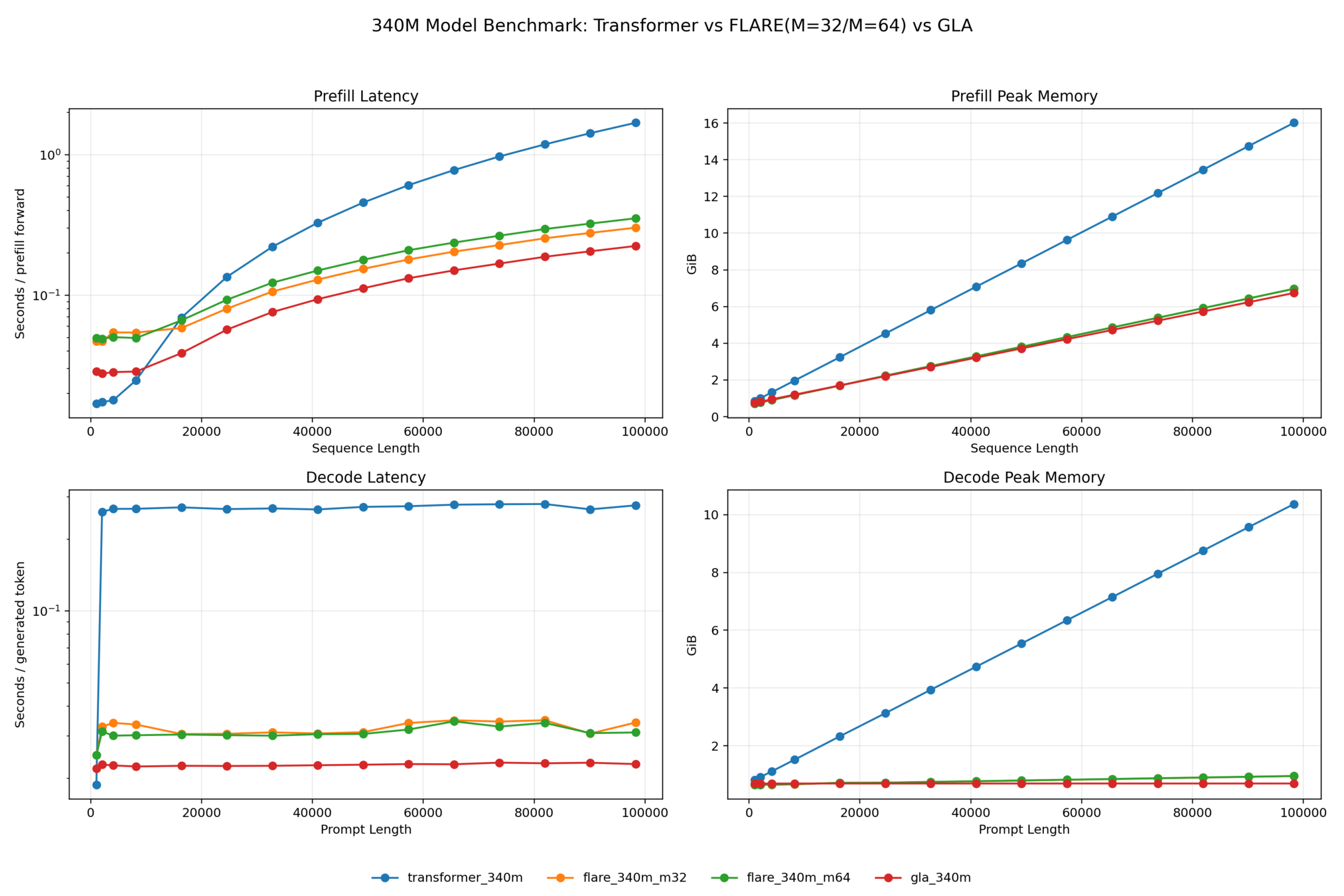
https://github.com/vpuri3/flash-linear-attention-pvt/blob/run/legacy/training/STORYTELLING.md
https://github.com/vpuri3/flash-linear-attention-pvt/blob/run/legacy/training/STORYTELLING.md
https://github.com/vpuri3/flash-linear-attention-pvt/blob/run/legacy/training/STORYTELLING.md
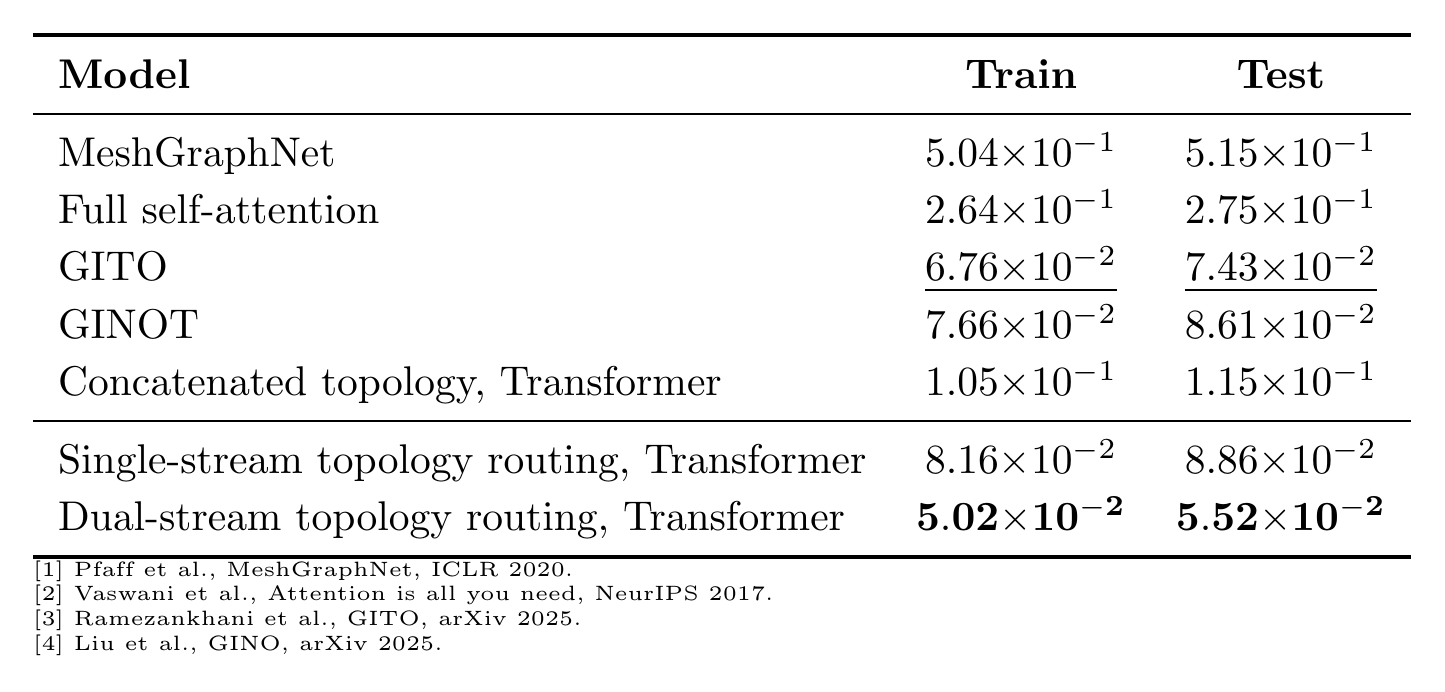
TopoFLARE
Point cloud attention fails on complex geometries
22
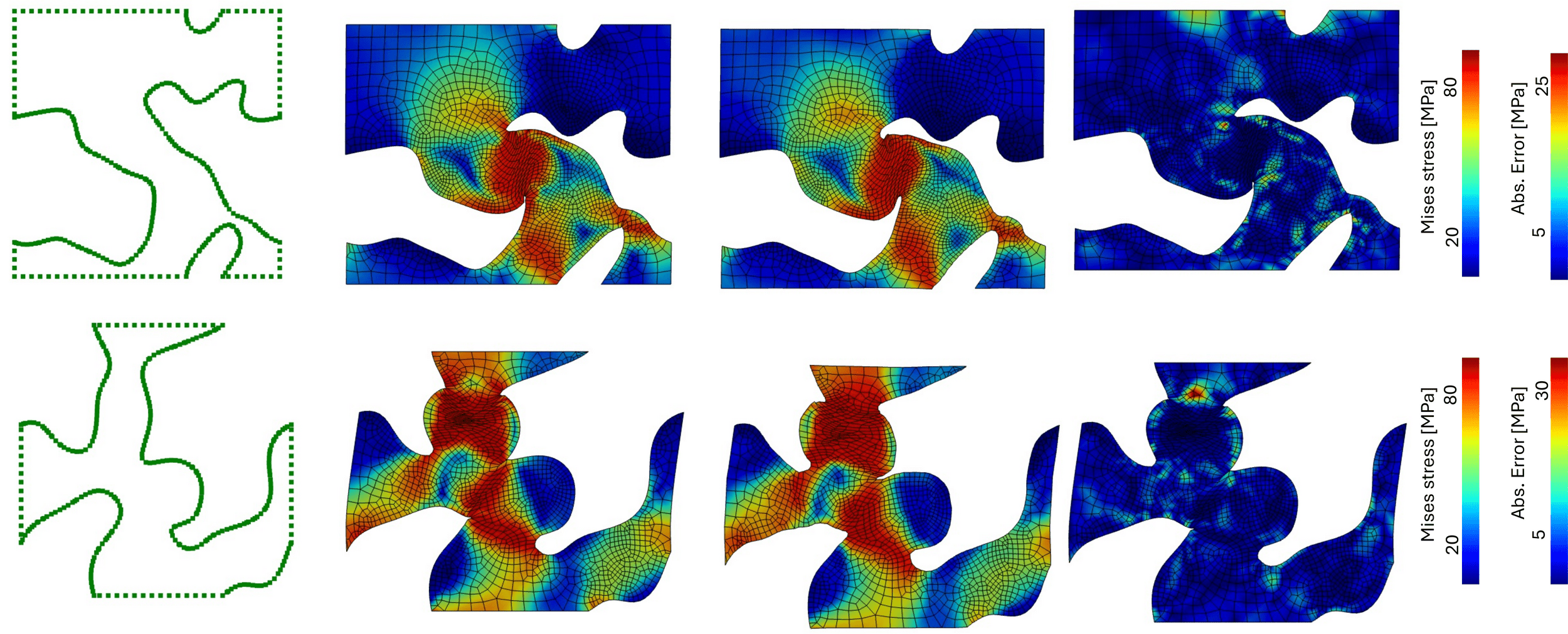
Topology-conditioned routing
22
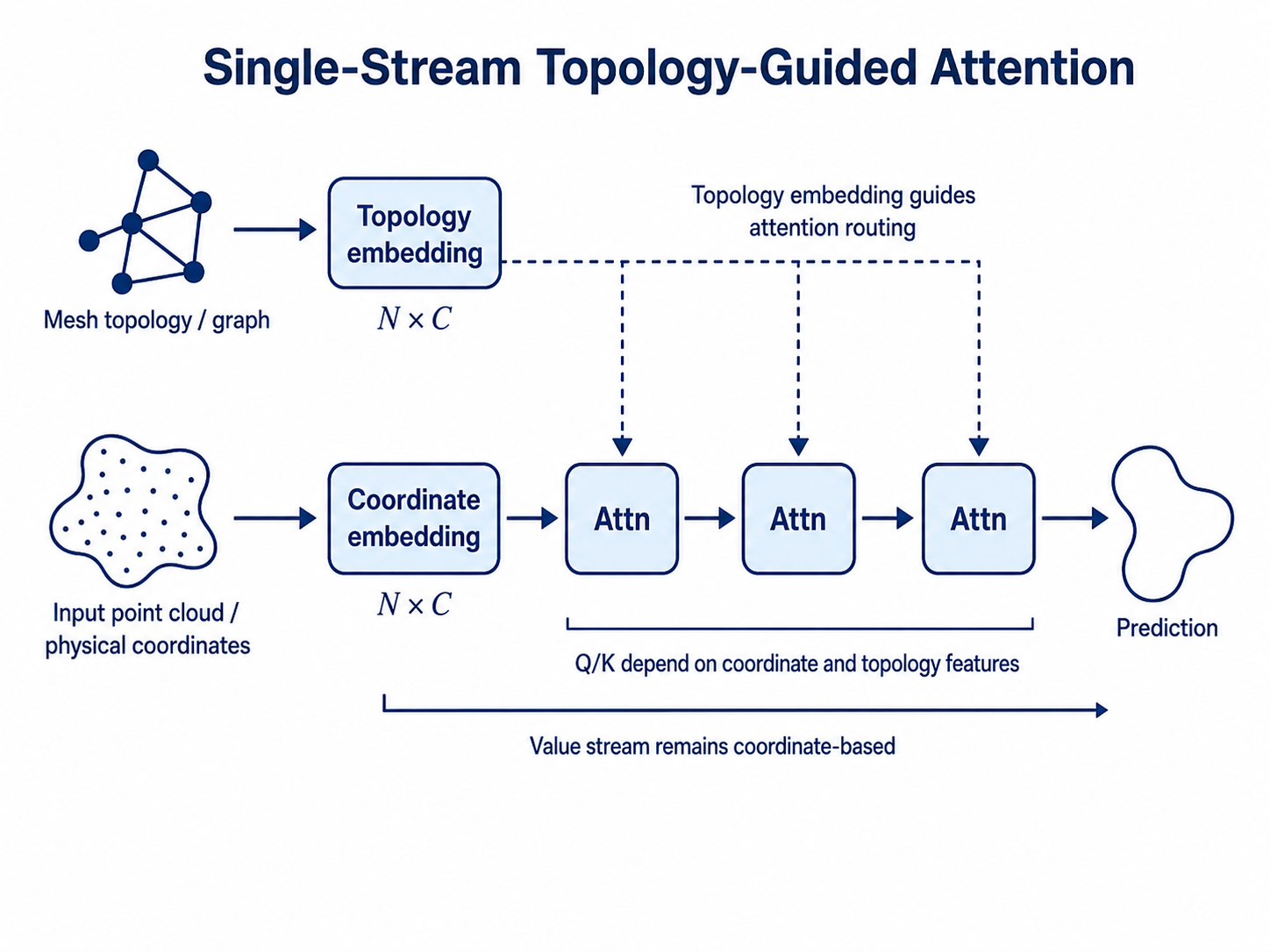
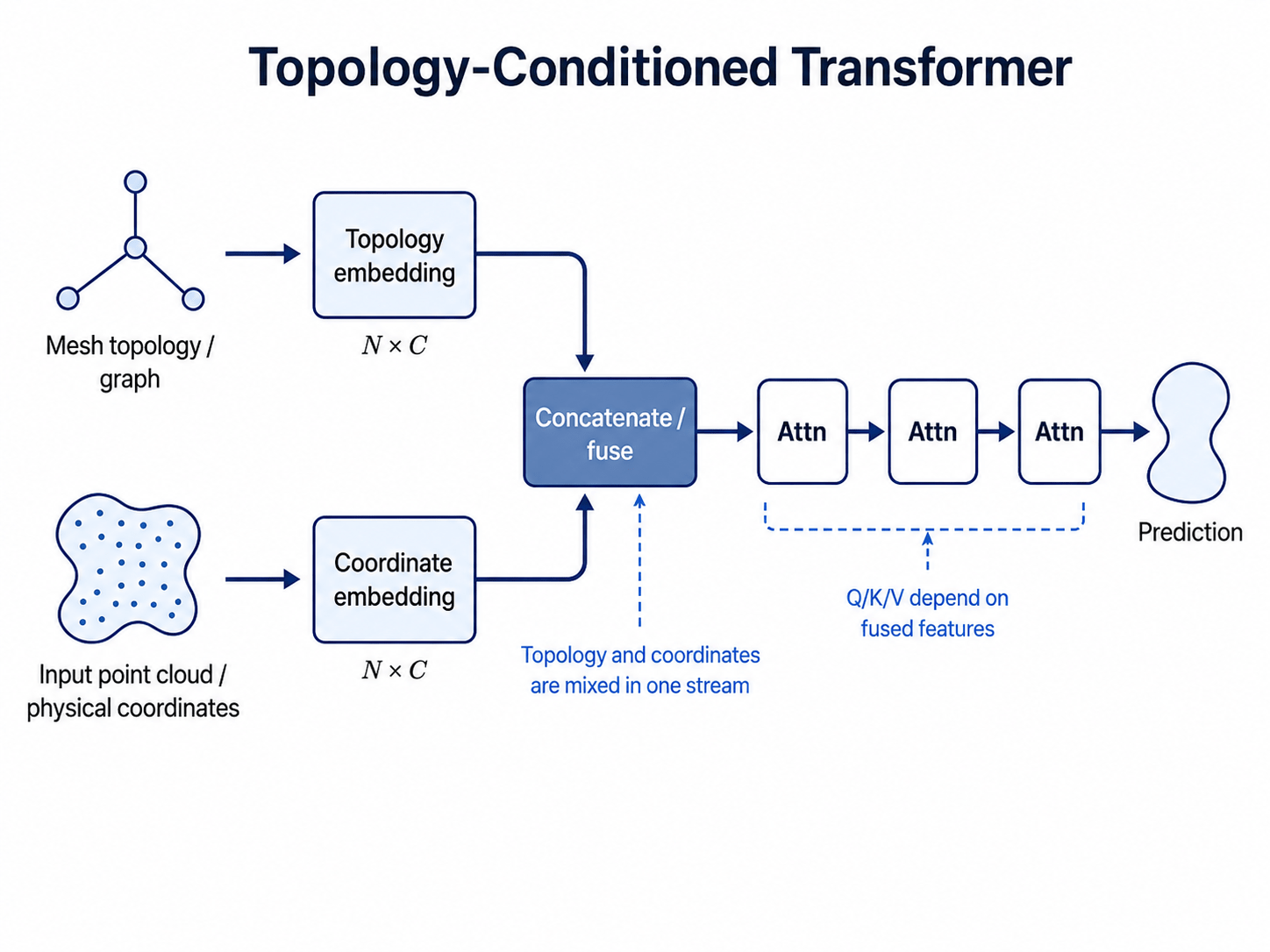
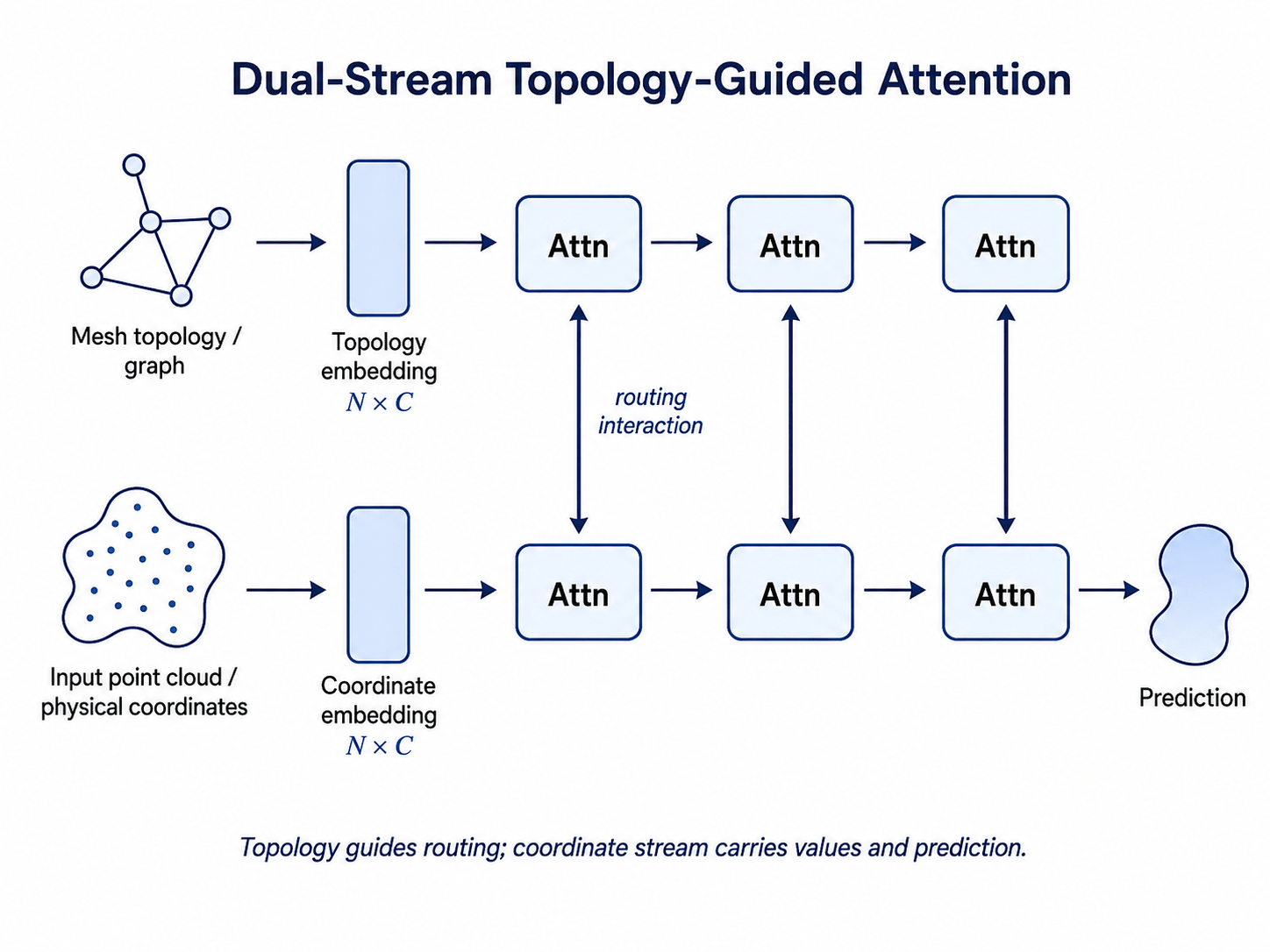
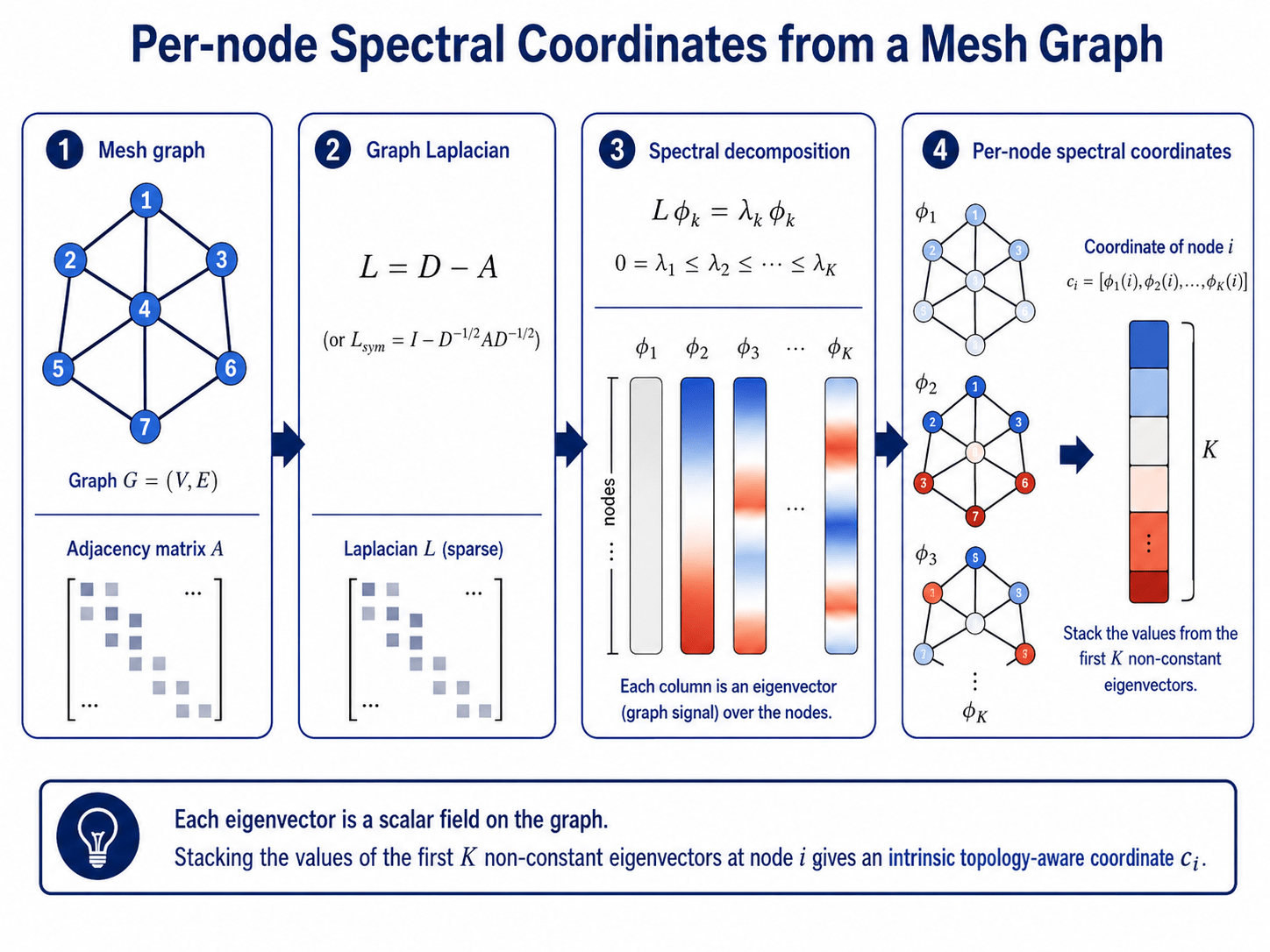
GeoFLARE
FLARE has been independently extended to problems with complex geometries
18
[2] Akhare et al. “High-Fidelity Industrial- Crash Dynamics”, arXiv:2605:27758
[1] Adams et al. “GeoTransolver”, arXiv:2512:20399
[3] Curtosi, et al. "Crash Assessment via Physics-Aware Attention", arxiv:2605:11784
[1]
[2]
FLARE backbone + multiscale geometry feature extractor
[2]
NVIDIA
Norte Dame, GM
SEAT, IDIADA (Spain)
[3]
GeoFLARE architecture
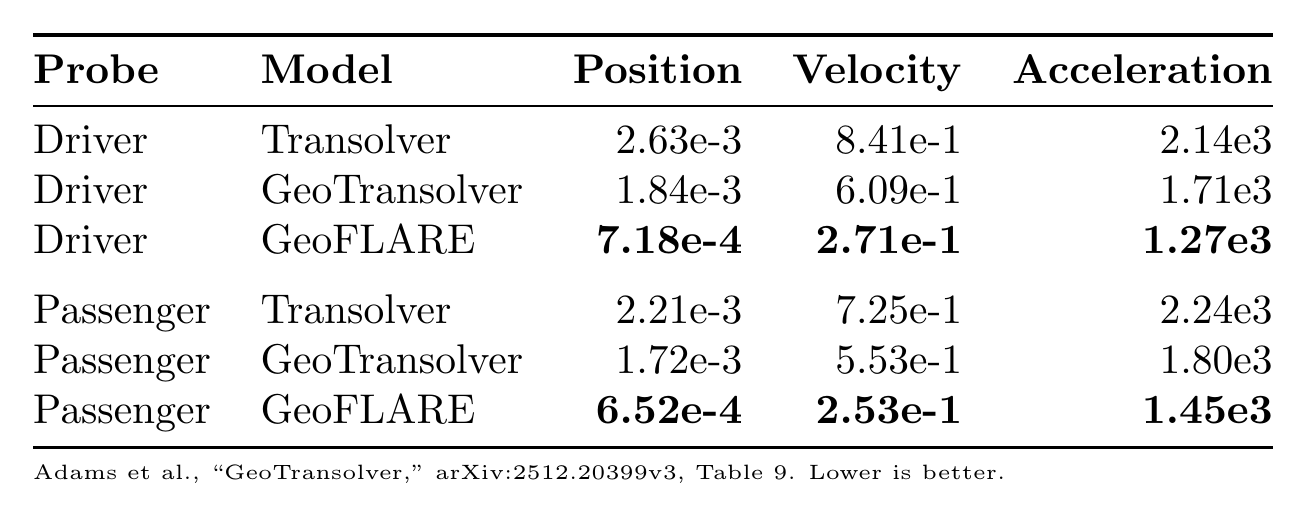
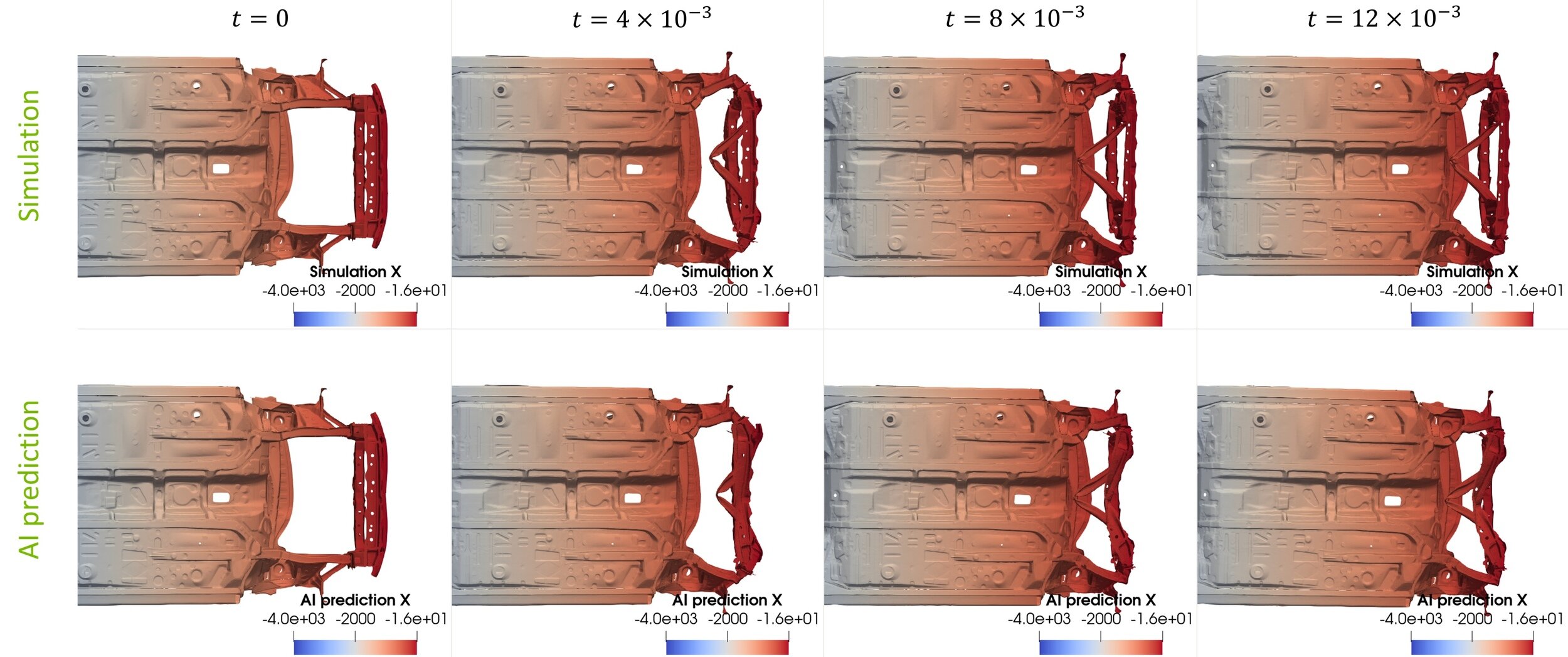
GeoFLARE is used for crash-dynamics calculations
19
[2] Akhare et al. “High-Fidelity Industrial- Crash Dynamics”, arXiv:2605:27758
[1] Adams et al. “GeoTransolver”, arXiv:2512:20399
[3] GitHub:NVIDIA/physicsnemo/examples/structural_mechanics/crash
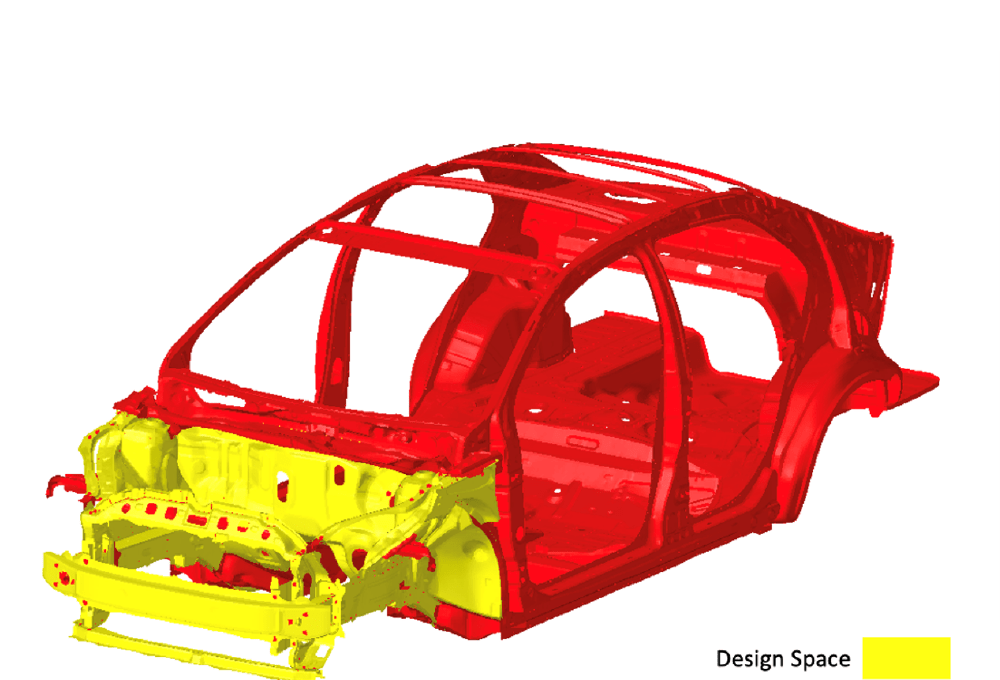
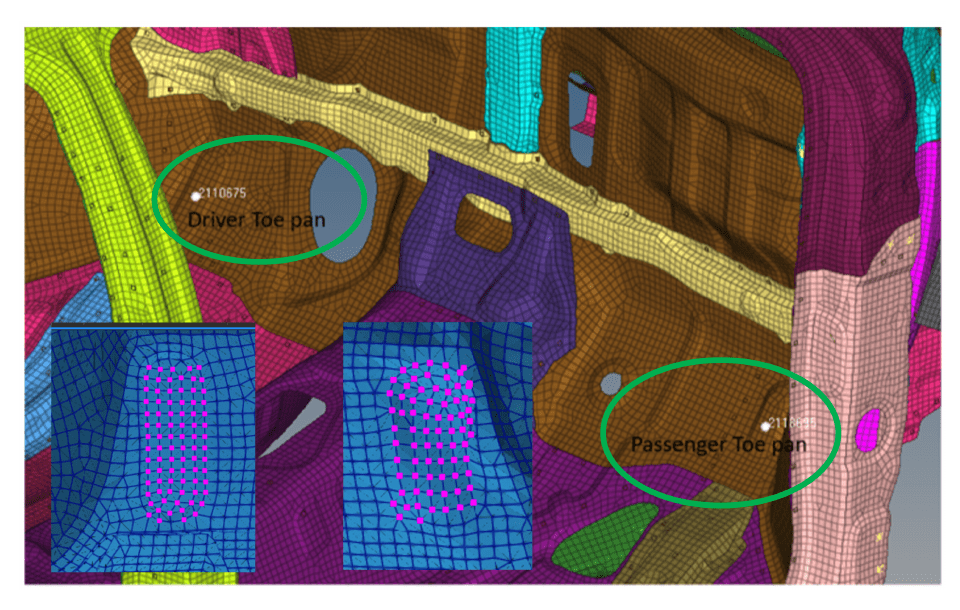
Crash-dynamics on bumper-beam problem
20
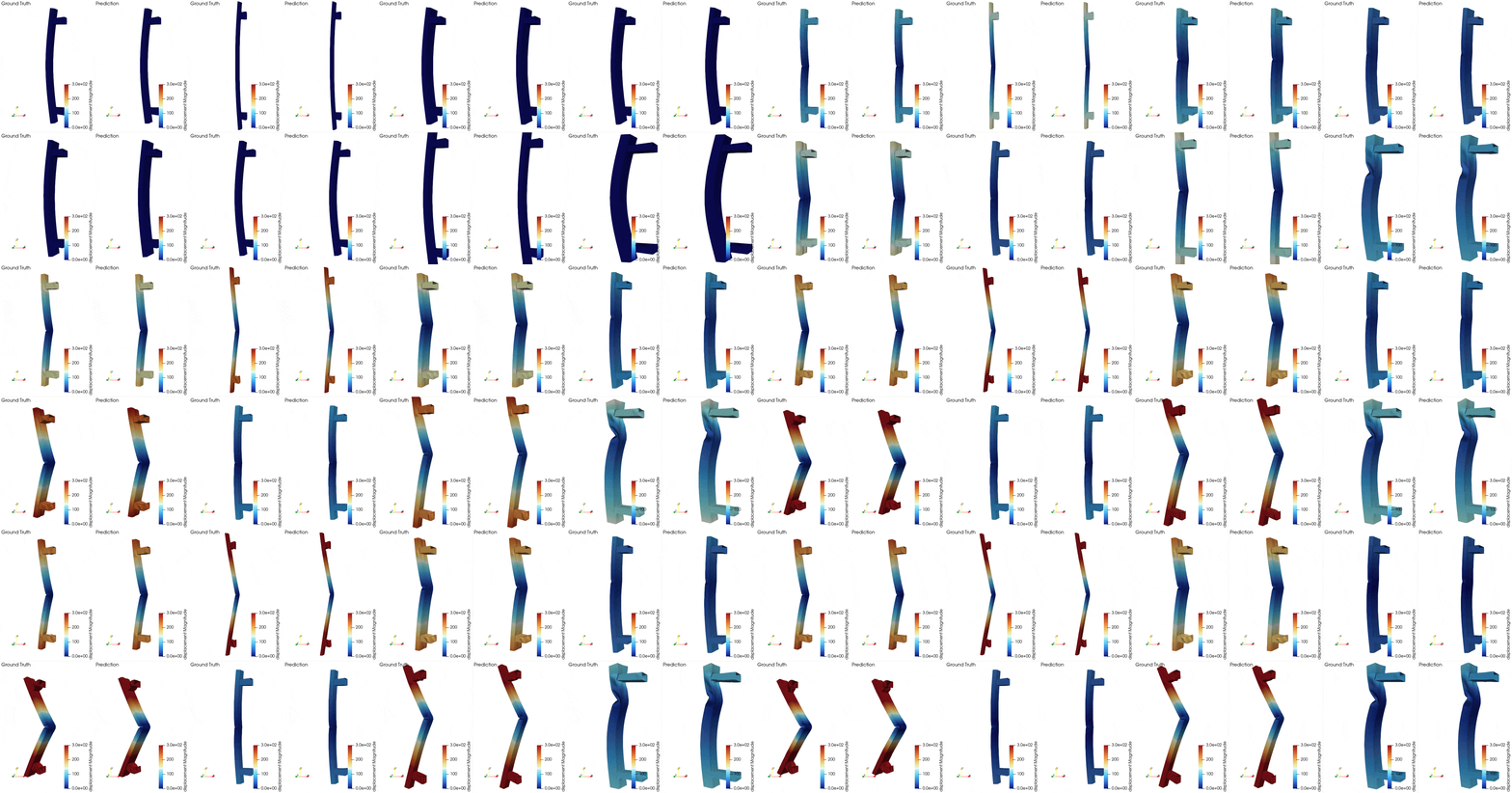
[2] Akhare et al. “High-Fidelity Industrial- Crash Dynamics”, arXiv:2605:27758
[1] Adams et al. “GeoTransolver”, arXiv:2512:20399
[3] GitHub:NVIDIA/physicsnemo/examples/structural_mechanics/crash