FLARE + High order attention ideas
Vedant Puri
https://vpuri3.github.io/
Data-Driven Modeling
Scalable neural surrogates for PDEs and beyond!
Surrogate models learn PDE solution operator from data
15
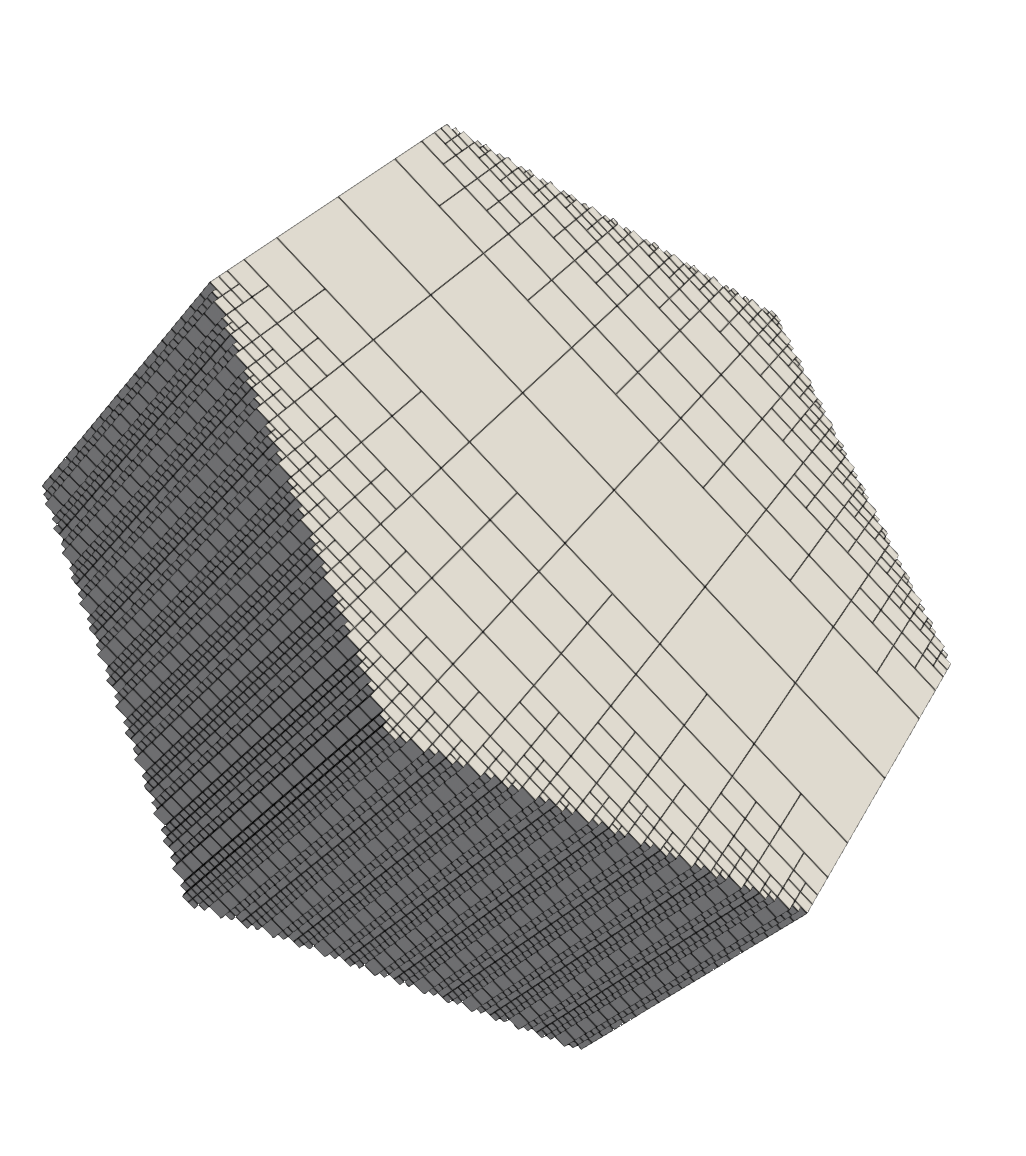


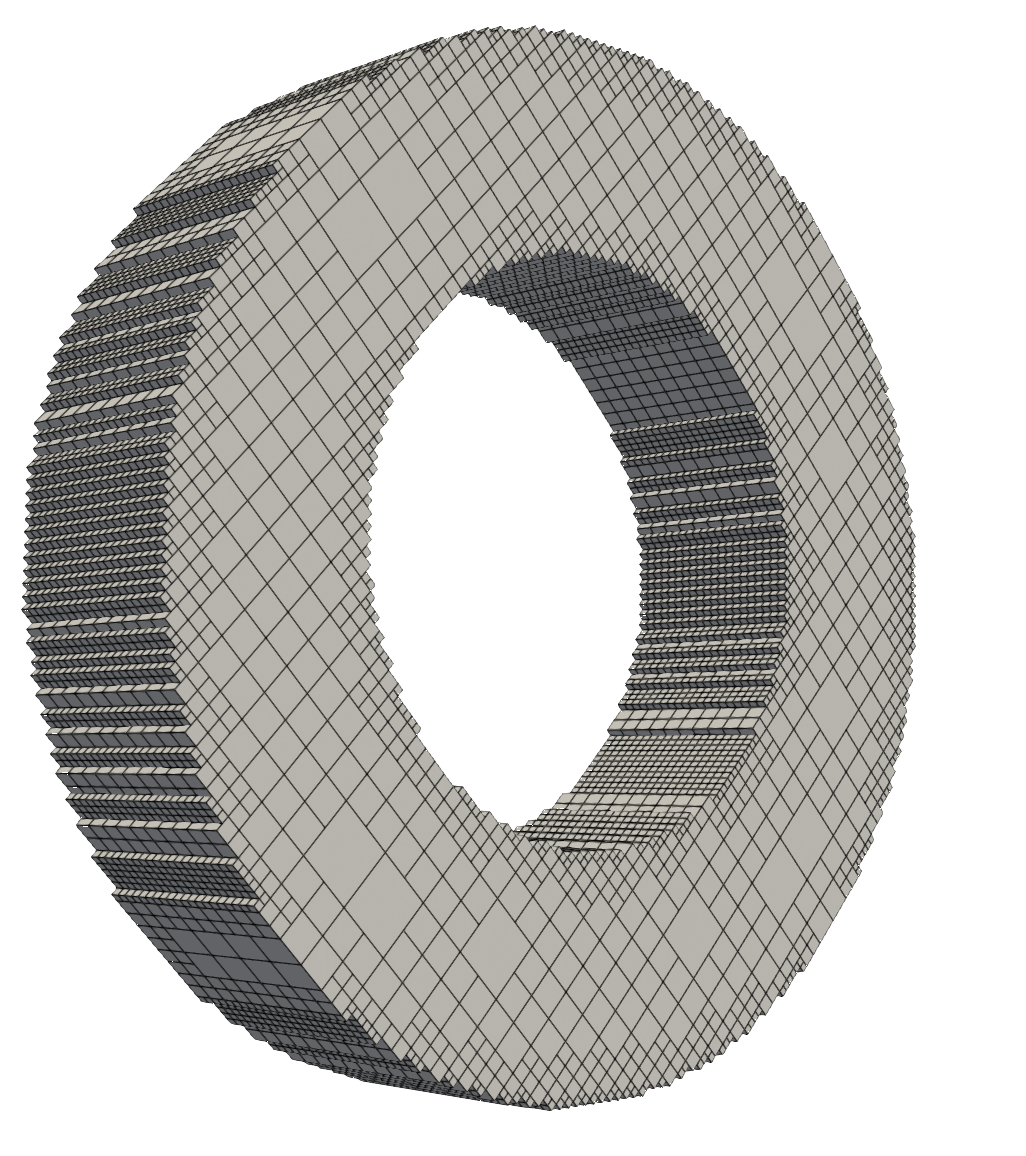
Training
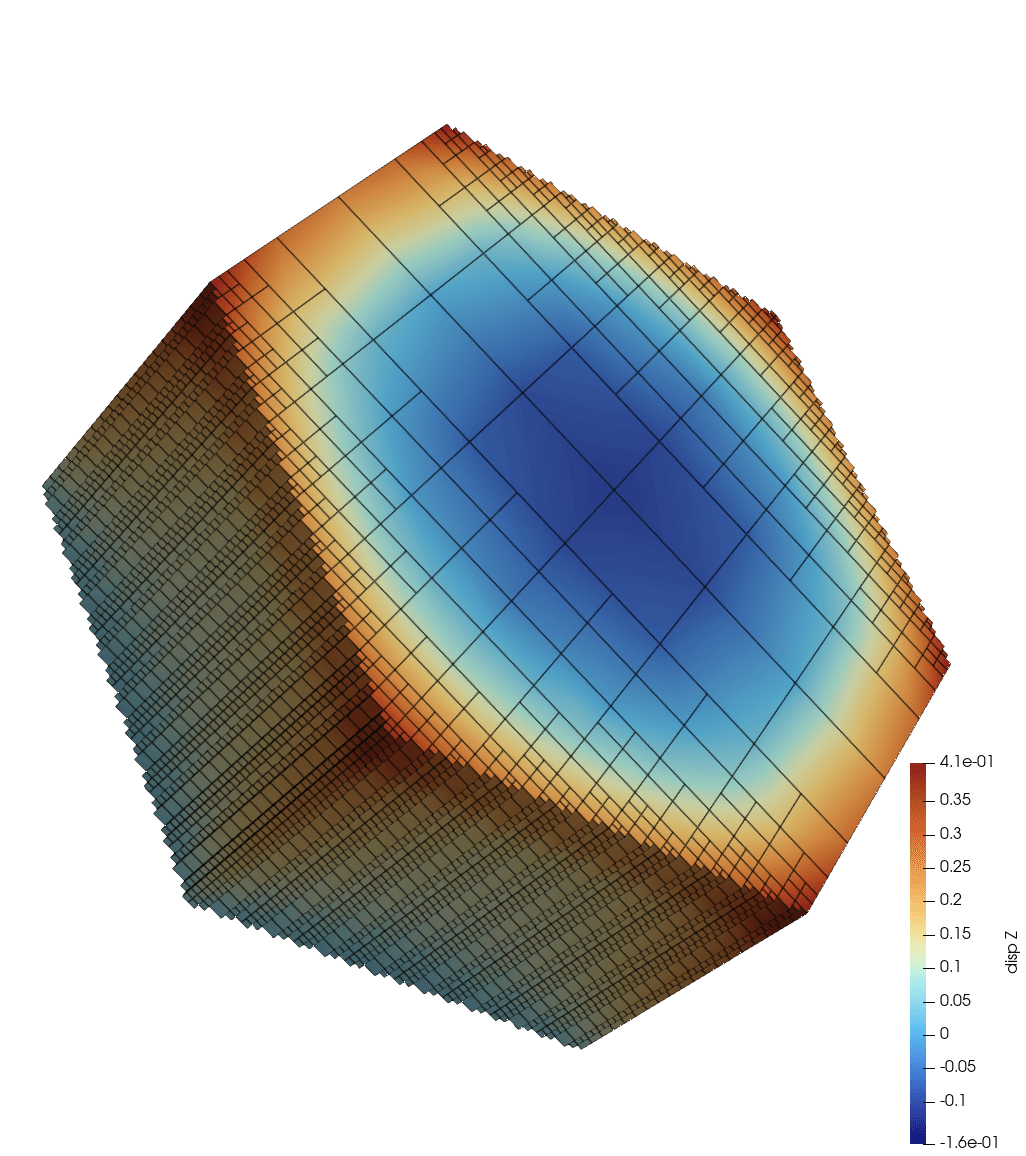
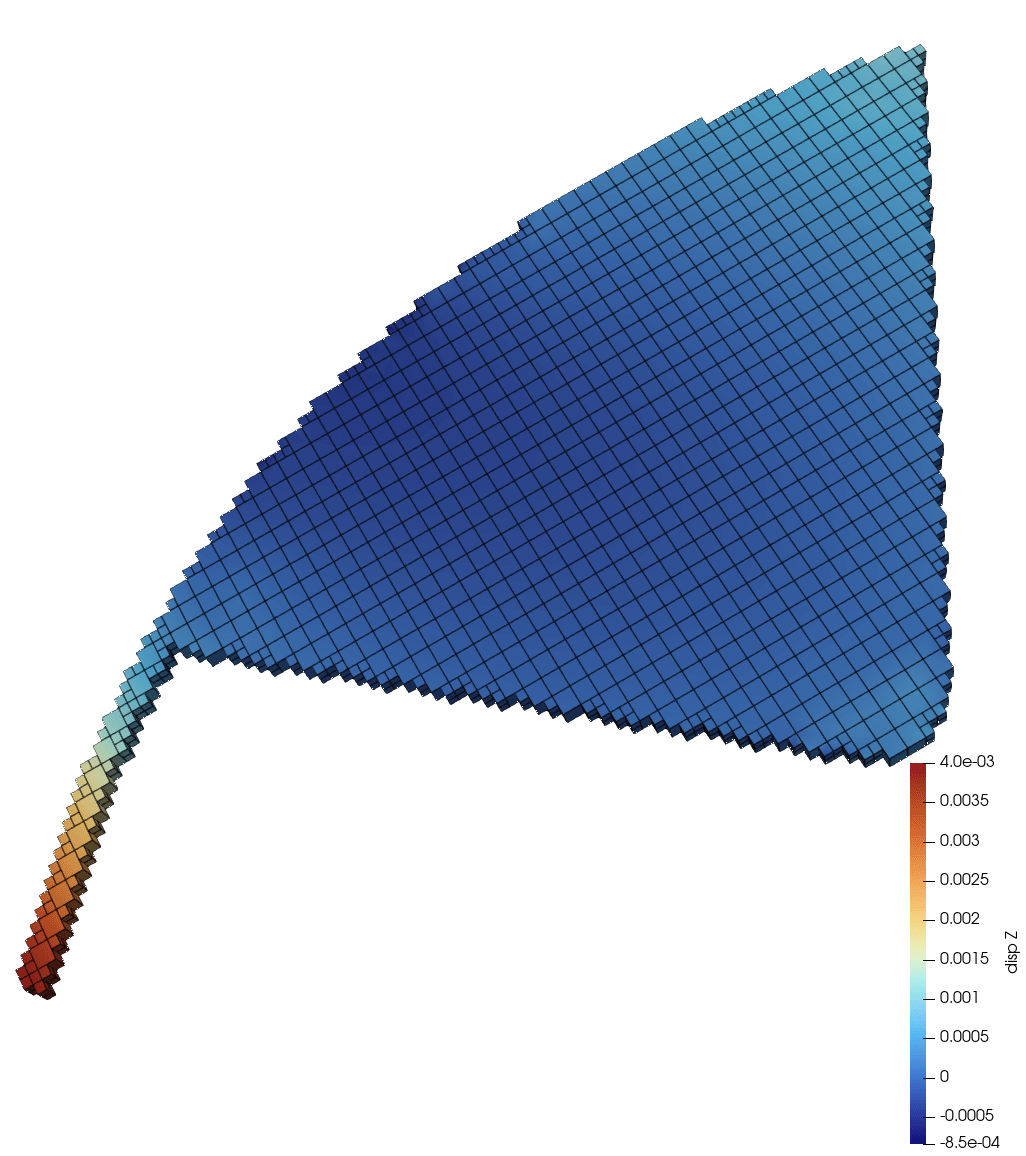
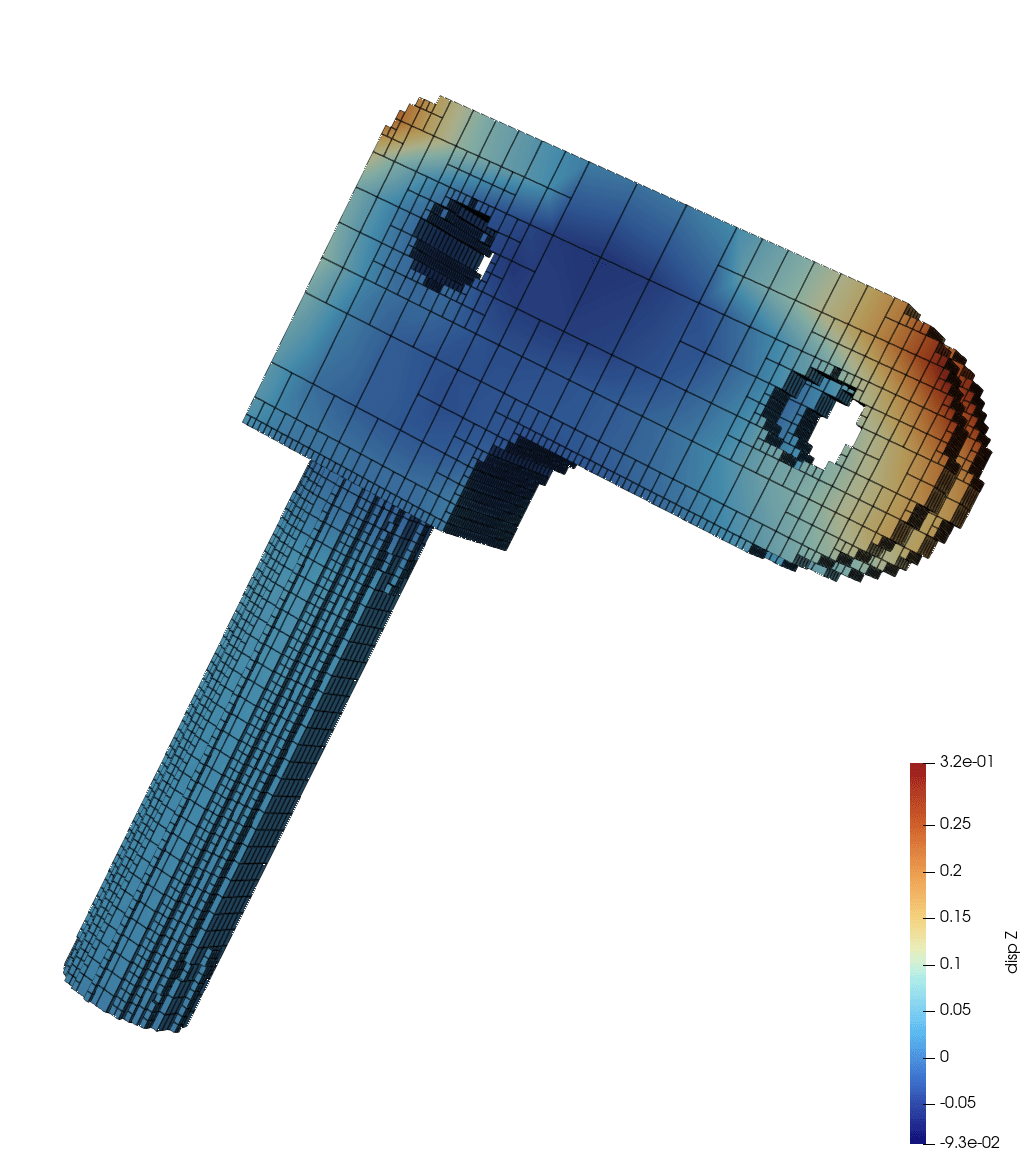
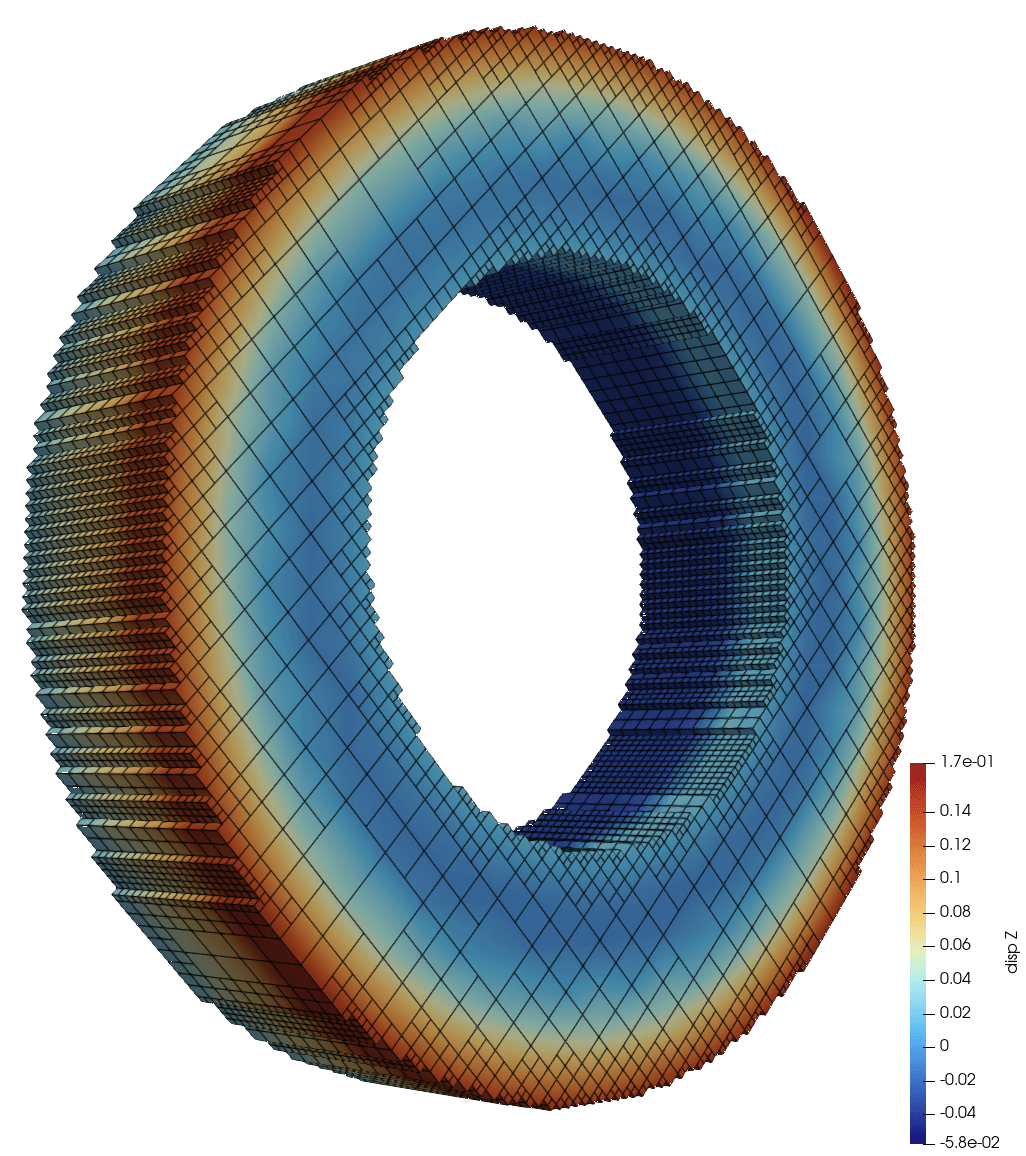
Inference
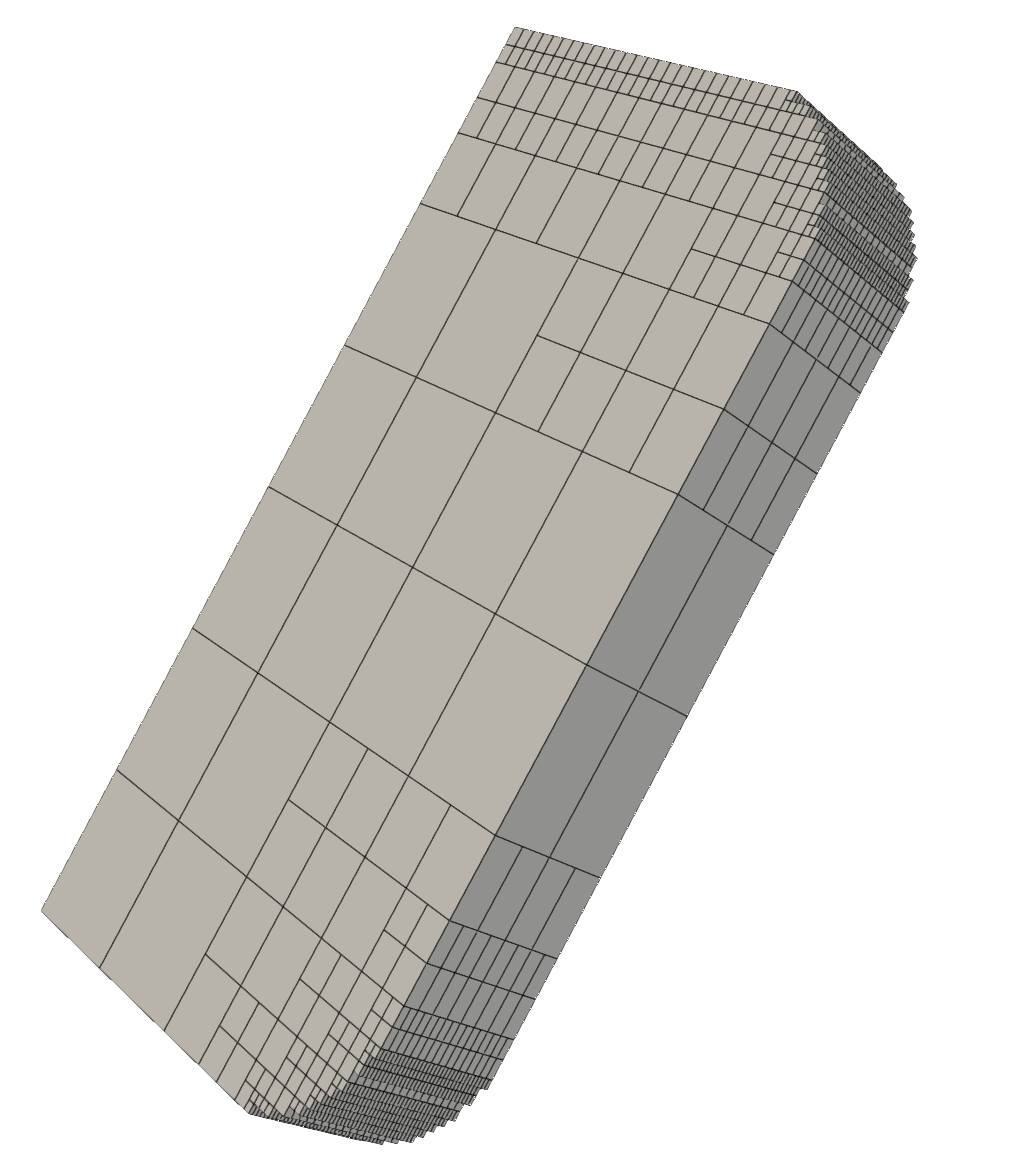
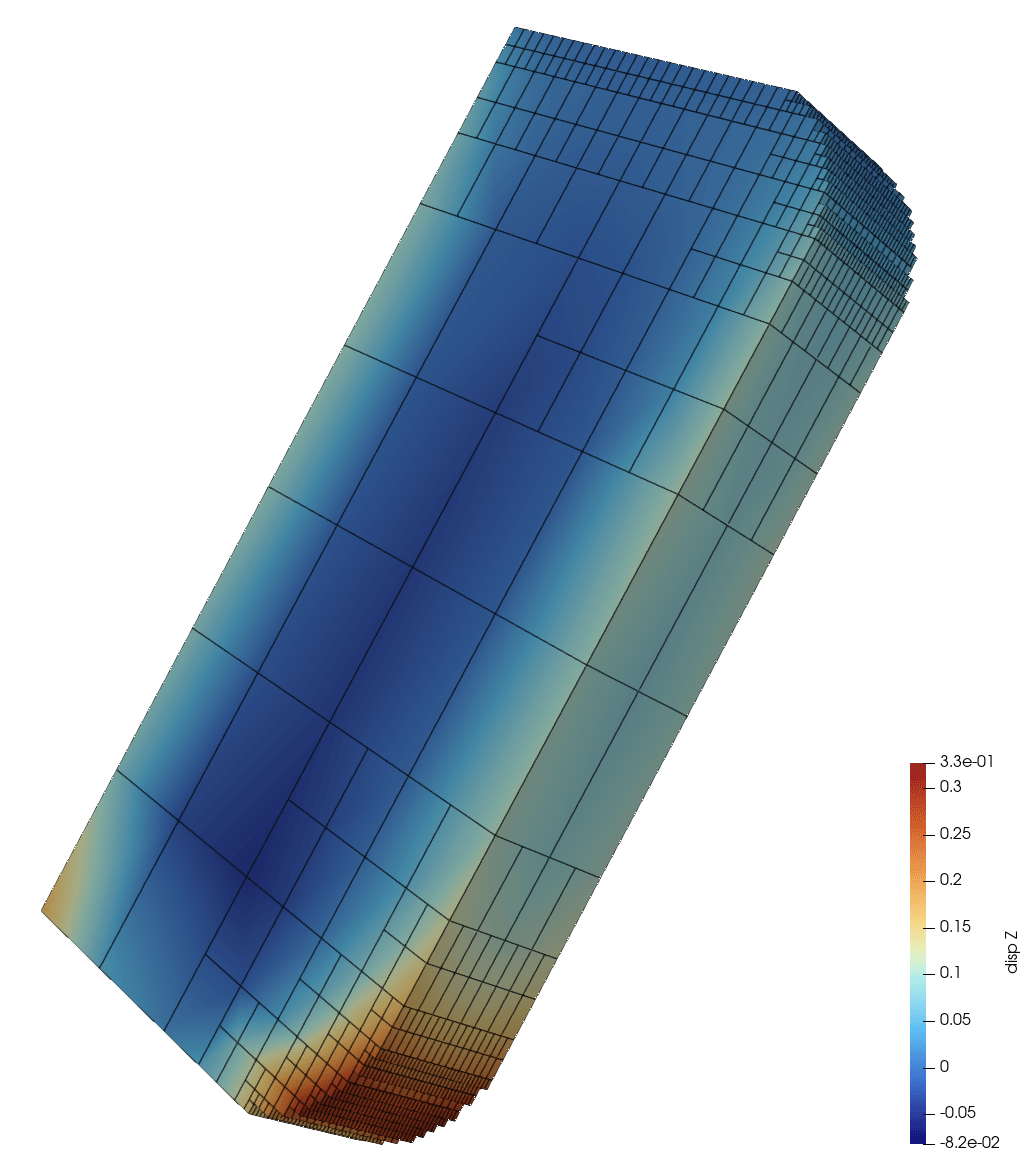
Large training cost is amortized over several evaluations
Model learns to predict \(\boldsymbol{u}\) over a distribution of \(\boldsymbol{\mu}\)
Transformers [1] are state-of-the-art surrogate models
16
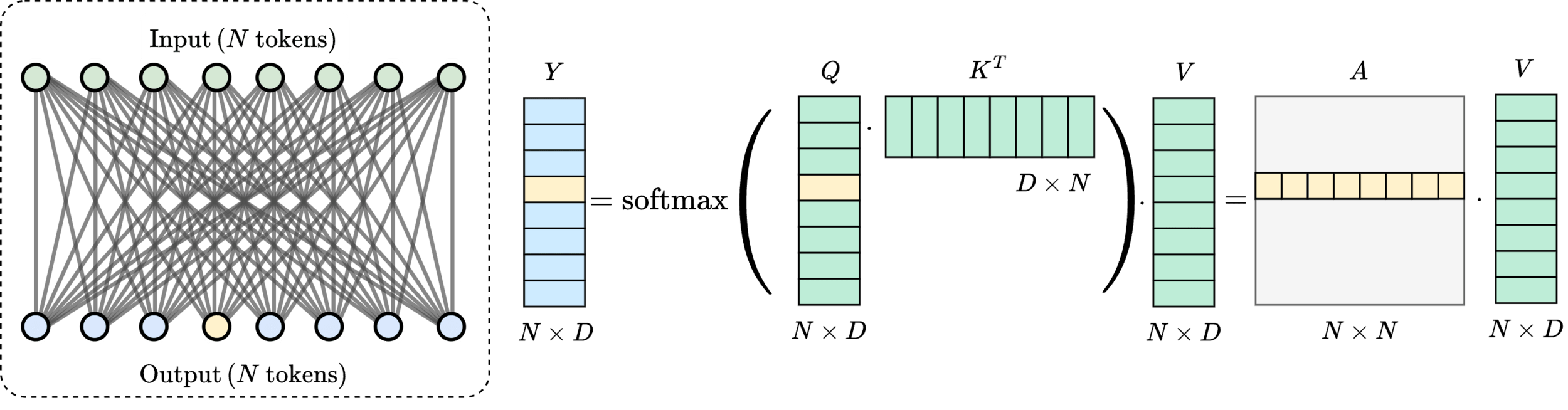
Message-passing on a dynamic all-to-all graph.
[1] Vaswani et al. — “Attention Is All You Need”, NeurIPS 2017
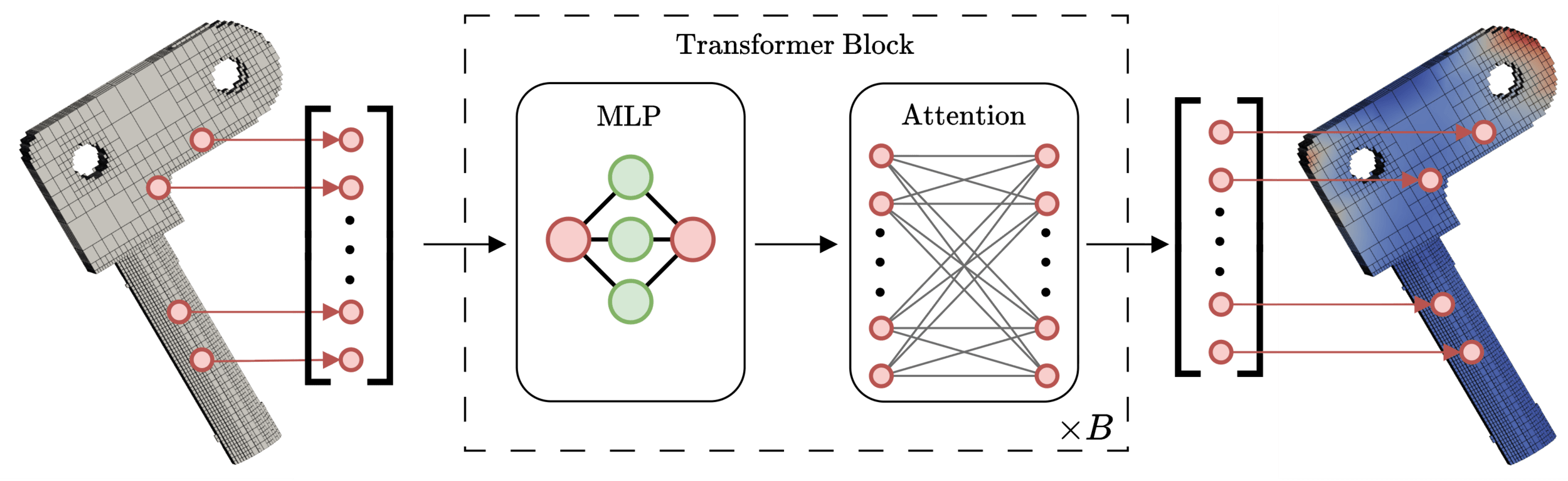
Quadratic (\(\mathcal{O}(N^2)\)) cost limits scalability
Quadratic \((\mathcal{O}(N^2))\) cost of attention limits scalability
17
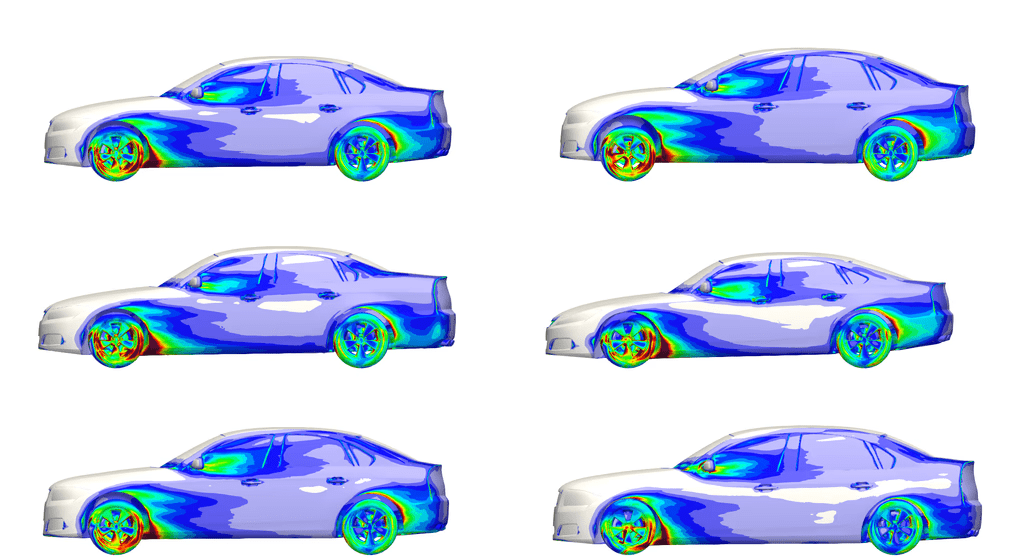
Over \(20~\text{s}\) per gradient step on a mesh of 1m poins!
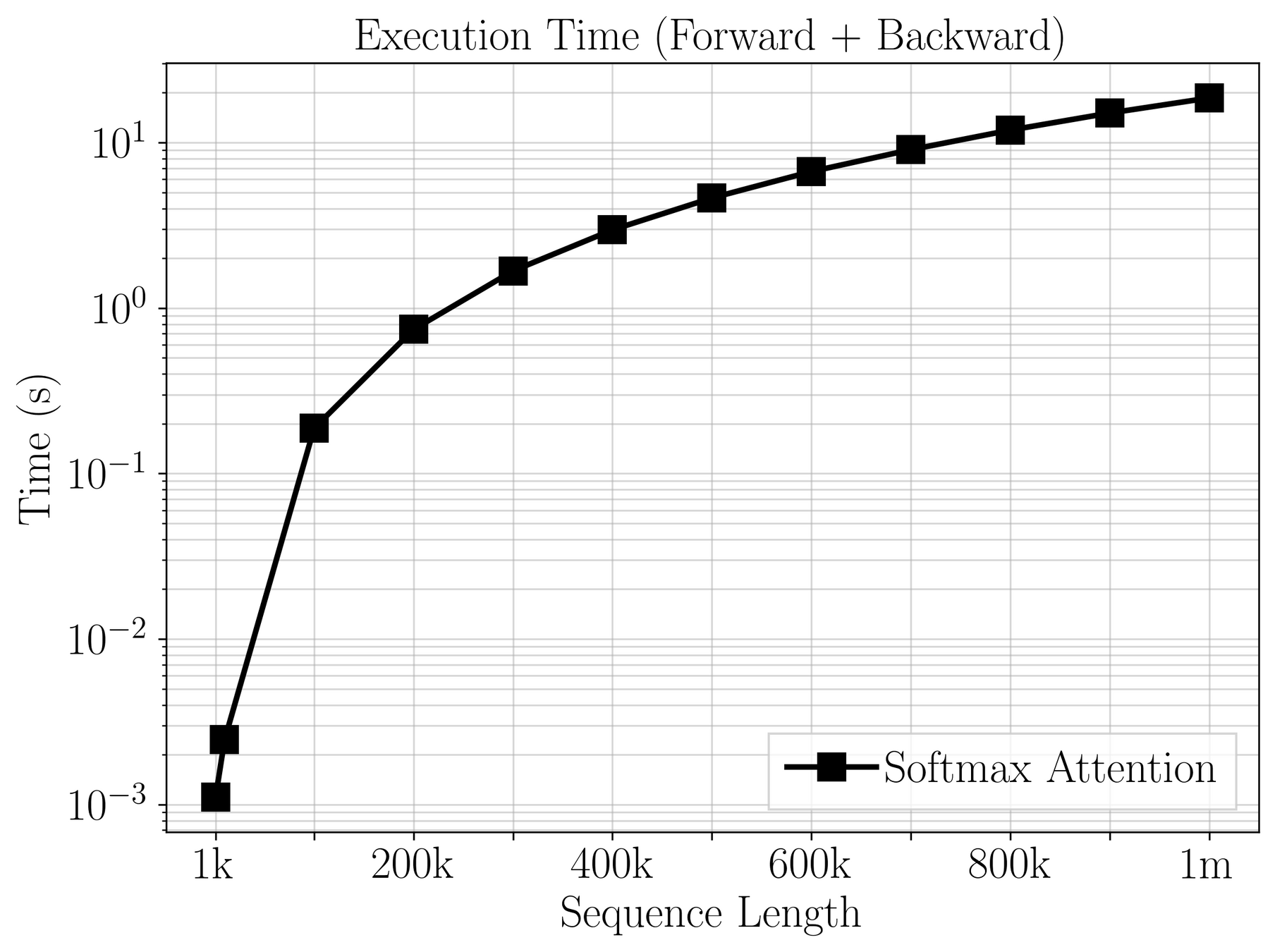
Goal: enable transformer models on large meshes.
[1] Vaswani et al. — “Attention Is All You Need”, NeurIPS 2017
\([1]\)
What are the limitations on communication patterns?
18
Solution operator requires global communication.
Forward operator is implemented with sparse, structured communication.
Need principled strategy for reducing communication cost.
[1] Math StackExchange — “Interpolation in Finite Element Method”
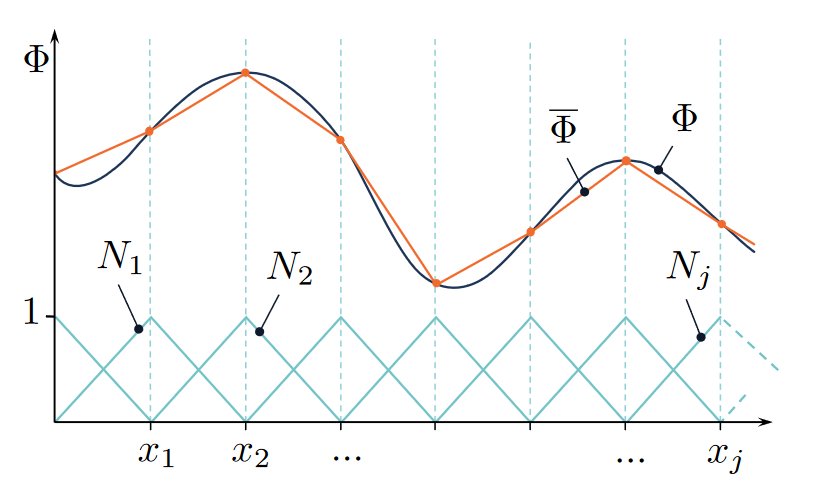
[1]
Are \(N \times N\) messages really necessary?
19
Smoothness implies redundancy in communication.
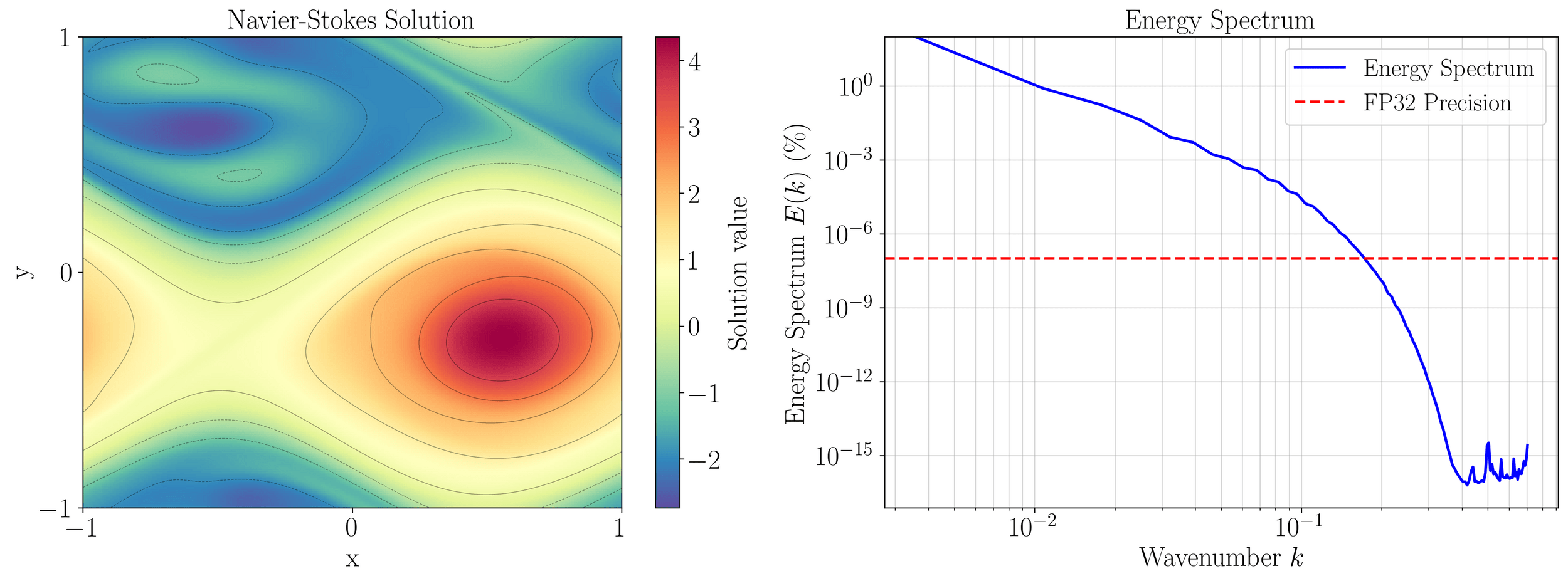
Are \(N \times N\) messages really necessary?
19
Smoothness implies redundancy in communication.
Method: club matching points to one cluster and communicate together.
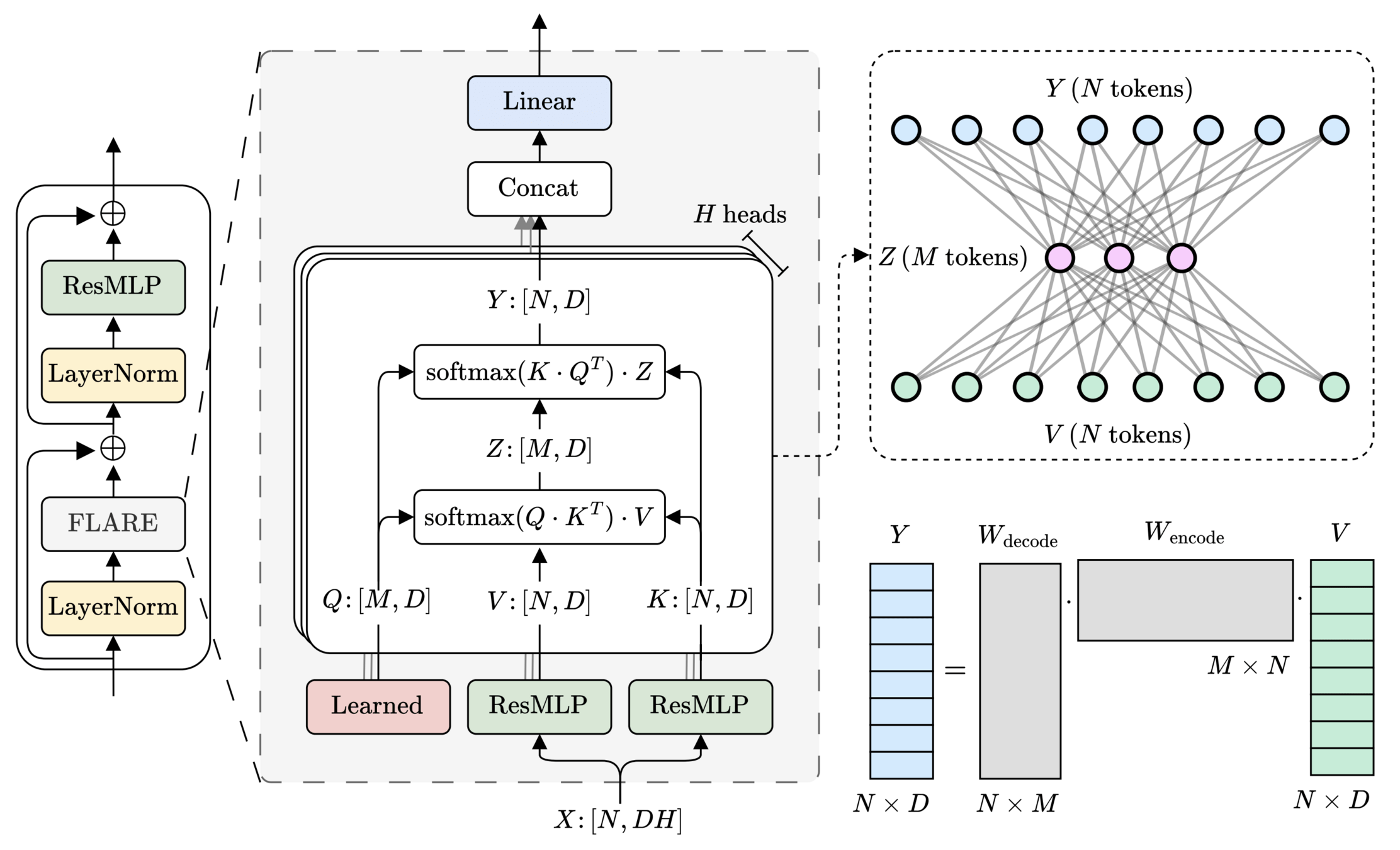
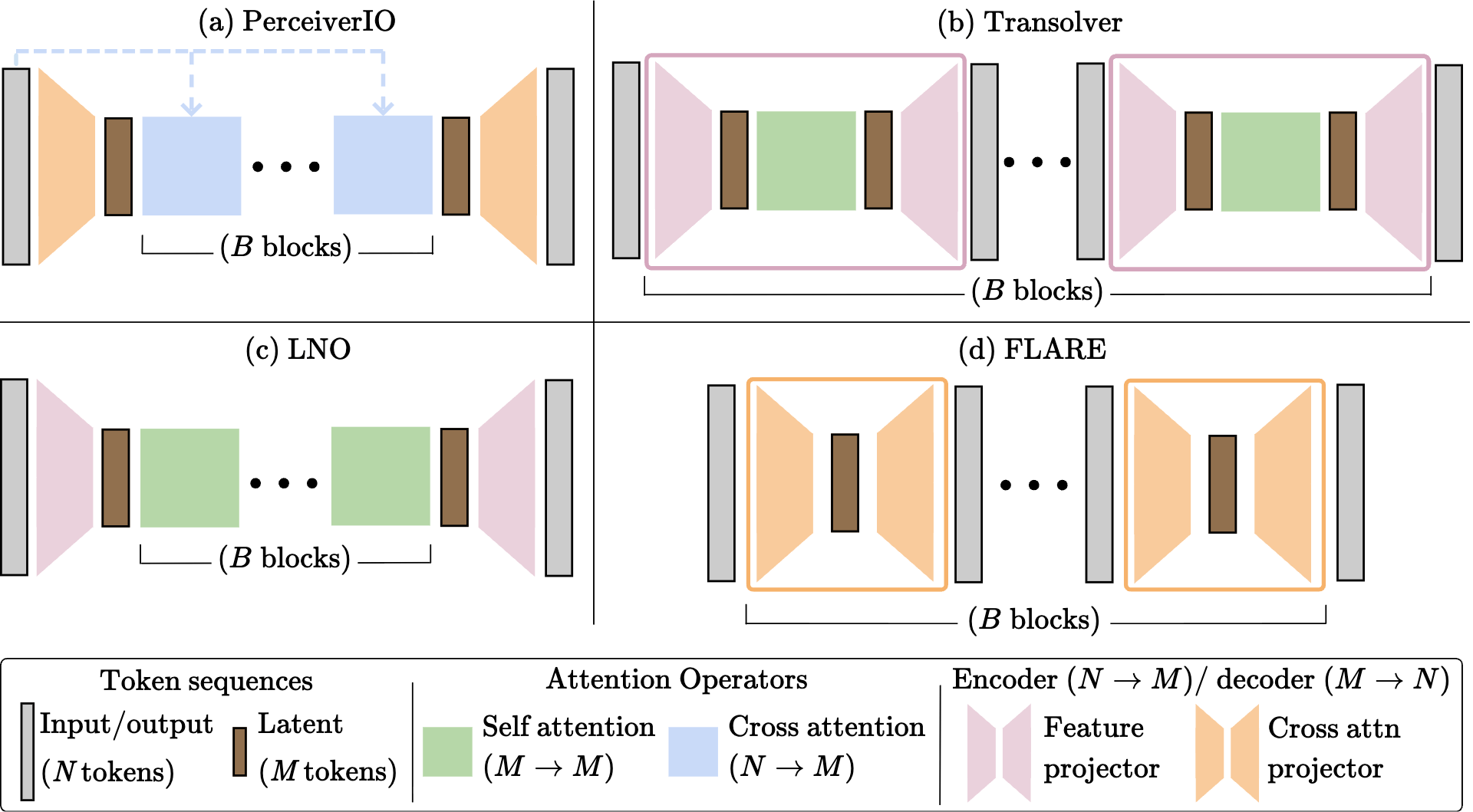
FLARE: Fast Low-rank Attention Routing Engine
20
Encoding: introduce \(M\) latent clusters to pool messages from matching tokens
\(M\) learned queries
Decoding: map pooled messages to matching output tokens
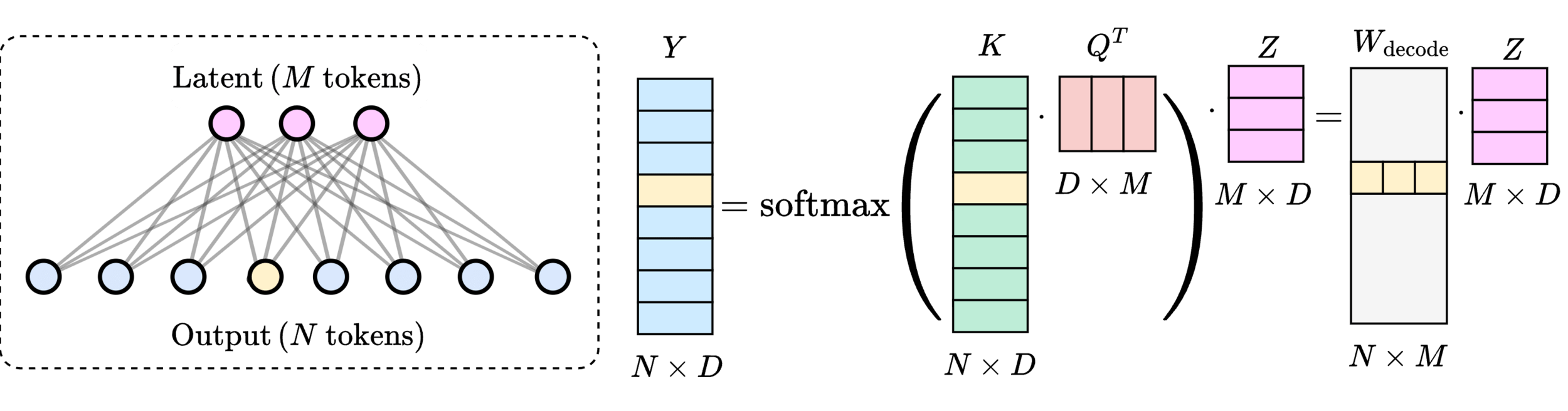
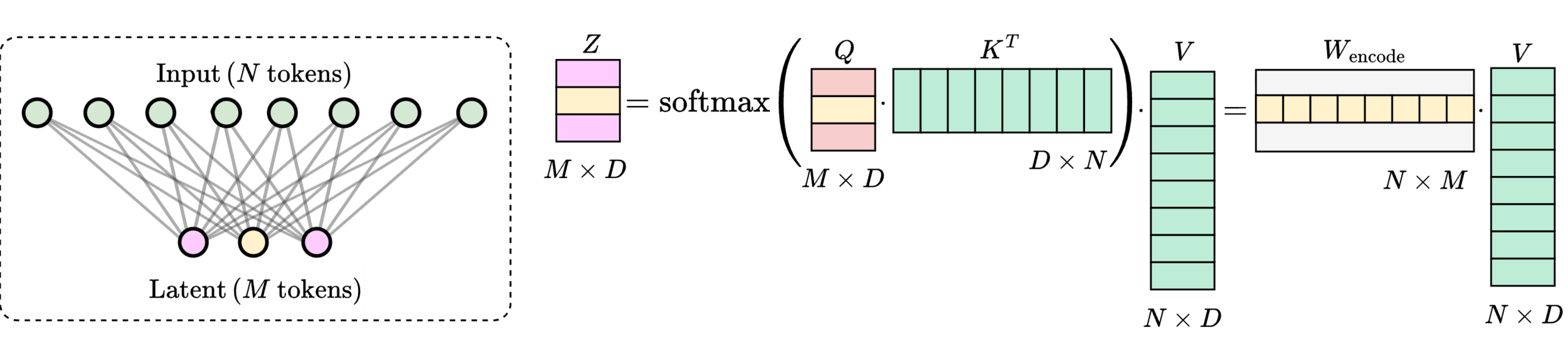
FLARE: Fast Low-rank Attention Routing Engine
21
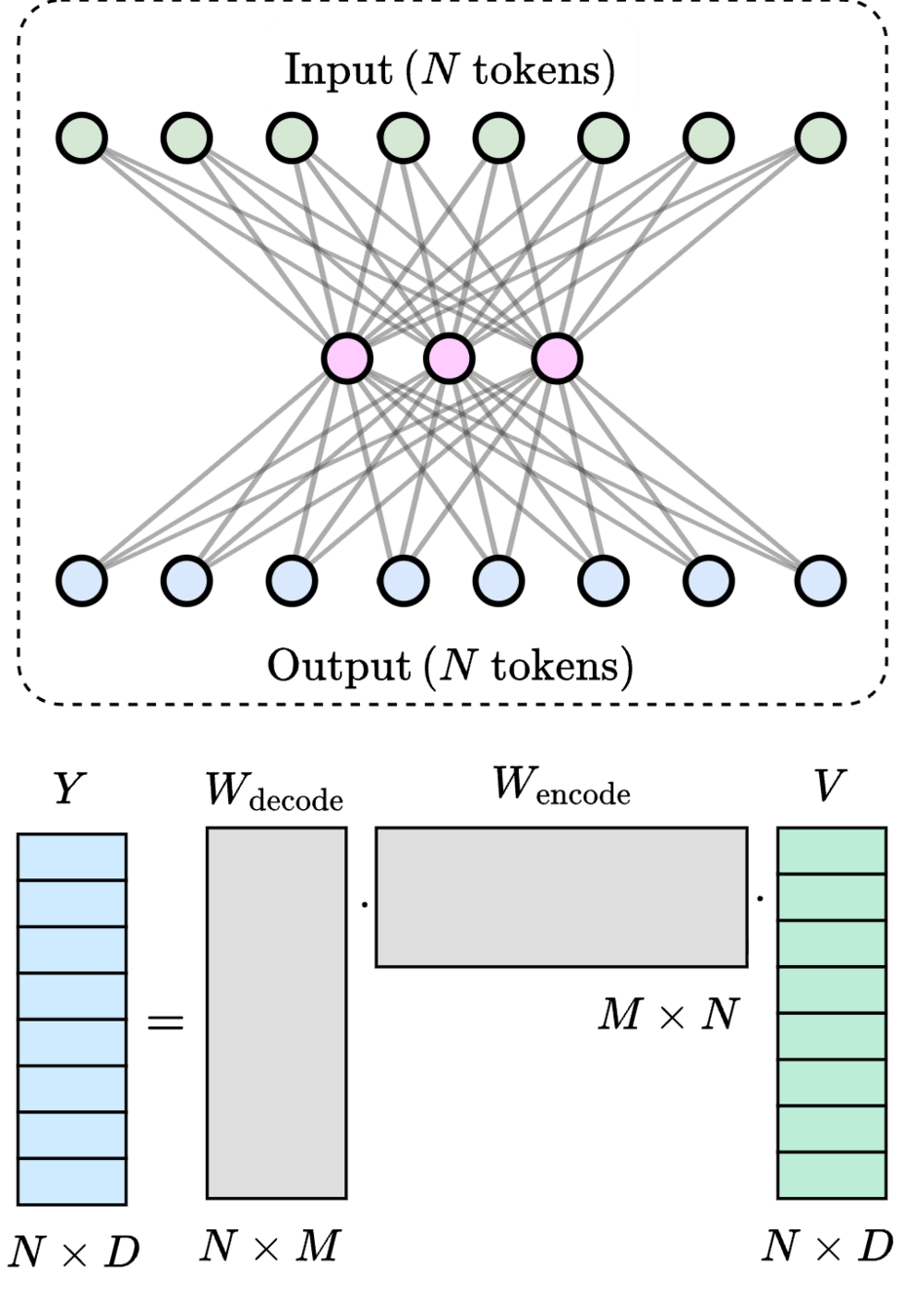
\(\mathcal{O}(2MN) \ll \mathcal{O}(N^2)\)
\(\text{rank}(W_\text{encode}\cdot W_\text{decode}) \leq M\)
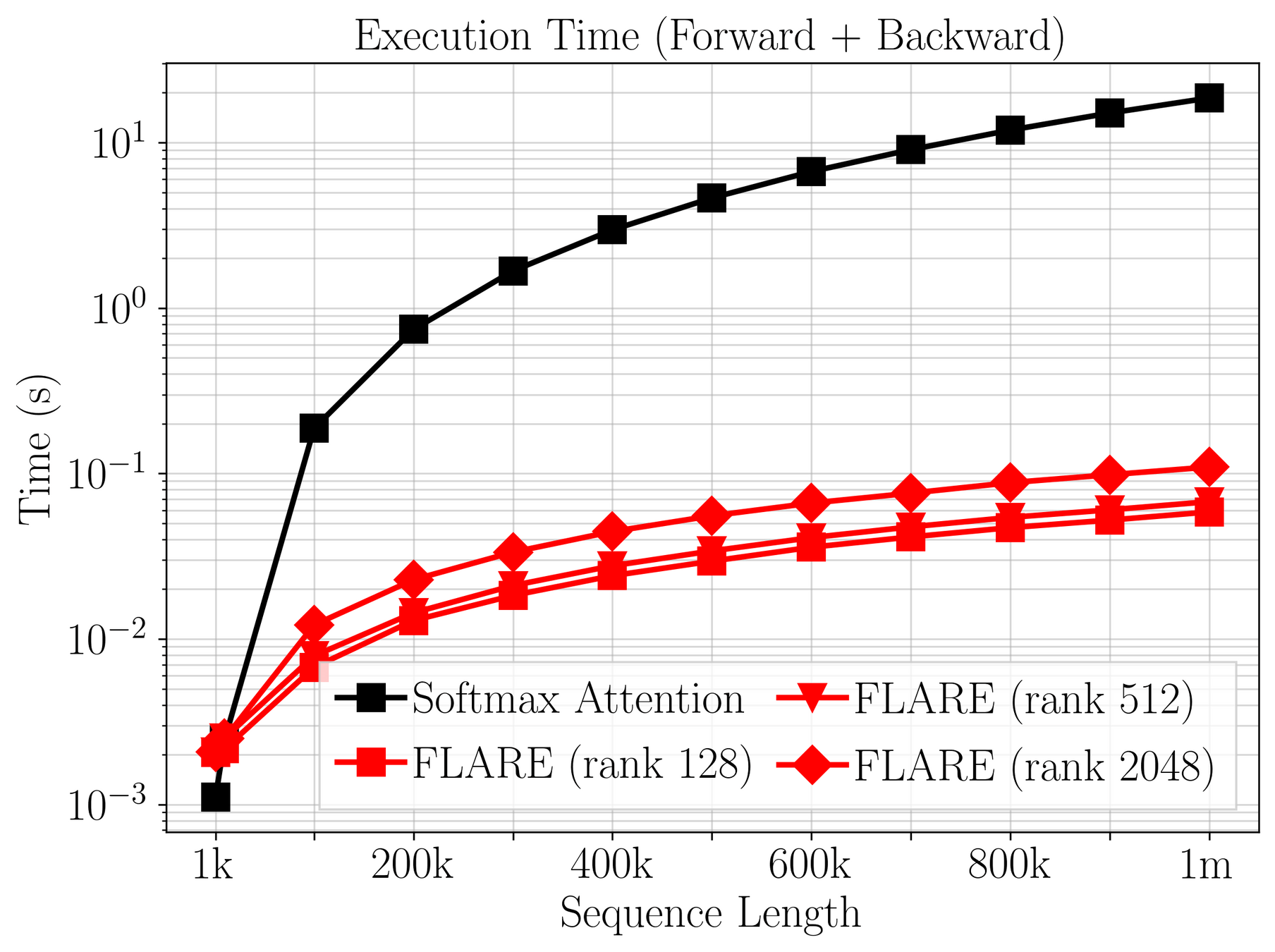
\(>200\times\) speedup
\(\text{(} M \text{ tokens)}\)
\(\text{Latent}\)
[1] Vaswani et al. — “Attention Is All You Need”, NeurIPS 2017
\([1]\)
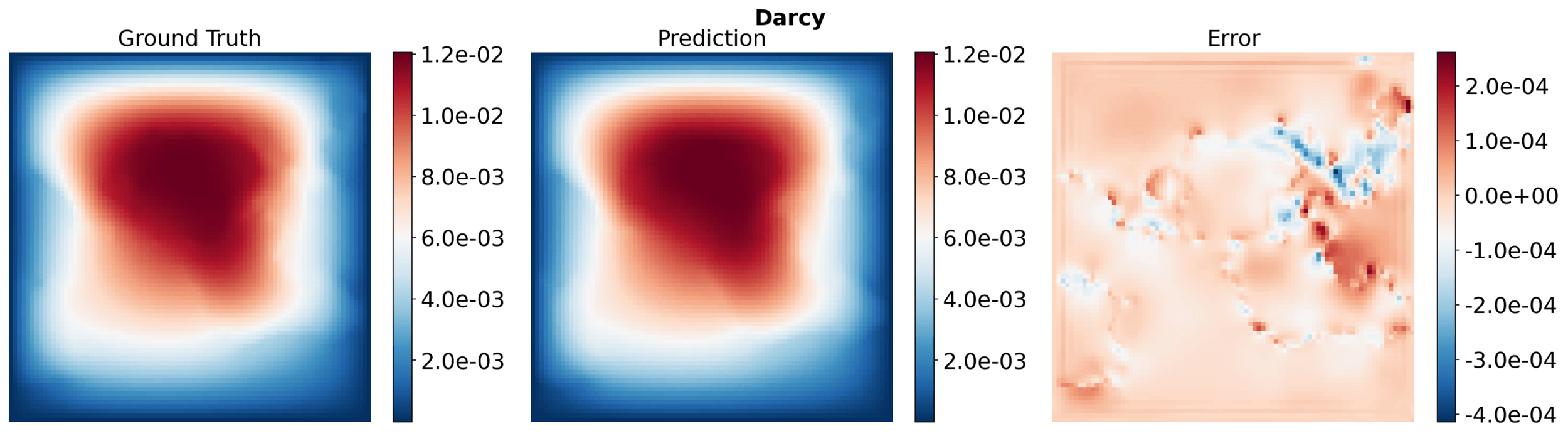
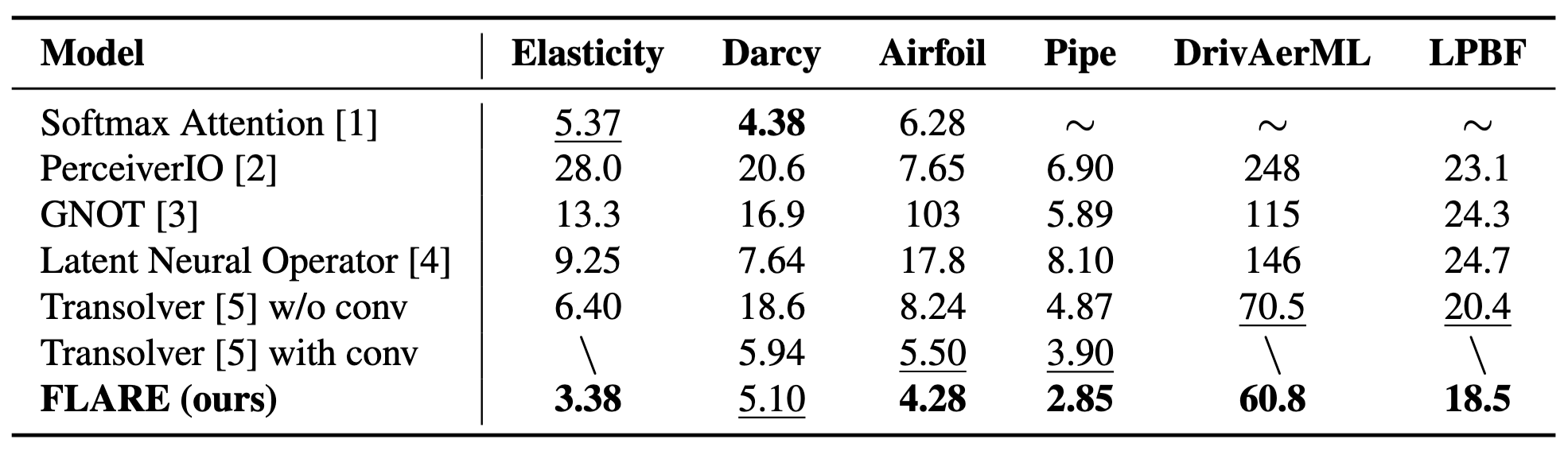
PDE surrogate benchmark problems
Relative \(L_2\) error \( (\times 10^{-3})\) (lower is better)
22
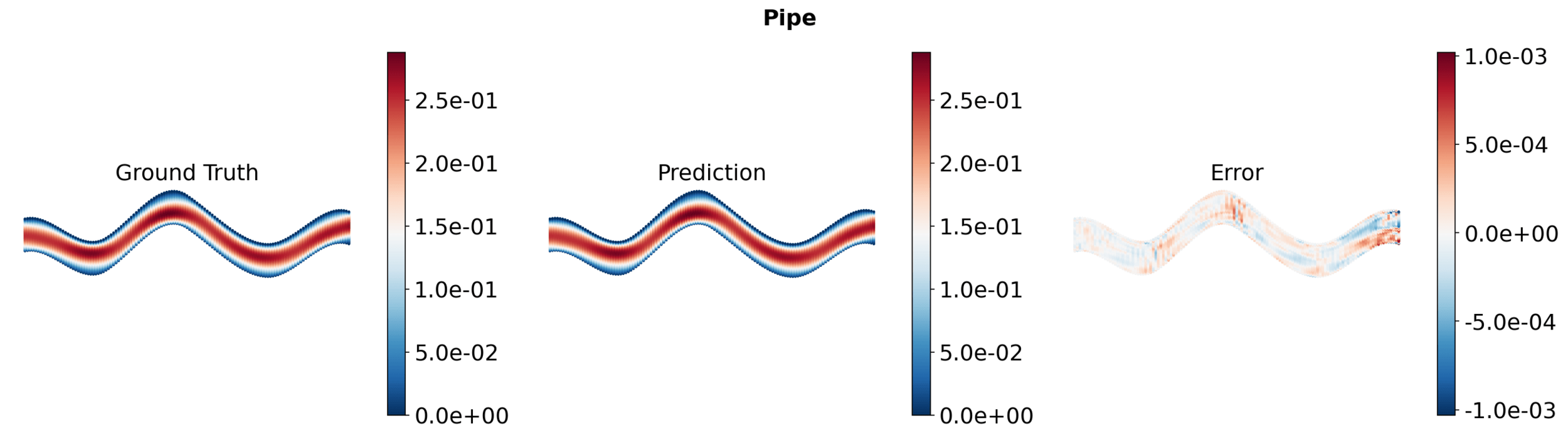
Pipe
Darcy
Elasticity
LPBF
DrivAerML
[1] Vaswani et al. — “Attention Is All You Need”, NeurIPS 2017
[2] Jaegle et al. — "PercieverIO: A General Architecture for Structured Inputs & Outputs", ICLR 2022
[3] Hao et al., — "GNOT: A General Neural Operator Transformer for Operator Learning", PMLR 2023
[4] Wang et al. —"Latent Neural Operator", NeurIPS 2024
[5] We et al. — "Transolver: A Fast Transformer Solver for PDEs on General Geometries", ICML 2024
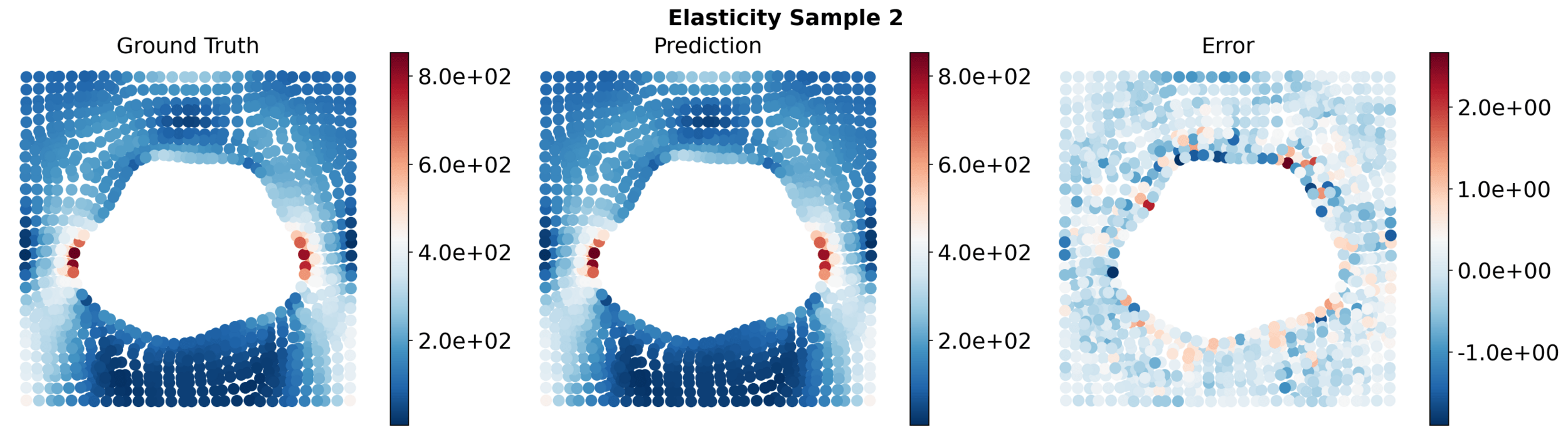
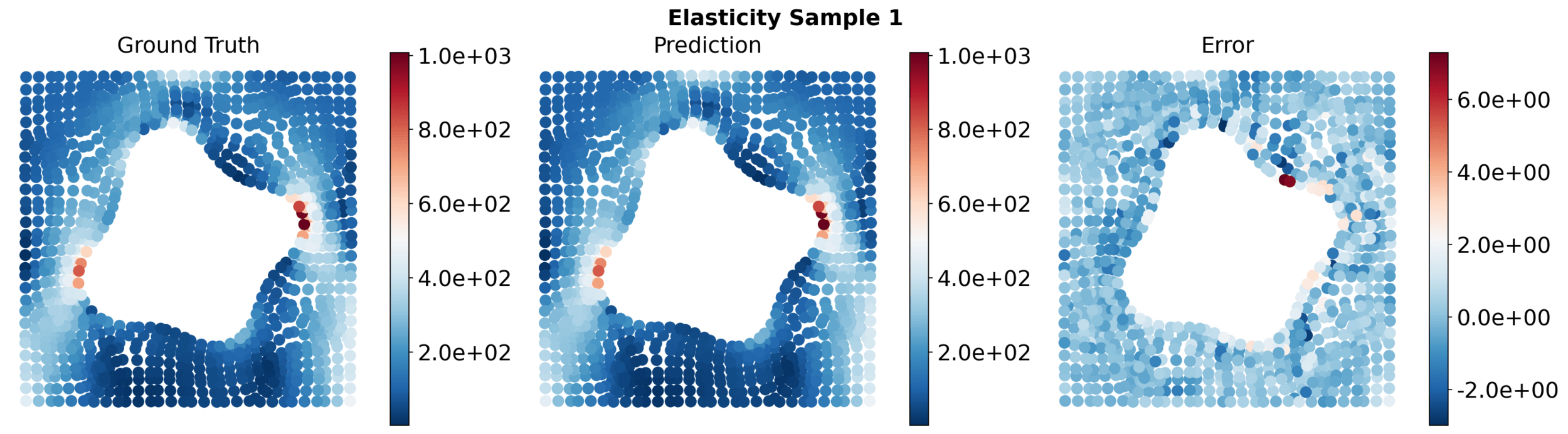
Elasticity benchmark problem
23
Pipe flow, Darcy flow benchmark problems
24
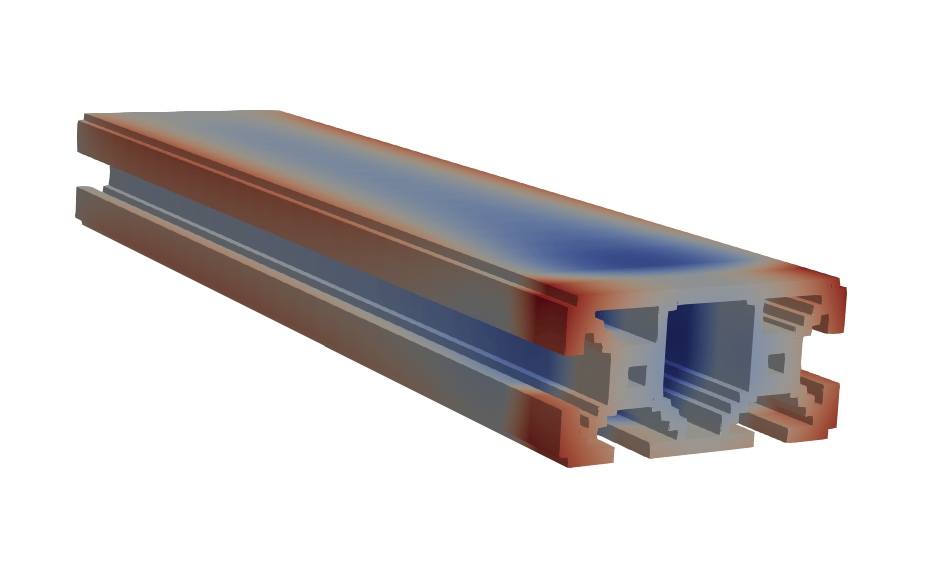
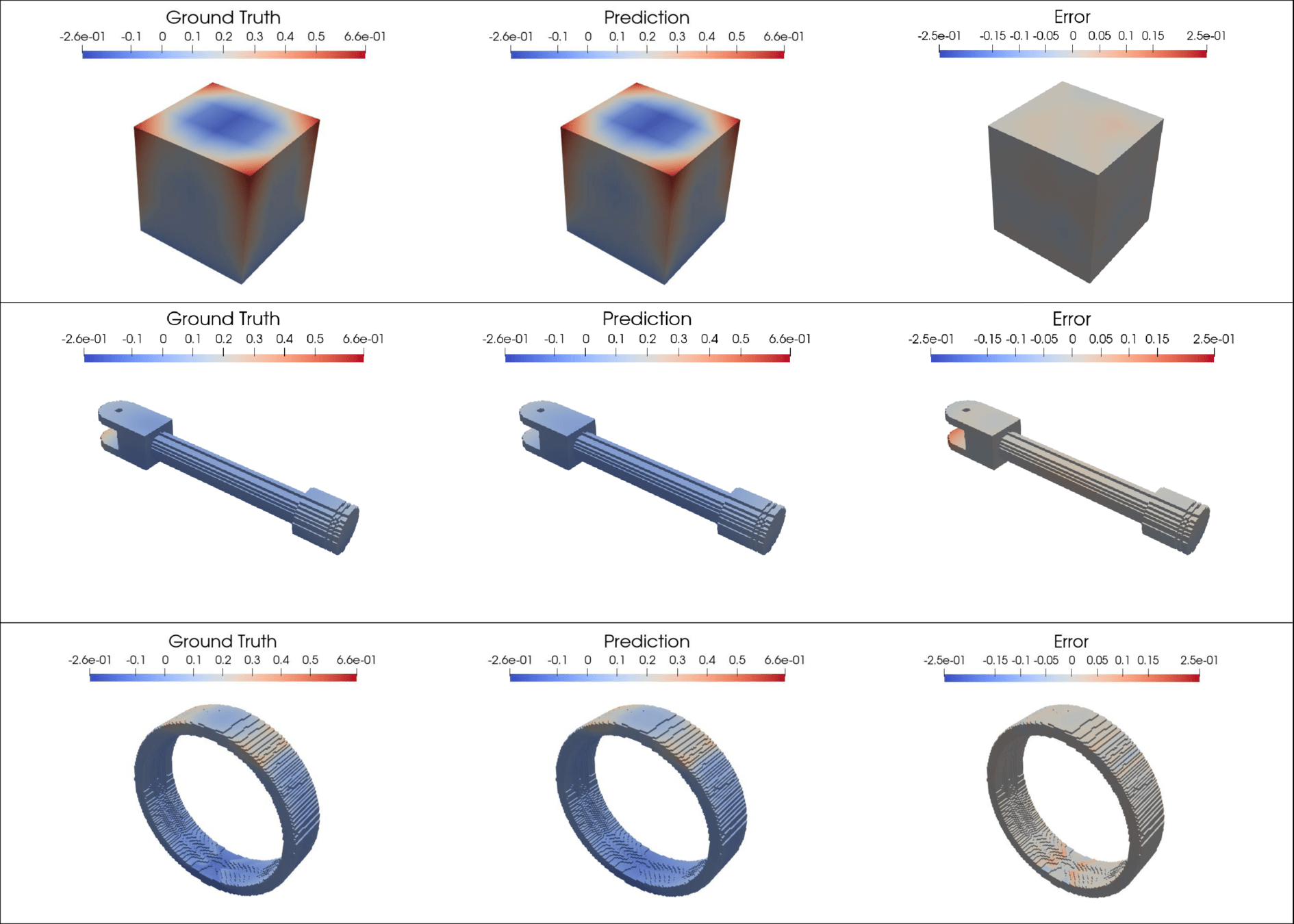
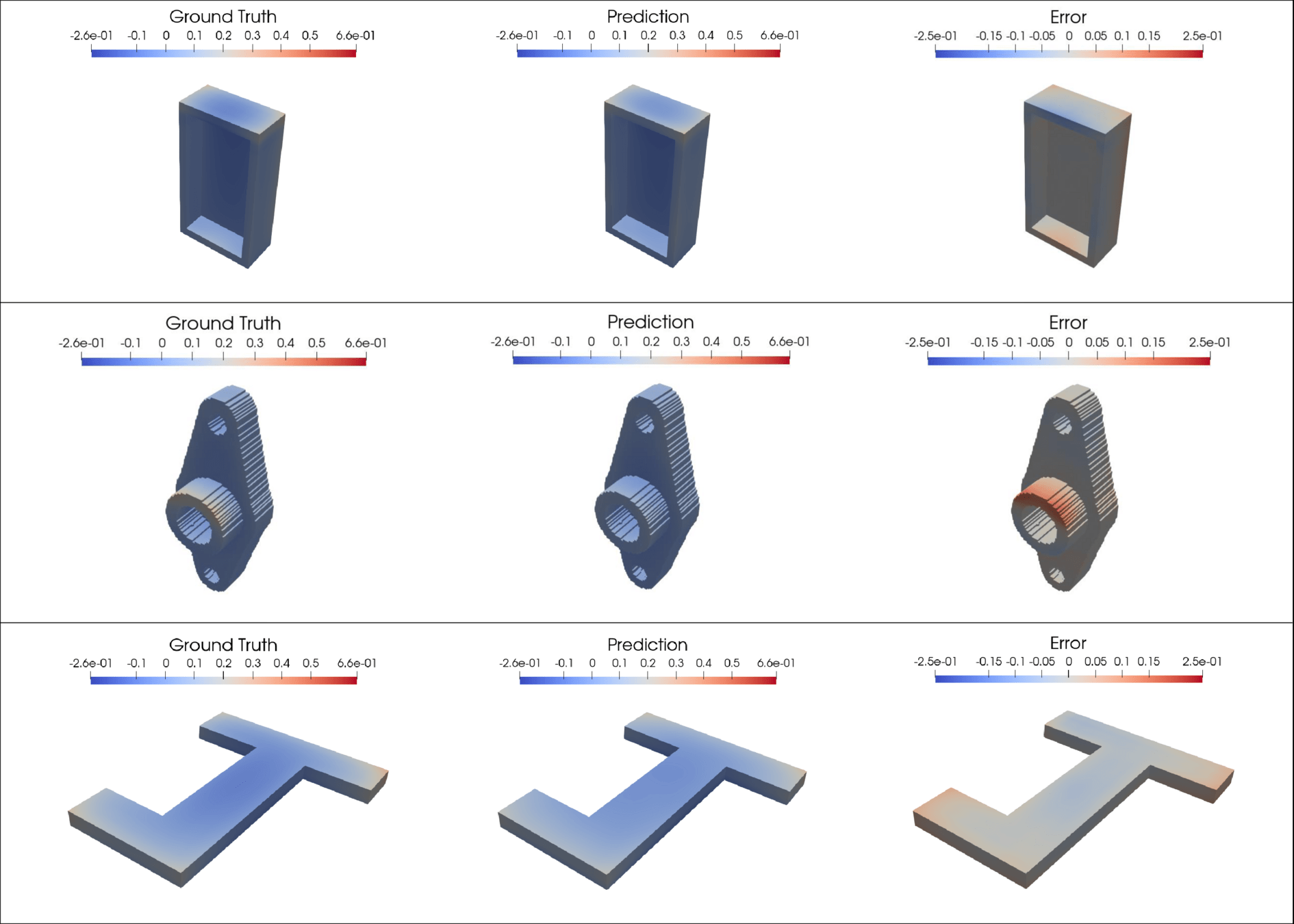
Laser powder bed fusion benchmark problem
25
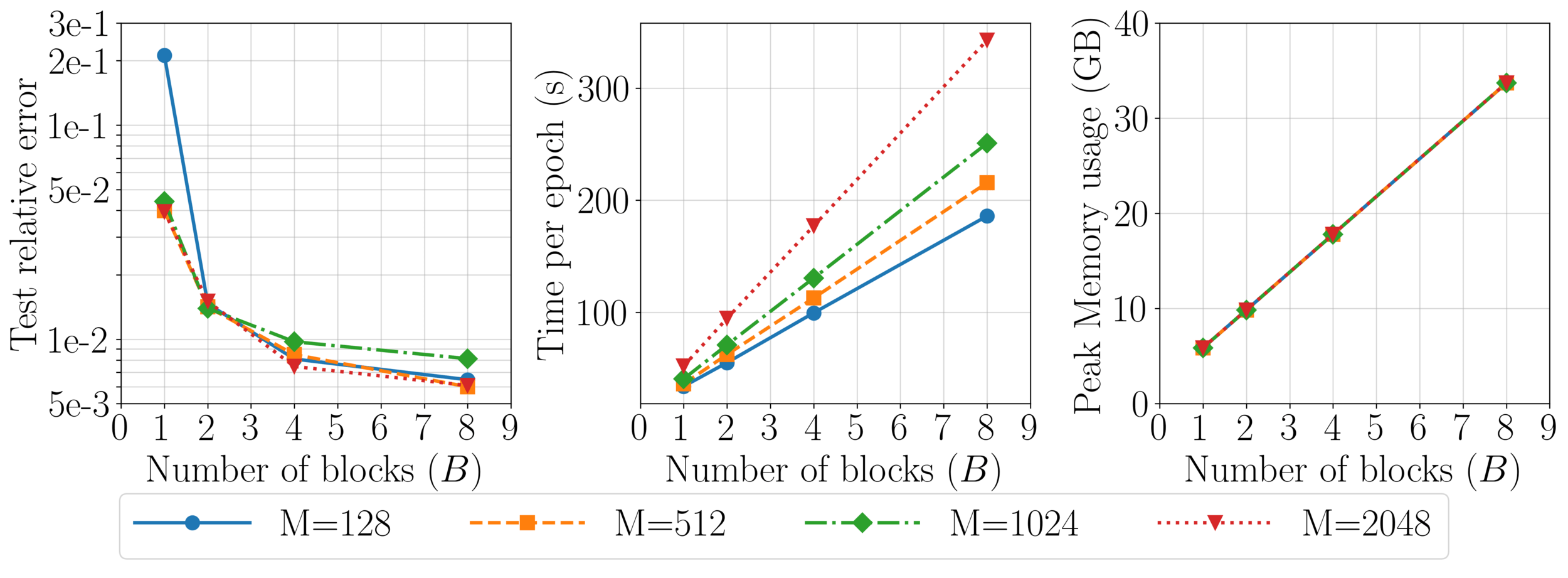
FLARE learns surrogate on a million-point mesh!
Largest experiment on a single GPU!
26
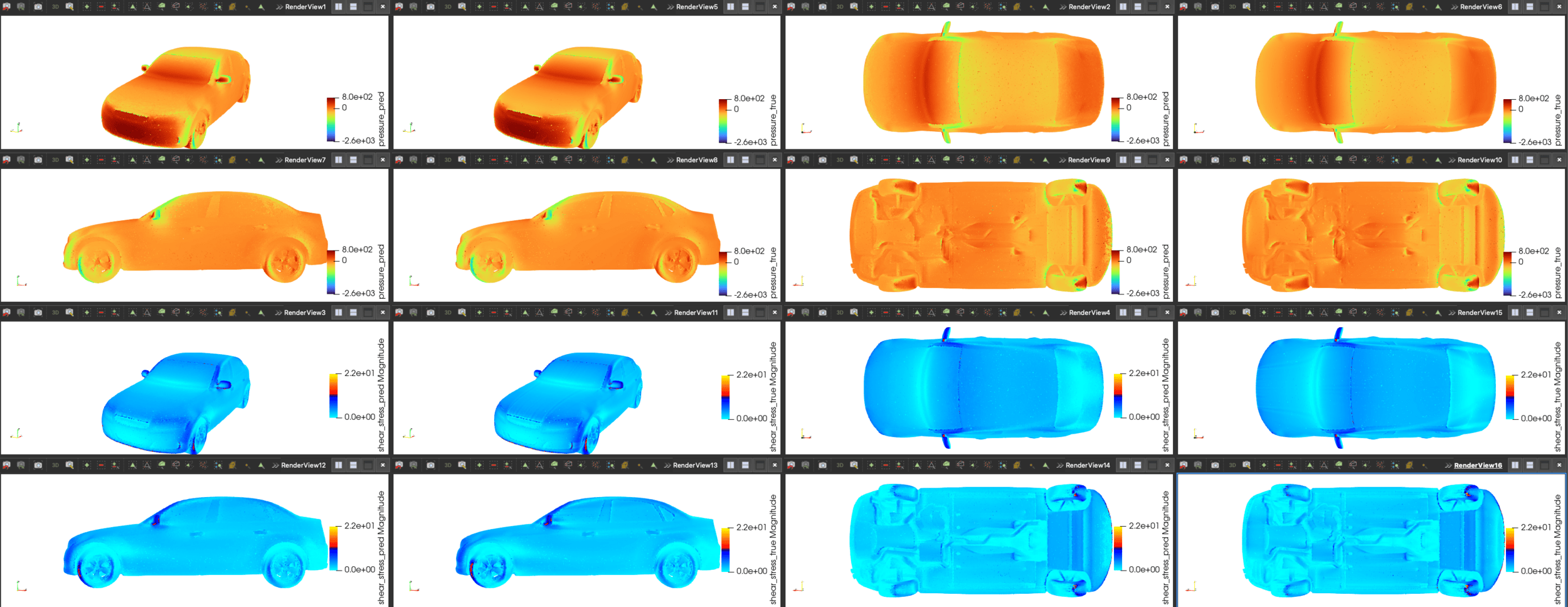
[1]
[1] Ashton et al. — “DrivAerML: High-Fidelity CFD Dataset for Road-Car Aerodynamics” (arXiv:2408.11969, 2024)
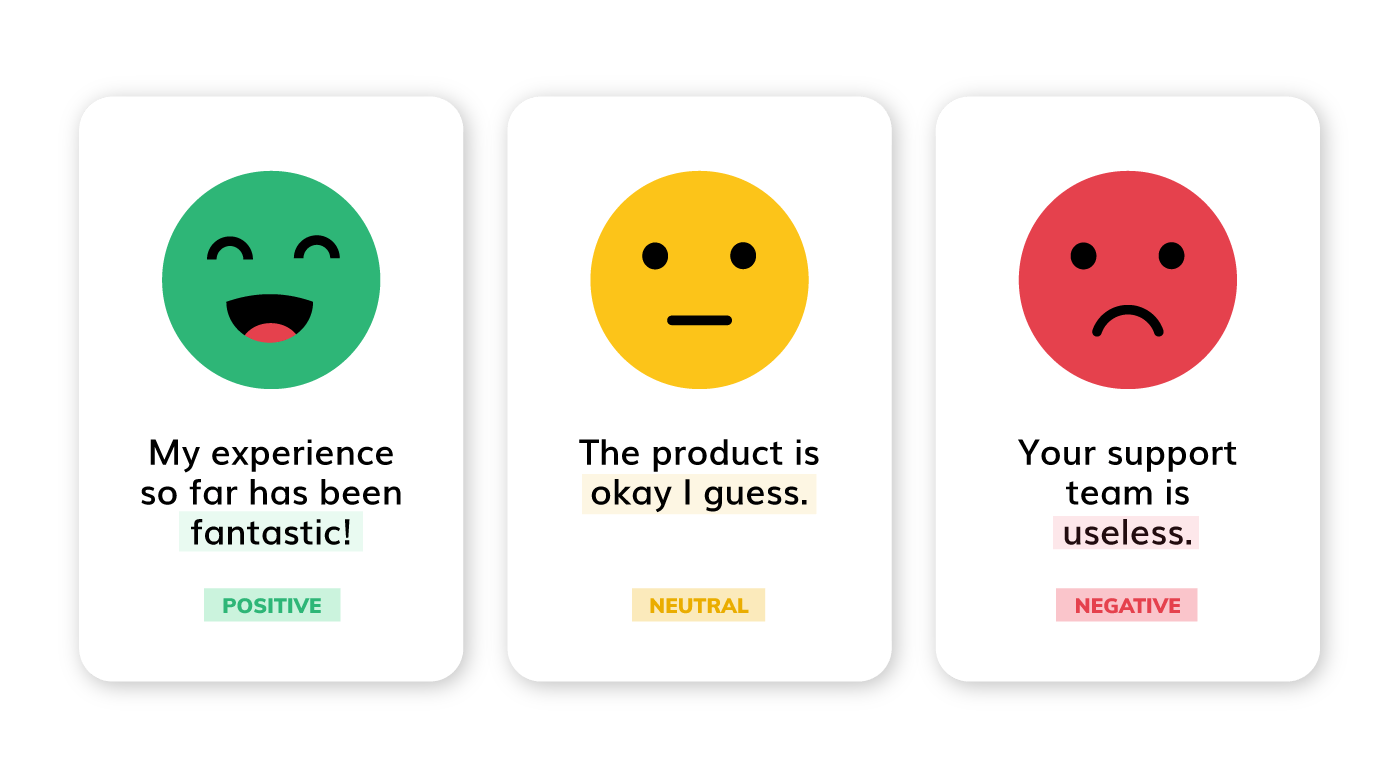
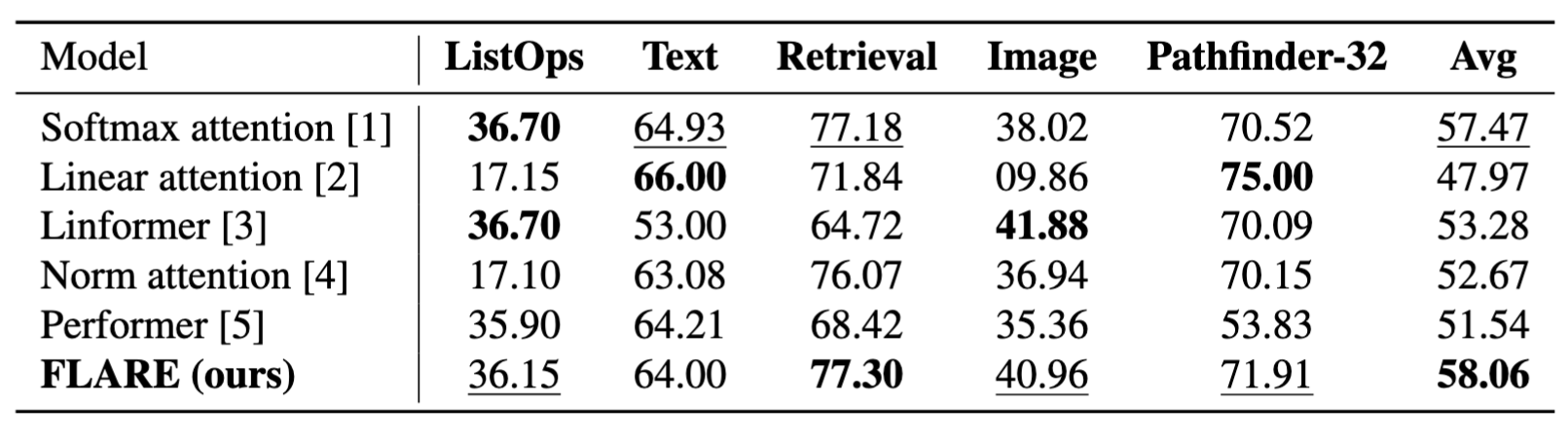
FLARE generalizes beyond PDE tasks
27
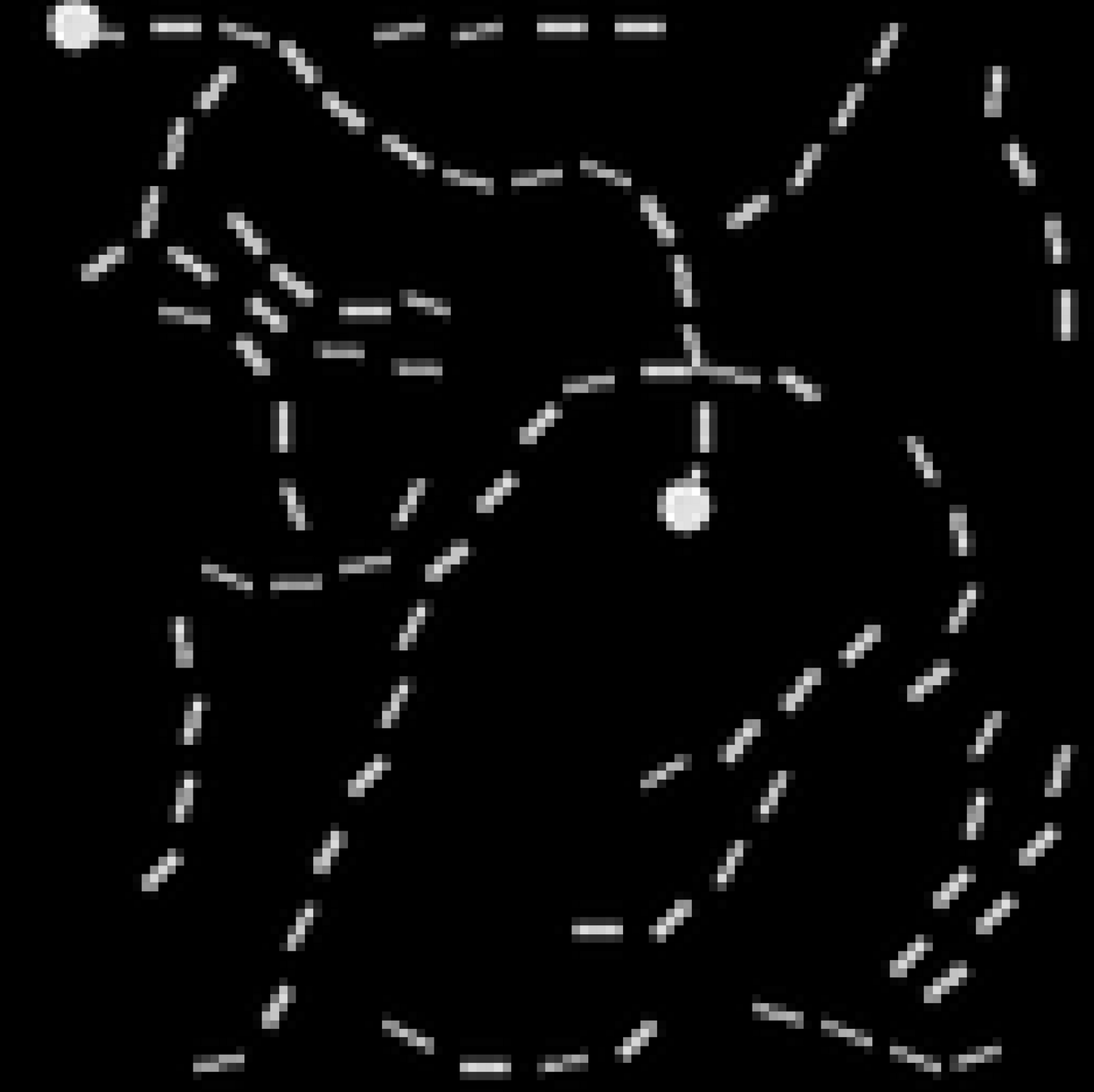
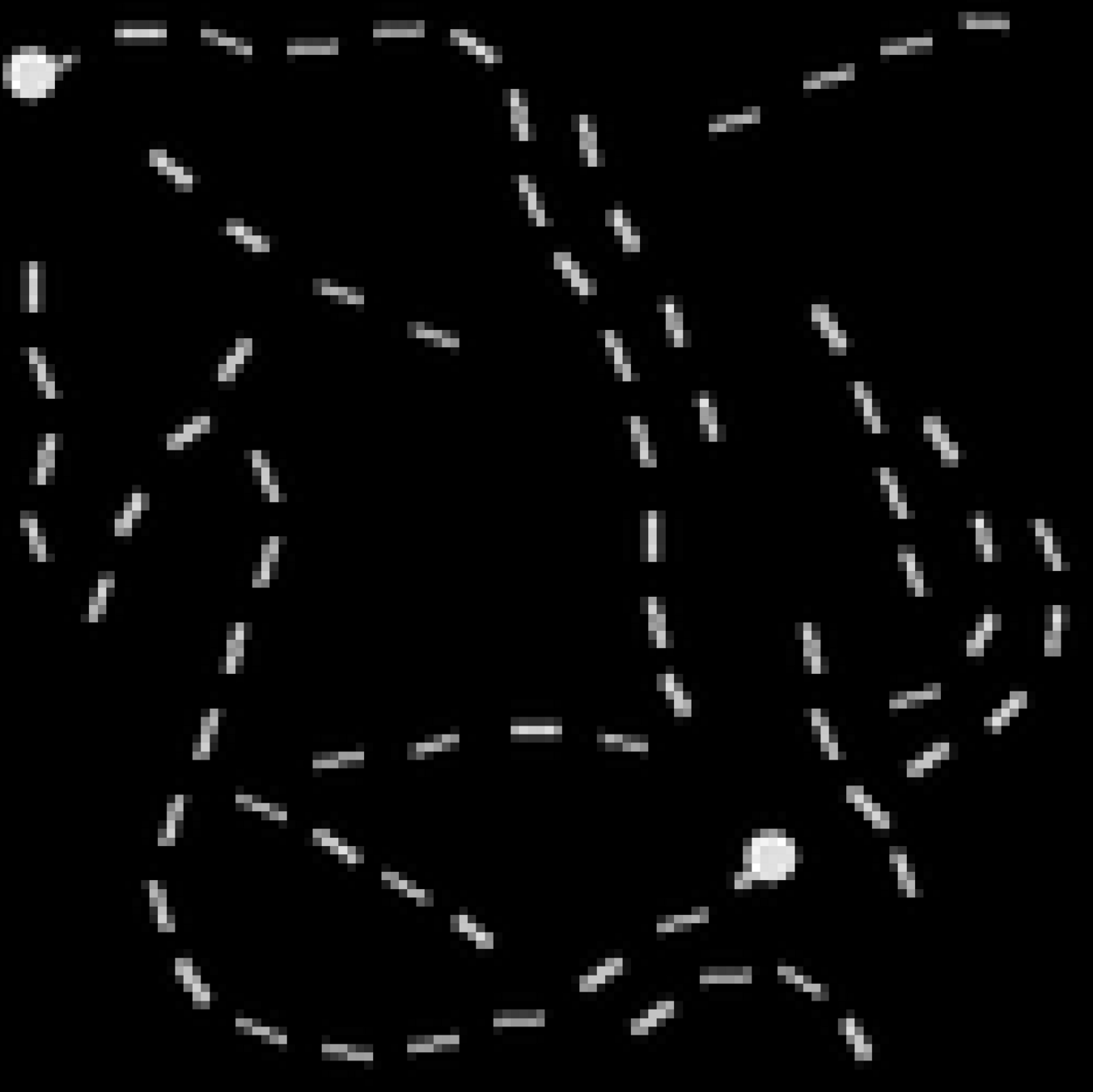
Pathfinder
Listops
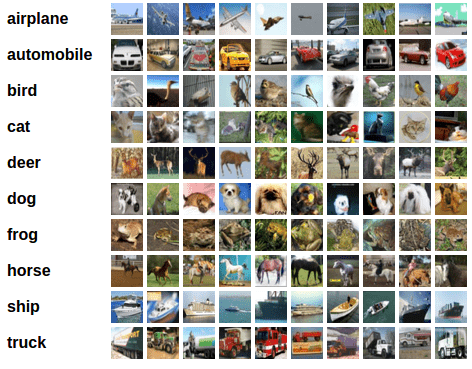
Image classification
Text sentiment analysis
[7]
[8]
[1]
[5]Choromanski et al. — "Rethinking Attention with Performers", ICLR 2021
[6] Tay, Y. et al. — “Long Range Arena: A Benchmark for Efficient Transformers” (arXiv 2020)
[7] Centric Consulting — “Sentiment Analysis: Way Beyond Polarity” (blog)
[8] Krizhevsky — CIFAR dataset homepage
[6]
Accuracy \((\%)\) (higher is better)
[1] Vaswani et al. — “Attention Is All You Need”, NeurIPS 2017
[2] Katharopoulos et al. — "Transformers are RNNs: Fast Autoregressive Transformers with Linear Attention", ICML 2020
[3] Wang et al. — "Linformer: Self-attention with linear complexity", arXiv:2006.04768 2020
[4] Qin et al. — "The devil in linear transformer", arXiv:2210.10340 2022
Key idea: Modulate token-mixing with conditioning tokens
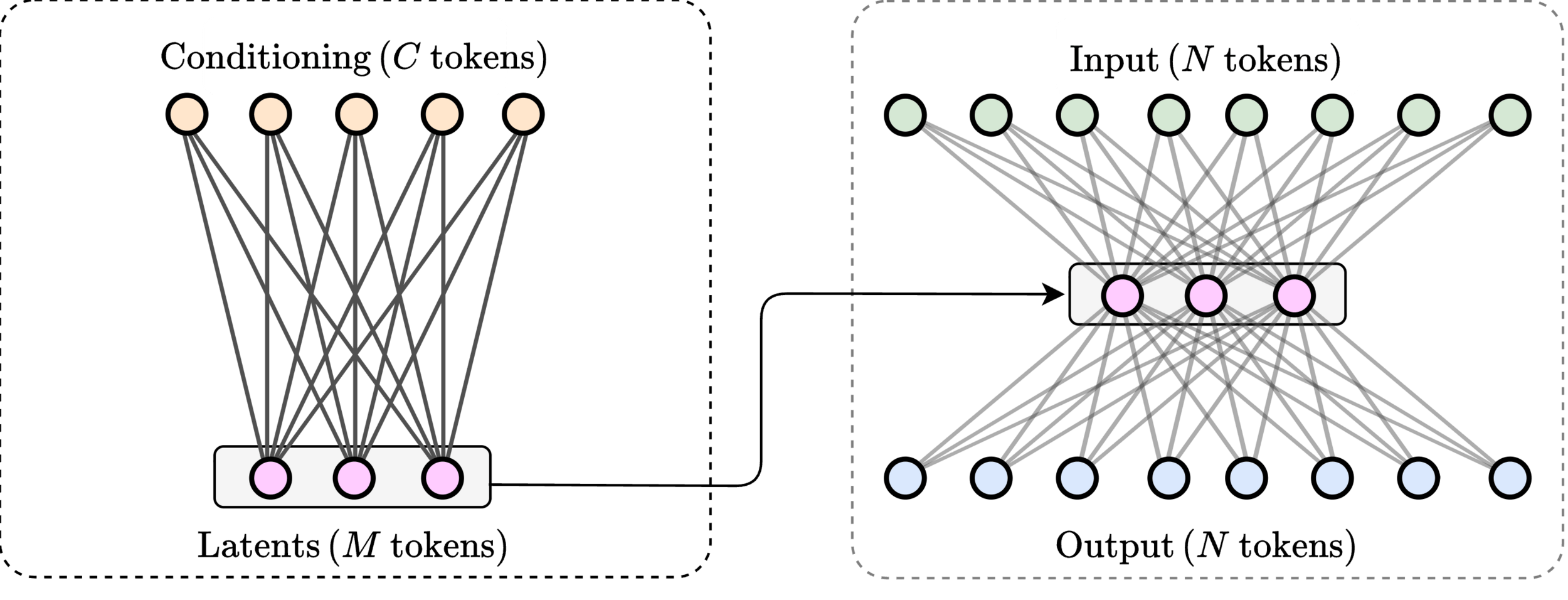
Cross FLARE
32
Conditioning mechanism for FLARE
We propose to handle token mixing and conditioning in one unified block
\(\mathcal{O}(2MN + MC) \) complexity
Notes on high-order attention
Linear attention replaces \(N\times N\) connections with fixed-size state
Full self-attention
Linear attention

Token mixing mediated through \(S\in\mathbb{R}^{D\times D}\)
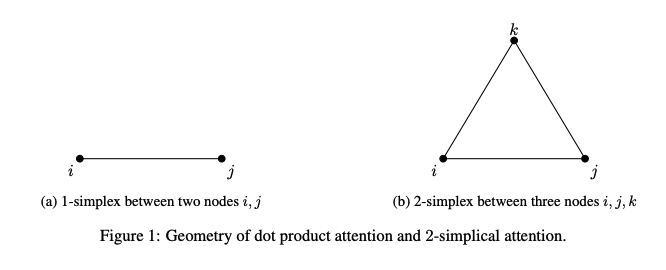
Proposal 1: Multilinear kernelized attention from 2-simplicial attn
Self attention is built on the bilinear form
2-simplicial attention generalizes it to trilinear forms
Then 2-simplicial attention proceeds as follows: consider \(Q, K^1, K^2, V^1, V^2 \in \mathbb{R}^{N \times D}\).
We review linear attention and note that removing softmax allows for exploiting associativity:
We linearize 2-simplicial attention
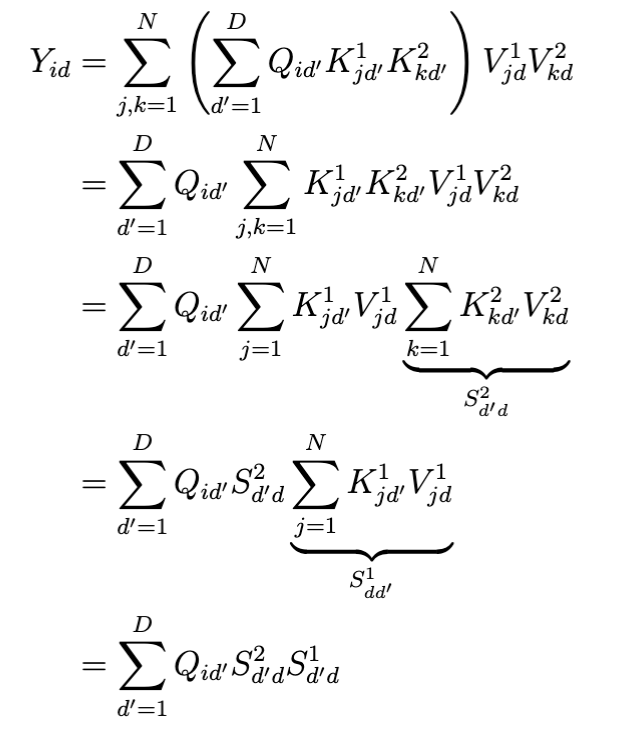
This implies:
We can generalize this to arbitrary order
Proposal 2: Higher order memory
Instead of the state being \(D \times D\), have the state be \(D \times D \times D\). We call it Triple Attention
Similarly, we propose Quad-Attention with \(D \times D \times D \times D\) state.
Triple Attention or Multi-linear attention
FEATURES
- Considers N-tuples of tokens at a time.
- More expressive than standard attention, linear attention
- Easily parallelizable across multiple GPUs
- Kernel-based interpretation
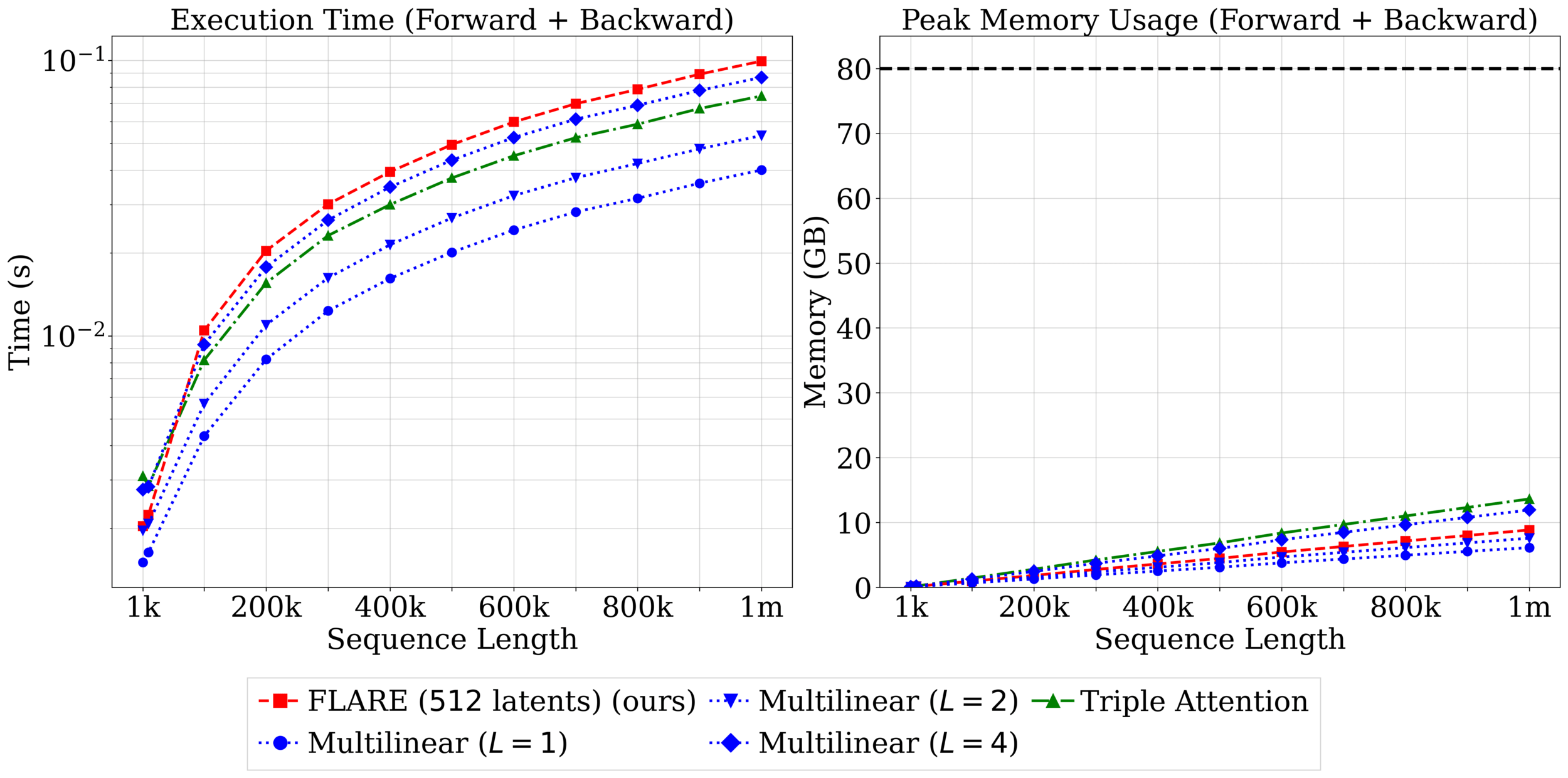
- As efficient and accurate as FLARE (SOTA)
DEMONSTRATIONS
- Encoder transformer
- PDE Surrogate modeling, Long-range arena
- Decoder transformer
- Next-token prediction/ language modeling
Triple Attention Scaling Study
Notes
Hyper-graph attention
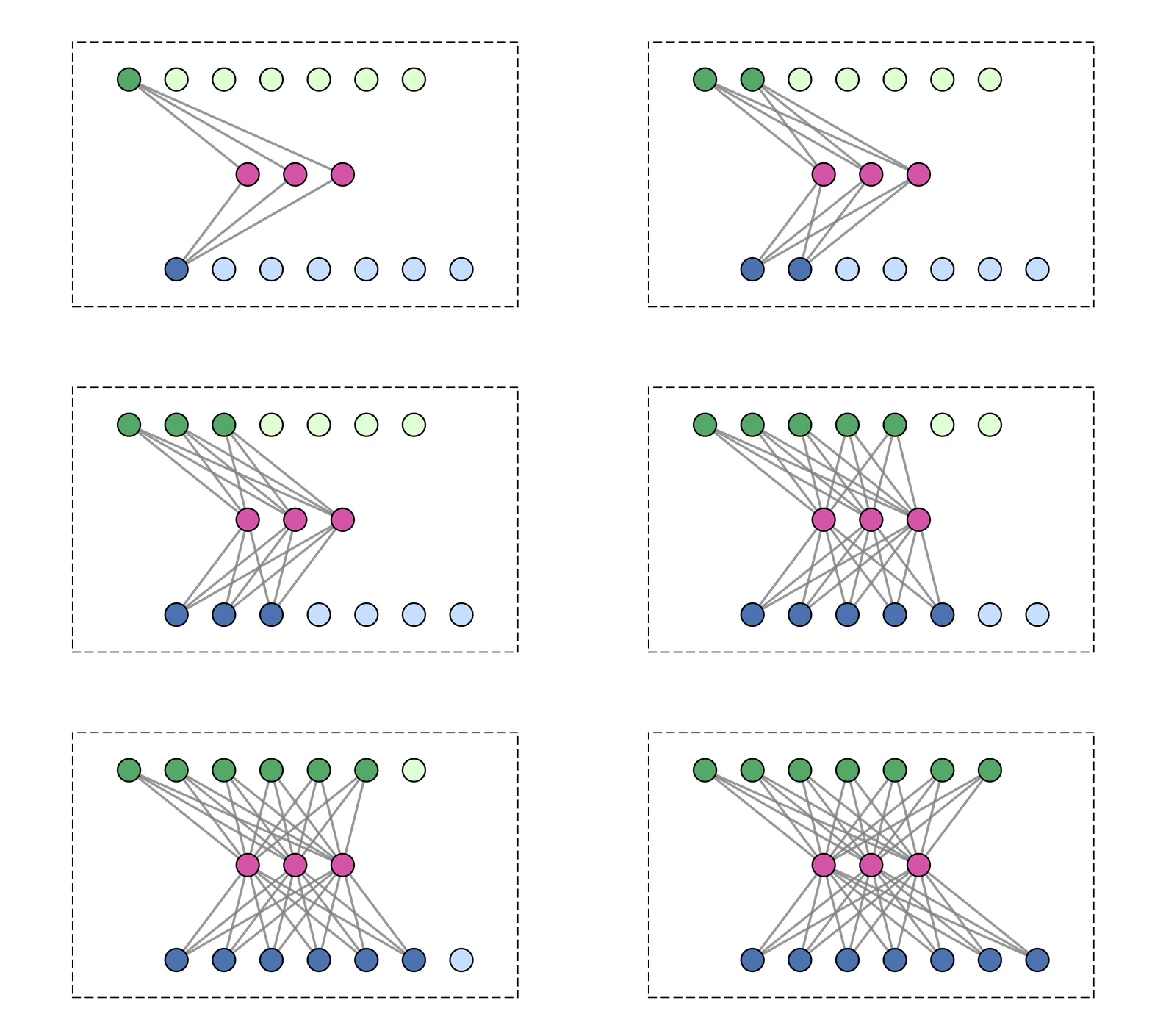
- Triple/third order attention is a starting point for exploring high-order attention but it really shouldn't be the end point. Real world tasks may need arbitrary order compositional reasoning.
- However, the methods we have explored thus far consider fixed-length N-Tuples. This is where the idea of looping becomes interesting: can we design a method that builds up high-order reasoning with low-order primitives?
Relation to linearized attention
- In principle, the state \(S \in \mathbb{R}^{D \times D}\) in linear attention can store information from several tokens. As such, does that negate the need for high-order attention methods? I don't know.
Proposed Work
Extend FLARE to transient problems
Motivation: preempt build failures in metal additive manufacturing
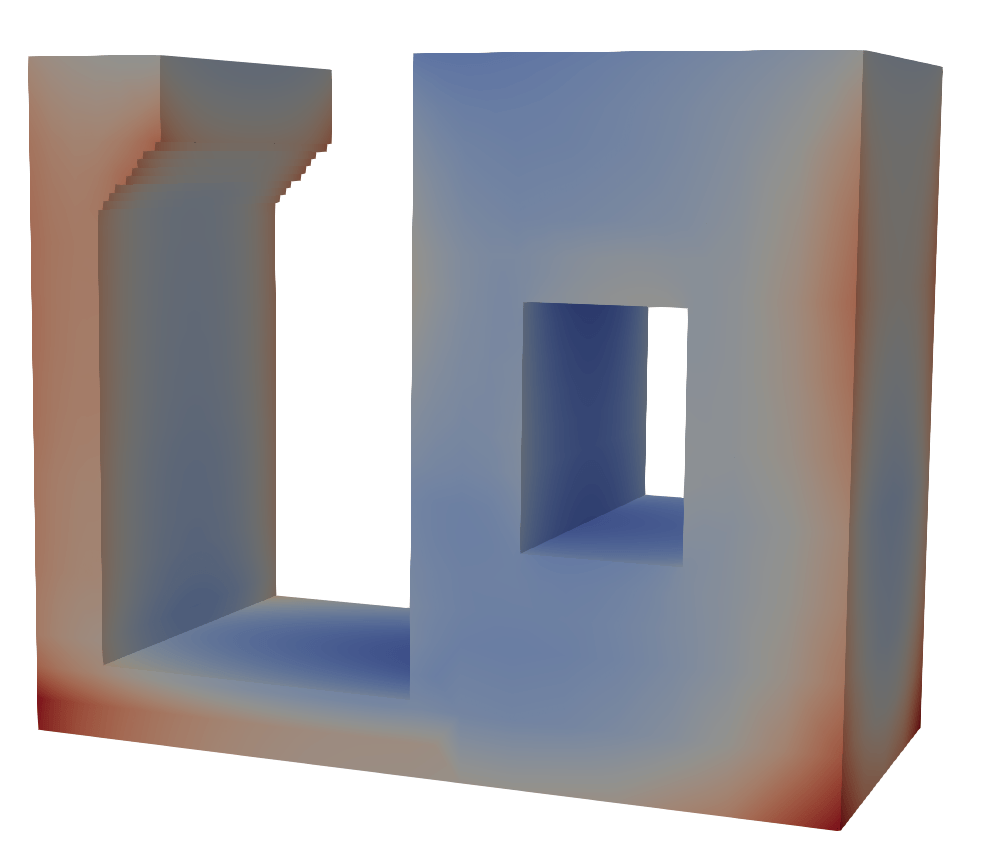
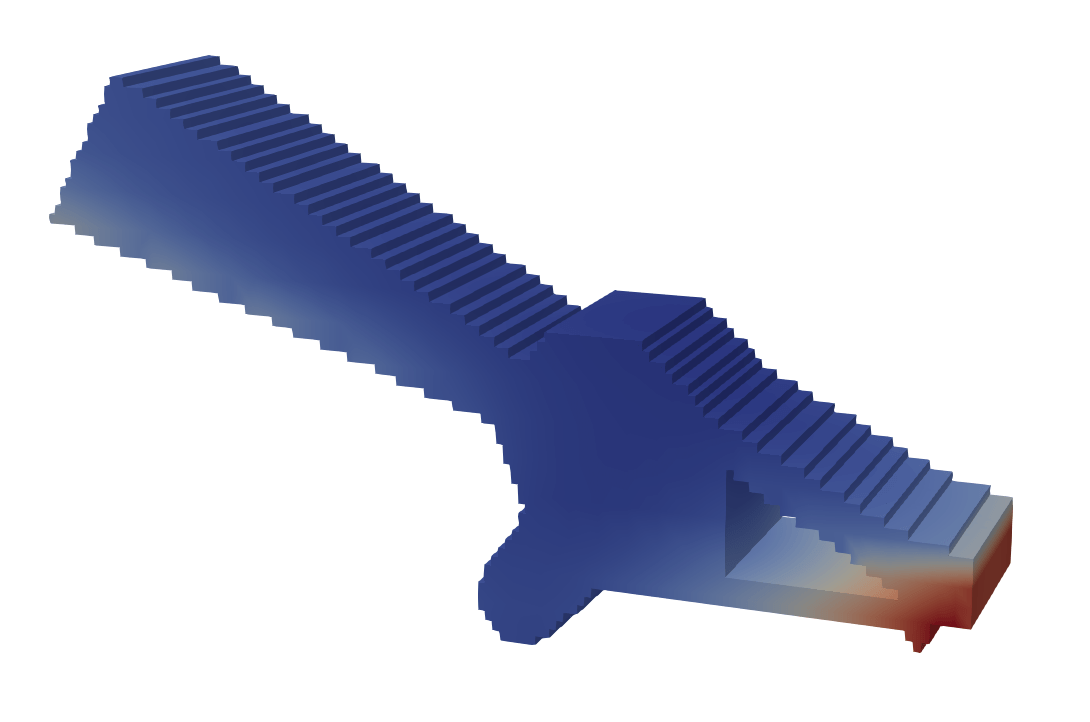
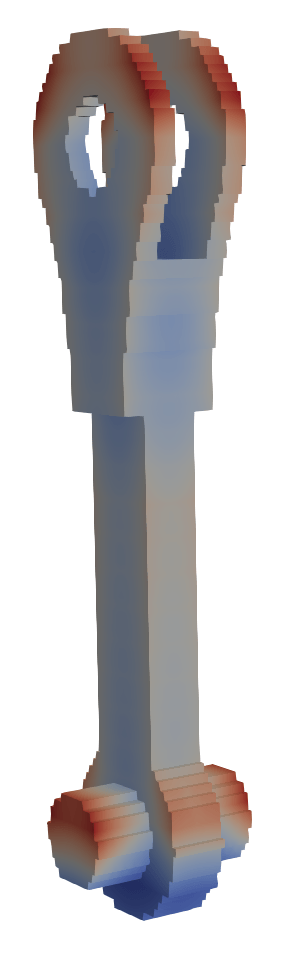
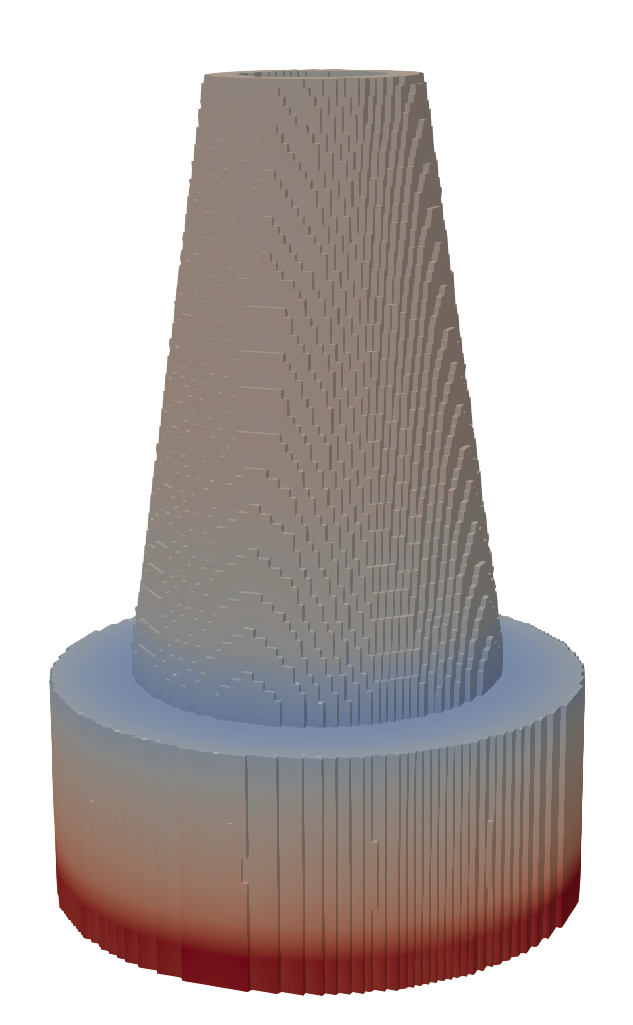
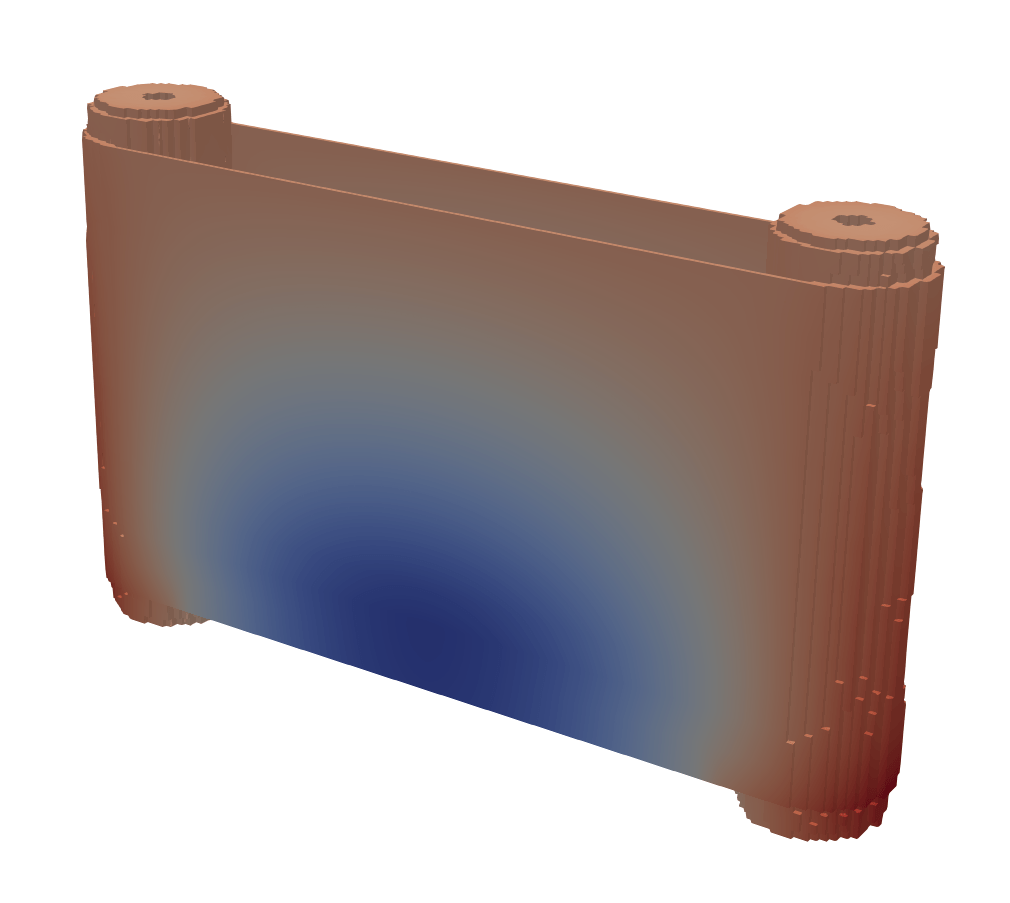
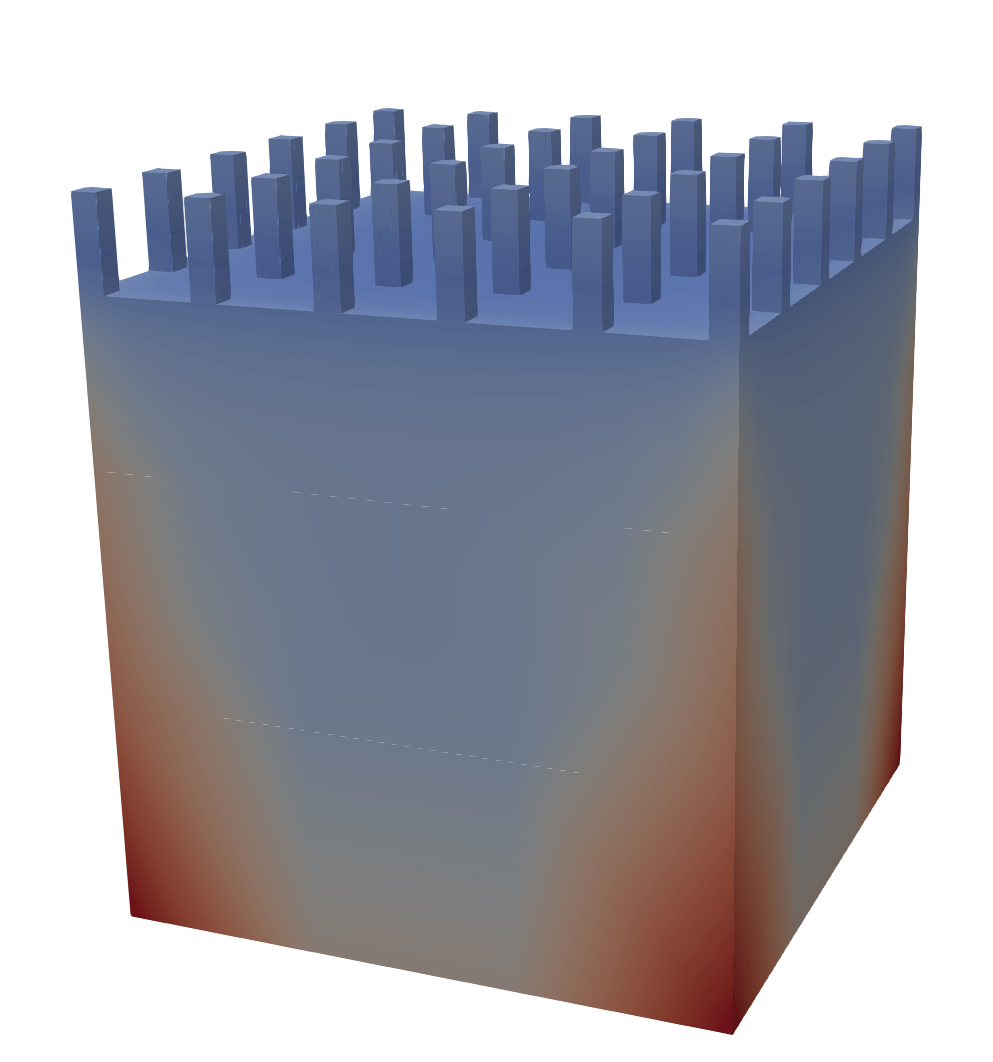
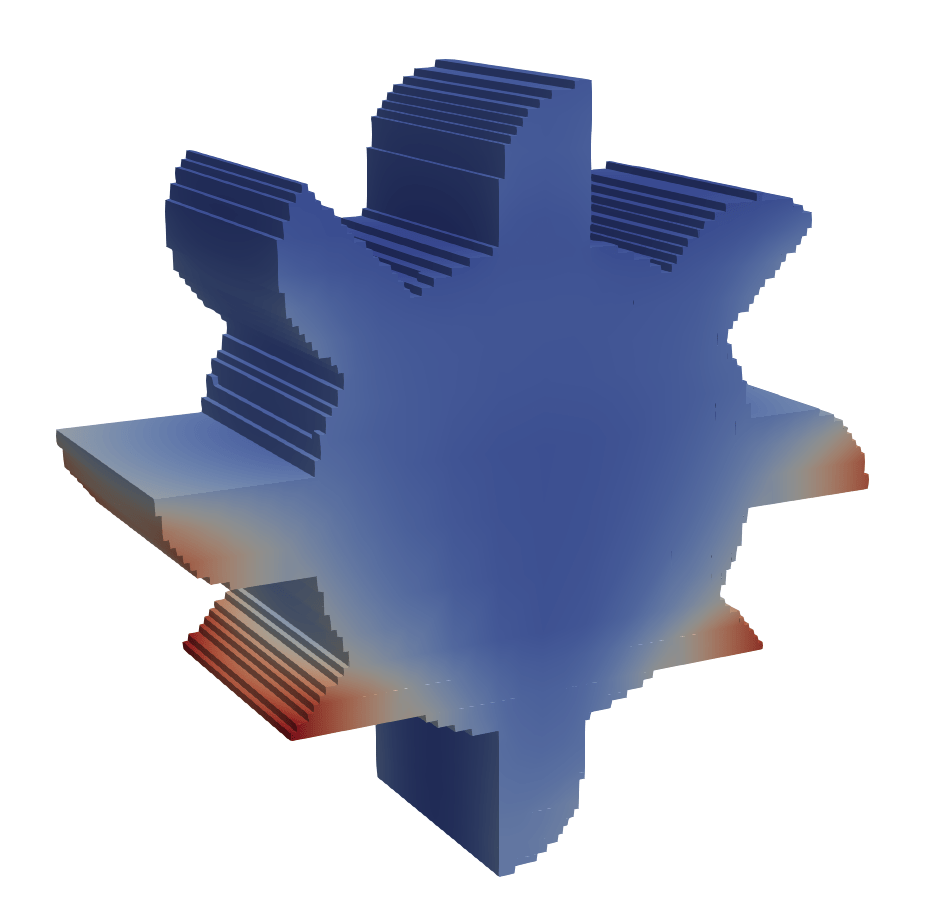
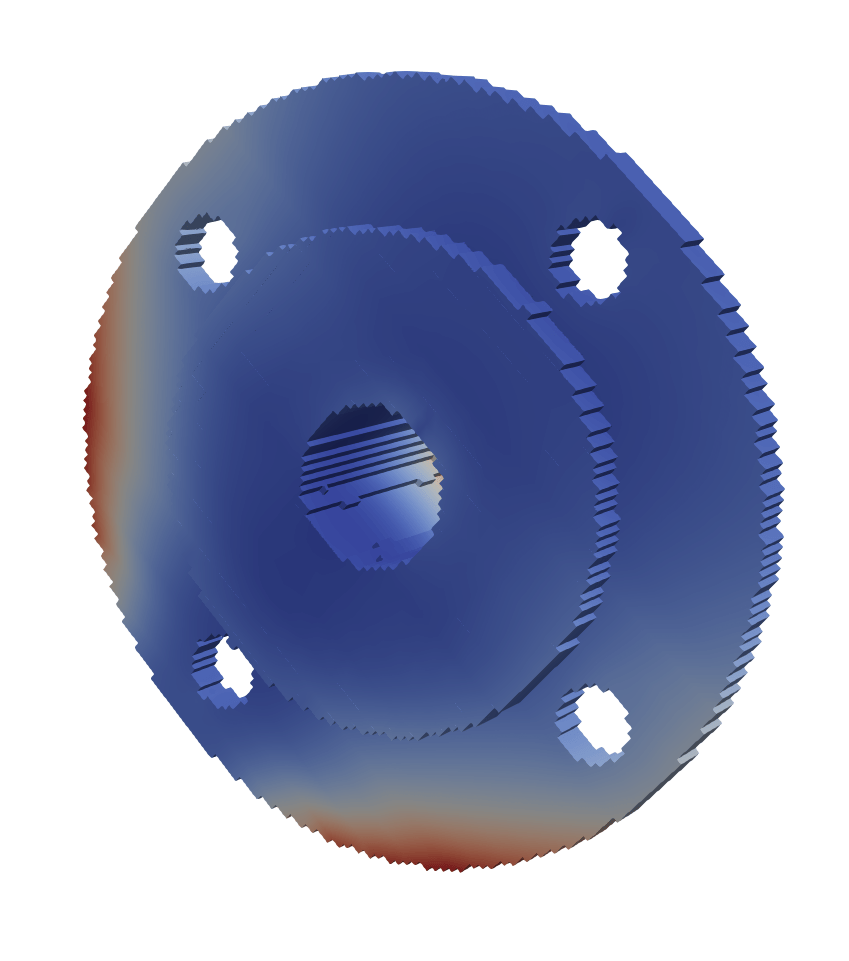

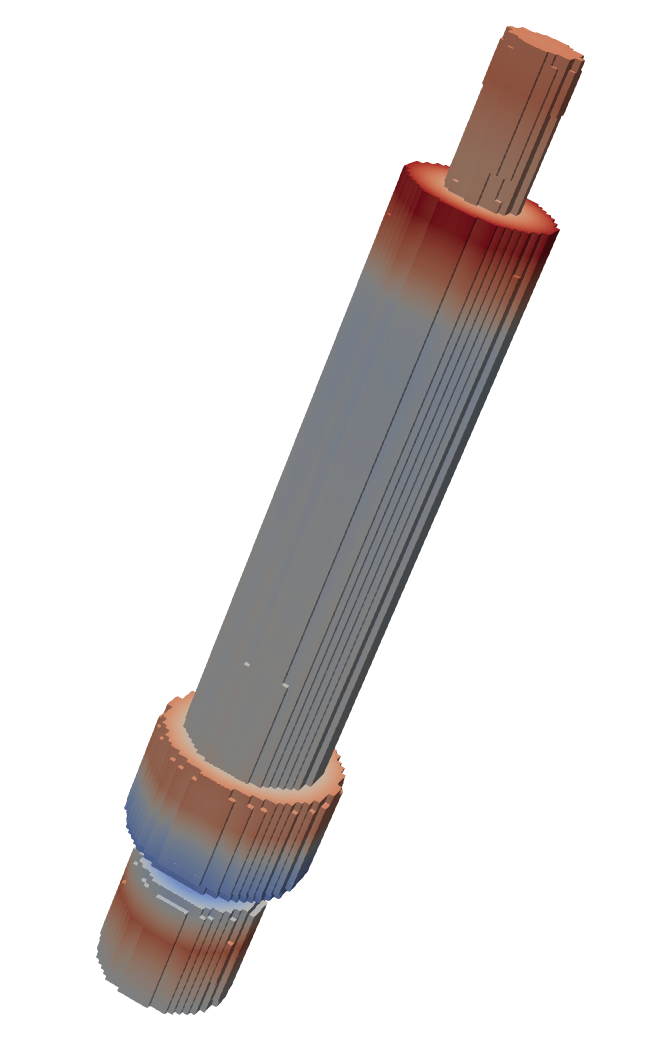
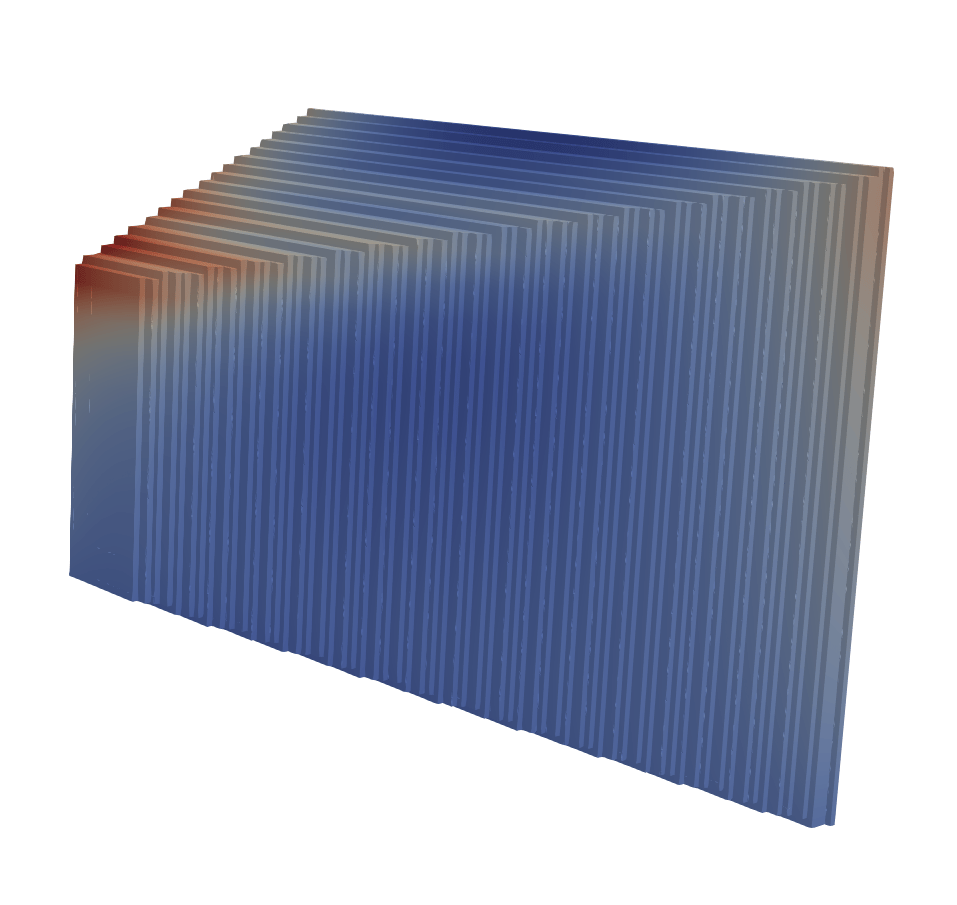
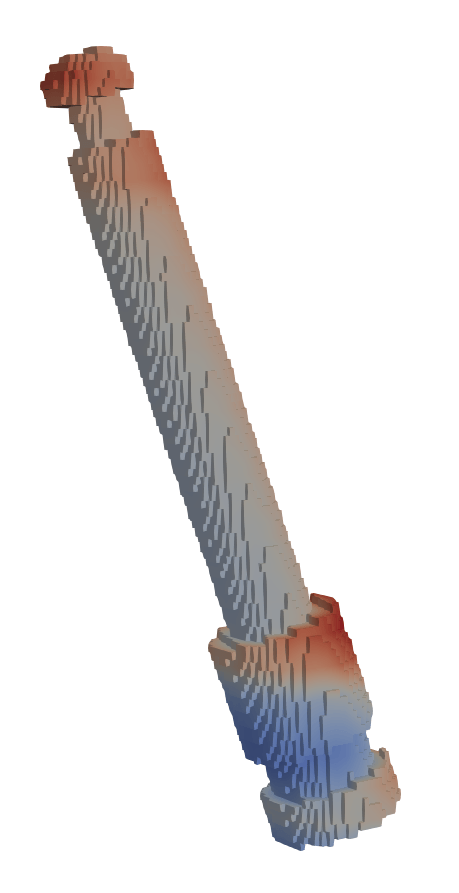
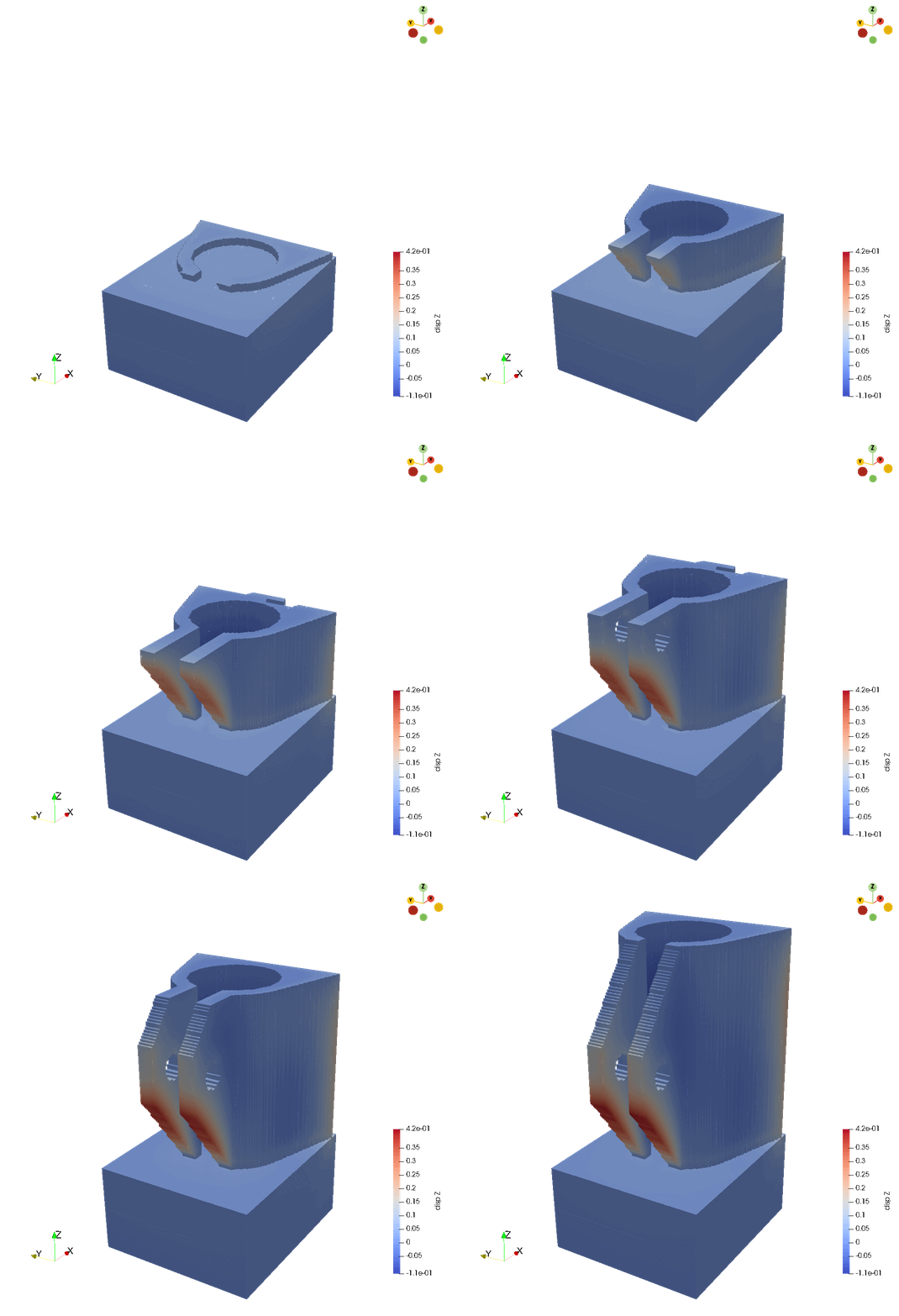
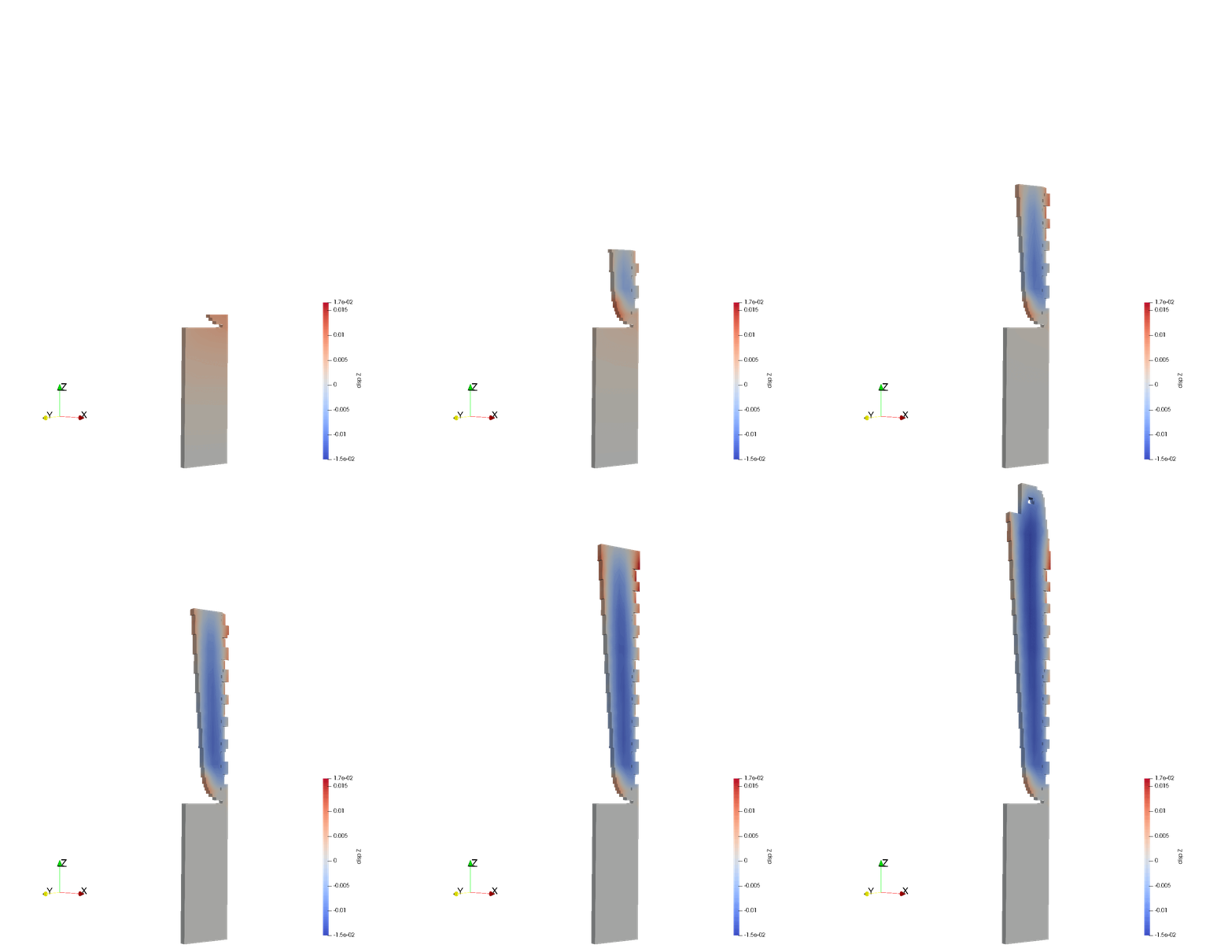
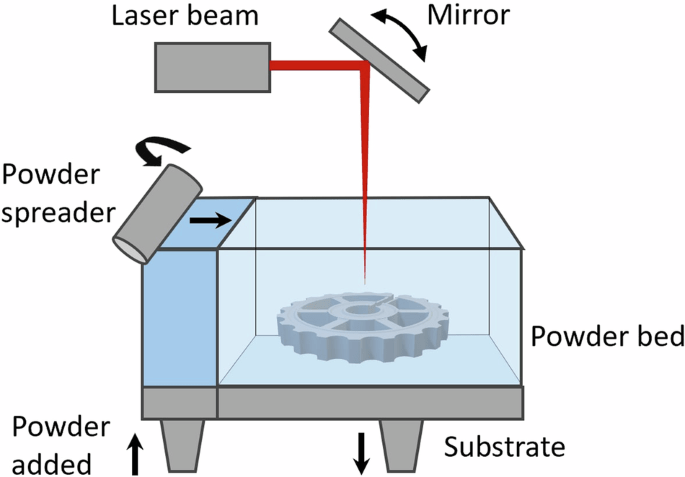
Laser Powder Bed Fusion (LPBF)
Dataset of 20k LPBF calculations
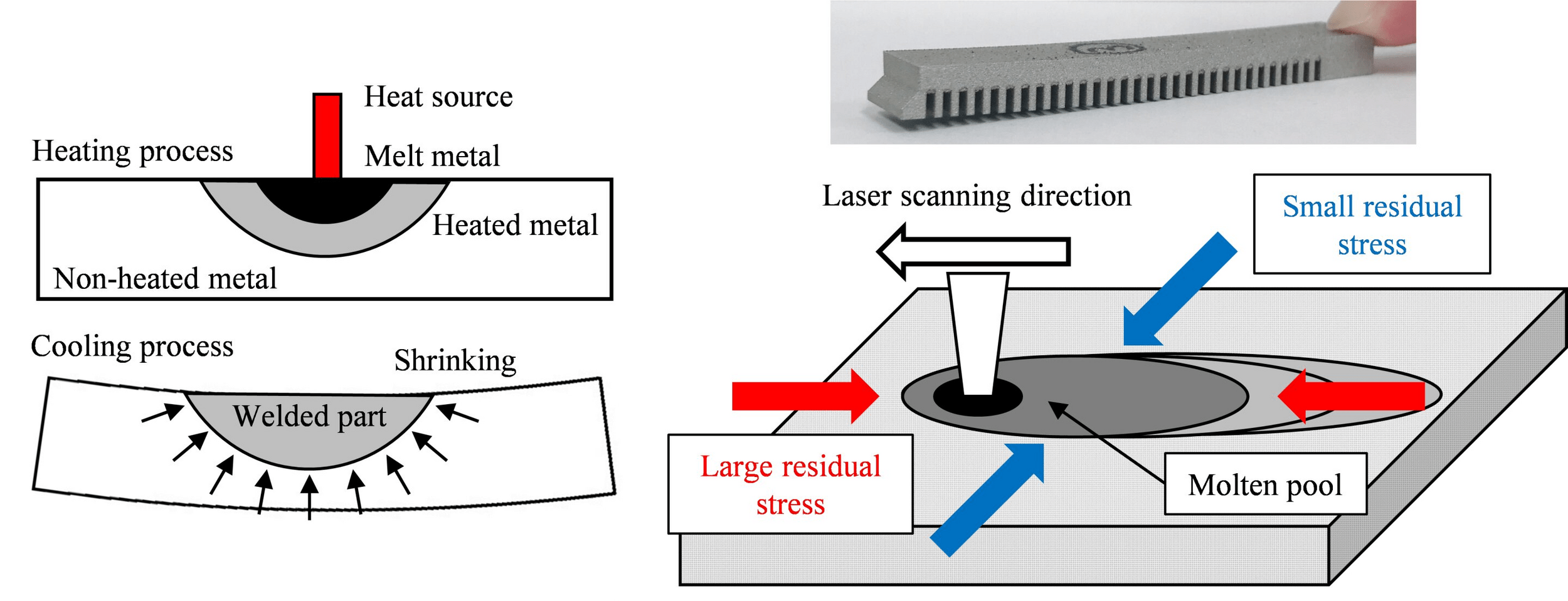
Goal: develop fast surrogate model to predict warpage during build
Governing equations
End results could be deployed as a valuable design tool for metal AM.
28
[1]
[2]
[1] Nature Scientific Data — High-resolution dataset (2025)
[2] TechXplore — “Synergetic optimization reduces residual warpage in LPBF” (2022)
Proposed aims
Aim 1: Advance FLARE for enhanced surrogate modeling
29
Aim 2: Develop decoder version of FLARE
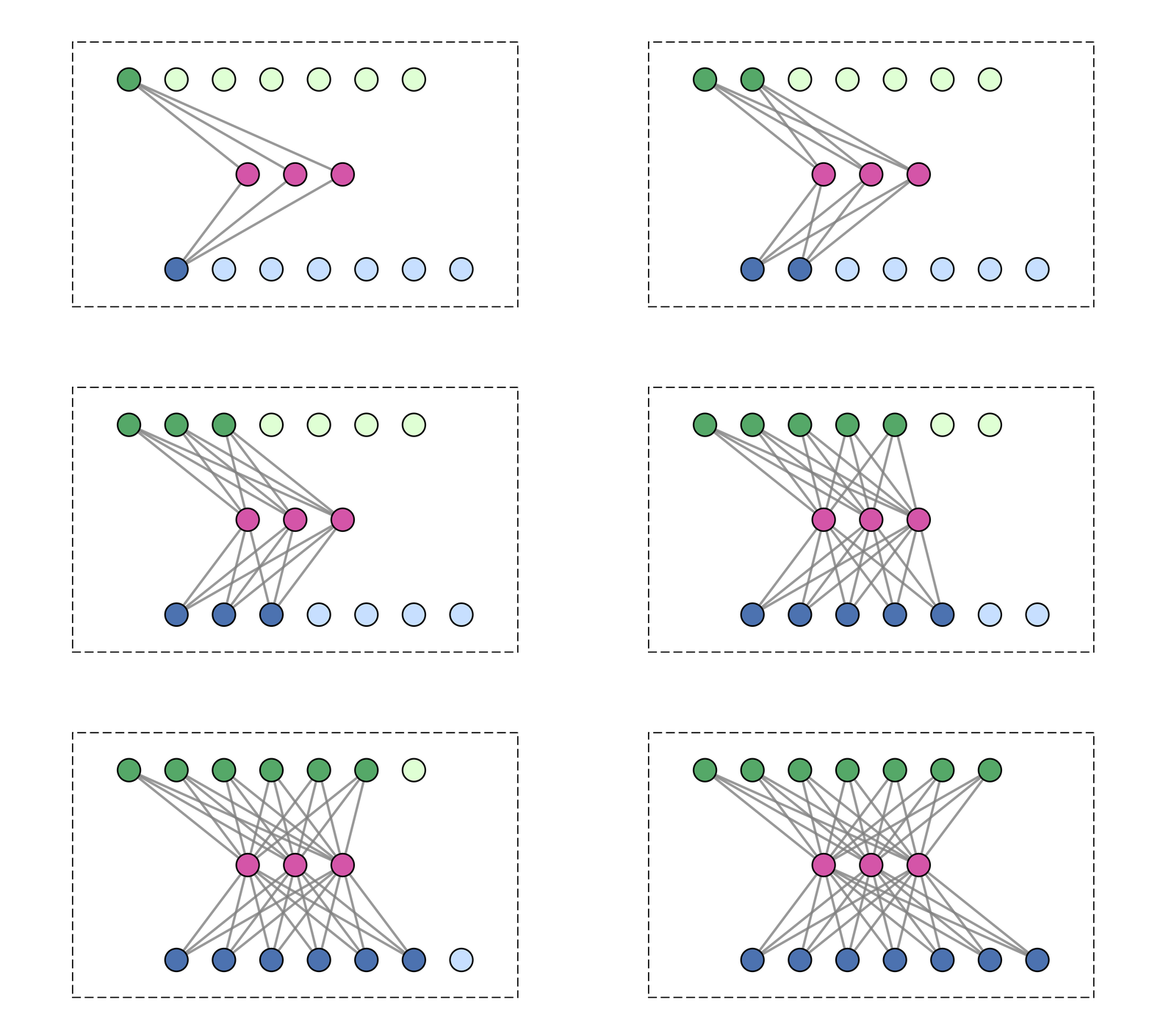
AIM 1(a): rank-adaptive FLARE
AIM 1(b): conditioning mechanism for FLARE
AIM 1: advance FLARE for enhanced surrogate learning
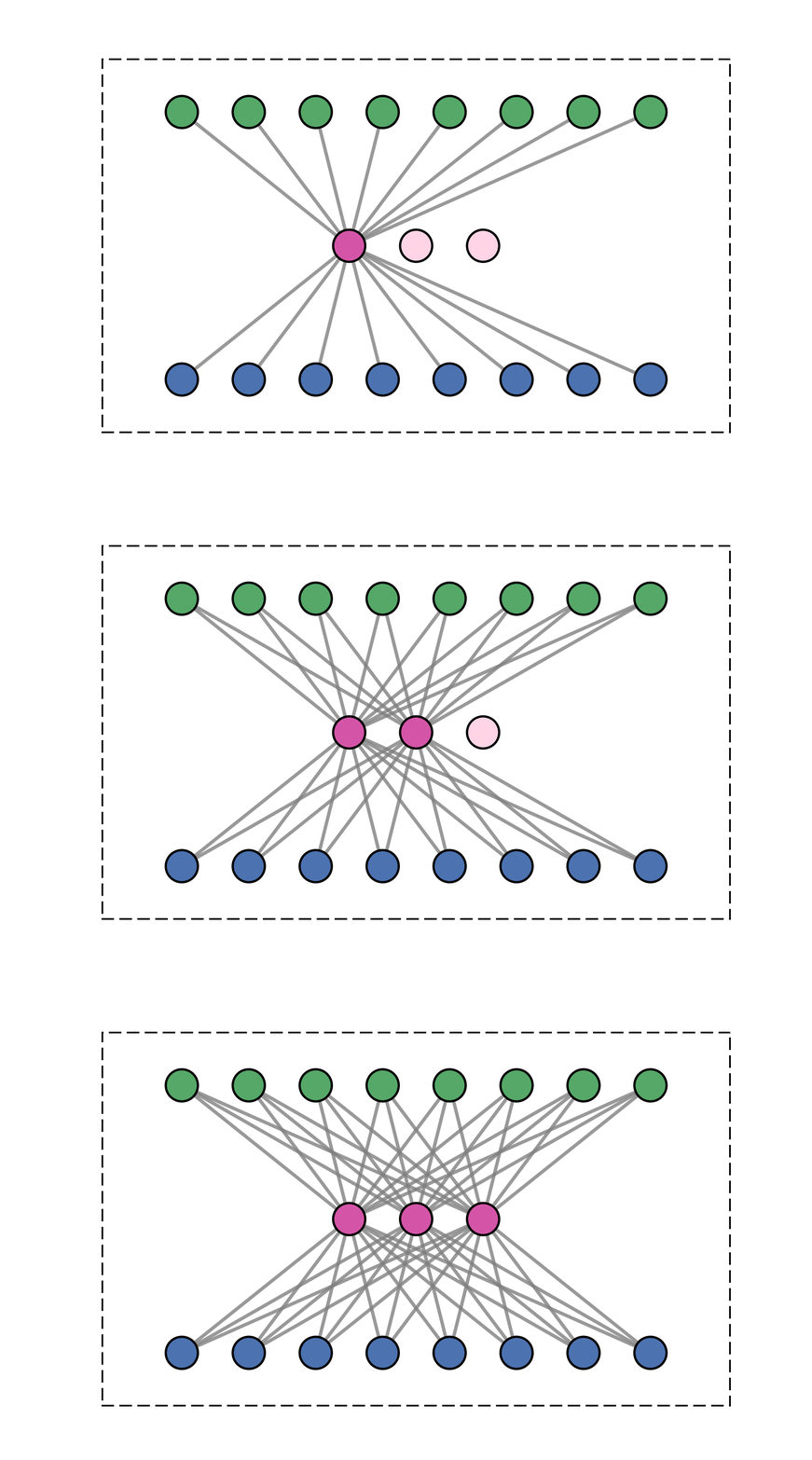
AIM 1(a): rank-adaptive FLARE for faster training
30
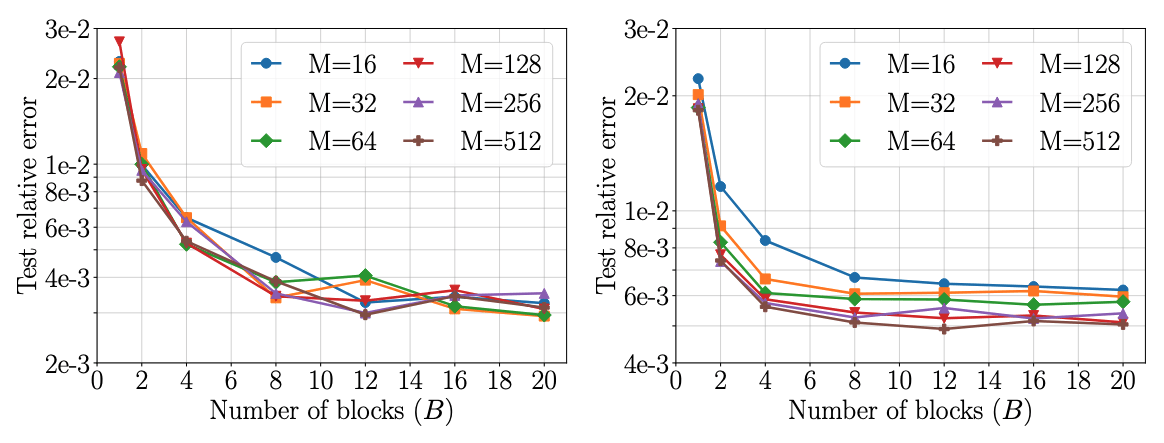
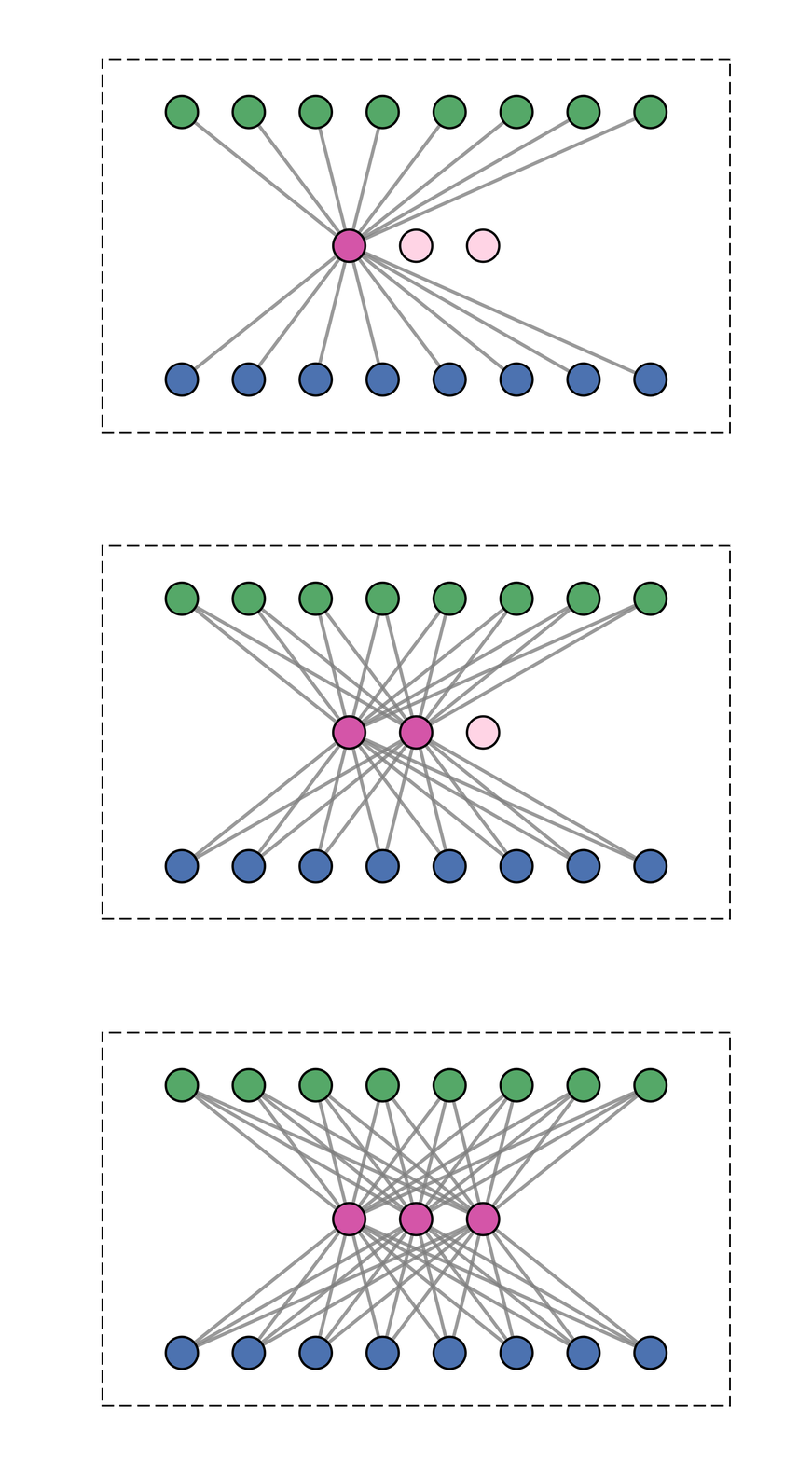
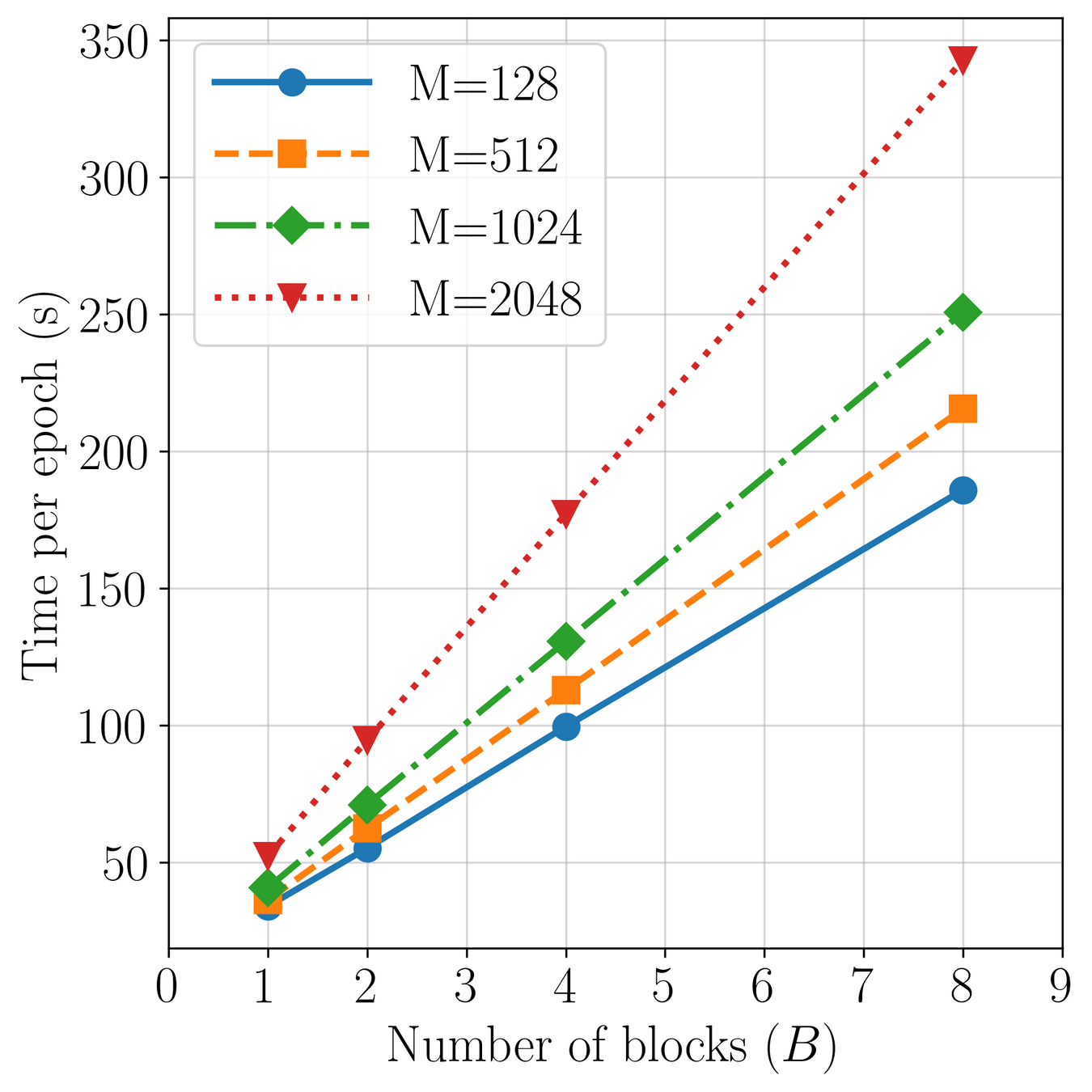
Complexity scales with latents (\(M\)): \(\mathcal{O}(2MN)\)
Accuracy increases with \(M\)
Method: progressively increase latents (\(M\)) through training.
Challenge: Minimize loss spikes, training instabilities.
Aim 1(b) background on conditioning in transformers
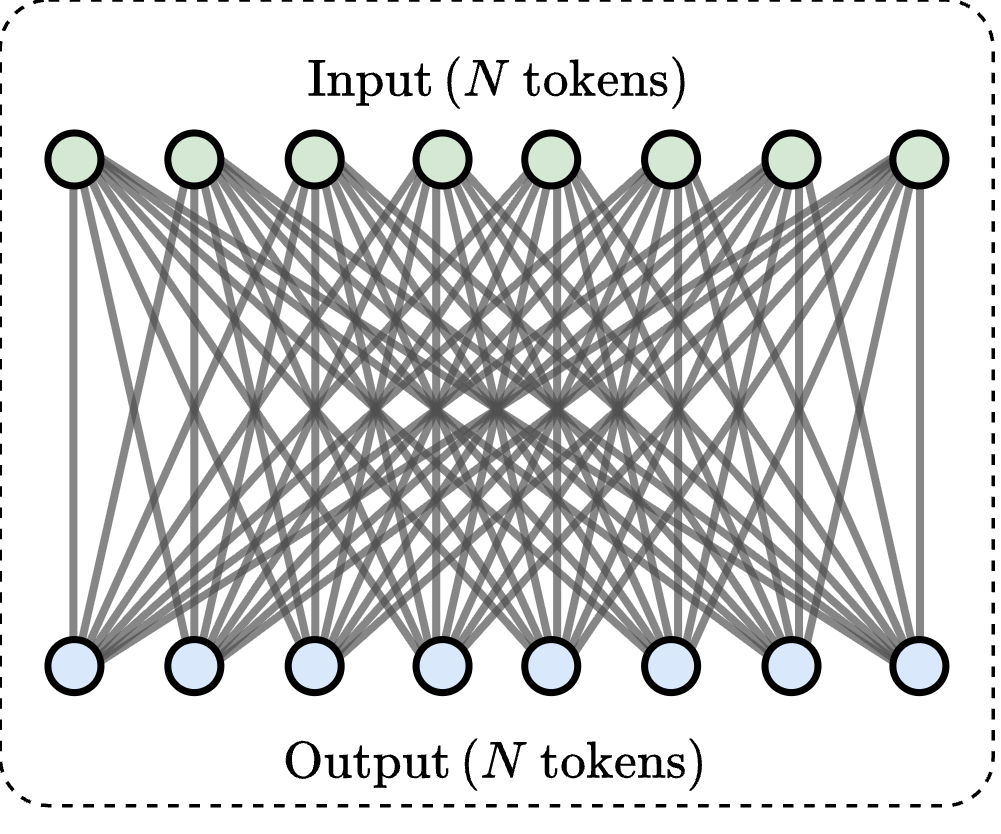
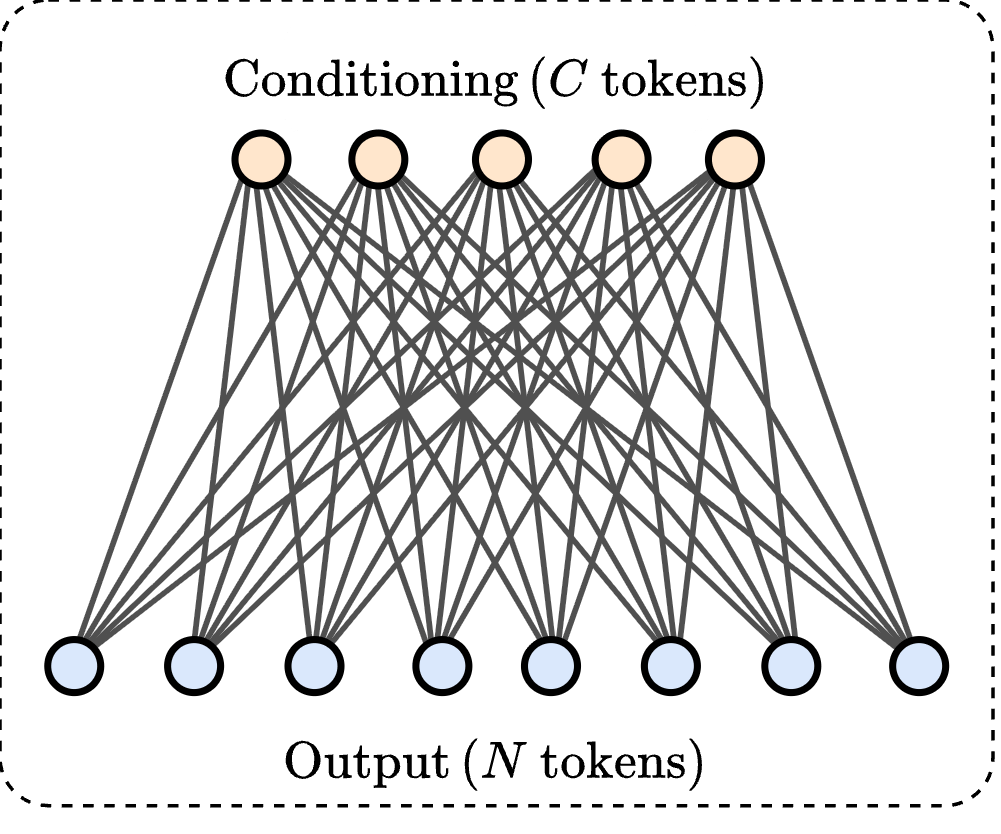
Token mixing [1] (\(\mathcal{O}(N^2)\))
Conditioning [1] (\(\mathcal{O}(N\cdot C)\))
Token mixing
Token mixing
Conditioning
31
[1] Vaswani et al. — “Attention Is All You Need”, NeurIPS 2017
Key idea: Modulate token-mixing with conditioning tokens
Cross FLARE
32
Aim 1(b) conditioning mechanism for FLARE
We propose to handle token mixing and conditioning in one unified block
\(\mathcal{O}(2MN + MC) \) complexity
Aim 2: background on next-token prediction transformers [1]
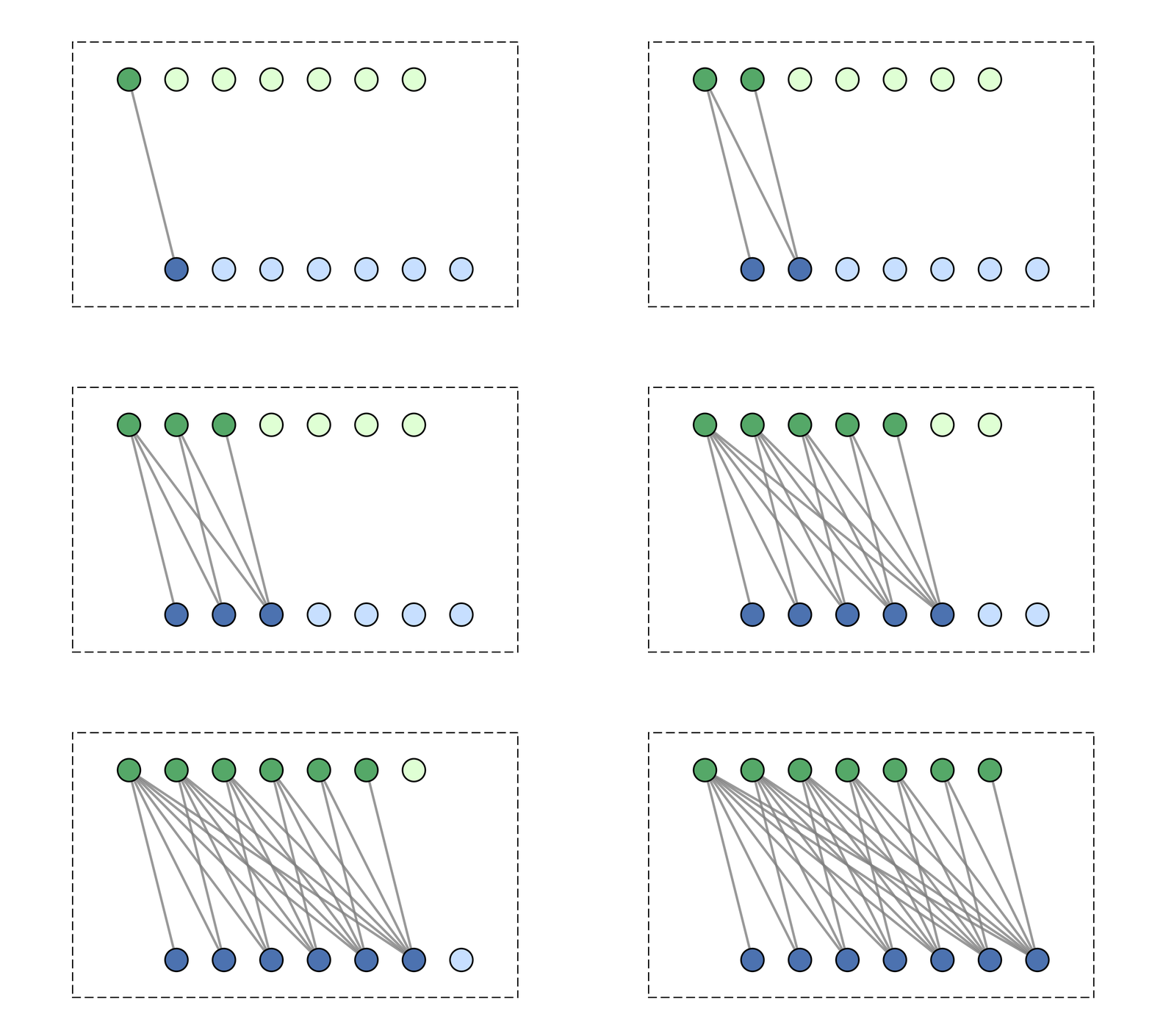
All previous key/value \(\{k_\tau, v_\tau \}_{\tau \leq t}\) must be cached on the GPU.
Major memory and latency bottleneck!
33
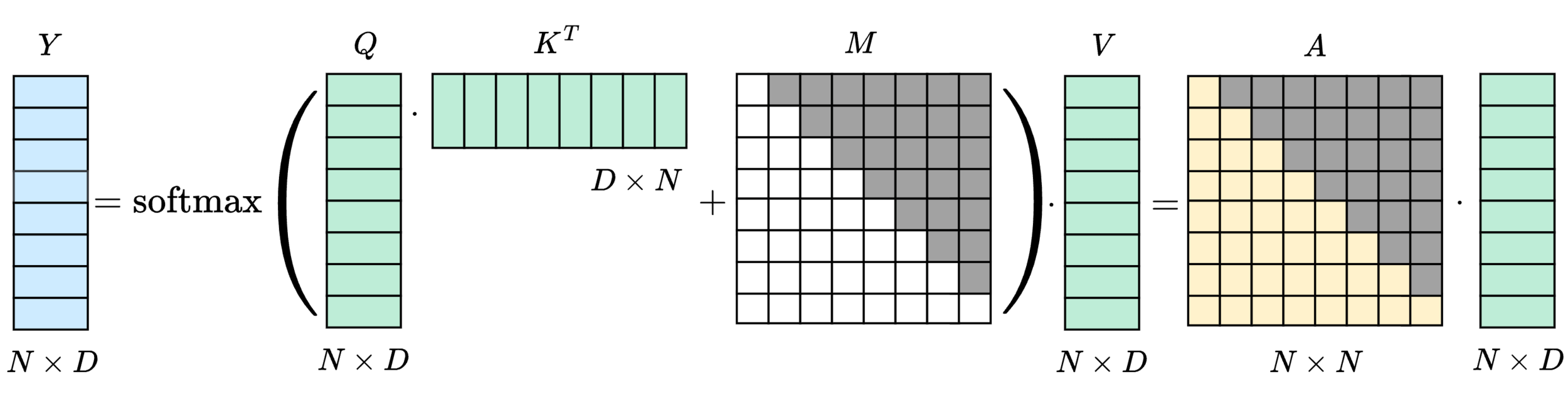
[1] Vaswani et al. — “Attention Is All You Need”, NeurIPS 2017
Training algorithm (causal masking)
Inference algorithm (recurrence relation)
Dot-products need to be recomputed for every \(q_t\).
\(\mathcal{O}(N^2)\) complexity.
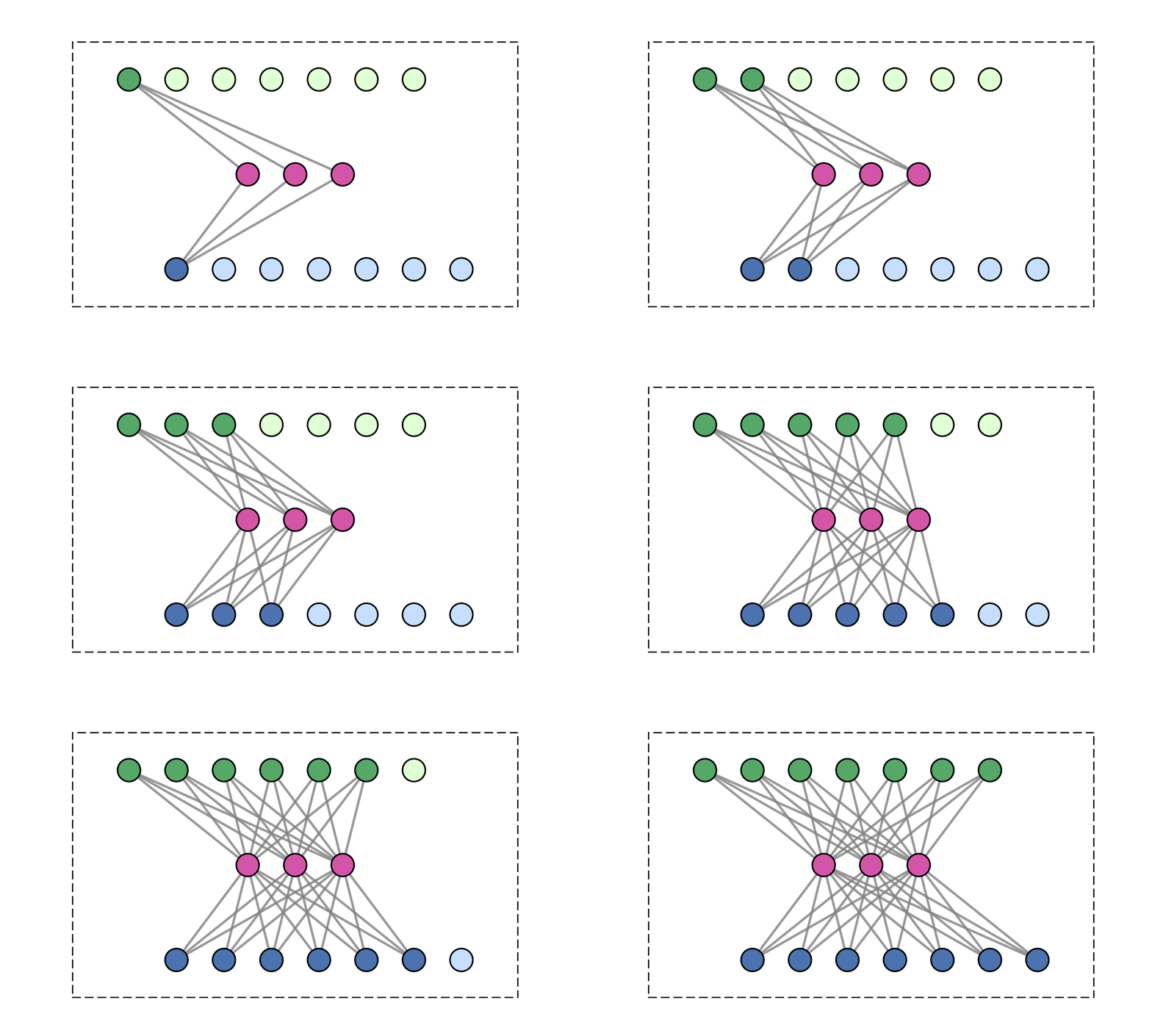
Aim 2: Develop decoder version of FLARE
Linear time auto-regressive attention.
Fixed memory footprint (only store \(\mathcal{O}(M)\) cache).
Flexible latent capacity.
Advantages
Required components
Fused GPU kernels for training and inference.
Bespoke training algorithm for causal FLARE.
Extensive benchmarking and evaluation.
34
Inference algorithm (recurrence rule)
Next-token prediction with FLARE
Efficient transformers models
Adaptive Layer Norm in Diffusion Transformer allows for token mixing + time-conditioning in one go
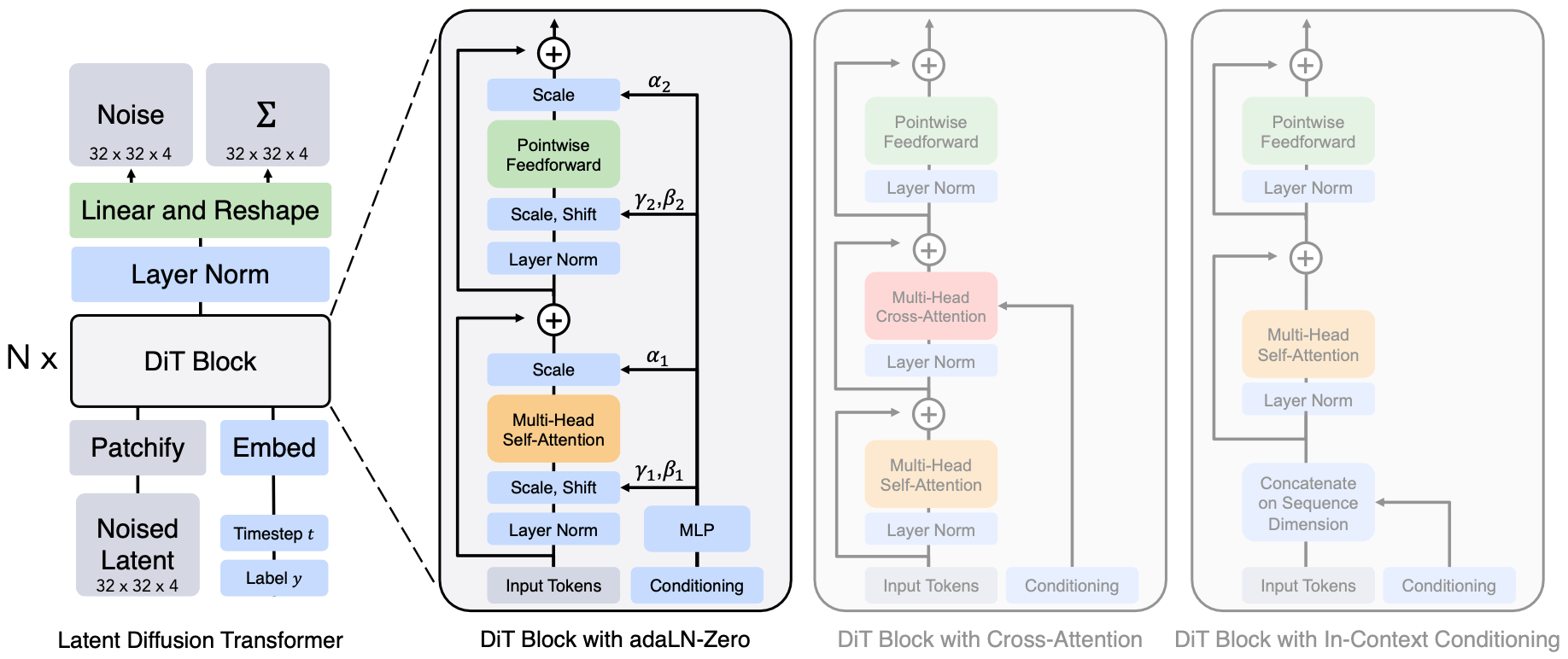
This is only possible with a single token as conditioning vector, and won't work when you want to condition on a sequence.
Linear transformers only store state \( S \in \mathbb{R}^{D \times D} \) but their performance is not on par with softmax attention
Linear transformers replace the softmax kernel with a feature map \(\phi(\cdot)\) such that
This factorization allows causal attention to be computed recurrently:
Chunkwise training for linear transformers
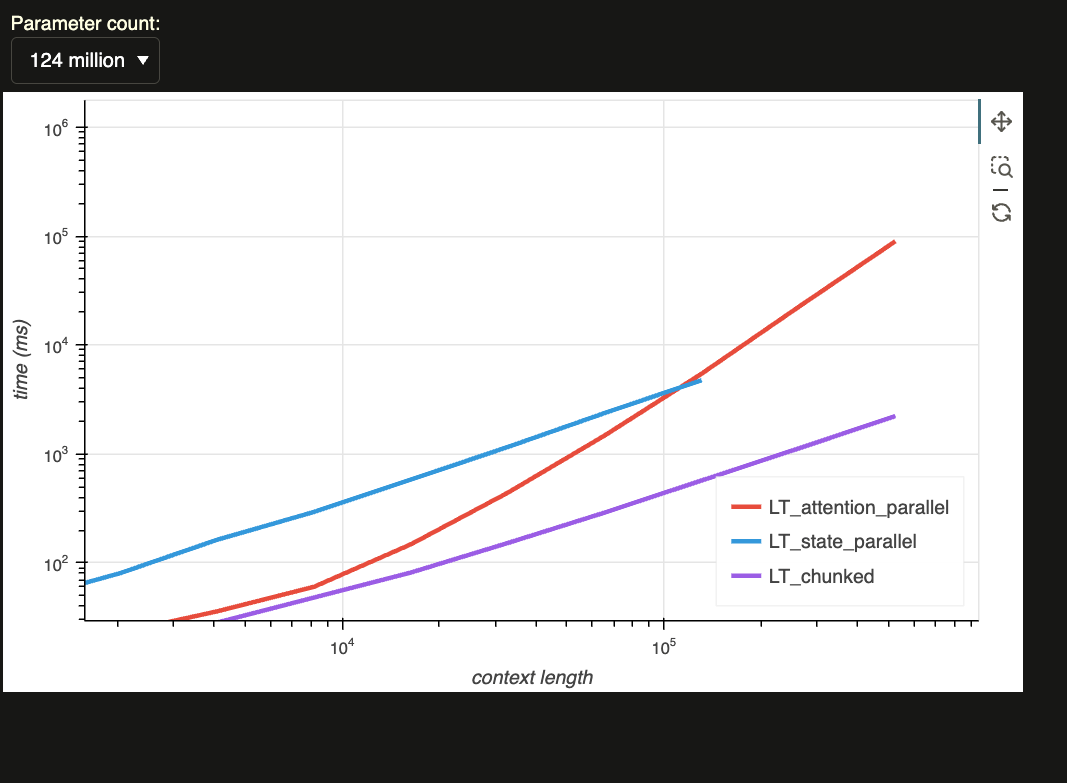
https://manifestai.com/articles/linear-transformers-are-faster/
Premise: strong encoder model --> strong LLM
- Next-token prediction model
- FLARE, Triple Attention
- Write CUDA kernels --> get scaling plots
- Test on language tasks
- Extend FLARE
- Allow model to increase/ decrease \(M\) during training
- Create efficient conditioning mechanism (time-series PDE problems)
- FOCUS ON NEW CONTRIBUTIONS and how we can differentiate ourselves from SOTA
- explain novelty compared to SOTA