Defi LEnding and Borrowing
Instructors: Andreas Park & Zissis Poulos


categories of finance
What do banks/financial institutions do?
disclaimer: an incomplete list
Bitcoin,
stablecoins, etc.

"higher layer"


lending
payments processing
financial
advice
trading
services
funding
services
prop trading to manage risks
too early, but projects are underway
as it turns out, these items are often directly related
what could defi do?
Five key problems in finance
Defi vs Legacy finance
interoperability
inefficiency
centralized control
limited access
opacity
interchange (=VISA) fees, settlement times, microtransactions, physical infrastructure
between-institution or transfers, reconciliation process, international remittances, various securities custody and trading systems
information for users, health of deposit taker, what-happens-behind-the-scenes, counterparty risk
local monopolies/switching costs, central banking, deposit concentration, control vs. competition
1.7B unbanked in the world, 24M in the US, many services or products not available based on location etc, lack of SME support, inability to collateralize
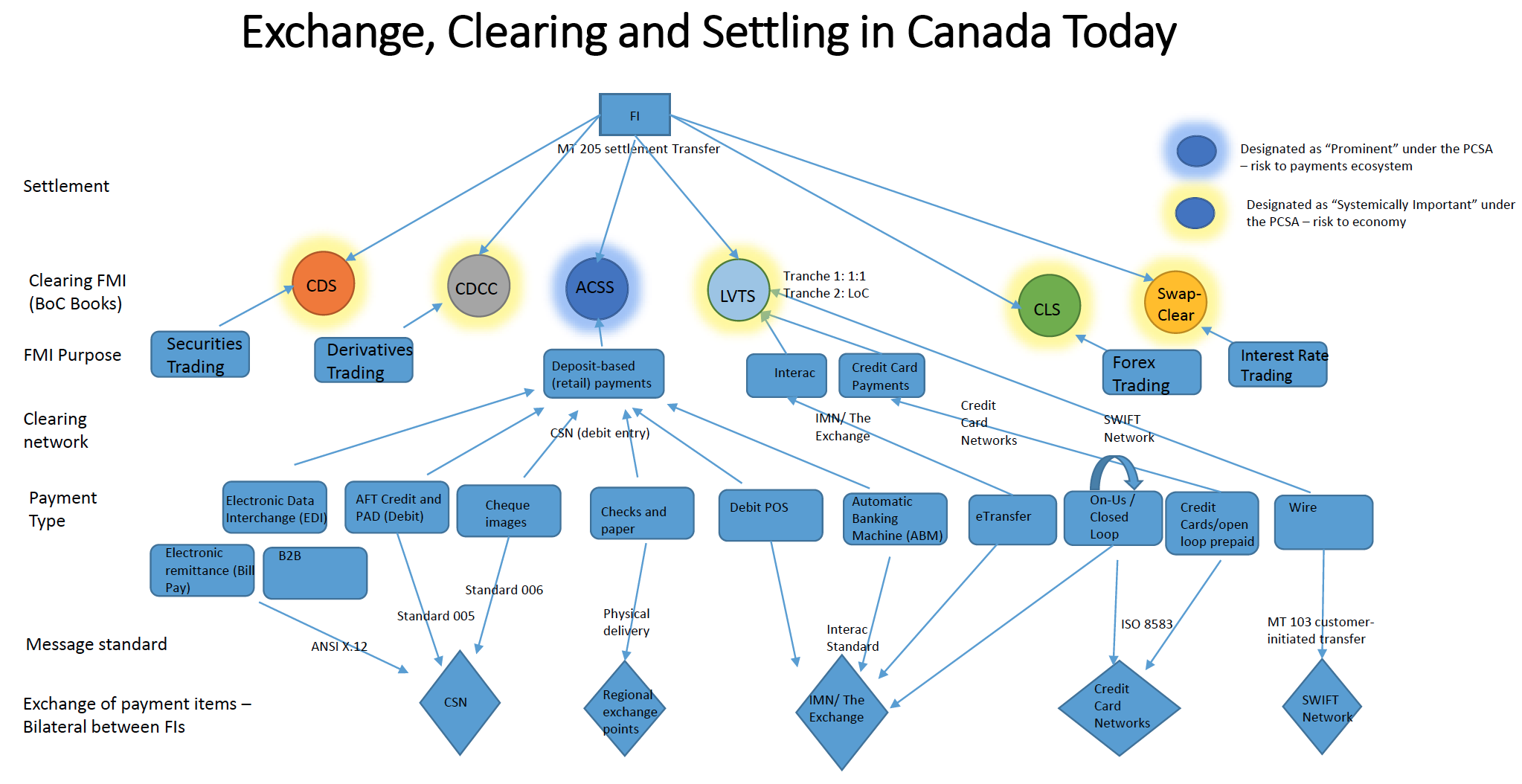
Source: Wendy Rotenberg's Payments lecture
payments pieces
simplified view

CDS
ACSS
LVTS
Cheques
Debit at POS
e-transfer
Credit Card/
open loop
ATMs
Wire
Interac
Credit
Card
deposit based retail
Interac standard
credit card network
SWIFT
CSN


Settlement
Clearing process
Underlying network
Type of payment
Financial market infrastructure purpose
Securities Trading
why blockchain?
a common resource

e-transfer
Wire
deposit based retail
CDS
Securities Trading
derivatives
swaps
property registry
interoperability
inefficiency
centralized control
limited access
opacity
siloed legacy system
is interoperable by design
reduces frictions and separates service from "commodity"
decentralized control and common operation
fewer barriers\(\to\) broad access
is/can be highly transparent
common infrastructure system
categories and assessment for defi
Our focus
interoperability
inefficiency
centralized control
limited access
opacity
- What do the projects do?
- How do these projects improve on legacy limitations?
payments
lending
trading
services
funding
services
prop trading
manage risks
Prerequistes
Key Components for Defi
unified money/unit of account
on-chain ability to exchange arbitrary value


(last class)
unified unit of account: dai
Money
Idea:
- create fiat money on chain
- mechanism
- a collateralized loan with ETH in escrow
- DAO-managed monetary policy (=creation or destruction of tokens)
Sidebar: what is a DAO?
- DAO=decentralized autonomous organization
- \(\to\) entity without management
- governance decided by token holders essentially by vote
- We'll devote a 0.5 class to DAO governance
user perspective
Maker DAO





4 ETH
(1 ETH = $375)
(Oct 15, 2020)
\(\approx\) $1,500

\(\vdots\)
1,500 DAI
(1 DAI = $1)
formally: this smart contract is a collateralized debt position (CDP)
user perspective
Maker DAO
fractional collateral \(\to\) collateralization factor \(=\) 150%
total collateral = $1,500
maximum loan = $1000
overcollateralization = $500
actual loan (example) = $500
buffer = $500
user perspective: what happens if the price of ETH rises?
Maker DAO
ETH \(\nearrow\) $500
value of ETH collateral = $2,000
maximum loan = $2,000/150%=$1,333
total collateral = $2,000
maximum loan = $1,333
overcollateralization = $667
actual loan (example) = $500
buffer = $500
overcollateralization = $667
new loan capacity= $333
user perspective: what happens if the price of ETH falls?
Maker DAO
ETH \(\searrow\) $187.5
value of ETH collateral = $750
maximum loan = $750/150%=$500
total collateral = $750
maximum loan = $500
overcollateralization = $250
actual loan (example) = $500
buffer = $0
for reference: former value of collateral
user perspective: what happens if the price falls & max loan is exceeded?
Maker DAO
ETH \(\searrow\) $150
value of ETH collateral = $600
maximum loan = $600/150%=$400
total collateral = $600
maximum loan = $400
required overcollateralization = $200
actual loan (example) = $500
buffer = -$100
for reference: former value of collateral
\(\Rightarrow\) liquidation possible by "keeper"
sell 3.33 ETH=$500=500 DAI
repay $500=500 DAI loan
retain incentive
return remainding ETH to vault owner
Maintaining the Peg: monetary policy
Maker DAO
- How works:
- 1 USDC=1.01 DAI
- use USDC to mint new DAI
- supply (DAI) \(\nearrow\)
- price (DAI) \(\searrow\)
- use USDC to mint new DAI
- 1 USDC=0.99 DAI
- Swap Dai for USDC (more below)
- demand (DAI) \(\nearrow\)
- price (DAI) \(\nearrow\)
- 1 USDC=1.01 DAI
\(\Rightarrow\) all relies on behavioral assumptions
\(\Rightarrow\) But: there are also real incentives & mechanisms
Maintaining the Peg: monetary policy
Maker DAO
- stability fee
- DAI savings rate (DSR)
- debt ceiling
borrowers of DAI need to pay interest \(\to\) stability fee
- if too much minting (=too much DAI) then
- \(\to\) interest \(\nearrow\) \(\to\) cost of DAI \(\nearrow\)
- \(\to\) minting \(\searrow\) \(\to\) supply DAI \(\searrow\)
DSR paid on "locked" DAI
- DAI deposited to specific contract (demand \(\nearrow\))
- funded by stability fees
- \(\to\) SF>DSR
total amount of debt (or DAI) outstanding is limited
Sidebar: how is this decided?
\(\to\) special "governance" token MKR
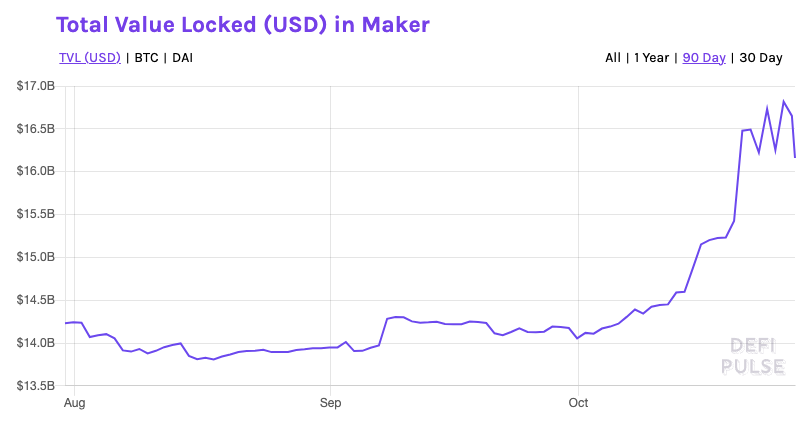
Value locked Oct 27, 2021
Maker DAO
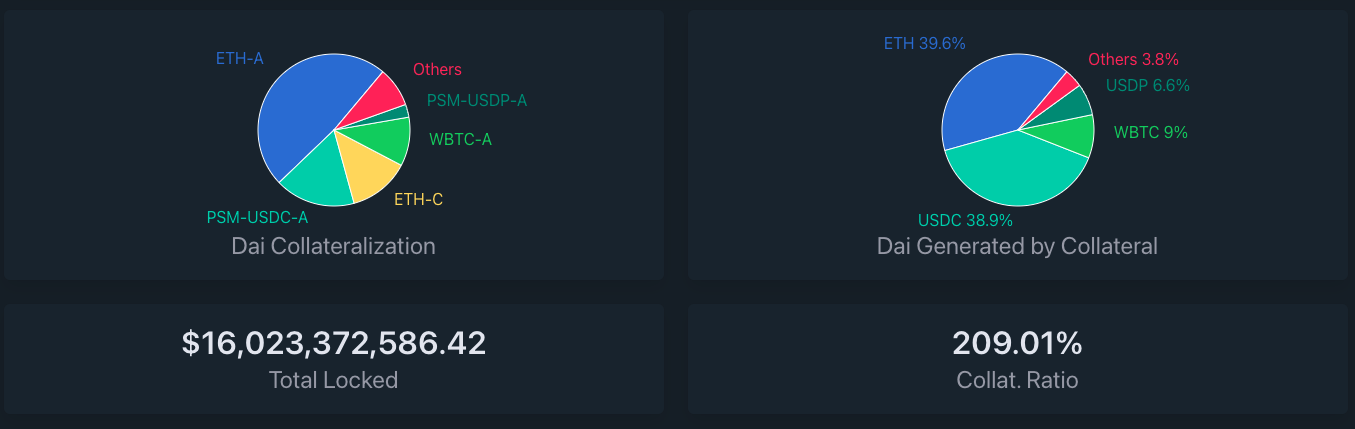
Source: daistats.com (Oct 27, 2021)
The March 12, 2020 "BlAck Thursday" Drama
Maker DAO
- some crypto prices dropped more than 50%
- cascading liquidations in leveraging platforms
- network congestion: some liquidations done at near-zero prices
- collateral shortfall in DAI
- MakerDAO sold new DAO tokens to collect collateral
- odd: DAI became riskier but high demand for DAI to trigger liquidations!
PEG stability module (PSM)
Maker DAO
The Problem:
- in extreme bull/bear runs, the peg may no longer work
- example: March 2020
- ETH dropped significantly and suddenly
- a rush occurred to (a) get out of ETH into save assets and (b) to collect DAI to get keeper fee
- upward pressure on price of DAI
The Solution:
- Peg stability module
- swap a given collateral type directly for DAI at a fixed rate (no minting/borrowing)
- like regular vault type with a zero stability fee and a liquidation ratio of 100%
- accessed through a user-facing smart contract containing the relevant swap functions (no ownership, just straight swap)
Note: In May 2021, ETH prices dropped again by >30% but no drama in DAI
categories and assessment for defi
assessment of makerdao
Interest rates influenced by the FED, access to loan products controlled by regulation and institutional policies
MakerDAO platform is openly controlled by the MKR holders.
Difficulty of obtaining loans for large majority of population
Open ability to take out DAI liquidity against an overcollateralized position in any supported ERC20 token. Access to a competitive USD denominated return in DSR.
Costs of time and money to acquire a loan
Instant liquidity with minimal transaction costs.
Can't seamlessly use the same USD across many platforms
Issuance of DAI, a permissionless USD-tracking stablecoin backed by cryptocurrency. DAI can be used in any smart contract or DeFi application.
interoperability
inefficiency
centralized control
limited access
opacity
Unclear collateralization of lending institutions.
Transparent collateralization ratios of vaults visible to entire ecosystem
legacy finance
MakerDAO
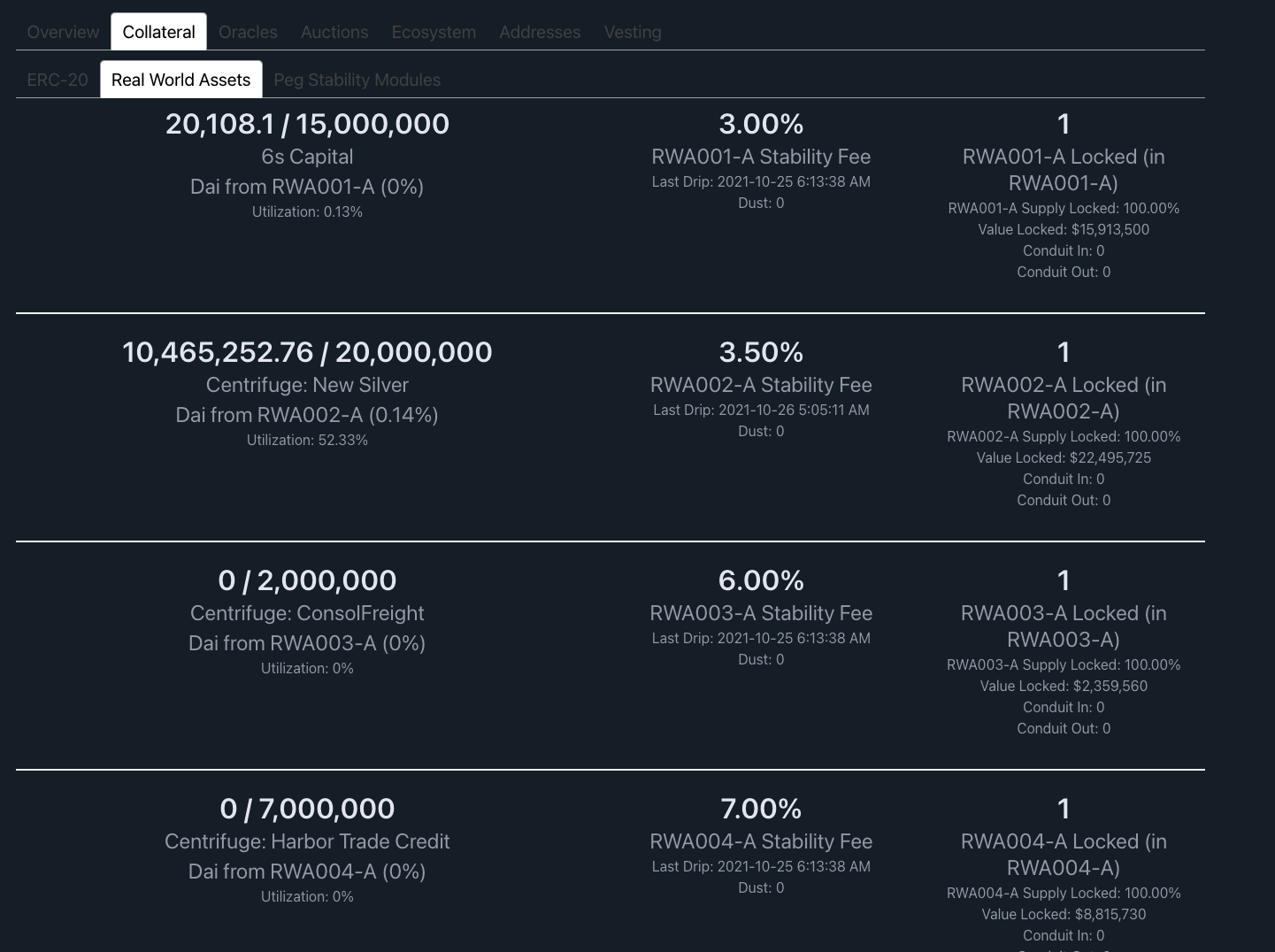
The frontier: DAI loans for real-world assets
Maker DAO
categories and assessment for defi
Our focus
interoperability
inefficiency
centralized control
limited access
opacity
payments
/lending
- Lightening Network
- xDai
- Makerdao
- Compound
- Aave
How does compound finance work?
Lending
Fundamentally, what does a bank do?
- size intermediation
- term intermediation
- risk intermediation
And how is this done?
- pooling deposits
- issuing loans based on deposits
- loan rates based on collateral or credit rating
on blockchain
- short-term loans
- pseudo-anonymous
collateral
compound Finance
- Collateral ratio \(\in[0,90]\)
- =0 \(\to\) not usable
- =90 \(\to\) stablecoin
- post 100 DAI
- factor 90
- \(\to\) for each $1 borrow, deposit $100/90=$1.11
- can borrow up to $90
- post 1 ETH=$300
- factor 60
- \(\to\) for each $1 borrowed, deposit $100/60=$1.67
- can borrow up to $180
Example 1
Example 2
Example 3
- post 1 ETH=$300 and 100 DAI \(\to\) $400
- factor 60 and 90
- \(\to\) for each $1 borrowed, deposit
$100/(.75\(\cdot\)60+.25\(\cdot\) 90)=$1.48 - can borrow up to $270
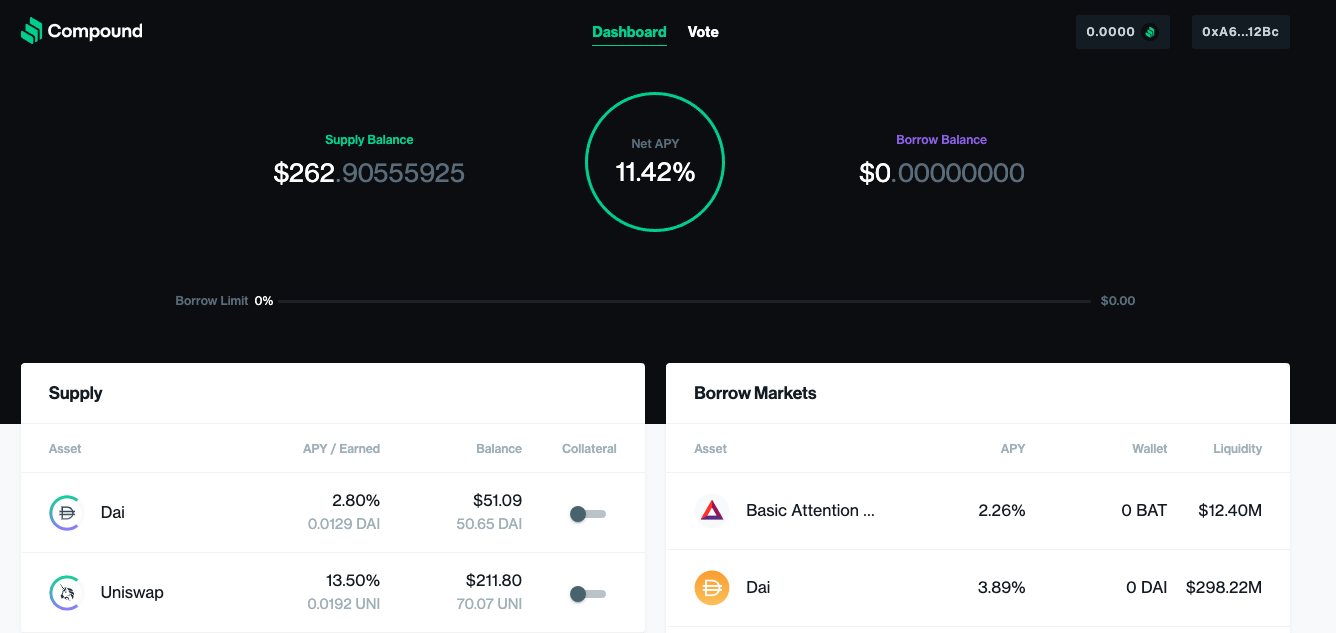
borrowing and lending rates compounded per block
how are the rates determined? - a function
compound Finance
100%
fraction of supplied that's been borrowed
base rate
borrow rate
compound Finance
- Compound escrows tokens
- must account for % ownership
- \(\to\) tokenized user share
- \(\to\) use the c-token
- cDAI
- cETH
- minted/burned based on funds added/removed from underlying
- seamless movement of these shares (reduced transactions costs!)
- ability to use the ctokens in other protocols
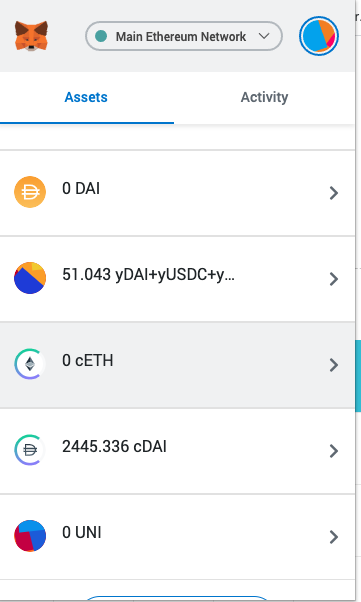
Tracking ownership - How do you reclaim a deposit?
Tracking ownership - Example
compound Finance
In Compound
translated
new deposit
1,000 DAI
100 cDAI
500 DAI
add 50 new cDAI
Tracking ownership - Example
compound Finance
In Compound
translated
new deposit
1,000 DAI
150 cDAI
500 DAI
1 year later: 10% interest on compound
150 DAI
(same cDAI, ownership shares don't change, just each cDAI is worth more)
(accrues per block per deposit)
Differences to Compound
Aave
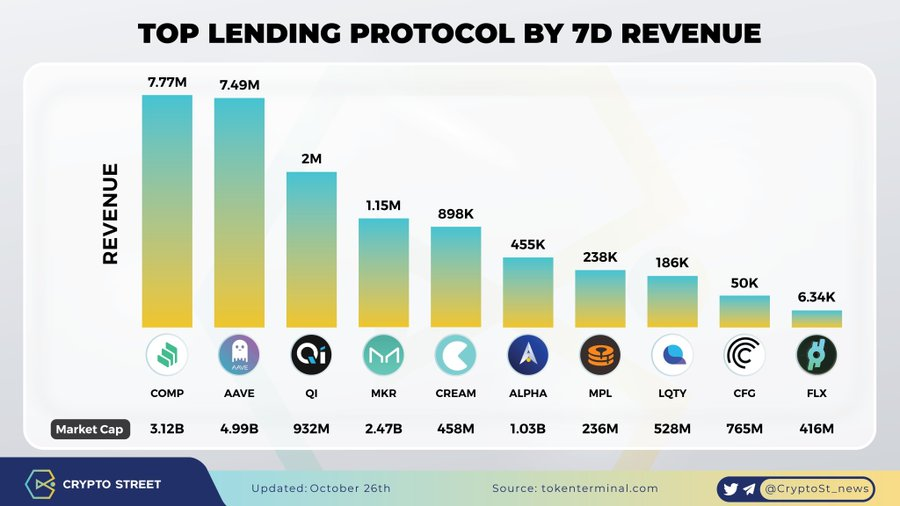
- Aave is the second-largest lending protocol to date
- has many features that are similar to Compound
- offers more assets
- offers flash loans (rate ~7bs)

common theme in DeFi: jumping between dApps
-
Assume
- 1 ETH = 200 DAI
- supplied 100 ETH in Compound
- borrowed 10,000 DAI to lever up and purchase an additional 50 ETH
- \(\to\) also supplied to Compound
-
Borrow interest rate in DAI
- Compound: 15%
- Aave: 5%.
- Can you refinance your borrowing?
dapp-linking
Defi is like real "high" finance
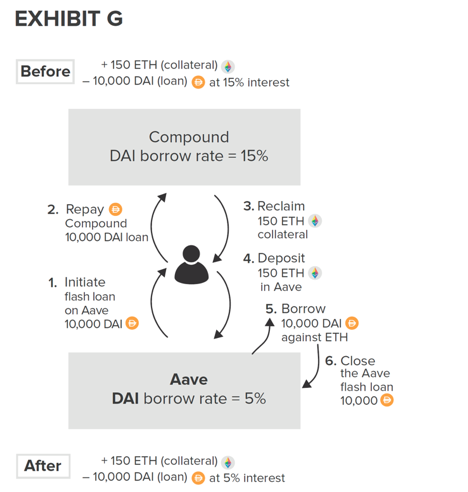
Source: Harvey, Ramachandran, and Santoro (2020)
2021

@financeUTM

andreas.park@rotman.utoronto.ca

slides.com/ap248

sites.google.com/site/parkandreas/

youtube.com/user/andreaspark2812/