
Webpack

Ali Arafati
@CitizenOfTheWeb




Webpack
Frontend development

Webpack
ESM & HTTP2
Let's go back
Legacy
## What was the pain?

* Keep dependencies up to date
* Order of things
* non-modular
* risk of dead code
* hard to configure

## Birth of new tools

* require.js
* browserify
* webpack
<!DOCTYPE html>
<html lang="en">
<head>
<link rel="stylesheet" href="./jquery-ui.css">
<link rel="stylesheet" href="./main.css">
<link rel="stylesheet" href="./form.css">
</head>
<body>
<script src="./jQuery.js"></script>
<script src="./main-app.js"></script>
<script src="./fancy-sidenav.js"></script>
<script src="./form-validator.js"></script>
</body>
</html>index.html
<!DOCTYPE html>
<html lang="en">
<head>
  <!--Inject CSS-->
  <!--End Inject CSS-->
</head>
<body>
  <div id="root"></div>
  <!--Inject JS-->
  <!--End Inject JS-->
</body>
</html>
index.html
https://hackernoon.com/how-it-feels-to-learn-javascript-in-2016-d3a717dd577f
How does it work?

Babel?
Webpack Options
module
resolve
plugins
...rest
module
module
import content from './example.txt'

console.log(content); // Hey Alice
module.exports = {
module: {
rules: [
{
test: /\.jsx?$/,
include: [
path.resolve(__dirname, 'app')
],
exclude: [
path.resolve(__dirname, 'app/demo')
],
loader: 'babel-loader',
options: {
presets: ['es2015'],
},
},
],
},
};module.exports = {
module: {
rules: [
{
test: /\.txt$/,
use: {
loader: path.resolve(
__dirname,
"./scripts/loader.js"
),
options: {
name: "Alice"
}
}
}
]
}
};Hey [name]!import { getOptions } from 'loader-utils';
export default function loader(source) {
const options = getOptions(this);
const content = source
.replace(/\[name\]/g, options.name);
return (
`export default ${JSON.stringify(content)}`
);
}https://webpack.js.org/configuration/
https://webpack.js.org/contribute/writing-a-loader/
webpack.config.js
webpack.config.js
example.txt
boo.js
loader.js
resolve
resolve
module.exports = {
  resolve: {
    modules: [
      "node_modules",
      path.resolve(__dirname, "app")
    ],
    alias: {
      "module": "new-module",
    }
  },
};
// absolute imports
import sidenav from 'components/sidenav';
// relative imports
import sidenav from '../../../components';
https://webpack.js.org/configuration/
https://nodejs.org/api/modules.html
webpack.config.js
index.js
plugins
Html Webpack Plugin
const HtmlWebpackPlugin =
  require('html-webpack-plugin');


module.exports = {
  plugins: [
    new HtmlWebpackPlugin()
  ]
}
https://webpack.js.org/plugins/html-webpack-plugin/
<!DOCTYPE html>
<html>
  <head>
    <meta charset="UTF-8">
    <title>webpack App</title>
  </head>
  <body>
    <script src="index_bundle.js"></script>
  </body>
</html>
webpack.config.js
dist/index.html
ProfilingPlugin
const webpack = require('webpack');

module.exports = {
  plugins: [
    new webpack.debug.ProfilingPlugin({
      outputPath: 'profileEvents.json'
    });
  ],
};
https://webpack.js.org/plugins/profiling-plugin/
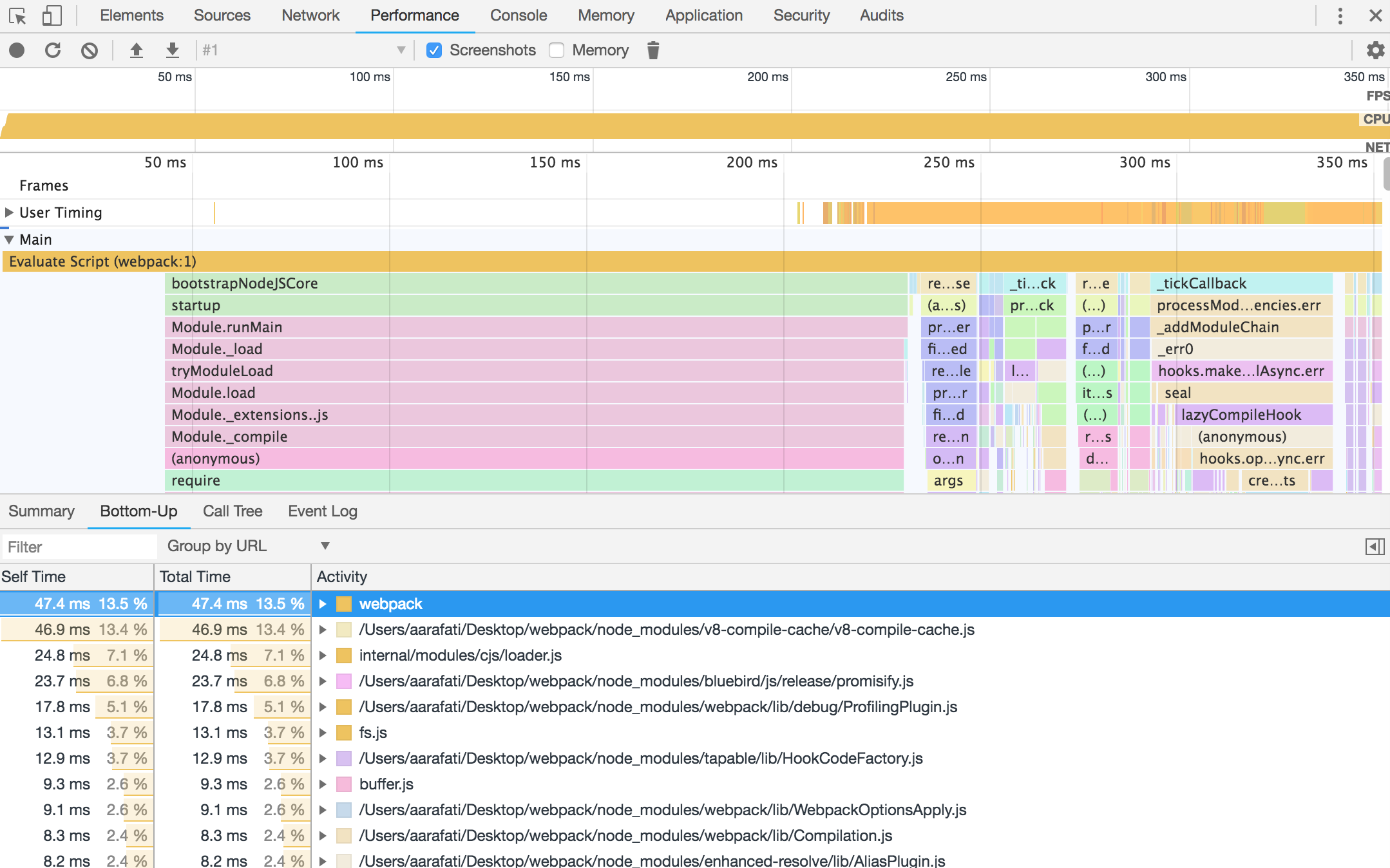
webpack.config.js
Webpack Bundle Analyzer
const BundleAnalyzerPlugin =
    require('webpack-bundle-analyzer')
        .BundleAnalyzerPlugin;

module.exports = {
  plugins: [
    new BundleAnalyzerPlugin()
  ]
}
https://www.npmjs.com/package/webpack-bundle-analyzer
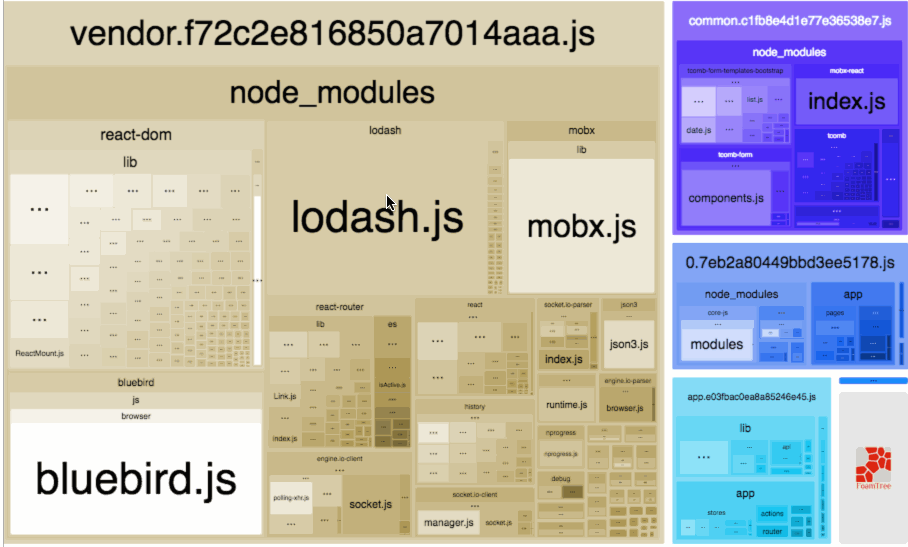
webpack.config.js
Code Splitting
caching
faster rebuild
faster load time
more fine-grained control (sourcemaps)
old vs new
module.exports = {
  plugins: [
    new webpack.optimize.CommonsChunkPlugin({
      name: 'vendors',
      chunks: ['main'],
      minChunks(module) {
        const context = module.context;

        return (
          context &&
          context.includes('node_modules')
        );
      },
    }),
  ],
}
module.exports = {
optimization: {
splitChunks: {
cacheGroups: {
vendors: {
chunks: "all"
name: "vendors",
test: /[\\/]node_modules[\\/]/,
}
}
}
}
}https://webpack.js.org/plugins/split-chunks-plugin/
Tobias Koppers https://medium.com/webpack/webpack-4-code-splitting-chunk-graph-and-the-splitchunks-optimization-be739a861366
- It can result in more code being downloaded than needed.
- It’s inefficient on async chunks.
- It’s difficult to use.
- The implementation is difficult to understand.
webpack.config.js
webpack.config.js
Performance
- babel
- transpile whats needed, don't generate
- cache-loader
- code splitting
- sourcemaps
- only source map the app, not the node modules
- seperate sourcemap files
- no eval for large projects
- no eslint-loader for large projects
- don't watch node_modules
https://webpack.js.org/configuration/performance/

happypack || parallel-webpack || ...

Last remark
- CLI tools
- react-scripts (create-react-app)
- angular-cli
- vue-cli
- next.js
More

https://www.youtube.com/watch?v=jUTE7lmrS70
Questions