Design Patterns
كل سنة وأنتم طيبين :)
Agenda
Behavioral Pattern
- Command
Review
- Factory
- Singleton
- Adapter
- Composite
- Observer
- State
- Strategy
- MVC
GraFCIS Design Discussion
Command Pattern
Encapsulate a request as an object, thereby letting you parameterize clients with different requests, queue or log requests, and support undoable operations.

Command Pattern Example

UML Diagram
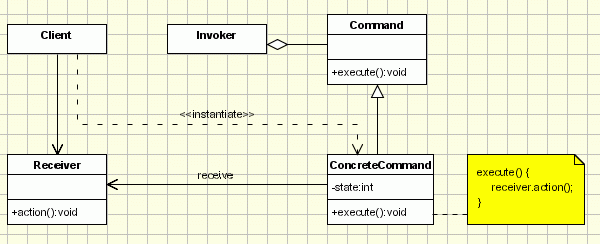
let's Implement it
 // Command pattern -- Structural example

using System;

namespace DoFactory.GangOfFour.Command.Structural
{
  /// <summary>
  /// MainApp startup class for Structural
  /// Command Design Pattern.
  /// </summary>
  class MainApp
  {
    /// <summary>
    /// Entry point into console application.
    /// </summary>
    static void Main()
    {
      // Create receiver, command, and invoker
      Receiver receiver = new Receiver();
      Command command = new ConcreteCommand(receiver);
      Invoker invoker = new Invoker();

      // Set and execute command
      invoker.SetCommand(command);
      invoker.ExecuteCommand();

      // Wait for user
      Console.ReadKey();
    }
  }

  /// <summary>
  /// The 'Command' abstract class
  /// </summary>
  abstract class Command
  {
    protected Receiver receiver;

    // Constructor
    public Command(Receiver receiver)
    {
      this.receiver = receiver;
    }

    public abstract void Execute();
  }

  /// <summary>
  /// The 'ConcreteCommand' class
  /// </summary>
  class ConcreteCommand : Command
  {
    // Constructor
    public ConcreteCommand(Receiver receiver) :
      base(receiver)
    {
    }

    public override void Execute()
    {
      receiver.Action();
    }
  }

  /// <summary>
  /// The 'Receiver' class
  /// </summary>
  class Receiver
  {
    public void Action()
    {
      Console.WriteLine("Called Receiver.Action()");
    }
  }

  /// <summary>
  /// The 'Invoker' class
  /// </summary>
  class Invoker
  {
    private Command _command;

    public void SetCommand(Command command)
    {
      this._command = command;
    }

    public void ExecuteCommand()
    {
      _command.Execute();
    }
  }
}
When to Use
- Specify, queue, and execute requests at different times.
- Support Undoable operations.
- Load and Store.
Review
Factory:
- Define an interface for creating an object, but let subclasses decide which class to instantiate.
When To Use:
- A class can't anticipate the class of object must create.
- A class wants its subclasses to specify the objects it creates.
Review
Singleton:
- Ensure a class has only one instance and provide a global point of access to it.
When To Use:
- There must be exactly one instance of a class, and it must be accessible to the clients from a well-known access point.
Review
Composite:
- Compose objects into tree structures to represent part-whole hierarchies.
When To Use:
- You want to represent part-whole hierarchies of objects.
- you want clients to be able to ignore the difference between compositions of objects and individual objects.
Review
State:
- Allow an object to alter its behavior when its internal state changes. The object will appear to change its class
When To Use:
- An object's behavior depends on its state, and it must change its behavior at run-time depending on the state.
- Operations have large, multipart conditional statements that depend on the object's state.
REVIEW
Strategy:
- Define a family of algorithms, encapsulate each one, and make them interchangeable. Strategy lets the algorithm vary independently from clients that use it.
When To Use:
- Many related classes differ only in their behavior.
GraFCIS
Demo.

Any Questions ?!
Thank You :)
The End
presented by Anas A. Ismail / _aaismail