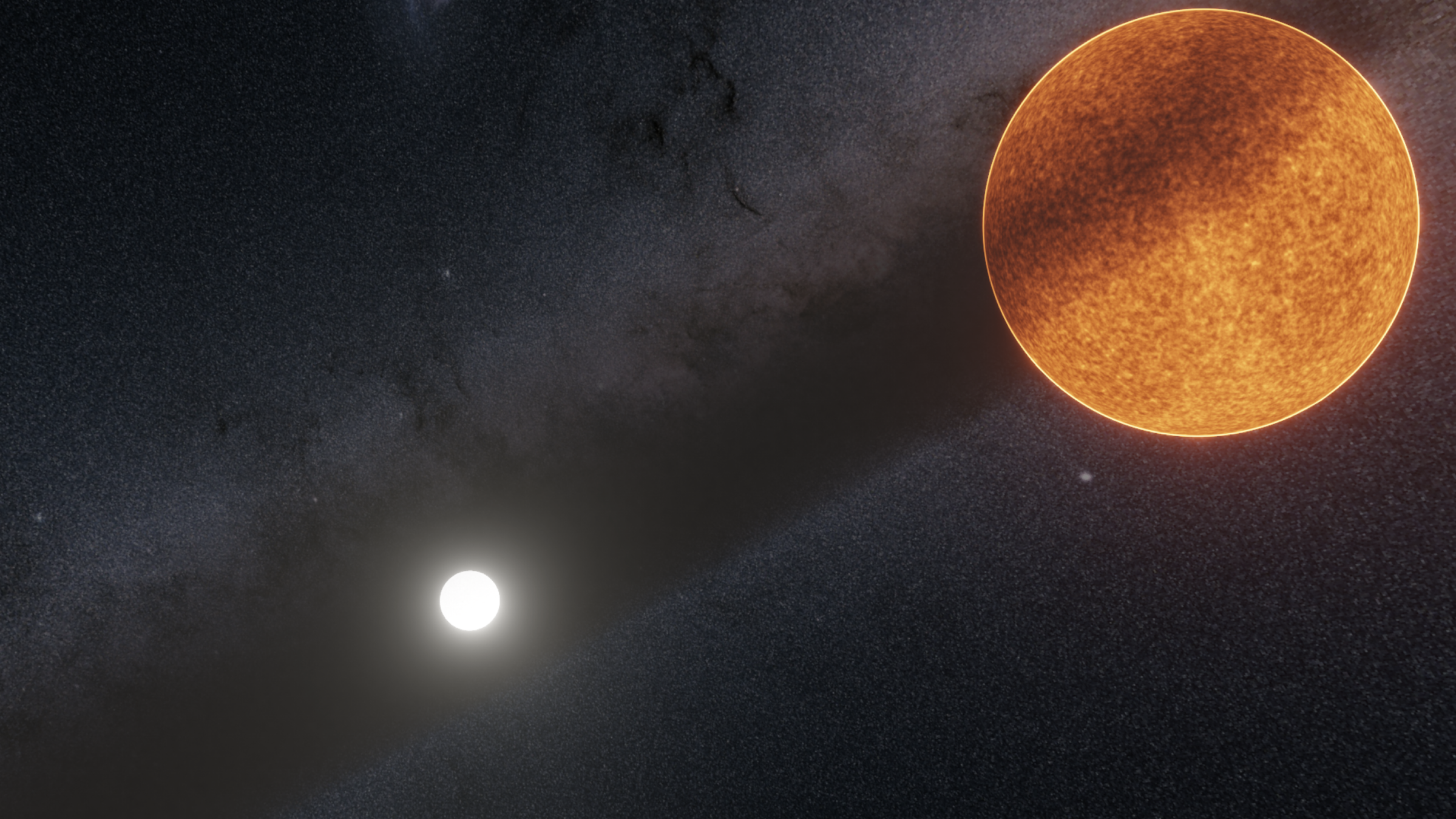
Building a census of Slow-Deep Occultations with Time-Domain Surveys
Anastasios (Andy) Tzanidakis // atzanida@github.io
DiRAC Lunch, December 2022

Art: Andy Tzanidakis
collaborators & Team
PAB B325 | atzanida@uw.edu
Andy Tzanidakis
Characterization of light curve statistics with the LSST Alert Production
Eric bellm
Stellar anomaly detections across the HR diagram with
synoptic TD surveys
James davenport


My awesome advisors!
Time domain | stellar populations | variable stars
(he/him)
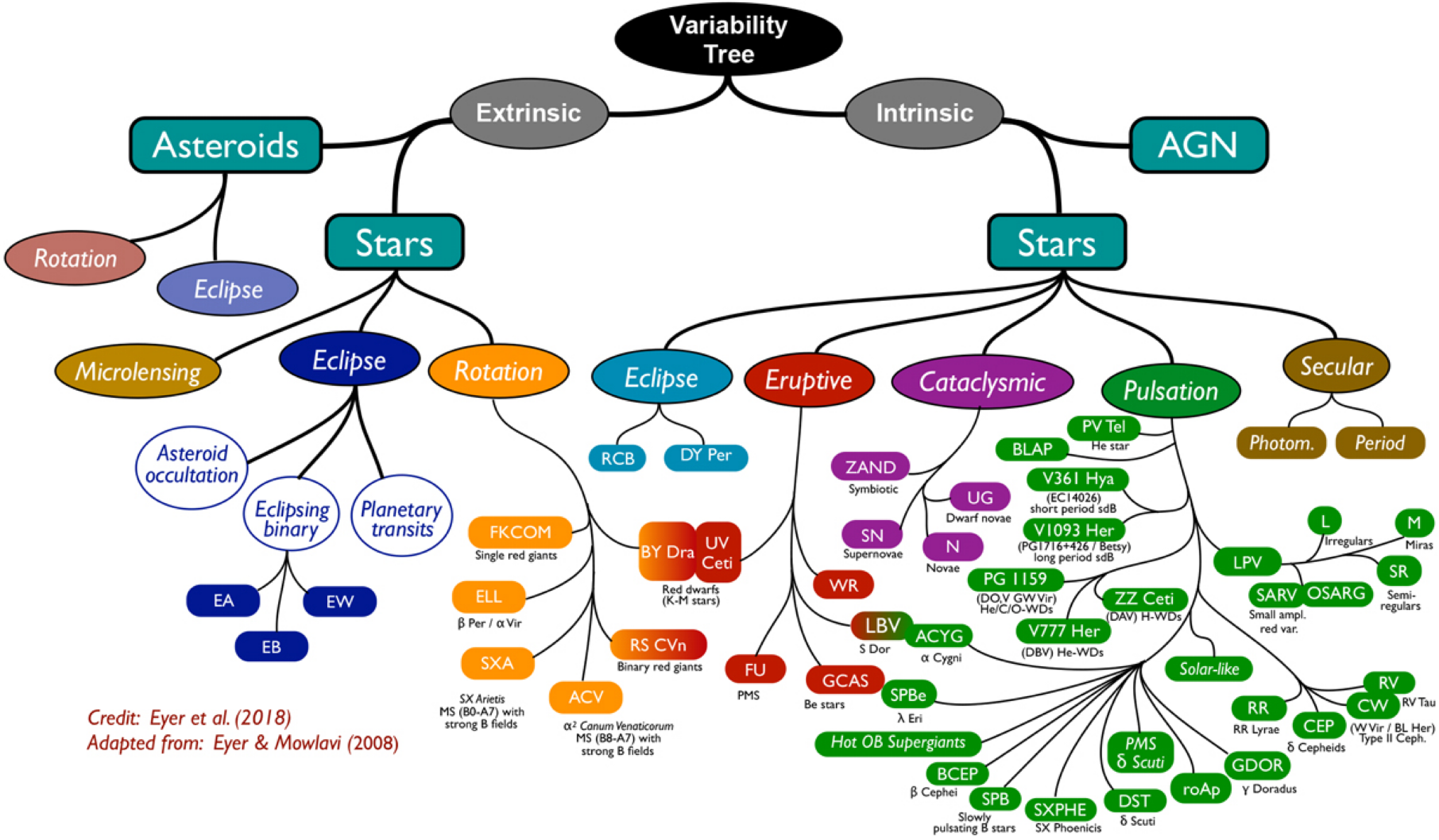
variability tree
Only a few classes of variable sources have been extensively characterized on the decade-long timescales. This means that large baseline surveys (i.e LSST, Gaia) will discover new/anomalous classes of variable stars that are comparable to the timescales of the survey duration, speed, and depth
why anomalous study stars?
Anomalous stellar systems
can teach us new variability mechanisms and different stellar environments (i.e YSO, AGB, RcB) and their surroundings
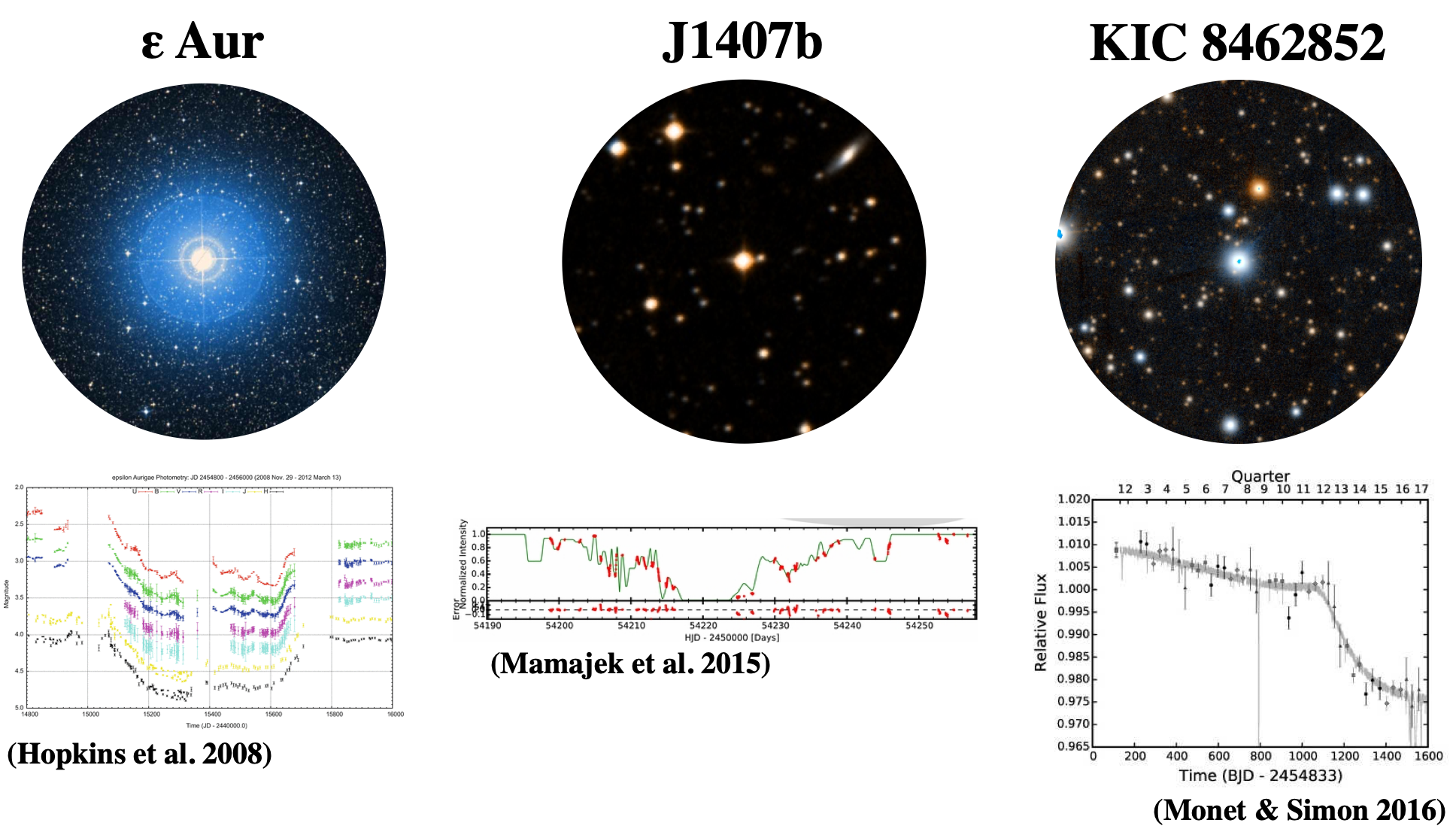
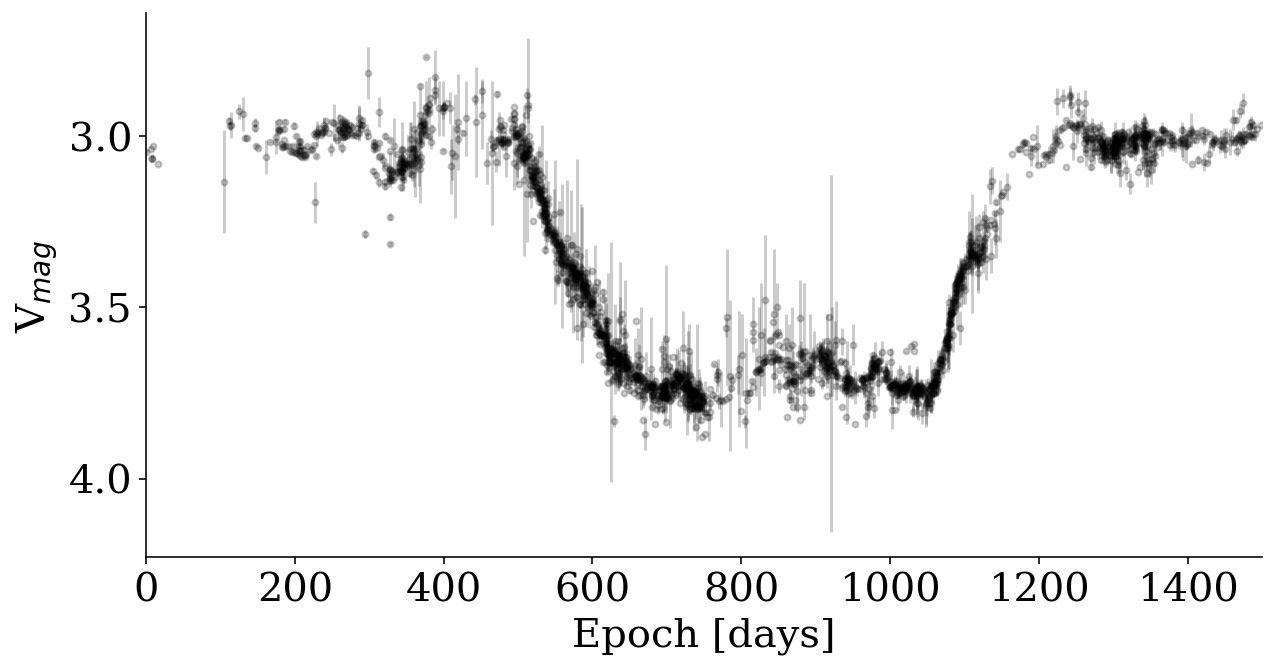
Case study: E-aur
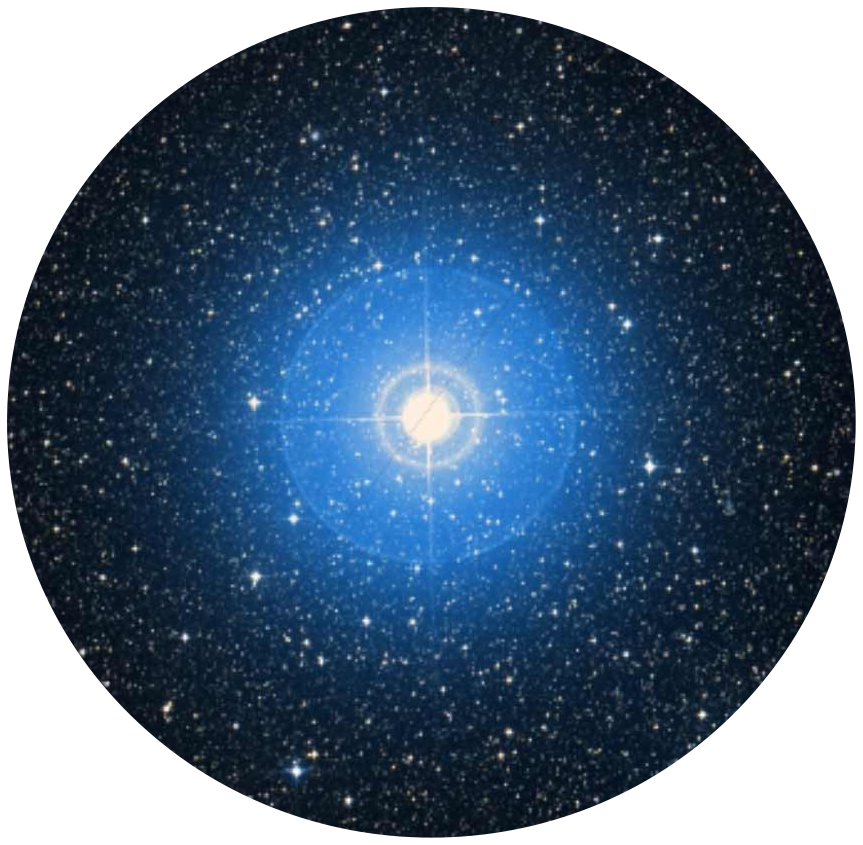
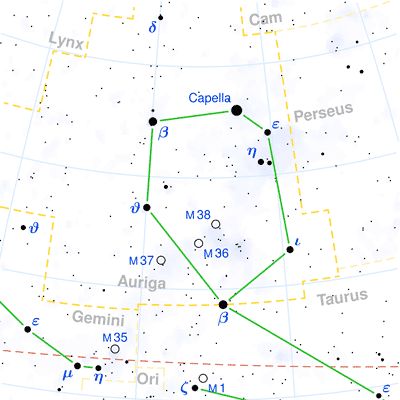
Torsten Bronger CC BY-SA 3.1
- First case study of an unusual variable
star that was known since the 1820s
- Initial theories of stellar occultation challenged our view on stellar theory. Until the hypothesis of Huang et al. 1965 of a disk occultation can cause a flat-bottomed dimming event
- Until the early 21st century, E-Aur was the record holder for the longest orbital period eclipsing binary.
~ 2 years (Porb~27.1 years)
Data: AAVSO
Case study: E-aur
mid-eclipse hole
Summary
- Large distance error 0.4-4kpc (...now with Gaia, low mass-model is supported)
- Challenge with the classification of primary, and tension with the mass of the system
- Central star not visible (likely obscured)
high mass
low mass
- Normal FI-supergiant 15 solar masses with companion star type BV at 13 solar masses
- A high mass scenario suggests a young age solution.
This would indicate the occulter to be a YSO disk (that usually lasts on the order of a few Myr)
- Normal FI-supergiant with ~1 solar mass with a secondary star at 5 solar masses
- A low mass scenario suggests that the primary has recently entered the post-AGB phase and the disk has formed due to mass exchange. However, spectroscopic follow-up does not suggest post-AGB
secondary
primary
disk
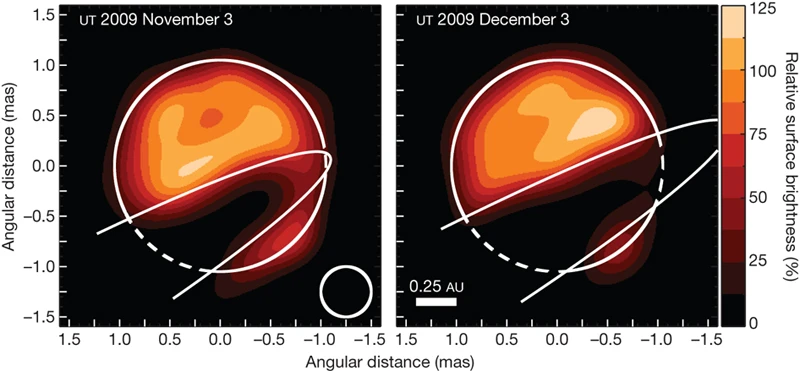
Kloppenborg et al. 2010
Interferometric images suggest
the disk is an optically thick disk
is likely a debris disk rather than a YSO-disk as it would be required by the short evolutionary timescales in the 15 Mdot scenario!
Case study: E-aur
imaged disk with the CHARA via optical interferometry
conclusions
ongoing challenges
- Disk accretion during 3rd contact (Gibson et al. 20018)
- The formation channel of such a system is unclear
- Presence of rare-Earth elements in optical spectra
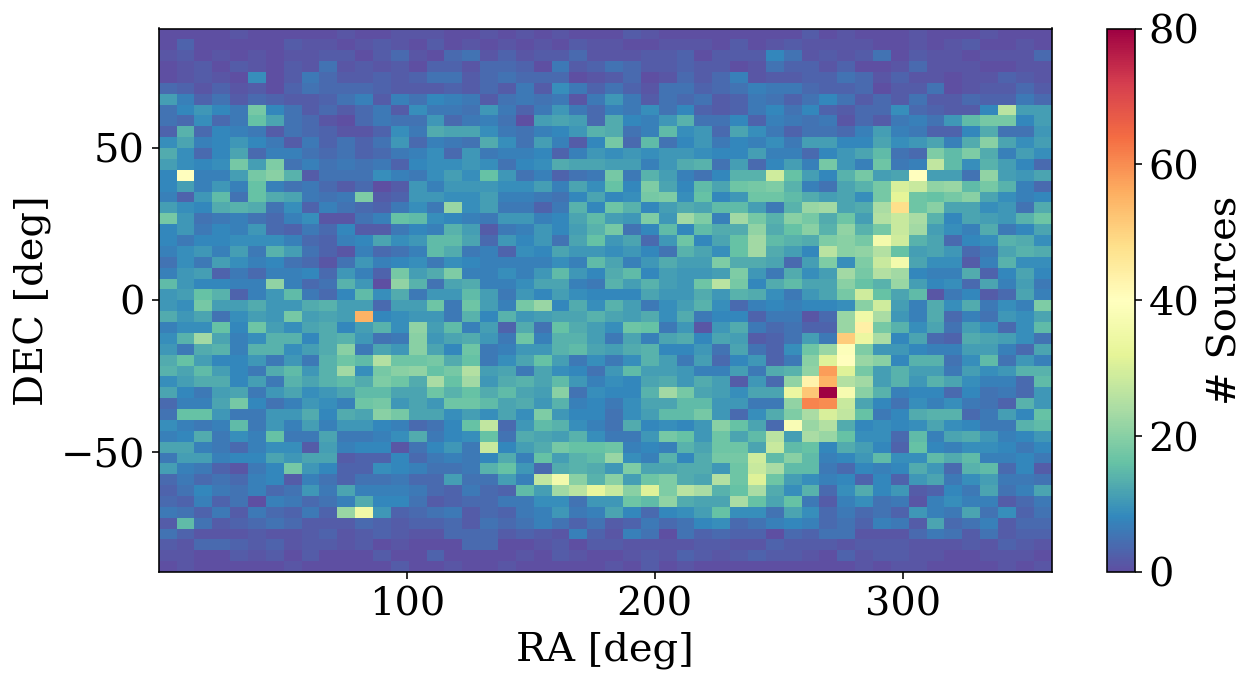
Gaia photometric
science alerts
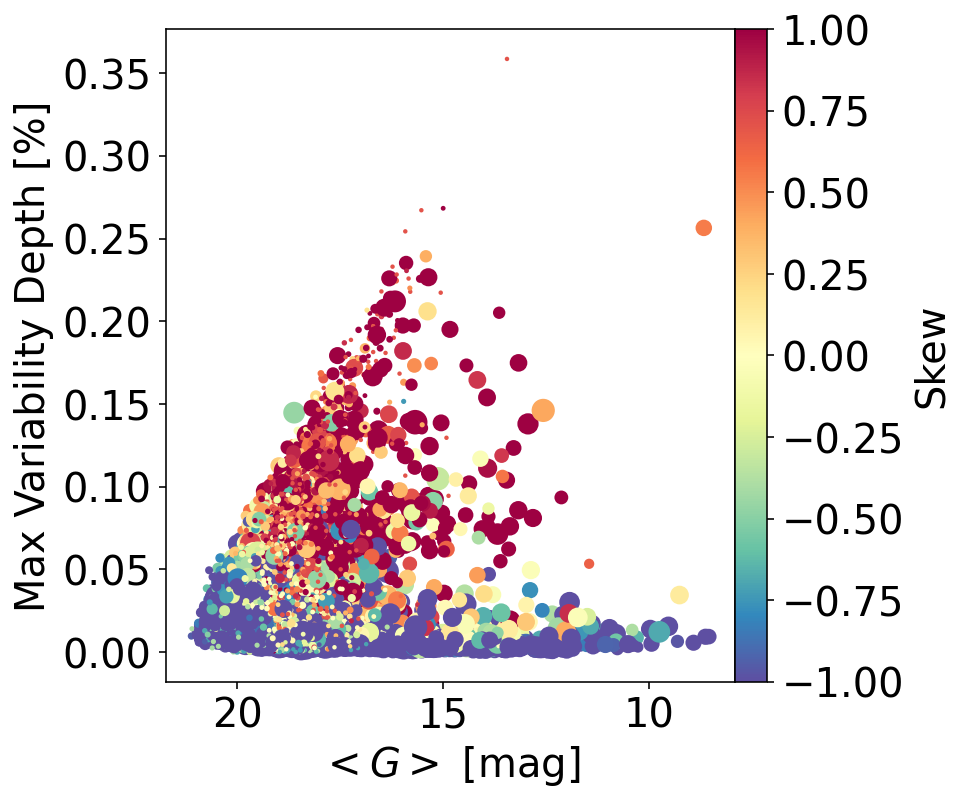
- Gaia Science Alerts (GSA) daily alert release of interesting transients identified by Gaia. Alerts are designed to pick up on both fast & slow evolving transients
- Limiting magnitude of ~20.5 Gaia G band
- ~45% of the 21,800 events have been classified. Majority of them still remain unknown and unclassified
- Almost all stellar events contain astrometric solutions
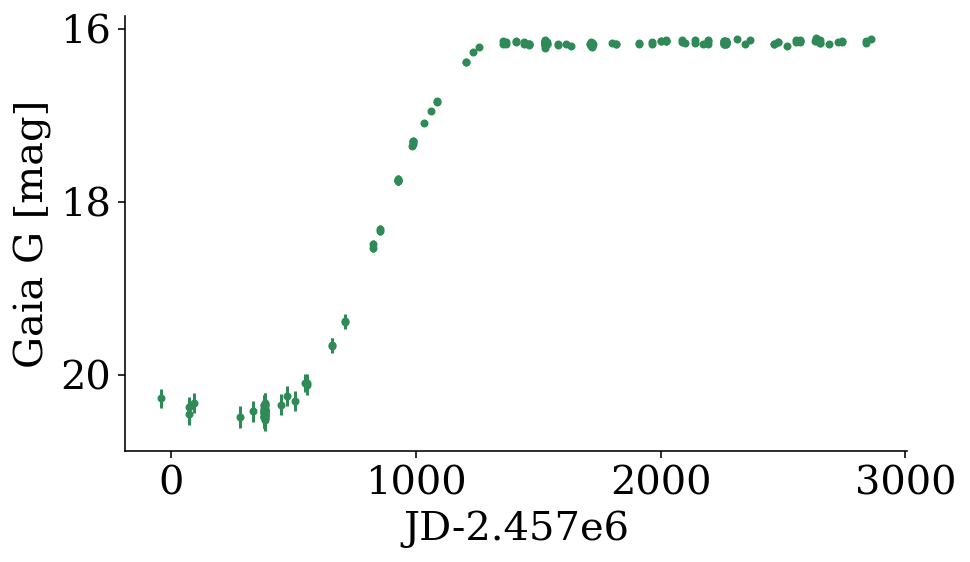
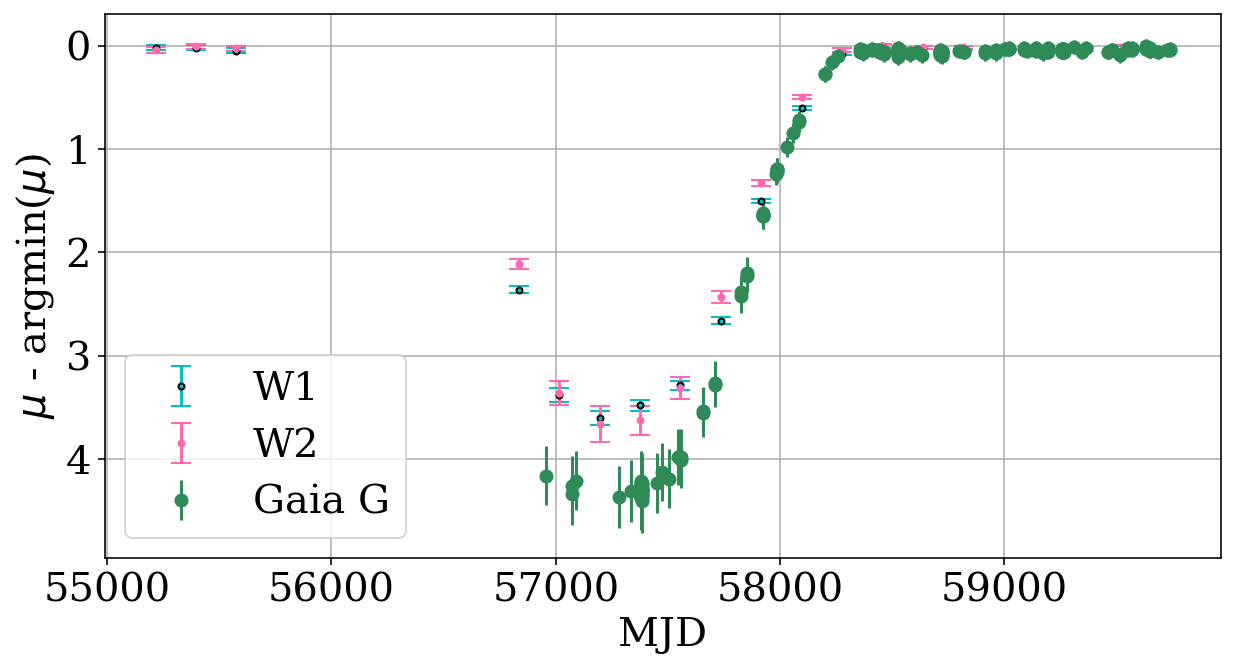
optical light curve: Gaia17bpp
~ 3.1 years
~4.5 mag deep
- Longest & deepest dimming duration
- No previous reporting groups?!!
- Odd location on the color-magnitude diagram
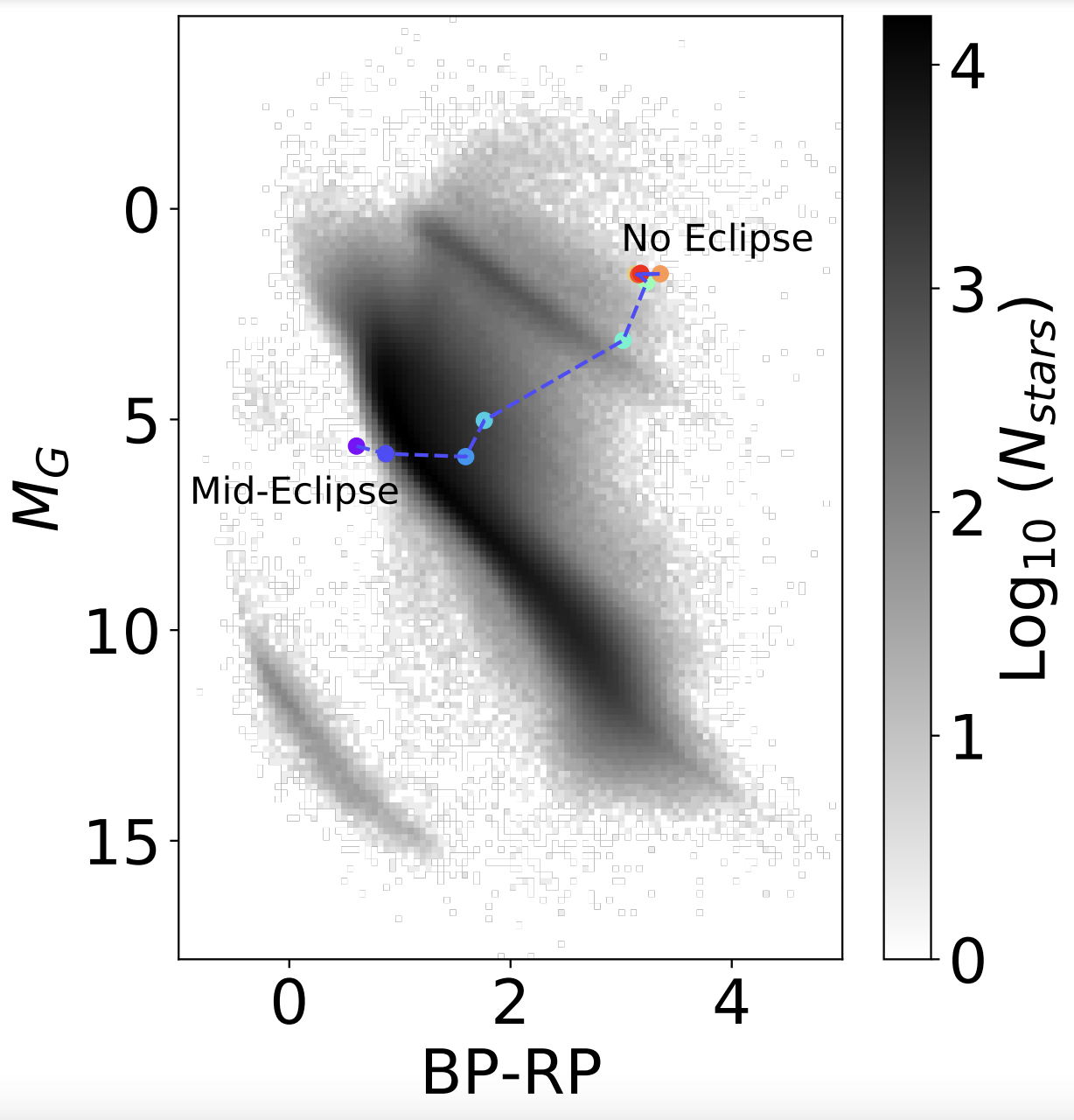
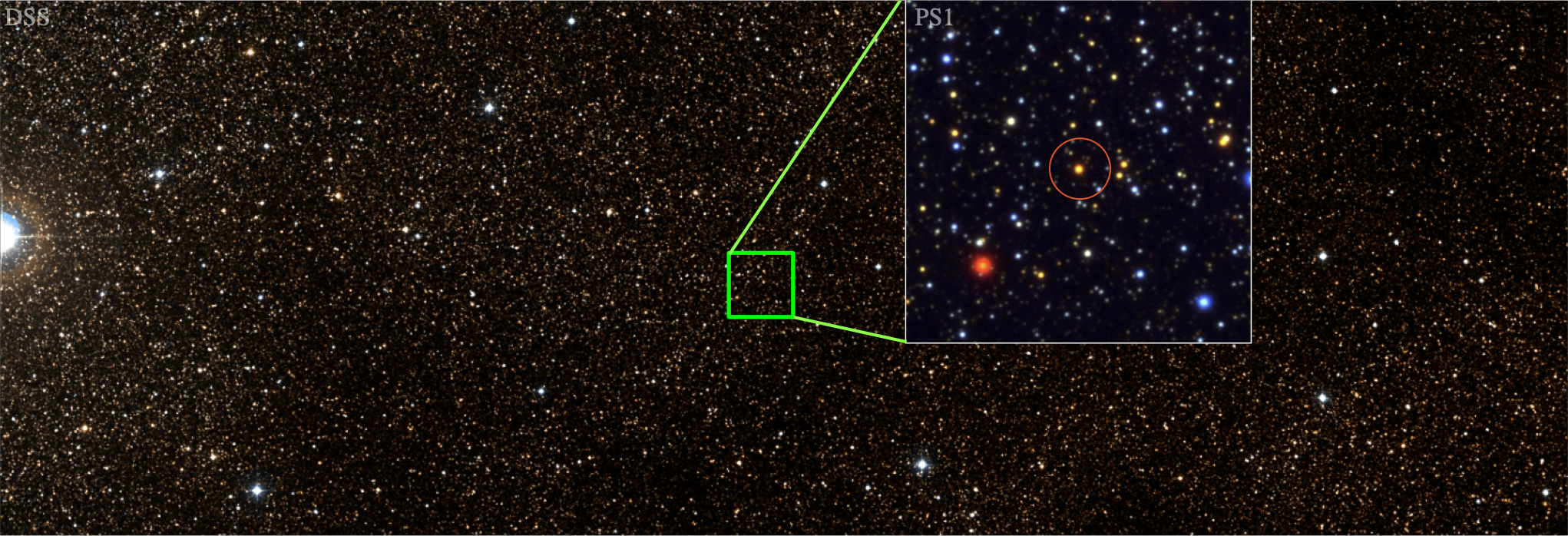
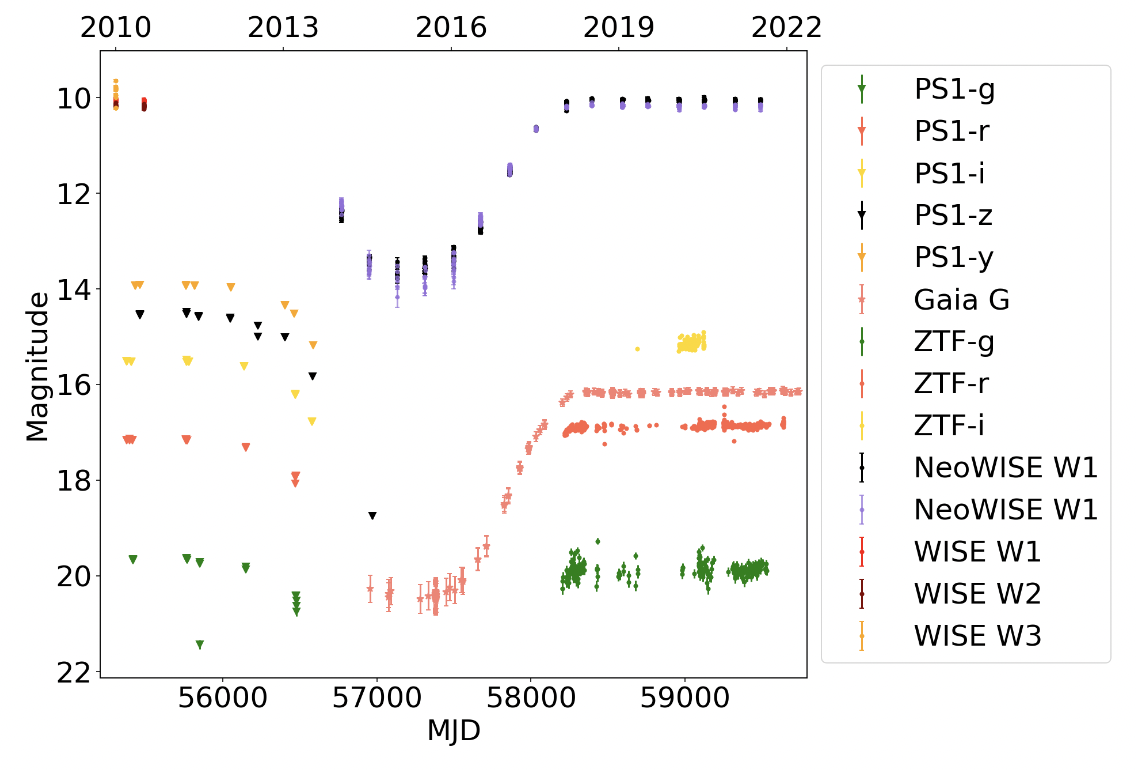
Archival photometry: IR-Optical
No obvious dimming event within the last 66 years!
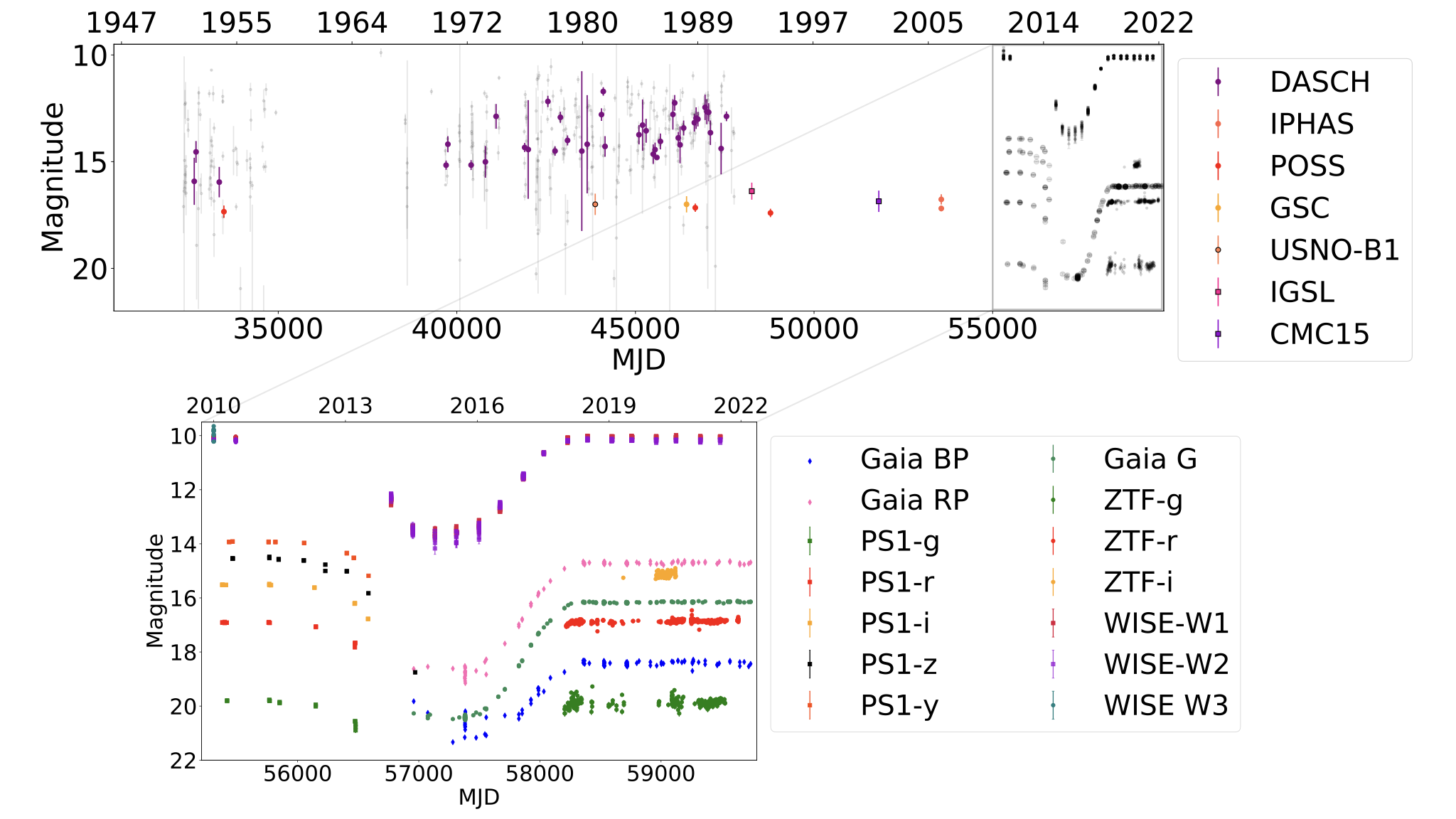

Digitize Access to a Sky Century @ Harvard (DASCH)
constraining the primary star
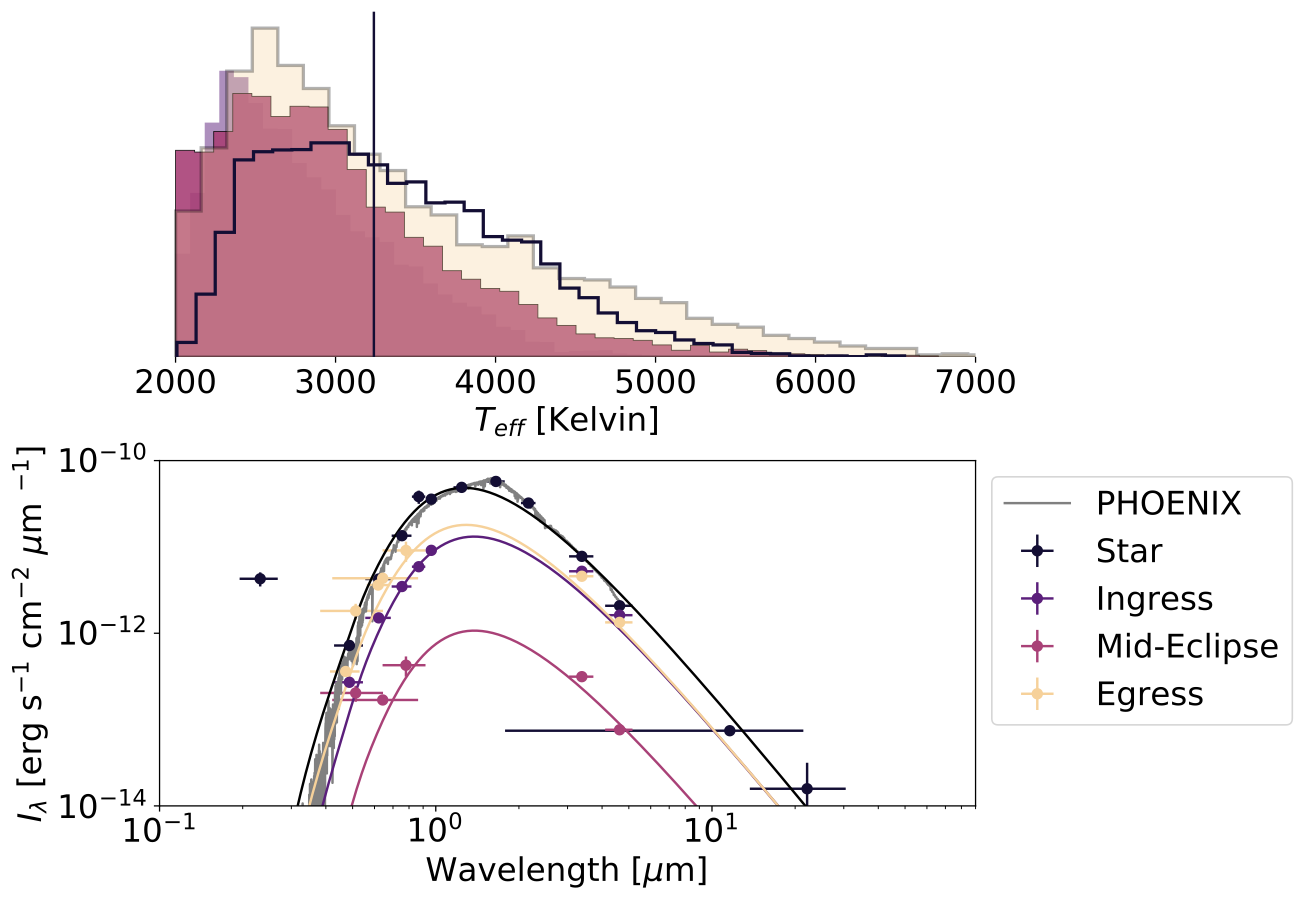

Conclusions:
- Photometric SED classification suggest M-giant (consistent with E-Aur previous analogs) with Teff~4100 K and ~55 solar radii
- Preliminary SED modeling reveals a ~400 K drop from the eclipse
astroARIADNE (Vines & Jenkins 22)
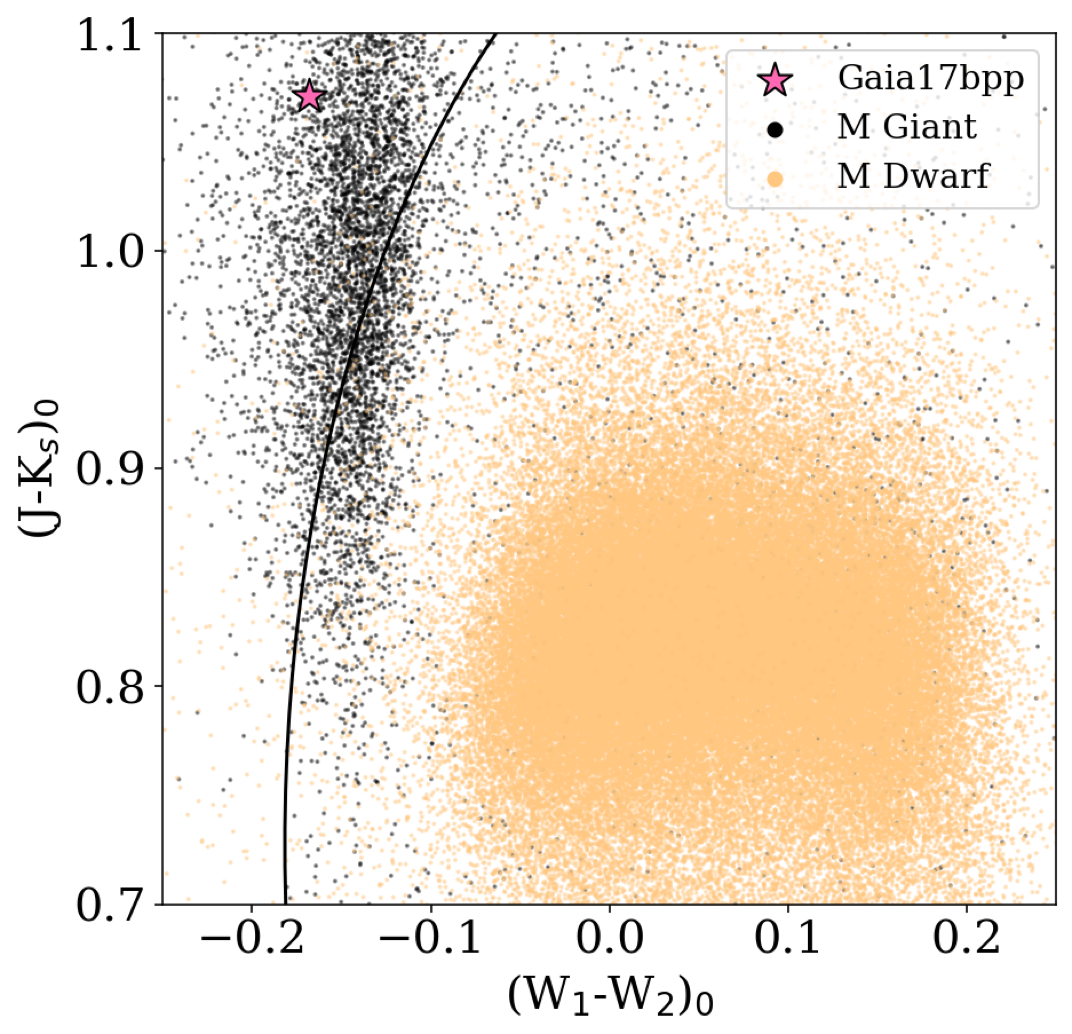
Giant or Dwarf?
Photometric Classification
- Naive Bayes Classifier on LAMOST M dwarf &
giants spectroscopically classified (Zhong et al. 2015) - 17bpp classified as giant based on 2MASS/WISE color
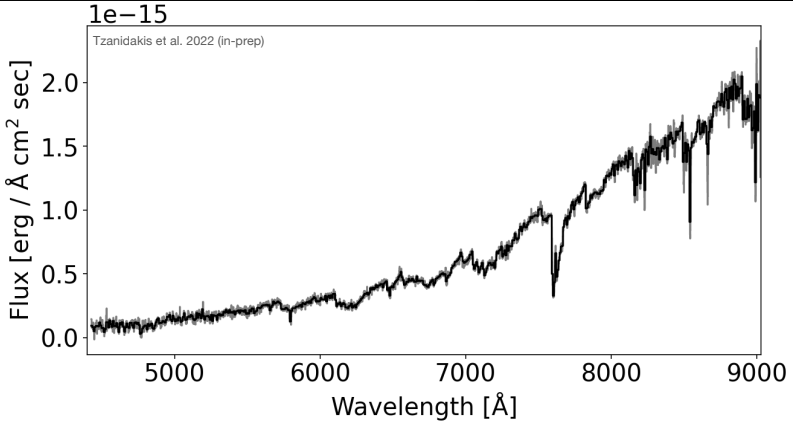
Spectroscopic Classification
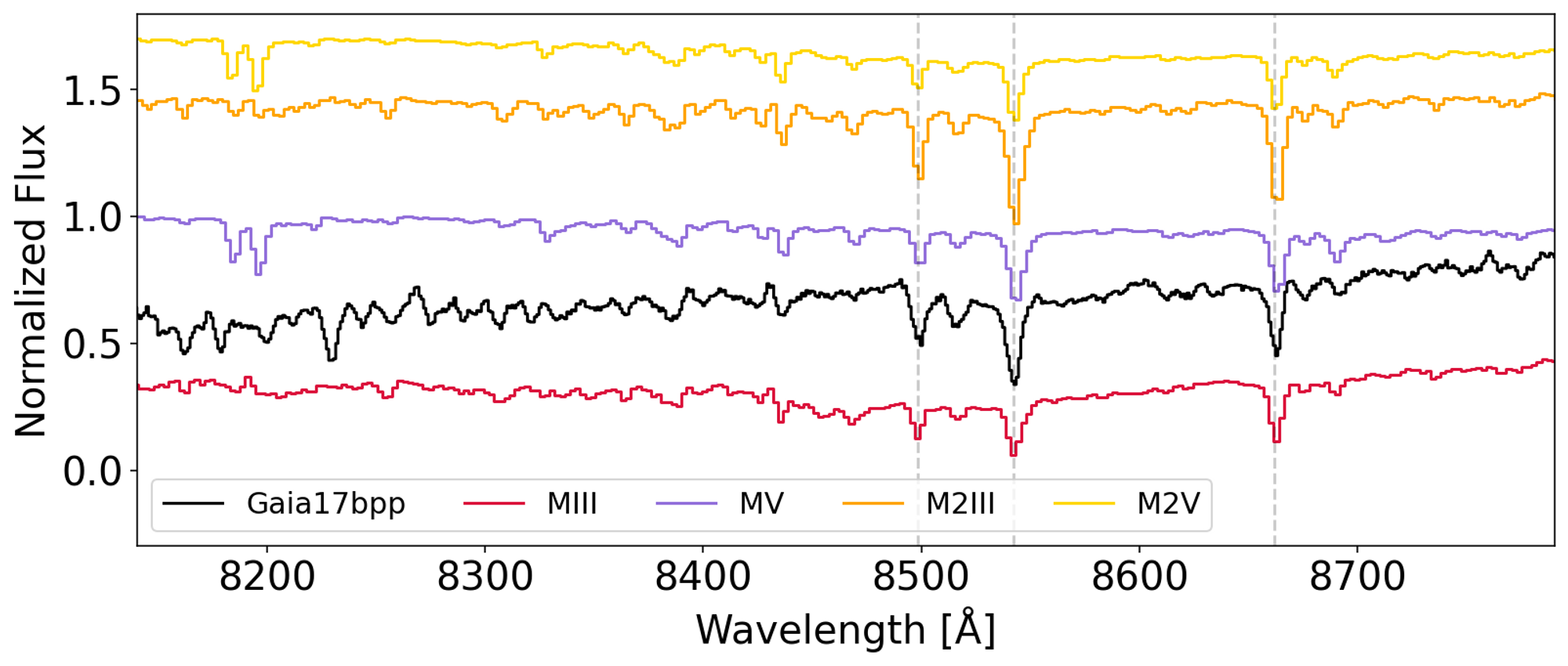
dwarf
giant
dwarf
giant
-
Absence of Na I D and strength of Ca II line indicates
small surface gravity values - No reported peculiarities or ongoing accretion
from the optical spectrum
APO 3.5 m ARC
Further clues
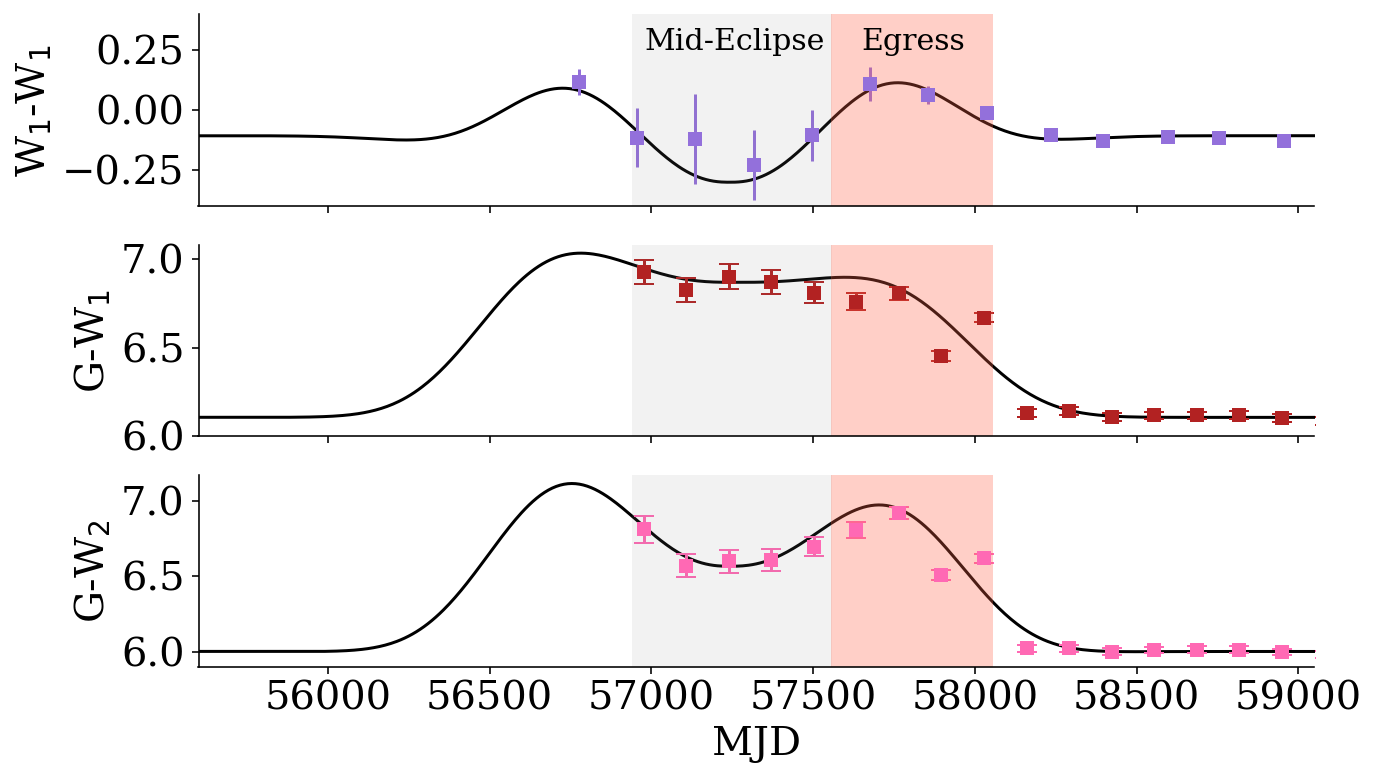
high order super-Gaussian function
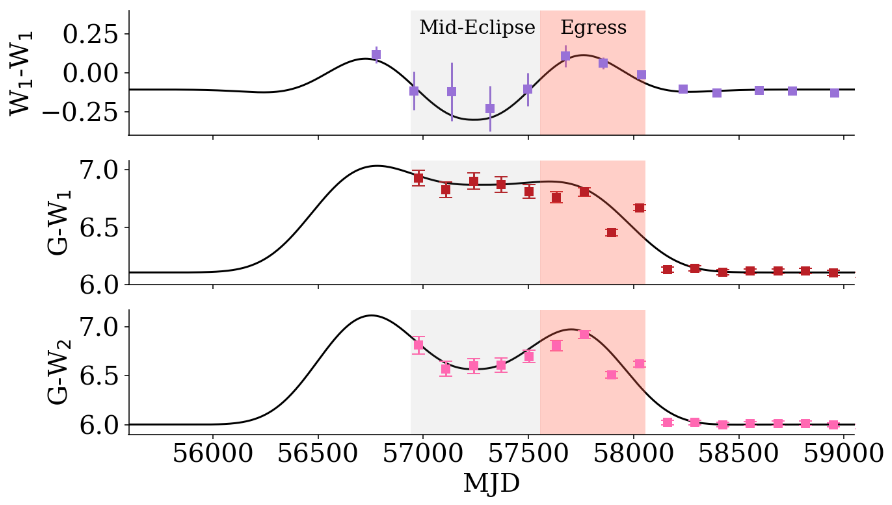
- Optical-IR colors suggest a reddening profile during egress
- IR (W1-W2) show a blue trend from the quiescent phase?
- Maybe a central hot source or Rayleigh scattering...? Extinction alone cannot contribute to this effect
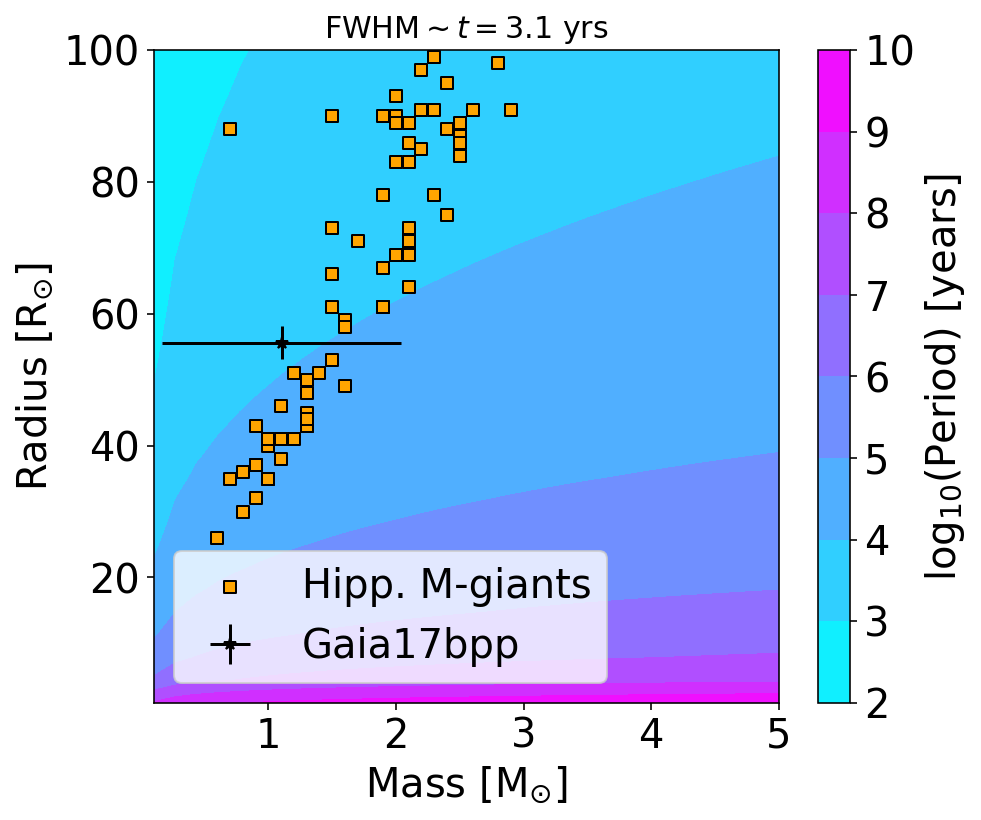
Assuming b=0, circular orbit,
and R/R*~1 using Kepler's law:
orbital period
duration (FWHM)
orbital period >1000 years assuming the secondary has a small mass
Long duration event
A long-duration (FWHM~3.1 years) and deep flat dimming event suggest:
extended object or large semi-major axis
mass estimate
via MESA Isochrones

Preliminary light curve
modeling


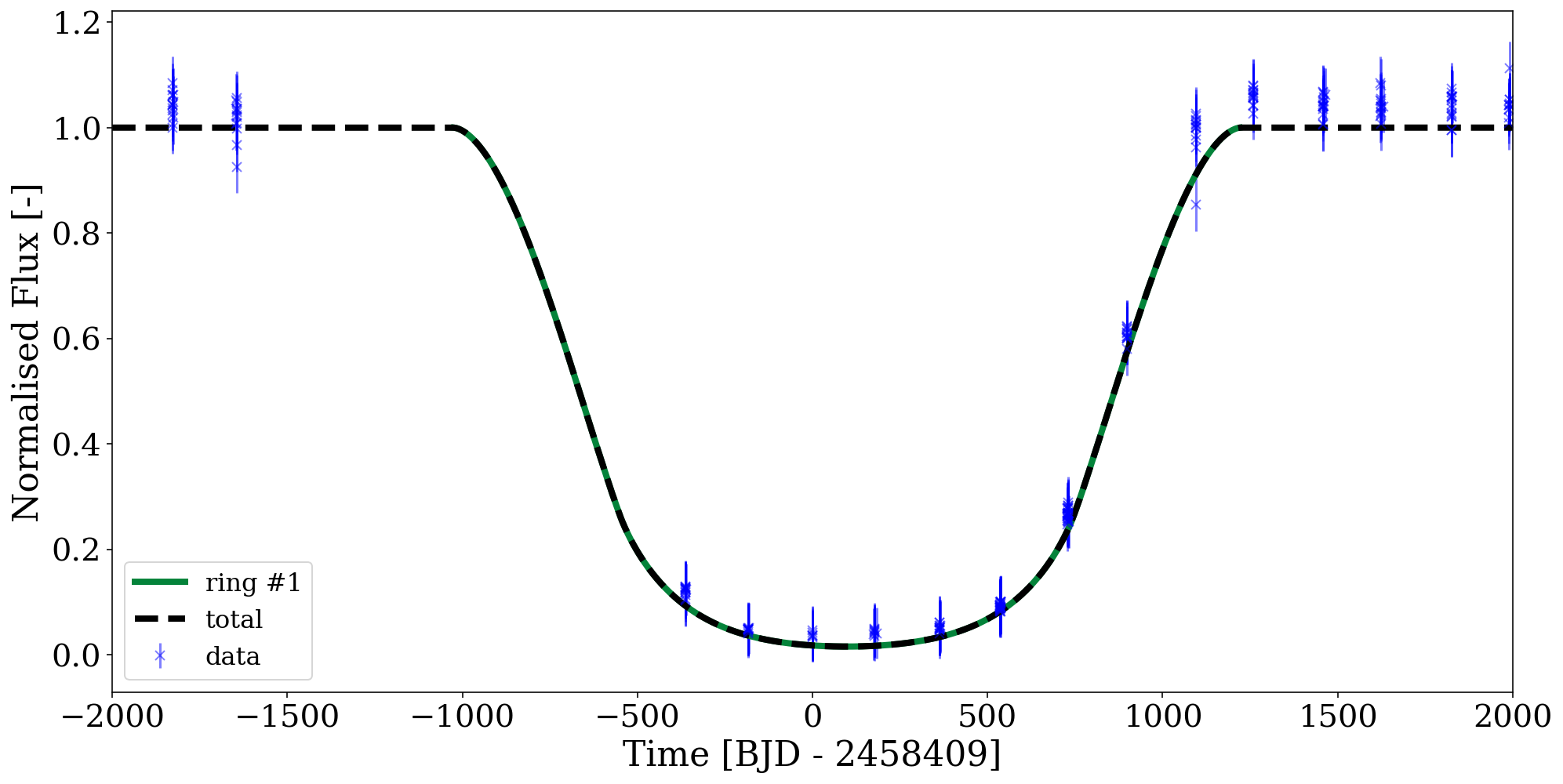
Toy model assuming an opaque
transiting disk (ignoring chromatic effects)
(van de Kamp et al. 2021)
Orbital velocity is suspiciously too
small & disk size is small for a YSO

Compared to the literature:
Gaia17bpp sets a new record!
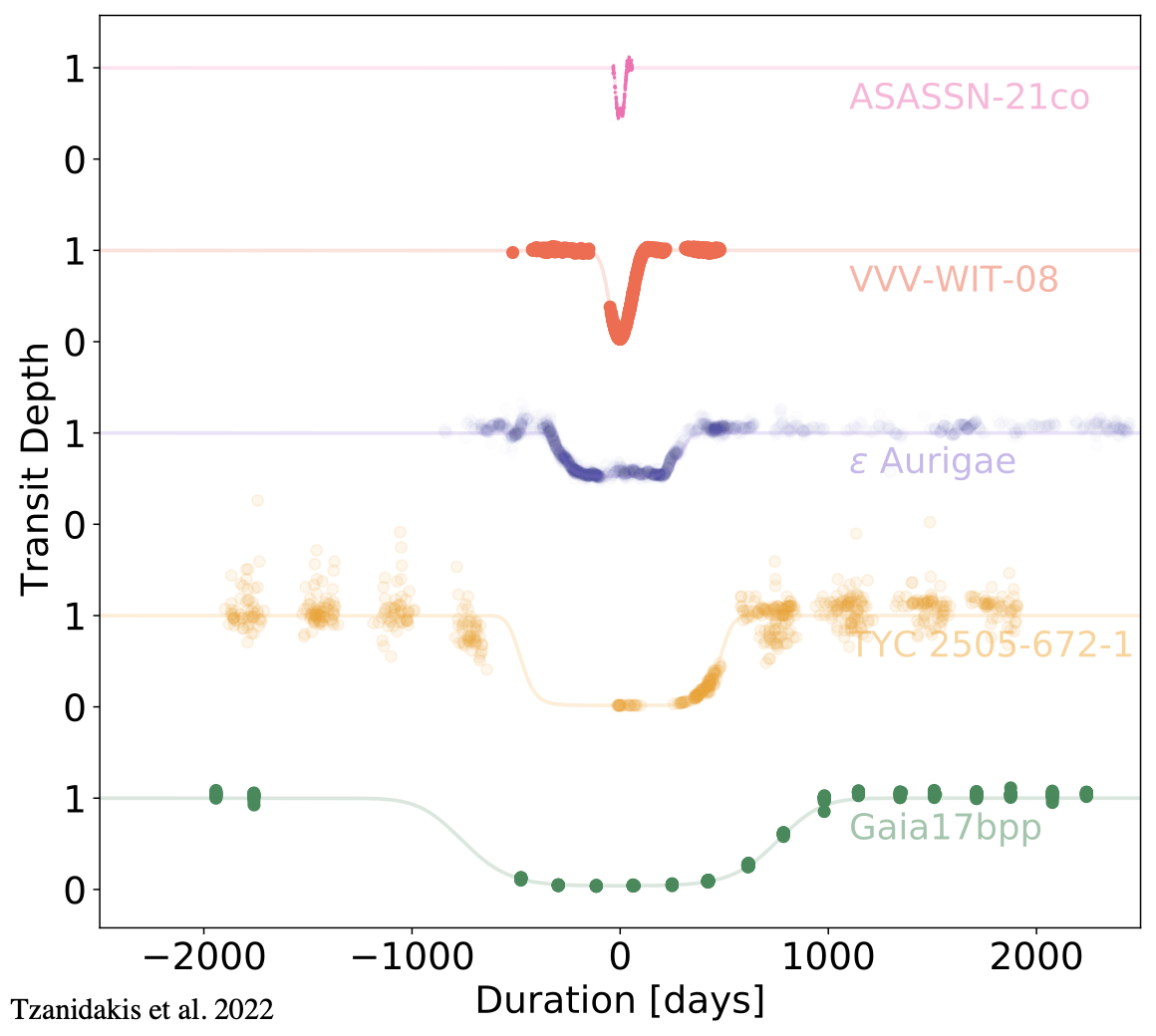
| Stellar Candidate | Period |
|---|---|
| ASASSN-21 co (Rowan et al. 2021) | 11.9 years |
| E-Aur (Ludendorff 1903) | 27.1 yrs |
| TYC 2505-76 (Lupinov et al. 2016) | 69.1 years |
| VVV-WIT-08 (Smith et al. 2021) | Unknown |
| Gaia17bpp | Unknown |
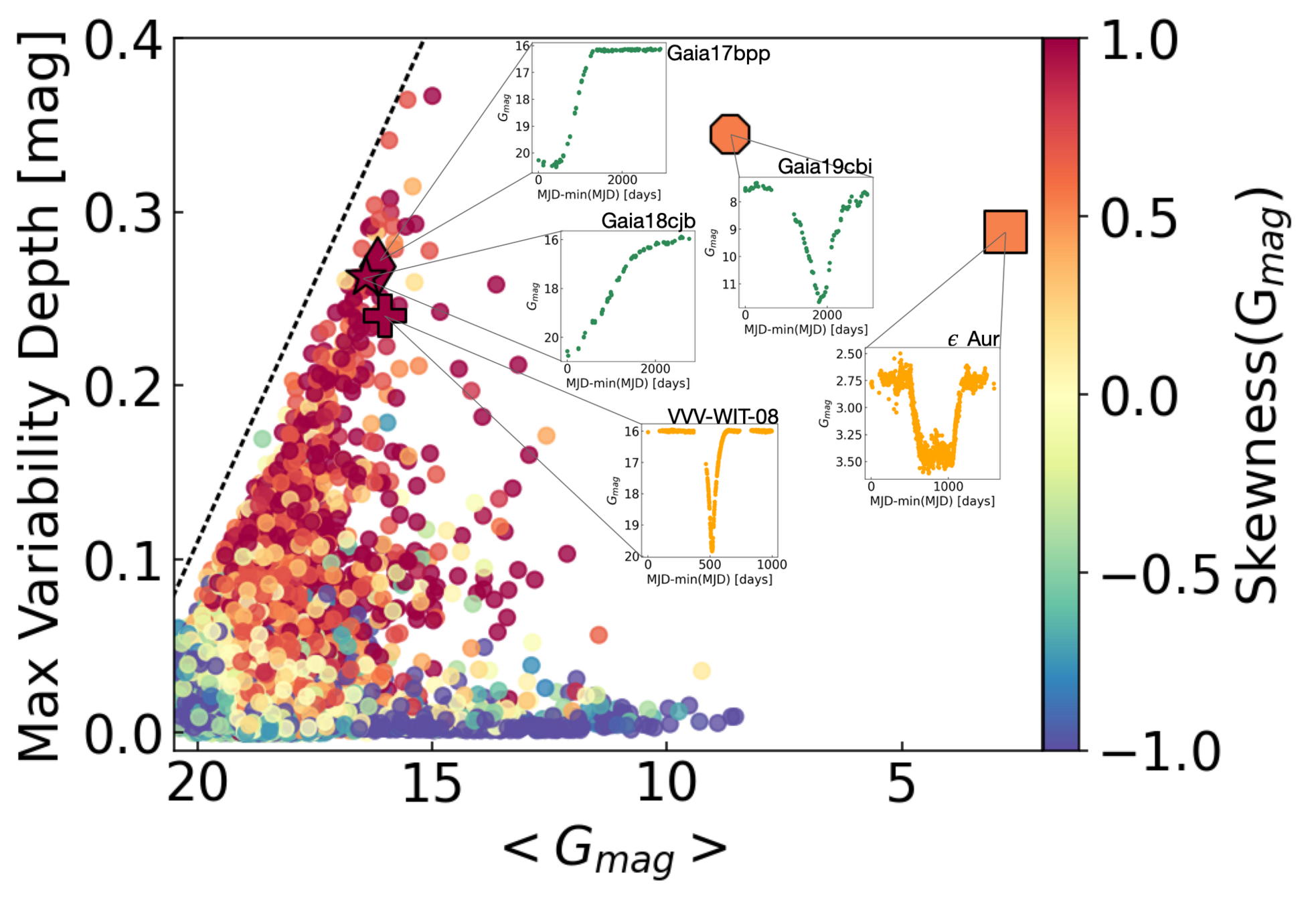
future prospects with gaia & LSST
Slow and large amplitude dimming events are prevalent in long-baseline surveys. The Gaia Science Alerts is already full of mysterious & unclassified stellar variability that deserves more attention and will set-up the stage for LSST
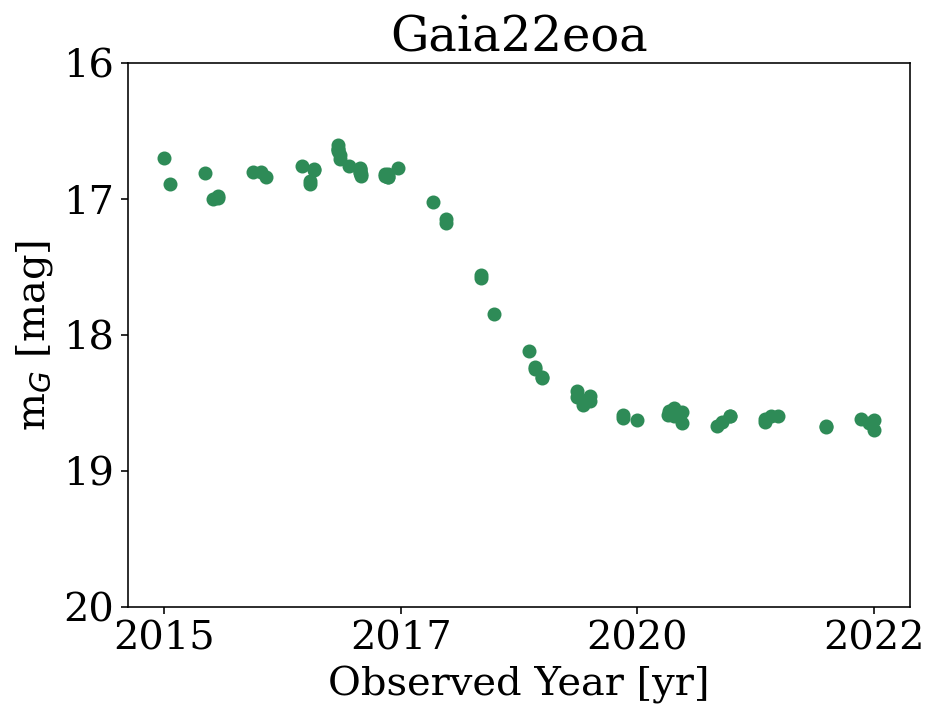
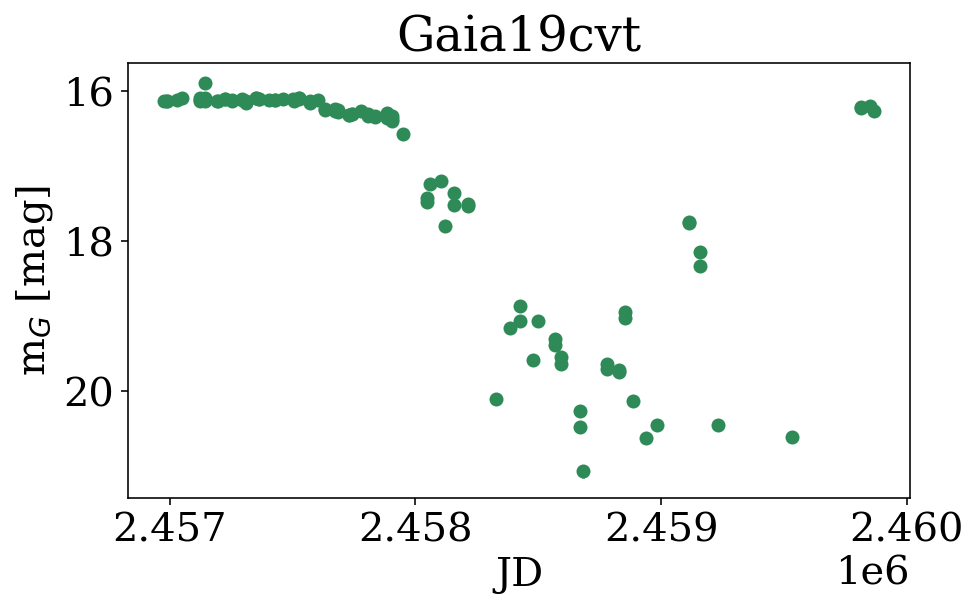
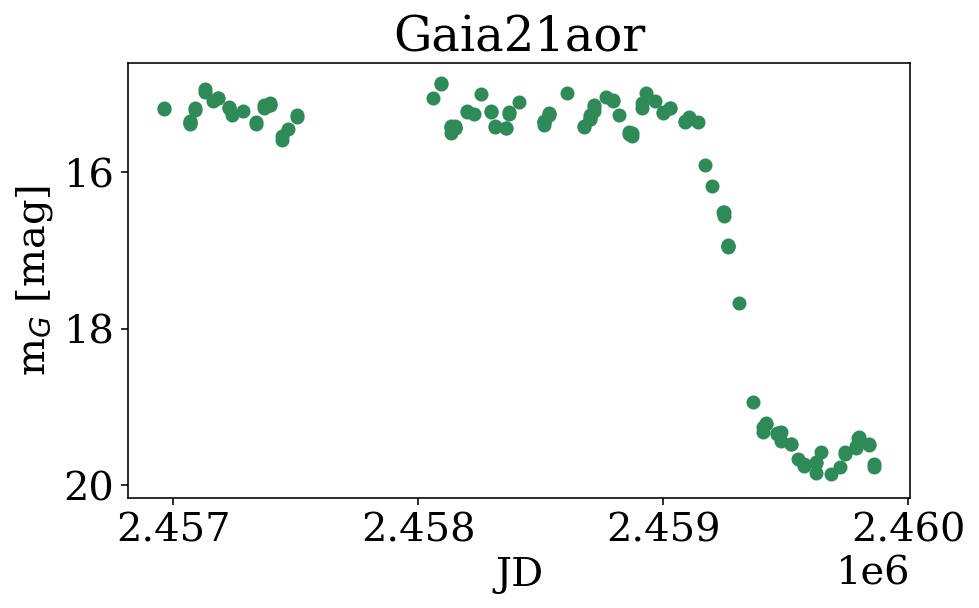


GSA also includes uncalibrated BP/RP low-res spectra!

conclusions
1.
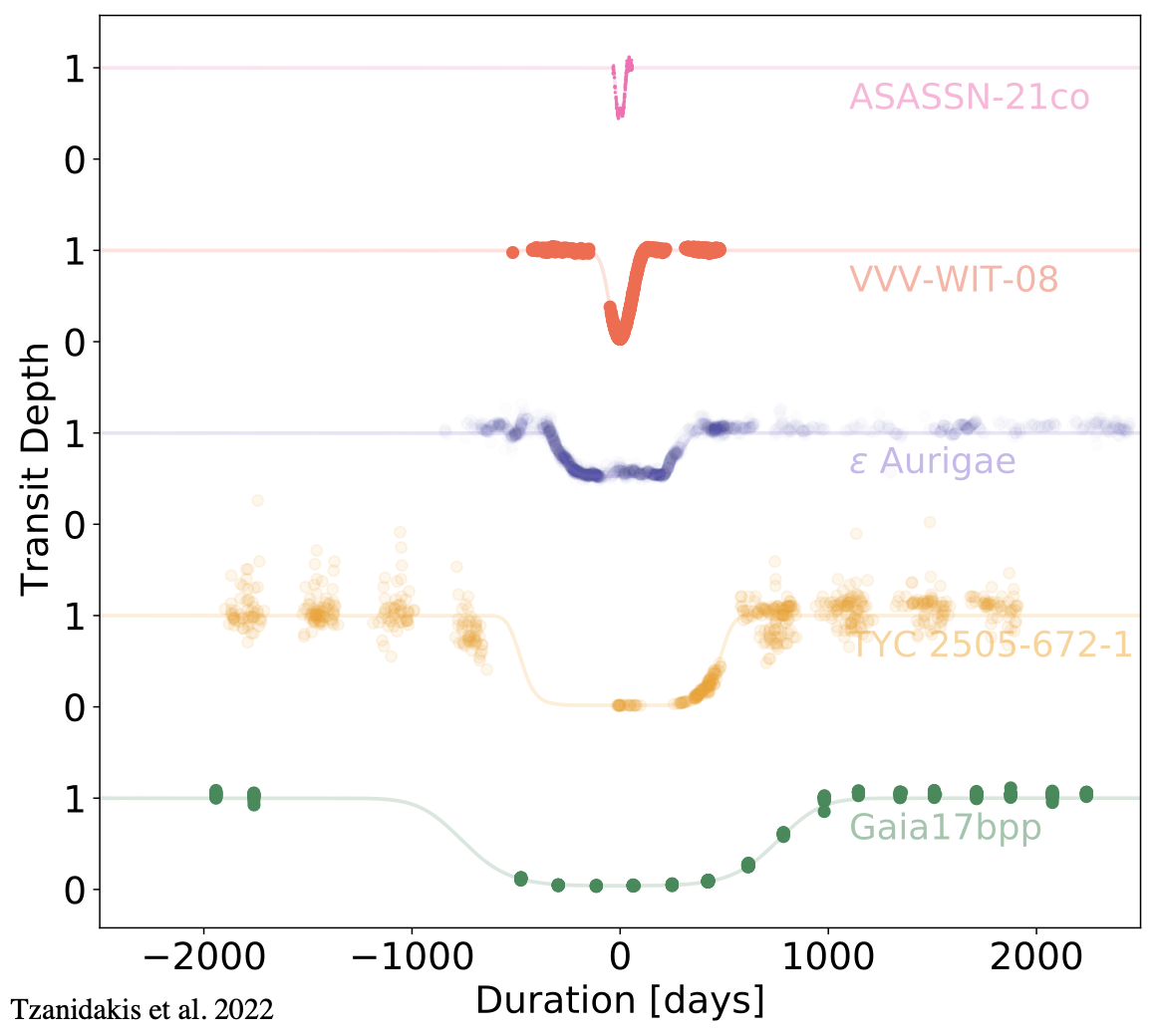
We report the discovery of the longest and deepest single dimming event recovered in the literature. The progenitor of the dimming event is not constrained
1.

2.
Both photometric and spectral classification indicates the presence of the primary star being a likely M-giant at Teff~4100 K with a radius of 55.6
3.
Using optical to IR colors, we find that the
color evolution near the optical bandpasses is flat near the photometric minimum. The IR color evolution during the eclipse has a blue color excess from the quiescent star
4.
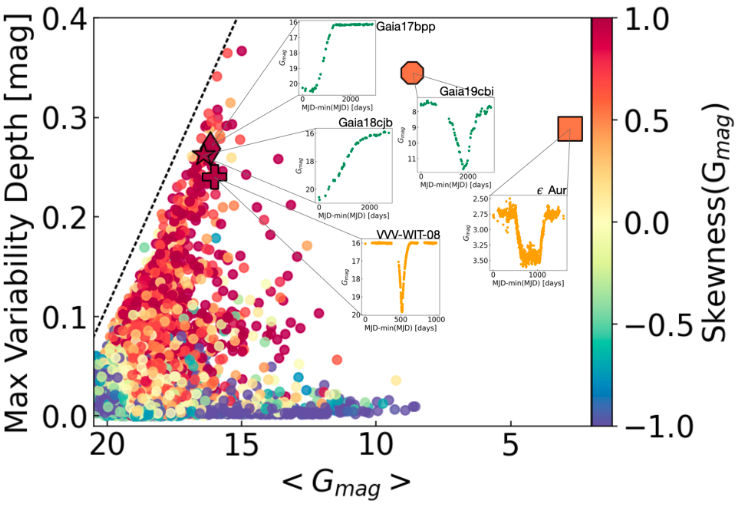
A systematic search for such dipping events will further shed light on the dimming mechanism. The Gaia Alerts System is already full of a small sample of such rare stellar transients. LSST will likely find more!
extra slides
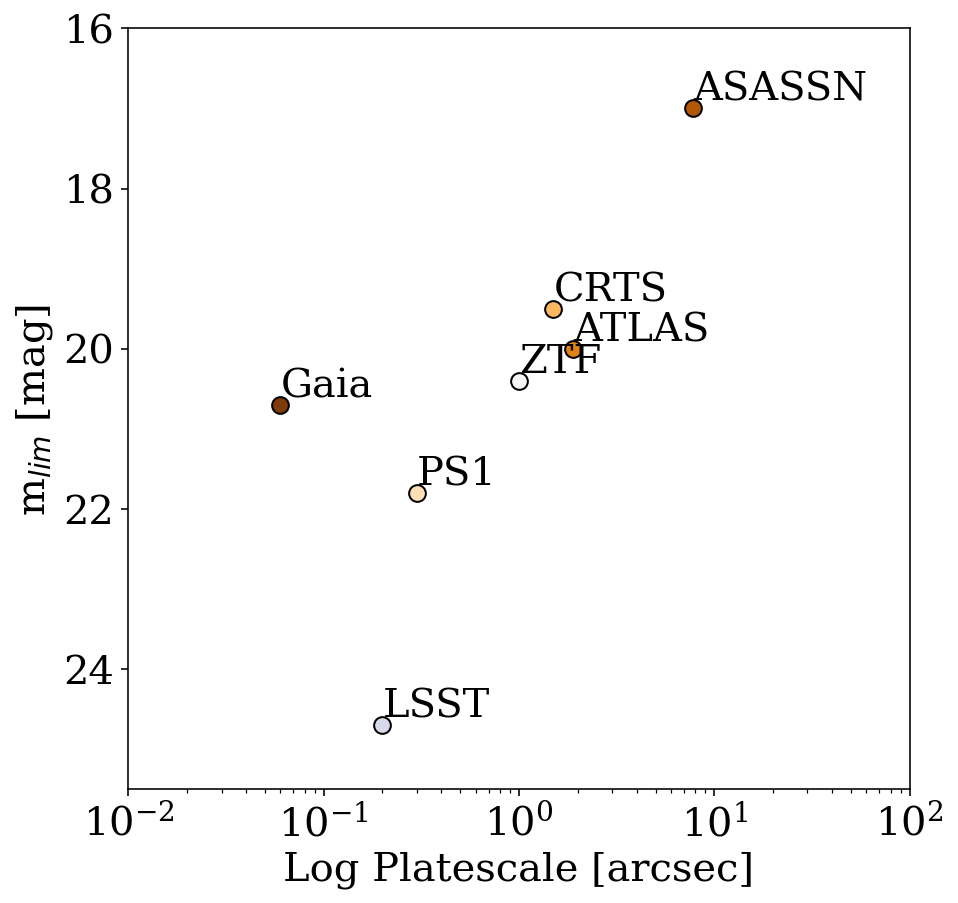
GSA compared to other
surveys
gsa alert identification
Alert must have at least two transients that differ by a historic magnitude mean of 1 mag and 3 sigma from the baseline
2.
Alert must have at least two transients that differ by a historic magnitude of 0.15 mag and 6 sigma from the baseline std
3.
1.
4.
A new source previously not seen and rising to G<19 mag will be considered an alert candidate
New source
Detection
Old Source
detection
Old Source
mean-rms
detection
skewness threshold
Detection

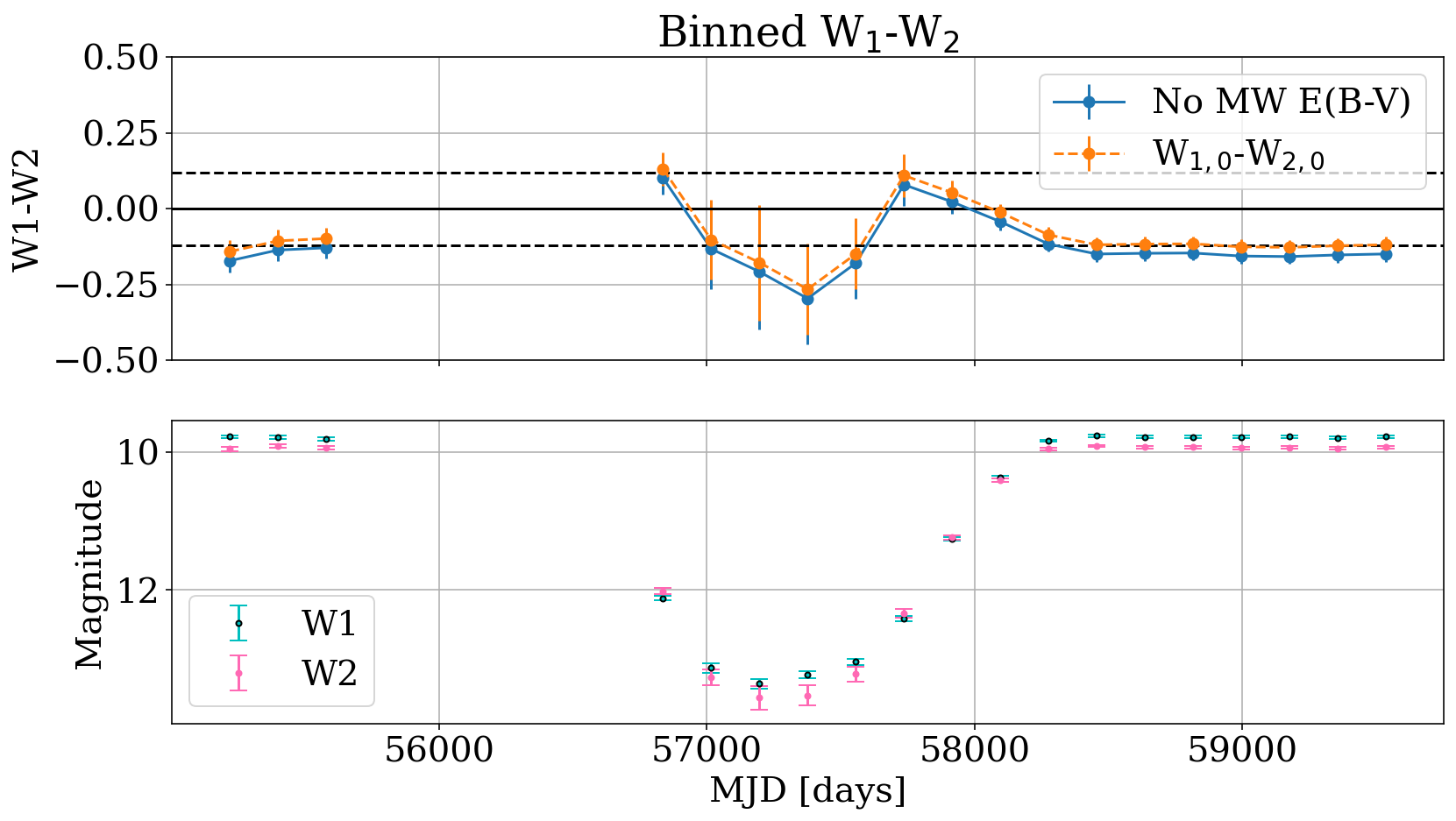
- Egress/ingress -> red
- eclipse -> bluer (than star?!



Case study: E-aur
Several tensions:
- Mass model
- Constraints on distance
- Classification
Summary
Caroll et al. 1991
- 27-year orbital period
- First discovered in the early 1820's if Fritch (german astronomer)
- spectrum does not change during the eclipse
- First theories suggested a stellar eclipse with a semi-transparent star
- E-aur eclipse through the 20th century was considered to be the largest star
- Huang et al. 1965 suggest the disk model theory tilted -- but issues with that came about the whole in the mid-eclipse
- Central star not visible... and some mass transfer (Gibson 2018) using the He I 10 730 Å EW that reveals the disk structure
-
Recent data from Gaia DR2 p~ 2.4 mas... d~350-525 parsec (supports small mass ratio (q<1) model
aavso.org
Torsten Bronger CC BY-SA 3.1