The Practitioner's Guide to C++ 17/20
Background
- C++ evolution defined by ISO committee
- Being a member helps
- Remember C++98 -> C++11? C++20 will be similar
Overview
- Process
- Big features and where they matter
Areas of Work
Evolution in several areas, in parallel. Several just missed C++17. Many major features ended up in C++20.
Features are proposals or Technical Specifications (TS)
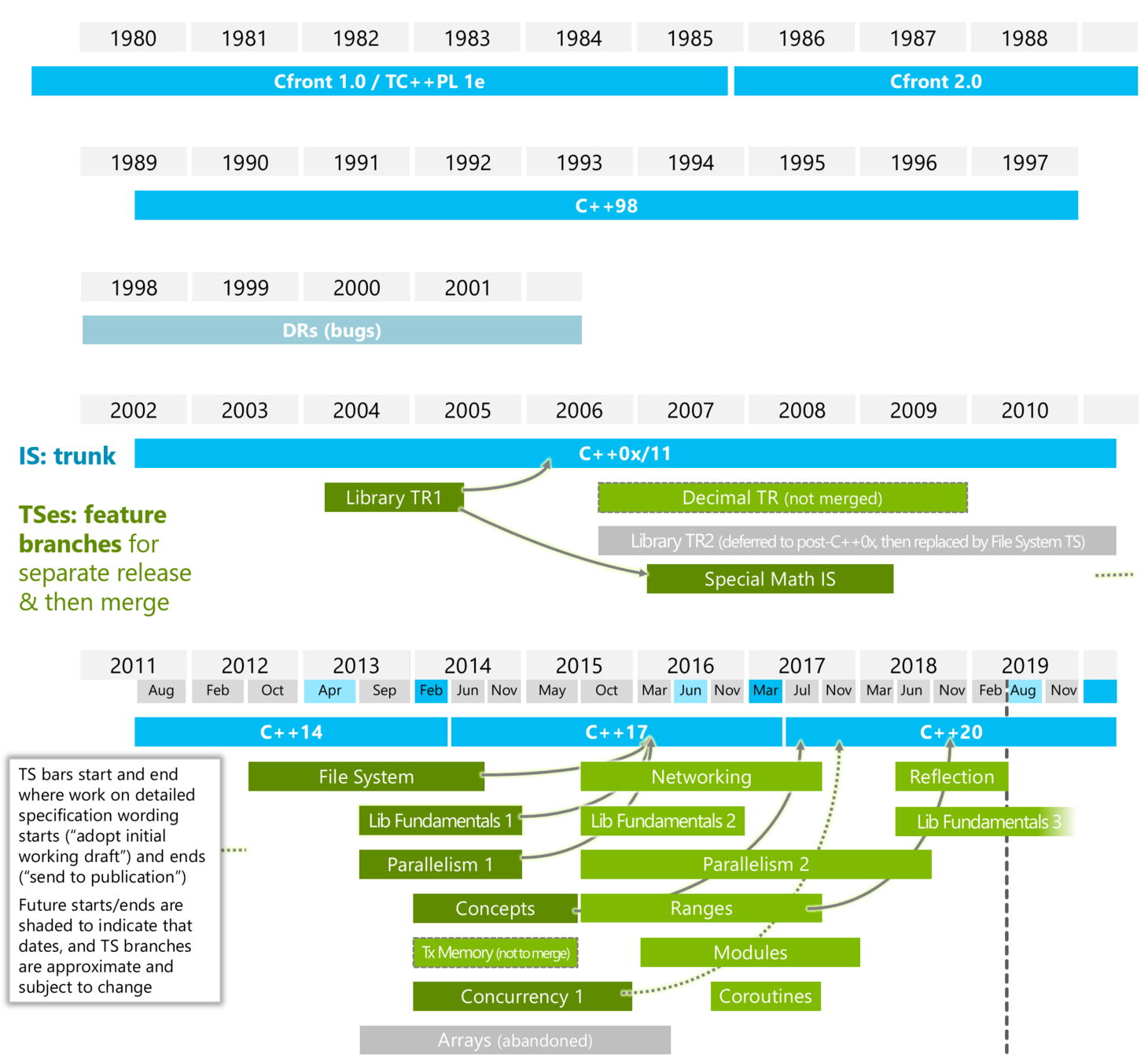
C++ TSes
C++20 TSes
Big Items
- Contracts
- Concepts
- Ranges
- Modules
- <=>
- Coroutines
- std::filesystem (C++17)
Small Items
- span
- format
- optional + variant (C++17)
- structured binding (C++17)
-
if constexpr (C++17)
-
if with variable declaration (C++17)
-
(string) literals as template parameters
-
more constexpr, consteval
-
class template argument deduction
Too much!
- selected those most relevant for us
- for the rest: check CppCon + MeetingCpp + CppNow
Little Helpers
if (auto v = f(); !v.get())
- reduces scope of variable
- extremely useful for things that are not true or false, but empty() or is_something()
if constexpr (is_enum_v<T>)
- the contained block is NOT compiled!
- needs to be parseable (not %$^&^&) but can be invalid!
- extremely useful for avoiding template specializations
- makes code MUCH more readable
MyTemplate<"a string">
- people really wanted this
- also allowed: any literal (="super simple") type with default <=> (see below)
auto [a, b] = getBoth()
- finally a way to sanely deal with multiple values being passed
- think if / for statements, where you can get key and value at once!
-
for (auto && [k,v] : myMap)
-
optional, variant
- std::optional: holds one of none
- std::variant: holds one of a set (union)
- possibly also std::expected: value or error
- extremely powerful for writing safe, compact code
variant<double, string> v{17.};
assert(get<double>(v) > 16); // good!
v.emplace<string>("ABC");
get<0>(v); // throws!
span
- whether std::vector, std::array or C-style array:
- refers to a contiguous array of given size
- wonderful as function parameter
- fixed-size or runtime-size
void func(span<double,4> lv);
array<double, 4> jetLV{...};
func(jetLV);
format
- not yet guaranteed for C++20 - but expected!
- an efficient and nice way to format strings in C++, finally
- printf-format plus so much more
- incl user-extensible: format your classes
string message = format("The answer is {}.", 42);The
Big
Five
Contracts
- specify what your function expects
- can be checked by compiler
- check can be turned off
- enables optimizations
Setting expectations
expects: condition on arguments
ensures: post-condition, a guarantee by the function
assert: a check to be performed within the function
int f(int i) [[expects: i > 0]];
int g(string& s) [[ensures: !s.empty()]] {
   [[assert: s.empty()]]
   s = "ABC";
}
Validating expectations
Multiple contract levels default, audit, axiom
compiler flag defines which contracts are checked
- default checks default
- off: nothing
- audit: default and audit
axiom is thus never checked:
good for expensive conditions
int f(int i) [[expects default: i > 0]];
int g(int i) [[expects audit: i > 0]];
int h(int i) [[expects axiom: i > 0]];
Concepts
- document and restrict template parameters
- better error messages
Ranges
- working on everything that has a begin
- generalized iterators
- much, much nicer syntax
Modules
- dramatic build time reduction
- hides implementation details
Spaceship <=>
- finally a default comparison!
- reduces code clutter and bugs
Summary
- C++20 is BIG
- Implementations are on their way, most of C++17 already available
- Get used to updating your compiler aggressively to benefit from C++
- Goals are simplicity, 0-cost, faster programs, commonly used features in the library
Outlook
- C++23 will be much smaller
- implementing language features for library where needed
- stdlib modules
- more concepts
- several major features did not make it:
- networking
- executors
- more features in the works, e.g. reflection
Your C++ representative
(disclaimer: not my main job)
- we have > 100 million lines of C++ code in HENP, replacing that might be more work than fixing C++
- I will be at ACAT all week: share your ideas, pet peeves, thoughts about C++'s future role in HENP codes
Conclusion (1/2)
- C++ learned a lesson: evolve or be dead
- relevant to us: better, more maintainable code
- we won't need all features, but we have a palette to select from
- need to upgrade our toolset (compilers!) and coding guidelines: contracts? concepts?
Conclusion (2/2)
- many features are targeted at us
- math special functions (C++17)
- ranges
- concurrency
- compile times of large-scale code
- not using them means missing out on benefits provided by the language and its tools
- we need to evolve tooling and code to benefit
- are we investing enough in our code and education?