Game Based Language Learning (GBLL)
SERIOUS GAMES & GAMIFICATION
Aylar Fallah Vazirabad, University of Limerick, PhD TESOL
Characteristics of Language Games
Prensky (2001) lists 12 elements on the characteristics of language games: fun, form of play, rules, goals, interactive, outcome and feedback, adaptive, win states, conflict, problem solving, interaction and story.
Why use language games?
In the easy, relaxed atmosphere which is created by using games, students remember things faster, and better (Wierus & Wierus, 2000)
EPISTEMIC GAMES
'Epistemic Games: Games that are fundamentally about learning to think in innovative ways.' (p. 10)
'What computers do...is let us work with simulation s of the world around us. Computers let us make models that work the way some part of the world does.' (p.9)
'Computers now make it possible to lean on a massive scale by doing the things that people do in the world outside of school. (p.9)
Shaffer, D. W. (2006). How computer games help children learn. New York: Palgrave Macmillan
Learner's Perception
The main goal of playing a game for the purpose of language learning is not to learn or practice language but it is to play by rules and to play well. It is the degree of pleasure that game brings (Hubbard, 1991)
To keep the focus on outcomes rather than on language aims ( R, Ellis, 2003).
From a student perspective we must reflect on the changing nature of our students as key stakeholders in the educational process. Sometimes called 'digital natives' or the 'Ninetendo generation', these new millennial's approach work, recreation and certainly education in new ways. (Tapscott, 1997). They obsorb information quickly, in images and video as well as text, from multiple sources simultaneously.
They operate at what Prensky (2004) desribes as, 'twitch speed', expecting instant responses and feedback. They prefer random 'on-demand' access to media; expect to be in constant communication with their friends and ease of access in the creation of their own new media.
Psycho-Pedagogical Framework for Educational Games
Massively Multiplayer Online Games (MMOGs), brings together millions of players in a single virtual world.
As important is the intrinsic motivation, equally the level of motivation and equally fragile is a suitable balance between challenges and abilities.
Essentially this idea is covered by the concept of flow - a highly immersed experience when a person is engaged in a mental and physical activity to a level where this person loses track of time and the outside world and when performance in this activity is optimal (Csikszentmihalyi, 1990)
Personalizing Learning and gaming
A. Adaptive Presentation
Adjusting the look and feel of a learning environment according to individual preferences or needs; for example, different color schemes, layouts, or amount of functionality
B. Adaptive Curriculum Sequencing
Providing the learning tailored to individual preferences, goals, learning styles, or prior knowledge;
C. Adaptive Problem Solving Support
Providing the learner with feedback, hints or solutions in the course of problem solving processes.
Conventional assessment methods such as popping up queries or multiple choice items would most likely destroy immersion and flow experience.
Non-Invasive Assessment of cognitive and motivational states
The basic idea is to monitor and interpret the learner's behavior in the game. e.g. formal framework of Competence-based knowledge Space Theory (CbKST), which is a cognitive framework, extending the originally behavioral knowledge Space Theory (Doignon & Falmagne, 1999).
The relationship between the skills and problems (or learning objects) are established by skill and problem functions.
Motivating factors
Cognitive framework for explaining Gameplay. Lindley, Nacke, and Sennersten (2008) list these factors to include:
Effectance- the feeling of empowerment created when an action of a player results in a response from the game.
Closure- the completion of the algorithm constituted by a play schema.
Autonomy- Making your cognitive, independent decision making and thinking process, level of difficulty and schemata
Achievement- which is rewarding due to the displacement of a player's identity into their character.
Achieving of a sense of Flow- being a state of being totally absorbed in meeting a constantly unfolding challenge.
Enjoyment- the pleasure of curiosity and discovery, as well as the pleasure of experiencing negative emotions of
Escape- an alternative reality provided by the fictional world represented by a game and facilitated by imaginative displacement.
Dissolving interactions
Further forms to provide the learner with specific information. The purpose of this intervention type is to provide the learner with the solution of a problem/task if the learner wasn't able to do so within a reasonable number of actions. Interventions, ultimately, shall assure that the game can continue even if the learner is not able to solve a problem/task. Of course for dialectical reasons, this intervention type might not be used for all problems/tasks.
Forms of such interventions are feedback, praise, incitation, encouragement, or directing attribution, encouragement, or directing attribution of success or failure (from a motivational point of view the learner should attribute success to his/her own abilities and failure to external components such as bad luck. (International Journal of Game-Based Learning, 2011)
THe realization
From technical perspective, two European project called 80days and ELECTA with Nebula2engine by Radon Labs: assess: present knowledge
motivational assessment
speed and intensity


Digital Games Sample Website
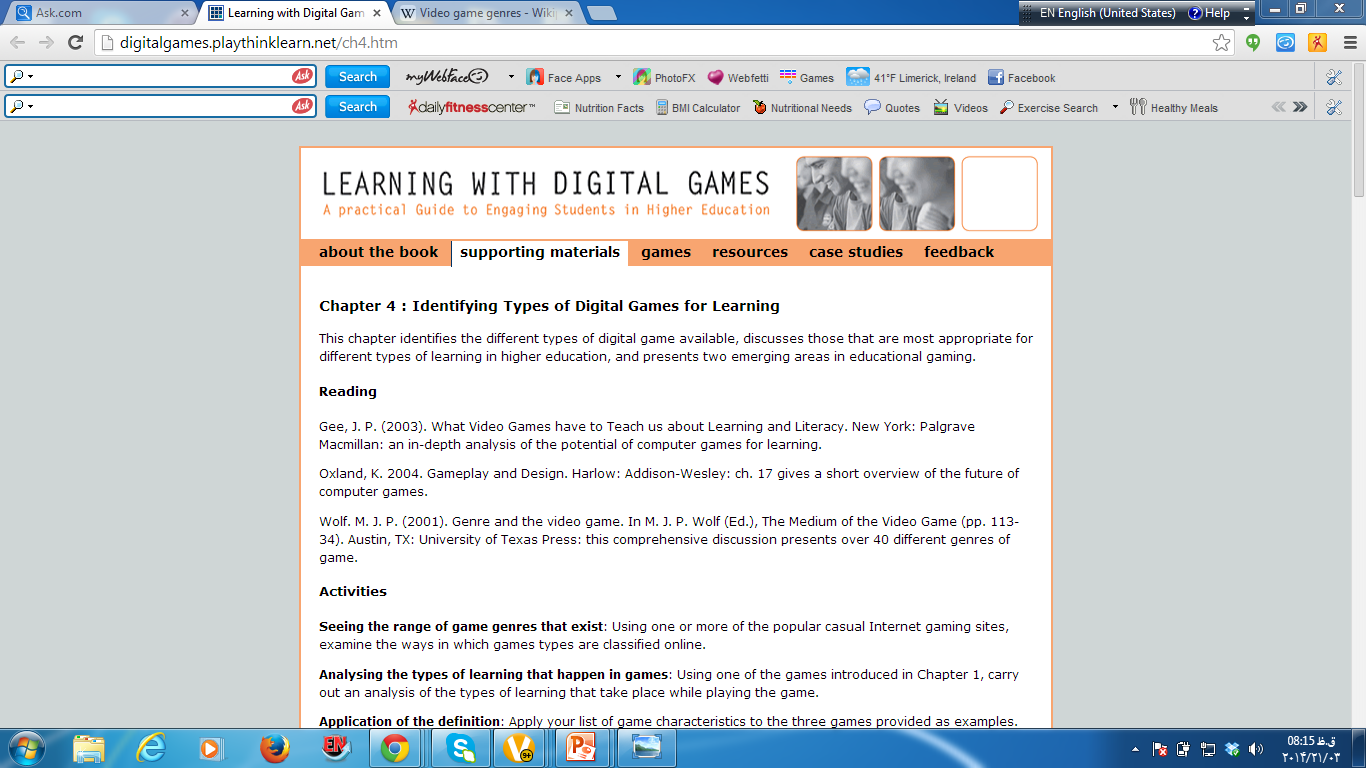
The bonte Room
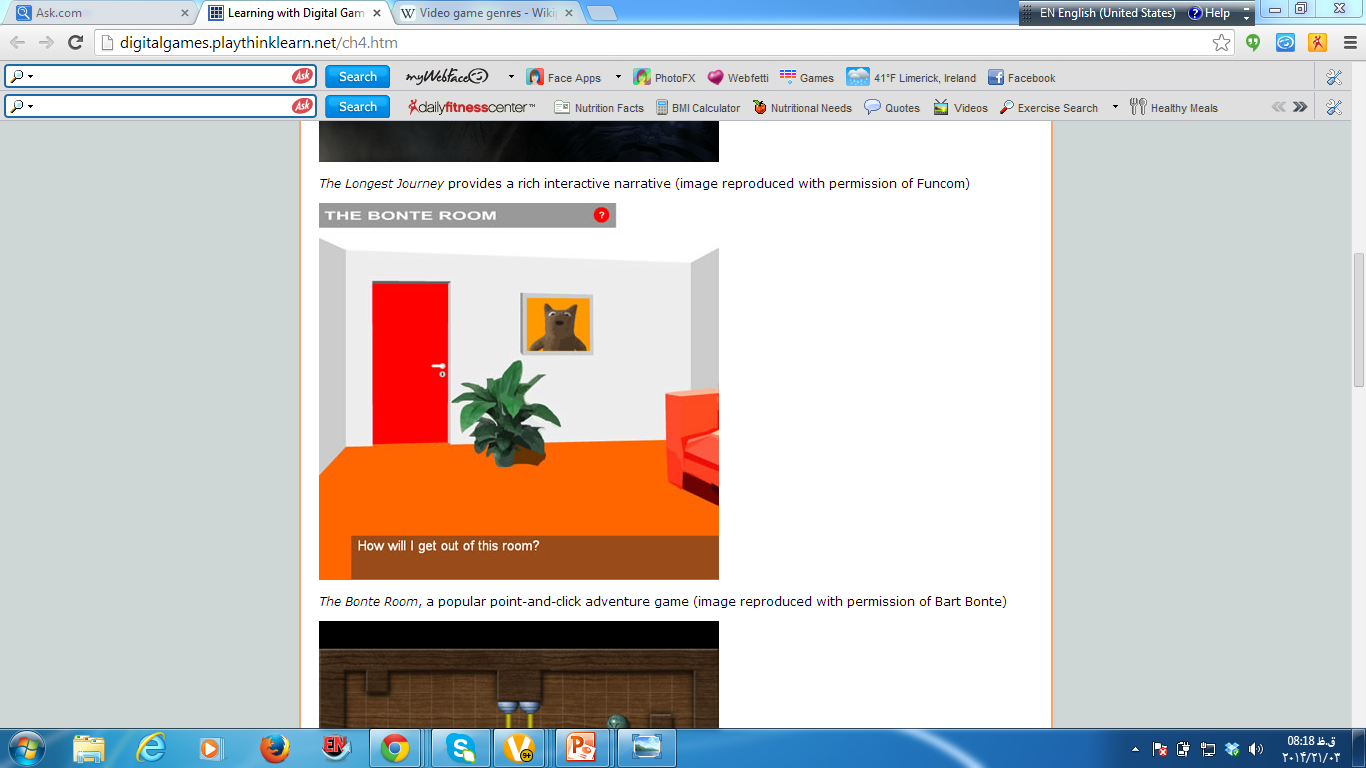
Sherlock Holmes, The Silver Earing
Complex context and comprehension of L2 development
Timing elements and face-to-face interaction
'inauthentic' language
( Piirainen-Marsh & Taino, 2009)
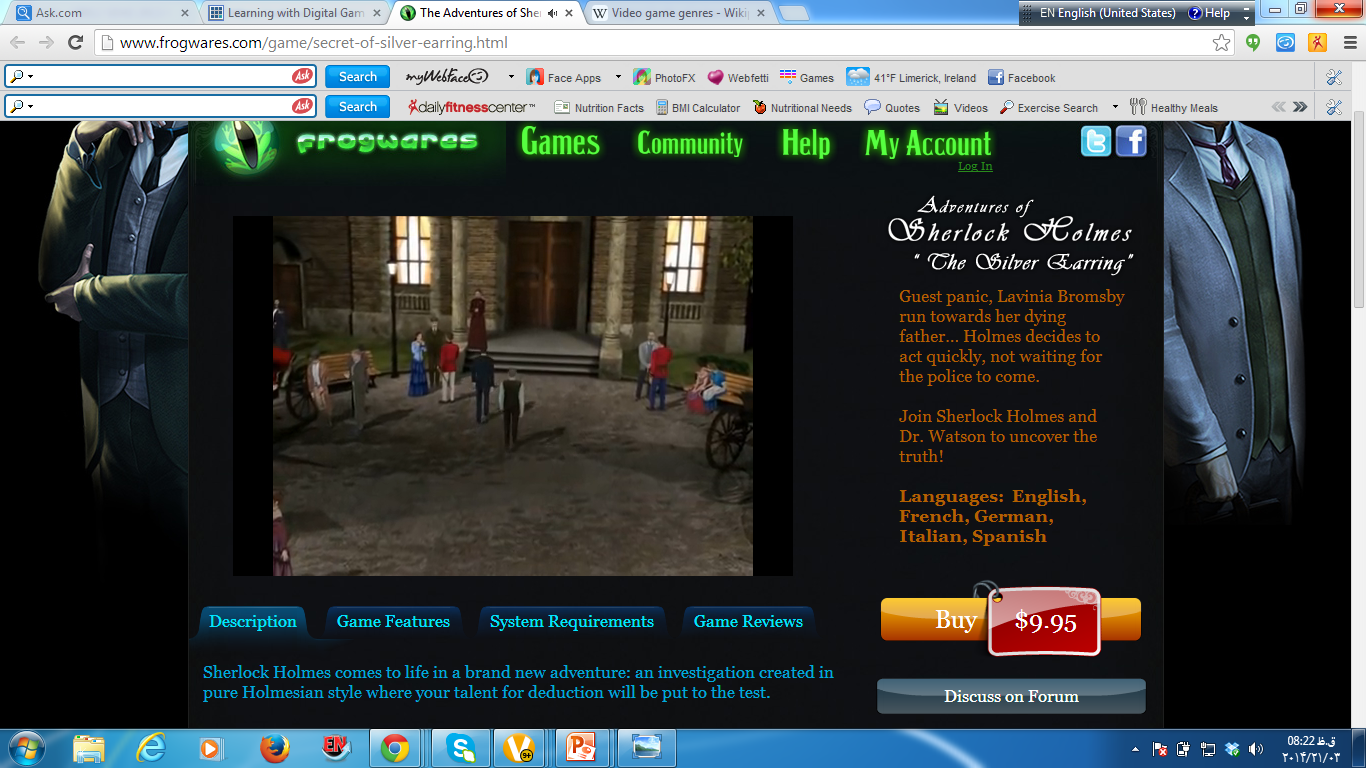
Corrective feedback (CF) in GBL and SLA
CF refers to all responses to learners' erroneous L2 utterances, and it may include an indication that an error has been made, can present the correct form or meta linguistic information about the nature of an error, or it may combine these various forms or meta-linguistic information about the nature of the error; or it may combine these various forms of information (Ellis, Loewen & Erlam, 2006)
CF has harmful effect and increase the role of anxiety and foster less favorable attitudes toward learning (Truscott, 1996).
Krashen's Monitor Theory (1981)
Generativist Theory of Language Learning ( Shwartz,1993).
Skill Acquisition Theory (DeKeyser, 2008) emphasizes the possibility of explicit knowledge becoming implicit knowledge over time.
Awareness and noticing in SLA (Schmidth, 1990)
Metalinguistic information (such as grammar rules) =prompts
(Ellis et al., 2006)
GBLL= Trial and error through experiment
Spot the Differences
Communicative Fluency or Linguistic Accuracy?

Determine the Pedagogical Approach
Determining the type of game genre and platform that is appropriate:
Are the potential players required to drill the knowledge or should they have an opportunity to gain the competencies gradually, exchange with other students, work on solutions, etc?
'Drill and practice' for the first one for vocabulary training. The second case, a game that is based on the communication and collaboration paradigm that supports teamwork, like the 'The Trainign Room' game concept (Pivec and Pivec, 2008).
This game can be classified as a role-play game, that fosters participation in problem-solving, effective communication, teamwork, project management, as well as other soft skills such as responsibility, creativity, micro-entrepreneurship, corcporate culture etc.
Elaborate the Details of the STORY LINE
Appropriate game level chosen,
What exactly is the task of the player or teams?
What do they have to achieve and how?
What is their current knowledge level, on what must they build on to be able to come to achieve the learning outcomes.
Where will they get the necessary knowledge, in the lectures, should they use special internet sites, or will the knowledge be provided as part of the game?
Vygotsky's (1978) Zone of Proximal Development must be taken into account.
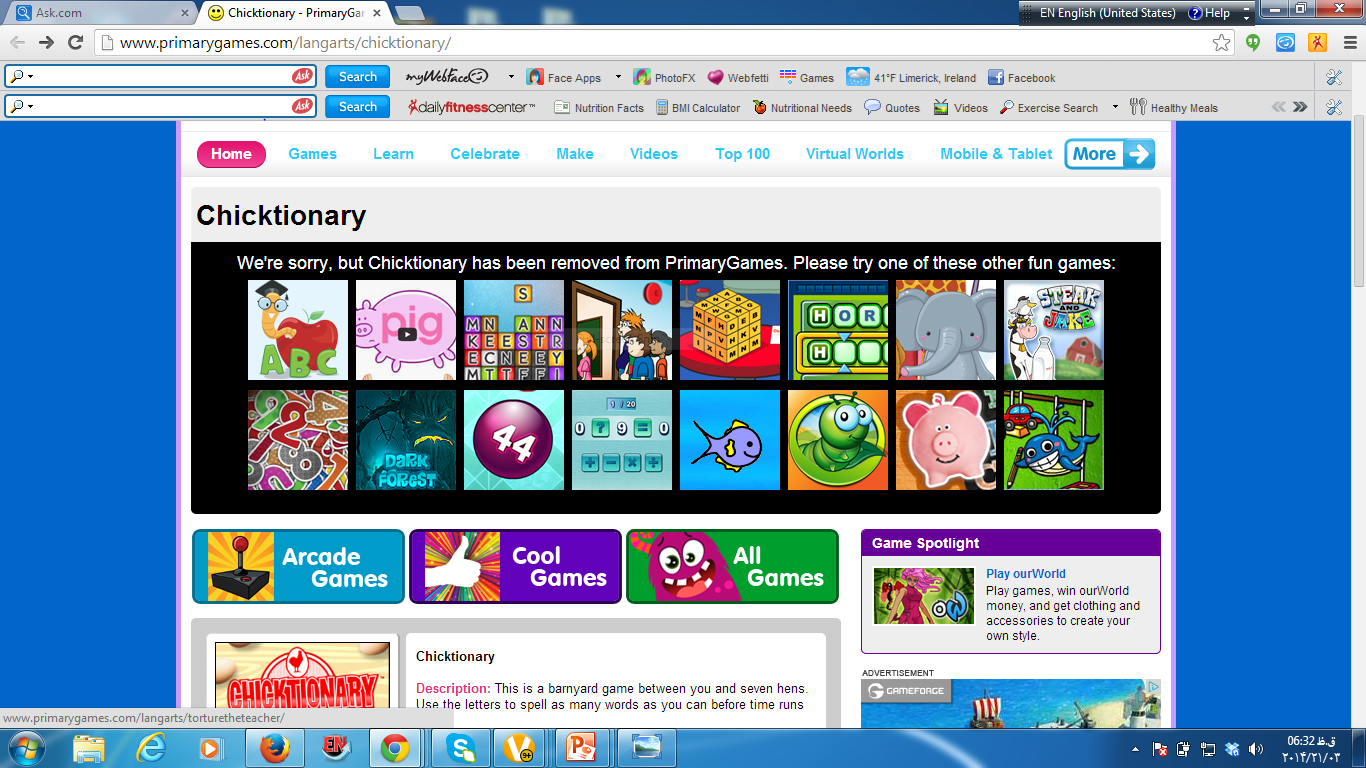
Chictionary
A Freely available online spelling game where players are given several letters and the objective is to find as many words as possible using the seven letters given.
-
Most theories of adult L2 development, to a greater or lesser degree, acknowledge
-
the importance of meaningful communicative engagement and exposure to adequate
-
volumes of the L2 so that its distributions, frequencies, functions, and forms become
- salient and learnable (e.g., Ellis & Collins, 2009; Ellis & Ferreira-Junior, 2009).
-
In combination with social, affective, and cognitive dynamics, quantity of exposure/
- engagement and quality of the linguistic environment are primary drivers of language development
When do you use Games?
Flipped classes?
Practice?
After class activity?
Role play?
What Types of Games do you use and why?
Do you use digital games?
What types and why?
Many thanks for your consideration!
Any questions?
aylar.vazirabad@ul.ie