Programming 101

I'm Mina.

I started programming for the web 16 years ago.
I studied Computer Engineering at the University of Waterloo.
Since then I've worked on many web projects, big and small.
I've been teaching web development at Bitmaker for the past three years.
I'm really passionate about technology and the web.
I'm Mina.
You can email me here:

mina@bitmaker.co
INTRO // Goal
By the end of this workshop, our goal is:
- modify a basic task list application
- marks tasks as complete when clicked
- update a count of completed tasks
The Internet
INTRO
INTRO // Web Development
The development process can be broken into two areas
FRONT-END WEB DEVELOPMENT
BACK-END WEB DEVELOPMENT
-
How things look to the user
-
Involves: Images, Content, Structure
-
HTML, CSS, & Javascript
-
How things work
-
Involves: "business logic"
-
Ruby, PHP, C++, Java, etc.
_________________________________________________________________________________________
INTRO // How The Web Works
A simplified look at a typical web architecture
Client
(Web Browser, Mobile App)
Web Server
Database
Requests
Responses
INTRO // Front-End Technologies
HTML
Content
CSS
Presentation
JavaScript
Interactivity
We'll be learning about JavaScript today
INTRO
Tools We'll Be Using
INTRO // Tools
Web Browser
We'll be using Google Chrome
It provides many developer-friendly tools ("inspect element")
INTRO // Tools
Coding Environment
We'll be using Cloud9
- It's free
- Provides syntax highlighting, code hinting, auto completion, and a lot more features geared toward writing code
- Word, Pages and any WYSIWYG editor are NOT suitable for code!
INTRO
Let's take a look!
JavaScript
The dynamic programming language built into every web browser
What's JavaScript used for?
JS
Adds interactivity to your web pages
Check out this fun lightbox example!
JS
JavaScript is available in every browser
JS
JavaScript is NOT Java
This is a common misconception
JS
Running Javascript Programs
JS
Any programming language needs to be run by some kind of interpreter that can recognize the code we write and have it do something. With JavaScript, we have a couple of options:
A) Web browsers have this interpreter
B) You can install a standalone interpreter on your computer (i.e. Node.js)
LET'S OPEN UP OUR CONSOLES
View > Developer > JavaScript Console
MAC
cmd + option + j
WIN
ctrl + shift + j
F12
or
JS
Basic Syntax
var someNumber = 10;- This is an example of a JavaScript statement
- Every statement ends with a semi-colon
JS
Comments
// This is a single line comment- The two forward slashes denote a single line comment
JS
How do you store values?
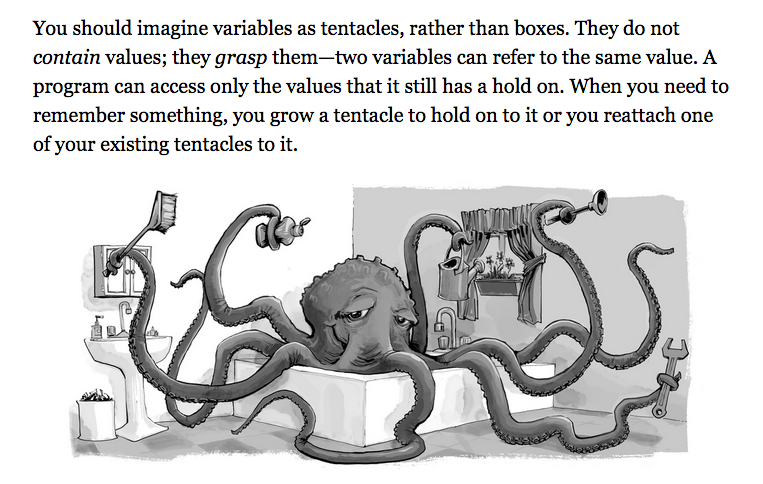
Values are stored in variables
JS
Variables
JS
Declaring a variable
var someNumber = 5;- var is reserved keyword
JS
- Prefix a statement with ' var ' to declare a variable
- Can change its value at anytime
- Equal sign is the assignment operator
Data Types
- Number
JS
- String
- Boolean
- Object
Some common data types are:
Let's look at a few data types ...
JS
Number
var someDecimalNumber = 3.1415926;- Values of the number type are numerical values
JS
- Can be a regular integer
- Can be a decimal number
String
var someString = "Some random text here";- Strings are used to represent text
JS
- Defined by enclosing string of text characters in quotes
- Can use " " or ' '
Boolean
        var aTruthyValue = true;
var aFalseyValue = false;- true and false are reserved words
JS
- Similar to the concept of 1 & 0
- true is different from "true"
Arrays (One Type of Object)
var someArray = [45, "bloop", true, null];- Allows you to store a sequence of values
JS
- It's a list of values stored between square brackets, separated by commas
- The values stored in the array can be of any data type
Arrays cont'd
     var someArray = [45, "bloop", true, null];
someArray[1] // returns "bloop"- Arrays are an ordered list of items
JS
- Each element in the array has an index position
- Index positions always start counting at 0
- Syntax: nameOfArray[indexPosition]
Arrays cont'd
     var someArray = [45, "bloop", true, null];
someArray.length // returns 4- To check how long an array is, check its length property
JS
- The length property returns how many elements are stored in the array
Time to try it yourself!
JS
Writing Basic Javascript Programs
JS
alert(''Hello");

console.log("Hello");
Producing Output:
NOTE - In the first example, the alert will only work if the code is being run from within a browser.
Writing Basic Javascript Programs
JS
var monthName = "June";

if (monthName == "June") {
  console.log("It must be summer");
}
Conditional Logic:
Conditional logic involves the use of expressions to evaluate statements that are true or false using operators:
==, <, >, >=, <=, !=
Writing Basic Javascript Programs
JS
var monthName = "July";
if (monthName == "June" || monthName == "July") {
console.log("It must be summer");
}
Conditional Logic:
Expressions can be combined using "OR", which is represented by double pipe characters ||
Writing Basic Javascript Programs
JS
var monthName = "July";
var currentYear = 2016;
if (monthName == "July" && currentYear == 2016) {
console.log("It must be summer of 2016!");
}
Conditional Logic:
Expressions can also be combined using "AND" which is represented by double ampersands &&
Writing Basic Javascript Programs
JS
var monthName = "July";
var currentYear = 2016;
if (monthName == "July" && currentYear == 2016) {
console.log("It must be summer of 2016!");
}
Conditional Logic:
JS and HTML (DOM)