Gamification = Enhanced Learning Experiences
Charlie Ball
Boise State University
2014 NMC Horizon Report
K-12 Edition
Games and Gamification

Time-to-Adoption: Two to Three Years
As pointed out in the Horizon Report, gamification has been a featured topic for several years, and yet it is still two to three years out as far as implementation in schools.
What is Gamification?
"The integration of gaming elements, mechanics, and frameworks into non-game situations and scenarios for training and motivational purposes" (Johnson, Adams Becker, Estrada, & Freeman, 2014).
Quest Based Learning
No more assignments with due dates, but rather "quests" or activities that students complete to earn "badges" or achievements.
Dr. Chris Haskell
"Blowing Up the Gradebook"
Quests
Experience Points (Grades)
Leader Boards (Competition)
Milestones/Levels (Scaffolding)
Badges (Concept Mastery)
(Lessons)
Example of Achievements
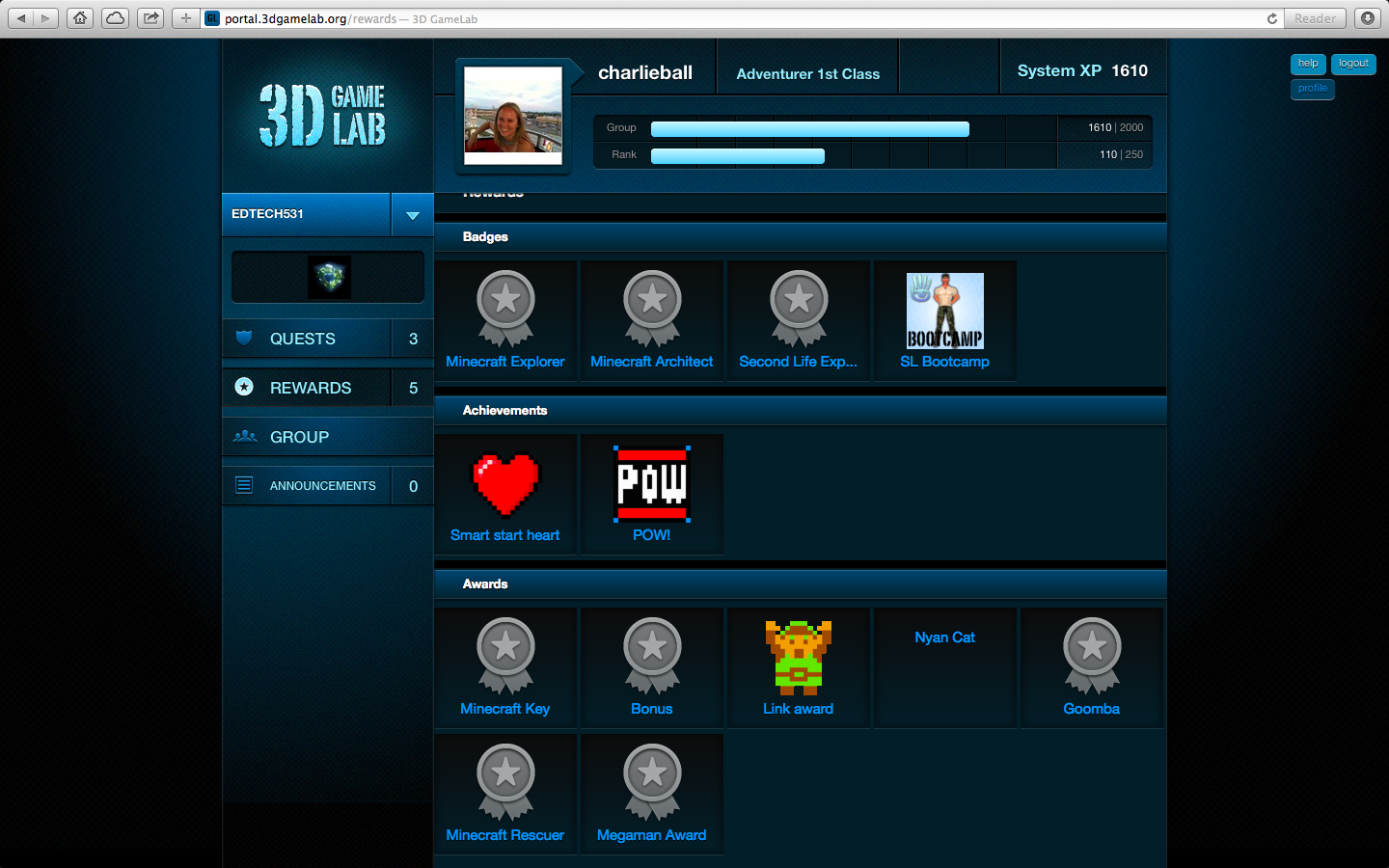
These lessons are created by teachers, and students perform tasks related to Common Core State Standards.
3D GameLab: Sample of Quests
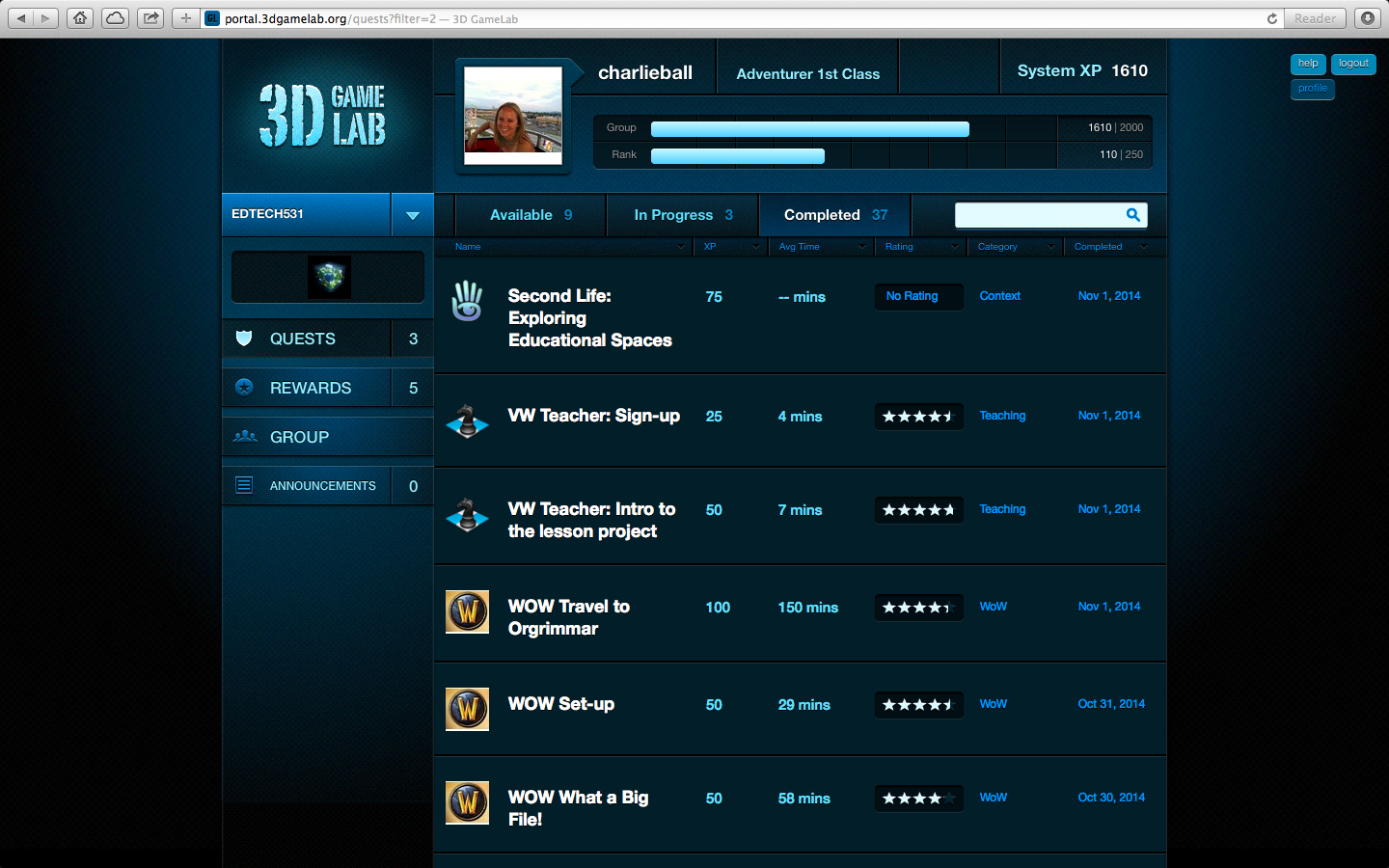
The 3D Game Lab Option
But why games?
Artistic
Social
Colaborative
(Johnson, Adams Becker, Estrada, & Freeman, 2014)
"A 2013 Accenture report highlighted the impact gamification will inevitably have as Generation Y, a demographic that is enthusiastic about online and social gaming, comes of age and enters the workforce" (Johnson, Adams Becker, Estrada, & Freeman, 2014).
Gaming Platform Options Available to Schools
-
Minecraft
-
Second Life
-
World of Warcraft
Why We Need to Adopt
Virtual Worlds
in the Bigfork School District
-
Student Engagement
-
Usability in the Classroom
-
Common Core Alignment
Jordan Shapiro, Game-Based Learning Expert
For more information, check out:
Student Engagement
Countless teachers who used game-based instruction tools and quests say their students are more engaged in learning.

https://d262ilb51hltx0.cloudfront.net/max/800/1*oDnX-qUoVDfGfJvQqR5RSg.jpeg
For example, in his article "Levelling the Playing Field: Engaging Disadvantaged Students Through Game-based Pedagogy" (2014), David Elliott describes a classroom of students in Australia who were behind grade-level on reading and writing, and through the use of Minecraft in the classroom, lessons were created which helped students re-focus and tune-in to the curriculum like never before.
Peggy Sheehy
World of Warcraft in School
Usability
Lessons are available for ALL classes of ALL ages.
This is not simply for use with one age-group, but something that can grow with the student as they progress. This also creates a great way for teachers to collaborate on units.
Accommodations are also available for students with disabilities.

http://degreedirectory.org/cimages/multimages/2/elementary-students-computer-laptop.jpg

http://education-portal.com/cimages/multimages/16/highschool-students-computer.jpg
Just A Sampling of Available Teacher Resources
-
3D GameLab Teacher Camps -
Minecraft:-
http://lessons4minecraft.com -
http://services.minecraftedu.com/wiki/Teaching_with_MinecraftEdu -
Multiple teacher blogs on how they use the program in their classrooms.
-
-
Second Life -
World of Warcraft
Common Core Alignment
A common fear is that students are simply "playing games", and parents and school districts often worry about student learning.

http://www.edutopia.org/sites/default/files/styles/share_image/public/slates/finley-CCIA-visual-literacy-Veer_0.gif?itok=_q0M3jK2
It is important to have parents see what students are doing online and to understand that these are not replacement to student learning. These Virtual Worlds are simply tools which help provide students with hands-on learning opportunities in a one-on-one environment much like tutoring.
"In every instance where a job or task has been gamified, results, productivity and involvement have improved" (Bolokhova & Nonkovic, 2014).
Why Bigfork? Why Now?
Again, gamification has been a featured topic in NMC's Horizon Report for several years, and while it is still two to three years out for implementation in most schools, Bigfork should be ahead of the game.
Let's get started!
References
Blowing up the gradebook. Retrieved from https://www.youtube.com/watch?v=atMlkVgzx-Y Bolokhova, E., & Nonkovic, Filip. (2014). A look at gamification: the shape of things to come. Parenting. Retrieved from http://www.parenting.com/blogs/mom-congress/elina-bolokhova-and-filip-nonkovic/gamification. Elliott, D. (2014). Levelling the playing field: Engaging disadvantaged students through game-based pedagogy. Australian Journal Of Language & Literacy, 37(2), 34-40. Johnson, L., Adams Becker, S., Estrada, V., and Freeman, A. (2014). NMC Horizon Report: 2014 K-12 Edition. Austin, Texas: The New Media Consortium. Peggy Sheehy-WOW in school: the hero's journey. Retrieved from https://www.youtube.com/watch?v=LFenJVg_4YM&feature=youtu.be Shapiro, Jordan. (2014). Here's why we need video games in every classroom. Forbes. 3D Gamelab-The power of quest based learning. (2013). Retrieved from https://www.youtube.com/watch?v=fwk0oCMWFzY
Image Credits
"Common core and digital literacy". Google Images. (2014). http://www.edutopia.org/sites/default/files/styles/share_image/public/slates/finley-CCIA-visual-literacy-Veer_0.gif?itok=_q0M3jK2

"Elementary students on computer". Google Images. (2014).  http://www.google.com/imgres?imgurl=&imgrefurl=http%3A%2F%2Fdegreedirectory.org%2Farticles%2FNew_Hands-on_Approach_for_Math_Education.html&h=0&w=0&tbnid=cZcjDUP4SiBaQM&zoom=1&tbnh=183&tbnw=276&docid=x4lUAODcgwnxXM&tbm=isch&client=safari&ei=nkdVVPT3E4-iyASU24LQBQ&ved=0CAQQsCUoAA

"High school students on computer". Google Images. (2014).  http://education-portal.com/cimages/multimages/16/highschool-students-computer.jpg

"Minecraft in the classroom". Google Images. (2014). https://d262ilb51hltx0.cloudfront.net/max/800/1*oDnX-qUoVDfGfJvQqR5RSg.jpe