Arrays and Hashing

What is an Array?
What is an Array?
An Array is a collection of items of the same data types with each item indexed starting with 0.
WHY ARE ARRAYS IMPORTANT ?

WHY ARE ARRAYS IMPORTANT ?
-
It’s one of the most popular and simple data structures and is often used to implement other data structures
-
Implementing data structures such as stacks and queues
-
Representing data in table and matrices
-
Creating dynamic data structures like linked list and trees
Accessing Array Index

Accessing Array Index
We access array index using square brackets notation
[...]
Example
cars = ["Ford", "BMW", "Honda"]

print(cars[0]) #Result: "Ford"

print(cars[1]) #Result: "BMW"

print(cars[2]) #Result: "Honda"
We have an array of length 3
Remember our computers count index from 0
Types of Arrays
There are different types of Arrays but we will be focusing on just two

Static Arrays
Dynamic Arrays
An array with a fixed size, meaning the number of elements is set when the array is created and cannot be changed later on.
Above we have an array of integers of fixed length 5
Only traversal can be performed.
int arr[5] = {1, 2, 3, 4, 5}STATIC ARRAYS
DYNAMIC ARRAYS
An array that can change in size during runtime
Above we have a dynamic array of integers
Traversal, Insertion and Deletion operations can be performed.
arr = [1, 2, 3, 4, 5].append()
INSERTION OPERATOR
Example
cars = ["Ford", "Volvo", "BMW"]

cars.append("Honda")

print(cars)

#Result

["Ford", "Volvo", "BMW", "Honda"]
Items are usually added to the ending of the arry
Time Complexity: O(1)
.pop()
DELETION OPERATOR
Example
cars = ["Ford", "Volvo", "BMW"]

cars.pop()

print(cars)


#Result

["Ford", "Volvo"]
Items are usually deleted from the end of the array
Time Complexity: O(1)
But that's not all for Deletion operator

We can also delete an Item at a particular index by passing the index at an argument to the operation
cars = ["Ford", "Volvo", "BMW"]

cars.pop(1)

print(cars)


#Result

["Ford", "BMW"]
Time Complexity: O(n)
where n is the index passed as argument
ARRAY ALGORITHMS

ARRAY ALGORITHMS
Remember what an Algorithm is ?
A step by step procedure to perform a specific task
ARRAY ALGORITHMS
We would be considering 2 types of task
SEARCHING and SORTING

Searching Algorithms
We have various types of searching algorithms in the real world
Some common ones include:
- Binary search
- Linear search
We would be looking more into them as we go on in this challenge
Sorting Algorithms
Same as searching, we have various types of sorting algorithms
Some common ones include:
- Bubble sort
- Quick sort
- Merge sort
We would be looking more into them as we go on in this challenge
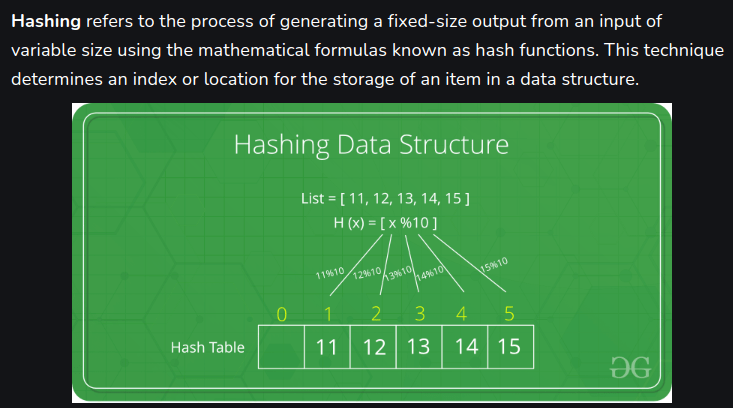
WHAT IS HASHING?
WHAT IS HASHING?
From geeksforgeeks
???

WHAT IS HASHING?
Hashing can be explained as giving a bunch of items different addresses for better locating and retrieving of these items later on
WHAT IS HASHING?
Hashing can be thought of as a process where each item in a collection is given a unique "index" or "address" based on a specific algorithm, known as a hash function. This index allows you to quickly locate and retrieve the item later on, making searching much faster.
Chat GPT
WHAT ARE HASH FUNCTIONS?
An Hash function is a function that maps out an address for a given item following a specific rule. This address (Key) mapped to the corresponding item (value) is what forms the
Hash map OR Hash table
TYPES OF HASH FUNCTIONS?
Hash functions are programmed based of requirements
Here we have some (3) popular hashing functions
Mid Square Method
Folding Method
Division Method
Structure of Hash Map or Table
| Hash value | Value |
|---|---|
Address
Value
Using the division method hash funtion
L = k mod x
Hash value (key)
any division number
item
Using the division method hash funtion
L = k mod x
Given an array [2, 3, 4]
Using 2 as divisor
1st iteration
2 mod 2 = 0
Hash map
| Hash value | Value |
|---|---|
| 0 | 2 |
2nd iteration
3 mod 2 = 1
Hash map
| Hash value | Value |
|---|---|
| 0 | 2 |
| 1 | 3 |
3rd iteration
4 mod 2 = 0
Hash map
| Hash value | Value |
|---|---|
| 0 | 2 |
| 1 | 3 |
The resulting hash value is 0, however there is already a value assigned to hash value 0
We have a problem

This is called Collision
Collision
A collision occurs when two different inputs produce the same hash value.

Collision
Collisions naturally happen in hashing because there are often more possible inputs (values) than there are available hash values.
More Examples Collision (2)
Two different keys, 'apple' and 'banana,' both being mapped to the same index in a hash table.
In a group of 13 people, at least 2 people would have the same birth month
Months of the year 12 (hash values) < group 13 (inputs)
Collision Resolution
Here we have some (3) popular collision resolution methods
Process of resolving collisions
Linear Probing
Quadratic Probing
Double Hashing
Using double Hashing to solve our division method problem

Double Hashing refers to running another hash function within the field with collision
Double Hashing
4 mod 2 = 0
| Hash value | Value |
|---|---|
| 0 | 2, 4 |
| 1 | 3 |
3rd iteration
Double Hashing
index mod 3 = hash value
| Hash value | Value |
|---|---|
| 1 | 4 |
| 2 | 2 |
[2, 4]
Hash map
Using 3 as divisor
Double Hashing
Finally we have our complete hash table as
| Hash value | Value |
|---|---|
| 1 | 4 |
| 2 | 2 |
Hash map
| Hash value | Value |
|---|---|
| 0 | |
| 1 | 3 |
Further Reading and Relevant Links
MIT 6.006 Introduction to Algorithms: Hashing
MIT 6.006 Introduction to Algorithms: Arrays
Tutorial Point Introduction to DSA: Hashing
Ready to solve Leetcode challenges on Arrays and Hashing ?

Thank you !!!!
