Math Review For Asymmetric Crypto
Divisibility
means a divides b:
for some c.
Examples:
Prime Numbers
A number p is prime if the only
numbers that divide it are 1 and p itself.
First few:
The most important thing about prime numbers is that they are building blocks of the integers.
Fundamental Theorem of Arithmetic
All numbers can be written uniquely as a product of prime numbers.
Examples:
This is not true when composite numbers are involved:
Greatest Common Divisor (GCD)
The GCD of two numbers is the largest number that divides both of them.
If the GCD is 1, the two numbers are said to be coprime or relatively prime.
Examples:
Calculating the GCD
can be done very efficiently,
even without knowing the factorizations
of the numbers themselves!
Solving
Given two integers a and b, the Euclidean algorithm will produce the GCD as well as two integers u and v that solve the above.
def egcd(a,b):
  """Extended GCD algorithm"""
  if b == 0:
    return (a, 1, 0)
  else:
    g, x, y = egcd(b, a%b)

  u = y
  v = x - (a/b)*y
  assert a*u + b*v == g

  GCD = namedtuple('GCD', 'gcd u v')
  return GCD(gcd = g, u = y, v = x - (a/b)*y)

print egcd(18,24)

$ python gcd.py
GCD(gcd=6, u=-1, v=1)Congruences: Modular arithmetic
means a - b is divisible by m.
Or: a and b differ only by a multiple of m.
Examples:
Addition and Multiplication mod p
The set of numbers mod p is often written
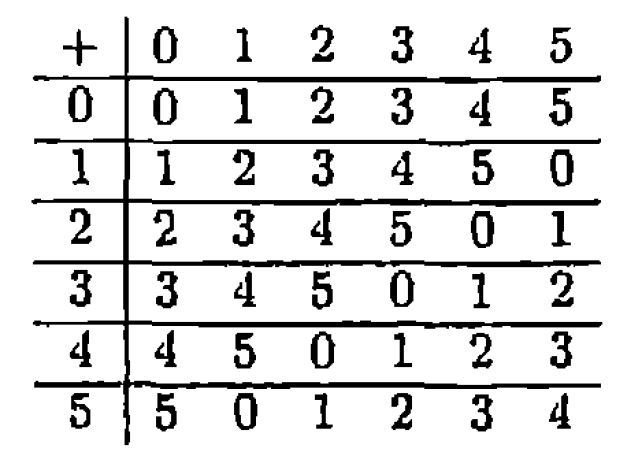
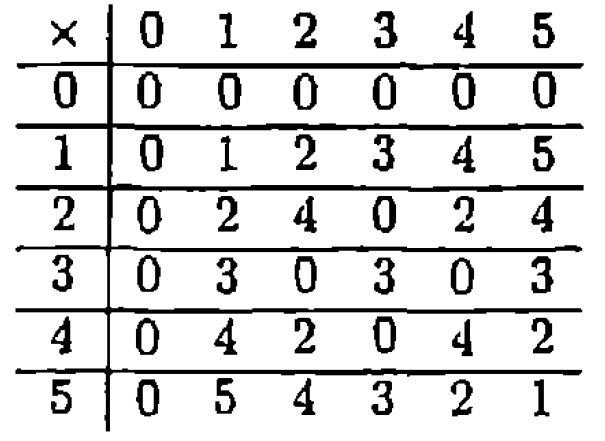
Addition in
Multiplication in
Division in
Let's say you want to solve for x:
This has a unique answer if and only if
Example:
Brute-force guessing gives:
Using the Euclidean Algorithm to find Inverses in
Thus 1583 and 7918 are coprime, and we can use Euclid's algorithm.
def invmod(a, m):
  assert gcd(a,m) == 1
  g = egcd(a,m)
  result = g.u
  # find the smallest positive solution
  while result < 0:
    result += m
  return result

$ python invmod.py
5277

>>> (5277 * 1583) % 7918
1Modular inverse example
Chinese Remainder Theorem
Suppose x = 25 mod 42.
This means x = 25 + 42*k for some integer k.
This means x = 25 + 6*(7k) = 25 + 6m for some m. So x = 1 mod 6. Also,
x = 25 + 7*(6k) = 25 + 7n for some n. So x = 4 mod 7.
The CRT says this process can be reversed if m and n are coprime.
Big numbers:
Modular exponentiation
In crypto, calculating these numbers raised to large powers happens all the time. Here's an example of the algorithm.
Let's calculate:
Notice how each subsequent term involves squaring the previous one (sometimes multiple times)
Write the exponent in binary.
Then reading the bits from right to left, you can build a table of intermediate products, taking mods at each step.
def expmod(g, A, m):
  bits = bin(A)[2:][::-1]
  a = []
  for i, bit in enumerate(bits):
    a.append(g%m)
    g = (g%m) * (g%m)

  res = 1
  for i, bit in enumerate(bits):
    res *= a[i]**(int(bit)) % m
    res %= m

  return res

print expmod(3, 218, 1000)

$ python expmod.py
489
"Fast Powering"
In Python, the "pow" function
does this for you, likely faster!
Fermat's Theorem
Here, p is a prime number, and doesn't divide a.
Example: let a = 2, and
Thus we know the number is composite!
(But no idea what its factors are)
Primitive Roots
Let
Thus 3 generates all the nonzero members of this set.
We call 3 a primitive root.
Public-Key Cryptosystem
In 1976, Diffie and Hellman came up with defined a PKC and trapdoor information.
Domain
Range
Easy!
Very difficult!
Easy, with some trapdoor information!
is a one-way function, easy to compute in one direction, very hard to invert without special information.
Are there truly one-way functions?
No one has concluded for sure that they exist. What we do have are several problems that people believe are very hard. Decades of trying to break them have failed--so far.
Two very common cryptosystems in use today depend on hard problems:
RSA: integer factorization problem
ECDH (Elliptic Curve Diffie-Hellman): discrete log problem (DLP)
Today we focus only on the DLP.
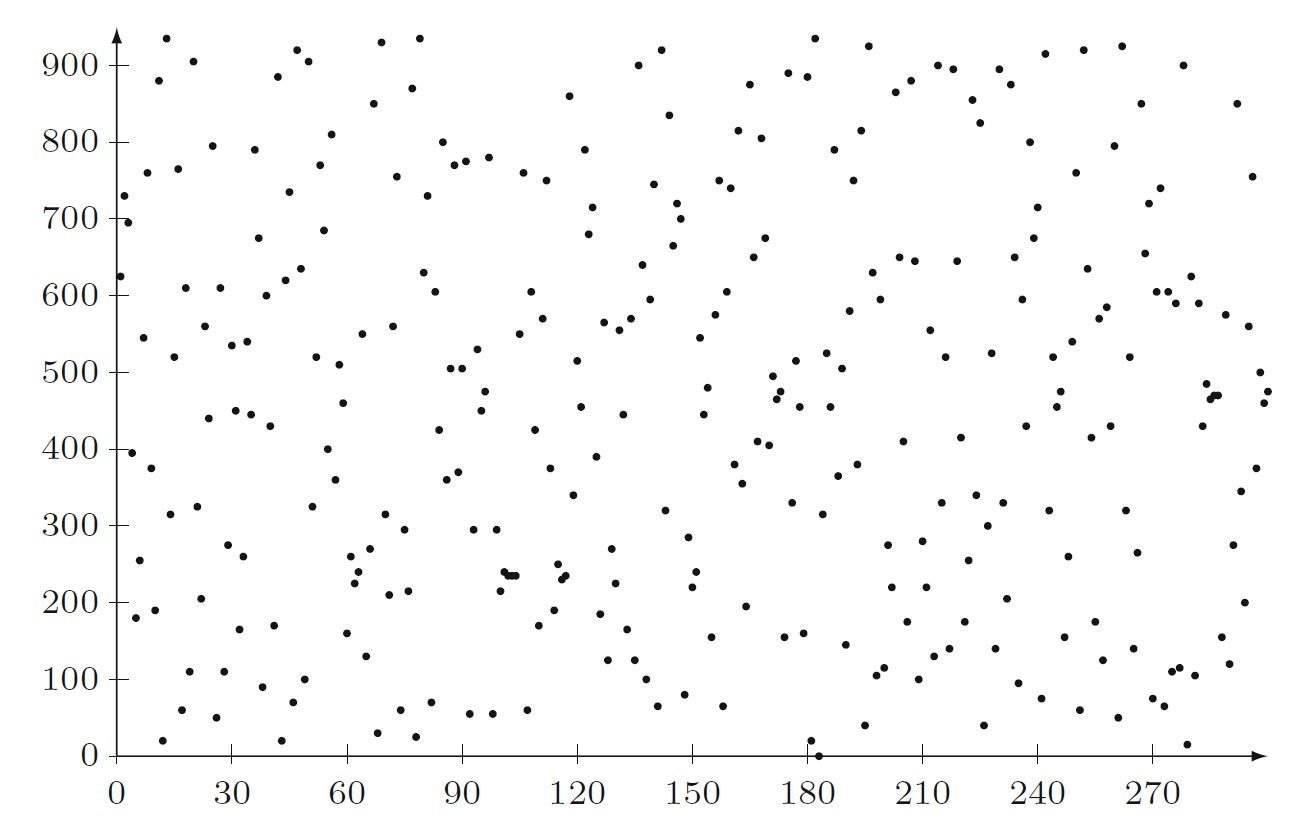
The Discrete Log Problem
Let p be a prime number. Then
Every element of
has an inverse, mod p.
You can prove that there is a primitive root g in this set. This means that g generates the set:
Let g be a primitive root for
Let h be an element of
Find x such that:
Discrete Logs Look Random
Diffie-Hellman Exchange
Step 0: Pick a (large) p and a primitive root g.
Step 1: Alice picks a secret integer a mod p and computes:
Step 2: Bob picks a secret integer b mod p and computes:
Step 3: Alice sends A to Bob. Bob sends B to Alice.
Step 4: Alice and Bob can compute a shared secret:
Eve's Hacking Challenge, mod p
She knows:
She wants:
This is the Diffie-Hellman Problem (DHP).
It is certainly no harder than the DLP.
If she solves the DLP (which is really difficult to solve) and gets a and b, she can solve the DHP.
If she solves the DHP, can she solve the DLP?
No one knows!
This problem is unfeasible to crack brute-force if
Key Exchange Example
Alice and Bob agree to use p = 941 and primitive root g = 627. This information is public. Even Eve knows it.
Alice chooses a secret key, 347. Bob chooses a secret 781.
Alice computes:
Bob computes:
Alice sends A to Bob. Bob sends B to Alice. Eve can see all this.
Alice and Bob can compute a shared secret key:
Breaking Lame Crypto: Pohlig-Hellman Theorem
The prime number you choose has to be very large, but that's not all.
Let's say p-1 factors into a product of "small" prime numbers.
Then for each small prime number r, I have a set of numbers:
generates
Eve gives this small generator to Bob, who computes a number
Now solve for each small factor.
Then stitch together x from all the x_i using the CRT!