Torture
Ivan Ricardo, Zi jing Zhao, Mimi Goetz, Alina Wilson, and Daniella Henao
What is torture?

“Any act by which severe pain or suffering, whether physical or mental, is inten- tionally inflicted on a person for such purposes as obtaining from him or a third person information or a confession, punishing him for an act he or a third person has committed or is suspected of having committed, or intimidating or coercing him or a third person, or for any reason based on discrimination of any kind, when such pain or suffering is inflicted by or at the instigation of or with the consent or acquiescence of a public official or other person acting in an official capacity”.
The United Nations General Assembly
SYmbolic interaction Theory
(Shibutani, 1961)
Theory analysis of what motives an individual to torture during wartime, according to Shibutani’s Symbolic Interaction Theory (1961) .
Impulse
“I” feelings, initial emotional reaction that affects the process of thinking.
Ex. “I” don’t want to dress weird to class.
Applied - to extract information to protect the US and its soldiers from terrorist harm.
Perception
What you selectively notice from your perspective. How you interpret the situation.
Applied - The prisoners in detention want to hurt America and have information that could prevent future attacks.
Manipulation
Trial and error in one’s mind, trying out different options to find the best possible outcome.
Applied - thinking through the outcomes of torture; protect troops and American’s at home, gain acceptance from fellow interrogators and soldiers.
Consummation of the Act
Actually committing the act and taking the decided action.
Applied - Interrogator tortures to follow orders, assumes it’s legal after getting green light from authority figures.
People try to please their reference groups to enhance their self esteem.
Reference Groups for this situation may include the American Public, fellow soldiers and workers, people in Iraq/Afghanistan and authority figures, ie commanding officers.
Dehumanizing the victim and viewing them as the enemy (other), helps the torturer dissociate from the act they are committing.
People operate based on their self image, which is comprised of their:
1. Self-concept (the roles they see of themselves)
ex, soldier who follows orders and wants to protect country
2. Self evaluation, which is how the subject evaluates their actions from the perspective of the generalized other.
Social construction of reality
(Berger & Luckmann)
Def; A phrase influenced by Peter L. Berger and Thomas Luckmann that states a person or group interacting in a social system create, over time, concepts or mental representations of each other's actions, and that these concepts eventually become habituated into reciprocal roles played by the actors in relation to each other.
THE “TORTURE MINDSET” IS ONE UNIVERSALLY RECOGNIZED BUT NOT SPOKEN WHEN A PERSON OR A GROUP COMMITS THE ACT OF TORTURE, AND ACCORDING TO THIS THEORY, BECAUSE PEOPLE COMMIT TORTURE, THEY ARE RESPECTED BY THEIR PEERS BECAUSE THEY ARE DOING WHAT IS EXPECTED OF THEM.
FUnctionalist theory
What is functionalism?
According to functionalism, society is a system of interconnected parts that work together in harmony to maintain a state of balance and social equilibrium for the whole.
Functionalists use the terms functional and dysfunctional to describe the effects of social elements on society. Elements of society are functional if they contribute to social stability and dysfunctional if they disrupt social stability
Functionalists believe in a socially constructed reality "created" by the government and those in power, that results in citizens believing that Torture in necessary and can be moral.
The tragedy of the events of 911, revived the discussion regarding the justification for torture.
Bush connected post-9/11 torture program practices with an ideological position that justified torture as moral, just, and necessary.
In a speech after the 911, Ex President Bush, described how information found by torturing prisoners, led to the capture of other suspected Al Qaeda and Taliban member and to foiling planned attacks on the U.S. and its allies.

“We watched the Twin Towers collapse before our eyes—and it became instantly clear that we'd entered a new world, and a dangerous new war” - The Bush Military Commissions Speech
“ This intelligence— this is intelligence that cannot be found any other place. And our security depends on getting this kind of information. The Bush Military Commissions Speech
A quiz done in an ethics class in a university less than one week after The Bush Military Commissions speech shows that many students favored the statements “execution sight”and “torture them”.
The concept of "justifiable" torture was also elaborated, constructed, and made familiar to us by television shows like 24, Alias, Lost, The Unit, and others.
Who owns those tv channels and produces the tv shows?
By practicing torture, The United States sent a message to the rest of the world that if you "mess" with this country you could also be hardly punished.
Title Text
Scheff’s Theory of Emotional Distancing
-
Emotional Distancing and defense mechanisms
-
Under distanced, Esthetic distance, and Over distanced
-
Under distanced: “Total immersion in emotional experience” and out of control
-
Esthetic distance: Maintaining self control
- Over distanced: Far away from emotional experience; feeling no emotions
-
The emotional distance depends on the reference group and situation
-
The U.S interrogators most likely feel over distanced when they are torturing terrorists in order to repress any feelings of guilt or emotions
-
The terrorists are feeling under distanced when being tortured because they are overwhelmed by their emotions and unable to maintain self control
- The American public most likely feels slightly under distanced when exposed to the type of torture tactics that the U.S has been using against terrorists because of the disturbing content
-
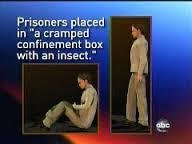
One of the torture tactics used by the Bush administration was “Cramped Confinement and Insects Placed In a Confinement box”
“You would like to place Abu Zubaydah in a cramped confinement box with an insect. You have informed us that he appears to have a fear of insects. In particular you would like to tell Zubaydah that you intend to place a stinging insect into the box with him. You would however place a harmless insect in the box (...) he may be placed in this box for up to eighteen hours at a time.”