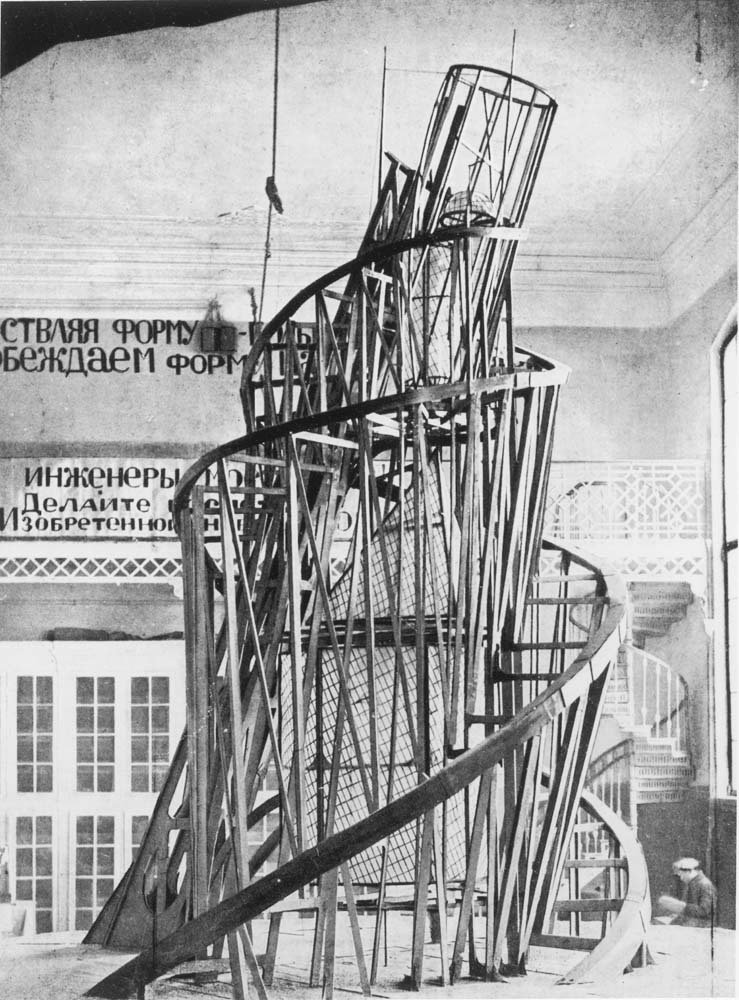
A Zodical man's challenge to Tatlin's materialism
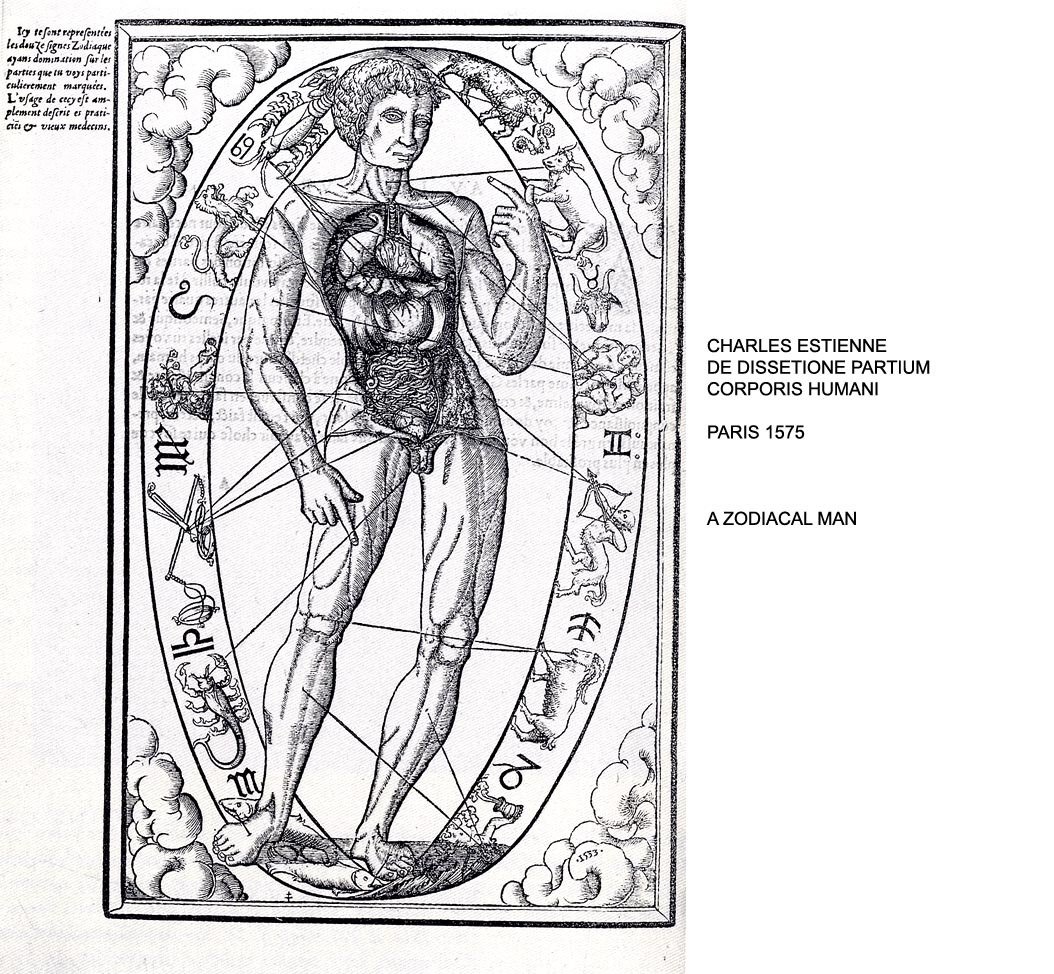
Plus: the irredeemable uselessness of art....
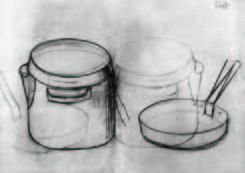
Artist uses form to make harmony. engineer - uses form for construction. artist reproduces nature and delights in it, engineer wages in continual battle with it. Malevich. Non-Objective World
Art has once again met the figurative world of motors and machines, the world of technology, which it must destroy as it did the figurative world of academic arts, and only then will come the true form of the new world. Malevich, 1921
Some definitions from wikipedia:
Constructivism was an artistic and architectural philosophy that originated in Russia beginning in 1913 by Vladimir Tatlin. This was a rejection of the idea of autonomous art. He wanted 'to construct' art. The movement was in favour of art as a practice for social purposes. Constructivism had a great effect on modern art movements of the 20th century, influencing major trends such as the Bauhaus and De Stijl movements. Its influence was pervasive, with major effects upon architecture, graphic design, industrial design, theatre, film, dance, fashion and to some extent music.
Some definitions from wikipedia:
Materialism is a form of philosophical monism which holds that matter is the fundamental substance in nature, and that all phenomena, including mental phenomena and consciousness, are results of material interactions.
— Friedrich Engels, Socialism: Scientific and Utopian:
The materialist conception of history starts from the proposition that the production of the means to support human life and, next to production, the exchange of things produced, is the basis of all social structure; that in every society that has appeared in history, the manner in which wealth is distributed and society divided into classes or orders is dependent upon what is produced, how it is produced, and how the products are exchanged. From this point of view, the final causes of all social changes and political revolutions are to be sought, not in men's brains, not in men's better insights into eternal truth and justice, but in changes in the modes of production and exchange. They are to be sought, not in the philosophy, but in the economics of each particular epoch.
My presentation is guided by two question, which I want to pose now and return to:
1. Revolution as a cycle versus revolution as evolution: when a materialist philosophy spreads to territories beyond the machine to the physical body and nature, celestial body, etc, are there challenges to Soviet materialist notion of progressive time that emerge?
2. To which extent is Constructivism - as implementations of functional, efficient principles to cultural production, inherently flawed by the resistance of art to utility? An artist will always be a bad engineer, no?
Failures of Constructivism:
Lodder: historical circumstance
Wood: betrayal of revolution by regime
Groys: not failure! avant-garde totalitarianism culminates in Stalinism
Theory in Practice: Biomechanics- an actor training program
definition: the study of the mechanical laws relating to the movement or structure of living organisms.
- Movement-centered system of actor training developed by V. Meyerhold between 1913 and 1922
- Expression in movement (motor function) automatically lead to emotions
- Art as struggle with material
- Precision, coordination, attention
- Stylized exaggeration
- Taylorism on stage: performance of efficiency and expediency
- The body is a machine, the actor is the machinist
- Industrialized gesture, gesture of labour
- The work of the actor in an industrial society will be regarded as a means of production vital to the proper organization of the labour of every citizen of that society.
Exercises with Sticks
- stand up
- pick a light, stick-like object
- consider it as liberated object, a comrade
- hold your object in front of you
- no emotion/all body
Throwing a Stone
- occupy a space in the room
- imagine a stone in your hand
- consider the space around as a composition
- be aware of own motor functions
- try to use the entirety of the room
- be aware of the bodies of others
- pause in stylized way in between movements to listen for instructions
- 2 times: once with instruction, second from memory.
Count to 5 silently. Start Over sans from body memory