Australia
BASIC FACTS
index
-
Location
- People
- Physical Features( any land forms)
- Climate
- Flora(plants & trees)/Fauna(animals)
- Tourist attractions
- Uniqueness
- Facts
Location
PEOPLE
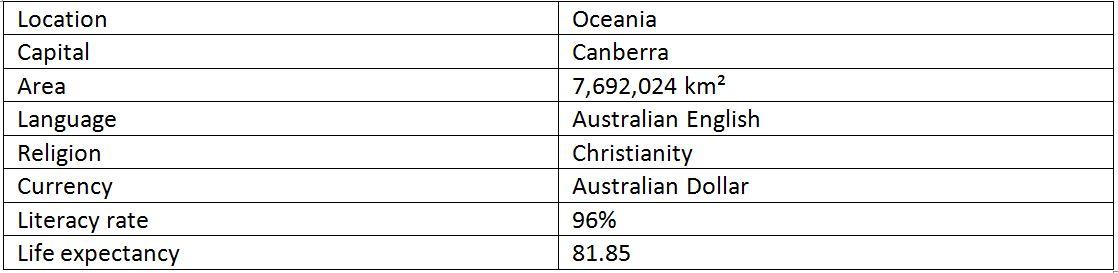
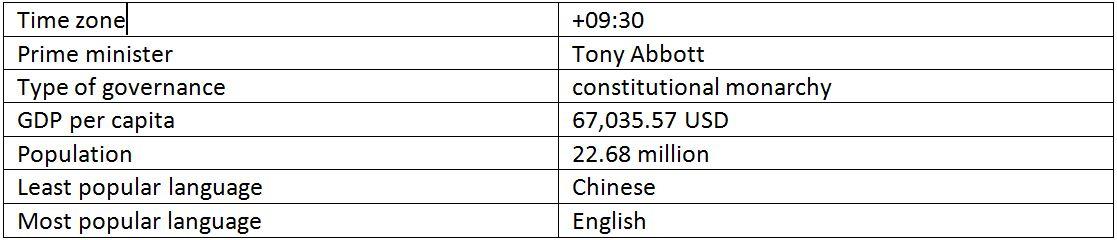
The people in Australia are well-known for their attitude towards their lives.The people of Australia believe in living their life to the fullest. It is this motivation which makes Australians a fun loving, courageous, talented, devoted and an adventurous nation. The Australians are also known for their patriotism.
Before the arrival of British colonisers in 1788, Australia was inhabited by the Indigenous peoples, referred to as the First Australians. Aboriginal people inhabited the whole of Australia and Torres Strait Islanders lived on the islands between Australia and Papua New Guinea, Today, Indigenous people make up 2.4 per cent of the total Australian population (about 460,000 out of 22 million people).
Physical features
lets see them!!
Eastern Highlands
Central Lowlands
western plateau
The Western Plateau is a low, flat area that has been eroded over a period of millions of years. Nullarbor comes from the Latin terms null, which means 'no', and arbor, means 'tree.' As the Nullarbor Plain is covered in limestone which was once a sea floor. Today, many fossilised sea creatures can be found here. Due to cold water currents off the coast of Western Australia, its very dry. Some of the deserts are Gibson, Tanami, Canning, Great Sandy . These monoliths came into being when soft rocks surrounding them were eroded.
Flora
fauna
There are three types of Australian mammals, which are animals that usually give birth to live young and feed their young with milk: monotremes, marsupials and placental mammals. Of the 238 species of mammals living in Australia, 144 are marsupials, and 90 percent of these are endemic to Australia. There are three types of Australian mammals, which are animals that usually give birth to live young and feed their young with milk: monotremes, marsupials and placental mammals. Marsupials are mammals that give birth to largely-undeveloped young.
unique organisms
Firstly, since the temperatures on the continent remained constant for such a long period of time, plants and animals were able to evolve and adapt to particular ecological conditions.The Australian continent is located on the Indo-Australian Plate, which includes the surrounding Indian Ocean and the Indian subcontinent.Secondly, the continent was so isolated that it was impossible for outside species to arrive, allowing native forms to develop unimpeded.The Indo-Australian Plate was originally connected to Gondwanaland before it began to drift north some 96 million years ago. As the Australian continent drifted north it developed unique flora and fauna. Many of the animals found here in Australia are very similar to the animals that were found long ago on Gondwanaland.
Climate
The northern states typically experience warm weather much of the time, with the southern states experiencing cooler winters. Australia experiences temperate weather for most of the year but the climate can vary due to the size of our continent. Like all countries in the southern hemisphere, Australia's seasons are opposite to those in the northern hemisphere. December to February is summer; March to May is autumn; June to August is winter; and September to November is spring.
tourists attractions
RED CENTER
- Uluru is located on a major planetary grid point much like the Great Pyramids in Egypt, these grid points act as a central power station of energy.
GREAT OCEAN ROAD
The Great Ocean Road is an Australian National Heritage listed 243 kilometers (151 mi) stretch of road along the south-eastern coast of Australia between the Victorian cities of Torquay and Allansford.
KAKADU
- Kakadu National Park is listed as a World Heritage Area (listed in 1992) and as a UNESCO site. There are only two other sites in the world that hold both awards. Kakadu is one of the few World Heritage Areas that are listed for both their natural and cultural heritage. 683'000 hectares of Kakadu wetlands are listed as Ramsar protected wetlands of international importance.
THE KIMBERLEY
- Kimberley was founded in 1871 when diamonds were discovered on a
nearby farm named Vooruitzicht (owned by the De Beers brothers). The
town was also known as New Rush before it was renamed to Kimberley
(after then British Secretary of State for the Colonies Lord Kimberley).
KANGAROO ISLAND
Kangaroo Island is one of Australia's great scenic treasures and a must for anyone interested in travel to wilderness destinations.
Located 110 km (70 miles) south-west of Adelaide and easily accessible by Ferry or Plane. A mix of attractive small townships and fascinating wilderness; Kangaroo Island is Australia's third largest island.
BYRON BAY
Cape Byron is Australia's most easterly point, 153° 39´ east, located on the north coast of New South Wales (see map of Australia below). With its numerous beaches, unspoilt hinterland, and relaxed lifestyle, Byron Bay is a popular tourist destination.
With average summer temperatures of 21C - 28C, and average winter temperatures of 15C - 21C, both locals and visitors are able to enjoy plenty of outdoor activities including the many festivals throughout the year.
TASMANIAN WILDERNESS
Covering an area of over 1 million hectares, the Tasmanian Wilderness constitutes one of the last expanses of temperate rain forest in the world. It comprises a contiguous network of reserved lands that extends over much of south-western Tasmania including several coastal islands.
AUSTRALIAN ALPS
Australian Alps, mountain mass, a segment of the Great Dividing Range (Eastern Uplands), occupying the south easternmost corner of Australia, in eastern Victoria and southeastern New South Wales. In a more local sense, the term denotes the ranges on the states’ border forming the divide between the watersheds of the Murray River system, flowing west, and the Snowy and other streams flowing southeastward directly to the Pacific.
NINGALOO
The Ningaloo is a 280 km long 'fringing' coral reef skirting the Cape Range karst limestone peninsular, mid way up the West Australian coastline, 1200km north of Perth. Ningaloo Reef is the longest western fringing coral reef and one of the last healthy major coral reef systems in the world.
- Whale sharks, the world's largest fish, gather in the reef waters each year and depend on the reef for part of their life cycle. Eco-tour operators take thousands of people swimming with these gentle giants every year.
FLINDERS RANGES
The Flinders Ranges National Park is one of South Australia's most popular destinations. This area is world-renowned for its geological history, Aboriginal rock art sites, impressive fossil remains and its ruins of early European settlement.
FREYCINET
A peninsula of pink granite mountains, pure white beaches and turquoise sea in Freycinet National Park.
Capture the perfect contours of Wineglass Bay on your camera. Then swim, boat, fish, snorkel and scuba dive from the dreamy white beach. Go abseiling in the Hazards and four wheel drive to Cape Tourville Lighthouse, where the view will make you dizzy.
GIPSLAND
The Gippsland region is located in the south-east of Victoria. It extends from the edge of Melbourne’s Metropolitan Region in the region’s west, eastwards to the New South Wales border, with the northern boundary formed by the edge of alpine country, with the coastline and Wilsons Promontory comprising its southern border.
BLUE MOUNTAINS
The Blue Mountains is a mountainous region in New South Wales, Australia. It borders on Sydney's metropolitan area, its foothills starting about 50 kilometres (31 mi) west of the state capital.
NAMADGI NATIONAL PARK
Explore Namadgi National Park in the Australian Alps - a world of silent bushland, breathtaking vistas and rich Aboriginal history just a 45 minute drive from Canberra.
Climb or abseil the granite rock outcrops, mountain bike along the fire trails or bushwalk into the Bimberi wilderness. Explore the campsites, ceremonial stone arrangements and rock art sites left by the Ngunnawal people more than 21,000 years ago. Then trace the trail of pastoralists and gold hunters.
uniqueness
Australia is a very unique and diverse continent that is an island and consists of one nation. Because of Australia’s long geographic isolation it has resulted in an exceptional variety of plant and animal life. Most of these are found nowhere else in the world. Its uniqueness is due to its flora and fauna which are native to Australia. The flora in Australia is truly amazing. Australia has a wide range of flora, like bottle brushes, waratahs, and eucalyptus trees. Its flora is very important for the habitat and food of its fauna. These plants definitely contribute to its colourful and beautiful environment. As for its fauna, it is important to Australia in keeping them safe.Something important.....
The current structure and performance of the main industrial components of the Australian economy, and their relative contribution to overall economic activity, are described in terms of the value of production and employment by industries. Statistics are also provided on the growth of industries over the past ten years and the changing contribution of individual industries to total economic activity during the period.
facts
- landforms were made due to uplifting, folding and volcanic processes in the Earth's crust.
- Australia's tallest mountain is found in the Eastern Highlands. It is Mount Kosciuszko, which is found in New South Wales in the Australian Alps. Mount Kosciuszko stands at 2228 metres (m), which is less than half the height of the tallest mountain found in Europe
- When it is full of water, Lake Eyre is the largest lake in Australia. The lake, however, only had water in it three times in the 20th century. Lake Eyre is also the lowest point at 15 metres below sea level.
- The Western Plateau is also home to many deserts. Due to cold water currents off the coast of Western Australia, this region is very dry.
- trees found in Australia include casuarinas, which grow on riverbanks, and mulgas, which are found in areas that have unreliable rainfall.
- In one square kilometre of land in the centre of Australia, more reptile species can be found than in a square kilometre in any other place in the world.
- Two of the world's three species of monotremes are found only in Australia, the duck-billed platypus and the short-beaked echidna.