Software Craftsmanship
OOP Crash Course
October 11, 2016
Object Oriented Programming
self-sustainable objects.
There are 4 core OOP concepts:
- Encapsulation
- Abstraction
- Inheritance
- Polymorphism
We are going to focus on the first two core concepts in this section.
Encapsulation is a simple concept; it's the black box that contains all of the internal implementation details. There are multiple scopes that can be encapsulated but for this class we will focus on class level encapsulation.
What are the primary goals of encapsulation?
- Reusable code to reduce development times and improve maintainability
- The ability to alter your program with minimal side effects
Encapsulation Example
Is the a good or bad example of encapsulation?
public class Point1 {
    public double x;
    public double y;
}
Remember the primary goals of Encapsulation are.
- Reusable code to reduce development times and improve maintainability.
- The ability to alter your program with minimal side effects.
How about this?
Is the a good or bad example of encapsulation?
public class Point2 {
    double getX();
    double getY();
    void setLocation(double x, double y);
}
Or this?
Is the a good or bad example of encapsulation?
public class Point3 {
    double getX();
    double getY();
    void setCartesian(double x, double y);
    double getR();
    double getTheta();
    void setPolar(double radius, double theta);
}
You can go from example 2 to example 3 without performing "Shotgun Surgery".
An association is simply a reference to another object.
class Class1 {
	private Class2 class2Instance;

	public Class1() {
		this.class2Instance = Class2();
	}
}
-
Aggregation is when Class A has a reference to Object B and Object B is able to exist outside Class A.
Composition
-
Composition is when Class A has a reference to Object B, but Object B is tied to the life cycle of Class A.
A Quick Quiz
Composition or Aggregation?
class Customer
{
	private Account account;

	public Customer()
	{
		this.account = new Account();
	}
}
Composition
A Quick Quiz
Composition or Aggregation?
class Customer
{
	private Account account;

	public Customer(Account account)
	{
		this.account = account;
	}
}
Aggregation
Aggregation
Aggregation provides references to objects you have no control over.
Aggregation
Aggregation
When is aggregation appropriate?
- When the state of the aggregated object is immutable or irrelevant.
Thoughts on Aggregation
Often times people will use aggregation to reduce boiler plate and prevent continually passing around variables.
class Request {
    public Dispatcher dispatcher;

    public Request(Dispatcher dispatcher) {
        this.dispatcher = dispatcher;
    }

    public send() {
        this.dispatcher.send(this.headers, this.body, this.timeout);
    }
}
class Request {
public send(final Dispatcher dispatcher) {
dispatcher.send(this.headers, this.body, this.timeout);
}
}Thoughts on Aggregation
Pros/Cons?
-
-
Example 2 is deterministic
Composition
Composition provides references to objects you have complete control over.
Composition
What are the pitfalls of composition?
- Classes become tightly coupled
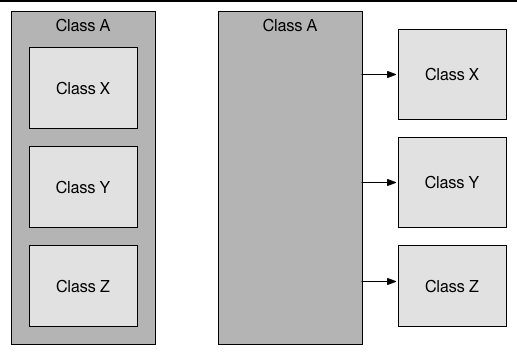
Composition
Abstraction
Wikipedia
Abstraction vs Encapsulation
How is Abstraction different from Encapsulation?
- Encapsulation hides internal details
- Abstraction reduces complexity
Abstract Classes
public abstract class LoggerBase {

  protected LoggerBase() {
    logger = log4net.LogManager.GetLogger(this.LogPrefix);
    log4net.Config.DOMConfigurator.Configure();
  }

  protected void LogError(string message) {
    if (this.logger.IsErrorEnabled) {
      this.logger.Error(message);
    }
  }
}
Interfaces
public interface ILogger
{
  bool LogError(string message)
}
Abstract Classes vs Interfaces
- Abstract Classes can define default behaviors and can influence the the design of their sub classes.
- Interfaces allow true plug and play interchangeability.
To summarize, abstract classes are for creating extensible systems. Interfaces are for ensuring behaviors.
Commons Collection Example
public class LRUMap<K, V> extends AbstractLinkedMap<K, V>
        implements BoundedMap<K, V>, Serializable, Cloneable {
    /**
    * A <code>Map</code> implementation with a fixed maximum size which removes
    * the least recently used entry if an entry is added when full.
    */
}

public abstract class AbstractLinkedMap<K, V>
        extends AbstractHashedMap<K, V> implements OrderedMap<K, V> {
}

public interface BoundedMap<K, V> extends IterableMap<K, V> {
    boolean isFull();
    int maxSize();
}

public interface OrderedMap<K, V> extends IterableMap<K, V> {
    boolean firstKey();
    int lastKey();
    K nextKey(K key);
    K previousKey(K key);
}
To Simplify
- Abstract classes contain shared code
- Interfaces enforce behaviors
- Base classes are the implementation of a specific use case
What about interfaces that allow implementations?
public interface A {
    default void foo(){
       System.out.println("Calling A.foo()");
    }
}

public class Clazz implements A {
}
OOP Exercise
http://bit.ly/2e4iJFW
- Abstract classes contain shared code
- Interfaces enforce behaviors
- Base classes are the implementation of a specific use case
And remember!
Imperative Programming
"In computer science, imperative programming is a programming paradigm that uses statements that change a program's state. In much the same way that the imperative mood in natural languages expresses commands, an imperative program consists of commands for the computer to perform." - Wikipedia
Functional Programming
"In computer science, functional programming is a programming paradigm—a style of building the structure and elements of computer programs—that treats computation as the evaluation of mathematical functions and avoids changing-state and mutable data." - Wikipedia
Advantages of Functional Programming
(According to Microsoft)
-
Increased readability and maintainability. This is because each function is designed to accomplish a specific task given its arguments. The function does not rely on any external state.
-
Easier reiterative development. Because the code is easier to refactor, changes to design are often easier to implement. For example, suppose you write a complicated transformation, and then realize that some code is repeated several times in the transformation. If you refactor through a pure method, you can call your pure method at will without worrying about side effects.
-
Easier testing and debugging. Because pure functions can more easily be tested in isolation, you can write test code that calls the pure function with typical values, valid edge cases, and invalid edge cases.
(According to John Carmack)
-
-
Reusability. It is much easier to transplant a pure function to a new environment. ... How many times have you known there was some code that does what you need in another system, but extricating it from all of its environmental assumptions was more work than just writing it over?
-
Easier testing and debugging. Because pure functions can more easily be tested in isolation, you can write test code that calls the pure function with typical values, valid edge cases, and invalid edge cases.
So What is Functional Programming?
Functions have to abide by two rules
- There are no side effects
- The same input results in the same output
A program that never alters state is probably not doing anything worth doing. Databases, file systems, etc... are never going to be deterministic. This is fine, the functional ideal is to compose stateless data capable of describing the transformation and then applying it all at once.
Collections Example
Imperative Collection
list = NewList();
list.Add(1)
list.Add(3)
list.Add(5)
list.Add(7)
Functional Collection
list = NewList();
list = list.add(1)
list = list.Add(3)
list.Add(5)
list = list.Add(7)[1,3,5,7]. The state of list changes each time add is called.
[1,3,7]. The list is overwritten each time the internal state never changes.