Power index-Based Ranking–Semantics

Master degree in Computer Science
Candidate
Francesco Faloci
Advisors
Stefano Bistarelli
Francesco Santini

Power index-Based Ranking–Semantics
AAF
Voting Games
Ranking Semantics
Power index-Based Ranking–Semantics - Argumentation
- Ranking Semantics
- Power Indexes
- PI based Ranking-Semantics
Power index-Based Ranking–Semantics
- Argumentation
- Ranking Semantincs
- Power Indexes
- PI based Ranking-Semantics
Argumentation

Argumentation
-
Bob: «I want to go soccer»
-
Alice: «I want to go to the theater»
-
Bob: «My ex-girlfriend is in the theater»
- Alice: «You have not an ex-girlfriend»
Argumentation
«I want to go soccer»
«I want to go to the theater»
«My ex-girlfriend is in the theater»
«You have not an ex-girlfriend»


Argumentation
Abstract Argumentation Framework [1]
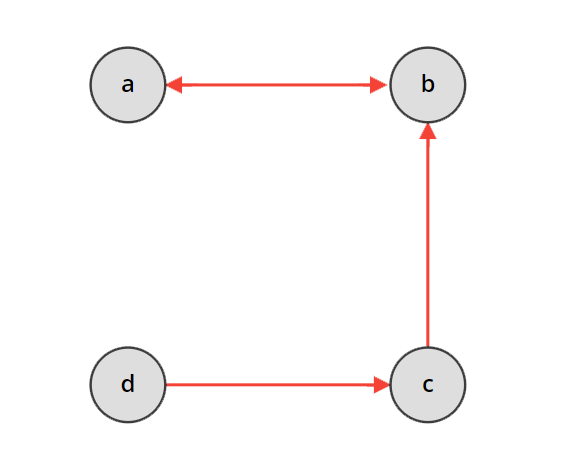
A: { a, b, c, d }
R: { (a,b), (b,a), (c,b), (d,c) }
Argumentation
Abstract Argumentation Framework
A: { a, b, c, d }
R: { (a,b), (b,a), (c,b), (d,c) }


Argumentation: Sets
-
Conflict-free
{} {a} {b} {c} {d} {a c} {a d} {b d}
-
Admissible
{} {a} {d} {a d} {b d}
{} {a} {b} {c} {d} {a b} {a c} {a d} {b c} {b d} {c d}
{a b c} {a b d} {a c d} {b c d} {a b c d}
Argumentation: Semantics
-
Complete
{d} {a d} {b d}
-
Preferred
{a d} {b d}
-
Stable
{a d} {b d}
-
Grounded
{d}
{} {a} {b} {c} {d} {a b} {a c} {a d} {b c} {b d} {c d}
{a b c} {a b d} {a c d} {b c d} {a b c d}
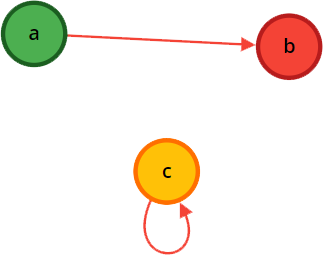
Argumentation: Labelling
Another Method to express acceptability of argument
- ∀ a, b ∈ A, a ∈ in(L) only if (b,a) ∈ R and b ∈ out(L)
- ∀ a, b ∈ A, a ∈ out(L) only if (b,a) ∈ R and b ∈ in(L)
- ∀ a ∈ A, if a ∉ in(L) and a ∉ out(L), then a ∈ undec(L)
Argumentation: Labelling
Power index-Based Ranking–Semantics
- Argumentation
- Ranking Semantics
- Power Indexes
- PI based Ranking-Semantics
Ranking Semantics

Ranking Semantics
d ≻ a ≻ c ≻ b
Ranking Semantics
Bbs and Dbs, Categorize function, Tuples, functions, Matt & Toni... [2]
- Focus on attacks between arguments
- Do not consider Dung's semantics
Power index-Based Ranking–Semantics
- Argumentation
- Ranking Semantics
- Power Indexes
- PI based Ranking-Semantics
Power indexes
Amaranth
Blue
Canary
36%
40%
17%
Voting Game!
Desert
11%
Power indexes
let's try the... Shapley Value [3]
SV (A) = 1,25
B ≻ A ≃ C ≻ D
-
if a coalition S reaches the 51% it values 1, 0 otherwise
-
we consider only minimal coalition: not the whole set
-
coalitions (A,B), (A,C), (B,C), (B,D) and (A,C,D) are minimal winning
A > C A ≻ C
A: 36%
C: 17%
SV (B) = 1,5
SV (C) = 1,25
SV (D) = 0,75
Power indexes: Shapley Value
We used the characteristic function defined on the coalition S that contains the agent i, as following:
... the Shapley Value formula for all the agents (i) as following:
Power indexes: MORE Indexes
Banzhaf Power Index [4]
Deegan-Pakel Index [5]
Johnston Index [5]
Power index-Based Ranking–Semantics
- Argumentation
- Ranking Semantics
- Power Indexes
- PI based Ranking-Semantics
PI Ranking–Semantics
A ⇒ agents
⇒ coalitions
{1} {2} {3} {4}
Conflict-free, Admissible, Complete, Preferred, Stable, Grounded
PI Ranking–Semantics
Characteristic Function(s)
Given a Dung semantics and the set of all possible labellings on F satisfying , we define:
PI Ranking–Semantics
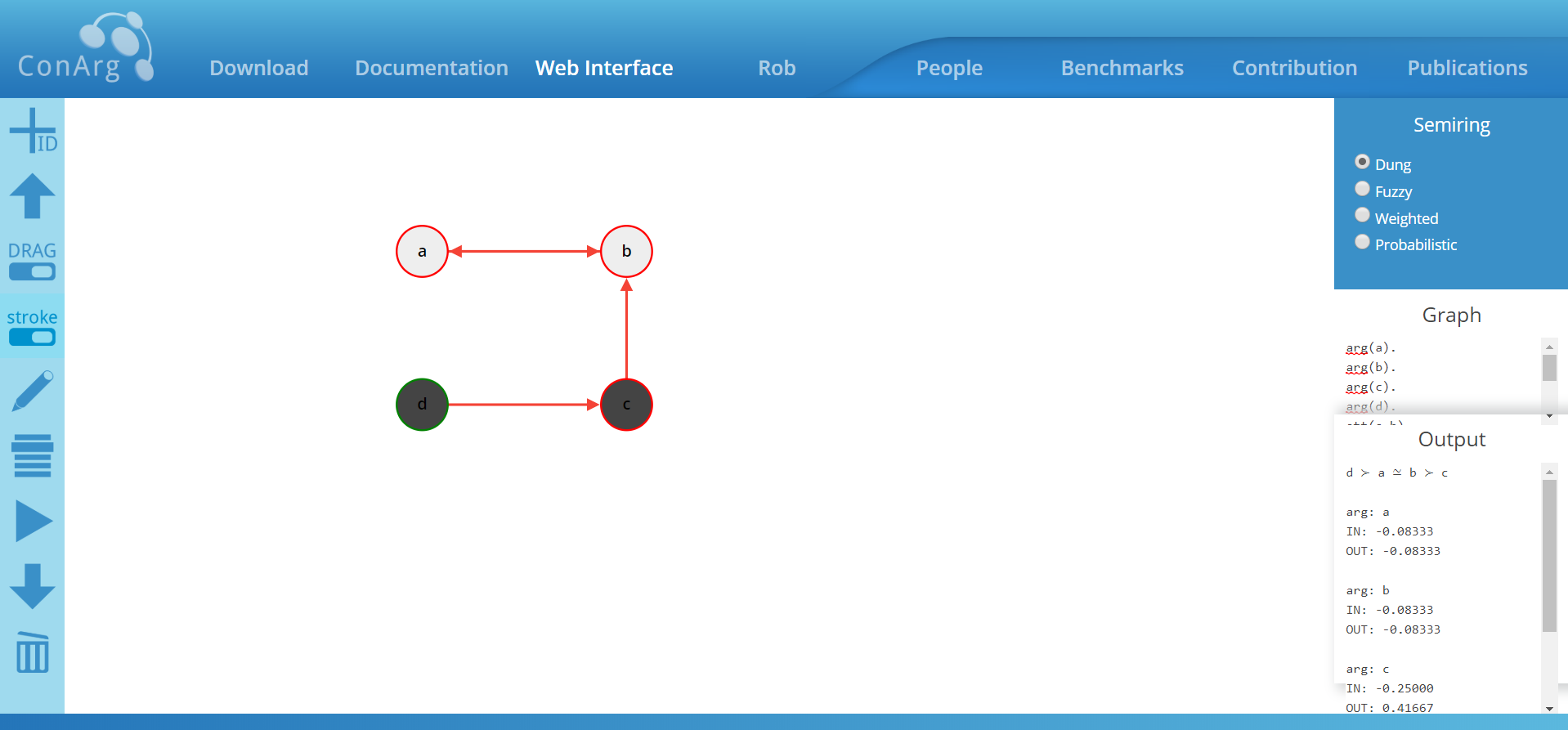
PI Ranking–Semantics
Shapley Value
(admissible)
d ≻ a ≻ b ≻ c
d (in: 0.08333; out: -0.58333)
a (in: -0.08333; out: -0.41667)
b (in: -0.41667; out: -0.08333)
c (in: -0.58333; out: 0.08333)
Banzhaf Power Index
(complete)
d ≻ a ≃ b ≻ c
d (in: 0.37500; out: -0.37500)
a (in: -0.12500; out: -0.12500)
b (in: -0.12500; out: -0.12500)
c (in: -0.37500; out: 0.37500)
PI Ranking–Semantics
1. S. Bistarelli, F. Faloci, F. Santini, and C. Taticchi. A Tool For Ranking Arguments Through Voting-Games Power Indexes. In Proceedings 34th CILC, volume 2396 of CEUR Workshop Proceedings, pages 193–201. CEUR-WS.org, 2019.
RESULTS
2. S. Bistarelli, F. Faloci, and C. Taticchi. Implementing ranking-based semantics in conarg: a preliminary report. ICTAI, 2019.
.
CoRR , abs/1908.07784, 2019. URL http://arxiv.org/abs/1908.07784
.
PI Ranking–Semantics
- Other Power Indexes
- Deep study on local and global properties
- Ranking function parametric to diferent subset
FUTURE WORKS
References
[2] Elise Bonzon, Jérôme Delobelle, Sébastien Konieczny, and Nicolas Maudet. A Comparative Study of Ranking-Based Semantics for Abstract Argumentation. In Proceedings of the Thirtieth AAAI Conference on Artificial Intelligence, February 12-17, 2016, Phoenix, Arizona, USA, pages 914–920. AAAI Press, 2016. ISBN 978-1-57735-760-5.
[1] Phan Minh Dung. On the acceptability of arguments and its fundamental role in nonmonotonic reasoning, logic programming and n-person games. Artif. Intell., 77(2):321–358, 1995. doi: 10.1016/0004-3702(94)00041-X.
URL https://doi.org/10.1016/0004-3702(94)00041-X.
[3] Lloyd S. Shapley. Contributions to the Theory of Games (AM-28), Volume II. Princeton University Press, 1953.
[4] John F. Banzhaf. Weighted voting doesn’t work: A mathematical analysis. Rutgers Law Review, 19(2):317–343, 1965.
[5] D. Keith. Encyclopedia of Power. SAGE Publications, Inc., 2011. ISBN 978-1-4129-2748-2.
PI Ranking–Semantics
</end>
Thanks for your attention