Power index-Based Ranking–Semantics


Master degree in Computer Science
Candidate
Francesco Faloci
Advisors
Stefano Bistarelli
Francesco Santini
Power index-Based Ranking–Semantics
- Argumentation
- Ranking Semantincs
- Power Indexes
- PI based Ranking-Semantics
Power index-Based Ranking–Semantics
- Argumentation
- Ranking Semantincs
- Power Indexes
- PI based Ranking-Semantics
Argumentation

Argumentation
-
Bob: «I want to go soccer»
-
Alice: «I want to go to the theater»
-
Bob: «My Ex is in the theater»
- Alice: «You don't have an Ex»
Argumentation
«I want to go soccer»
«I want to go to the theater»
«My Ex is in the theater»
«You don't have an Ex»


Argumentation
Argumentation Framework
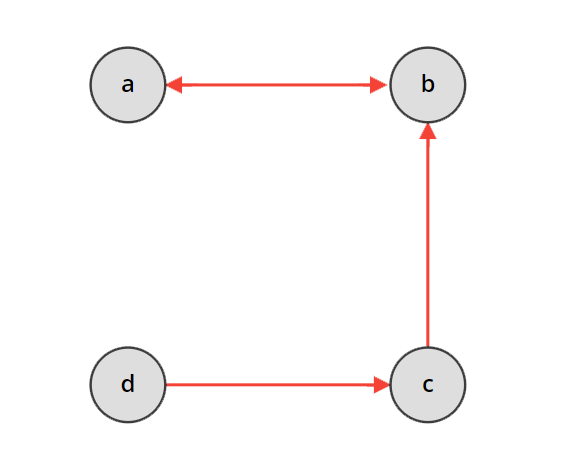
Argumentation
Abstract Argumentation Framework
- set of abstract elements "A", called arguments
- set of binary relations "R", on the elements of A
F = CC
Argumentation
A: { a, b, c, d }
R: { (a,b), (b,a), (c,b), (d,c) }
Argumentation
-
Acceptability
an argument a ∈ A is acceptable with respect to S ⊆ A ⇔
S defends a: ∀ b ∈ A such that (b,a) ∈ R, ∃ c ∈ S such that (c,b) ∈ R
-
Conflict-free
a set of arguments S is conflict-free if there is no attack between its arguments: ∀ a,b ∈ S, (a,b) ∉ R
-
Admissible
a set of arguments S is admissible ⇔ it is conflict-free and all its arguments are acceptable with respect to S.
Argumentation: Sets
-
Conflict-free
{} {1} {2} {3} {4} {1 3} {1 4} {2 4}
-
Admissible
{} {1} {4} {1 4} {2 4}
{} {1} {2} {3} {4} {1 2} {1 3} {1 4} {2 3} {2 4} {3 4}
{1 2 3} {1 2 4} {1 3 4} {2 3 4} {1 2 3 4}
Argumentation: Semantics
-
Complete
S is a complete extension of F ⇔ it is admissible and every acceptable argument with respect to S belongs to S.
-
Prefered
S is a preferred extension of F ⇔ it is a maximal element among the admissible sets with respect to F.
-
Stable
S is a stable extension of F ⇔ it is a conflict-free set that attacks every argument that does not belong in S.
-
Ground
S is the (unique) grounded extension of F ⇔ it is it is the smallest element among the complete extensions of F.
Argumentation: Semantics
-
Complete
S is a complete extension of F ⇔ it is admissible and every acceptable argument with respect to S belongs to S.
-
Complete
{4} {1 4} {2 4}
Argumentation: Semantics
-
Prefered
S is a preferred extension of F ⇔ it is a maximal element among the admissible sets with respect to F.
-
Preferred
{1 4} {2 4}
Argumentation: Semantics
-
Stable
S is a stable extension of F ⇔ it is a conflict-free set that attacks every argument that does not belong in S.
-
Stable
{1 4} {2 4}
Argumentation: Semantics
-
Ground
S is the (unique) grounded extension of F ⇔ it is it is the smallest element among the complete extensions of F.
-
Ground
{4}
Argumentation: Semantics
-
Complete
{4} {1 4} {2 4}
-
Preferred
{1 4} {2 4}
-
Stable
{1 4} {2 4}
-
Ground
{4}
{} {1} {2} {3} {4} {1 2} {1 3} {1 4} {2 3} {2 4} {3 4}
{1 2 3} {1 2 4} {1 3 4} {2 3 4} {1 2 3 4}
Argumentation: Labelling
Another Method to express acceptability of argument
-
∀ a,b ∈ A, if A ∈ in(L) and (b,a) ∈ R, then b ∈ out(L)
- ∀ a ∈ A, if a ∈ in(L), then ∃ b ∈ A such that A ∈ in(L) and (b,a) ∈ R
Power–index Based Ranking–Semantics
- Argumentation
- Ranking Semantincs
- Power Indexes
- PI based Ranking-Semantics
Ranking Semantincs

Ranking Semantincs
a ≻ d ≻ c ≻ b
Ranking Semantincs
Categorize
(..)
Ranking Semantincs
Discussion-based semantics
(..)
Burden-based semantics
(..)
Ranking Semantincs
Two-person zero-sum game semantics
(..)
Power index-Based Ranking–Semantics
- Argumentation
- Ranking Semantincs
- Power Indexes
- PI based Ranking-Semantics
Power indexes
Arancio
Bianca
Celeste
20%
40%
15%
Voting Game!
Power–indexes
Arancio
Bianca
Celeste
20%
40%
15%
60%
Power–indexes
A: 20%
B: 40%
C: 15%
Voting Game
Power-Index
Calculate the marginal contribution of each agent
Power–indexes
A: 20%
B: 40%
C: 15%
let's try the... Shapley Value ! (SV)
SV (A) = 0,5
SV (B) = 1
SV (C) = 0,5
B ≻ A ≃ C
-
if a coalition S reaches the 51% it values 1, 0 otherwise
-
we consider only minimal coalition: not the whole set
-
Only coalitions (A,B) and (B,C) are winning
Power indexes: Shapley Value
We used the characteristic function defined on the coalition S that contains the agent i, as following:
and the Shapley Value formua for all the agents (i) as following:
Power–indexes: MORE Indexes
Banzhaf Power Index
Deegan-Pakel Index
Johnston Index
Power–index Based Ranking–Semantics
- Argumentation
- Ranking Semantincs
- Power Indexes
- PI based Ranking-Semantics
PI Ranking–Semantics
AF
Voting Game
Ranking Semantincs
PI Ranking–Semantics
A: { a, b, ... }
AF Dung's Semantics
Coalitions :
Agents :
Characteristic function based on Acceptability of arguments
PI Ranking–Semantics
A ⇒ agents
⇒ coalitions
{1} {2} {3} {4}
Conflict-free, Admissible, Complete, Preferred, Stable, Ground
PI Ranking–Semantics
Characteristic Function(s)
Given a Dung semantics and the set of all possible labellings on F satisfying , we define:
PI Ranking–Semantics
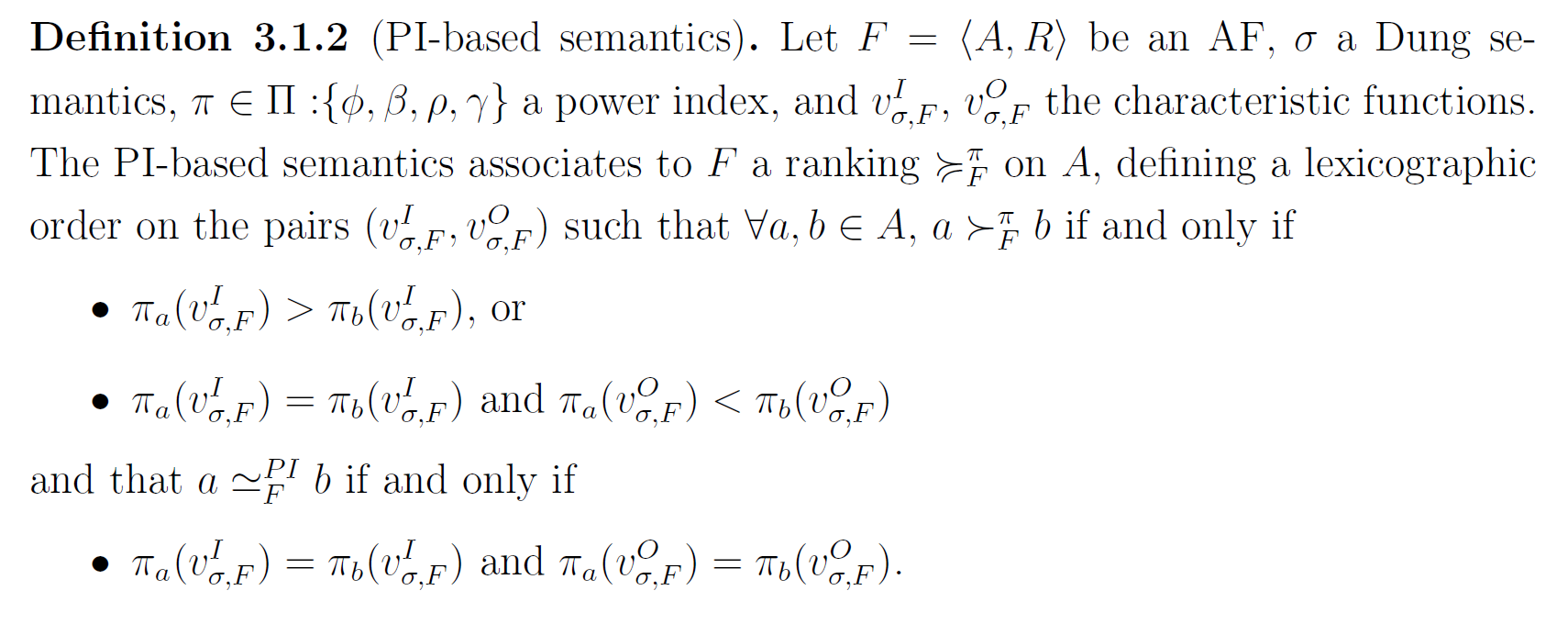
Formal Definition
S. Bistarelli, F. Faloci, F. Santini, and C. Taticchi. A Tool For Ranking Arguments Through Voting-Games Power Indexes. In Proceedings 34th CILC, volume 2396 of CEUR Workshop Proceedings, pages 193–201. CEUR-WS.org, 2019.
PI Ranking–Semantics
(Esempio applicativo con SV e Banzhaf)
PI Ranking–Semantics
(4 chiacchiere su conarg)
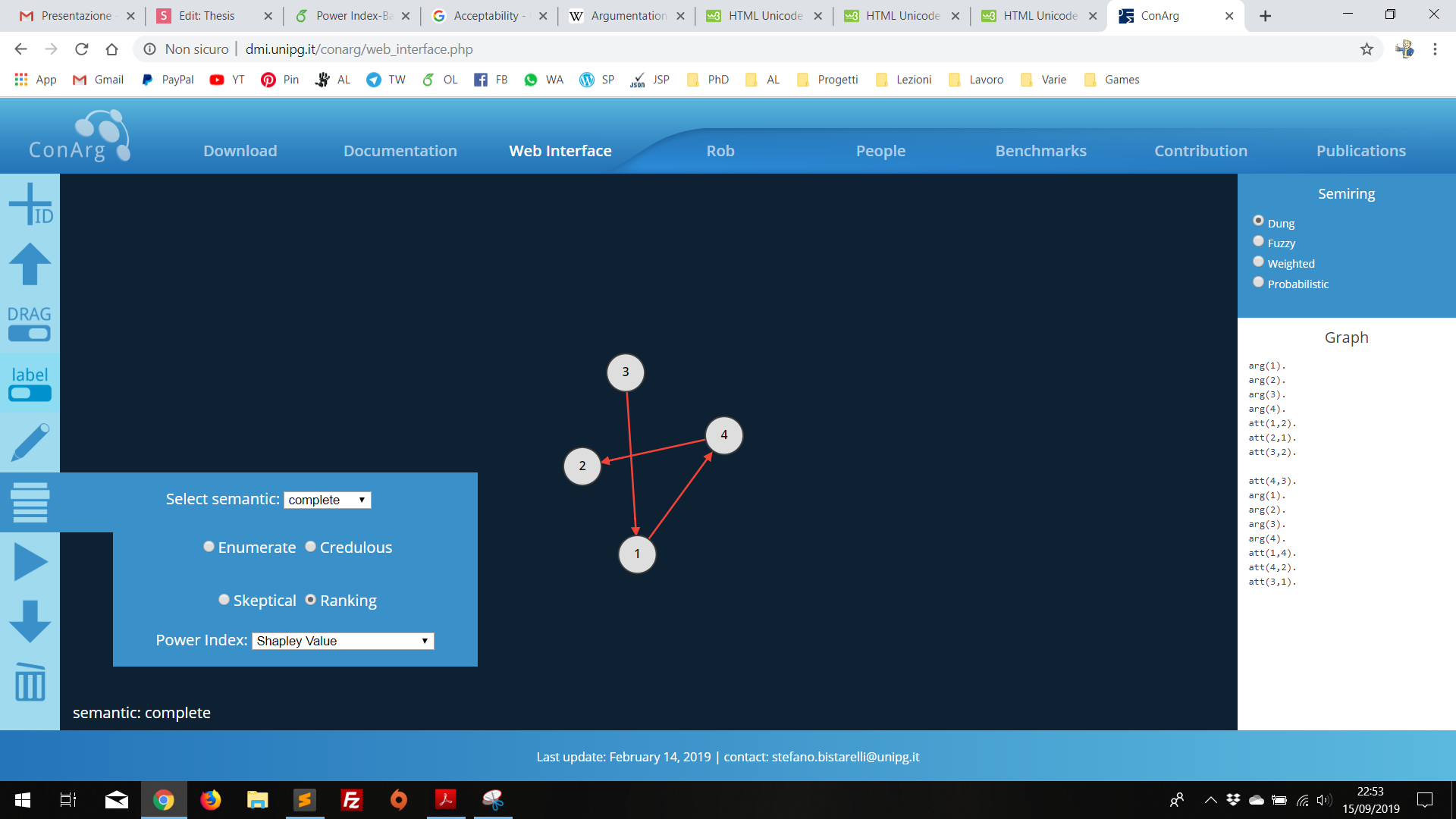
PI Ranking–Semantics
(Elenco delle pubblicazioni fatte su sta roba)
PI Ranking–Semantics
Future
PI Ranking–Semantics
/end