Microservices
at NewStore

/whois
Jan-Oliver Pantel
Software Engineer Commerce Backend
@NewStore

Conway's Law
organizations which design systems ... are constrained to produce designs which are copies of the communication structures of these organizations
What do we want?
Quick reaction times
High Quality
Pick one
Small teams
- Small problem domains
- Less cognitive load
- Less overhead
- Not to much layers of communication
- Small teams are quicker
Big teams
- Big problem domains
- No communication boundaries
Monoliths
and
Microservices
Preface
- There is no perfect solution for everyone
- Monolith and Microservices both have their trade-offs
- Monolith != messy code
- Microservices != clean code
- Monolith is not evil!
- Microservice architecture is a complete different architectual approach

The monolith
Monolith and small teams
- Teams block each other while working on the same monolith
- "We can not deploy this yet!"
Microservices

Microservices and small teams
- One guy owns one service
- Deep understanding
- Threat: Silo knowledge
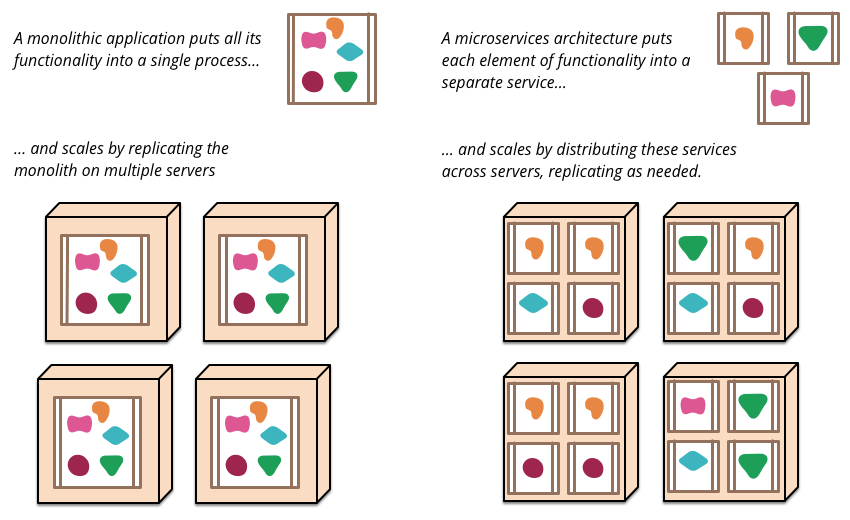
Copyright Martin Fowler
Deployment


Deployment

Why MS?
- Scalability
- Polyglotism
- Independence
- Best technology for the job
- Replaceability
Expectations
- Seperation of concerns
- Decoupling
- Clear fail spots
Who?





From PHP monolith
to Rails monolith
to MS with WebSocket API
1 Request ~= 100 Services
Search "Nike shoe" = 170 services
From monolith with huge DB
to 450 MS with own data management
Independent teams ('squads')
and the No-Shared-Data-Principle
Decoupling and async data transfer
through internal REST APIs
HOW?

we did it...








- Easy deployment
- No "works on my machine"
- Easy scaling
- Reproducable
- Concurrency for free
- Easy to learn
- Rich stdlib
- Fast compiling
- Single static binary
- No runtime on server
- Open Source Community

- AMQP protocol
- Fast
- Failsafe
- Topic exchanges
- Fanout exchanges
- (Service discovery)
- Caching

- Caching
- Inter instance sync
- Distributed locks
- Amazon RDS
- JSON fields
- JSON queries
- Service Discovery
- Health Checks
- DNS
- Property Store
- Watch function
- Metrics
- Small protocol
- Small footprint
- Data pull
In the future











Implementation

RPC
Service A
{
    "exchange": "rpc",
    "routing_key": "rpc.service_b.do",
    "context": {
        "user_id": "4711",
        "request_id": "0815",
        "tenant": "hannoverjs"
    },
    "body": {
        "hello": "world",
        "foo": "bar"
    }
}
Service B
{
    "request_id": "0815",
    "has_error": false,
    "response": {
        "done": true
    }
}
Events
Service A
{
    "exchange": "events",
    "routing_key": "events.called_service_b",
    "context": {
        "user_id": "4711",
        "request_id": "0815",
        "tenant": "hannoverjs"
    },
    "body": {
        "hello": "world",
        "foo": "bar"
    }
}
Why RabbitMQ?
- No service discovery bottleneck
- Persistent messages
- Acknowledging
- Brokers available (host and go)
Service Discovery
for Infrastructure
Where is Rabbit / Postgres / ... ?
{
    "service": "rabbitmq",
    "host": "192.168.278.32",
    "port": "5432",
    "user": "guest",
    "password": "guest"
}
Service Discovery
for Services
Where is Service B?
{
    "service": "service_b",
    "host": "192.168.278.133",
    "port": "1337",
    "up": true,
    "up_since": 7437981
}
{
"service": "service_b",
"host": "",
"port": "",
"up": false,
"up_since": null
}Service Registration
Hey it's me Service A
{
    "service": "service_a",
    "host": "192.168.278.133",
    "port": "1337",
    "health_check": "/health"
}
Sample
Import
API
Import
Pers.
Prod.
Import
Prod.
Pers.
Post
processor
Indexer
Conclusion

Microservices are not the holy grail
- Service can and will fail
- Makes development harder
- Network overhead
- Transactions!
Should I do this thing?
- Startup? Do the monolith!
- You can always extract single services
- Small team? Monolith!
- If business domain is clear
But... why?
- Lot of initial development for communication layer
- Lots of conventions to create
- Hard to focus on business goals
- Deployment becomes a HUGE topic
- Monitoring is hard
- Monolith dies => completly clear
- Single service dies => WTF?!?
- Debugging is hard
- Bye interactive debugging all the way
- Refactoring is hard
- Testing is hard
- How guarantee that my service mocks behave equal to the production service
But you did?
- Teamsize > 50 devs
- 4 locations
- 6 different business domains
- Business domain is already fixed
- We have dedicated ops people (!)
- We designed our communication to fit
What's the right spot?
- You already have a product
- Or your entire team is big / distributed
- And you have dedicated ops people
- Server Admins != ops
- And your company culture is ready
- And you are aware of the trade-offs !!!
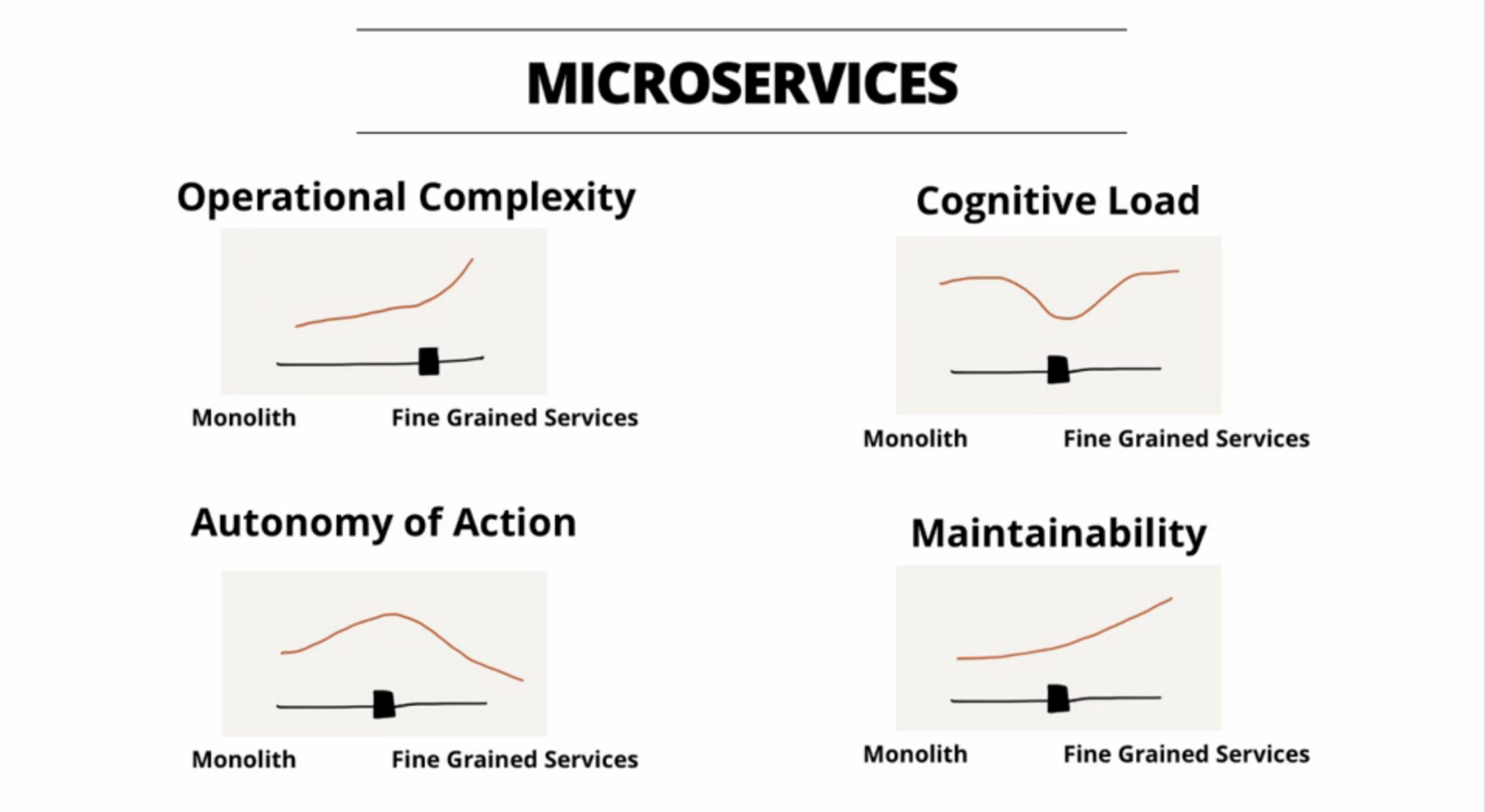
Copyright by ThoughtWorks
Learnings

Use open source solutions for communication layer
If possible
Mind HTTP when designing own RPC layer
If your protocol isn't HTTP anyway
Mind latency and the network itself
Think about versioning from the beginning
Test each service individually
Log everything!
Stick to a limited stack of technology in the beginning
Log everything!
Let everything be human readable and verbose
Questions?

Thank you!