The Good and Bad of Software Metrics
Jason Pugh
Devspace Conference 2016
”When you can measure what you are speaking about, and can express it in numbers, you know something about it; but when you cannot measure it, when you cannot express it in numbers, your knowledge is of a meager and unsatisfactory kind: It may be the beginning of knowledge, but you have scarcely in your thoughts advanced to the stage of science.” -Lord Kelvin
DevSpace would like to thank our sponsors!

Agenda
-
Introduction
-
Code Scanned
-
Definition
-
Why Software Design Metrics
-
The Bad
-
The Good
-
Process Integration
-
Products
-
Conclusion
Introduction
- Jason Pugh
- COLSA Corporation
- Zenoware
- UAH


Code Scanned
- MongoDB .NET Driver
- GitHub
- C#
What are Metrics?
- Type of objective scoring that is used to quantitatively measure aspects of software
- More detailed results === increased efficiency && productivity
Software Design Metrics
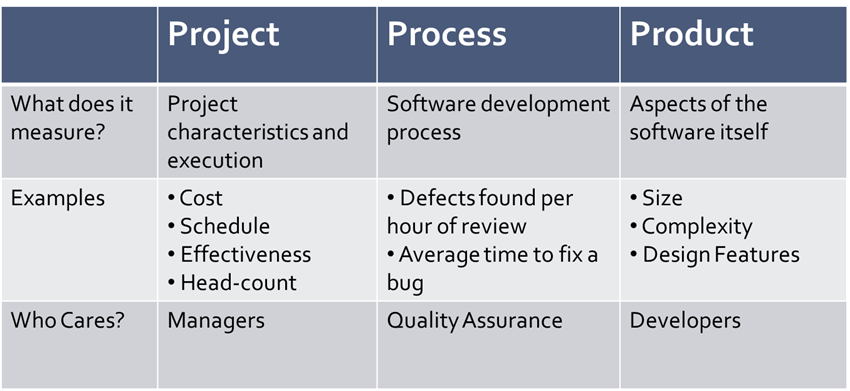
Software Design Metrics
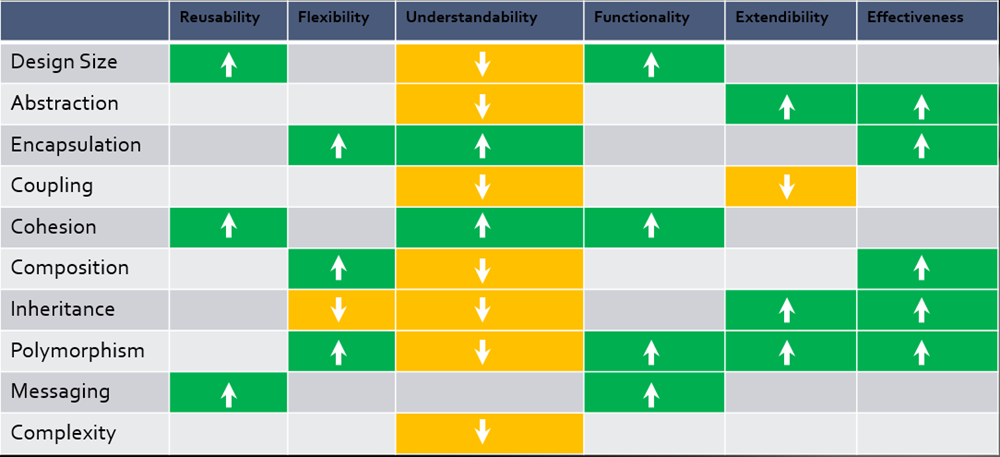
Why Software Design Metrics
- Lower Maintenance
- Faster Throughput
- Easier Estimation
Useful Metrics
- There is NOT one metric to rule them all!!
- Combine useful metrics your TEAM finds useful
- COLSA’s Approach:
- Complexity
- Cohesion
- Coupling
Complexity - Weighted Method per Class
- where ci is the complexity of a method
- Viewpoints:
- Time and Effort required to develop and maintain the class
- greater potential impact on children
- limits the possibility of reuse
Chidamber, S.R.; Kemerer, C.F.; , "A metrics suite for object oriented design," Software Engineering, IEEE Transactions on , vol.20, no.6, pp.476-493, Jun 1994
L. H. Etzkorn et al., “A comparison of cohesion metrics for object-oriented systems,” Information and Software Technology, vol. 46, no. 10, pp. 677-687, Aug. 2004.
Complexity - Weighted Method per Class
wmc = 0
for ctor in c.Constructors:
    if(calculateComplexity == True):
        wmc += ctor.DecisionsCount + 1
    else:
        wmc += 1
for m in c.Methods:
    if(calculateComplexity == True):
        wmc += m.DecisionsCount + 1
    else:
        wmc += 1
Complexity - Weighted Method per Class
/// <summary>
/// Checks whether a given collection name is valid in this database.
/// </summary>
/// <param name="collectionName">The collection name.</param>
/// <param name="message">An error message if the collection name is not valid.</param>
/// <returns>True if the collection name is valid; otherwise, false.</returns>
public virtual bool IsCollectionNameValid(string collectionName, out string message)
{
    if (collectionName == null)
    {
        throw new ArgumentNullException("collectionName");
    }

    if (collectionName == "")
    {
        message = "Collection name cannot be empty.";
        return false;
    }

    if (collectionName.IndexOf('\0') != -1)
    {
        message = "Collection name cannot contain null characters.";
        return false;
    }

    if (Encoding.UTF8.GetBytes(collectionName).Length > 121)
    {
        message = "Collection name cannot exceed 121 bytes (after encoding to UTF-8).";
        return false;
    }

    message = null;
    return true;
}
Complexity - Weighted Method per Class
/// <summary>
/// Checks whether a given collection name is valid in this database.
/// </summary>
/// <param name="collectionName">The collection name.</param>
/// <param name="message">An error message if the collection name is not valid.</param>
/// <returns>True if the collection name is valid; otherwise, false.</returns>
public virtual bool IsCollectionNameValid(string collectionName, out string message)
{
    if (collectionName == null)
    {
        throw new ArgumentNullException("collectionName");
    }

    if (collectionName == "")
    {
        message = "Collection name cannot be empty.";
        return false;
    }

    if (collectionName.IndexOf('\0') != -1)
    {
        message = "Collection name cannot contain null characters.";
        return false;
    }

    if (Encoding.UTF8.GetBytes(collectionName).Length > 121)
    {
        message = "Collection name cannot exceed 121 bytes (after encoding to UTF-8).";
        return false;
    }

    message = null;
    return true;
}
1
2
3
4
5
Total WMC = 5
Coupling - Direct Class Coupling
- Where cpi is unique custom parameters for a method, cfi is unique custom fields in a class, and mcri is unique custom method return types
- Viewpoints:
- Higher coupling reduces reuse
- High dependency on other objects
J. Bansiya and C. Davis, “A hierarchical model for object-oriented design quality assessment,” Software Engineering, IEEE Transactions on, vol. 28, no. 1, pp. 4-17, 2002.
Coupling - Direct Class Coupling
  dcc = 0
  types = []
  for a in c.Fields:
    if((a.Type.Name in types) == False and (a.Type.IsUserDefined == True)):
       types.append(a.Type.Name)

  for m in c.Methods:
    for p in m.Parameters:
      if((p.Type.Name in types) == False and (p.Type.IsUserDefined == True)):
        types.append(p.Type.Name)

    if((m.ReturnType.Name in types) == False and m.ReturnType.IsUserDefined == True):
        types.append(m.ReturnType.Name)

  dcc = len(types)
Coupling - Direct Class Coupling
/// <summary>
/// Runs an aggregate command with explain set and returns the explain result.
/// </summary>
/// <param name="args">The args.</param>
/// <returns>The explain result.</returns>
public virtual CommandResult AggregateExplain(AggregateArgs args)
{
    var messageEncoderSettings = GetMessageEncoderSettings();
    var operation = new AggregateExplainOperation(_collectionNamespace,
                        args.Pipeline,
                        messageEncoderSettings)
    {
        AllowDiskUse = args.AllowDiskUse,
        Collation = args.Collation,
        MaxTime = args.MaxTime
    };
    var response = ExecuteReadOperation(operation);
    return new CommandResult(response);
}
Coupling - Direct Class Coupling
/// <summary>
/// Runs an aggregate command with explain set and returns the explain result.
/// </summary>
/// <param name="args">The args.</param>
/// <returns>The explain result.</returns>
public virtual CommandResult AggregateExplain(AggregateArgs args)
{
    var messageEncoderSettings = GetMessageEncoderSettings();
    var operation = new AggregateExplainOperation(_collectionNamespace,
                        args.Pipeline,
                        messageEncoderSettings)
    {
        AllowDiskUse = args.AllowDiskUse,
        Collation = args.Collation,
        MaxTime = args.MaxTime
    };
    var response = ExecuteReadOperation(operation);
    return new CommandResult(response);
}
Both are custom types, therefore, DCC is 2
Cohesion - Lack of Cohesion in Methods
instance variables used in a method
Chidamber, S.R.; Kemerer, C.F.; , "A metrics suite for object oriented design," Software Engineering, IEEE Transactions on , vol.20, no.6, pp.476-493, Jun 1994
L. H. Etzkorn et al., “A comparison of cohesion metrics for object-oriented systems,” Information and Software Technology, vol. 46, no. 10, pp. 677-687, Aug. 2004.
Cohesion - Lack of Cohesion in Methods
  lcom = 0
  I = [] # An empty list of sets
  i = 0 # A counter

  p = 0  # The cardinality of set P
  q = 0  # The cardinality of set Q
  N = 0  # The number of methods in class C

  N = c.Methods.Count

  for m in c.Methods:
    methodSet = set() # empty set, initially

    # Determine which of the accessed variables
    # are instance variables of the current class.
    for v in m.AccessedVariables:
      tempSet = set()
      tempSet.add(v)
      if(c.IsInstanceVariable(v) == True):
        methodSet = methodSet | tempSet

    # Keep the sets of accessed instance variables around. We will
    # need them for the next step of the calculation.
    I.append(methodSet)

  for i in range(0, N):
    for j in range(0, N):
      intersection = I[i] & I[j]
      if(len(intersection) == 0):  # i.e. is the empty set
        p += 1
      else:
        q += 1

  #
  # Now p is the number of pairs of methods which don't have
  # have any instance variable accesses in common.
  #
  # q is the number of pairs of methods which DO have an instance
  # variable access in common
  #
  if(p > q):
    lcom = p - q
  else:
    lcom = 0
Cohesion - Lack of Cohesion in Methods
private readonly CollectionNamespace _collectionNamespace;

/// <summary>
/// Runs an aggregate command with explain set and returns the explain result.
/// </summary>
/// <param name="args">The args.</param>
/// <returns>The explain result.</returns>
public virtual CommandResult AggregateExplain(AggregateArgs args)
{
    var messageEncoderSettings = GetMessageEncoderSettings();
    var operation = new AggregateExplainOperation(_collectionNamespace,
                        args.Pipeline,
                        messageEncoderSettings)
    {
        AllowDiskUse = args.AllowDiskUse,
        Collation = args.Collation,
        MaxTime = args.MaxTime
    };
    var response = ExecuteReadOperation(operation);
    return new CommandResult(response);
}
Cohesion - Lack of Cohesion in Methods
private readonly CollectionNamespace _collectionNamespace;

/// <summary>
/// Runs an aggregate command with explain set and returns the explain result.
/// </summary>
/// <param name="args">The args.</param>
/// <returns>The explain result.</returns>
public virtual CommandResult AggregateExplain(AggregateArgs args)
{
    var messageEncoderSettings = GetMessageEncoderSettings();
    var operation = new AggregateExplainOperation(_collectionNamespace,
                        args.Pipeline,
                        messageEncoderSettings)
    {
        AllowDiskUse = args.AllowDiskUse,
        Collation = args.Collation,
        MaxTime = args.MaxTime
    };
    var response = ExecuteReadOperation(operation);
    return new CommandResult(response);
}
Instance Variable _collectionNamespace
- therefore p > q : LCOM is 1
The Good
- "You can't control what you can't measure"
Tom DeMarco
- We need some way to measure and know when things need to be reconsidered/refactored
Define Useful Metrics
-
What Language are you using?
-
What are important aspects of the language?
-
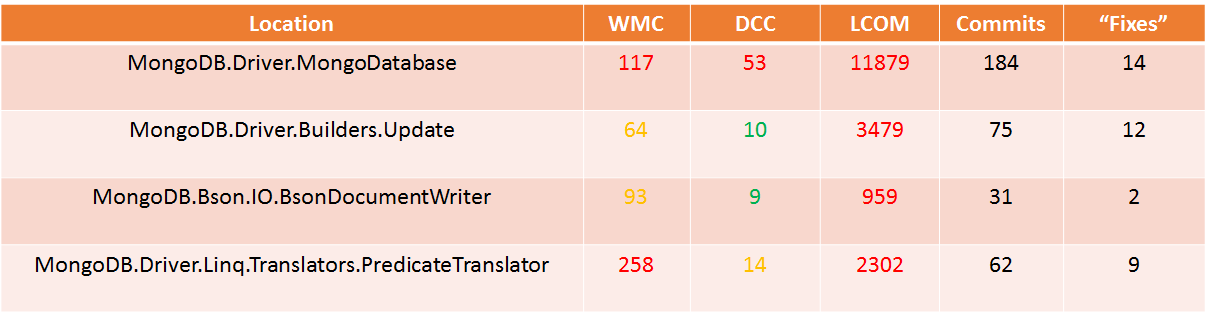
Complexity: 0 - 49 is Good, 50-99 is Potential Issues, and >= 100 is Concerning
-
Cohesion: 0 - 499 is Good, 500-899 is Potential Issues, and >= 900 is Concerning
-
Coupling: 0 - 11 is Good, 12-39 is Potential Issues, and >= 40 is Concerning
MongoDB Scanned Results - The Good
The Bad
-
Why design metrics are considered bad:
-
Incorrect usage of metrics
-
Using just one metric for a decision.
-
Using too many metrics for a decision.
-
Using a single threshold for separate projects and not adapting.
-
-
The Bad - Simple Example
-
Sandy, Joe and Susan run in a race. Sandy comes in first, Joe second, and Susan third.
-
We assign Sandy the number 1 for first place and give her $10,000
-
We assign Joe the number 2 and give him $1,000
-
We assign Susan the number 3 and give her $100
-
We assigned the numbers according to a rule.
-
Questions
-
Is Sandy twice as fast as Joe and three times as fast as Susan?
-
Is Sandy 10 times as fast as Joe and 100 times as fast as Susan?
-
Isn’t the assignment of the numbers based on their speed?
-
Did we measure their speed or not?
Kaner, C. “Yes, But What Are We Measuring?,” 1999 PNSQC
Douglas Hoffman
-
The Bad - Using just One Metric
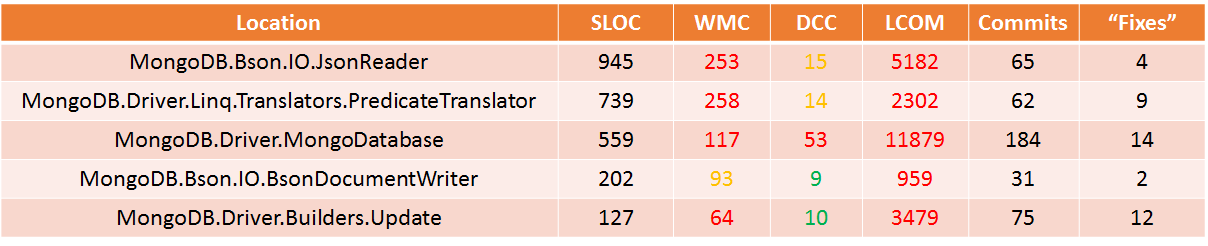
How to Interpret Metrics
- Measurements are… MEASUERMENTS!!
- Software is inherently difficult
- Example: If a car is large, it has poor gas mileage. Is that true?
- It is a good observation, but not ALWAYS true...
- You have to LOOK at the specifications and inspect/research first
Metrics in Software Design Process
-
Architect:
-
Scan Code and Documentation Monthly*
-
Retrieve Metrics and Review
-
-
Project Manager:
-
Review Architect Findings
-
Assign to Team Lead
-
-
Team:
-
Schedule Peer Reviews
-
Schedule Refactor Task (IF NECESSARY)
-
Available Products
-
Understand
-
Cantata++
-
McCabe IQ
-
Coverity
Zenoware CSMS
Currently revamping CSMS (Custom Software Metric Suite)
SaaS and Atlassian Support – December Timeframe
Actively looking for Closed Beta Users
Special Thanks
- DevSpace Conference
- UAH and Dr. Letha Etzkorn
- Zenoware Team Members
- Kurt Lawson