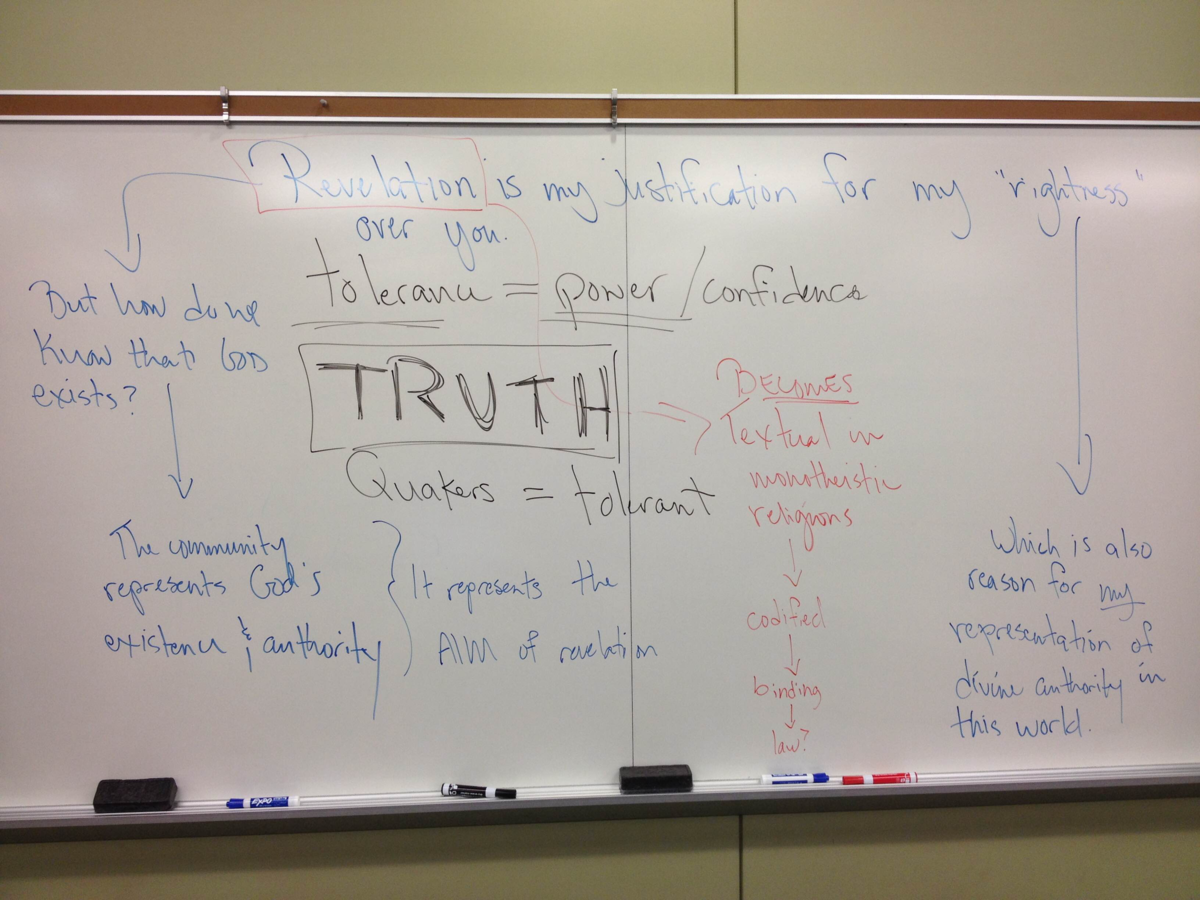
God and Revelation
"God"
    Big G, little g.
    What begins with "G"?
Groovy, god, great, and a garrulous geek..jpg)
Original conflicts
- Judaism: exile and unsupportive context in Yehud (continued under successive empires)
- Christianity: desire for restoration under the Roman empire and conflict between growing numbers of sects with Judaea
- Islam: Social-economic conflict in Mecca and larger internecine conflicts.

Redefined the nature of "community" as bound by common creed/belief.
|
|
Exclusionary in response to external forces/threats/lack of fulfilled desire (restoration)
A "monotheistic" people is a prerequisite for a monotheistic God. The idea of an absolute, solitary God depends upon the outward expression of a community recognizable by its attitude of exclusion. In other words, a monotheistic God is the product of a self-awaredly exclusionary community.
"Monotheism" refers to collective strategy and intention rather than a presupposed supernatural invention.
Monotheism is not exclusionary because of the existence of a single God. A single God is thought to exist because monotheism is exclusive.
Expression of collective desire for stability, including controlled space and authority over it, as exclusionary provides the basis for monotheism when that expression is given divine legitimation.
"God" = shared symbol of the highest ideal and desire of the community (thus, Jewish God ≠ Christian God ≠ Islamic God)
The monotheistic perception of God, with which we are most familiar, was initially defined in reaction to the multiplicity of competing authorities and ideologies by a solitary community desiring authority for itself.
You all threaten me. I represent the stability of the world. You represent anomy.
What troubles me, however, is the suspicion that to focus on the divine unity and transcendence as the principle taxonomic markers of monotheism over other systems of religion—and the primary principle of its superiority as a religious worldview—is at the same time to ignore much that characterizes monotheism as a system of religion. (M. Jaffee)
"God" = the projected ideal of an exclusionary community. (Not the other way around.)
Revelation correlates with the distinction of the community.
Submission to God = submission to the collective desire of the community?
Pillars of Monotheism
Revelation, Law, Restoration
The "pillars" of monotheism were those constructed as barriers against heightened anxieties over anomy and "death." They are all, fundamentally, reactions.
Among other things, they offer ideological justifications for attitudes and actions of exclusion, corresponding prejudices, and an internal sense of superiority and right to authority (cf. Zech. 9:9-17; Ps. 68:19-23; Rev. 19:13-18).
- Revelation is interruption.
- Law (text or example) is "blueprint"
- Restoration is the ideal, stabilized reality. It is utopian.
For our purpose:
Revelation means divine revelation, the moment, or process, in which the Divine "entered" the social and material world to begin the process of restructuring social-political systems in support of divine authority. ...
Revelation is a process, an atemporal instance rather, that begins a process. That is, revelation does not secure authority for the religious community but inaugurates the process (symbolized by "law") toward restoration in which divine authority would be absolutely (re)established and in which the religious community would be granted the benefits of divine authority.
That means, a radical interruption of the dominant normative order. This interruption restructures the normative order for the benefit of the community. Revelation necessitates simultaneously change and conservation.
Religion legitimates this purposeful interruption as the action of the Divine.
Practice Debate
ROE
Marty Party vs. Lilla 'Zillas
Start with McBrien and Jaffee readings. Add additional research as necessary.
- Write a two-minute thesis/position statement.
- Prepare responses for the following:
- Monotheism breeds fundamentalism.
- Fundamentalism is on the "same continuum" as the parent religion's mainstream.
- Monotheism seeks to control/rule the normative order of the social-political world.
- Prepare a 1-2 minute closing argument.