Zionism

The rise of secular Judaism as a political identity?

What’s important about Zionism?

The “Jewish Question/Problem”


Zionism and the “Jewish Problem” are topics of the same “conversation.”


European intellectuals during the 18th and 19th centuries debated the so-called Jewish Question: What is the appropriate status and treatment of Jews, in terms of civil, legal and national status of Jews as a minority?

Political impact: some initial observations

  1. Zionism has played a significant part in the political ideology of Israel’s relationship to Palestine.
  2. It has had significant impact in U.S. relationship to Israel, namely in the voice of the Christian Zionists from the Christian Right (who have held the ears of key political figures).
  3. It supports the preservation of a space in which Jewish communities may be established in their own sovereign homeland, free from persecution and able to protect themselves. (Where Jews need not feel insecure as Jews in a hostile context.)

No one can deny the gravity of the situation of the Jews. Wherever they live in perceptible numbers, they are more or less persecuted. Their equality before the law, granted by statute, has become practically a dead letter. They are debarred from filling even moderately high positions, either in the army, or in any public or private capacity. And attempts are made to thrust them out of business also: “Don’t buy from Jews!” (Theodor Herzl, “The Jewish State,” 1896)
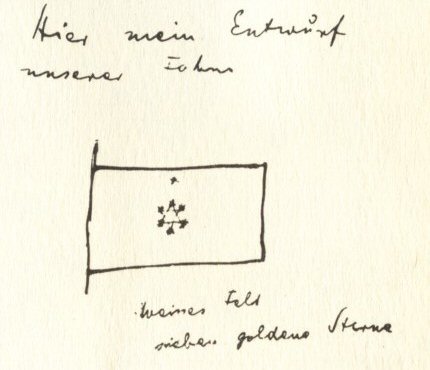
Herzl flag design

Hier (ist) mein Entwurf (für) unserer Fahne.

Weissen Feld zwischen goldene Sterne

Zionism reflects a nationalistic fervor that has increasingly secularized Jewish identity. (Conflation of religious identity and national identity?)

Brief history RE Zionism


The national movement for the return of the Jewish people to their homeland and the resumption of Jewish sovereignty in the Land of Israel. (Jewish Virtual Library)


A political-philosophical movement that embraces human action (in contrast to waiting for the Divine to act).

International “permission”

His Majesty’s Government view with favour the establishment in Palestine of a national home for the Jewish people and will use their best endeavors to facilitate the achievement of this objective (Arthur James Balfour in the Balfour Declaration, 1917).


Balfour was writing to Baron Lionel Walter Rothschild, a prominent Jewish citizen in Britain, expressing British support for Jewish homeland in Palestine. (Compare Herzl's early openness to space, notably the Uganda Plan.)

The Uganda Plan involved land from the British East Africa Protectorate. Much of that land is in modern Kenya.

The Protectorate, which was governed by the British, was seeing a decline in the number of British settlers occupying the land.

With the direction of WWI, some believed that this would elicit Jewish support in neutral countries such as the U.S. and Russia (the latter in which an anti-semitic czar, Nicholas II, had just been overthrown).

British leaders viewed support for a Zionist state, under British protection, to be crucial for controlling the land bridge between India and Egypt (which was a post-war goal for the British).

With the treaty of Versailles in 1919, Britain was given temporary administration of Palestine with the understanding that it would work with both Jews and Arabs toward a more permanent solution.


With increasing numbers of Jews, however, conflicts between Jews and Arabs increased. Instability resulted in a delay regarding Britain’s decision of what to do with Palestine.


After WWII, international support for Zionism led to the establishment of the Jewish State in 1948.

As an increasingly secularized ideology, and with the reality of a possible homeland, Zionism became equated with nationalism, according to Rabkin.


Nationalism = patriotic feelings, principles, and efforts that often include feelings of political/national superiority.

Zionism = nationalism?

According to Rabkin, Zionism is a nationalist movement (which reflects a more secularized form of Judaism).


Secularization also revolutionized Jewish identity from within; traditional Jews can be distinguished by what they do or should do; the new Jews by what they are. While they practice the same religion, it would be truly daring to assume that Jews from Poland, Yemen, and Morocco belong to the same ethnic group, let alone are descendants of the Biblical Hebrews. Some, such as Professor Shlomo Sand of Tel-Aviv University, argue that the Jewish people, as an ethnic concept, was simply “invented” for the needs of Zionism in the late 19th century: after all, one needs a nation to be a nationalist. (Rabkin)

Zionism rejected the traditional definition in favour of a modern national one. In this sense, Zionists accepted the anti-Semites’ view of the Jews as a distinct people or race and, moreover, internalized much of the anti-Semitic blame directed at the Jews, accused of being degenerate unproductive parasites. Zionists set out to reform and redeem the Jews from their sad condition. In the words of Professor Elie Barnavi, former Israeli ambassador in Paris: “Zionism was an invention of intellectuals and assimilated Jews . . . who turned their back on the rabbis and aspired to modernity, seeking desperately for a remedy for their existential anxiety.” Most Jews rejected Zionism from the very beginning. They saw that Zionists played into the hands of their worst enemies, the anti-Semites: the latter wanted to be rid of Jews while the former wanted to gather them to Israel. (Rabkin)

Four objectives of Zionism:

  1. To transform the transnational and extraterritorial Jewish identity centred on the Torah into a national identity, like ones then common in Europe
  2. To develop a new national language based on biblical and rabbinical Hebrew
  3. To transfer the Jews from their countries of origin to Palestine
  4. To establish political and economic control over the land, if need be by force.

Compare this with what Herzl wrote:

When we occupy the land, we shall bring immediate benefits to the state that receives us. We must expropriate gently the private property on the estates assigned to us. We shall try to spirit the penniless population across the border by procuring employment for it in the transit countries, while denying it any employment in our country. The property owners will come over to our side. Both the process of expropriation and the removal of the poor must be carried out discretely and circumspectly … It goes without saying that we shall respectfully tolerate persons of other faiths and protect their property, their honor, and their freedom with the harshest means of coercion. This is another area in which we shall set the entire world a wonderful example … Should there be many such immovable owners in individual areas [who would not sell their property to us], we shall simply leave them there and develop our commerce in the direction of other areas which belong to us. (Herzl’s diary)

ERETZ-ISRAEL (the Land of Israel) was the birthplace of the Jewish people. Here their spiritual, religious and political identity was shaped. Here they first attained to statehood, created cultural values of national and universal significance and gave to the world the eternal Book of Books. After being forcibly exiled from their land, the people kept faith with it throughout their Dispersion and never ceased to pray and hope for their return to it and for the restoration in it of their political freedom.

Declaration of Independence

Criticisms

… Against the secularization of Judaism

As a “national movement” for Jewish sovereignty, Zionism, or at least its adherents, permits aggressive action in establishing Israel. (“By force, if necessary.”)


Human led aggression replaces an emphasis upon divine action.

Zionism seems to reject a traditional definition of “Jew” with a modern secular one.


(One need not follow/believe in God to be considered a “Jew,” a term that came increasingly to refer to political citizenship.)

Zionists accepted the anti-Semites’ view of the Jews as a distinct people or race and, moreover, internalized much of the anti-Semitic blame directed at the Jews, accused of being degenerate unproductive parasites. Zionists set out to reform and redeem the Jews from their sad condition (Rabkin).

Some Jews claim that Zionism either (1) rejects the role of the Creator in history, or (2) attempts to force the Creator’s hand in history (cf. Neturei-karta)

Zionist influence on Israeli policies

Settlements

Number of settlements per prime minister (NY Times):
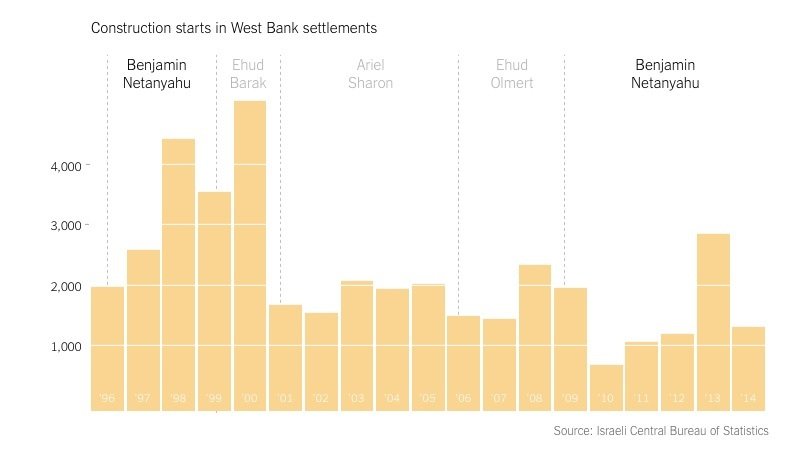
For example:

enter image description here
Modiin Illit

The biggest and fastest-growing settlement is Modiin Illit, an insular, ultra-Orthodox enclave just over the 1967 line that is widely expected to stay in Israel. In 2009, the community recorded 60 births a week; today, it has more than 60,000 residents. (NY Times)

Settlements are conducted under the belief that the land of Palestine/Israel belongs to Jews--that the Palestinian peoples have no legal or sovereign claim to the land.

The other side of the issue

To Israel or not to Israel?


The atrocities of the Holocaust created a sense of immediacy to find ways in which to resolve the so-called Jewish Question. (Ways that didn't involve annihilation.)

As citizens of their own sovereign State, Jews need not exist as a minority in a social-political context that did not welcome them as “full citizens.”


Is the issue a religious issue?

Made with Slides.com