Design Patterns for Webdev
Dependency Injection
- Overcome coupled classes
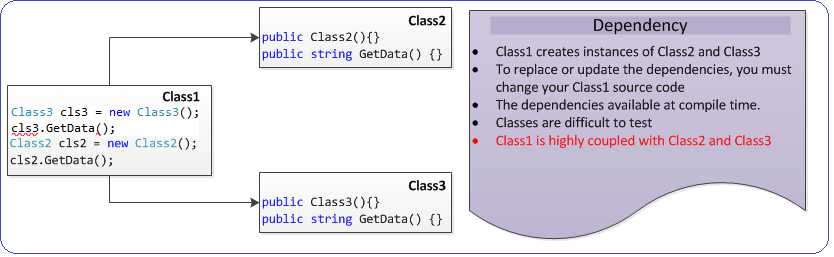
- highly coupled
- difficult to maintain
- not testable

NEW == GLUE
Dependency Injection
- Loosly coupled
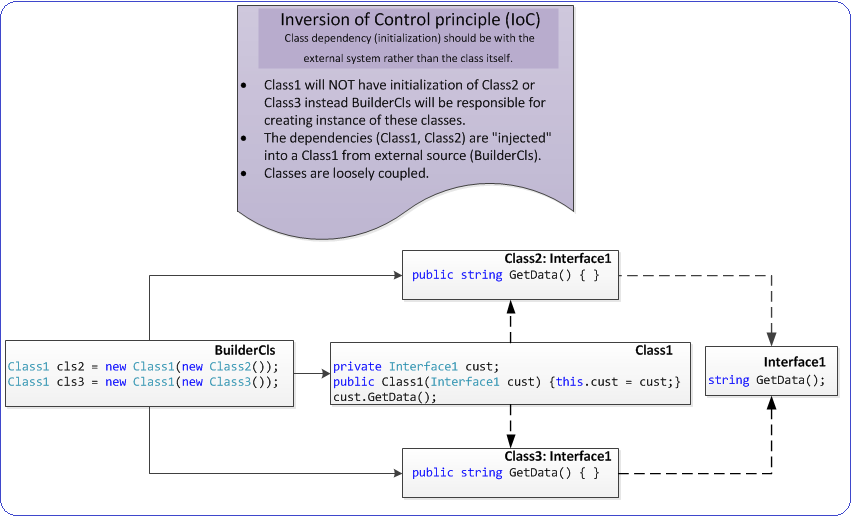
Dependency Injection
- Loosely coupled
- Objects are created by DI container
- Configured in a central place
- Interface instead of concrete classes
- implementation can be changed
- testability
- DI in three ways
- constructor injection
- method injection
- property injection
Dependency Injection
- ASP.NET Core Dependency Injection
public class MyDependency : IMyDependency
{
    private readonly ILogger<MyDependency> _logger;

    public MyDependency(ILogger<MyDependency> logger)
    {
        _logger = logger;
    }

    public Task WriteMessage(string message)
    {
        _logger.LogInformation(
            "MyDependency.WriteMessage called. Message: {MESSAGE}",
            message);

        return Task.FromResult(0);
    }
}
//startup.cs
public void ConfigureServices(IServiceCollection services)
{
//Demo (show with an example)
...
}Dependency Injection
-
Register additional services (groups of dependencies) with extension methods (Add...)
public void ConfigureServices(IServiceCollection services)
{
    services.Add(new ServiceDescriptor(typeof(IX), typeof(X), ServiceLifetime.Scoped));
    services.AddScoped<IX, X>();

    services.AddDbContext<ApplicationDbContext>(options =>
        options.UseSqlServer(Configuration.GetConnectionString("DefaultConnection")));

    services.AddIdentity<ApplicationUser, IdentityRole>()
        .AddEntityFrameworkStores<ApplicationDbContext>()
        .AddDefaultTokenProviders();

    ...
}
Dependency Injection
//https://docs.microsoft.com/en-us/aspnet/core/fundamentals/dependency-injection?view=aspnetcore-3.0
public void ConfigureServices(IServiceCollection services)
{
    ...


        services.AddScoped<IAuthorRepository, AuthorRepository>();
        services.AddScoped<IMessageRepository, MessageRepository>();
        services.AddScoped<IBlackListRepository, BlackListRepository>();

        services.AddTransient<IUnitOfWork, UnitOfWork>();
    ...
}- Lifetime of Dependencies
- Per (HTTP) Request
- Scoped
- Transient (tijdelijk)
- Created every time when requested
- Singelton (shared by all users & all request)
- Created once, shared everywhere
- Per (HTTP) Request
Trick to Check if object are the same
- In most debuggers, it's possible to "Make an object Marker"
- Check if life-time is correct and object reference variable use the same object
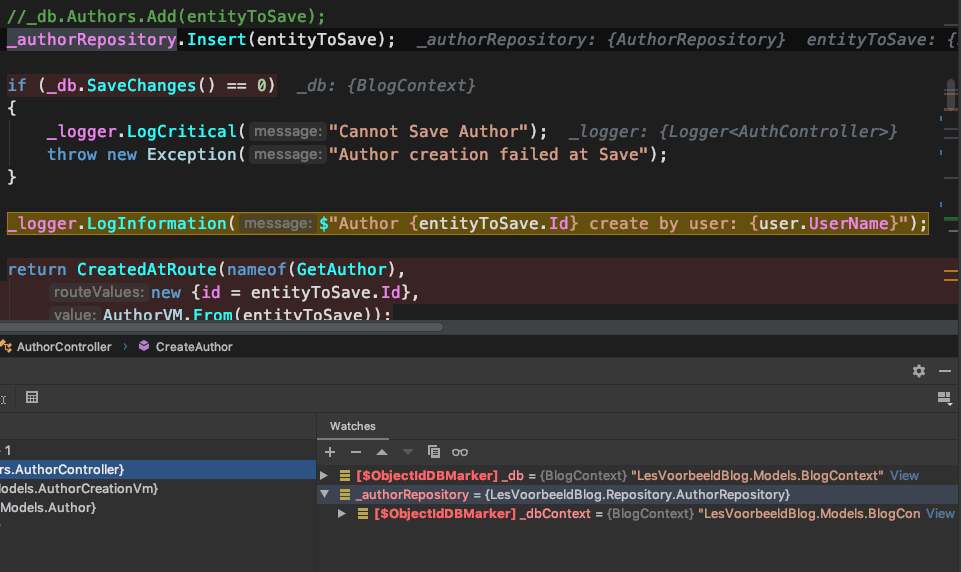
Object Marker
N - Layer architecture
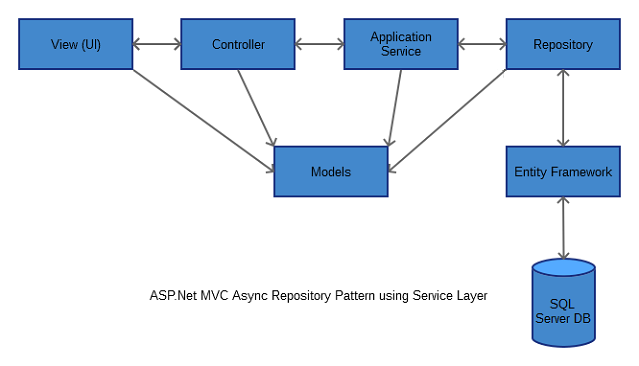
- Different Models for different "layers"
- ViewModel
- DataTransferModel (DTO)
- Conversion between models, with Mapper (Assambler Pattern)
What is a Mapper?
A mapper converts one object type into another. Typical use cases:
-
DTO ↔ Domain Model
-
API Models ↔ View Models
-
Database Entities ↔ Business Objects
Mappers help keep layers decoupled, clean, and testable
CoPilot: Can you make a sheet about mappers (AutoMapper, Mapster) design pattern idea etc
Mapster (my choice), AutoMapper ($$, :-( )
Practical Example - Mapster
Domain Model (Data Model / Entities)
public class DepartmentSummaryDto
{
    public string DepartmentName { get; set; }
    public int EmployeeCount { get; set; }
    public List<EmployeeDto> Employees { get; set; }
}

public class EmployeeDto
{
    public string FullName { get; set; }
    public string DepartmentName { get; set; }
}
public class Employee
{
    public int Id { get; set; }
    public string FirstName { get; set; }
    public string LastName { get; set; }

    public int DepartmentId { get; set; }
    public Department Department { get; set; }
}

public class Department
{
    public int Id { get; set; }
    public string Name { get; set; }

    public List<Employee> Employees { get; set; } = new();
}
DTO (Data Transfer Object)
Mapping Configuration
var department = new Department
{
    Id = 1,
    Name = "Engineering",
    Employees =
    {
        new Employee { FirstName = "Alice", LastName = "Smith" },
        new Employee { FirstName = "Bob", LastName = "Johnson" }
    }
};

var dto = department.Adapt<DepartmentSummaryDto>();
TypeAdapterConfig<Department, DepartmentSummaryDto>.NewConfig()
    .Map(dest => dest.DepartmentName, src => src.Name)
    .Map(dest => dest.EmployeeCount, src => src.Employees.Count)
    .Map(dest => dest.Employees, src => src.Employees.Adapt<List<EmployeeDto>>());

TypeAdapterConfig<Employee, EmployeeDto>.NewConfig()
    .Map(dest => dest.FullName, src => $"{src.FirstName} {src.LastName}")
    .Map(dest => dest.DepartmentName, src => src.Department.Name);
Usage
Practical Example - Mapster
Result
{
  "DepartmentName": "Engineering",
  "EmployeeCount": 2,
  "Employees": [
    { "FullName": "Alice Smith", "DepartmentName": "Engineering" },
    { "FullName": "Bob Johnson", "DepartmentName": "Engineering" }
  ]
}
Practical Example - Mapster
Repository Pattern
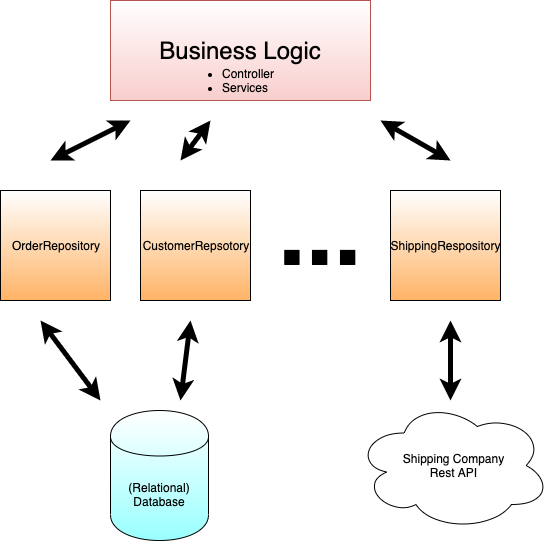
Repository Pattern
- Separate business code from data retrieval and update logic
- Shielded from Low-level Details
- Any Data Source can be used (combination)
- SQL Code (ADO.NET), ORM Frameworks, File, Webservice, NoSQL database, etc
- Testability
- Mock with stubs
- Use a simple (in memory) database for testing
- Data access is not the responsibility of Business Logic
- SoC = Separation of Concerns
- ORM/Data-access details changes over time, new features other/frameworks
Repository Pattern
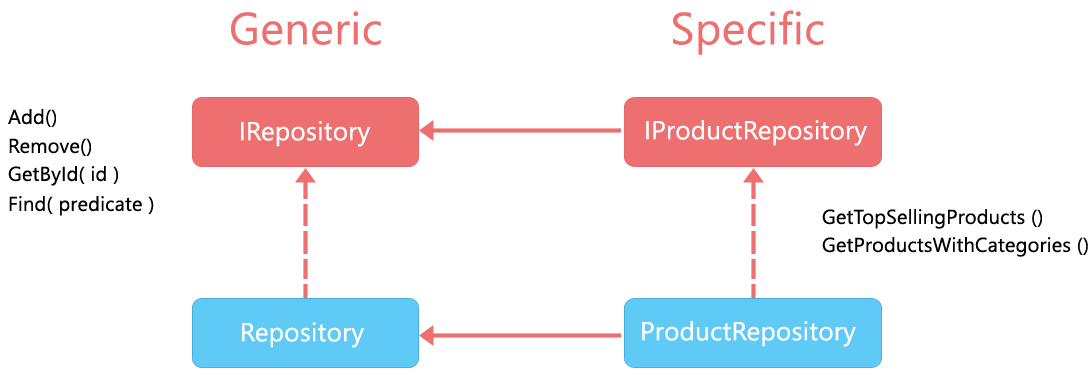
Repository behaves like a collection!
Repository Generic Interface
    public interface IRepository<T> where T : class
    {
        T GetById(int id);
        IEnumerable<T> Get();
        IEnumerable<T> Get(Expression<Func<T, bool>> predicate);
        void Insert(T entity);
        void Delete(T entity);
        void Update(T entity);
    }
Repository Generic Abstract base class
public abstract class Repository<T> : IRepository<T> where T : class
{
    protected readonly DbContext _dbContext;

    //Normally Repository works only with UnitOfWork!
    //this is only for demonstration purpose, such that this repository
    //also works without a UnitOfWork.

    public Repository(DbContext dbContext)
    {
        _dbContext = dbContext;
    }

    //exposes IQueryable interface to outside world (with a public access modifier)
    //is not a good idea!
    protected IQueryable<T> AsQueryable()
    {
        return _dbContext.Set<T>().AsNoTracking();
    }

    public virtual T GetById(int id)
    {
        return _dbContext.Set<T>().Find(id);
    }

    public virtual IEnumerable<T> Get()
    {
        return _dbContext.Set<T>().AsEnumerable();
    }

    public virtual IEnumerable<T> Get(Expression<Func<T, bool>> predicate)
    {
        return _dbContext.Set<T>()
            .Where(predicate)
            .AsEnumerable();
    }

    public void Insert(T entity)
    {
        _dbContext.Set<T>().Add(entity);
    }

    public void Update(T entity)
    {
        _dbContext.Entry(entity).State = EntityState.Modified;
    }

    public void Delete(T entity)
    {
        _dbContext.Set<T>().Remove(entity);
    }
}
Specific Repository Implementation
    public interface IAuthorRepository : IRepository<Author>
    {
        Author GetByIdWithOwner(int id);
    }

    public class AuthorRepository : Repository<Author>, IAuthorRepository
    {
        public AuthorRepository(BlogContext dbContext) : base(dbContext)
        {
        }

        public Author GetByIdWithOwner(int id)
        {
            return AsQueryable().Include(x => x.Owner)
                .FirstOrDefault(x => x.Id == id);
        }
    }
Usage of Repository in Controller
        [HttpGet(Name = nameof(GetAuthor))]
        public ActionResult<IEnumerable<AuthorVM>> GetAuthor()
        {
//            var authorDtos = _db.Authors
//                .Include(x => x.Owner)
//                .Select(x => AuthorVM.From(x)).ToList();

            var authors = _authorRepository.Get();
            var authorDtos = _mapper.Map<IEnumerable<AuthorVM>>(authors);
//                .Select(x => AuthorDto.From(x));

            return Ok(authorDtos);
        }

        [HttpGet("{id}")]
        public ActionResult<AuthorVM> GetAuthors(int id)
        {
//            var author = _db.Authors
//                .Include(x => x.Owner)
//                .SingleOrDefault(x => x.Id == id);

            var author = _authorRepository.GetByIdWithOwner(id);

            if (author == null)
            {
                return NotFound();
            }

            return Ok(AuthorVM.From(author));
        }
Mocking Repository to test controller
[Fact]
public void Get_ReturnsAuthorVm_VMModelHasCorrectAuthorValues()
{
    // Arrange
    var mockRepo = new Mock<IAuthorRepository>();
    var author = new Author()
    {
        Id = 1,
        BirthDate = new DateTime(2000, 1, 1),
        Email = "test@test.com",
        FirstName = "test1 firstname",
        LastName = "test1 lastname",
        Owner = new IdentityUser("AdminTest")
    };
    mockRepo.Setup(repo => repo.GetByIdWithOwner(1))
        .Returns(author);

    var controller = new SimpleControllerForTest(mockRepo.Object);

    // Act
    var result = controller.Get(1);

    var okObjectResult = Assert.IsAssignableFrom<OkObjectResult>(result.Result);
    var authorVm = Assert.IsAssignableFrom<AuthorVM>(okObjectResult.Value);

    // Assert
    Assert.Equal(author.Id, authorVm.Id);
    Assert.Equal(author.FirstName + " " +author.LastName, authorVm.Name);
    Assert.Equal(author.Owner.UserName, authorVm.OwnerName);
}
Repository Result
- Complexity reduces because of abstractions
- more classes, interfaces
- Benefits
- keeps business logic free from data access code
- central class for data access
- maintainability, flexibility
- not tied to a data access implementation
- testability (mocks)
- Related Design Patterns
- Unit of Work (atomic work over multiple Repo's)
- Decorating a Repository (caching, logging, etc)
- Mappers (to and from View Models Models)
- The repository can be used in services (complex business logic)
A Better Repository Implementation
Unit of Work
- Unit of Work = track changes to be made
- efficiency
- transaction management (atomic operation)
- commit or rollback
- Complex interactions with all or nothing behavior with multiple repositories
- Complex interaction = update, delete, insert
- all or nothing = transaction (concurrency issues)
- For example
- Subtract the amount x from account 1
- Add the amount x to account 2
- For example
- Saves database roundtrips
- when doing multiple C
RUD operations- updates/inserts/delete
- when doing multiple C
Unit of Work
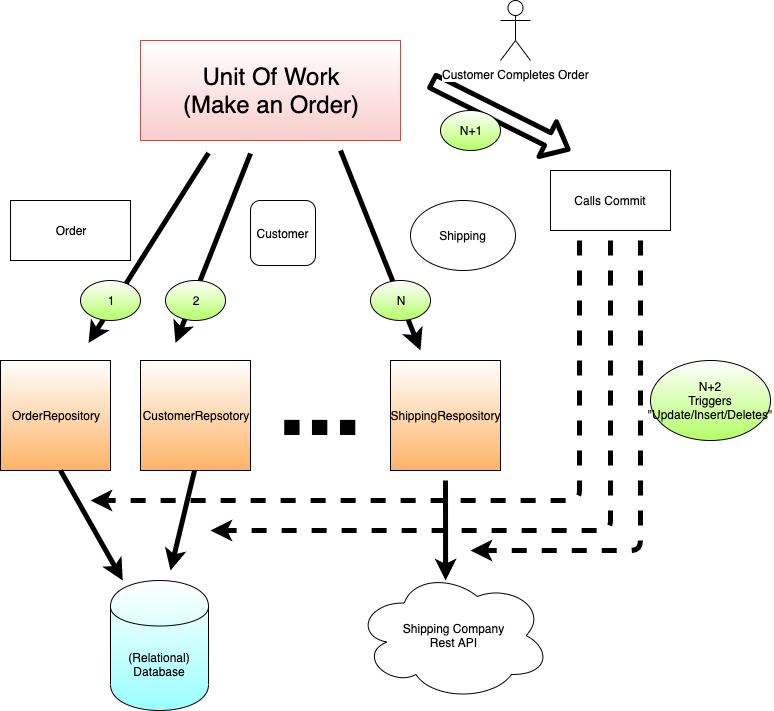
Unit of Work
- An example without Unit of Work
- A lot of database interaction, for each Delete(...)
- What happens when code crashes?
- Author not Blacklisted, some message "f**k" deleted others not
        [HttpGet("{id}")]
        public ActionResult<bool> BlackListAuthorWithoutUnitOfWork(int id)
        {
            var author = _authorRepository.GetById(id);

            bool blackList = false;
            foreach (var message in _messageRepository.GetMessageForAuthor(author))
            {
                if (message.Description.Contains("f**k"))
                {
                    _messageRepository.Delete(message);
                    //suppose something goes wrong with deleting or program crashes (Exception)!
                    //some messages are delete and others not
                    blackList = true;
                }
            }

            if (blackList)
            {
                _blackListRepository.AddAuthorToBlacklist(author);
            }

            return Ok(blackList);
        }
Unit of Work
- An example with Unit of Work
- all database calls are sent once
        [HttpGet("{id}")]
        public ActionResult<bool> BlackListAuthorWithUnitOfWork(int id)
        {
            bool blackList = false;

            var author = _authorRepository.GetById(id);

            foreach (var message in _messageRepository.GetMessageForAuthor(author))
            {
                if (message.Description.Contains("f**k"))
                {
                    _messageRepository.Delete(message);
                    //suppose something goes wrong with deleting or program crashes (Exception)!
                    //some message are delete and others not
                    blackList = true;
                }
            }

            if (blackList)
            {
             	_blackListRepository.AddAuthorToBlacklist(author);
                _db.SaveChanges(); //Commit() the Unit Of Work
            }

            return Ok(blackList);
        }
Unit of Work
- Implementation
- In Entity Framework Core
- The DbContext is a Unit Of Work!!!
- Unit Of Work for free by Dependency Injection container
- Why are there so many crappy implementations on the internet?
- In Entity Framework Core
Unit of Work
public void ConfigureServices(IServiceCollection services)
{
    services.AddDbContext<BlogContext>(options =>
        options.UseSqlite("Data Source=Blog.db"));

    services.AddMvc().SetCompatibilityVersion(CompatibilityVersion.Version_2_1);

    services.AddIdentity<IdentityUser, IdentityRole>()
        .AddEntityFrameworkStores<BlogContext>();

    services.AddScoped<IAuthorRepository, AuthorRepository>();
    services.AddScoped<IMessageRepository, MessageRepository>();

services.AddTransient<IBlacklistService, BlacklistService>();- Unit Of Work == BlogContext == DbContext
- AddDbContext registers BlogContext as Scoped
- Lifetype is Scoped!
- The same BlogContext instance is injected into the Repo's by dependency injection
Unit of Work
- For each HTTP Request
- For each HTTP Request Create a Unit of Work
- AddDbContext<T> (lifetime scoped)
- For each HTTP Request Create a Unit of Work
-
Atomicity & Saves database calls!
- SaveChanges()
- Logical transactions
- Tracks changes
- Related to Repository Design Pattern
- they work together