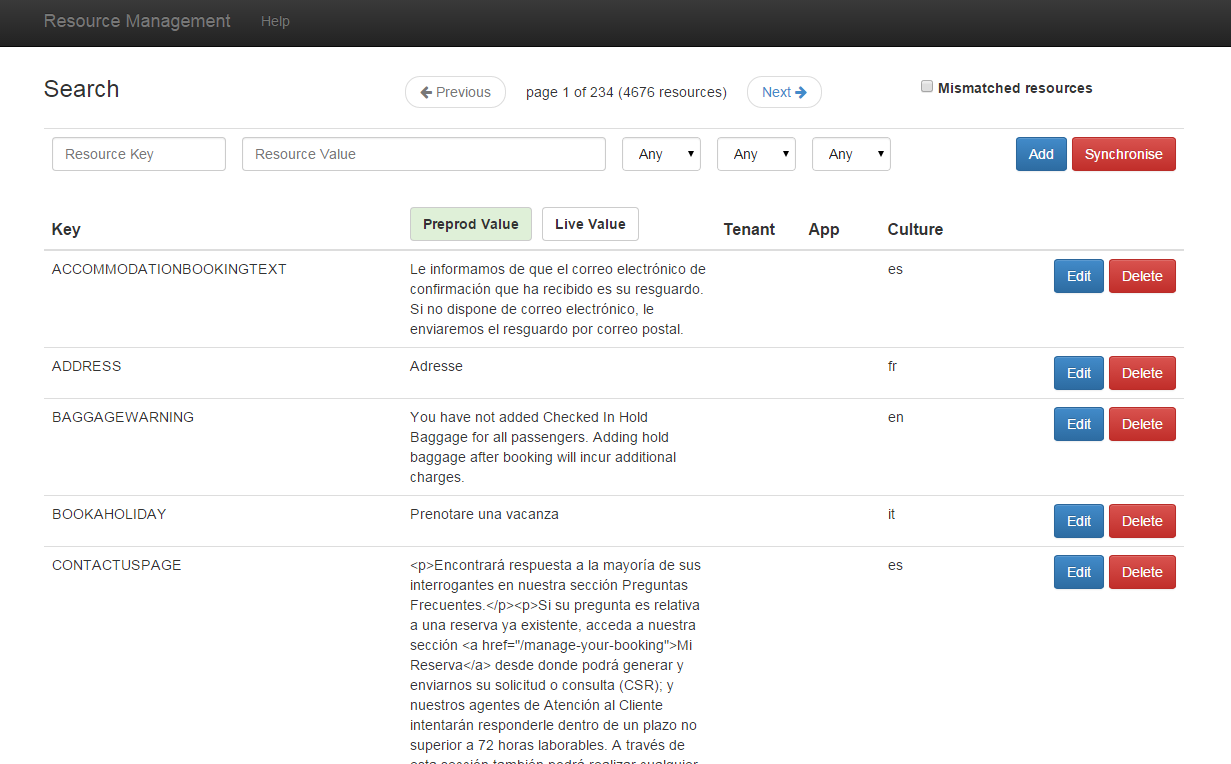
Resource Dashboard
there will be no maths ...
Problems with most* UI development
-
spaghetti
-
two-way data flow
-
rampant mutation
-
expensive change tracking
-
performance
* yes ours too

- Rich Hickey -
The role of functional programming
-
FP programs are compositions of pure functions with strictly contained side effects -
Pure functions are easy to test, easy to parallelise, easy to refactor -
FP programs are predictable
-
FP favours immutable data
How does this solve the UI problem?
-
An app or site is a composition of UI components -
A UI component is a pure function that accepts application state and returns a representation of the UI -
Same state -> same UI -
Different state -> new UI
Has anyone done this for us?
-
Facebook with React framework? -
Gives us a one way data flow -
Components can be regarded as pure functions -
Virtual DOM is the much copied secret sauce -
One way flow + vdom + immutable data == FAST

Why Clojure?
* puke
-
Very well designed simple lisp - we all “transpile*” anyway -
powerful meta programming capabilities -
code is data -
“Isomorphic*” -
Functional slant -
Immutable by default with good concurrency primitives -
Live coding -
Fun -
Hiccup - html is code not a string (can be transformed)

A crash course in clojure ...
(
func
(
func2 arg arg)
)
arg
start s-expression
first form is always a function
then come the arguments
which can be function calls
#
(
func3 arg arg)
or lambdas
close s-expression
Notice that this whole thing is itself a list:
codeception
Why Reagent?
-
A super simple wrapper around react -
Very nice hiccup style templating
(defn simple-parent []
  [:div
   [:p "I include simple-component."]
   [simple-component]])
(defn hello-component [name]
[:p "Hello, " name "!"])
(defn say-hello []
[hello-component "world"])(ns example
(:require [reagent.core :as reagent :refer [atom]]))
(def click-count (atom 0))
(defn counting-component []
[:div
"The atom " [:code "click-count"] " has value: "
@click-count ". "
[:input {:type "button" :value "Click me!"
:on-click #(swap! click-count inc)}]])(ns example
(:require [reagent.core :as reagent :refer [atom]]))
(defn atom-input [value]
[:input {:type "text"
:value @value
:on-change #(reset! value (-> % .-target .-value))}])
(defn shared-state []
(let [val (atom "foo")]
(fn []
[:div
[:p "The value is now: " @val]
[:p "Change it here: " [atom-input val]]])))Why Re-frame?
-
provides a simple and magical way to manage state
;;subscriptions

(register-sub :paging
    (fn [db _]
        (reaction (:paging @db)))))
;;component
(defn pager []
  (let [paging (subscribe [:paging])]
    (fn []
      (let [index (:index @paging)
            size (:size @paging)
            total (:total @paging)
            pages (.ceil js/Math (/ total size))
            start (* index size)
            end (+ start size)]
      [:ul.pager
       [:li {:className (if (= index 0) "disabled") }
        [:a {:on-click #(when (> index 0) ( dispatch [:change-page dec]))
             :href "#"} [:i.fa.fa-arrow-left] "  Previous"]]
       [:li.record-count (str "page " (inc index) " of "  pages  " (" total " resources)")]
       [:li {:className (if (= pages (inc index)) "disabled") }
        [:a {:on-click #(when (< (inc index) pages) ( dispatch [:change-page inc]))
             :href "#"} "Next  " [:i.fa.fa-arrow-right]]]]))))
;;message handler
(register-handler
  :change-page
  (fn [db [_ op]]
    (let [i (get-in db [:paging :index])
          paging (assoc (get db :paging) :index (op i))]
     (search (:search db) paging :search-results)
      (assoc db :paging paging))))
Not everything
is awesome
-
testing -
debugging -
THE BRACKETS! -
learning curve
Should we do this?
-
Yes and no -
Maybe -
Probably not - We should be inspired by it
Questions?
https://github.com/clojure/clojurescript
https://github.com/Day8/re-frame
http://facebook.github.io/react/
https://reagent-project.github.io/index.html
References
- Demo (repl [doc, source, js/alert], render function, interactive message dispatch, add new mode)
- It there's time - have a look at the server.
- Explain a bit about compojure, edn, YESQL ...
- Talk about tools editors (vim, fireplace, lightable, cursive)