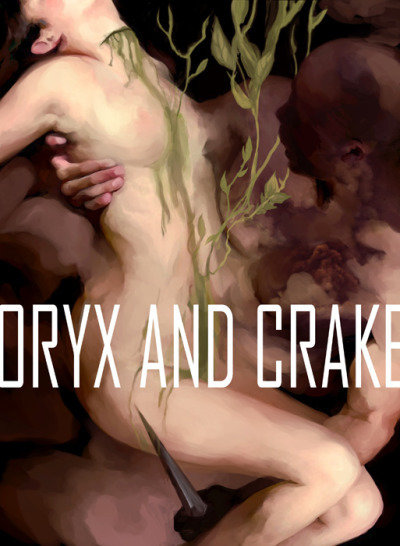
The Post-human in Oryx and Crake
The Other
Lorem ipsum dolor sit amet, consectetur adipiscing elit. Morbi nec metus justo. Aliquam erat volutpat.
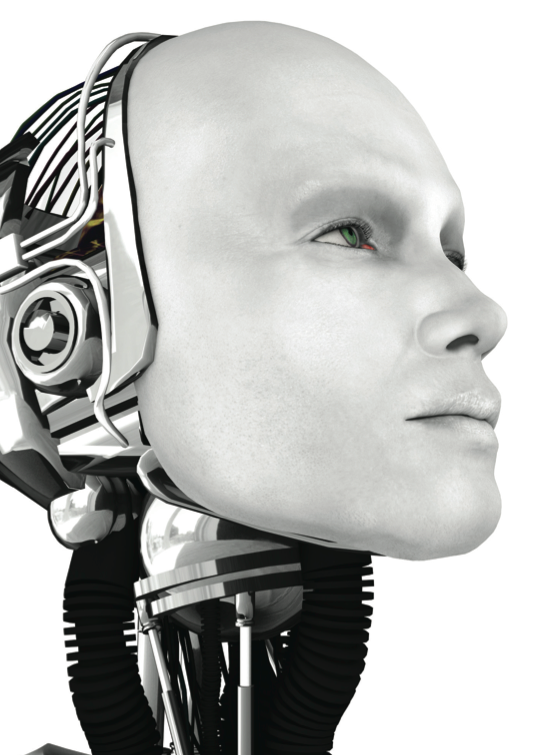
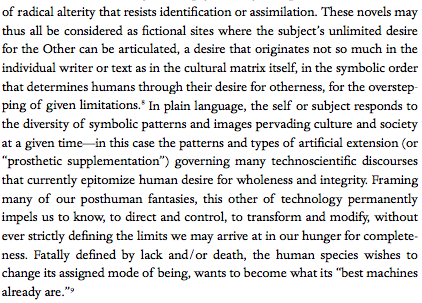
—Ralph Pordzik. "The Post-Human Future of Man." Utopian Studies.
Simulacra & Post-humans
- Baudrillard
- Humans so reliant on models and maps as to lose contact with the real world
- Twitter, iPhones, Google Maps
- "The territory no longer precedes the map, nor does it survive it. It is nevertheless the map that precedes the territory—precession of simulacra—that engenders the territory." (Baudrillard, "The Precession of Simulacra")
Simulacra
Pordzik: In some fictions, the post-human appears to be human, but lacks "meaning, alternatives, or real means of change...embody humanism without essence, physicality without inwardness, animation without direction" (147).
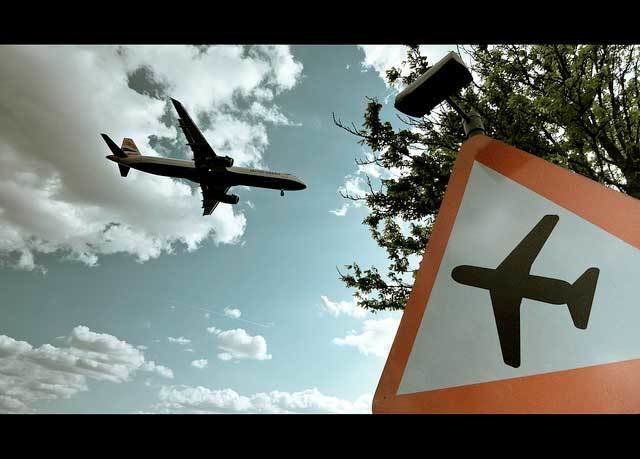
Cyborgs
Pordzik
"The sovereignty of the self, already under attack in the last decades of the nineteenth century and put to a further test by the digital revolution of the twentieth century, is promised a new, if only conferred, life and future in a quasi-spiritual medium no longer in need of a natural environment" (150).
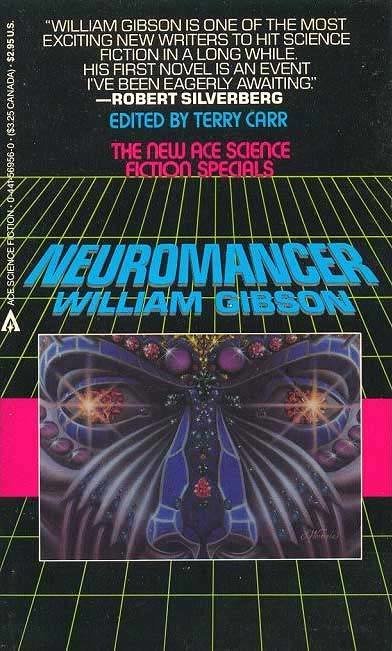
"By creating new machinery to improve conditions of living, humanity also changes the accompanying processes of environmental interaction—a form of intervention that in turn impinges on its further intellectual and emotional development" (150).
Pordzik
"The posthuman as a means of managing the human and the technological domains, as a pattern inflected and enriched by computational systems, is achieved and partially confirmed, but it also remains a questionable if not dismal scenario. The production of a body and self purified and rejuvenated is only possible at the great cost of permanent exchange with the others of technology: All one's energies and desires are going into the project of creating and sustaining an updated version of humanity; conversely, new technologies and information systems are grafted onto the inborn 'lack' of a human individual in constant need of such therapeutic supplementation" (152).
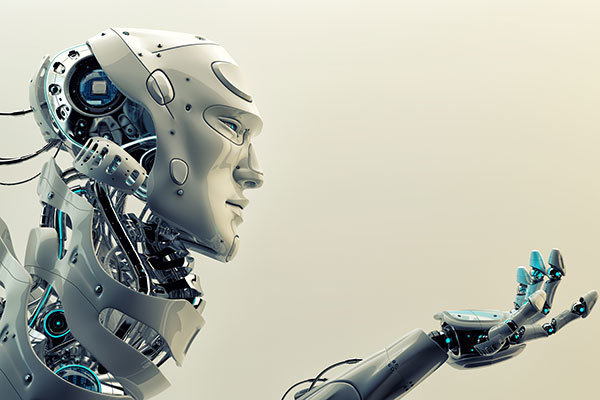
Crakers in O&C
""They are supposed to be perfectly balanced and happy the way they are: no instinct for self-preservation corrodes their artless ways; no sense of competition, sublimation, or religion; no need to consume proteins—invariably, they are grass-eating herbivores" (Pordzik 153).
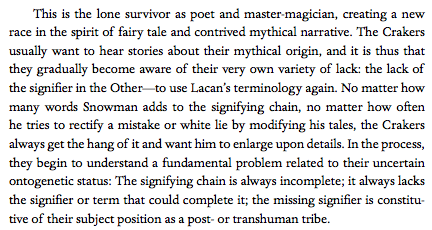
(Pordzik 154)
Discourse and Language
- Language as intrinsic to biological materiality (155)
- "Words are always supplementary...discourse is therefore another prosthesis the human subject puts to good use, intent on trespassing acknowledged limitations, exploring new territory, and thus changing or enhancing the brain's substance in neuronal, organic terms as well" (155).
- Crakers "acknowledge and transcend the lack they perceive to exist in their world" (155).