Quantum algorithms for optimisation derived from the non-Euclidean geometry of quantum computing operations
Marek Gluza
NTU Singapore
Scan QR code or go to slides.com/marekgluza

What is a quantum computer?
It is a quantum system e.g. ionized atom, loop of a superconductor
It is modeled by a finite dimensional vector space \(\mathcal V = \mathbb C^d\)
It is modular: We can add more of its components and make \(d\) grow
It is programmable: There are ways (quantum gates) to change its states in a reproducible and reversible manner
It is universal: Composing sufficiently many of the programmable operations allows to approximate any \(v = |v\rangle \in \mathcal V\)
We take more qubits
Apply patterned EM radiation
Reproducible: Use FPGA
Reversible: Physics challenge; keep cold
Physics papers from the 90's
|
|
|
|---|---|
|
|
|
|
|
|
|
|
|
|
|
We can make it!
We take \(n\) qubits then \(\mathcal V = (\mathbb C^2)^{\otimes n}\) and \(d=2^n\)
What is a quantum computer?
A quantum computer is an experimental setup A which includes a quantum system B and that setup A allows to manipulate the quantum state of B.
This is modeled by mulitplying unitary matrices to vectors from a finite-dimensional vector space.
Types of quantum computers:
- A) Superconducting loops
- B) Ionized atoms
- C) Neutral atoms
- D) Others
Companies:
- A) Google, IQM, IBM, Rigetti
- B) Quantinuum, IonQ
- C) Quera, Atom Computing, Pasqal
- D) Alice&Bob, Qolab, Normal Computing, Psi-Quantum,
Zapata
Currently 80 companies listed here:
https://thequantuminsider.com/2025/09/23/top-quantum-computing-companies/
What are quantum algorithms?
We model quantum computing operations by mulitplying unitary matrices to vectors from a finite-dimensional vector space:
- States of the quantum computer are vectors.
- Operations on the quantum computer rotate these vectors.
- Two consecutive rotations are a rotation.
- The space of all rotations generalizes the geometry of the sphere.
- Straight lines in the space of rotations are those which don't change their direction.
- Going SOUTH-WEST-NORTH-EAST in the space of all rotations spirals away from the point of origin.
- Repeating two directions sufficiently many times will bring you eventually everywhere.
Braket notation
1 qubit:
*The biography of the physicist who proposed it is literally called "The strangest man"

*Dirac was one of the smartest quantum physicist in history
"ket"
"bra"
"bracket"
"quantum superposition"
What is a universal quantum computer?
1 qubit
2 qubits
3 qubits
4 qubits
it can approximate any state preparation via circuits
It is a machine for realizing such linear combinations in nature
0
0
0
0
C
Operating a quantum computer is all about the group of unitary matrices
Think of rotations on a sphere
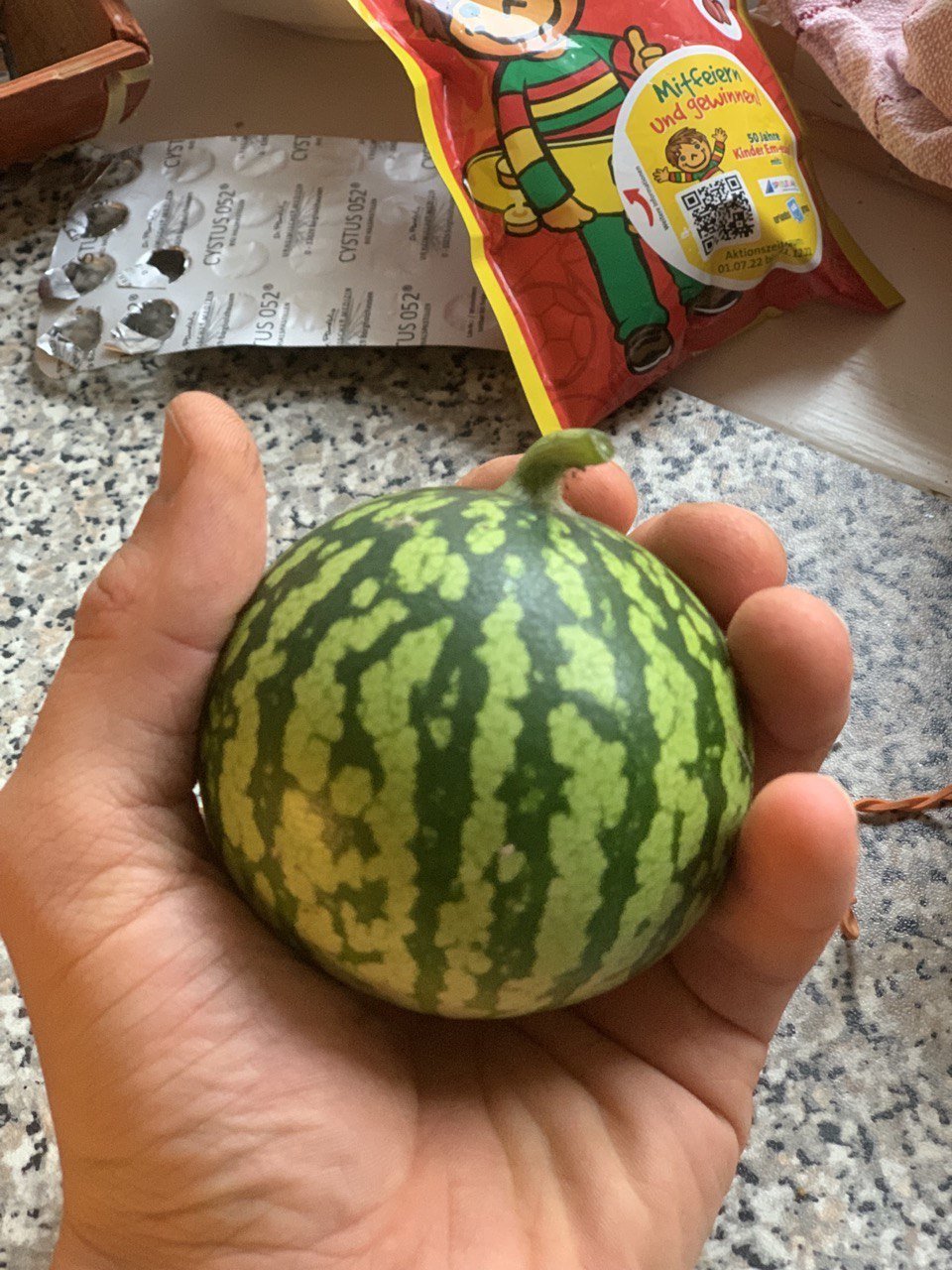
What are quantum algorithms?
We model quantum computing operations by mulitplying unitary matrices to vectors from a finite-dimensional vector space:
- States of the quantum computer are vectors.
- Operations on the quantum computer rotate these vectors.
- Two consecutive rotations are a rotation.
- The space of all rotations generalizes the geometry of the sphere.
- Straight lines in the space of rotations are those which don't change their direction.
- Going SOUTH-WEST-NORTH-EAST in the space of all rotations spirals away from the point of origin.
- Repeating two directions sufficiently many times will bring you eventually everywhere.
Riemannian geometry is essential for quantum computation
- The unitary group \(U(d)\) is a Riemannian manifold
- It is an embedded manifold \(U(d) = \{M\in \mathbb C^{d\times d}:~M^{-1}=M^\dagger\}\)
- The tangent space is \(\{W\in \mathbb C^{d\times d}:~W^{\dagger}= -W\} \simeq\{iH \mathrm{~where~} H=H^\dagger\in \mathbb C^{d\times d}\} \)
- The geodesics are matrix exponentials \( \{e^{sW}\}_{s\in\mathbb R} \subset U(d)\) or \( \{e^{isH}\}_{s\in\mathbb R} \subset U(d)\)
- Computing a "gradient" must output an element of the tangent space
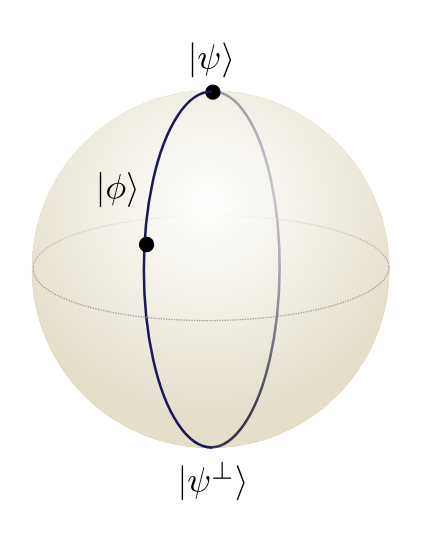

\(\partial_{i,j}\) points to the interior, not tangential
To go straight to New York, follow the equator. Don't drill a tunnel to literally go straight.
Unlike in flat space, going SOUTH-WEST-NORTH-EAST in the space of all rotations spirals away from the point of origin.
Riemannian geometry is essential for quantum computation
- The unitary group \(U(d)\) is a Riemannian manifold
- The tangent space is \(\{H\in \mathbb C^{d\times d}:~H^{\dagger}= H\} \)
- The geodesics are matrix exponentials \( \{e^{isH}\}_{s\in\mathbb R} \subset U(d)\)
- \(U(d)\) is a curved manifold
Operating a quantum computer is all about the group of unitary matrices
Think of rotations on a sphere
Universal quantum computation means: Composing sufficiently many basic unitary matrices (elementary quantum gates \(G_1,G_2,\ldots, G_K\)) can approximate any other 'larger' unitary.
(finding these sequences = task of unitary synthesis)
4 stages of creating quantum algorithms
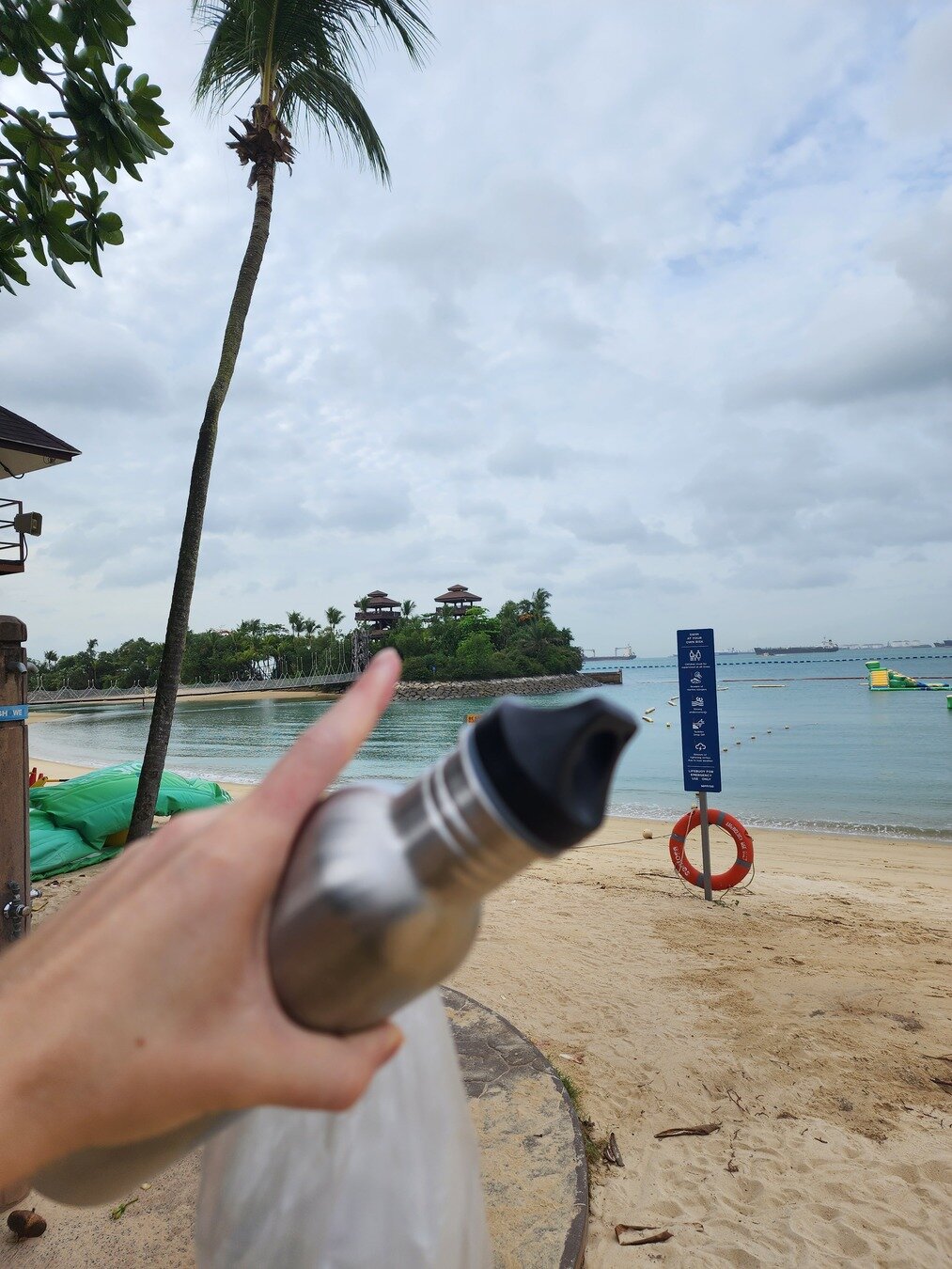
1. Design choice:
How to go about it?
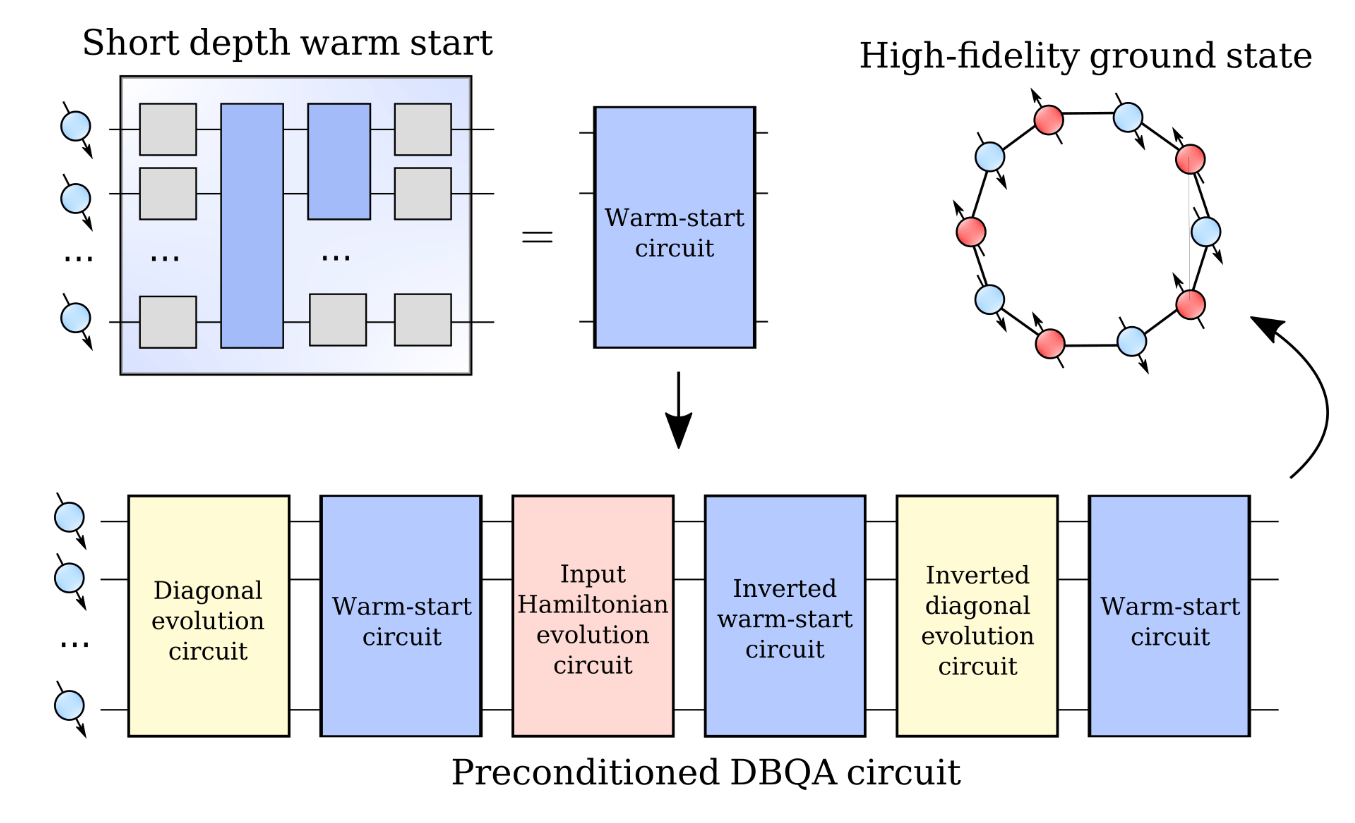
2. Unitary synthesis:
How to do it?

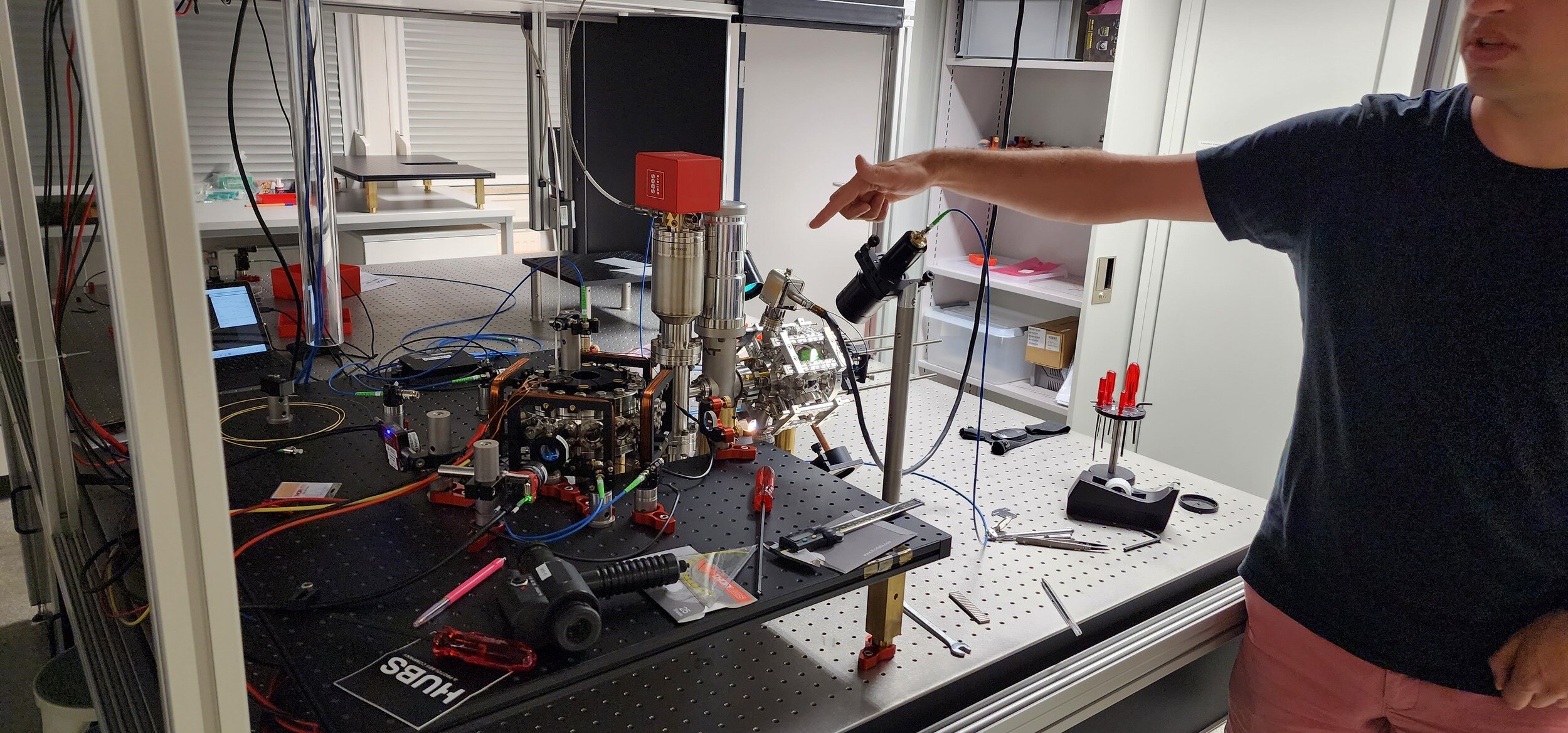
3. Circuit compilation:
What gates to do?
0. Problem choice:
What challenge to take up?
Double-bracket quantum algorithms:
Systematic framework for unitary synthesis
Quantum computing cannot be useful if
- The problem can be solved quickly on classical computers
- Solving the problem isn't important
- Solving the problem is too hard for the quantum computer
Classical computation
Key question in current quantum computation:
Find an important problem which is difficult yet doable
Millenials
What challenge to take up?
Quantum computing cannot be useful if
- The problem can be solved quickly on classical computers
- Solving the problem isn't important
- Solving the problem is too hard for the quantum computer
Key question in current quantum computation:
Find an important problem which is difficult yet doable
What challenge to take up?
Materials science?
Why materials science? Imagine improving photovoltaics by 1%.
What needs to be done? Perform \(\bra\psi H\ket\psi\) optimization.
How? Quantum circuit synthesis.
Non-Euclidean geometry leads to quantum algorithms
Next: How to get $$ from a quantum computer?
We need to optimize among all operations of the quantum computer to get a low-energy state
(Non-Euclidean optimization)
4 stages of creating quantum algorithms
1. Design choice:
How to go about it?
3. Circuit compilation:
What gates to do?
0. Problem choice:
What challenge to take up?
2. Unitary synthesis:
How to do it?
Double-bracket quantum algorithms:
Systematic framework for unitary synthesis
4 stages of creating quantum algorithms
4 stages of creating quantum algorithms
1. Design choice:
How to go about it?
3. Circuit compilation:
What gates to do?
0. Problem choice:
What challenge to take up?
2. Unitary synthesis:
How to do it?
4 stages of creating quantum algorithms
Imaginary-time evolution
4 stages of creating quantum algorithms
1. Design choice:
How to go about it?
3. Circuit compilation:
What gates to do?
0. Problem choice:
What challenge to take up?
2. Unitary synthesis:
How to do it?
4 stages of creating quantum algorithms
4 stages of creating quantum algorithms
1. Design choice:
How to go about it?
3. Circuit compilation:
What gates to do?
0. Problem choice:
What challenge to take up?
2. Unitary synthesis:
How to do it?
Double-bracket quantum algorithms:
Systematic framework for unitary synthesis
4 stages of creating quantum algorithms
Operating a quantum computer is all about the group of unitary matrices
Think of rotations on a sphere
The Lie bracket of two 'velocities' is again a velocity:
Check: \([A,B]^\dagger = (AB- BA)^\dagger = B^\dagger A^\dagger -A^\dagger B^\dagger = -[A,B]\)
\([A,B]^\dagger = -[A,B]\)
Check: \([A,B]^\dagger = -[A,B]\)
Operating a quantum computer is all about the group of unitary matrices
Think of rotations on a sphere
Fact 3: The Lie bracket of two 'velocities' is again a velocity
Operating a quantum computer is all about the group of unitary matrices
Think of rotations on a sphere
Fact 3: The Lie bracket of two 'velocities' is again a velocity
My quantum algorithms use such unitary matrices - they are implementing Riemannian gradient descent
The main tool of double-bracket quantum algorithms
Note that choosing \(A=H\) doesn't change the energy
Let's find which directions \(A\) are more useful!
\(\partial_{i,j}\) points to the interior, not tangential so which direction is best?
Text
We need to find a tangential direction which lowers the energy of \(\ket\psi\)
Let's see how a direction \(A=A^\dagger\) changes the energy of \(\ket\psi\)
This bracket is called the Riemannian gradient
Double-bracket quantum algorithms:
Systematic framework for implementing exponentials of commutators on quantum computers. This uncovered new unitary synthesis formulas.

4 stages of creating quantum algorithms
1. Design choice:
How to go about it?
3. Circuit compilation:
What gates to do?
0. Problem choice:
What challenge to take up?
2. Unitary synthesis:
How to do it?
Double-bracket quantum algorithms:
Systematic framework for unitary synthesis
4 stages of creating quantum algorithms
4 stages of creating quantum algorithms
Product formula approximation:
\(e^{\tau[|\psi\rangle\langle\psi|,H]} = e^{i\sqrt{\tau}H}e^{i\sqrt{\tau}|\psi\rangle\langle\psi|}e^{-i\sqrt{\tau}H}e^{-i\sqrt{\tau}|\psi\rangle\langle\psi|} + O(\tau^{3/2})\)
4 stages of creating quantum algorithms
2. Unitary synthesis:
How to do it?
1. Design choice:
How to go about it?
3. Circuit compilation:
What gates to do?
0. Problem choice:
What challenge to take up?
3. Circuit compilation:
What gates to do?
Product formula approximation:
\(e^{\tau[|\psi\rangle\langle\psi|,H]} = e^{i\sqrt{\tau}H}e^{i\sqrt{\tau}|\psi\rangle\langle\psi|}e^{-i\sqrt{\tau}H}e^{-i\sqrt{\tau}|\psi\rangle\langle\psi|} + O(\tau^{3/2})\)
Quantum algorithm DB-QITE - iterate recursively:
- Define \(|{\psi_k}\rangle = U_k |0\rangle\)
- Use \(e^{is |\psi_k\rangle\langle\psi_k|} = U_ke^{is |0\rangle\langle0|}U_k^\dagger \)
- Recursively iterate \( U_{k+1} = e^{is H} U_k e^{is |0\rangle\langle 0|} U_k^\dagger e^{-is H} U_k\)
3 stages of creating quantum algorithms
1. Design choice:
How to go about it?
3. Circuit compilation:
What gates to do?
0. Problem choice:
What challenge to take up?
4 stages of creating quantum algorithms
2. Unitary synthesis:
How to do it?

(accepted at PRL)
3. Circuit compilation:
What gates to do?
Product formula approximation:
\(e^{\tau[|\psi\rangle\langle\psi|,H]} = e^{i\sqrt{\tau}H}e^{i\sqrt{\tau}|\psi\rangle\langle\psi|}e^{-i\sqrt{\tau}H}e^{-i\sqrt{\tau}|\psi\rangle\langle\psi|} + O(\tau^{3/2})\)
Quantum algorithm DB-QITE - iterate recursively:
- Define \(|{\psi_k}\rangle = U_k |0\rangle\)
- Use \(e^{is |\psi_k\rangle\langle\psi_k|} = U_ke^{is |0\rangle\langle0|}U_k^\dagger \)
- Recursively iterate \( U_{k+1} = e^{is H} U_k e^{is |0\rangle\langle 0|} U_k^\dagger e^{-is H} U_k\)
3 stages of creating quantum algorithms
1. Design choice:
How to go about it?
3. Circuit compilation:
What gates to do?
0. Problem choice:
What challenge to take up?
4 stages of creating quantum algorithms
2. Unitary synthesis:
How to do it?
(accepted at PRL)
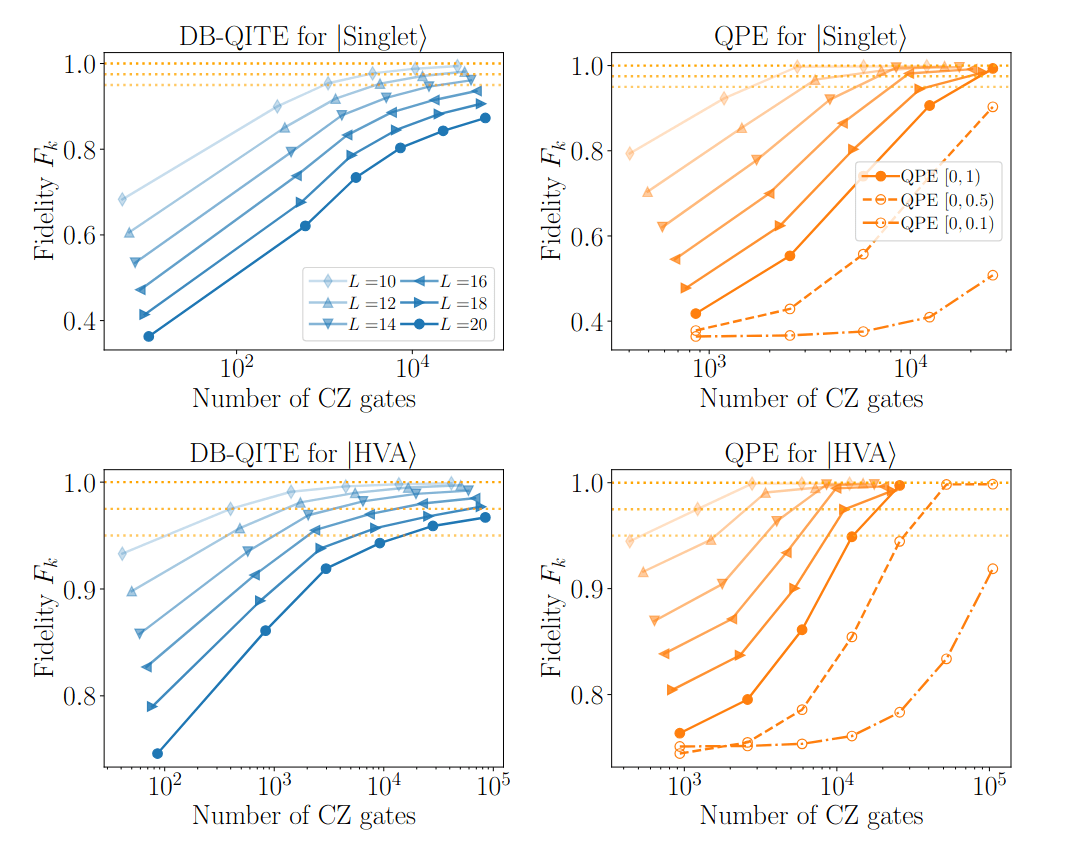
Numerical results for DB-QITE:
DB-QITE:
- Define \(|{\psi_k}\rangle = U_k |0\rangle\)
- Recursively iterate \( U_{k+1} = e^{is H} U_k e^{is |0\rangle\langle 0|} U_k^\dagger e^{-is H} U_k\)
Then:


Quantinuum
(accepted at PRL)
4 stages of creating quantum algorithms
1. Design choice:
How to go about it?
3. Circuit compilation:
What gates to do?
0. Problem choice:
What challenge to take up?
2. Unitary synthesis:
How to do it?
Double-bracket quantum algorithms:
Systematic framework for unitary synthesis
4 stages of creating quantum algorithms
Double-bracket quantum algorithms
Click these links at slides.com/marekgluza
| Diagonalization | https://arxiv.org/abs/2206.11772 | ||
|---|---|---|---|
| Imaginary-time evolution | https://arxiv.org/abs/2412.04554 | ||
| Quantum signal processing | https://arxiv.org/abs/2504.01077 | ||
| Grover's search | https://arxiv.org/abs/2507.15065 | Approximates ITE |
Solve the unitary synthesis problem in all these cases through Riemannian gradients!
Double-bracket quantum algorithms
- Coherently implement Riemannian gradient steps
-
Give rigorous unitary synthesis for
- imaginary-time evolution
- quantum signal processing
- diagonalization unitaries
- Grover's as an approximation to imaginary-time evolution
- Training quantum circuits from data doesn't work well, unlike in classical machine learning applications. However those variational learning methods are great for warm-starting double-bracket quantum algorithms!
Tell me when not fast enough? Get stuck? Something else?
Your input is needed to improve them!
N. Ng
Z. Holmes
R. Zander

R. Seidel
Y. Suzuki
B. Tiang
J. Son
S. Carrazza
Stay in touch on LinkedIn:
Text
Text
Text
Marek Gluza
The double-bracket quantum algorithms roadmap
I grew up around these mountains where Poland meets Czech Republic and Slovakia (in Europe)
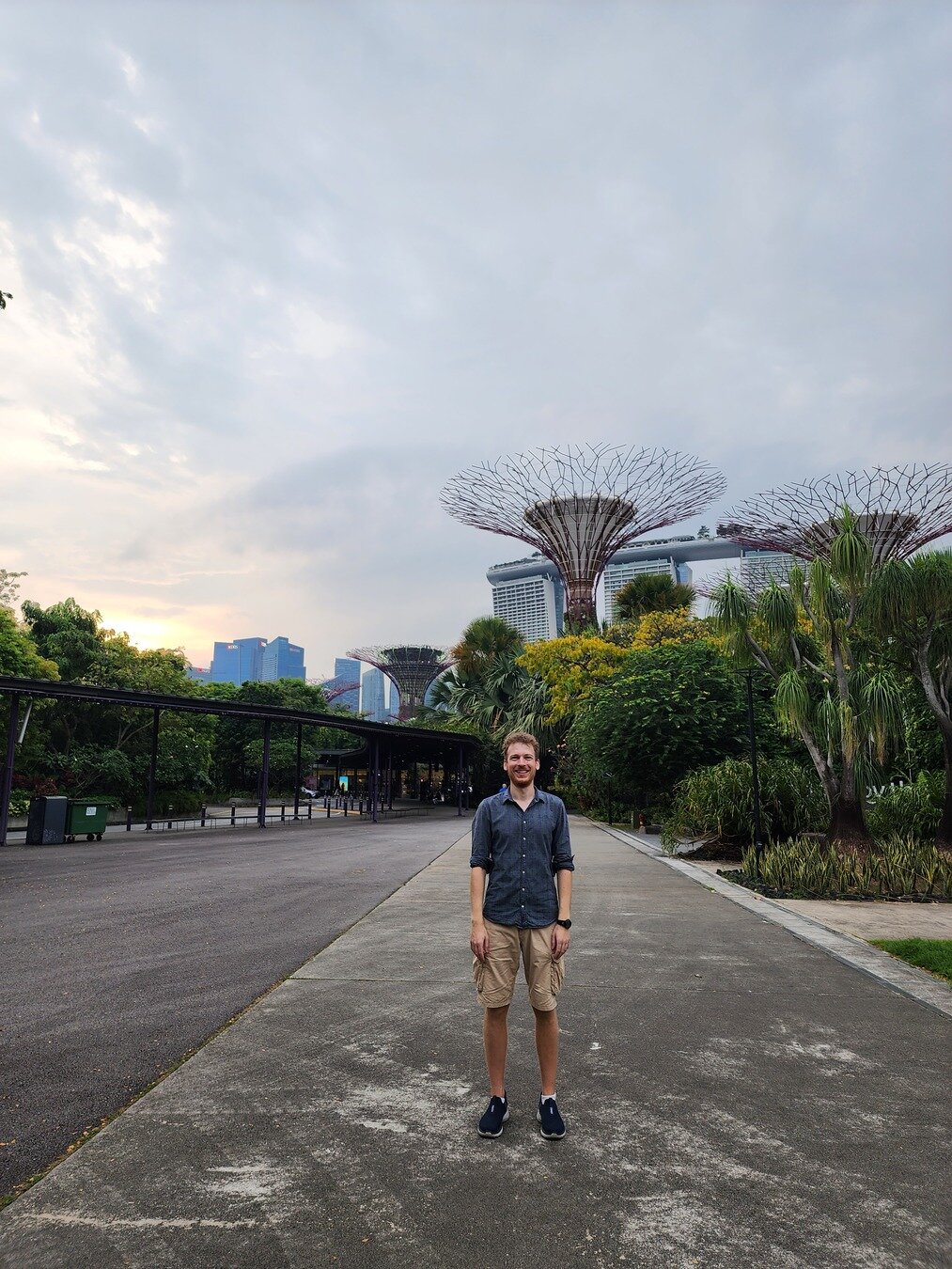
June '22: Single-author double-bracket proposal

This talk is an overview of 4 years of my research on double-bracket quantum algorithms:
- Never worked on quantum algorithms before \(\rightarrow\) 9 papers, 1 experiment
- Never participated in a research program \(\rightarrow\) lead a collaboration of 25 co-authors
- It was the mathematical observations guiding us \(\rightarrow\) Riemannian geometry is key!
[1]
[9]
[8]
[5]
[2]
[3,4]
[6]
[7]
Click these links at slides.com/marekgluza
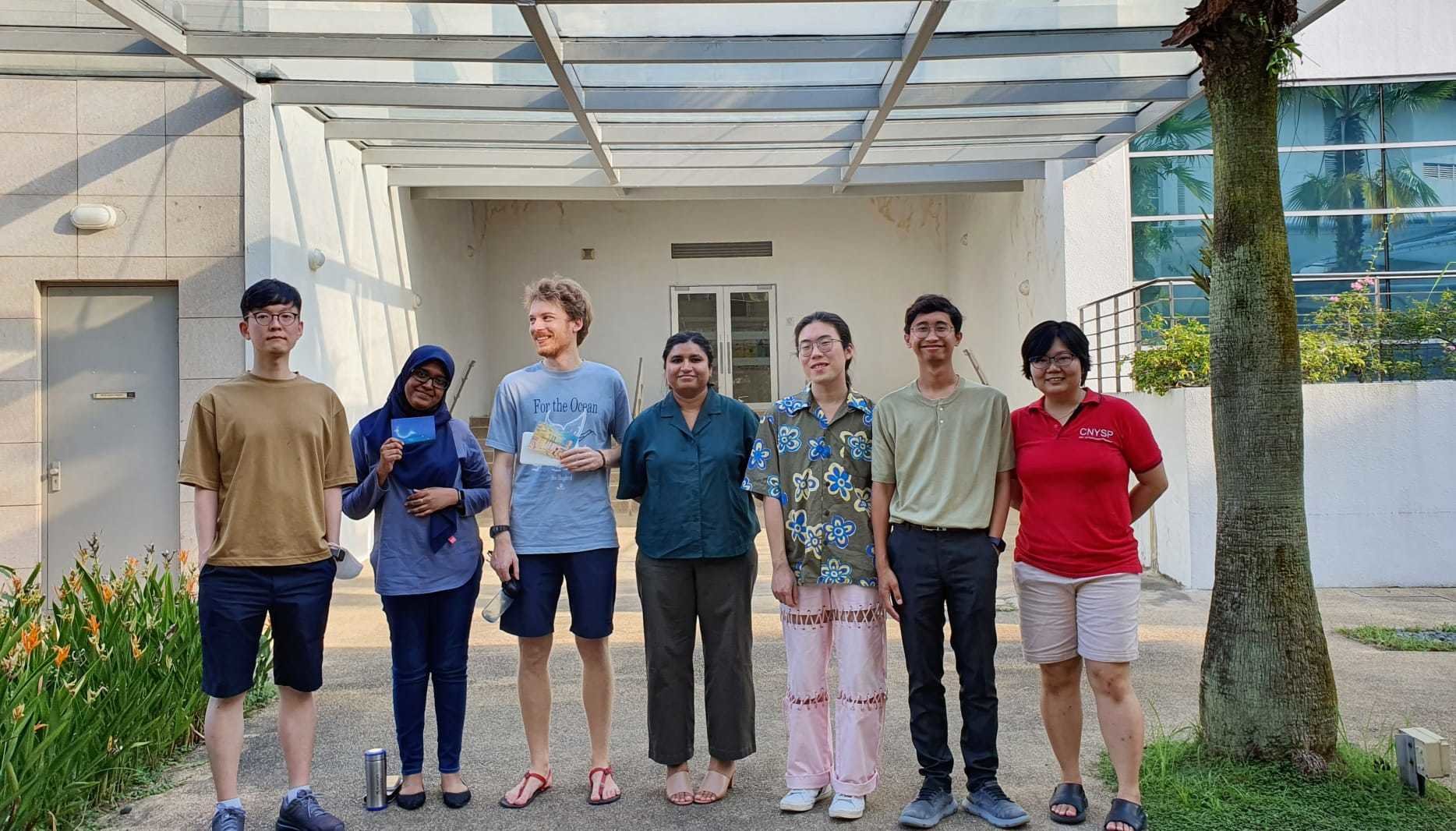

October '21: Arrived to Singapore