Microservices Architecture: Navigating Complexity and Opportunity
A Case Study of DoorDash's Architectural Transformation
Presented by: Meet Sureshbhai Master
Course: System Design

As companies scale, traditional monolithic systems struggle with adaptability and scalability. This is especially evident in industries like food delivery where speed and flexibility are key to customer satisfaction.
DoorDash faced major challenges with its monolithic system, including slow scaling, difficulty in introducing new features, and prolonged downtime during deployments. These limitations were becoming a barrier to the company’s growth.
Monolithic Architecture: A single, unified codebase where all functionalities are tightly coupled, meaning that changes to one part of the system often require updates across the entire application.
Key Issues:
Scaling: Scaling requires replicating the entire system, which is inefficient and resource-heavy.
Deployment Delays: Any update necessitates redeploying the whole system, resulting in downtime.
Tight Coupling: Changes in one component can affect others, complicating maintenance and feature introduction.
Microservices Architecture: An architecture that divides the application into independent, self-contained services that communicate via APIs.
Key Benefits:
Scalability: Services can be scaled individually based on their demand, making it more efficient.
Independent Deployment: Each service can be deployed and updated independently, reducing downtime.
Flexibility: New features and updates can be introduced without impacting the entire system.
Tools & Technologies
Docker: Docker allowed DoorDash to containerize their microservices, ensuring that each service ran in a consistent environment from development to production.
Kubernetes: Kubernetes was used to manage, scale, and orchestrate the containerized services. It automated the deployment process and ensured high availability of services.
Service Discovery: Tools like Consul and Eureka enabled services to dynamically discover and communicate with each other, which was essential for maintaining service availability as the number of services grew.
Research Methodology
A qualitative research methodology was employed to analyze DoorDash’s microservices transition.
The study focuses on DoorDash as a case study, synthesizing academic research and real-world data.
Studies include detailed architectural analysis of monolithic and microservices systems and examination of challenges faced during system design and migration
Key Strategies
Decomposition: Breaking the monolith into domain-aligned services based on business needs.
API Communication: Ensuring smooth interaction between services through APIs.
Fault Isolation: Reducing system-wide failures by isolating issues to individual services, preventing cascading failures.
Auto-Scaling: Using predictive scaling to adjust resources based on demand, optimizing cost and performance.
Results
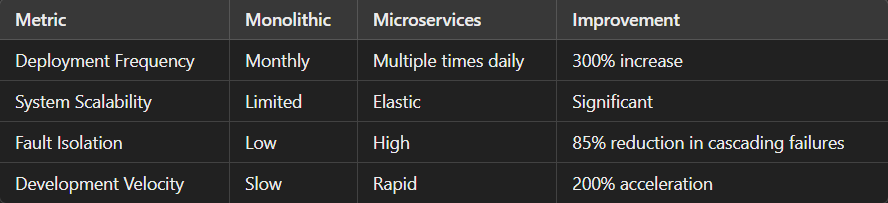
Scalability: Microservices enabled DoorDash to scale individual services based on demand, leading to cost savings and more efficient resource allocation.
Faster Deployment: By decoupling services, DoorDash could deploy new features or bug fixes quickly, without waiting for the entire system to be updated.
Team Productivity: Decentralized teams could focus on specific services, improving overall development velocity.
Resilience: With improved fault isolation, failures in one service did not affect others, leading to a more reliable system.
Conclusion
The transition to microservices provided DoorDash with the scalability, resilience, and operational efficiency it needed to compete in the fast-paced food delivery market.
Key Takeaways:
Service decomposition aligned with business domains was crucial for scalability.
API-driven communication enabled seamless interactions between services.
Infrastructure tools like Docker, Kubernetes, and service discovery were essential for managing microservices at scale.