Python Workshop
What Is python?
Python is an interpreted, interactive, object-oriented programming language
Is kind of a tool you start to use and never look back
https://www.python.org

Short history of
- Creator: Guido van Rossum
- February 1991 - First appearance
- Monty Python's Flying Circus
- January 1994 - Python 1.0
- October 2000 - Python 2.0
- December 2008 - Python 3

# python for nonprogrammers
https://wiki.python.org/moin/BeginnersGuide/NonProgrammers

# python for programmers
https://wiki.python.org/moin/BeginnersGuide/Programmers

# official docs
https://docs.python.org/3/tutorial/

# The Hitchhiker’s Guide to Python!
http://docs.python-guide.org/en/latest/

# automate the boring stuff
https://automatetheboringstuff.com
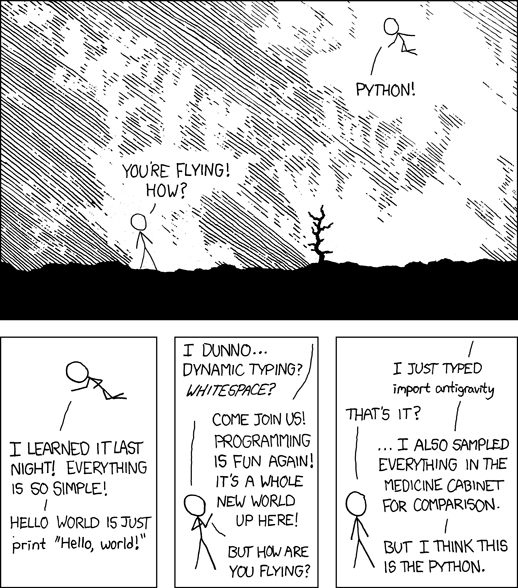
How long does it take?
PEPs
-
PEP 0 - index of PEPs
-
PEP 8 - Code style guide
-
PEP 20 - The Zen of Python
-
PEP 405 - Virtual Envrionments
-
PEP 484 - Type Hints
Python Enhancement Proposals
The Zen of Python
>>> import this$ python3The Zen of Python, by Tim Peters
Beautiful is better than ugly.
Explicit is better than implicit.
Simple is better than complex.
Complex is better than complicated.
Flat is better than nested.
Sparse is better than dense.
Readability counts.
Special cases aren't special enough to break the rules.
Although practicality beats purity.
Errors should never pass silently.
Unless explicitly silenced.
In the face of ambiguity, refuse the temptation to guess.
There should be one-- and preferably only one --obvious way to do it.
Although that way may not be obvious at first unless you're Dutch.
Now is better than never.
Although never is often better than right now.
If the implementation is hard to explain, it's a bad idea.
If the implementation is easy to explain, it may be a good idea.
Namespaces are one honking great idea -- let's do more of those!Code style
PEP 8
# in:

def very_important_function(template: str, *variables, file: os.PathLike, debug: bool = False):
    """Applies `variables` to the `template` and writes to `file`."""
    with open(file, 'w') as f:
        ...

# out:

def very_important_function(
    template: str,
    *variables,
    file: os.PathLike,
    debug: bool = False,
):
    """Applies `variables` to the `template` and writes to `file`."""
    with open(file, "w") as f:
        ...
# Scroll for more

# in:

l = [1,
     2,
     3,
]

# out:

l = [1, 2, 3]

# in:

l = [[n for n in list_bosses()], [n for n in list_employees()]]

# out:

l = [
    [n for n in list_bosses()], [n for n in list_employees()]
]Text Editors / IDEs
Python Shells
- python
- ipython
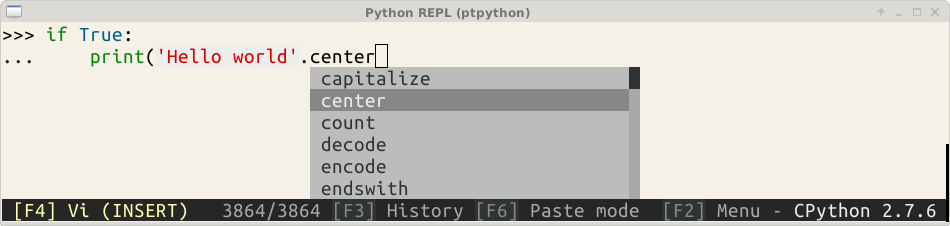
- ptpython
- Project jupyter
Local (offline)
Online (browser)
ipython

ptpython
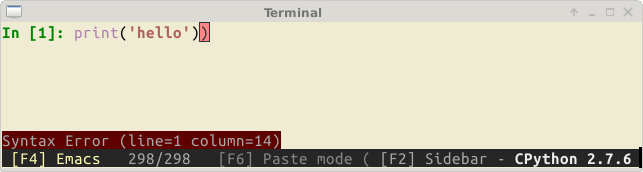
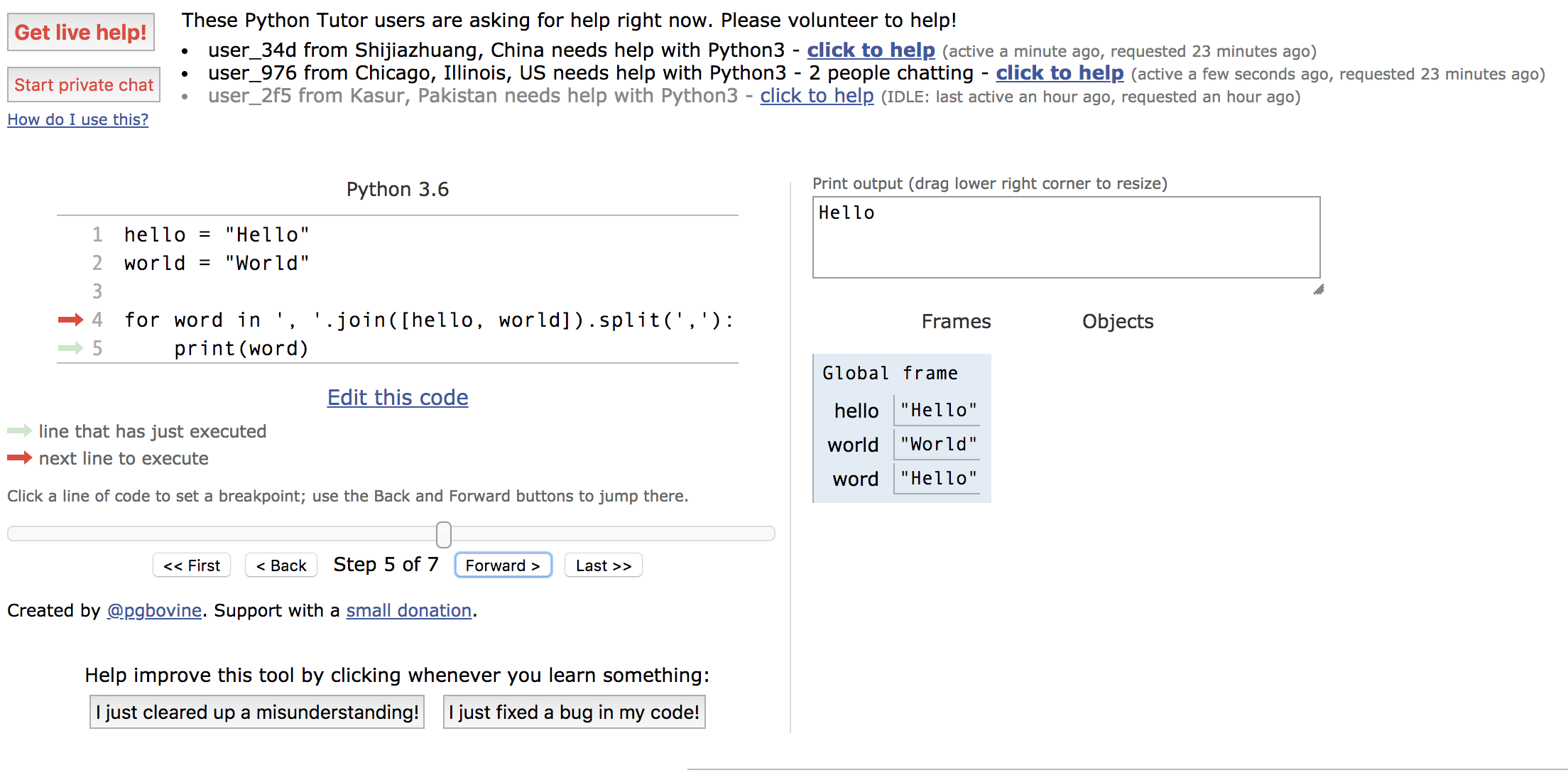
jupyter notebook

Modules / packages
├── module_1.py
├── module_2.py
└── package (DIR)
    ├── __init__.py
    └── module_in_package.py

Documentation
def function_with_pep484_type_annotations(param1: int) -> int:
    """Example function with PEP 484 type annotations.

    The return type must be duplicated in the docstring to comply
    with the NumPy docstring style.

    Parameters
    ----------
    param1
        The first parameter.

    Returns
    -------
    int
        True if successful, False otherwise.

    """
    return  param1
I believe in it.

Use of docstrings

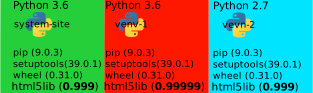
Virtual Environments
Labs
All labs also at: http://jans-workshops.gitlab.io/all-in-one/