Photon Maps
Oscar Ivarsson and Pär Eriksson
Global Illumination
using
- Overview
- Pass 1: Photon Map Construction
- Pass 2: Rendering
- Discussion
- Future Work
Introduction
Overview
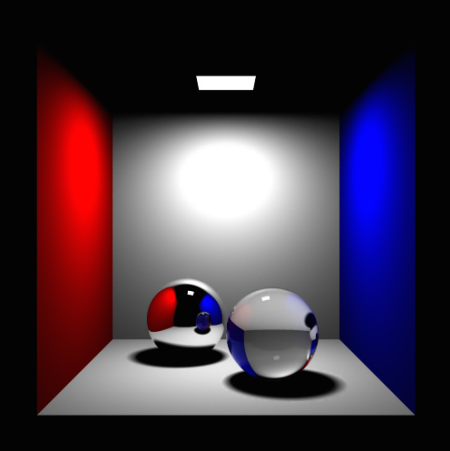
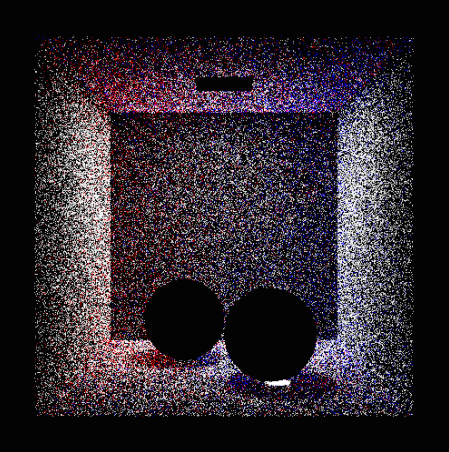
- View independent preprocessing
- More efficient than pure ray tracing
- Good for caustics
- Simulates diffuse reflections
Properties
Pass 1: Photon Map Construction
The Life of a Photon

"A photon checks in at a hotel and is asked if he needs any help with his luggage."
"No, I'm travelling light."
Pass 1: Photon Map Construction
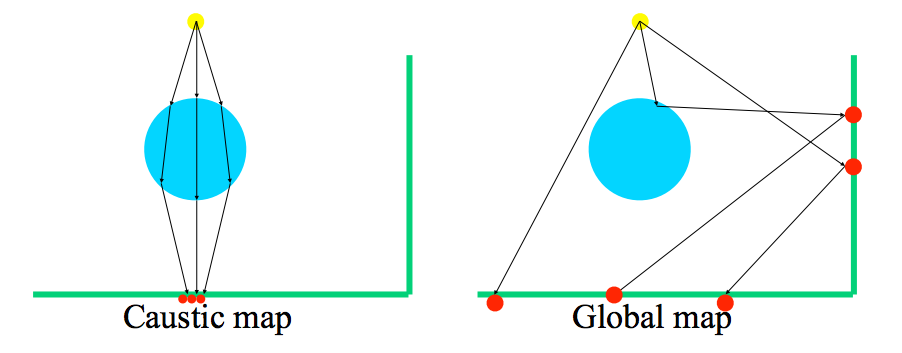
1. Emission
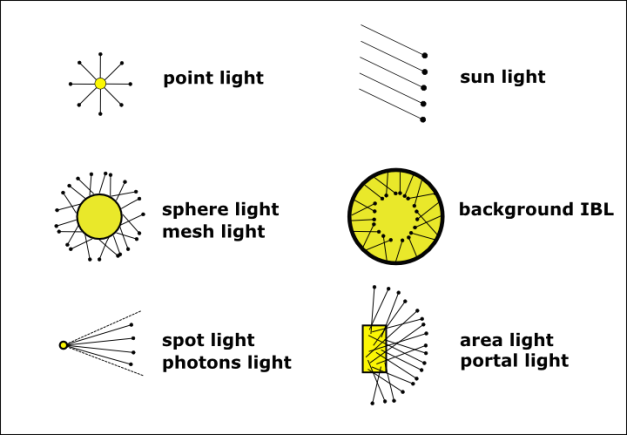
Pass 1: Photon Map Construction
2. Scattering
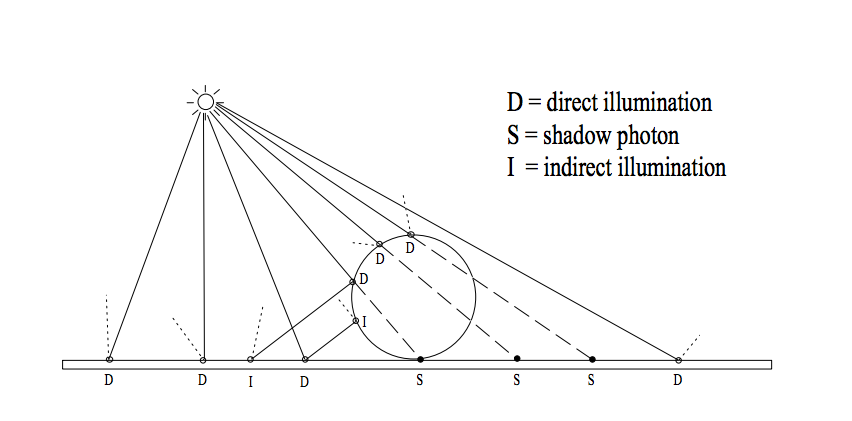
Pass 1: Photon Map Construction
3. Storage
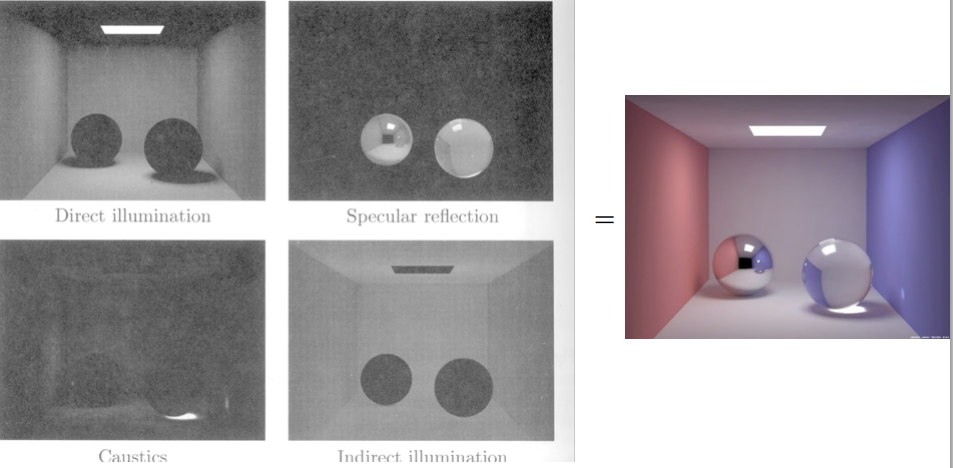
Final image rendered using Monte Carlo ray tracing
Pass 2: Rendering
Rendering Equation
- Rendering Equation can be subdivided


-Lr can be split into a sum of components and defined as:




-Direct illumination contribution
-Specular reflection contribution
- Caustics on diffuse & slightly glossy surfaces
- Soft indirect illumination

Pass 2: Rendering
Direct illumination (the first term)
Approximated:
- Radiance estimate obtained from the global photon map
Accurate:
- If all in shadow or not in shadow, assume the same.
- If mixed, send shadow rays
Two methods used
Pass 2: Rendering
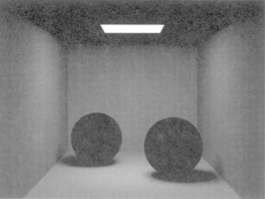
What:
- Contribution via direct illumination by the light sources
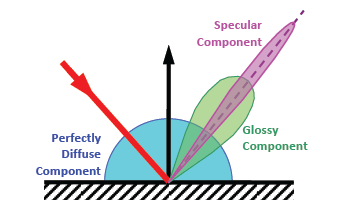
Specular reflection (the second term)
What:
-Radiance reflected of specular and higly glossy surfaces
How:
- Evaluated with Monte Carlo ray tracing
- Importance sampling based on BRDF minimizes computation
Pass 2: Rendering
Pass 2: Rendering
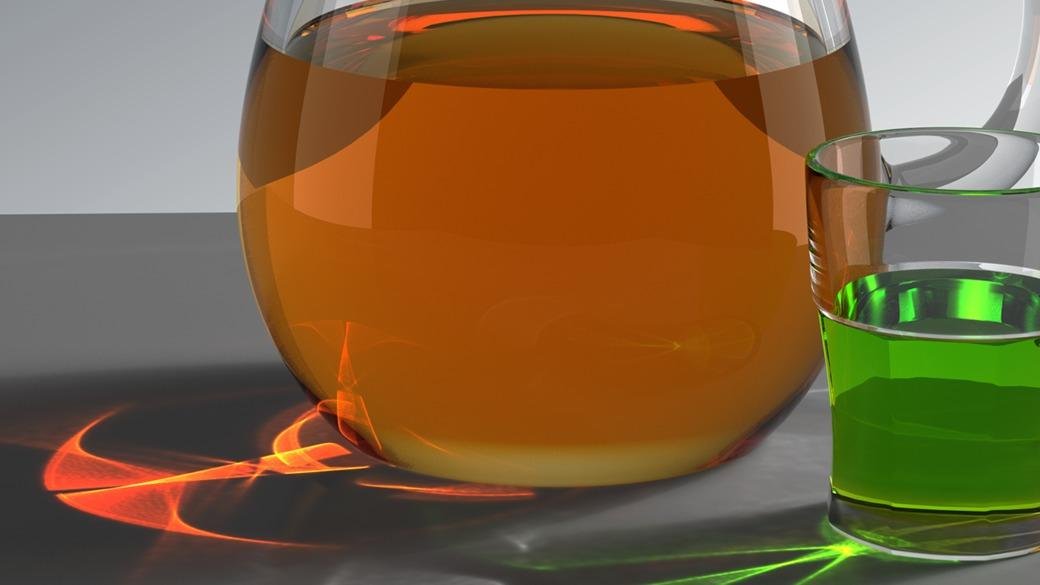
Caustics (the third term)
What:
-Represent caustics on diffuse and slightly glossy surfaces.
How:
-Visualized directly using photons in the caustic photon map
-Number of photons must be high
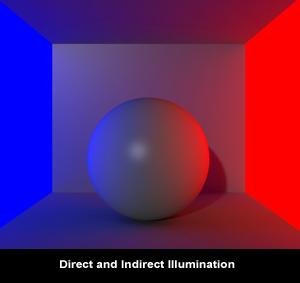
Soft indirect illumination (the fourth term)
What:
-Incoming light which has been reflected diffusely at least once.
How:
-Since the incoming direction is stored with each photon we can integrate the information with any BRDF. (Accurate method)
-In practice the approximation is limited to surfaces ranging from Lambertian to slightly glossy.
Pass 2: Rendering
Estimating Radiance using the Photon Map


What:
-Computing radiance leaving an intersection point x.
How:
-Use the same approximation of dA as where a sphere is centered at x is expanded until it contains N and has radius r. "dA" is then approximated as "pi*r^2".
Pass 2: Rendering

Filtering the result
Why:
- Problems occur when the photon density is too low -> gives blurry results
How:
- By applying a cone-filter to the estimate the occurring blur can be compensated
-For each element in the sum, look up the contribution of the wight function


vs