Types in Python
Why do we need types?
digits = datasets.load_digits()
n_samples = len(digits.images)
X = digits.images.reshape((n_samples, -1))
y = digits.target

X_train, X_test, y_train, y_test = train_test_split(
    X, y, test_size=0.5, random_state=0)

tuned_parameters = [{'kernel': ['rbf'], 'gamma': [1e-3, 1e-4],
                     'C': [1, 10, 100, 1000]},
                    {'kernel': ['linear'], 'C': [1, 10, 100, 1000]}]

scores = ['precision', 'recall']

for score in scores:
    clf = GridSearchCV(SVC(), tuned_parameters, cv=5, scoring='%s_macro' % score)
    clf.fit(X_train, y_train)

    print("Best parameters set found on development set:", clf.best_params_)
    means = clf.cv_results_['mean_test_score']
    stds = clf.cv_results_['std_test_score'],
    for mean, std, params in zip(means, stds, clf.cv_results_['params']):
        print("%0.3f (+/-%0.03f) for %r" % (mean, std * 2, params))
    y_true, y_pred = y_test, clf.predict(X_test)
    print(classification_report(y_true, y_pred))
Why do we need types?
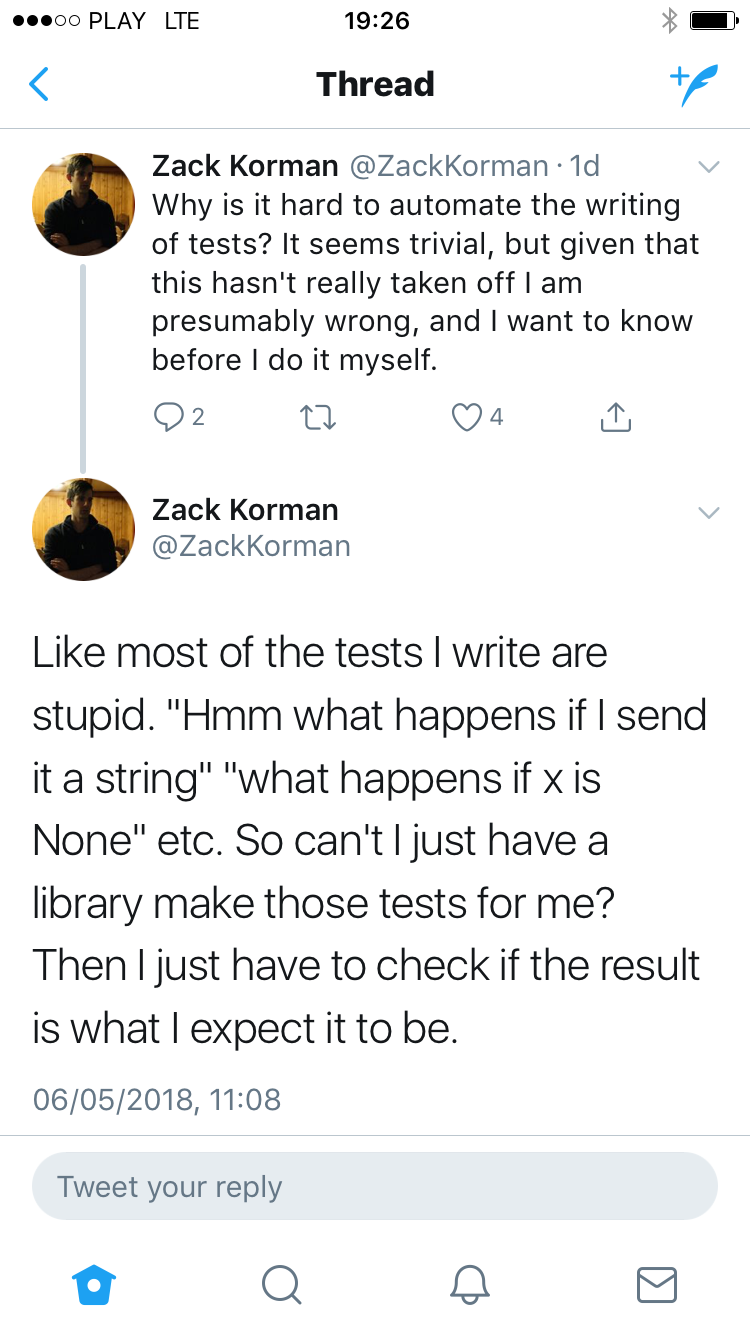
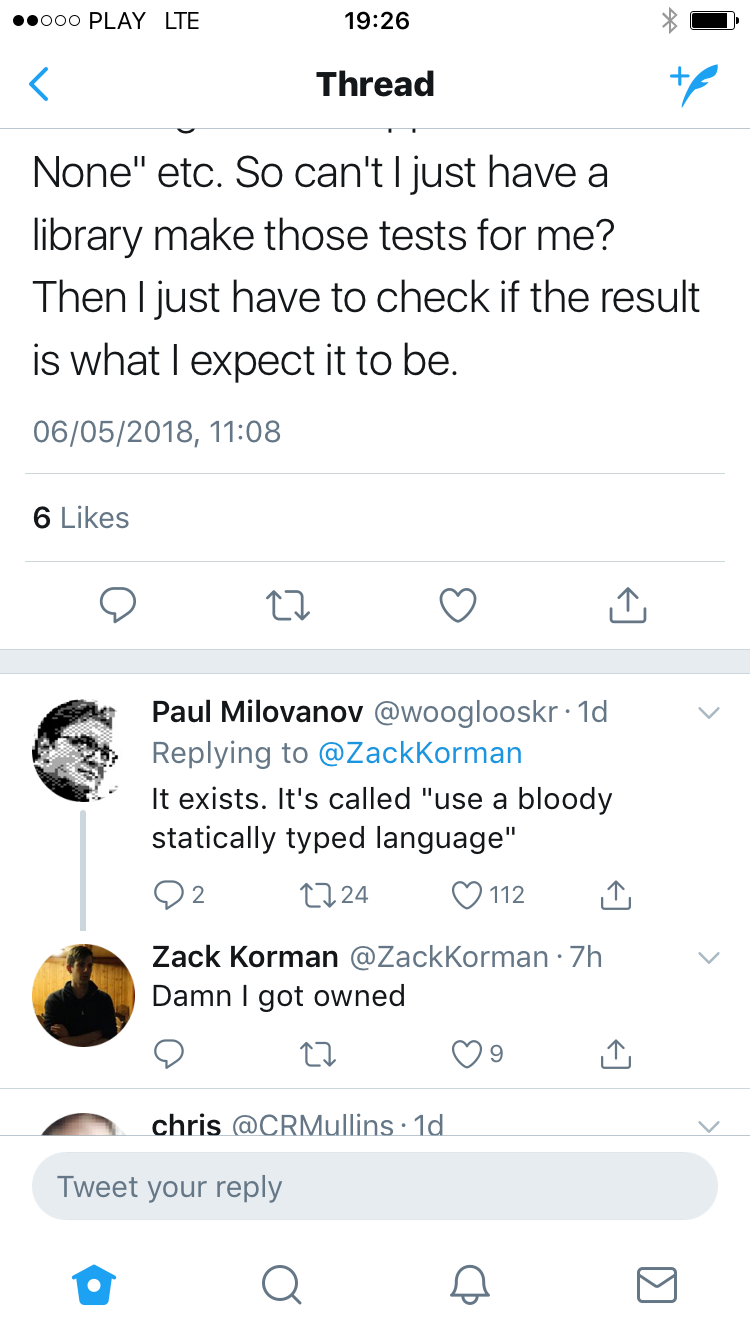
What are types?
What are types?
Sets of values.
-
Int: a set of all integer numbers.
-
Float: a set of all floating point numbers.
-
DbConnection: a set of all possible database connections.
How can we use them?
To constrain the set of values a variable can hold:
n: int = 42
x: float = 42.5
rex: Dog = Dog("rex")
To constrain the set of values a function accepts as parameters:
def foo(x: int):
    return x + 1
To constrain the set of values a function can return:
def foo() -> float:
    return np.random.random_sample()
Basic types
The built-in simple types:
n: int = 42
x: float = 42.5
b: bool = True
s: str = 'hello world'
And built-in complex types:
from typing import Dict, List, Set, Tuple

xs: List[int] = [1,2,3,4,5]
d: Dict[str, str] = {'hello': 'world', 'ala': 'makota'}
s: Set[float] = {1.5, 2.5, 3.5}
t: Tuple[int, float, str] = (42, 42.5, "fortytwo")
Notice that for complex types you need to provide the type of the elements inside.
Btw, this is called a "kind", i.e. "a type of type".
Callable
For functions and lambdas (in callbacks and HOFs).
def f(x: int, y: int) -> float:
    pass

my_fun: Callable[[int, int], float] = f
my_other_fun: Callable[[str], bool] = lambda s: s.startswith('http')
The first parameter is a list of argument types. The second is return type.
Optional type
It's all about being honest. Consider this function:
def get_db_connection(conn_str: str) -> DbConnection:
    try:
        return my_db.connect(conn_str)
    except DbError as e:
        log.error(e)
        return None
It's a nice function. It's also a liar. Its type is not DbConnection, because the set of values it can return is larger: it also contains None.
from typing import Optional

def get_db_connection(conn_str: str) -> Optional[DbConnection]:
    try:
        return my_db.connect(conn_str)
    except DbError as e:
        log.error(e)
        return None
Whenever a function returns None, its type will be Optional[*]
Union type
Previously we said: "this function can return a DbConnection OR a None". This extends to other types as well:
def get_db_connection(conn_str: str) -> Union[PSQLConnection, CouchConnection, None]:
    try:
        if conn_str.startswith('psql'):
            return my_psql_db.connect(conn_str)
        return my_couch_db.connect(conn_str)
    except DbError as e:
        log.error(e)
        return None
AVOID union types.
A type that's a Union of everything possible is called Any.
Classes
A class is a type by itself.
class Foo:
    def __init__(self, x: int):  # self is untyped
        self.x = x

    def foo(self) -> int:
        return self.x + 10

    @classmethod
    def create(cls) -> 'Foo':    # note the ''
        return Foo(random.randint(10, 20))


def process_foo(f: Foo) -> Foo:
    print(f.foo())
    f.x += 1
    return f

foo: Foo = Foo.create()
foo2: Foo = process_foo(foo)
Generic types
"Give me whatever, I'll give you back the same whatever"
E.g. what's the type of List.reverse?
For a List[int] it returns List[int].
For a List[Foo] it returns List[Foo].
from typing import List, TypeVar

T = TypeVar('T')

def my_reverse(xs: List[T]) -> List[T]:
    xs.reverse()
The typevar is a name for "whatever type".
Generic types vs. Any
Notice how List[T] is very different from List[Any].
List[Any] could be: [1, 1.5, "hello"].
List[T] has all of the elements of the same type.
T = TypeVar('T')

def my_fun1(xs: List[T]) -> List[T]:
    # cannot modify elements of the list!
BONUS QUESTION:
Why my_fun1 cannot modify elements of the list?
Type aliases
Sometimes the names are cumbersome to type.
def create_user_mapping() -> Optional[Iterable[Dict[str, User]]]:
    pass
We can give a name to that type:
UserMapping = Optional[Iterable[Dict[str, User]]]

def create_user_mapping() -> UserMapping:
    pass
And save some keystrokes in the long run.
NewTypes
How to make sure we never treat inches as centimeters? Both are really floats in the program...
from typing import NewType

Inch = NewType('Inch', float)
Cm = NewType('Cm', float)

def inch2cm(x: Inch) -> Cm:
    pass

def cm2inch(x: Cm) -> Inch:
    pass
def inch2cm(x):
return x * 2.54
x_in_cm = 4.23
y = inch2cm(x_in_cm)That makes no sense...
How to check the types?
IDEs like PyCharm do this on the fly. They also provide excellent type-driven autocompletion.
There's also MyPy:
$ pip install mypy

$ mypy test.py