S tructured
Q uery
L anguage
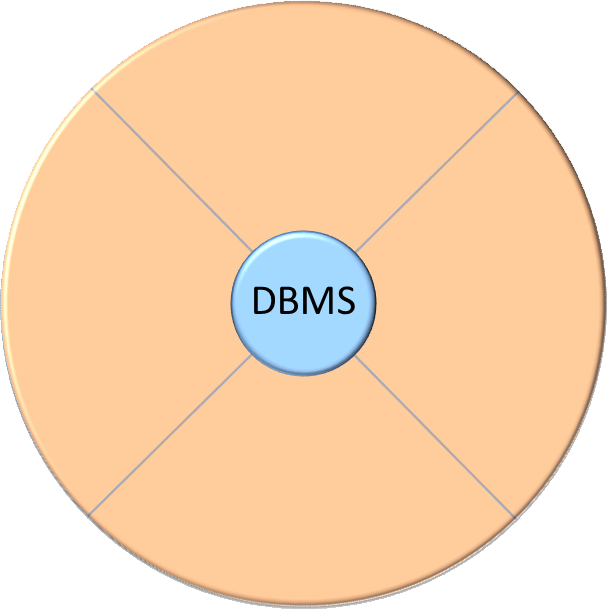
Data Manipulation
Language (DML)
Data Definition
Language (DDL)
Data Query
Language (DQL)
Data Control
Language (DCL)
INSERT INTO [table] (field1, fieldN) VALUES (('a','b'),('foo','bar'))
GRANT SELECT, UPDATE ON TABLE [table] TO user1;
CREATE TABLE [table] (
`id` int(10) unsigned NOT NULL AUTO_INCREMENT,
`field1` varchar(255), `field2` int not null)
SELECT * from [table] WHERE field1='a';
Field 1
Field 2
Field n
Column
- Feldbezeichner
- Feldtyp
- Begrenzungen
- Default Value
Tabelle
Field 1
Field 2
Field n
Value
Column
Tabelle
Field 1
Field 2
Field n
Record / Tupel
Value
Column
Tabelle
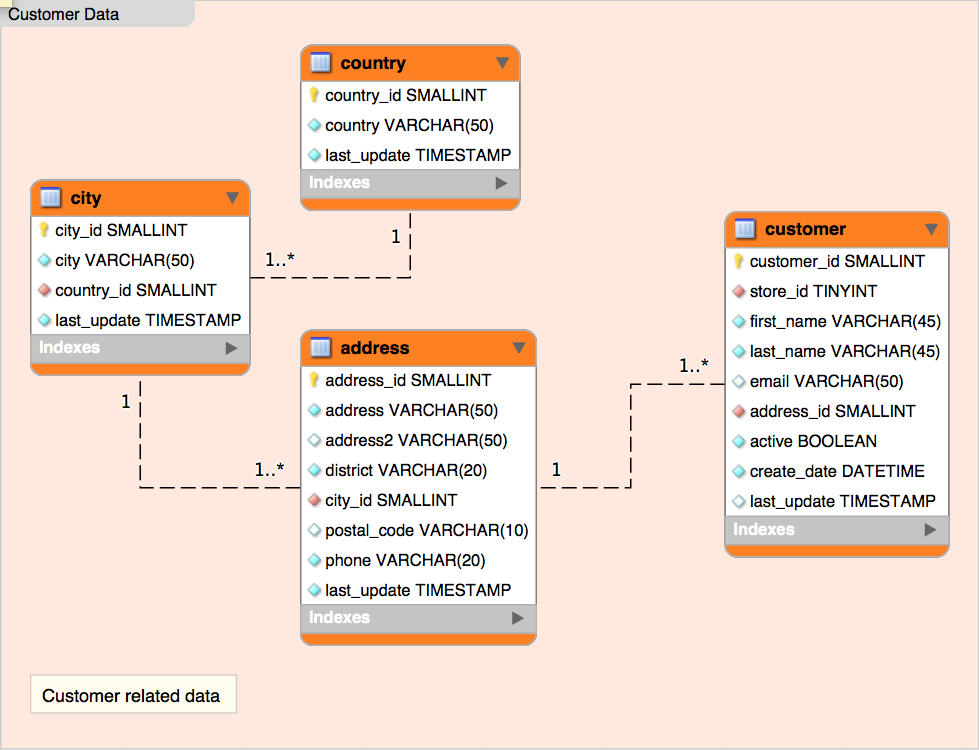
Relational Database Management System
(RDBMS)
- Relation beschreibt die Beziehung eines Tupel zu einem anderen
- Nur zwischen Schluesselpaaren moeglich (FK <-> PK)
Relationtypes
- one to one (1-1)
Jeder Coupon ist genau einem Customer zugewiesen
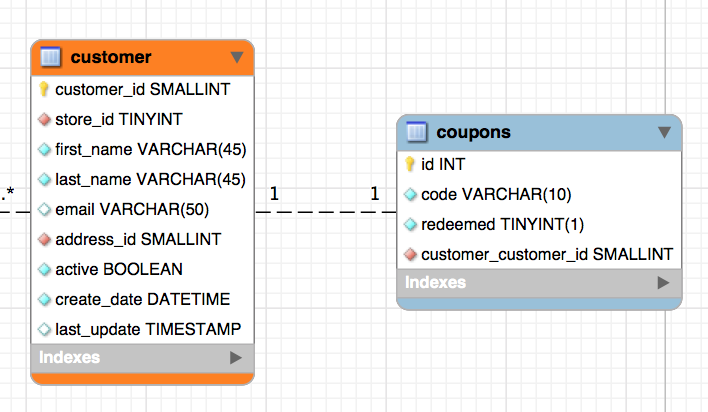
Relationtypes
- one to Many (1-n)
1 Customer Record hat n Address Records
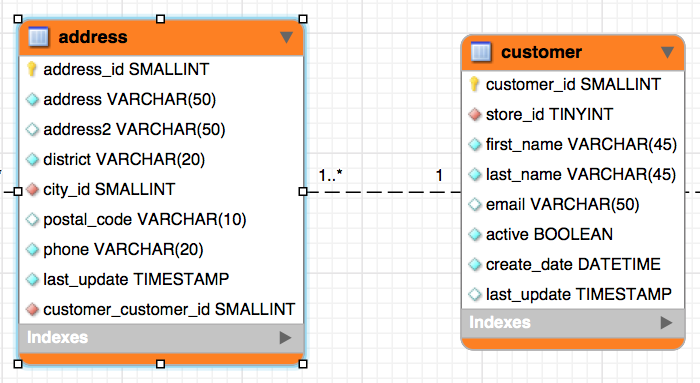
Relationtypes
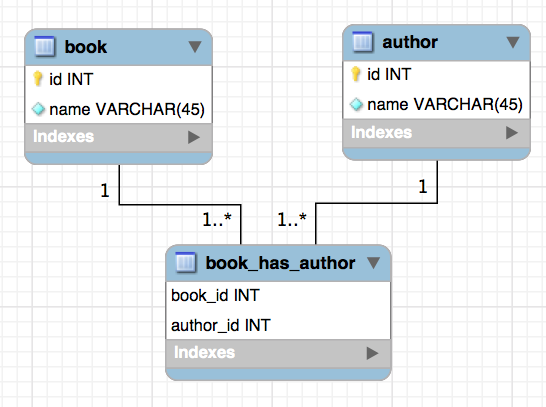
- Many to Many (m-n)
- Junction Object / Table
Ein Buch hat n-Autoren
1 Autor hat n-Bücher geschrieben
Normalformen
was ist schon normal?
Unter Normalisierung eines relationalen Datenschemas (Tabellenstruktur) versteht man die Aufteilung von Attributen (Tabellenspalten) in mehrere Relationen (Tabellen) gemäß den Normalisierungsregeln, so dass eine Form entsteht, die keine vermeidbaren Redundanzen mehr enthält.
Warum?
Ein konzeptionelles Schema, das Datenredundanzen enthält, kann dazu führen, dass bei Änderungen der damit realisierten Datenbank die mehrfach enthaltenen Daten nicht konsistent, sondern nur teilweise und unvollständig geändert werden, womit sie obsolet oder widersprüchlich werden können. Man spricht von auftretenden Anomalien. Zudem belegt mehrfache Speicherung derselben Daten unnötig Speicherplatz. Um Redundanz zu verhindern, normalisiert man solche Tabellen.

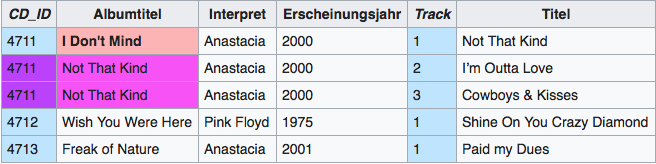
1. NF
2. NF
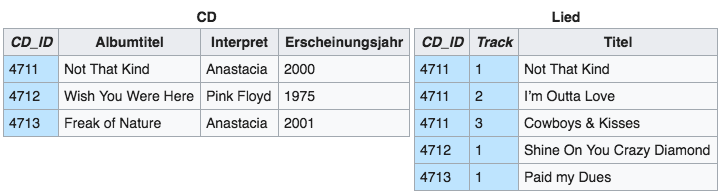
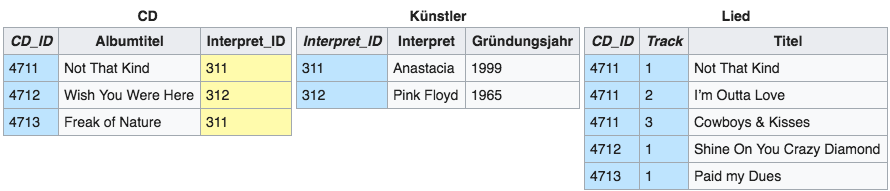
Die dritte Normalform ist erreicht, wenn sich das Relationenschema in 2NF befindet, und kein Nichtschlüsselattribut von einem anderen Nichtschlüsselattribut funktional abhängig ist.
Data Query Language
endlich
select  pstaff.shortname as "Manager Kurzname",
  pclient.person_name as "Kundenname",
  job.jobno as "Jobnummer",
  job.job_name as "Jobname",
  job.job_status_p_job_status as "interner Jobstatus",
  CASE
    when job.job_status_p_job_status = '100' then
      concat('Vorbereitung')
    when job.job_status_p_job_status = '200' then
      concat('Angebot')
    when job.job_status_p_job_status = '300' then
      concat('Durchführung')
    when job.job_status_p_job_status = '301' then
      concat('Durchführung - bereits abgerechnet')
    when job.job_status_p_job_status = '400' then
      concat('Geliefert (',job.job_status_p_job_status,')')
    when job.job_status_p_job_status = '500' then
      concat('Abgerechnet')
    when job.job_status_p_job_status = '600' then
      concat('Abgebrochen')
    else
      concat('unbekannt')
    end as "Jobstatus",
  job.own_service_budget_total as "Budget Gesamt Soll",
  (wb.own_service_total +wb.external_cost_total) as "Budget Gesamt Ist",
    (job.own_service_budget_total - (wb.own_service_total +wb.external_cost_total)) as "Budget Soll/Ist Saldo",
    CASE when job.own_service_budget_total <> 0 then
        concat((-100 * (wb.own_service_total +wb.external_cost_total) / job.own_service_budget_total) + 100)
    else
        concat('---')
    end as "Budget Soll/Ist in %",
  wb.own_service_total as "Eigenleistung Gesamt",
  wb.external_cost_total as "Fremdleistung Gesamt",
    job.state_p_budget_control_state as "Budget Kontroll-Status",
  job.description as "Beschreibung",
  job.orderno as "Auftragsnummer",
  job.order_date as "Auftragsdatum",
  job.delivery_date as "Lieferdatum"
from
            job
            left join
    person as pstaff on (job.staff_2_person = pstaff.urno)
  left join
    person as pclient on (job.client_2_person = pclient.urno)
  left join (
    select warehouse_budgetcontrol.job_2_job,
      max(warehouse_budgetcontrol.own_service_total) as own_service_total ,
      max(warehouse_budgetcontrol.own_service_total_warn_exceed) as own_service_total_warn_exceed,
      max(warehouse_budgetcontrol.external_cost_total) as external_cost_total
      from warehouse_budgetcontrol group by warehouse_budgetcontrol.job_2_job
    ) as wb on (job.urno = wb.job_2_job)
  where
            -- Budget Controll is active
    job.budget_control = true
    AND cast(job.job_status_p_job_status as int) NOT IN (500,600,301)
Zur einstimmung - ein einfaches Beispiel
select  pstaff.shortname as "Manager Kurzname",
  pclient.person_name as "Kundenname",
  job.jobno as "Jobnummer",
  job.job_name as "Jobname",
  job.job_status_p_job_status as "interner Jobstatus",
  CASE
    when job.job_status_p_job_status = '100' then
      concat('Vorbereitung')
    when job.job_status_p_job_status = '200' then
      concat('Angebot')
    when job.job_status_p_job_status = '300' then
      concat('Durchführung')
    when job.job_status_p_job_status = '301' then
      concat('Durchführung - bereits abgerechnet')
    when job.job_status_p_job_status = '400' then
      concat('Geliefert (',job.job_status_p_job_status,')')
    when job.job_status_p_job_status = '500' then
      concat('Abgerechnet')
    when job.job_status_p_job_status = '600' then
      concat('Abgebrochen')
    else
      concat('unbekannt')
    end as "Jobstatus",
  job.own_service_budget_total as "Budget Gesamt Soll",
  (wb.own_service_total +wb.external_cost_total) as "Budget Gesamt Ist",
    (job.own_service_budget_total - (wb.own_service_total +wb.external_cost_total)) as "Budget Soll/Ist Saldo",
    CASE when job.own_service_budget_total <> 0 then
        concat((-100 * (wb.own_service_total +wb.external_cost_total) / job.own_service_budget_total) + 100)
    else
        concat('---')
    end as "Budget Soll/Ist in %",
  wb.own_service_total as "Eigenleistung Gesamt",
  wb.external_cost_total as "Fremdleistung Gesamt",
    job.state_p_budget_control_state as "Budget Kontroll-Status",
  job.description as "Beschreibung",
  job.orderno as "Auftragsnummer",
  job.order_date as "Auftragsdatum",
  job.delivery_date as "Lieferdatum"
from
            job
            left join
    person as pstaff on (job.staff_2_person = pstaff.urno)
  left join
    person as pclient on (job.client_2_person = pclient.urno)
  left join (
    select warehouse_budgetcontrol.job_2_job,
      max(warehouse_budgetcontrol.own_service_total) as own_service_total ,
      max(warehouse_budgetcontrol.own_service_total_warn_exceed) as own_service_total_warn_exceed,
      max(warehouse_budgetcontrol.external_cost_total) as external_cost_total
      from warehouse_budgetcontrol group by warehouse_budgetcontrol.job_2_job
    ) as wb on (job.urno = wb.job_2_job)
  where
            -- Budget Controll is active
    job.budget_control = true
    AND cast(job.job_status_p_job_status as int) NOT IN (500,600,301)
Zeige jene Records der Tabelle "DealerAppointmentConfirmation - Live", von nun an "e" genannt, welche ein AppointmentDate Wert zwischen "jetzt in 481Minuten" und "jetzt in 540Minuten" aufweisen und nicht Abgebrochen wurden.
Operator
Command
Column
Function
Condition
Source
Alias
Filter und Operatoren
| Operator | Bedeutung | Bespiel |
|---|---|---|
| = | Gleich | field1 = 123 ; field1 = "foobar" |
| > | Größer als | field1 > 1; |
| < | Kleiner als | field1 < 10; |
| >= | Größer als oder gleich | field1 >= 5; |
| <= | Kleiner als oder gleich | field1 <= 12; |
| <> | Ungleich | field1 <> 10; |
| != | Nicht gleich (kein ISO-Standard) | boolfield != 0; |
| [ NOT ] LIKE | String-Suche | field1 LIKE "%test"; field2 LIKE "_est"; |
| [ NOT ] IN | in einer Menge von x | field1 IN (1,3,5,7,10); field2 IN ("abc","foo","bar"); |
Einleitung mit WHERE oder ON
Verkettung mit AND oder OR
Aggregation und Gruppierung
The GROUP BY statement is often used with aggregate functions (COUNT, MAX, MIN, SUM, AVG) to group the result-set by one or more columns
SELECT * FROM table GROUP BY field1, fieldN| Funktion | Bedeutung |
|---|---|
| AVG(field) | Mittelwert |
| SUM(field) | Summe aller Werte |
| COUNT(field) | Anzahl der Elemente |
| MIN(field) | kleinster Wert eines Feldes |
| MAX(field) | groesster Wert eines Feldes |
Group wird immer auf das gesamte RecordSet ausgefuehrt
The SQL HAVING Clause
The HAVING clause was added to SQL because the WHERE keyword could not be used with aggregate functions.
SELECT
  project.name, SUM(project.amount) AS SubTotal
FROM
    projects
WHERE
    amount => 1000
GROUP BY
    project
HAVING
    SubTotal > 10000;
select
  pstaff.shortname as "Manager Kurzname",
  pclient.person_name as "Kundenname",
  job.jobno as "Jobnummer",
  job.job_name as "Jobname",
  job.job_status_p_job_status as "interner Jobstatus",
  CASE
    when
      job.job_status_p_job_status = '100'
    then
      concat('Vorbereitung')
    when
      job.job_status_p_job_status = '200'
    then
      concat('Angebot')
    when
      job.job_status_p_job_status = '300'
    then
      concat('Durchführung')
    when
      job.job_status_p_job_status = '301'
    then
      concat('Durchführung - bereits abgerechnet')
    when
      job.job_status_p_job_status = '400'
    then
      concat('Geliefert (', job.job_status_p_job_status, ')')
    when
      job.job_status_p_job_status = '500'
    then
      concat('Abgerechnet')
    when
      job.job_status_p_job_status = '600'
    then
      concat('Abgebrochen')
    else
      concat('unbekannt')
  end
  as "Jobstatus", job.own_service_budget_total as "Budget Gesamt Soll",
  (
    wb.own_service_total + wb.external_cost_total
  )
  as "Budget Gesamt Ist",
  (
    job.own_service_budget_total - (wb.own_service_total + wb.external_cost_total)
  )
  as "Budget Soll / Ist Saldo",
  CASE
    when
      job.own_service_budget_total <> 0
    then
      concat(( - 100 * (wb.own_service_total + wb.external_cost_total) / job.own_service_budget_total) + 100)
    else
      concat('---')
  end
  as "Budget Soll / Ist in % ",
wb.own_service_total as "Eigenleistung Gesamt",
wb.external_cost_total as "Fremdleistung Gesamt",
job.state_p_budget_control_state as "Budget Kontroll - Status",
job.description as "Beschreibung",
job.orderno as "Auftragsnummer",
job.order_date as "Auftragsdatum",
job.delivery_date as "Lieferdatum"
from
  job
  left join
    person as pstaff
    on (job.staff_2_person = pstaff.urno)
  left join
    person as pclient
    on (job.client_2_person = pclient.urno)
  left join
    (
      select
        warehouse_budgetcontrol.job_2_job,
        max(warehouse_budgetcontrol.own_service_total) as own_service_total,
        max(warehouse_budgetcontrol.own_service_total_warn_exceed) as own_service_total_warn_exceed,
        max(warehouse_budgetcontrol.external_cost_total) as external_cost_total
      from
        warehouse_budgetcontrol
      group by
        warehouse_budgetcontrol.job_2_job
    )
    as wb
    on (job.urno = wb.job_2_job)
where
  -- Budget Controll is active
  job.budget_control = true
  AND cast(job.job_status_p_job_status as int) NOT IN
  ( 500, 600, 301 )
Select b.JobID,
b.EventDate,
b.BounceCategoryID,
b.BounceTypeID,
b.SMTPCode,
b.SubscriberID,
b.Domain,
b.BounceCategory,
b.BounceSubcategoryID,
b.BounceSubcategory,
b.BounceType,
b.SMTPBounceReason,
b.SMTPMessage,
s.EmailAddress
from [_Bounce] b
join [_Subscribers] s
on b.SubscriberID = s.SubscriberID
where b.BounceCategory = 'Hard bounce'SELECT * FROM [retention] r
WHERE
r.creation_date >= '2017-09-25 10:12'
AND r.creation_date <= '2017-9-27 04:03'select
a.customer_id,
a.email
from [account] a
join [_Complaint] c
on a.customer_id = c.SubscriberKeyAll Complaints
Filtering Retention by CreationDate
All HardBounces
select
    i.customer_id,
    i.first_name,
    i.last_name,
    i.email,
    i.opt_out_token
from [IP_Warmup_T-Online_new] i
    left join [IP_WarmUp_T-Online_send] s
    on
        i.customer_id = s.customer_id
    where
        s.customer_id Is Null
select
i.customer_id,
i.first_name,
i.last_name,
i.email,
i.opt_out_token,
j.JourneyName,
j.VersionNumber,
ja.ActivityName as 'EmailName',
s.EventDate as 'SendTime',
su.EmailAddress,
su.SubscriberKey as 'ContactKey',
s.SubscriberID as 'ContactID',
s.JobID,
s.ListID,
s.BatchID
from
[_Bounce] s
join
[_JourneyActivity] ja
on s.TriggererSendDefinitionObjectID = ja.JourneyActivityObjectID
join
[_Journey] j on ja.VersionID = j.VersionID
join
[_Subscribers] su on s.SubscriberID = su.SubscriberID
join
[IP_Warmup_T - Online_new] i on i.customer_id = s.SubscriberKey
where
ja.ActivityType in ( 'EMAIL', 'EMAILV2')
and j.JourneyName = 'IP_Warmup_T-Online'
and s.BounceCategory = 'Block bounce'IPWarumUp T-Online Block Bounces
IPWarmup T-Online get NotSent
select * from [IP_WarmUp_T-Online_blockbounced] bb
Union
select * from [IP_WarmUp_T-Online_notsend] ns
SELECT
*
FROM
[DealerAppointmentConfirmation - Live] e
WHERE
e.AppointmentDateTime > DATEADD(minute, 481, GETDATE())
AND e.AppointmentDateTime < DATEADD(minute, 540, GETDATE())
AND e.Cancelled != 1DealerAppointmentReminder
Merge Bounces and NotSent
Select l.customer_id From [listing] l
Inner Join [fsbo_customer] f
On l.customer_id = f.customer_id
Where f.marketing_action_approved = 1 And l.vehicle_category = 'Car'
And DATEDIFF(day, l.creation_date, GETDATE()) = 1
Filtering Listing Data Extension