
| dimensions | stimuli | system | method | |
|---|---|---|---|---|
| Haxby et al. (2011) | 35 | movies | human ventrotemporal cortex | PCA |
| Huth et al. (2012) | 6-8 (4 shared) | movies | human cortex | PCA |
| Lehky et al. (2014) | 60 (~87 estimate) | objects | macaque inferotemporal cortex | PCA |
| Tarhan et al. (2020) | 5 | visual actions | human cortex | k-means |
| Hebart et al. (2020) | 49 | objects | human behavior | SPoSE |
| Khosla et al. (2022) | 20 (5 reliable) | scenes | human ventral visual stream | NMF |
| Hebart et al. (2023) | 66 | objects | human behavior | SPoSE |


Theory: Visual cortex compresses representations.
1



Visual cortex representations are high-dimensional (>1,000).
1
power-law covariance spectra
human fMRI (Natural Scenes Dataset)
8 subjects × 10,000 images × 3 repetitions


shared across subjects
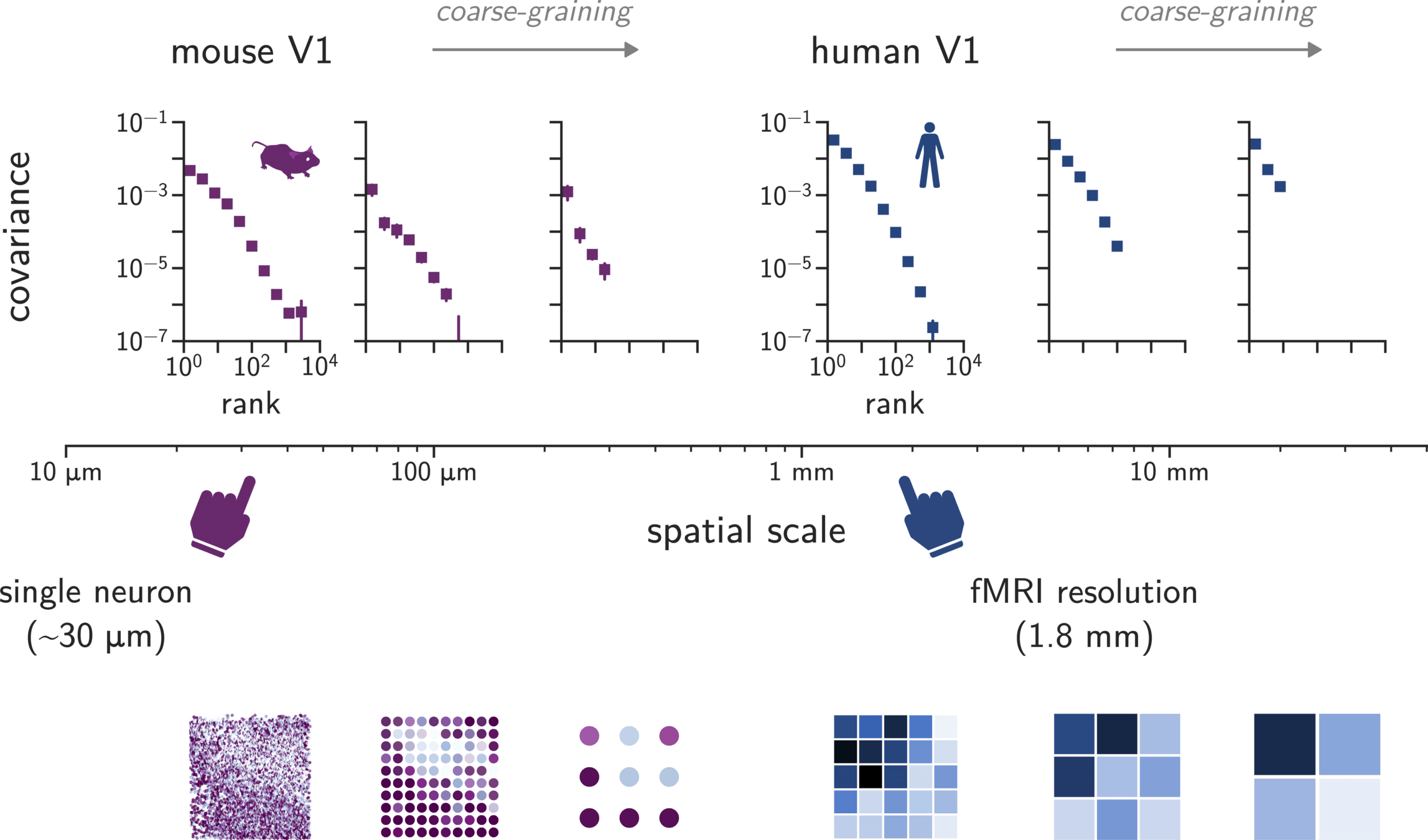
They are self-similar over a huge range of spatial scales.
2
remarkably similar across species

mouse Ca-imaging (V1)
7 mice × 2,800 images × 2 repetitions × 10,000 neurons
invariant to spatial scale
The same geometry underlies mental representations of images.
3
shared neural and mental representations
THINGS fMRI (V1-V4) + behavior (66 latent dimensions)
3 humans × 8,640 images
higher ranks encode finer distinctions
neural correlates of the development of 1-shot perceptual memory in children
intracranial sEEG experiments

feedback?

representational shift?