Be Proactive, Not Reactive
Be Reactive!
Rob Bosman 21-02-2019

-
Responsive
-
Resilient
-
Elastic
-
Message Driven
class FetchJokeService {

  private static final Logger LOG = LoggerFactory.getLogger(FetchJokeServiceJava.class);
  private static final String API_URL = "http://api.icndb.com/jokes/random?limitTo=[explicit,nerdy]"; // Chuck Norris jokes

  static String fetchJoke() {
    LOG.debug("fetch joke");
    try {
      final HttpURLConnection connection = (HttpURLConnection) new URL(API_URL).openConnection();
      try {
        try (final BufferedReader reader = new BufferedReader(new InputStreamReader(connection.getInputStream(), UTF_8))) {
          return reader.lines().collect(joining());
        } catch (IOException e) {
          throw new RuntimeException("Error reading from InputStream", e);
        }
      } finally {
        connection.disconnect();
        LOG.debug("fetched joke");
      }
    } catch (MalformedURLException e) {
      throw new RuntimeException("Error in URL " + API_URL, e);
    } catch (IOException e) {
      throw new RuntimeException("Error connecting to " + API_URL, e);
    }
  }
}
IntelliJ IDEA
MongoDB
Don't block the main Thread


Multi Thread programming
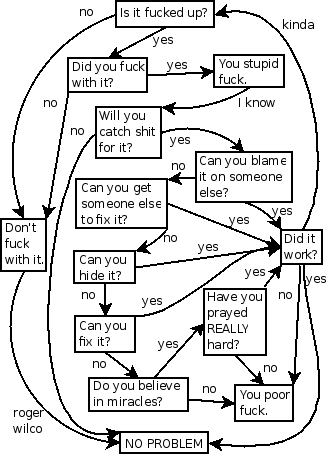
before Java 5:
-
Hashtable
-
Semaphore
-
synchronized
-
volatile
-
Runnable
-
ThreadPool
-
ThreadLocal
-
InterruptedException
Multithread programming
since Java 5:
-
ConcurrentHashMap
-
fork / join
-
Future
private fun findTheAnswer(): Int {
  log.debug("pondering...")
  Thread.sleep(1000)
  return 42
}

fun backToTheFuture() {
  val executor = Executors.newFixedThreadPool(2)

  val future = executor.submit(::findTheAnswer)

  log.debug("are you done? - ${future.isDone}")

  // do other stuff

  val answer = future.get() // blocking wait
  log.debug("ah, the answer is $answer.")

  executor.shutdown()
}
IntelliJ IDEA
fun backToTheCompletableFuture() {

  val provideAnswerCF = CompletableFuture

      .supplyAsync               {
                                   log.debug("determine required processing time")
                                   1500L
                                 }
      .thenApply                 { delayMillis ->
                                   log.debug("pondering...")
                                   Thread.sleep(delayMillis)
                                   42
                                 }
      .thenApply                 { answer ->
                                   log.debug("got it!")
                                   answer
                                 }

  log.debug("do you know the answer? - ${provideAnswerCF.isDone}")
  log.debug("ah, the answer is ${provideAnswerCF.get()}.") // blocking wait
}
Two distinct 'flows':
-
preparation
-
execution
fun backToTheCompletableFuture() {

  val provideAnswerCF = CompletableFuture

      .supplyAsync               {
                                   log.debug("determine required processing time")
                                   1500L
                                 }
      .thenApply                 { delayMillis ->
                                   log.debug("pondering...")
                                   Thread.sleep(delayMillis)
                                   42
                                 }
      .thenApply                 { answer ->
                                   log.debug("got it!")
                                   answer
                                 }

  log.debug("do you know the answer? - ${provideAnswerCF.isDone}")
  log.debug("ah, the answer is ${provideAnswerCF.get()}.") // blocking wait
}
Functor
- filter
- transform (map)
Monad
-
is a Functor
-
flatten (flatMap)
A monad is just a monoid in the category of endofunctors, what's the problem?
Golem




Rabbi Jehoeda Löw




Functor
F(f\circ g)=F(f)\circ F(g)=F(g)\circ F(f)
F:M_{C}(x,y)\rightarrow M_{D}(F(x),F(y))
(G\circ F)(f)=G(F(f))
F:Obj(C)\rightarrow Obj(D)

Monads in Java 8
- Stream
- Optional
- CompletableFuture
- Rx Observable

ReactiveX Observable
-
lazy execution
-
push vs pull
-
hot vs cold
-
rich API
-
polyglot
-
well documented
-
version 1.0 vs 2.0
IntelliJ IDEA
fun run() {
  log.debug("here we go")
  val processControl = Semaphore(0)

  val jokeRawO = Observable
      .create<String> { emitter -> emitter.onNext(fetchJoke()) }
      .subscribeOn(Schedulers.io())

  Observable
      .create<MongoClient> { emitter -> emitter.onNext(getMongoClient()) }
      .subscribeOn(Schedulers.io())
      .zipWith(jokeRawO,
          BiFunction { mongoClient: MongoClient, jokeRaw: String ->
            val joke = convertAndStore(jokeRaw, mongoClient)
            mongoClient.close()
            log.debug("closed MongoDB client")
            joke
          })
      .subscribe { joke ->
        log.info("'$joke'")
        processControl.release()
      }

  log.debug("wait until all is done")
  processControl.tryAcquire(3000, MILLISECONDS)
  log.debug("there you are!")
}
fun backToResilience() {
log.debug("here we go")
val processControl = Semaphore(0)
Single
.create<String> { emitter -> emitter.onSuccess(fetchJokeFlaky()) }
.timeout(200, MILLISECONDS)
.subscribeOn(Schedulers.io())
.doOnSuccess { jokeRaw -> if (!jokeRaw.contains("success"))
throw Throwable("invalid data: $jokeRaw") }
.doOnError { t -> log.warn("error detected: '${t.message}'", t) }
.retry(3)
.onErrorResumeNext(Single.just("fallback joke"))
.doFinally { processControl.release() }
.subscribe(
{ jokeRaw -> log.info("'$jokeRaw'") },
{ t -> log.error("an ERROR occurred", t) }
)
log.debug("wait a second...")
processControl.tryAcquire(1000, MILLISECONDS)
log.debug("there you are!")
}Software engineer
-
highly skilled craftsman
-
uses advanced tools
-
creative
-
bug fixer
-
about estimates:
"You can't rush art."
Single instead of Observable?
fun backToResilience() {
  log.debug("here we go")
  val processControl = Semaphore(0)

  Single
      .create<String> { emitter -> emitter.onSuccess(fetchJokeFlaky()) }
      .timeout(200, MILLISECONDS)
      .subscribeOn(Schedulers.io())
      .doOnSuccess { jokeRaw -> if (!jokeRaw.contains("success"))
          throw Throwable("invalid data: $jokeRaw") }
      .doOnError { t -> log.warn("error detected: '${t.message}'", t) }
      .retry(3)
      .onErrorResumeNext(Single.just("fallback joke"))
      .doFinally { processControl.release() }
      .subscribe(
          { jokeRaw -> log.info("'$jokeRaw'") },
          { t -> log.error("an ERROR occurred", t) }
      )

  log.debug("wait a second...")
  processControl.tryAcquire(1000, MILLISECONDS)
  log.debug("there you are!")
}Recall two distinct phases:
-
preparation
-
execution
-
RxJava
-
Vert.x
-
Project Reactor
-
Java 9 Flow API
Resilience
dealing with errors

Separate (async) flows for
-
messages
-
Exceptions

goto(label);throw new Exception();fun backToResilience() {
log.debug("here we go")
val processControl = Semaphore(0)
Single
.create<String> { emitter -> emitter.onSuccess(fetchJokeFlaky()) }
.timeout(200, MILLISECONDS)
.subscribeOn(Schedulers.io())
.doOnSuccess { jokeRaw -> if (!jokeRaw.contains("success"))
throw Throwable("invalid data: $jokeRaw") }
.doOnError { t -> log.warn("error detected: '${t.message}'", t) }
.retry(3)
.onErrorResumeNext(Single.just("fallback joke"))
.doFinally { processControl.release() }
.subscribe(
{ jokeRaw -> log.info("'$jokeRaw'") },
{ t -> log.error("an ERROR occurred", t) }
)
log.debug("wait a second...")
processControl.tryAcquire(1000, MILLISECONDS)
log.debug("there you are!")
}Message Driven



request - reply (sync)
request - reply (async)
Vert.x
-
library
-
message driven
-
Verticles
-
non-blocking
-
integrates with Rx
-
rich API
-
polyglot
-
well documented

Vert.x
fun main() {
  val vertx = Vertx.vertx()

  CompositeFuture
      .all(
          CompositeFuture.all(
              deployVerticle(vertx, PeanutPooper::class.java.name),
              deployVerticle(vertx, Chocolatifier::class.java.name),
              deployVerticle(vertx, Painter::class.java.name),
              deployVerticle(vertx, LetterStamper::class.java.name),
              deployVerticle(vertx, MnMPackager::class.java.name)),
          CompositeFuture.all(
              deployVerticle(vertx, PeanutSpeedLogger::class.java.name),
              deployVerticle(vertx, HttpEventServer::class.java.name))
      )
      .setHandler { result ->
        if (result.succeeded()) {
          log.info("We have hyperdrive, captain.")
        } else {
          log.error("Error", result.cause())
        }
      }
}
demo time!
Chocolate factory







One more thing...
Kotlin coroutines and Java fibers
import kotlinx.coroutines.GlobalScope
import kotlinx.coroutines.delay
import kotlinx.coroutines.launch
import kotlin.concurrent.thread
GitHub: Cerios/
ReactiveChocolate