Scaling Ethereum 2.0
Saulius Grigaitis
The Scaling Problem
- Most popular blockchains handle only 7-15 transactions/second (Visa - 4000 transactions/second)
- How can we reach performance close to the traditional systems while maintaining properties found among various blockchains:
- Decentralized
- Censorship free
- Fault-tolerant
- Tamper-resistant
- Ability to run on commodity devices
...
A Few Ways to Solve Scaling Problem
-
Larger blocks - simply increasing the size of a block in order to make space for more transactions
- Sharding - transactions distributed across parallel chains that execute transactions separately
- Off-chain execution - probably the most realistic short- term solution with multiple different proposals (State Channels, Plasma, Rollups, etc.)
Larger Blocks
- Increases processing time
- Increases storage requirements
- Increases network load
- Increases forking
All this leads to higher centralization as full nodes (supernodes) demand high-end hardware and infrastructure. Not considered as a proper solution.
Sharding
(Initial Ethereum 2.0 Plan)
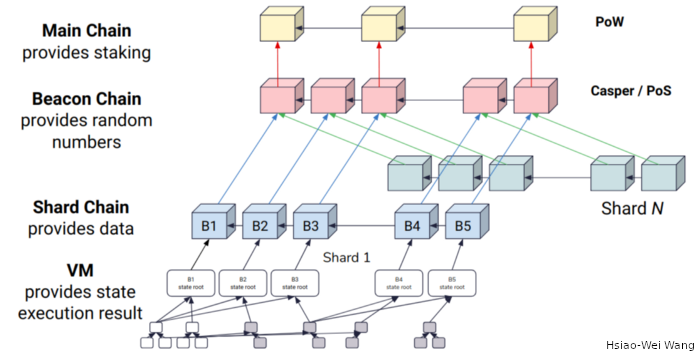
Sharding
- The idea is relatively simple - split transactions across multiple shard chains, however, this approach has multiple complicated problems such as:
- Atomic cross-shard transactions (especially complex Smart Contracts) are complicated, some workarounds:
- Design the use-case on a single shard
- Move assets to destination shard and execute transactions in later blocks
- Risk of accepting invalid chain (the main benefit of sharding is that every node doesn't need to verify all shards data)
- Atomic cross-shard transactions (especially complex Smart Contracts) are complicated, some workarounds:
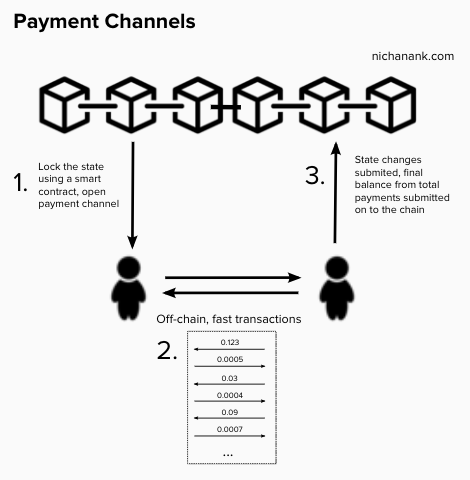
State Channels
- Participants must deposit
- Bidirectional payments
- Composition (A -> B -> C)
- Can't send payments
off-chain to non-participants
- Transactions balance can't
exceed deposits
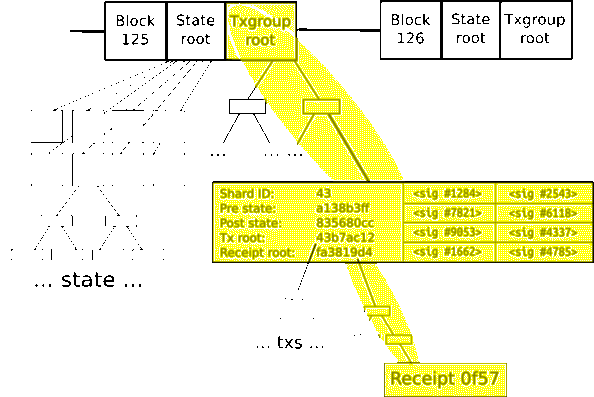
Plasma
- Transactions in Off-chain
Merkle trees - Possible to send to
non-participant - Requires publishing hash at
regular intervals - Somebody needs to
challenge fraudulent
transactions - Long exit time (7-14 days)
Rollups
.
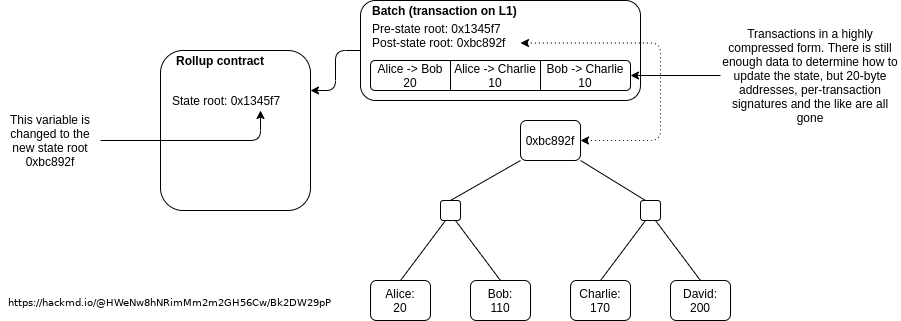
Rollups
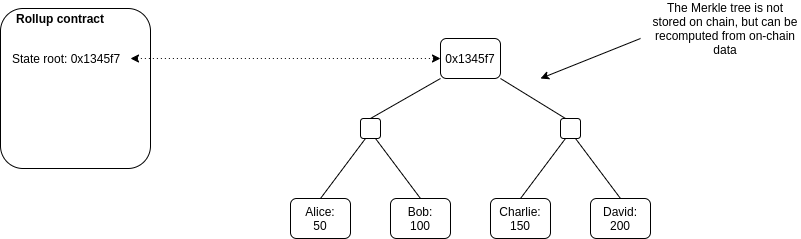
- Hybrid approach - moves computation off-chain, keeps partial data on-chain (the rest of the data can be recomputed)
- On-chain data is part of the consensus, everyone who wants can verify it
- Speed-up limited by on-chain part (ERC20 transfer costs ~150x less gas)
- Possible to send/receive assets from/to non-participants
- Two main types:
- Optimistic Rollups - uses fraud proofs
- ZK-Rollup - uses cryptographic validity proofs
Optimistic
- Low complexity
- Easier generalization
- Long withdrawal period
- Lower fixed costs of
batch (state root change)
- Higher per transaction cost
ZK Rollups
- High complexity
- Harder generalization
- Short withdrawal period
- Higher fixed costs of batch (expensive ZK-SNARK computation)
- Lower per transaction cost (no need to publish all data)
Data Sharding for Rollups
- Full blockchain sharding (separate execution on shards) still has multiple unresolved problems
- Rollups are limited by available data in a block (~25kb in Ethereum 1.0)
- Data increase inside a block isn't a real solution
- Ethereum 2.0 proposes Data Sharding:
- Up to 16 megabytes per slot
- Every node doesn't needs to download all the data
Data Sharding (DS)

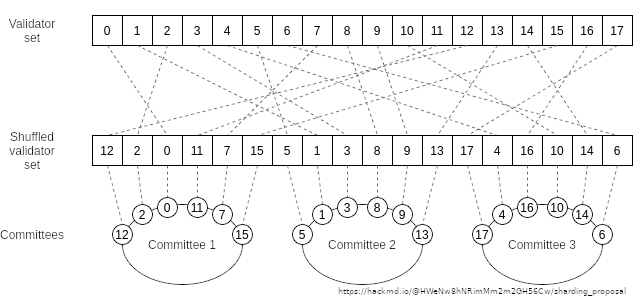
DS: Randomly Sampled Commitees
- Committee votes only for assigned shard
- Validators are shuffled after validators' indexes are fixed, so it's very hard for an attacker to control a committee
DS: Data Availability
Sampling (DAS)
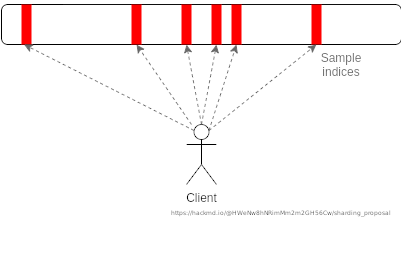
- A client randomly chooses samples (every client needs to download only a small part of the data)
- It's complicated for an attacker with high control to convince clients to accept unavailable blob
DS: Erasure Coding
- Polynomial oversampling can be used against attackers that avoid publishing full blobs by publishing only the chunks that clients requested:
- Split blob into N data chunks
- Interpolate through those data points
- Calculate redundant data for next N+1 - 2N
- It's possible to recover the original data from any N points of the 2N data samples
DS: Kate Polynomial Commitments
- Kate polynomial commitment scheme allows a prover to commit to a polynomial using only a single elliptic curve point
- This commitment can be later opened at any position (prover can prove that the value of the polynomial at some position is equal to the claimed value)
- A pairing-friendly elliptic curve is needed for this scheme (for example, BLS12-381)
- Such a commitment hides polynomial
- A trusted setup is needed (for example, via Secure Multiparty Computation)
My Further Research Options
- Proceed with the latest design (Data-only Sharding) Ethereum 2.0 and propose improvements
- Stick to the original Ethereum 2.0 Executable Shards proposal and focus on unsolved problems