www.bacartography.org
https://slides.com/sferna109/deck/live
Understanding U.S. Mexico Borderlands:
Newspapers Mapping Geographical Borders
Borderlands Lecture Series, Pueblo, Colorado
US National Discourses
US-Mexico Borderlands
El Paso Bishop Mark Seitz said, "most people see a border as a place of no return, a no-man's-land, a place where one reality ends and another begins, but for us a border is so different,"
"For us it's a place of passage, it's a place of encounter, it's a place you cross in order to join your family; it's not this place of armies confronting one another … We have a different understanding of what a border is and should be.”
Edith Tapia, policy research analyst at the Hope Border Institute said, "It's not an empty space. It's not a hypothetical either."
"We have very unique circumstances, but we make the best of what we have … Sharing that with people from the outside has always been a shock because they imagine the border to be this empty land. They come here and express, 'I didn't realize it was big. I didn't realize it was a city.' …”
Border Identities
Fronteriza: Border native or someone who lived or resides in the Mexican or US borderland region.
Transfronteriza: As a way of life characterized by the continuous interaction among individuals and institutions belonging to two distinct socioeconomic [and diverse cultural] structures in the region where they share a common border...Therefore, its inhabitants must learn to negotiate the different opportunities and specific limitations of border life and the differences of those within each country, this can result in a way of thinking or a border society. (Ruiz 107; Newby 3)
Borderlands Archives Cartography
Why the use of newspapers?
BAC's Transnational Archive
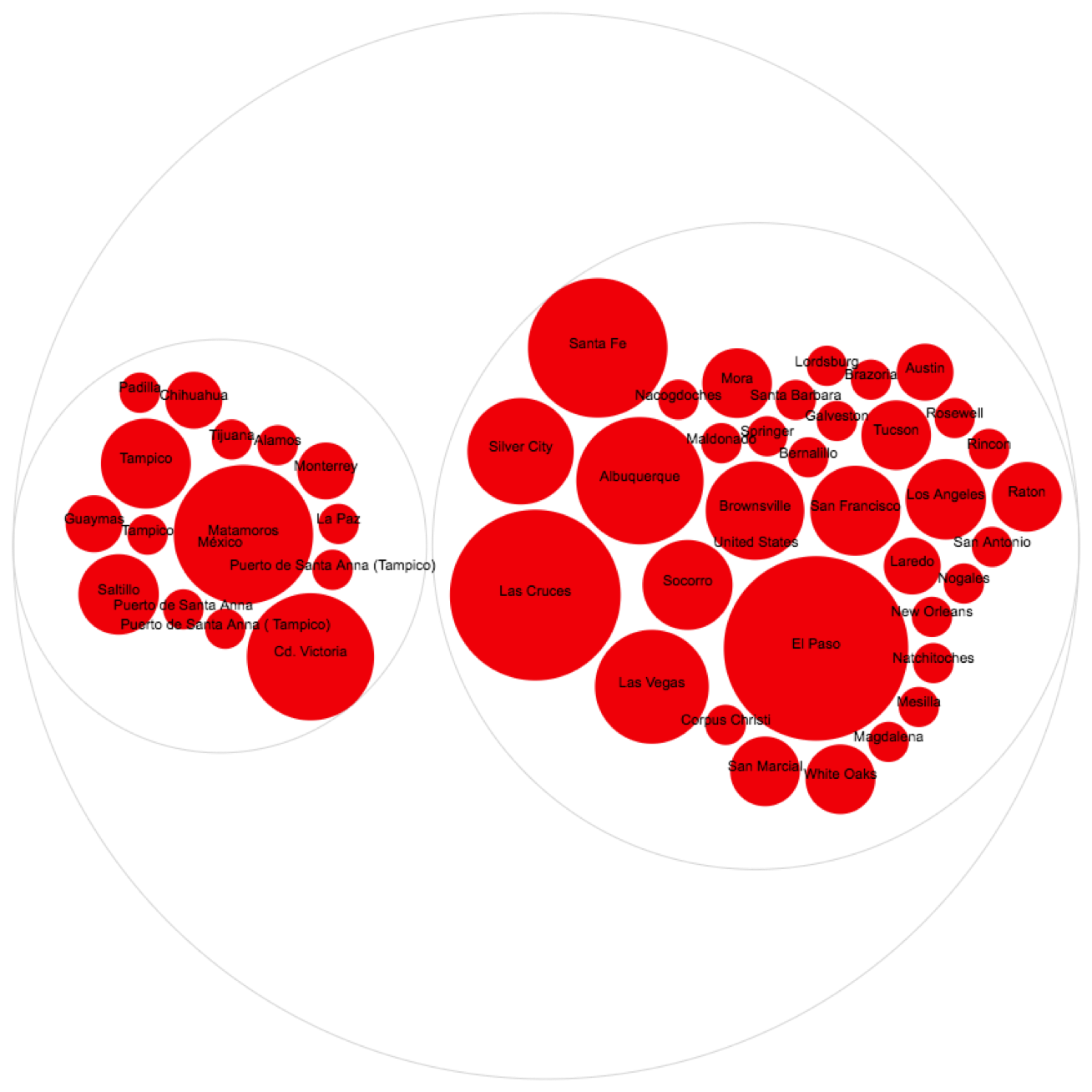
México
United States
Colorado 19th Century Newspapers
- El Anciano, Trinidad, Colorado. 1882 - 1uuu
- Anunciador de Trinidad, Trinidad, Colorado. 1882
- The Colorado Pioneer, Trinidad, Colorado. 1875 - 1878?
- Las Dos Repúblicas, Denver, Colorado. 1896-1877
- El Explorador, Trinidad, Colorado. 1876-1877
- Heraldo Dominical, Trinidad, Colorado. 1uuu-1uuu
- Huérfano Independent, Walsenberg, Colorado. 1875-18uu
- El Independiente, Walsenberg, Colorado. 1896-1uuu
- La Patria, Denver, Colorado. 1891-1uuu
- El Progreso, Trinidad, Colorado. 1891?-1944?
-
Repúblicas, Denver, Colorado. 1895-1896
-
Las Repúblicas, Trinidad, Colorado. 1895-1897
-
Trinidad Weekly Advertiser / El Anunciador de Trinidad, Trinidad, Colorado. 1882-1uuu
-
Trinity Weekly Times, Trinidad, Colorado. 1881-1uuu
-
El Triunfo, Antoñito, Colorado. 1uuu-1uuu
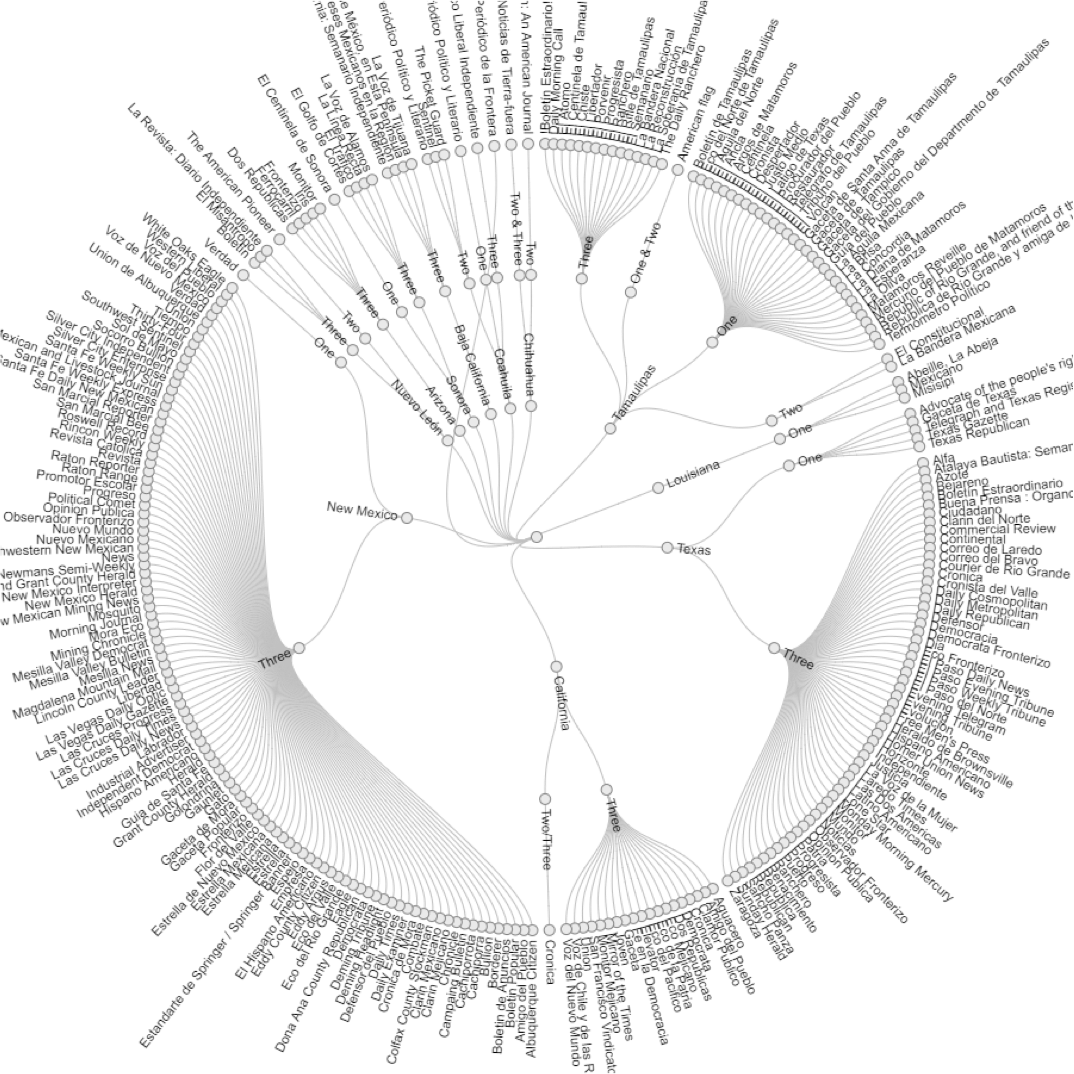
BAC and Geographical Border Transitions
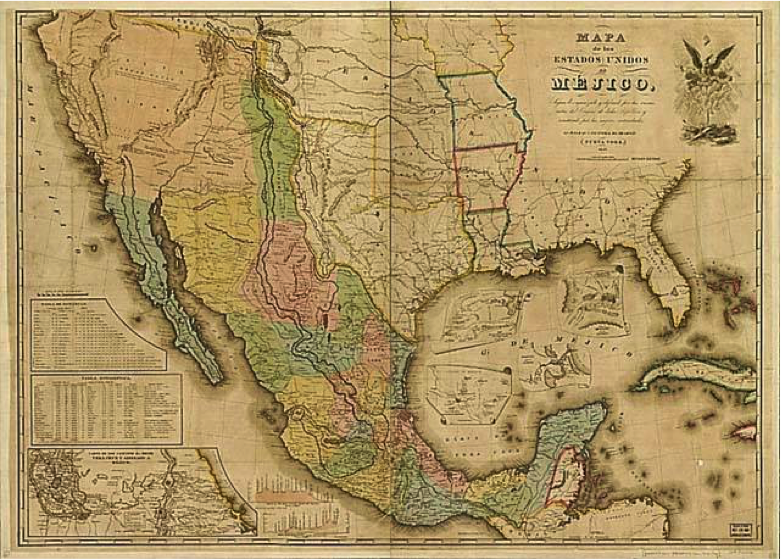
Map of Mexico by John Distrunell, the 1847 map used during the Treaty of Guadalupe Hidalgo negotiations.
Courtesy of National Archives
Multiple Voices
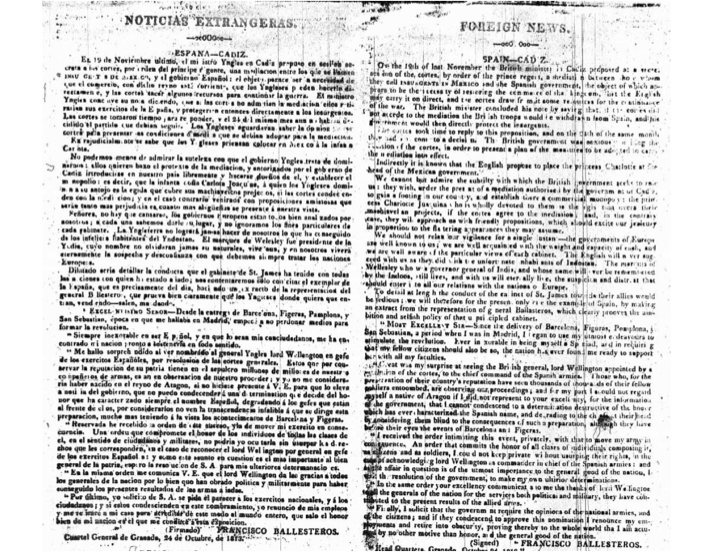
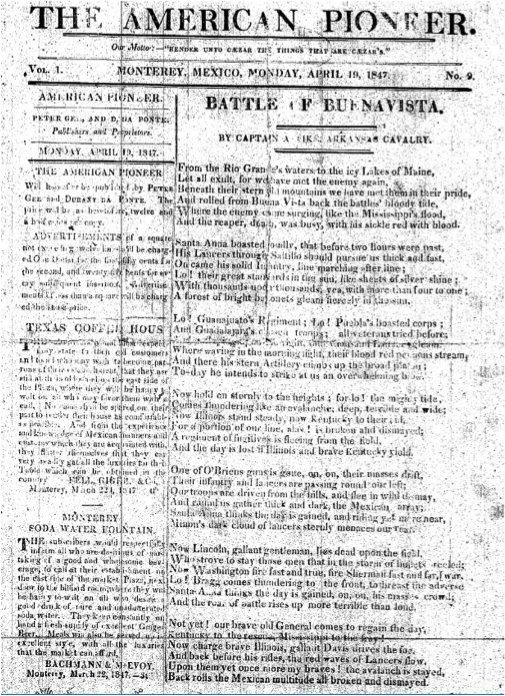
Period Two
Period One
Period Three
Colonial Period
El Mexicano,
Natchitoches, Louisiana.
Hispanic American Newspapers. Readex: Newsbank.
Mexican American War Period
The American Pioneer. Monterrey, Nuevo León. Latin American Newspapers. Nettie Lee Benson
Current Division Line Period
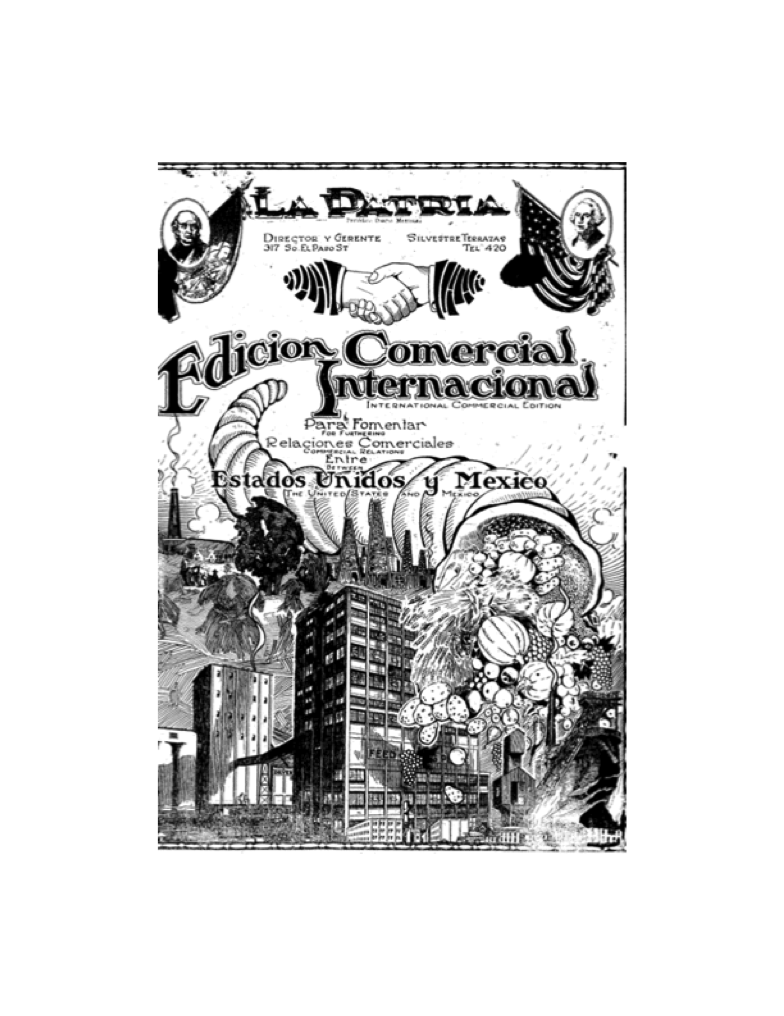
La Patria. El Paso, Texas. Hispanic American Newspapers. Readex: Newsbank.
BAC as a Bridge
"Somos una gente"
Hay tantísimas fronteras /
que dividen a la gente, /
pero por cada frontera /
existe también un puente.
—Gina Valdés (Anzaldúa 107)
Borderlands Archive Cartography, as a transnational project, invites to inquire the content of newspaper archives with the aim of new interpretations of the past for a deeper understanding of the present in order to challenge discourses of oppression.
Thank you! ¡Gracias!
www.bacartography.org

@bacartography
Bibliography
Anzaldúa, Gloria. Borderlands/ La Frontera: The New Mestiza. 4th ed., Aunt Lute Books, 2012.
Ayers, Edward. Turning toward place, space, and time. The Spatial Humanities: GIS and the Future of Humanities Scholarship, edited by David
Bodenhamer, John Corrigan and Trevor M. Harris, Indiana University Press, 2010, pp. 1-12.
Cordell, Ryan. “What has the Digital Meant to American Periodicals Scholarship?” American Periodicals: A Journal of History & Criticism, vol. 26 no. 1, 2016, pp. 2-7. Project MUSE https://muse-jhu-edu/article/613373
Cors, Alexander. “Digital Humanities & Methods: Mapping Social Networks and Indigenous Legal Culture in Colonial Mexico,” HASTAC, July 15, 2018, https://www.hastac.org/blogs/alexofcors/2018/07/15/digital-humanities-methods-mapping social networks-and-indigenous- legal, Accessed August 20, 2018.
Kanellos, Nicolás and Helvetia Martell. Hispanic Periodicals in the United States, Origins to 1960: A Brief History and Comprehensive Bibliography. Arte Público Press, 2000.
Moraga, Cherríe and Gloria Anzaldúa, editors. This Bridge Called My Back: Writings by Radical Women of Color. Albany, NY, State University of New York Press, 2015.
Newby, C., Alison. “Border Crossing and Settlement in El Paso, Texas: Understanding Transborder Actors.” Annual Meeting, Montreal, Canada. http://citation.allacademic.com//meta/p_mla_apa_research_citation/1/0/5/4/4/pages105441/p105441-1.php. Accessed July 2018.
Risam, Roopika. “Breaking and building: The case of postcolonial digital humanities.”The Postcolonial World, edited by Jyotsna G. Singh and David D. Kim, Routledge, 2017, pp. 345-362.
Ruiz, Vicki. "Nuestra América: Latino History as United States History.” The Journal of American History, vol. 93, no. 3, 2006, pp. 655-672.