organisational
justice
justice
"Justice, sir, is the greatest interest of man on earth."
- Daniel Webster
Justice (or fairness) refers to the idea that
an action or decision is morally right.
organisational justice
what is it ?
Personal evaluation about ethical and moral
standing of managerial standards
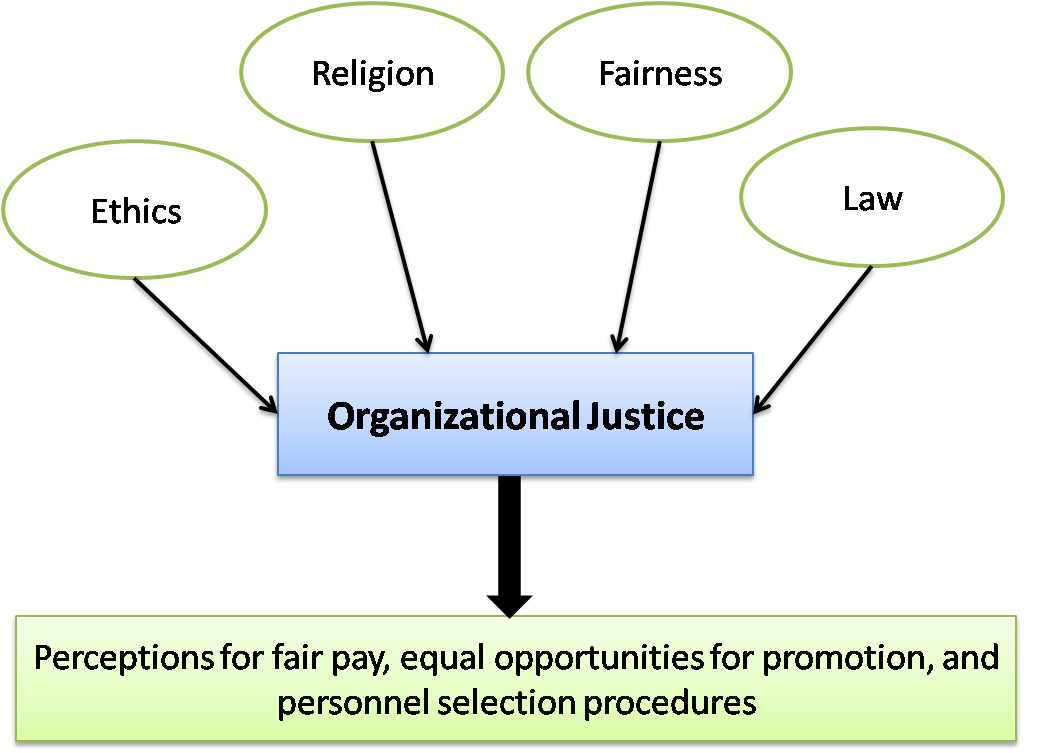
organisational justice
evolution
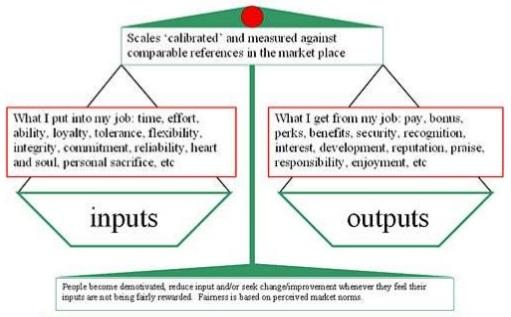
Adam's Equity theory of Motivation
(1963, 1965)
Judgement of equity are derived from comparisons between one's self and others based on
inputs & outcomes
INPUT
Refers to what a person perceives to contribute
eg: knowledge and effort
eg: knowledge and effort
OUTCOMES
What an individual perceives to get out of an exchange relationship
eg: pay and recognition
INTRODUCTION TO
CASE STUDY
STORY OF ARUN, A SOFTWARE DEVELOPER
STARTUP
Team is exceptional
All members are professional and experienced developers
They work at a breakneck speed
STARTUP
- Arun joins the team
- He is assigned a sub project
- He is given a documentation file which lists all the expected features in the finished project and how the features should work
COMPANY
Arun joins a company
Company is renowned but doesn't pay very well.
His team members are his college mates and his boss is two years senior to him.
COMPANY
- Arun is assigned a project and provided with a documentation.
- He is asked to evaluate and resubmit the documentation along with suggestions for other features.
- His suggestions are discussed with him and added to the official documentation.
Types OF
ORGANISATIONAL JUSTICE
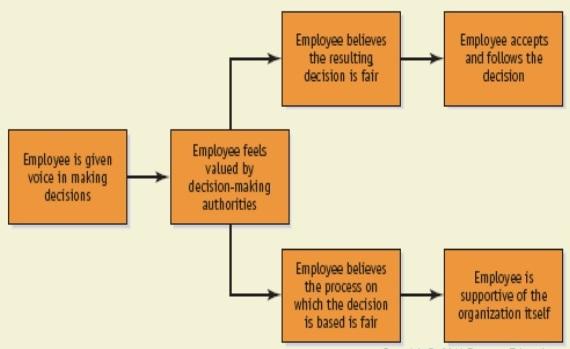
procedural justice
Appropriateness of allocation process
Consistency | Lack of Bias | Accuracy | Correction | Ethics
Leventhan (1980)
The Fair Process effect
distributive justice
Appropriateness of outcome
Equity | Equality | Need
interactional justice
Appropriateness of treatment from authority
Interpersonal | Informational
Colquitt (2001)
WHY JUSTICE
MATTERS TO PEOPLE
LONG RANGE BENEFITS
People are often motivated by economic and quasi-economic interests
SOCIAL CONSIDERATIONS
Just treatment tells us that we are respected and esteemed by the larger group
ETHICAL CONSIDERATIONS
When individuals witness an event they believe is ethically inappropriate, they are likely to take considerable risks in the hopes of extracting retribution
ORGANISATIONAL JUSTICE
PERCEPTIONS
EMPLOYEE PARTICIPATION
The opportunity to participate in decision making improves an individual’s perceptions of procedural justice, even when the decision is unfavorable to the individual
(Bies & Shapiro, 1988)
leadership
In just environment, decisions taken by leaders
reflect fair treatment of people.
(B. Charles Tatum, 2003)
communication
It is important that information provided be accurate, timely and helpful to impact perceptions of justice.
(Schweiger & Denisi, 1991)
justice climate
Researches show members learn justice evaluation from other team members.
(Roberson & Colquitt, 2005)
organizational justice
outcomes
trust on supervisor
A positive relationship between an employee and supervisor can lead to trust in the organization
(Hubbell & Chory-Assad, 2005)
performance
Improving justice perceptions improves
productivity and performance.
(Karriker & Williams, 2009)
job satisfaction
It was found to be positively associated
with overall perceptions of organizational justice.
(Cohen- Charash & Spector, 2001)
organisational citizenship behavior
Actions that employee takes to support the organization
that go above and beyond the scope of their job description.
(Karriker & Williams, 2009)
counterproductive work behavior
Increased judgments of procedural injustice, for instance
can lead to employee unwillingness to comply
with an organization's rules.
(Cohen- Chatash & Spector, 2001)
absenteeism & withdrawal
Failure to receive a promotion is an example of a situation in which feeling of injustice may result in an employee being absent from work without reason.
(Johns,2001)
emotional exhaustion
As perceptions of justice increase
employee health increases.
(Liljegren & Ekberg, 2009)
ORGANIZATIONAL JUSTICE
CASE STUDY
Experience of a software developer, Arun, at a
STARTUP vs COMPANY
STARTUP
Team is exceptional
All members are professional and experienced developers
They work at a breakneck speed
STARTUP
-
Arun joins the team
-
He is assigned a sub project
-
He is given a documentation file which lists all the expected features in the finished project and how the features should work
STARTUP
- Arun gets stuck on a particular issue and asks a senior for help. The senior mails him the software code solution for the problem by the end of the day
-
He has no idea what others are working on
COMPANY
Arun joins a company
Company is renowned but doesn't pay very well.
His team members are his college mates and his boss is two years senior to him.
COMPANY
- Arun is assigned a project and provided with a documentation.
- He is asked to evaluate and resubmit the documentation along with suggestions for other features.
- His suggestions are discussed with him and added to the official documentation.
COMPANY
-
When Arun got stuck on a particular feature, his boss sat down with him and helped him figure out the problem.
- His boss also sends a daily mail with status of everyone's projects and also provides feedback on the progress.
DIFFERENCES
PAY | QUALITY OF WORK | INTERACTION | SPEED OF ITERATION
PERSONAL DEVELOPMENT
PROBLEMS AT THE STARTUP
-
No participation of employees
-
Reduction in Productivity, Creativity, Innovation, Ideas and Commitment
- No smooth communication between Boss and his team members.
- No external motivation
- There was no feedback for personal growth
MISSING
Procedural Justice
Communication
Job Satisfaction
Organisational Citizenship Behaviour
Counterproductive work behaviors
SOLUTION TO
ORGANISATIONAL JUSTICE
CONCLUSION
ORGANISATIONAL JUSTICE
THANK YOU
Suraj Kumar Sau
Vijay Jain
Rajat Srivastava
Manush Gupta
Shashank Mehta
\m/