COMP2521
Data Structures & Algorithms
Week 8.4
Quicksort
Author: Hayden Smith 2021
In this lecture
Why?
- We need to learn about n*log(n) time algorithms for a sorting algorithm suitable for large data sets
What?
- Quick Sort
Quicksort
General idea:
- Choose an item to be a "pivot"
- Re-arrange (partition) the array such that:
- All elements to the left of pivot are smaller than pivot
- All elements to the right of pivot are greater than pivot
- (recursively) sort each of the partitions
Generally implemented recursively. Though can be implemented iteratively with a stack.
Conceptual Process
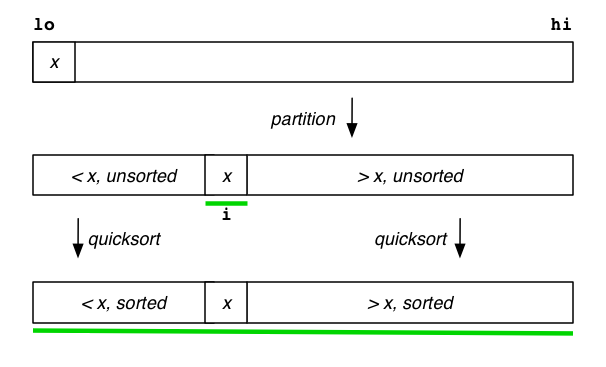
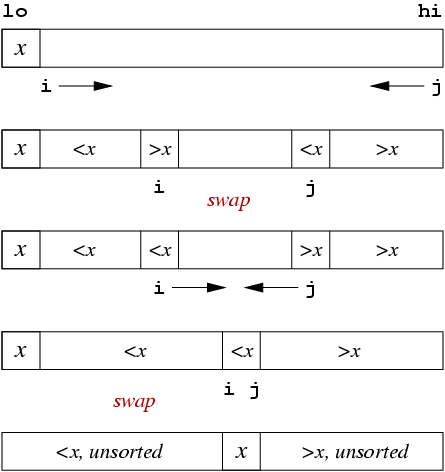
Conceptual Process
Implementation
void quicksort(Item a[], int lo, int hi) {
   if (hi <= lo) return;
   int i = partition(a, lo, hi);
   quicksort(a, lo, i-1);
   quicksort(a, i+1, hi);
}

int partition(Item a[], int lo, int hi) {
   Item v = a[lo];  // pivot
   int  i = lo+1, j = hi;
   for (;;) {
      while (less(a[i],v) && i < j) i++;
      while (less(v,a[j]) && j > i) j--;
      if (i == j) break;
      swap(a,i,j);
   }
   j = less(a[i],v) ? i : i-1;
   swap(a,lo,j);
   return j;
}
Performance
-
Best case: O(n*log(n))
- EVERY choice of pivot gives two equal-sized partitions
- Essentially halving at each level (logn)
-
Worst case: O(n^2)
- EVERY choice of pivot is one of the highest or lowest values
- Results in each level requiring n comparisons
As you can see, the choice of pivot is very important
Median-of-three improvement
Rather than choosing a static or random pivot, try to find a good "intermediate" value by the median-of-three rule. Make sure the 3 elements (high, low, mid) arei nt he right order
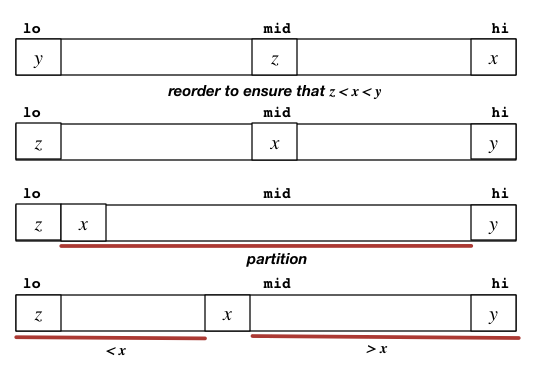
Median-of-three improvement
void medianOfThree(Item a[], int lo, int hi) {
   int mid = (lo+hi)/2;
   if (less(a[mid],a[lo])) swap(a, lo, mid);
   if (less(a[hi],a[mid])) swap(a, mid, hi);
   if (less(a[mid],a[lo])) swap(a, lo, mid);
   // now, we have a[lo] < a[mid] < a[hi]
   // swap a[mid] to a[lo+1] to use as pivot
   swap(a, mid, lo+1);
}
void quicksort(Item a[], int lo, int hi) {
   if (hi <= lo) return;
   medianOfThree(a, lo, hi);
   int i = partition(a, lo+1, hi-1);
   quicksort(a, lo, i-1);
   quicksort(a, i+1, hi);
}
Insertion Sort improvement
Recursive function calls have high overhead. Quicksorting partitions with sizes < 5 (approx) have very little benefit compared to simple sorts.
Solution: Handle small partitions with insertion sort
void quicksort(Item a[], int lo, int hi) {
   if (hi-lo < Threshhold) {
      insertionSort(a, lo, hi);
      return;
   }
   medianOfThree(a, lo, hi);
   int i = partition(a, lo+1, hi-1);
   quicksort(a, lo, i-1);
   quicksort(a, i+1, hi);
}