字串
string
-葉子齊-
Index
字元 char
ASCII表
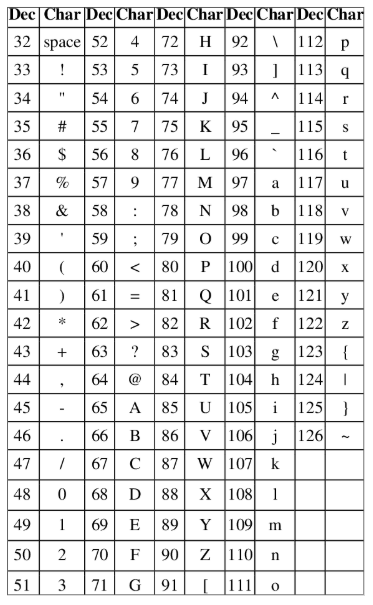
- 一種將字元對應到數值的標準編碼方式
- 開發始於 1963,它的創建是為了改進電報中使用的程式碼
- "美國資訊交換標準代碼"的縮寫
ASCII表
只需要知道:
- a比z的ASCII小
- A比Z的ASCII小
- 0比9的ASCII小
詳細版:
-
數字字元 '0' ~ '9':ASCII 值為 48 ~ 57
-
大寫字母 'A' ~ 'Z':ASCII 值為 65 ~ 90
-
小寫字母 'a' ~ 'z':ASCII 值為 97 ~ 122
顯示 ASCII 碼
可利用 (int) 將字元強制轉型為整數,取得對應的 ASCII 碼:
#include <iostream>
using namespace std;
int main()
{
    char ch = 'a';
    cout << "ASCII 碼為:" << (int)ch << endl;


    return 0;
}
字元 & 字串
正式進入主題辣

字元
在 C++ 中,字元使用 char 資料型別表示,
一個 char 變數可以儲存一個 ASCII 字元
char ch = 'A'; 使用單引號' '表示字元
判斷字元類型
輸入一個字元,
若為大寫輸出upper,
小寫輸出lower,
不是字母則輸出Not a letter
char ch;
cin >> ch;
if(ch>='A' && ch<='Z') cout << "upper" << endl;
else if(ch>='a' && ch<='z') cout << "lower" << endl;
else cout << "Not a letter" << endl;
判斷字元類型
#include <iostream>
using namespace std;
int main()
{
    char ch;
    while(cin>>ch){

        if (isupper(ch)) cout << "是大寫字母";
        else if (islower(ch))  cout << "是小寫字母";
        else if (isdigit(ch)) cout << "是數字";
        else cout << "是其他符號";

    }

    return 0;
}
判斷字元類型
更多判斷字元類型的功能可以函式庫<cctype>
參考資料:
字串 string
字串
字串是多個字元組成的,使用 string 資料型態
需 #include <string>
#include <string>
string name = "Leaf";
使用雙引號" "
字串
- 輸入時遇到空白或換行停止
string str1, str2;
cin >> str1 >> str2;
輸入 : Hello World
輸入 : Hello
World
結果 : str1 = Hello
str2 = World
常用用法
- 可取出其中的單一字元
- 宣告後可更改其中的內容(部分or全部)
- 相等比較 == : 比較兩個字串的字元內容是否相同
- 串接字串 + : 直接使用 + 運算子來串接字串
- 字串長度 str.size() : 字串長度
- 字串長度 str.length() : 字串長度
- 字串為空 str.empty() : 字串是否為空
注意事項
- #include<string>
- 使用雙引號(")
- 輸入時遇到空白或換行停止
常用用法
- 可取出其中的單一字元
- 可相加
string str = "Hello World!";
char first = str[0];
char second = str[1];
cout << first <<" "<< second;
//H e
string first = "Hello ";
string second = "World!";
cout << first + second;
//Hello World!常用用法
- 宣告後可更改其中的內容(部分or全部)
string str = "Hello World!";
str[1]='a';
cout << str;
//Hallo World!
string str = "Hello World";
str = "new Hello World";
cout << str << endl;
//new Hello World常用用法
string str1;
string str2 = "Hello";
string str3(str2);

cout << "str1 是否為空:" << str1.empty() << endl;
cout << "str1 長度: " << str1.size() << endl;
cout << "str2 長度: " << str2.size() << endl;
cout << "str3 長度: " << str3.size() << endl;
cout << "str3 長度: " << str3.length() << endl;

if(str1 == str2)cout << "str1 與 str2 內容是否相同:Yes" << endl;
else cout << "str1 與 str2 內容是否相同:No" << endl;


if(str2 == str3)cout << "str2 與 str3 內容是否相同:Yes" << endl;
else cout << "str2 與 str3 內容是否相同:No" << "\n";
str1 是否為空:1
str1 長度: 0
str2 長度: 5
str3 長度: 5
str1 與 str2 內容是否相同:No
str2 與 str3 內容是否相同:Yes
string str3(str2);
string str3 = str2;
=>
輸入整行字串:getline
-
當接收一個字串時,可以接收空格
#include <iostream>
using namespace std;

int main()
{
    string name;
    cout << "Please, enter your full name: ";
    getline (cin,name);
    cout << "Hello, " << name << "!\n";

    return 0;
}
Please, enter your full name: jason chen
Hello, jason chen!
實作
提示 :
先確認字串長度
再判斷字串s頭尾是否相同
#include<iostream>
#include<string>
using namespace std;

int main(){
    string s;bool c=1;
    cin >> s;
    for(int i=0,len=s.size(); i<len; i++){

        if(s[i]!=s[len-1-i]){ //判斷字串s頭尾是否相同
            c=0;
            break;
        }
    }

    if(c) cout << "yes" << endl;
    else cout << "no" << endl;

    return 0;
}提示 :
使用ASCII碼的觀念 : 0比9的ASCII小
不考慮輸入空格的情況 (用cin輸入)
引入 <string> 函式庫,使用 size() 取長度
#include<iostream>
#include<string>
using namespace std;

int main(){
    //K==7
    string p, ans;
    cin >> p;
    for(int i=0,len=p.size(); i<len; i++){
        ans += char(p[i]-7);
    }
    cout << ans << endl;
}提示:
- 引入 <math.h> 函式庫後,可以使用 abs() 取絕對值
- 將輸入的數字以字串處理,方便取各個位數的值
#include<iostream>
#include<math.h>
using namespace std;

int main(){
    string p;
    int A = 0, B = 0;
    cin >> p;
    for(int i=0,len=p.size(); i<len; i++){

        if(i%2) A += p[i]-'0';
        else B += p[i]-'0';
        //最後是取絕對值,所以重點是交錯取,A是奇數位總和或偶數位總和不會造成影響

    }
    cout<< abs(A - B) <<endl;
}
為什麼要 -'0'
從 cin 讀進來的字串(或字元),
每個數字其實是以 字元(char)型態 儲存的,
例如:
string p = "263541";
char ch = p[0];  // ch = '2'
你以為是數字 2,其實是字元 '2',它的 ASCII 值是 50
所以:
就會變成:
這樣就可以把字元 '2' 轉為整數 2,開始進行數學運算
p[i] - '0'
'2' - '0' = 50 - 48 = 2
'6' - '0' = 54 - 48 = 6
解答中這段程式碼:
A += p[i] - '0';
B += p[i] - '0';
意思是:「把字串中的字元 char 轉成數值 int 後加總」