Engaging resistance:
implementing a project amidst hostility



Define Resistance
Define engagement

Change is a process not an event
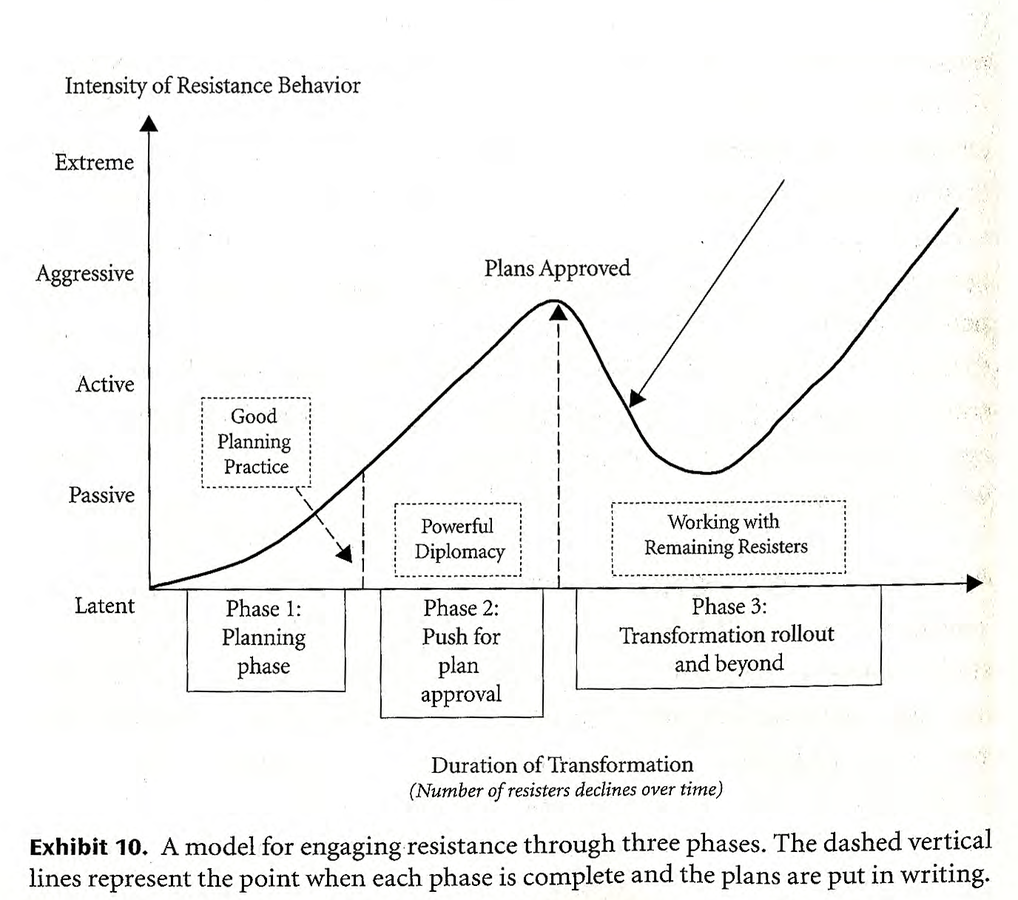
Types of Resistors
- Historicism
- Skepticism
- Naysaying
- Passive Aggression
- Disengagement/Apathy
- Intimidation
- Fearfulness
Historicism
Historical opposition is grounded in the belief that the college has not changed; that it is impossible to change. On one end of the spectrum, the use of anecdotes is the primary strategy. They might be heard to say, “Not that again.” On the other end of the spectrum, the past may be revisited by involving other players to strengthen the argument that the case for change will end the way that it did in the past.

Historian behavior is often marked by stories of past failures. They are quick to argue that there are no new ideas and that any change is just a recapitulation of something already tried.
Skepticism
Skeptical behavior is demonstrated by questioning and the pursuit of doubts. Change agents may feel that the skeptic is asking questions to be annoying. It may be that some colleagues just approach new ideas by challenging them, not matter the issue. In other words, these people may just be in the habit of questioning everything and everyone.

In more extreme cases, some skeptics may insist on deeper questioning, even in situations when evidence is provided to address the questions. In those situations, it seems like they refuse to be satisfied by any answer.
Naysaying
When presented with data, evidence, or other arguments, naysayers often fail to engage reasoning, focusing instead on the impossibility that anything can be done about the problem, even if evidence of the problem exists is credible, or that the college has the will, funding, or personnel to make a meaningful step toward progress. Naysaying may be punctuated by overt rejections like “never,” “ridiculous,” or “impossible.”

Naysaying can occur in public or privately, depending on the people exhibiting the behavior. In either case, naysaying is often marked by irrational incredulity.
Passive Aggression
This behavior is often marked by active public agreement, and then sabotage behind the scenes with other colleagues or other groups. Change agents may look to others honest dialogue from colleagues, and when resistance is not voiced or clearly signaled, that creates an assumption that agreement has been reached.

People who use passive aggressive resistance may even deliberately misrepresent themselves as in agreement, and then in private launch a resistance campaign, fail to act as they pledged, or slip into apathy as a form of resistance.
Part II: Passive
The “aggression” can be subtle and difficult to detect, but often does eventually show itself when what appeared to be agreement is, in fact, a subterfuge.
Aggression
Even so, passive aggressive colleagues will often reassure with their allegiance to an idea or initiative in public. Their more private conduct often demonstrates their real feelings, however
Disengagement/Apathy
Disengaged colleagues can also be difficult to detect. On one hand, some colleagues may be actively disengaged and fail to show an interest in anything except the minimum of what their job descriptions define. On the other hand, other colleagues my take on committee work or task force assignments, but fail to expend any energy or effort, despite their presence at meetings or volunteerism.

Disengagement can also be represented by claims of being “overwhelmed” or “too busy” to take on new tasks or new initiatives
Intimidation

Intimidation
Intimidation can take many forms in an academic setting. By their very stature at the institution, some colleagues may intimidate without meaning to do so. Others intimidate much more consciously and deliberately, using different approaches to intimidate their co-workers.
Resistors
Those approaches may include body language and insinuations, which may be more subtle ways of silencing change agency. While others approach intimidation with forceful rhetoric, political channels, and public challenges. Even if the intent does not exist, the result is often a “chilling effect” on courageous conversation and open dialogue about new ideas.

Fearfulness
Fearfulness
Fearfulness in higher education is not displayed as openly as this picture may depict it; however, it is a common condition. Change agents who seek to build coalition around an initiative may find themselves building support in one-on-one conversations. While many colleagues may pledge their support privately, they are unwilling to make a public display of their support, fearing criticism, negative attention, and isolation. Sometimes, change agents may go to public venues counting on that support and find themselves quite alone because their co-workers wanted to wait to read the room before they commit to an opinion or a comment.
How do we deal with these types of
RESISTORS????
Thank you!
Vanson Nguyen
vansonnguyen@peralta.edu
vanson@gmail.com
FB: Vanson Nguyen
IG: vansonian
http://rpgroup.org/projects/leading-middle-academy