Neural Representations for Computational Physics:
from Reduced Order Models to Scalable Transformers
Vedant Puri
DEC 04, 2025

Committee:
Levent Burak Kara, Yongjie Jessica Zhang, Amir Barati Farimani, Krishna Garikipati
Computer simulations are critical for industrial applications
1
Modern engineering is reliant on computer simulations
Predictive maintenance
Design space exploration
[2]
[1]
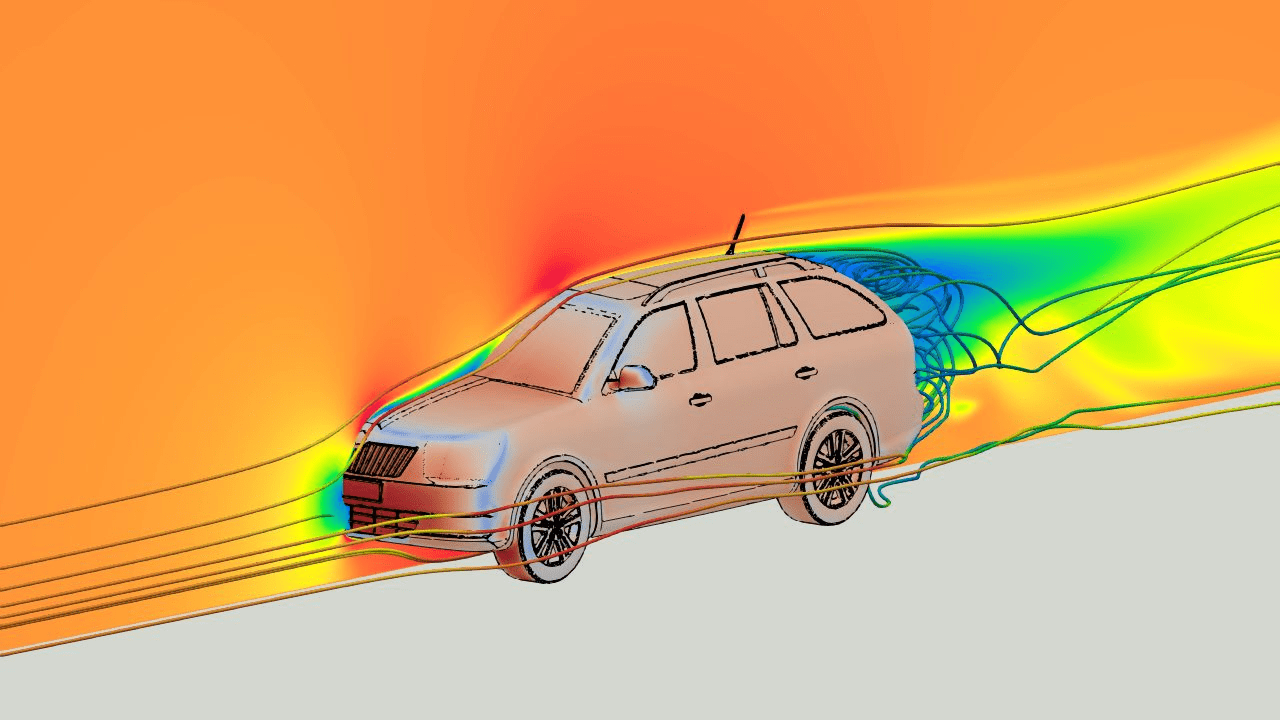
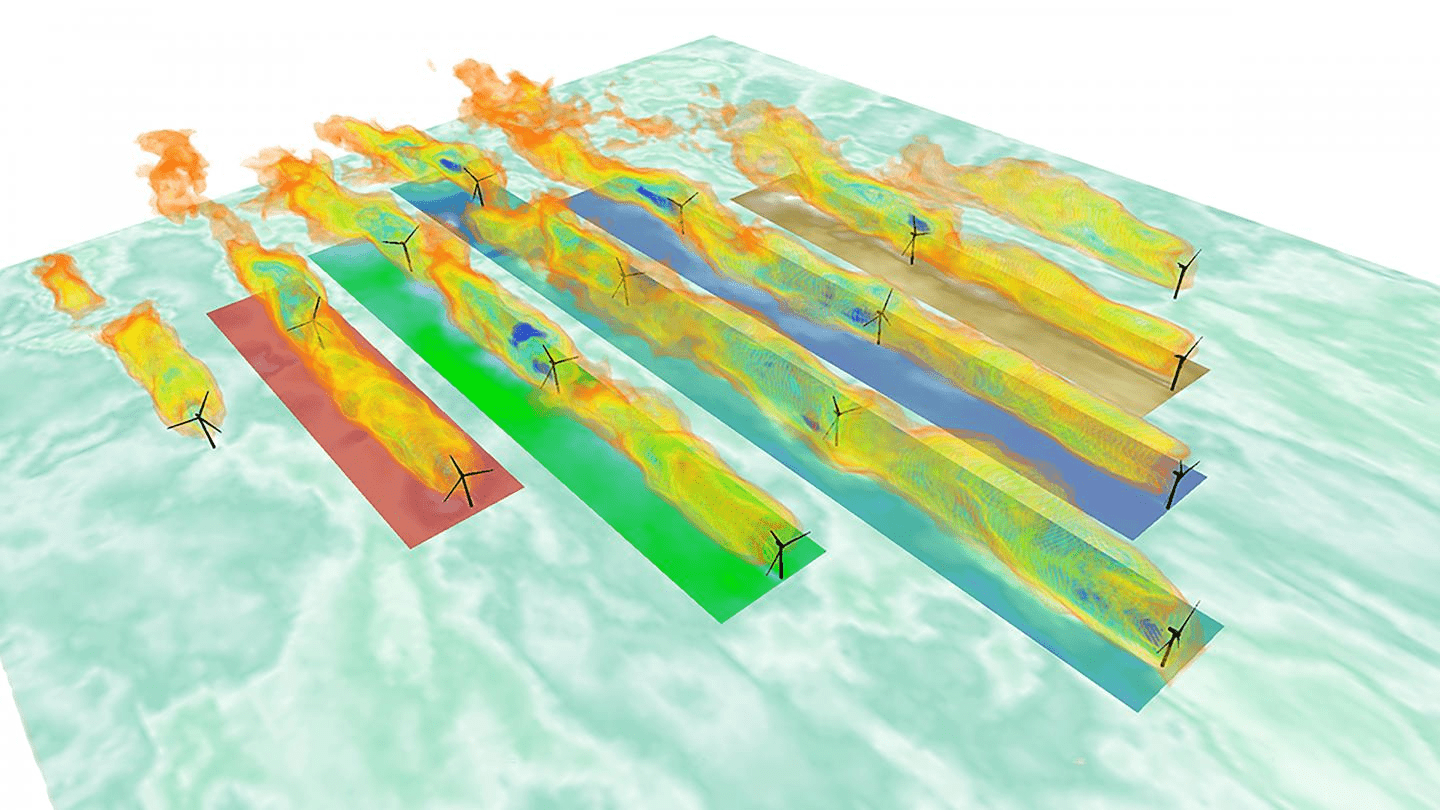
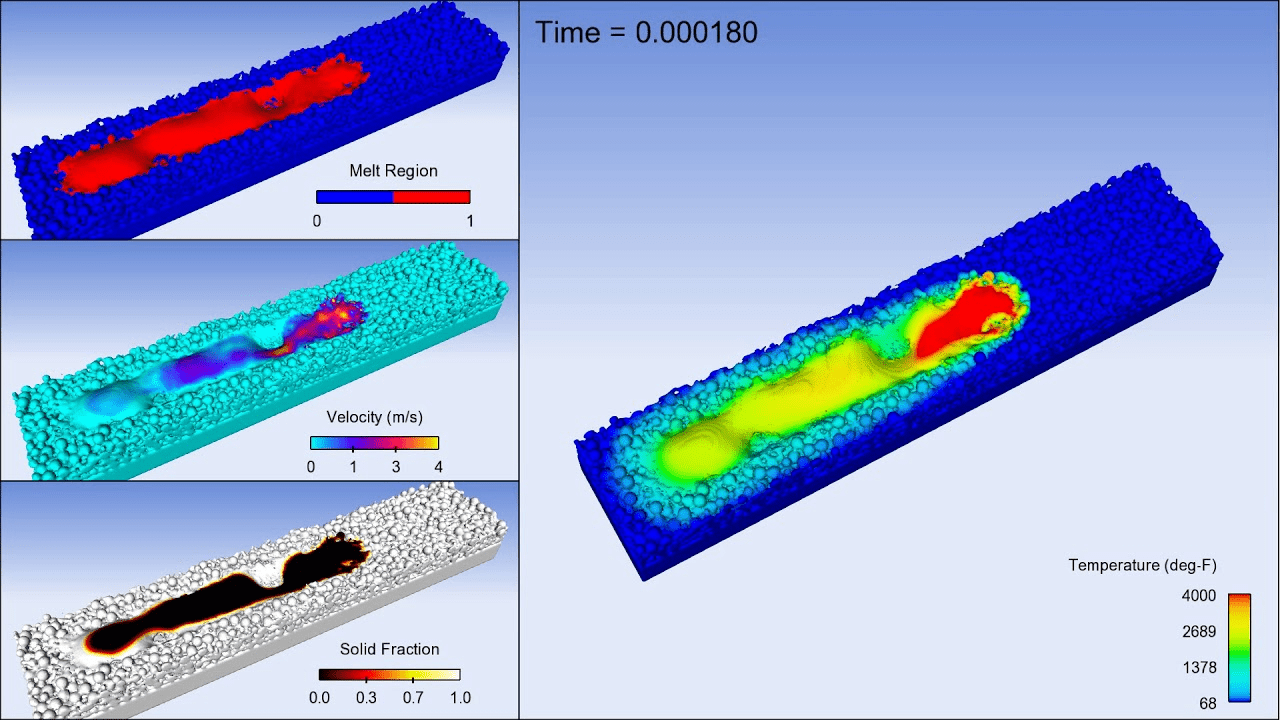
[3]
[1] CFD Direct / OpenFOAM – “OpenFOAM HPC on AWS with EFA”, cfd.direct
[2] EurekAlert — “New concrete system may reduce wind-turbine costs”
[3] Flow-3D, “FLOW-3D AM” product page, flow3d.com
Process optimization
Automotive engineering
Civil engineering
Advanced manufacturing
[1]
2
Physics-based simulations bottleneck many engineering workflows
[1] COMSOL — “Mesh Refinement”
[2] Langtangen, H. P. — INF5620: Finite Element Methods (Lecture Notes)
[3] GridPro Blog — “The Art and Science of Meshing Airfoil”
[4] ResearchGate — “Transition to turbulence of Taylor-Green Vortex at different time (DNS)” (figure)
[5] ORNL / U.S. Department of Energy — “DOE and Cray deliver record-setting Frontier supercomputer at ORNL”
Governing Equations
[1]
[2]
Discretization machinery
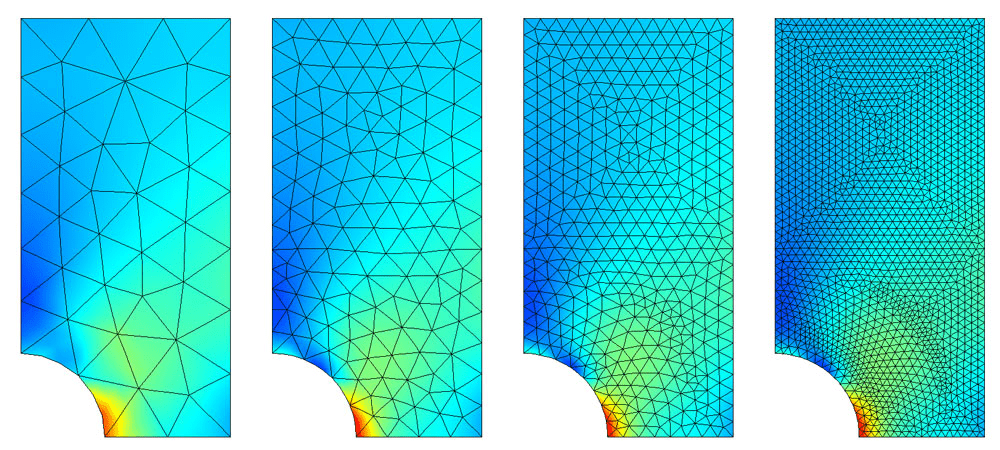
Repeated large system solves
[5]
Multiscale physics \(\implies\) small \(\Delta t\)
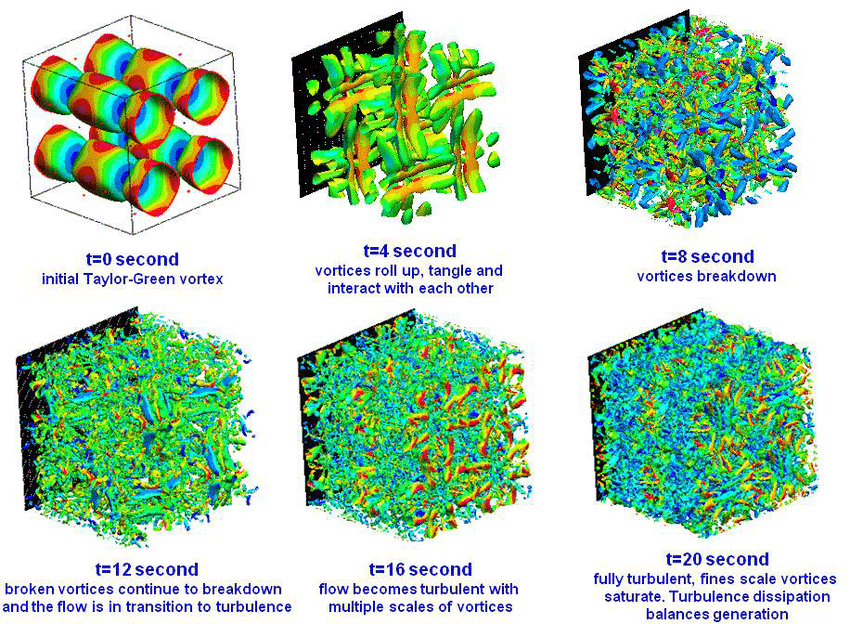
[4]
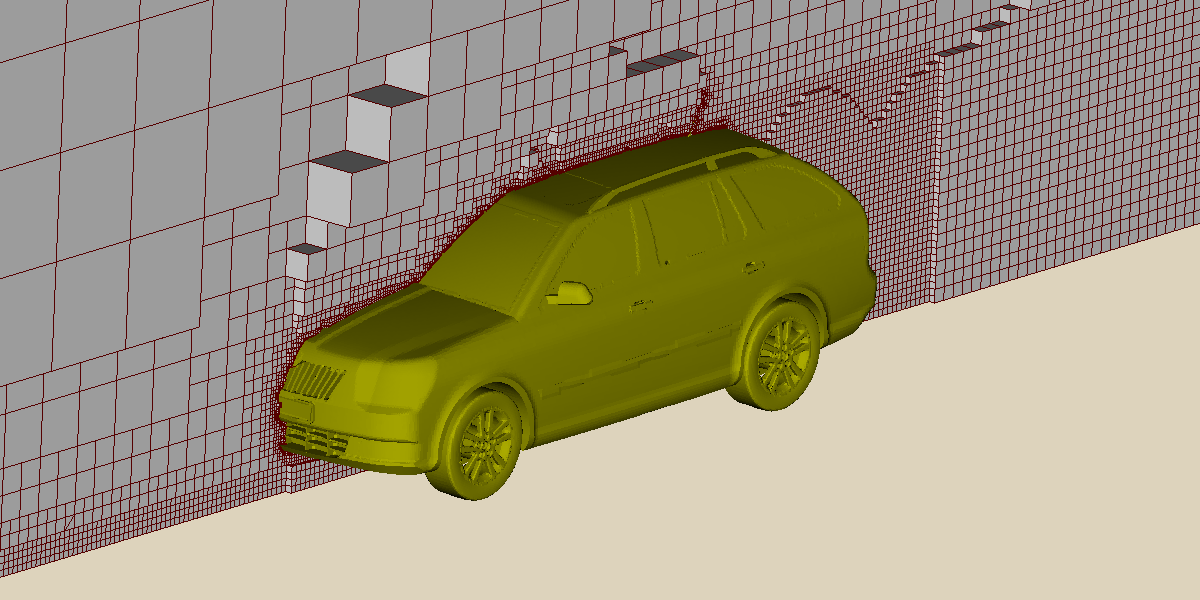
Complex geometry \(\implies\) fine meshes
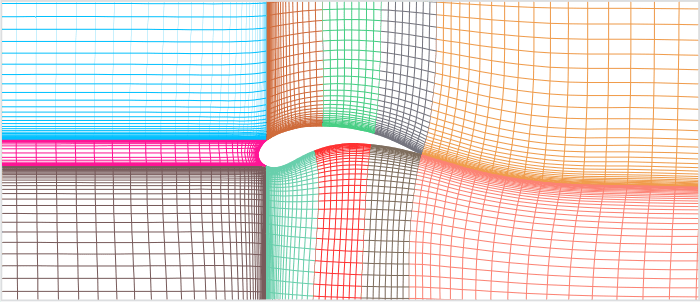
[3]
Complex geometry \(\implies\) fine meshes
The cost of this procedure scales poorly for several reasons.
Neural signal representations learn to emulate physics from data
3
(Explicit) Weighted sum of polynomial interpolants
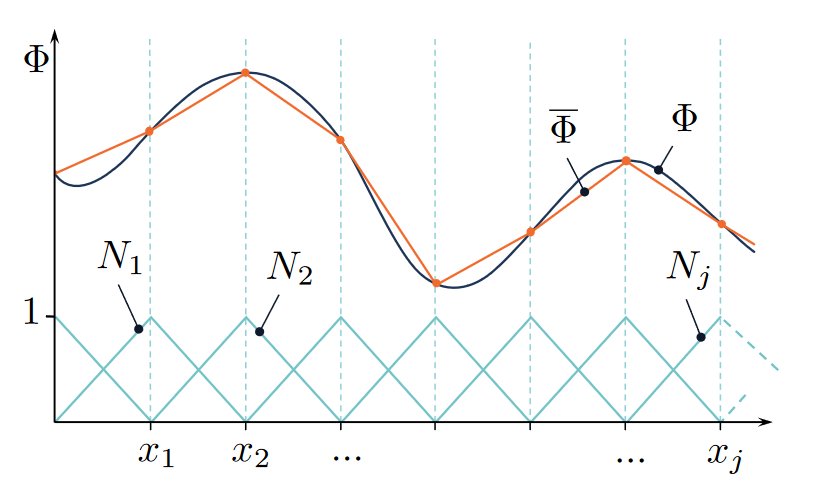
Finite Elements
[1]
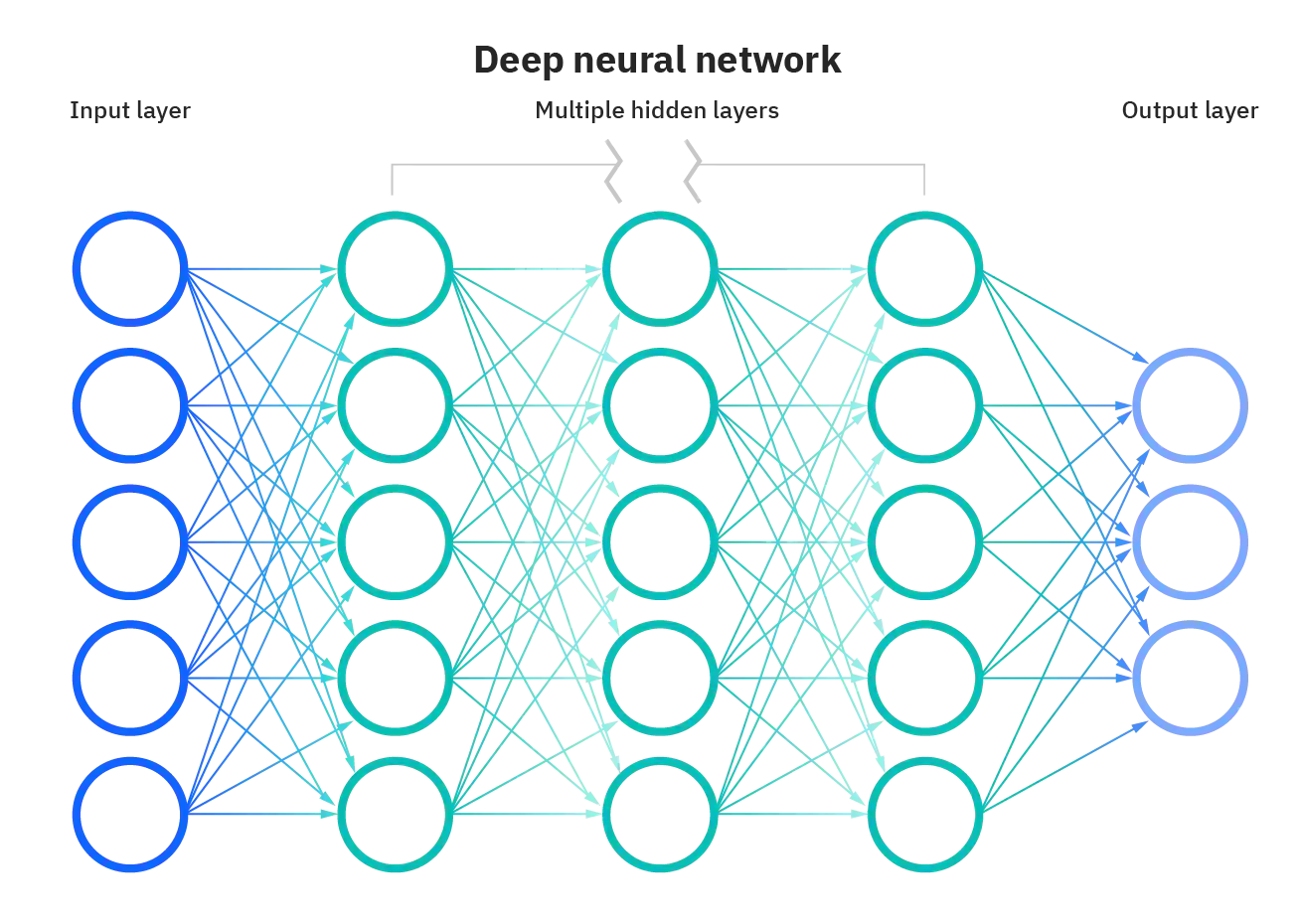
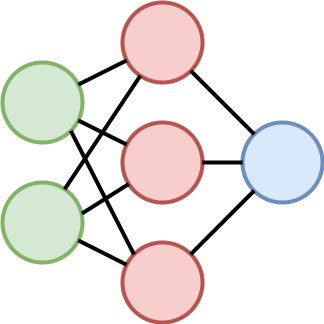
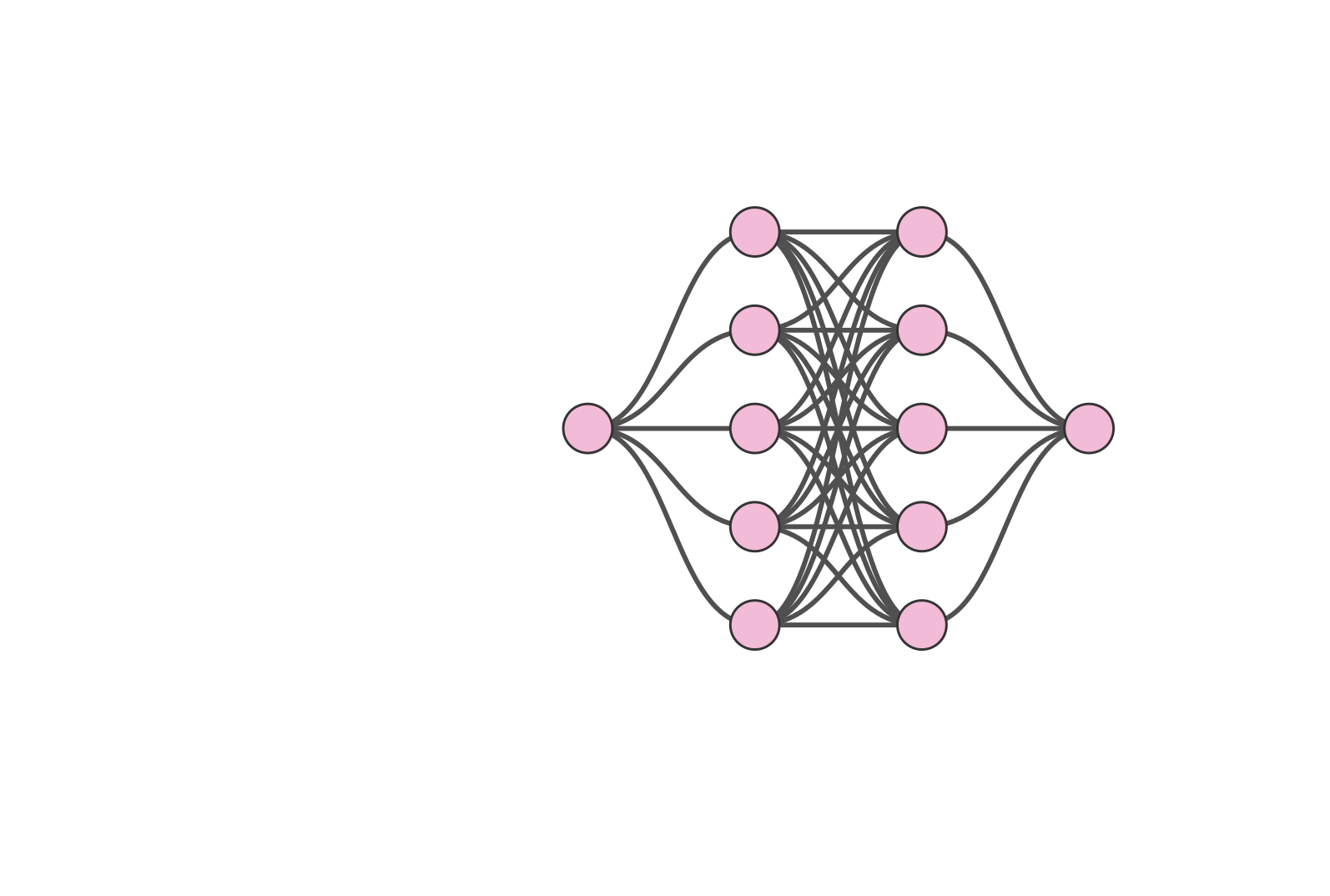
(Implicit) High-dim nonlinear feature learners
Multilayer Perceptron (MLP)
[2]
Cannot learn from data
Can learn from data
Large cost per simulation
Cheap evaluation after training
High-accuracy
Problem-specific
Robust
Up to \(0.1\%\) accuracy
[1] Math StackExchange — “Interpolation in Finite Element Method”
[2] ResearchGate — “Structure of a Deep Neural Network” (figure)
\(\text{Mesh ansatz}\)
\({u}(x)=\)
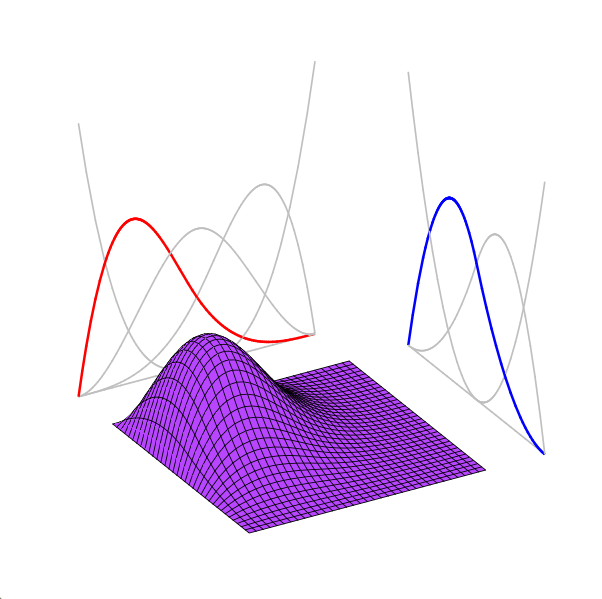
\(u(x) = \)
\(\text{Neural ansatz}\)
\(\text{Physics-based}\)
\(\text{Data-driven}\)
\(\text{Numerical}\)
\(\text{Simulation}\)
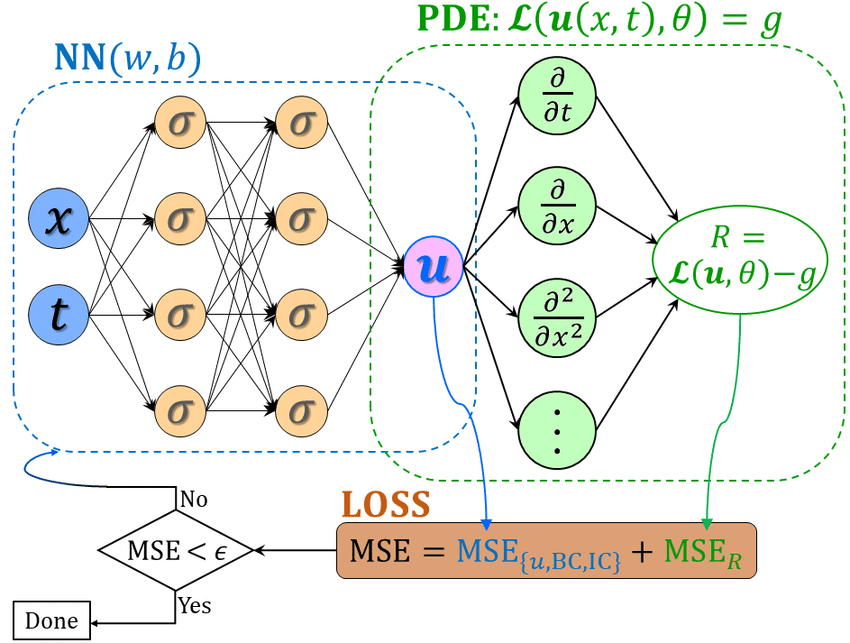
\(\text{Reduced Order}\)
\(\text{Modeling}\)
\(\text{Neural ROMs}\)
\(\text{Surrogate}\)
\(\text{Learning}\)
\(\text{Transformers}\)
\(\text{PINNs}\)
\(\text{Finite Elements}\)
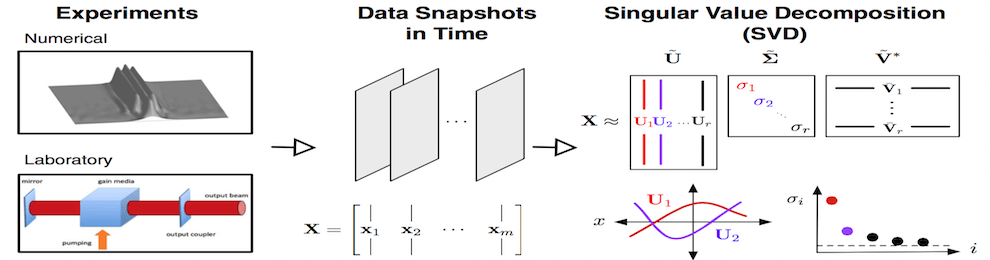
\(\text{PCA/POD}\)
\(\text{Graph Networks}\)
Landscape of data-driven methods in computational physics
Fast and accurate latent space traversal in neural ROMs
4
Scalable transformer models for large-scale surrogate modeling
[1]
[3]
[2]
[1] CFD Direct / OpenFOAM — “Introduction to Computational Fluid Dynamics”
[2] ResearchGate — “Schematic of a Vanilla Physics-Informed Neural Network” (figure)
[3] Kutz, J. N. — “Data-Driven Modeling & Dynamical Systems” (UW)
Outline
Project 2: PDE surrogate models
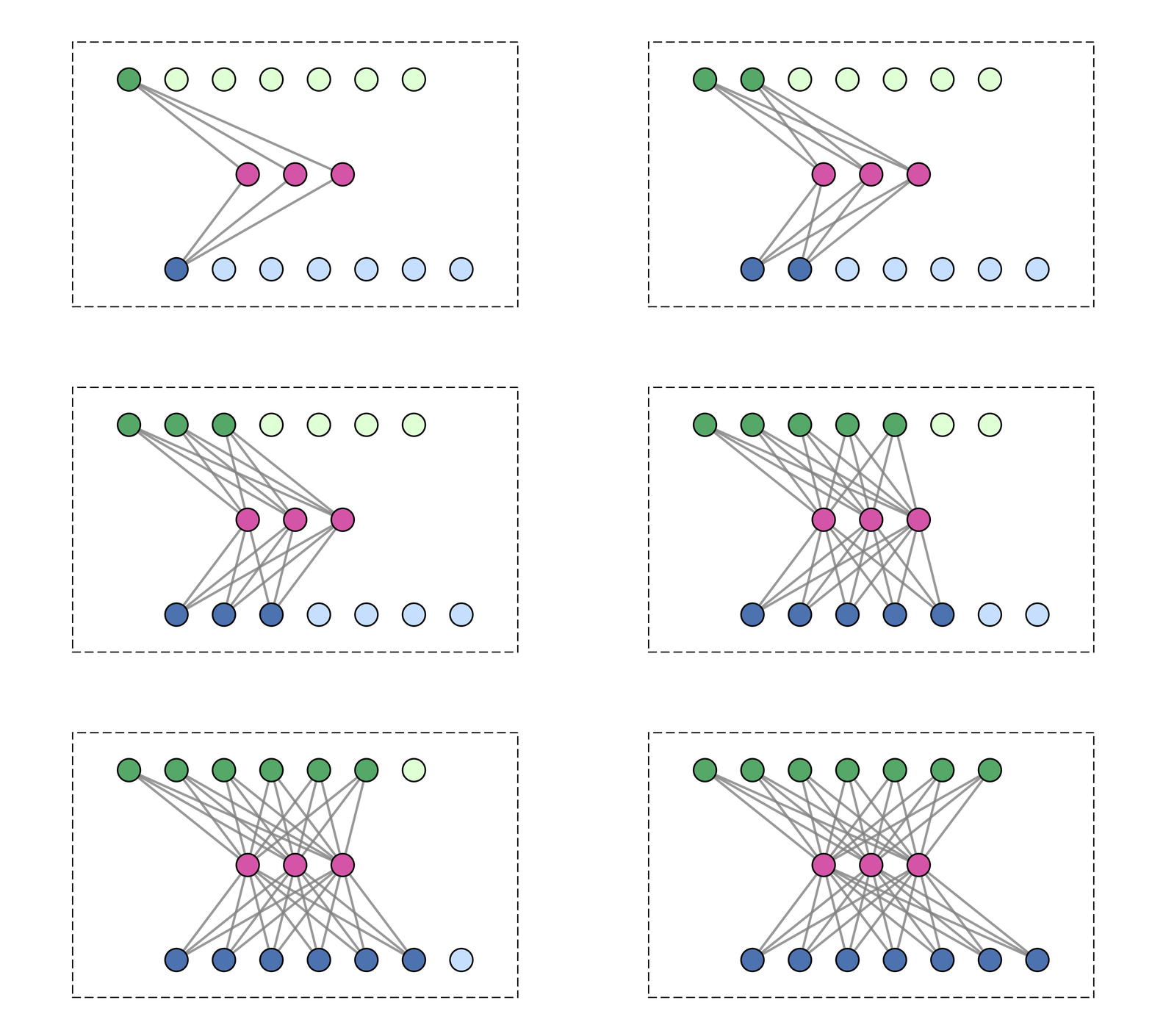
Project 1: Neural Reduced Order Modeling
Proposed work: transient PDE surrogates
5
Accelerate PDE solves with structure learned from data.
Replace simulation with solution operator learned from data.
Extend surrogate methodology to transient PDE problems.
Neural Reduced Order Modeling
Accelerate simulations with structure learned from data.

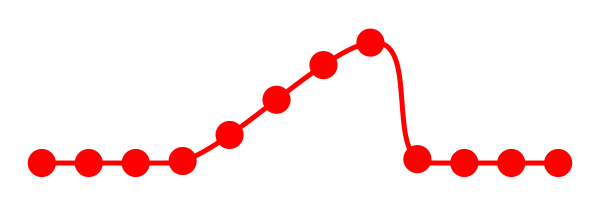
Primer on model order reduction
6
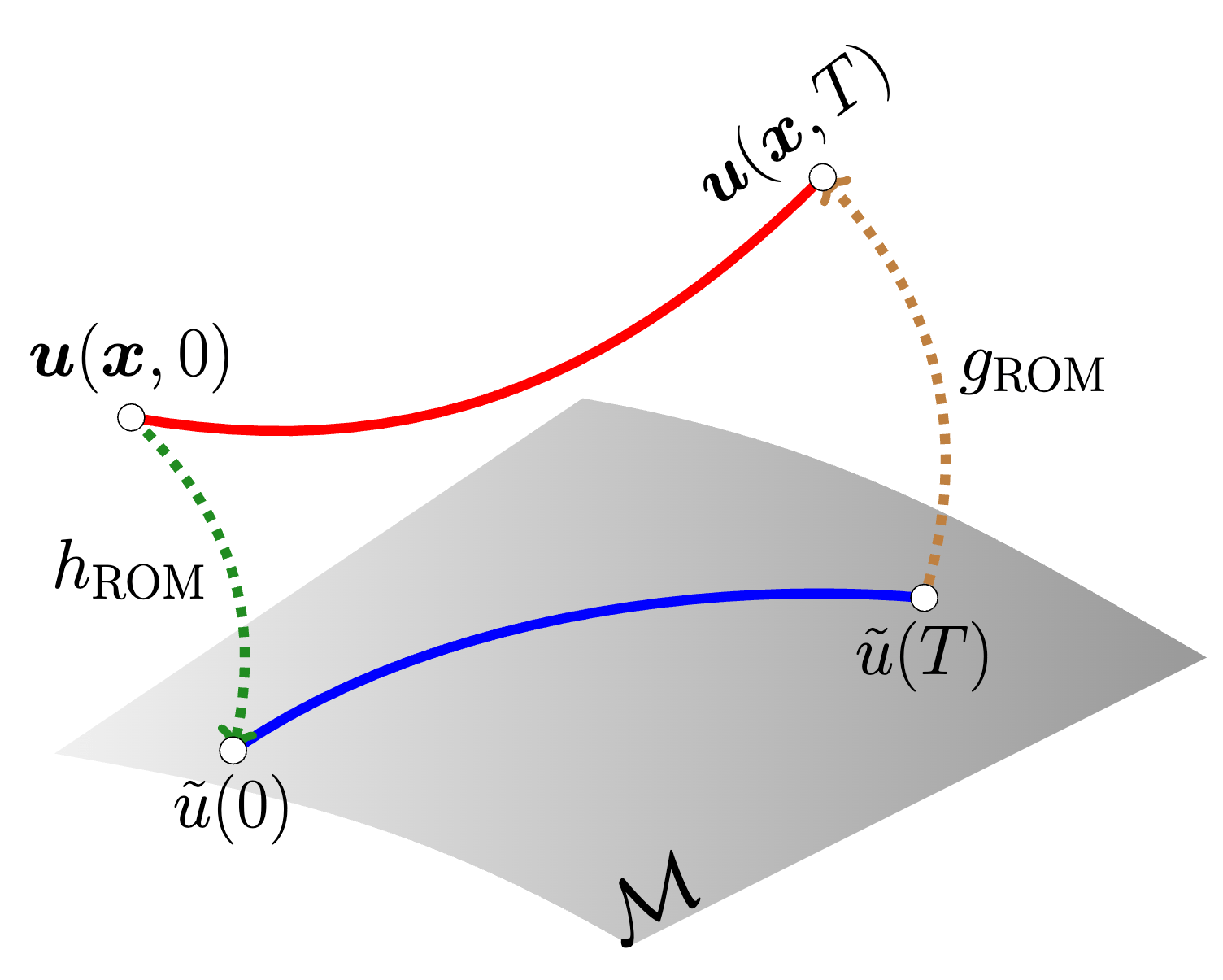
Learn low-dimensional solution representation with data + evolve with physics.
High-dimensional simulation data
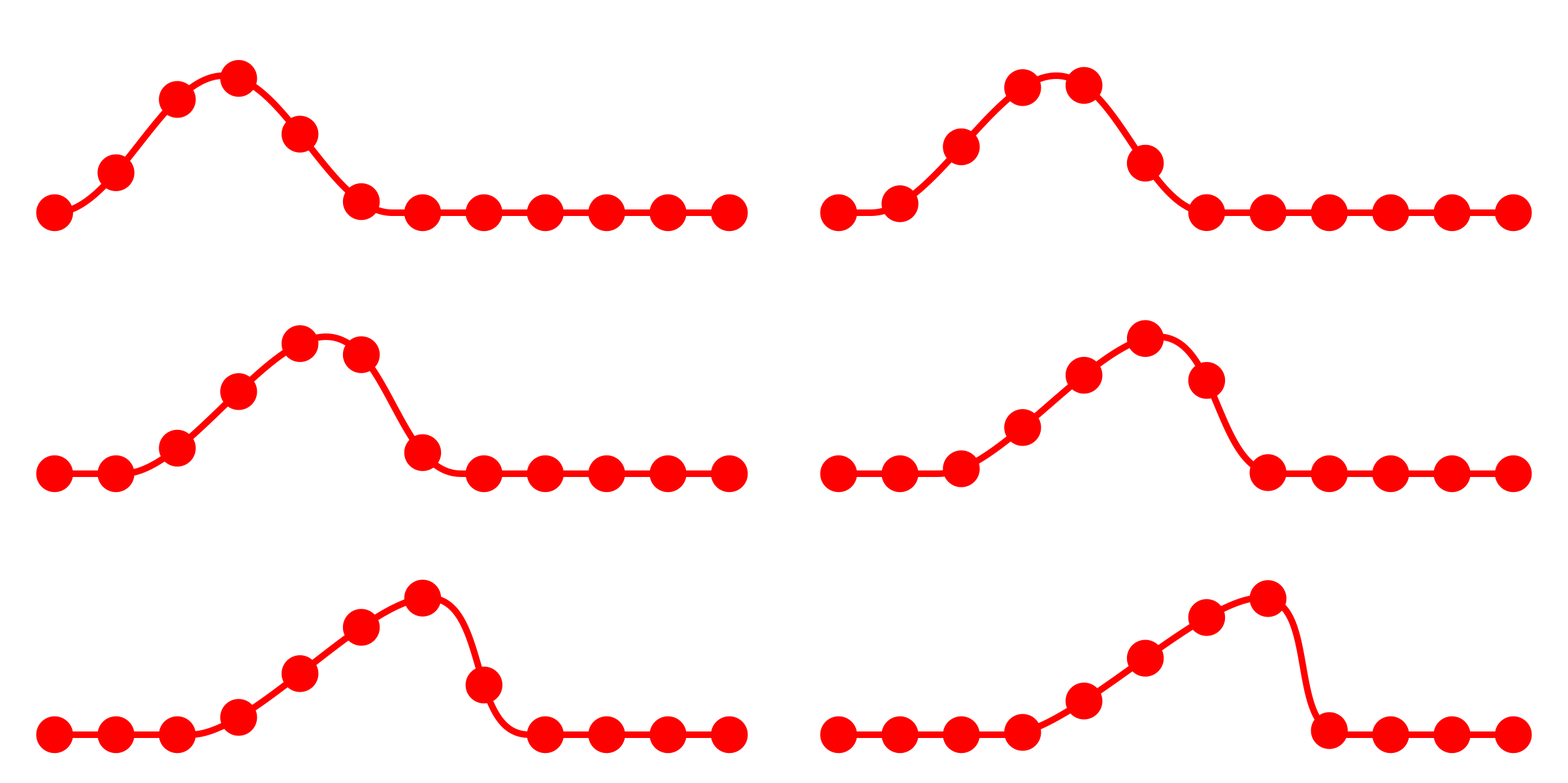
Collect and compress data
Evolve ODE on low-dim manifold
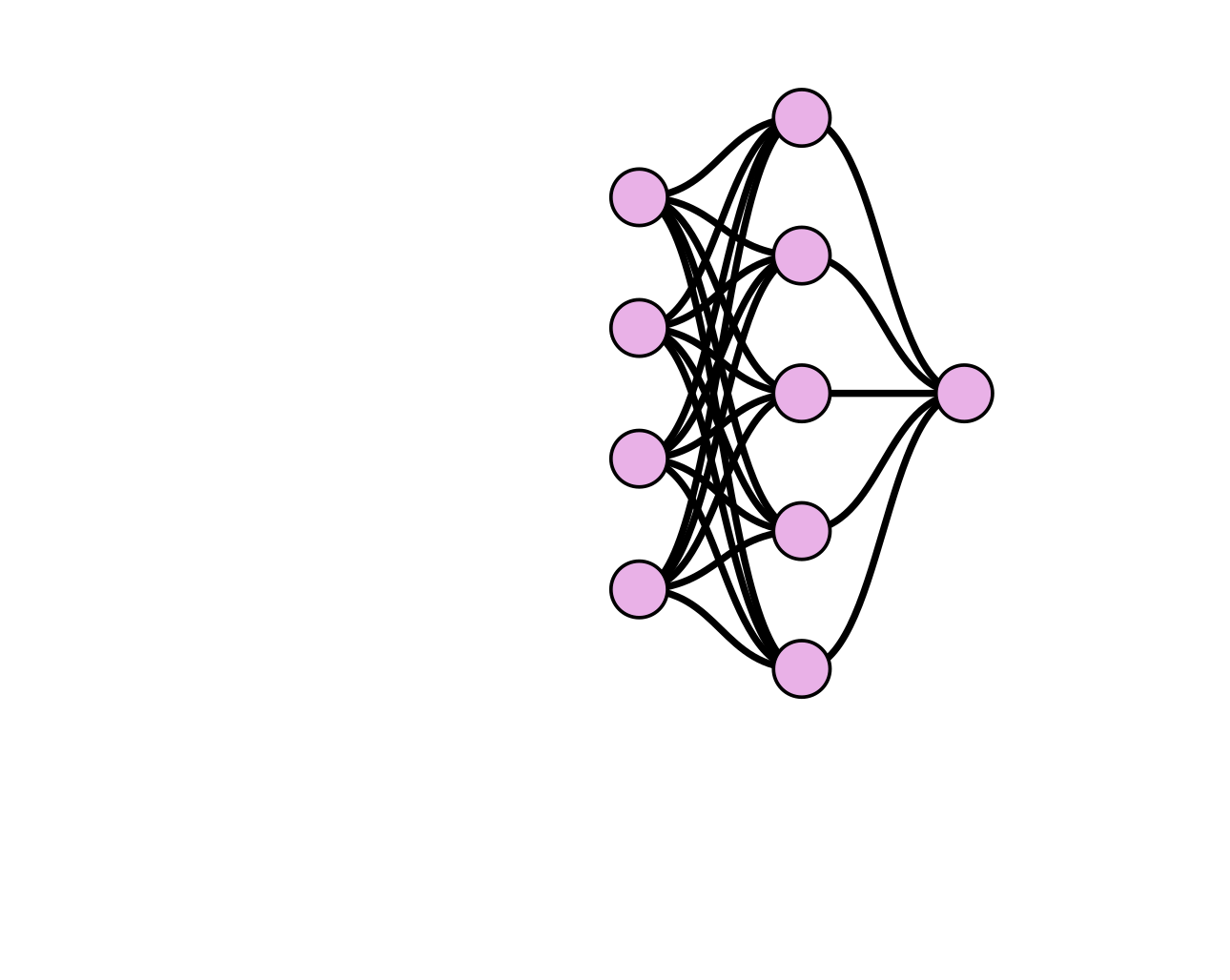
Cheap online solve can be deployed for time-critical applications.
Cost savings from solving smaller ODE system.
Background on manifold learning
7
Full order model (FOM)
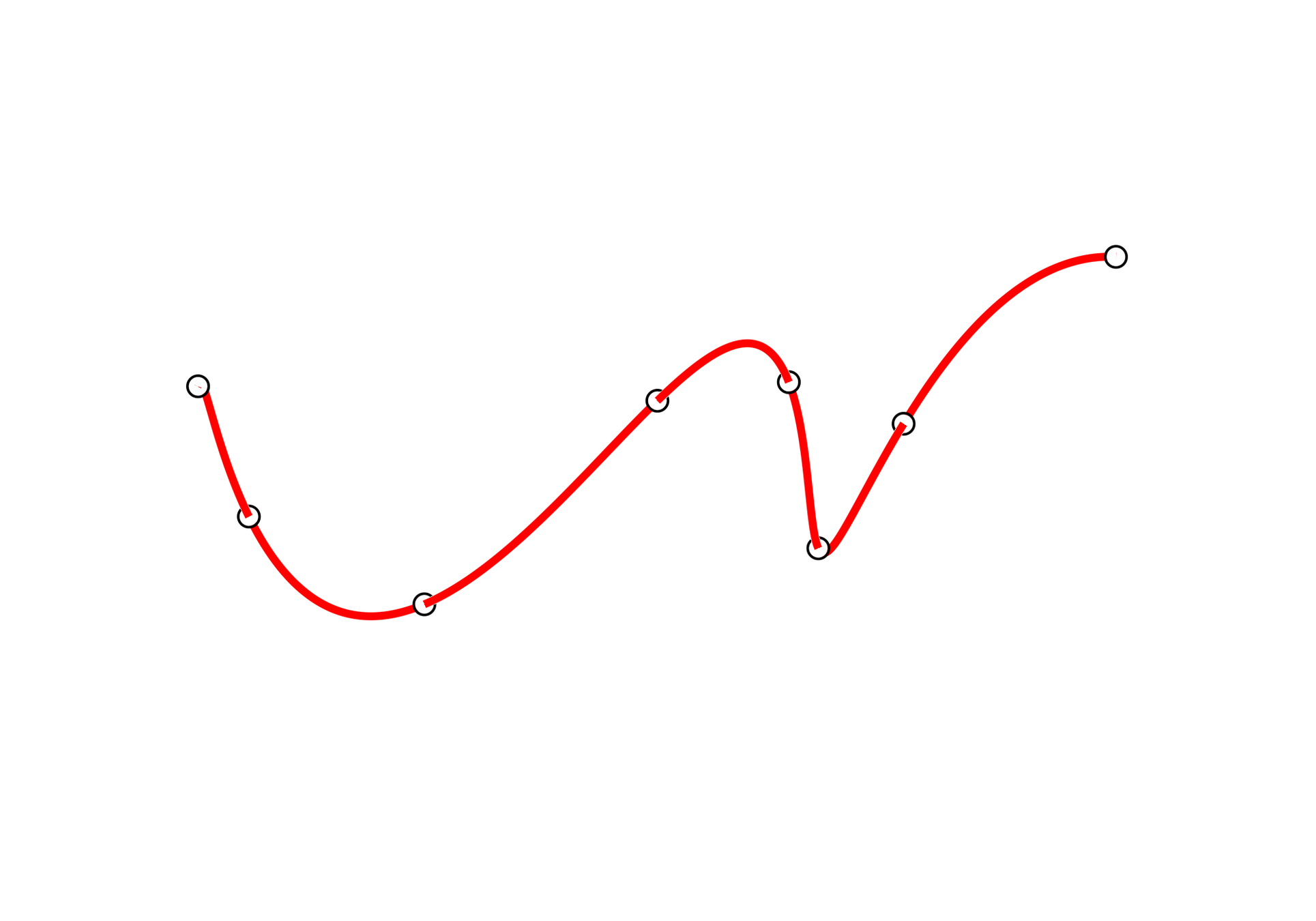
Background on manifold learning
7
Full order model (FOM)
Linear POD-ROM
Learn low-order spatial representations
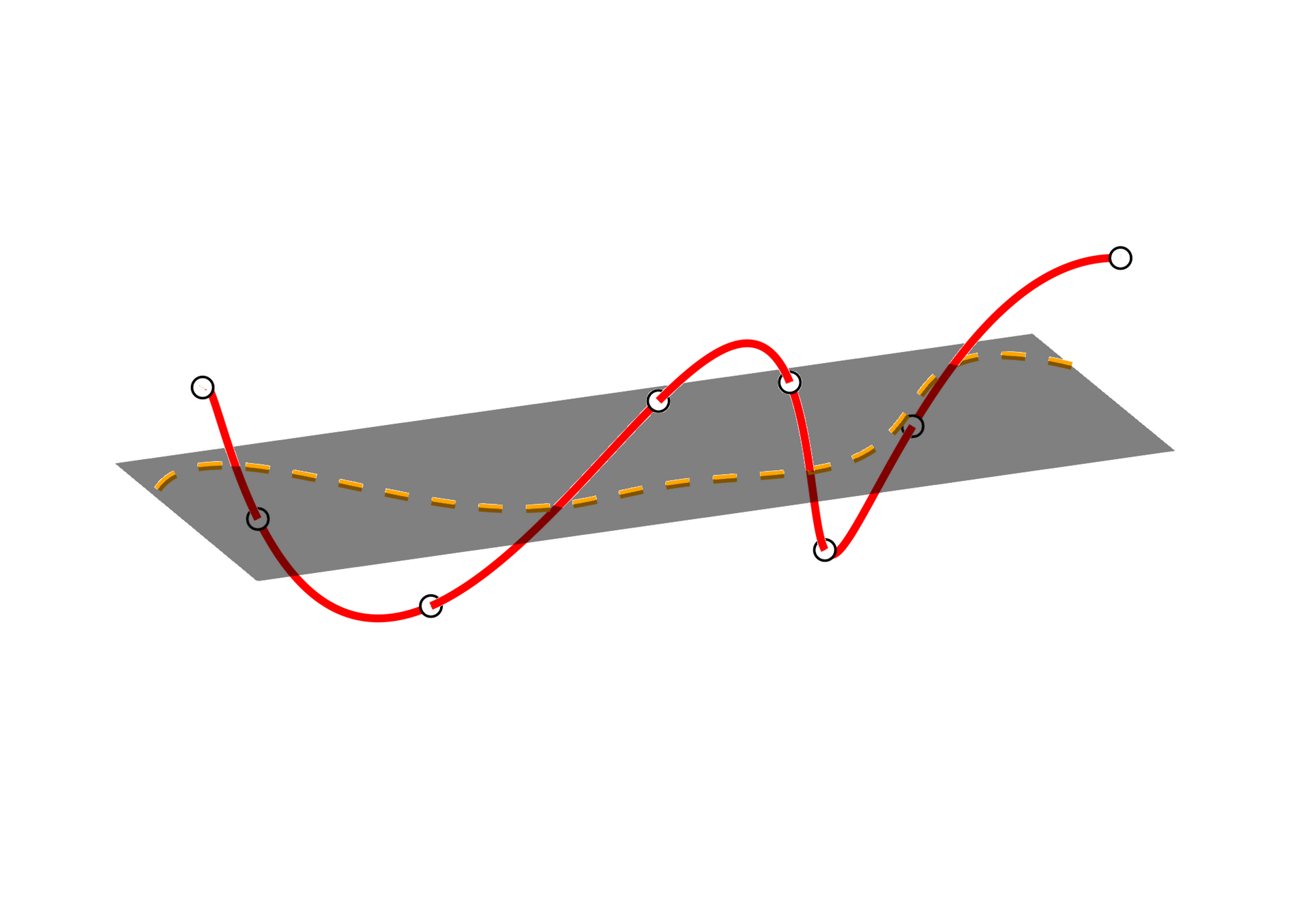
Background on manifold learning
7
Full order model (FOM)
Linear POD-ROM
Nonlinear ROM
Learn low-order spatial representations
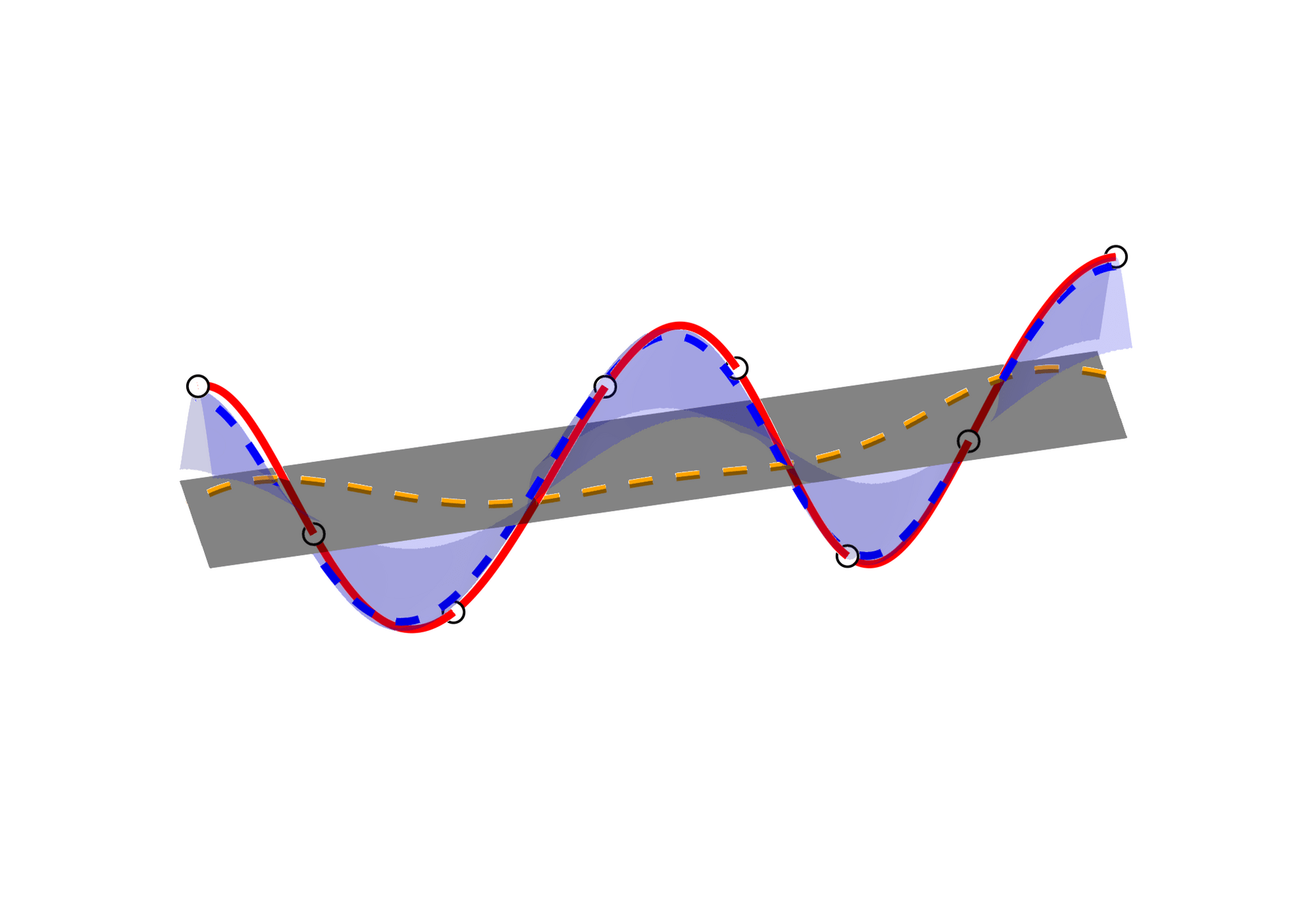
Conv. Autoencoder ROMs [1] cause deviations in physics solve
8
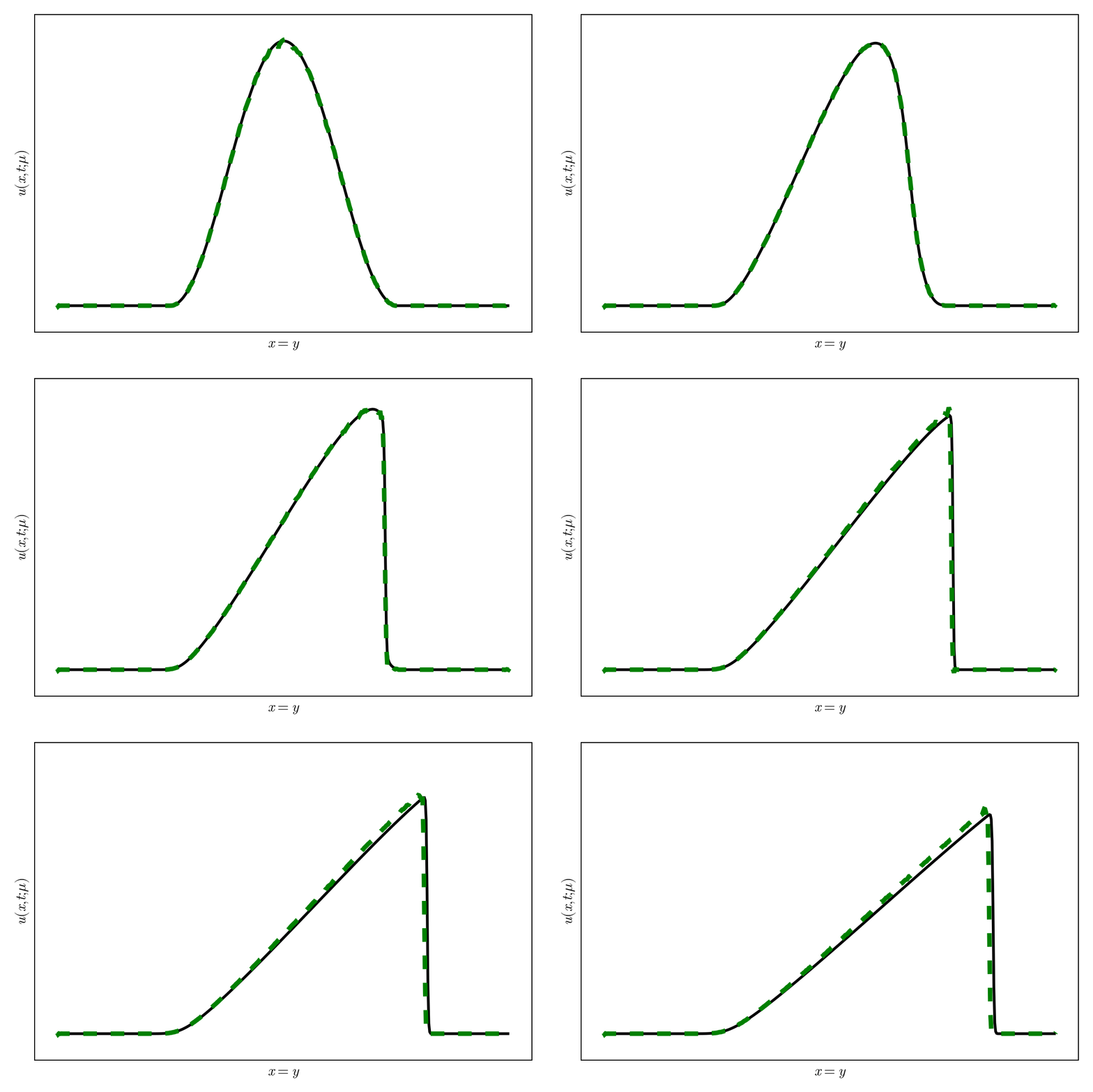
\(\text{Encoder}\)
\(\text{Decoder}\)
Intrinsic perspective
[1] Lee & Carlberg — Nonlinear manifold ROM via CNN autoencoders (JCP 2020)
Extrinsic perspective
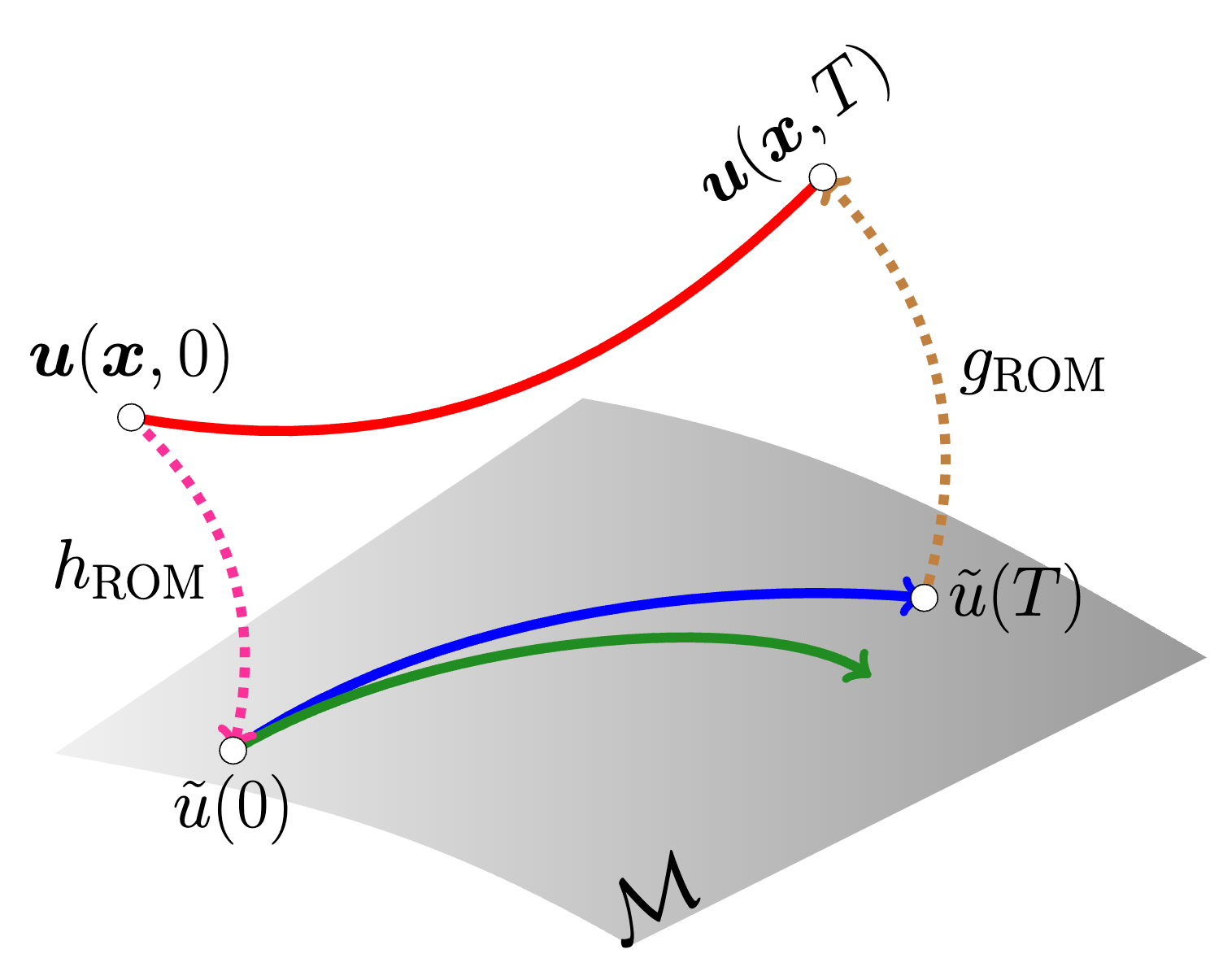
Compression/decompression workflow offers no control over latent trajectories.
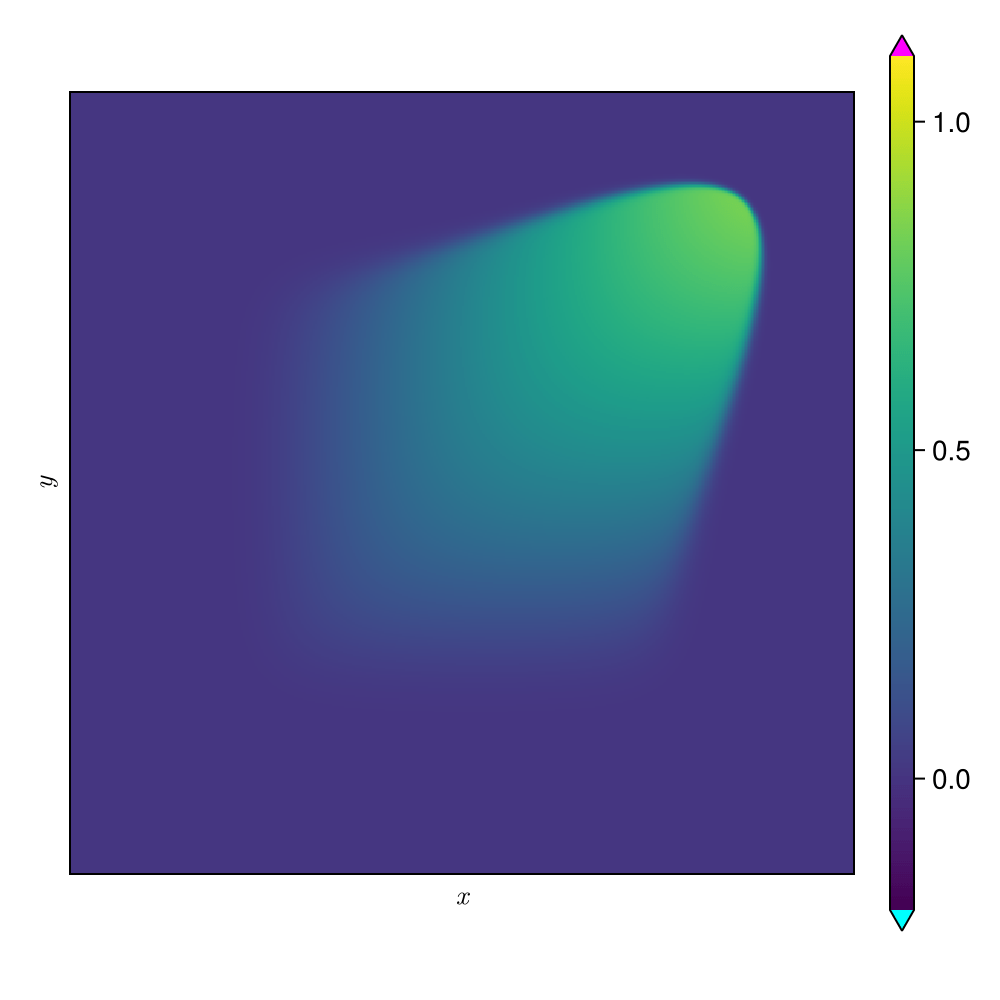
2D Burgers \(\mathit{Re}=1\mathit{k}\)
Smooth Neural Field ROM directly controls latent trajectories
9
Supervised learning problem jointly learns latent trajectories and data manifold.
\(\text{Loss } (L)\)
\(\text{Backpropagation}\)
\(\nabla_\theta L\)
\(\nabla_\varrho L\)
\(\nabla_\theta L\)
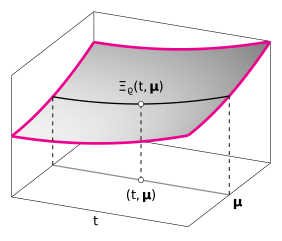
\(\text{PDE Problem}\)
\((\boldsymbol{x}, t, \boldsymbol{\mu})\)
\(\text{ Parameters}\)
\( \text{and time}\)
\(\text{ Intrinsic ROM manifold}\)
\(\text{Coordinates}\)
\(\text{Smooth neural field MLP }(g_\theta)\)

\(\tilde{u}\)
\(\boldsymbol{x}\)
\(\boldsymbol{u}\left( \boldsymbol{x}, t; \boldsymbol{\mu} \right)\)
Force \( t \mapsto \tilde{u}(t) \) to be simple, e.g., shallow MLP.
Coordinate MLPs with sinusoidal activations offers grid-independence.
Replace autoencoder with a direct prediction workflow.
Accurate derivatives require smooth neural field representations
10
SNF-ROM with Lipschitz regularization (SNFL-ROM)
\(\text{Penalize the \textcolor{blue}{Lipschitz constant} of the MLP [arXiv:2202.08345]}\)
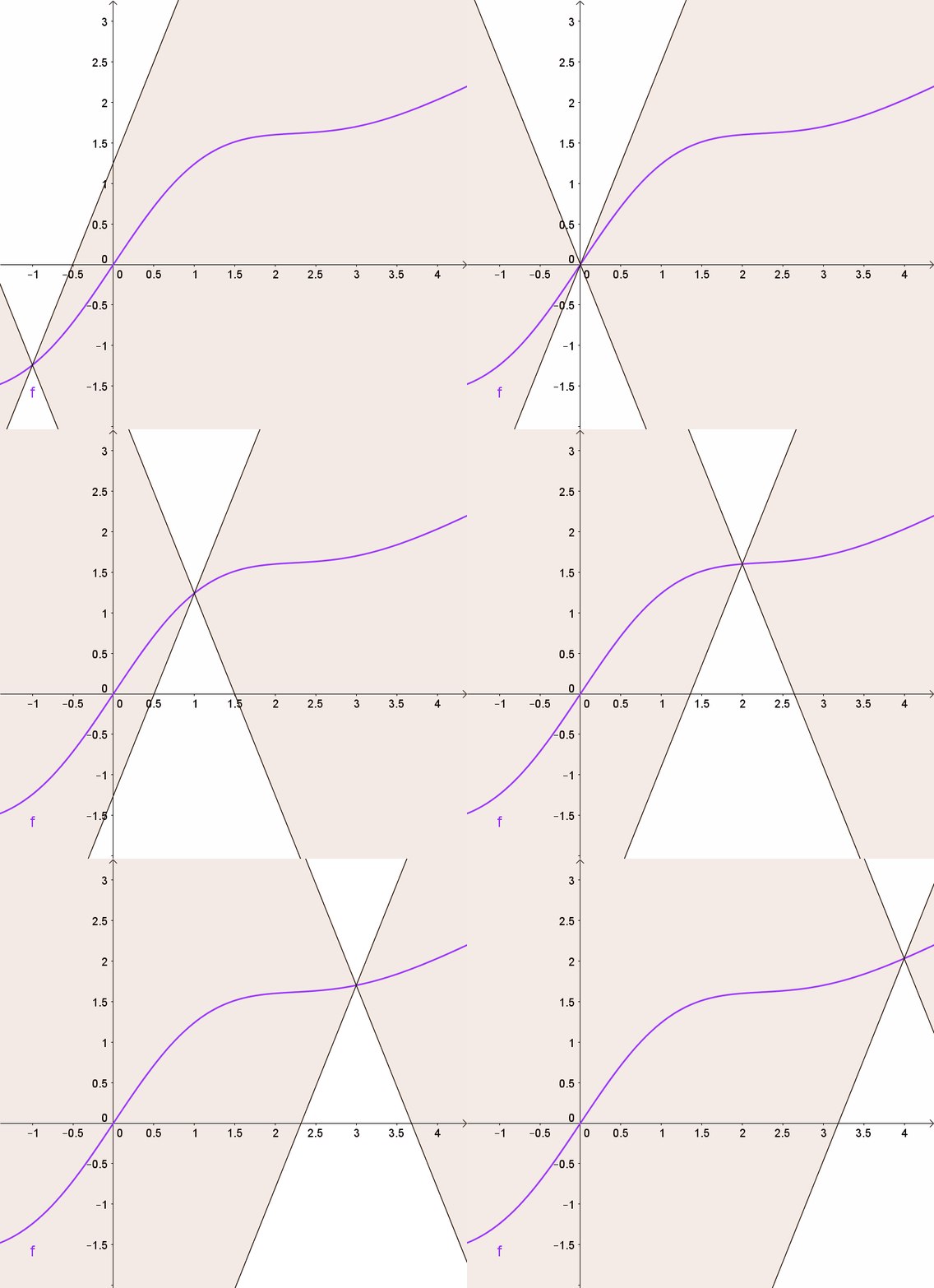
\(\text{[enwiki:1230354413]}\)
SNF-ROM with Weight regularization (SNFW-ROM)
\(\text{Directly penalize \textcolor{red}{high-frequency components} in }\dfrac{\text{d}}{\text{d} x}\text{NN}_\theta(x)\)
We present two approaches to learn inherently smooth and accurately differentiable neural field MLPs.
\({x}\)
\({u(x)}\)
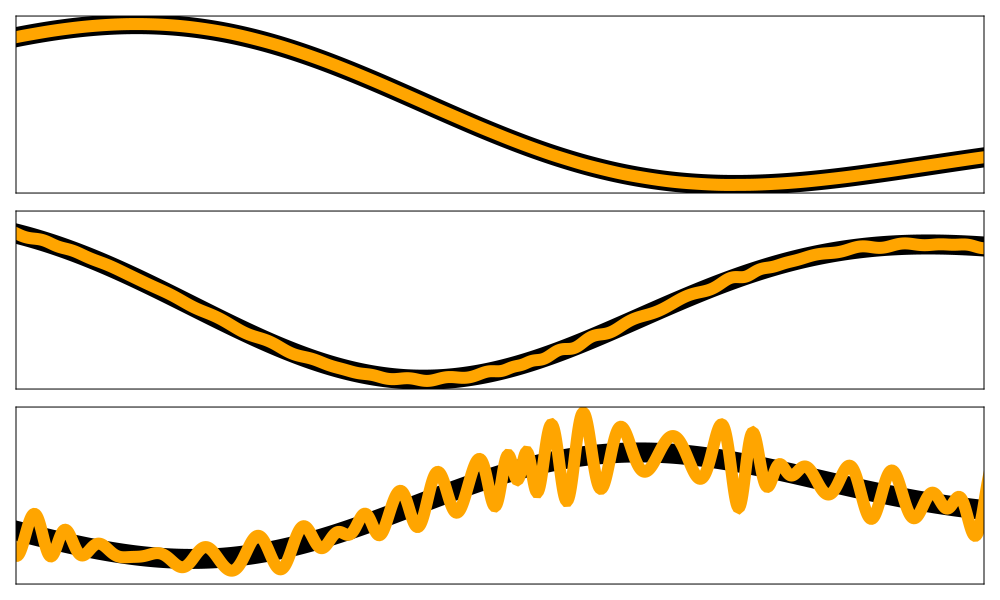
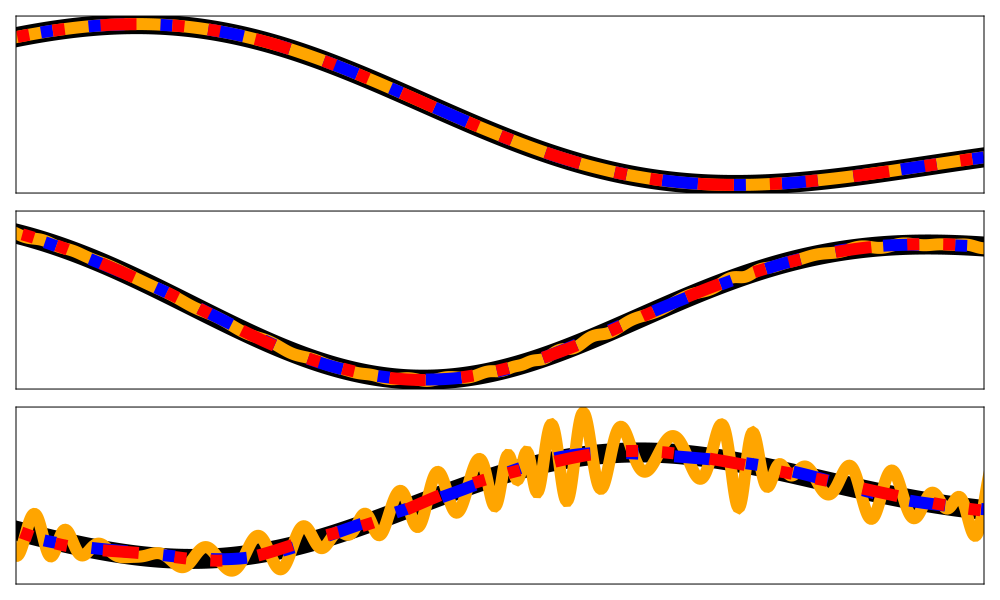
High freq. noise
11
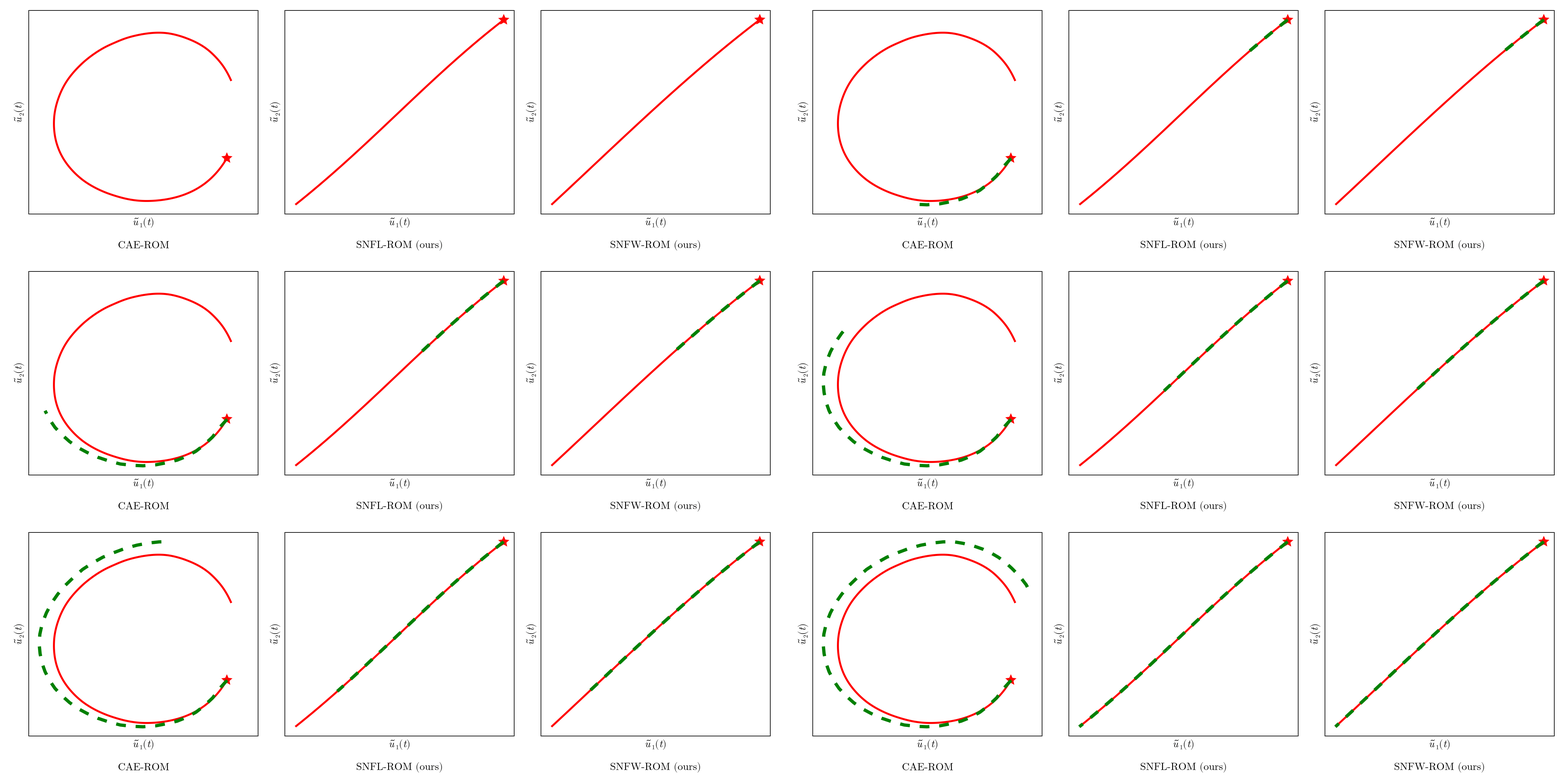
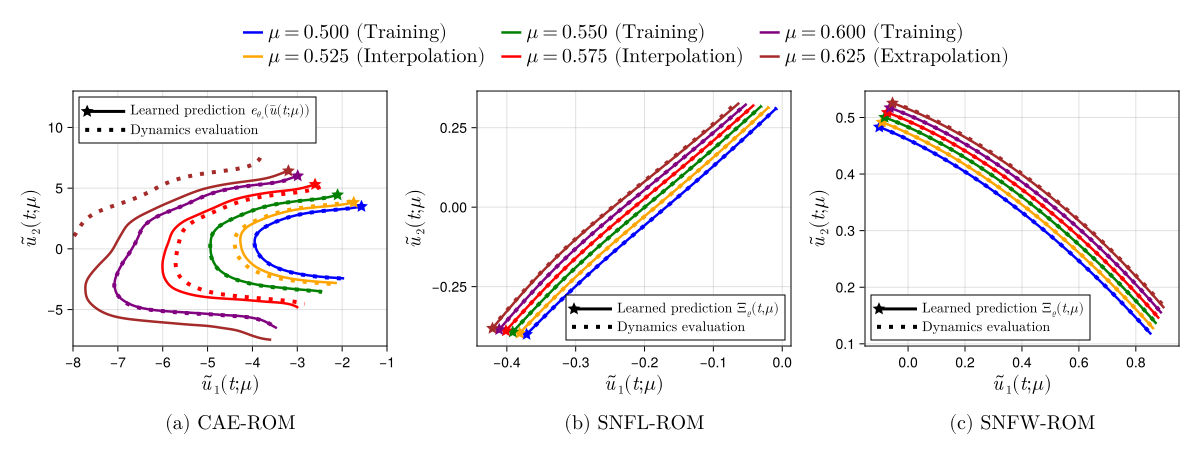
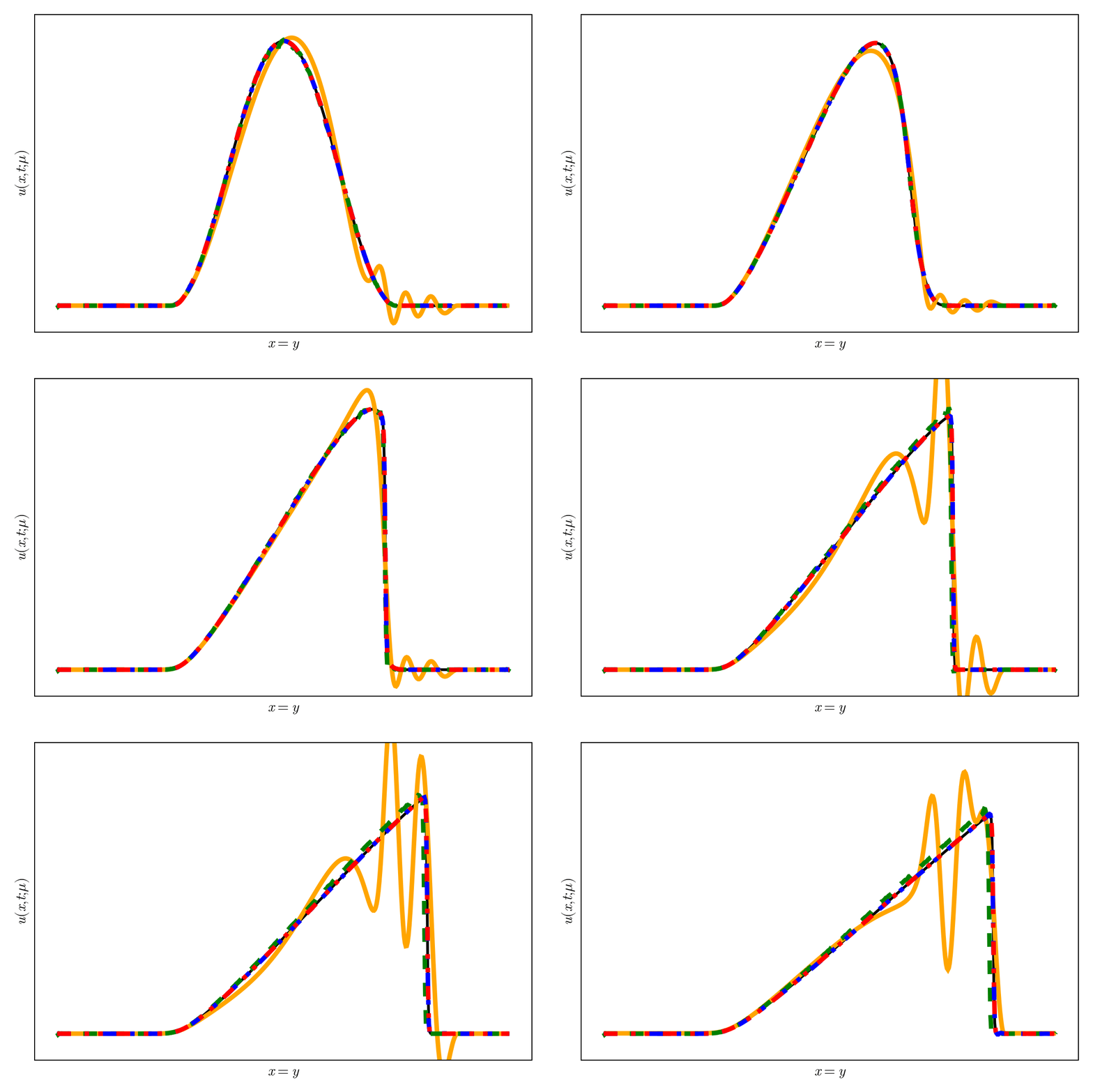
Experiment: 1D Viscous Burgers problem \( (\mathit{Re} = 10~{k})\)
\(\text{CAE-ROM}\) [1]
\(\text{SNFL-ROM (ours)}\)
\(\text{SNFW-ROM (ours)}\)
Online dynamics solve matches learned trajectories
Online evaluation deviates!
Distribution of reduced states \((\tilde{u})\)
[1] Lee & Carlberg — Nonlinear manifold ROM via CNN autoencoders (JCP 2020)
Experiment: 1D Kuramoto-Sivashinsky problem
12
SNF-ROM maintains high accuracy even with larger time-steps.
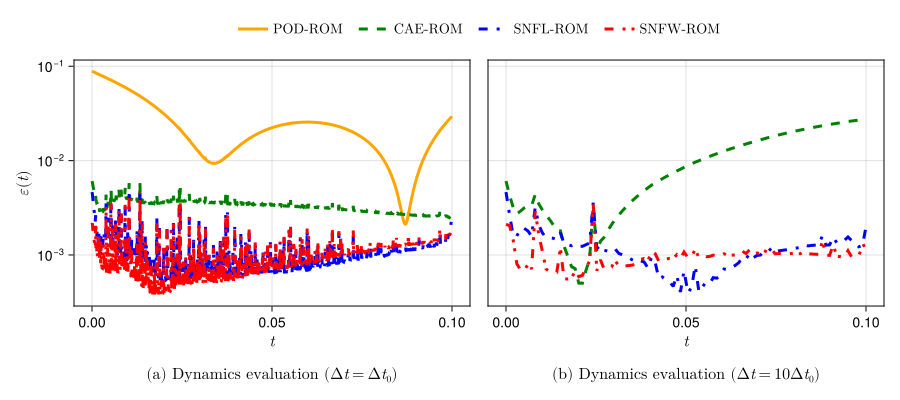
\(\text{Relative error vs time } (\Delta t = \Delta t_0)\)
\(\text{Relative error vs time } (\Delta t = 10\Delta t_0)\)
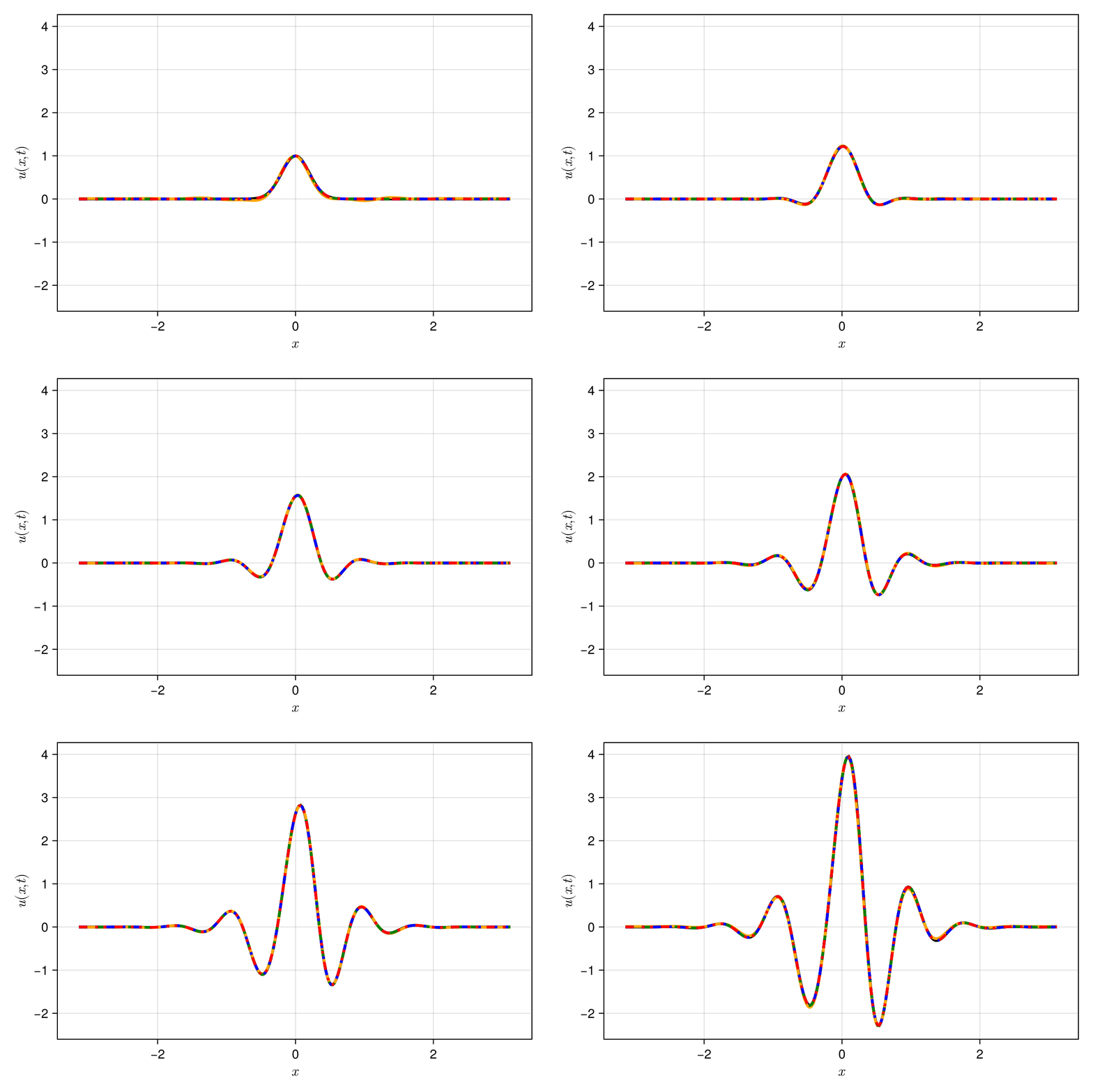

[1] Lee & Carlberg — Nonlinear manifold ROM via CNN autoencoders (JCP 2020)
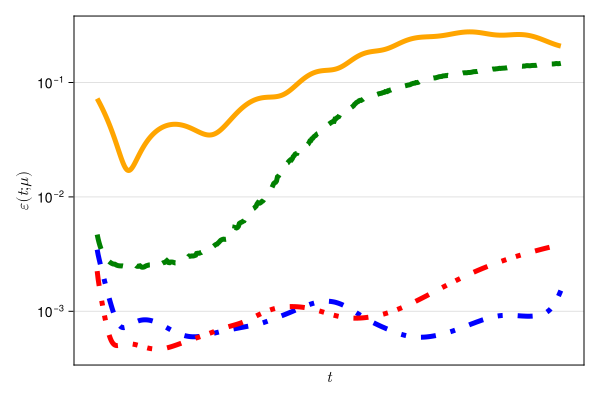
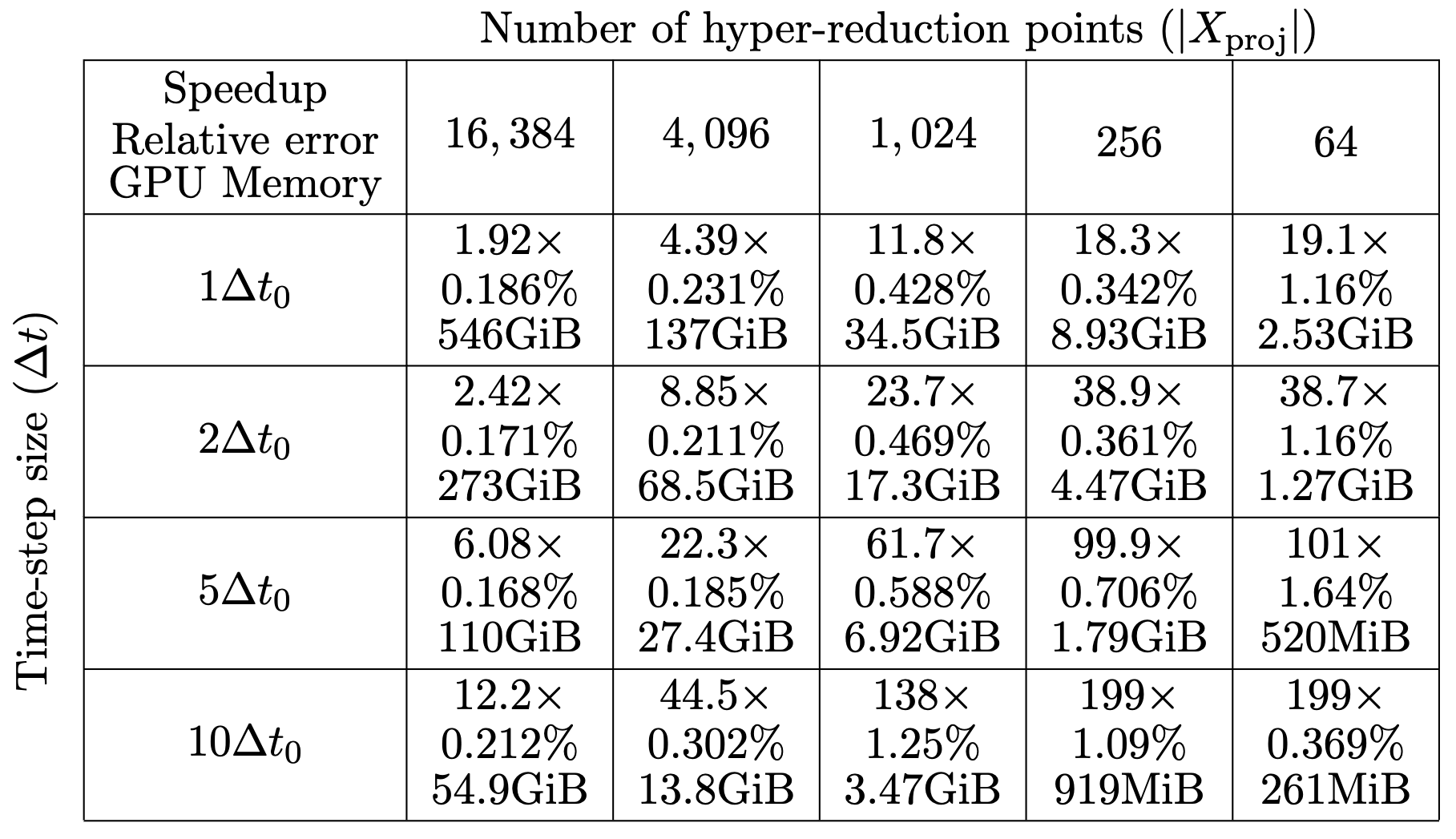
Experiment: 2D Viscous Burgers problem \( (\mathit{Re} = 1~{k})\)
13
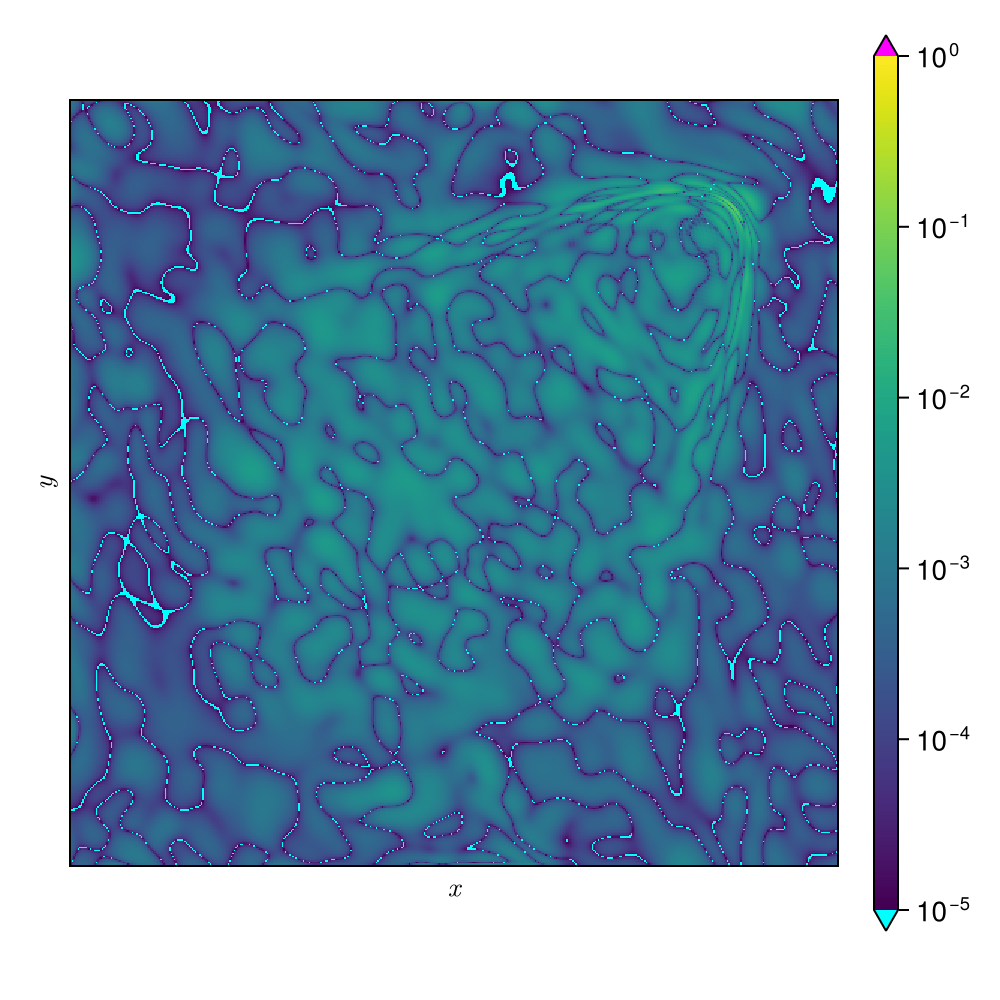
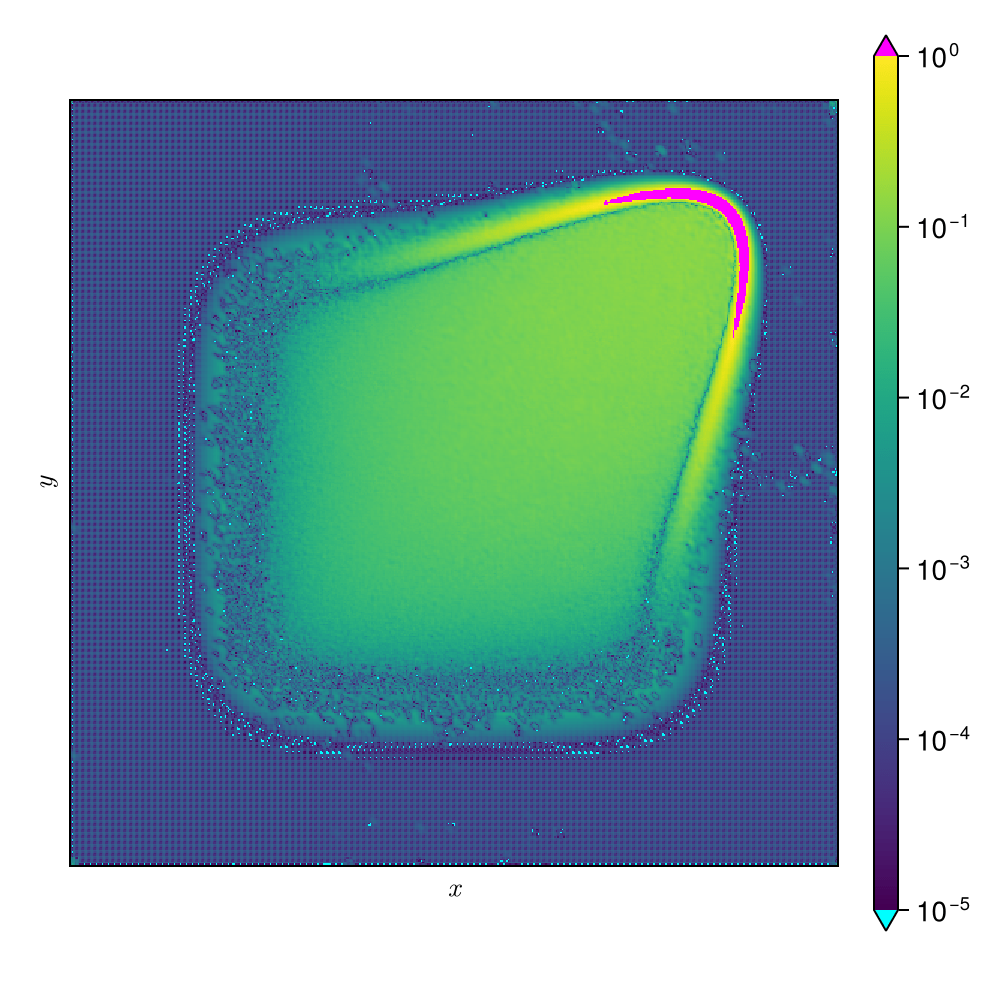
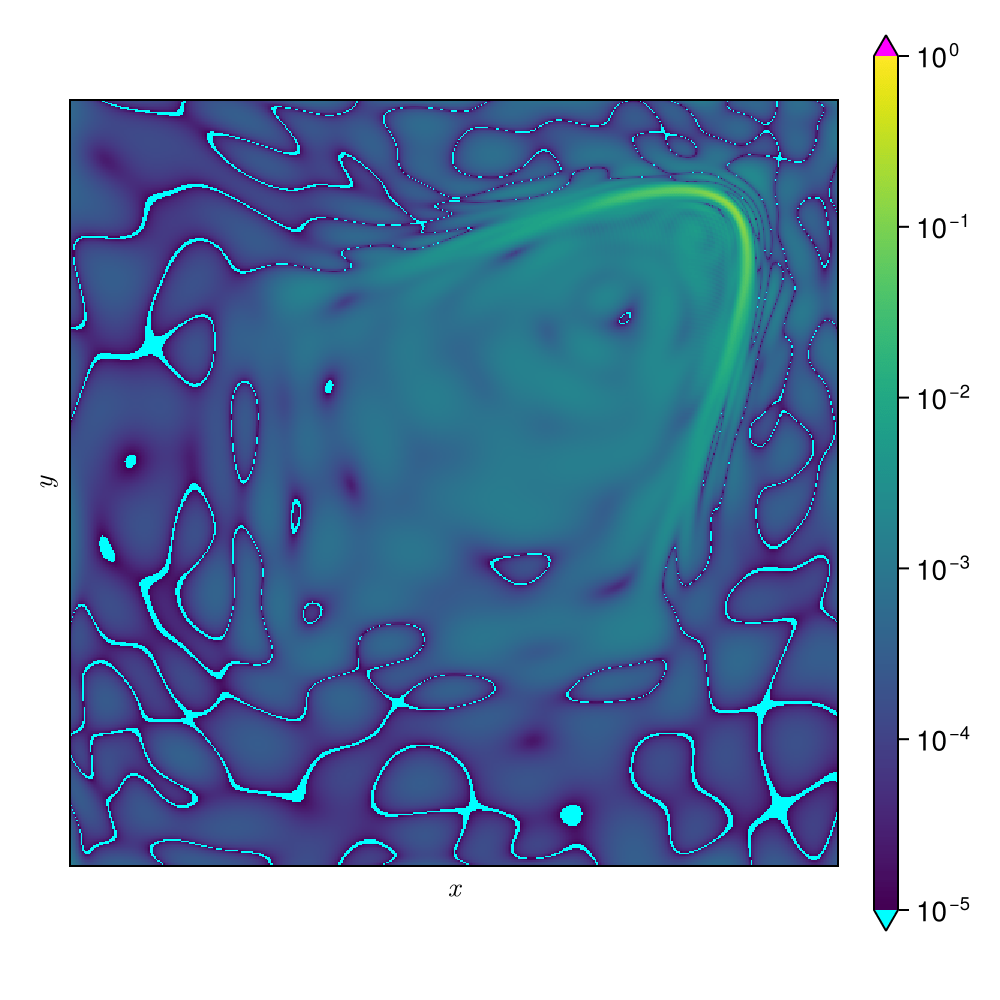
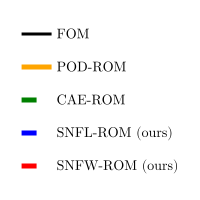
\(\text{CAE-ROM}\) [1]
\(\text{SNFL-ROM (ours)}\)
\(\text{SNFW-ROM (ours)}\)
Relative error
[1] Lee & Carlberg — Nonlinear manifold ROM via CNN autoencoders (JCP 2020)
\([1]\)
\(0.4\%\) relative error
\(\text{DoFs: }524~k \to 2\)
\(\text{Time }(t)\)
\(\text{Relative Error}(t)\)
\(199\times\) speed-up
Takeaways from SNF-ROM
14
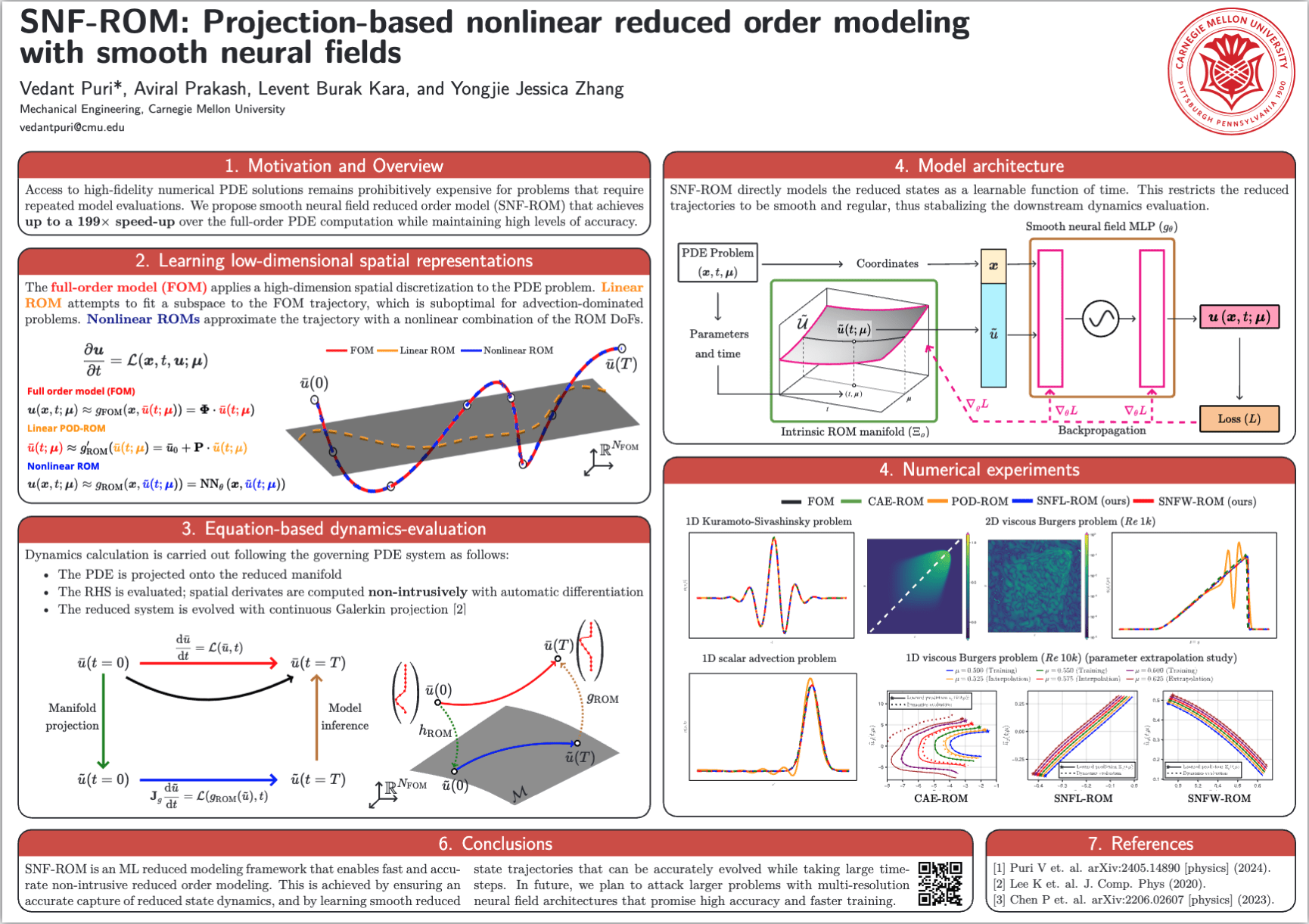
Accurate derivate evaluation for neural representations.
Fast and accurate latent space traversal in neural ROMs
Contributions
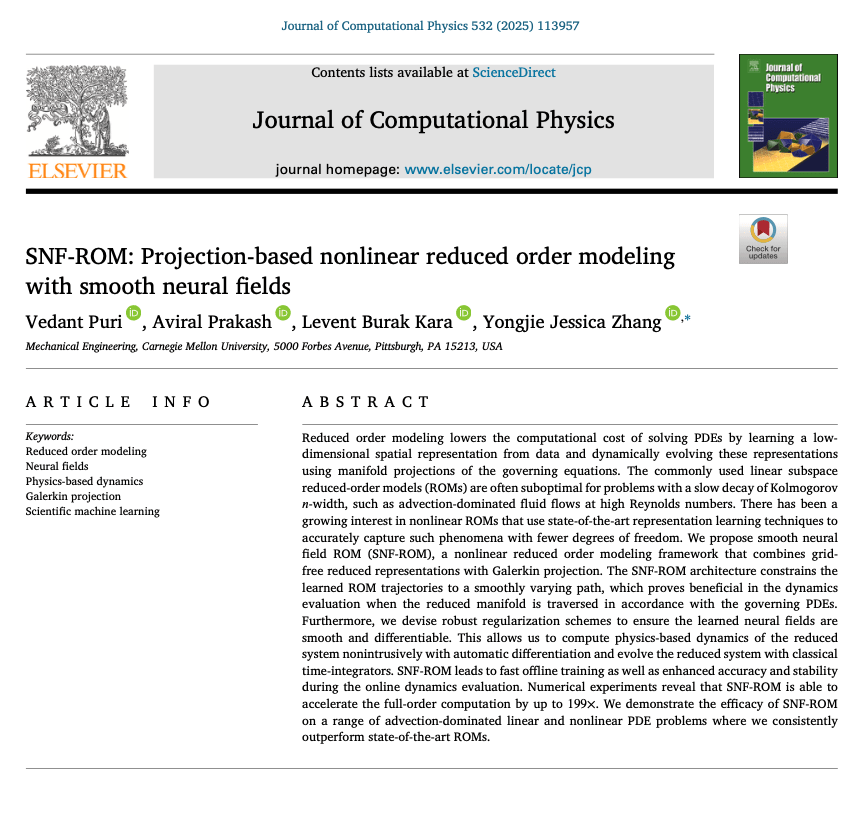
Won poster award at World Conf. Comp. Mech. 2024
Published in Journal of Comp. Phys.
Data-Driven Modeling
Scalable neural surrogates for PDEs and beyond!
Surrogate models learn PDE solution operator from data
15
Training
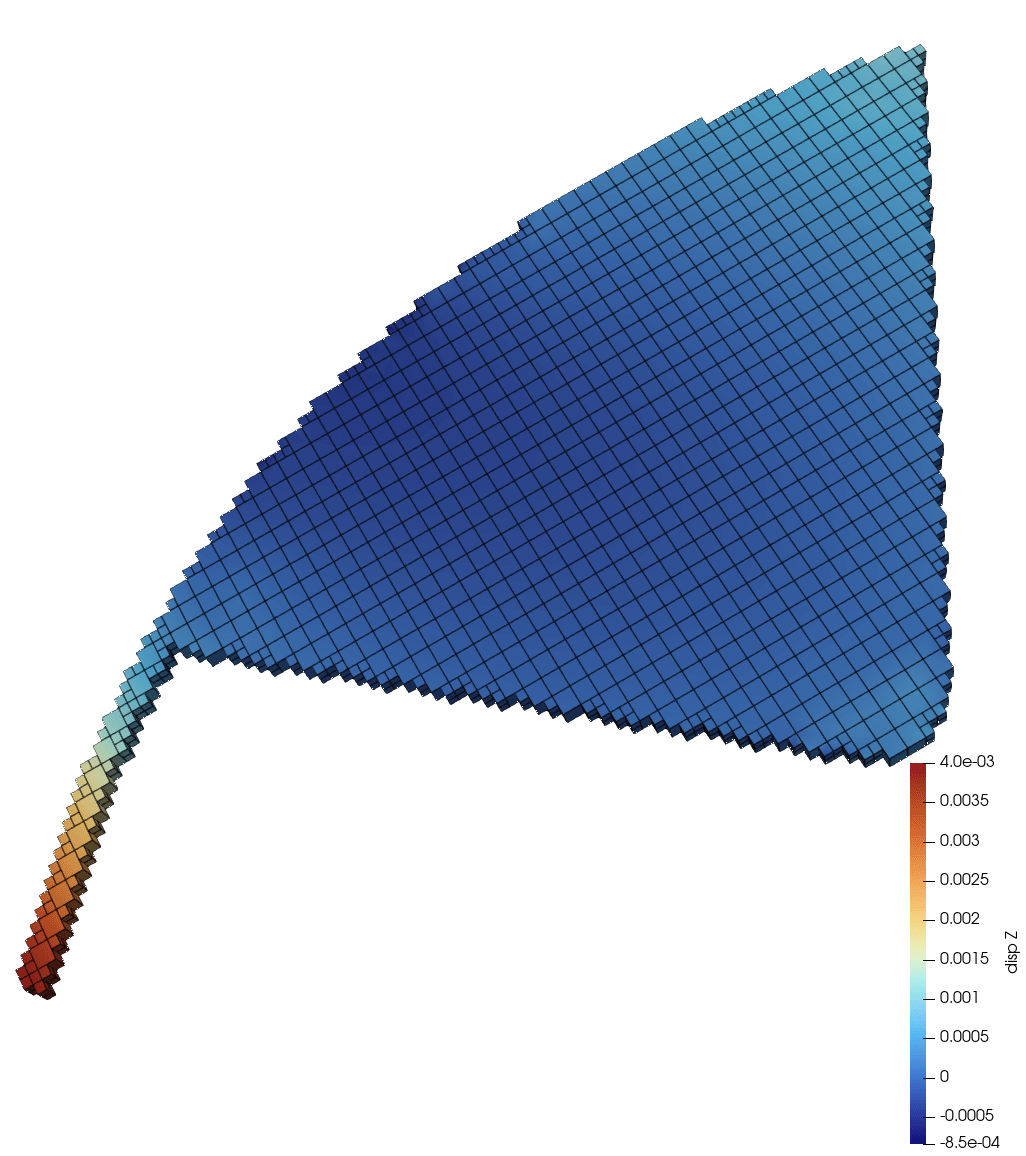
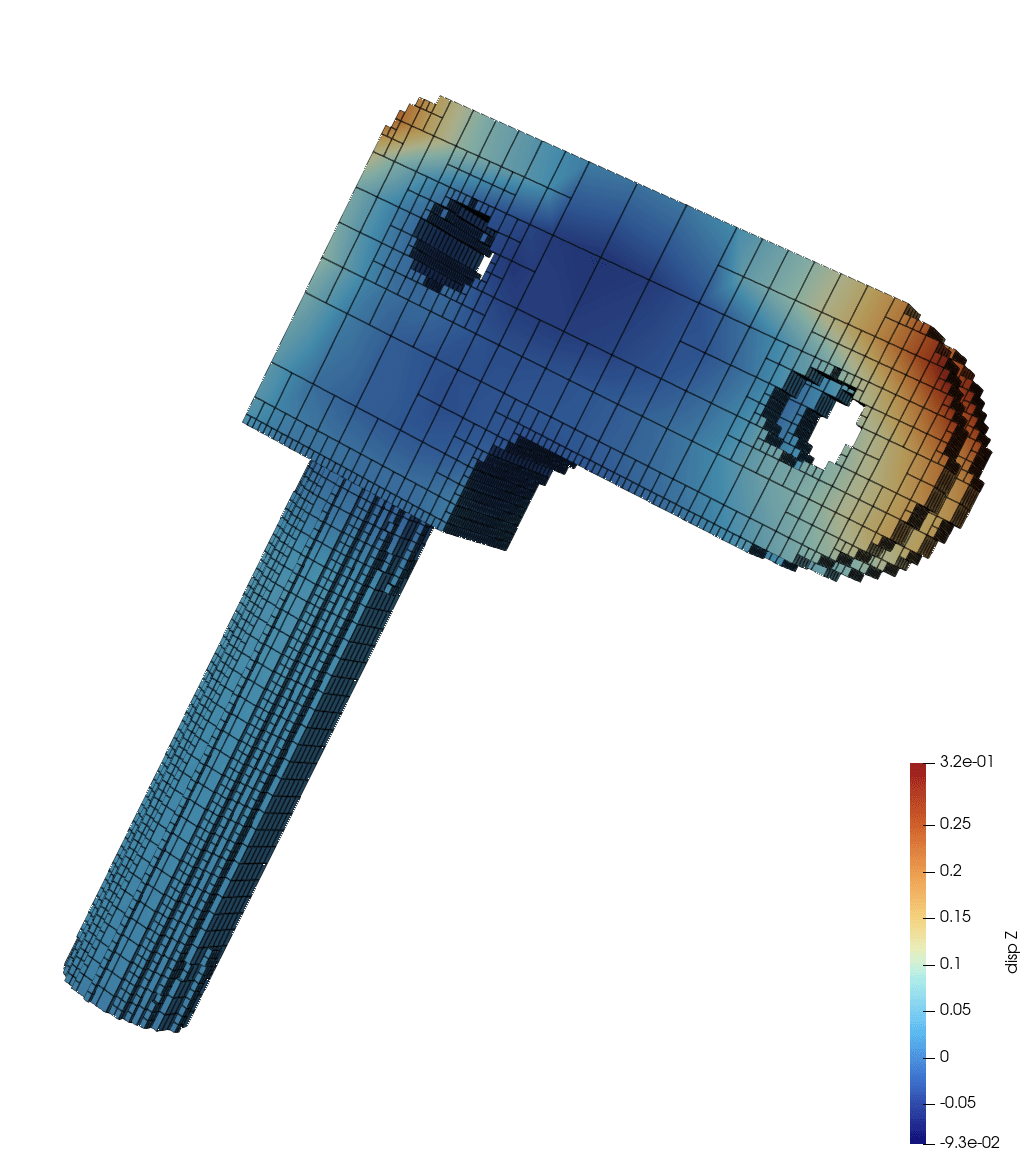
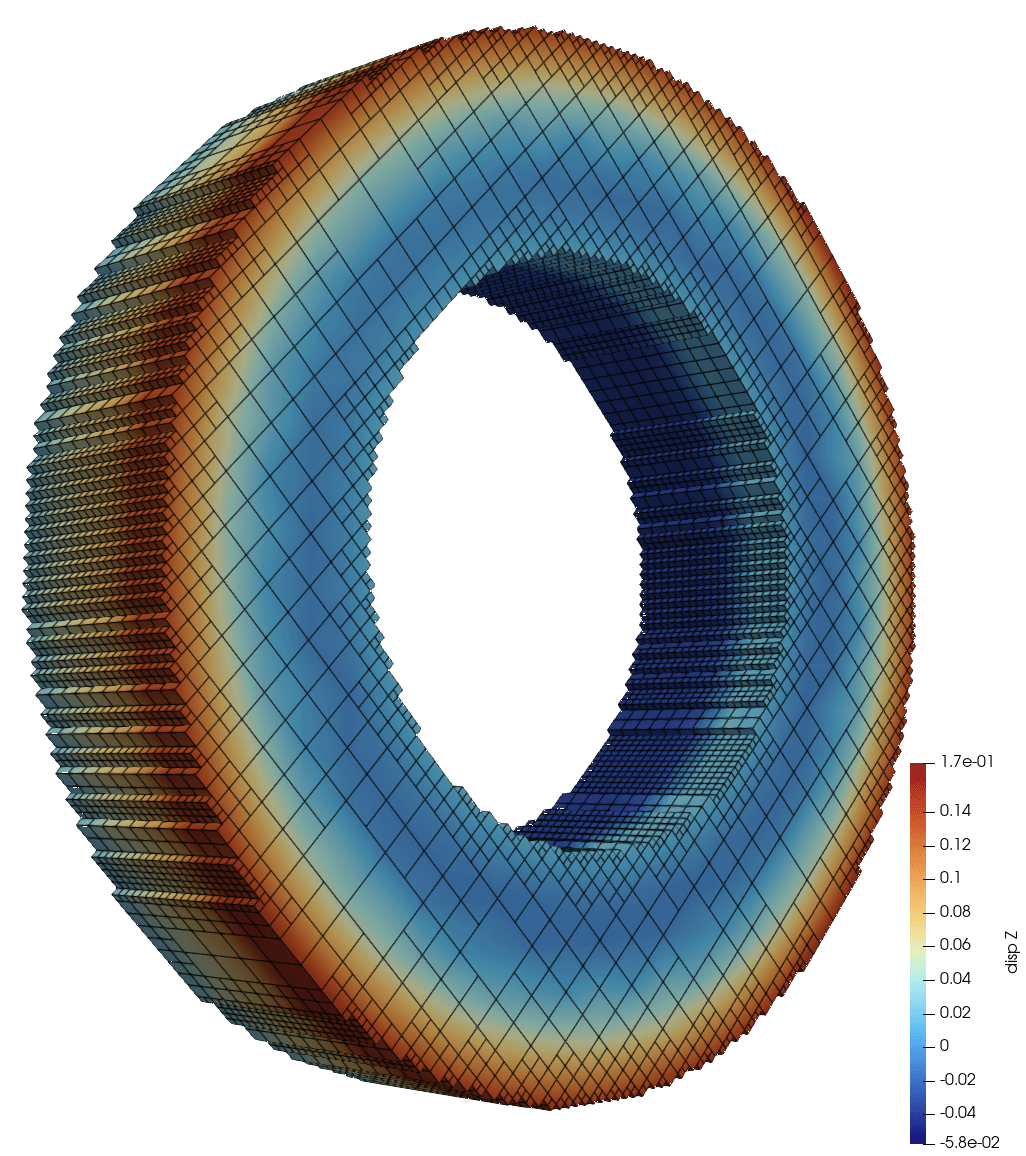
Inference
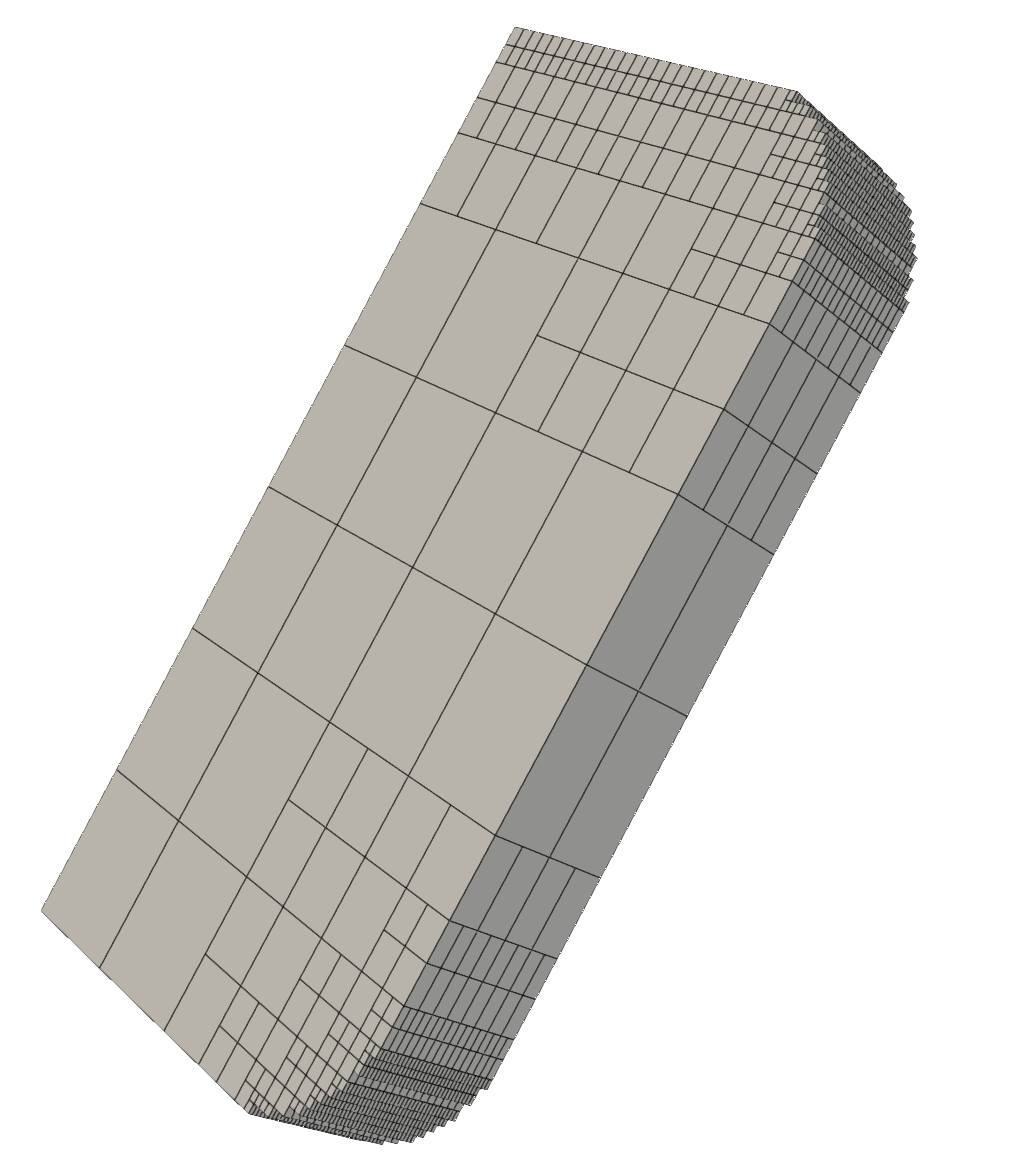
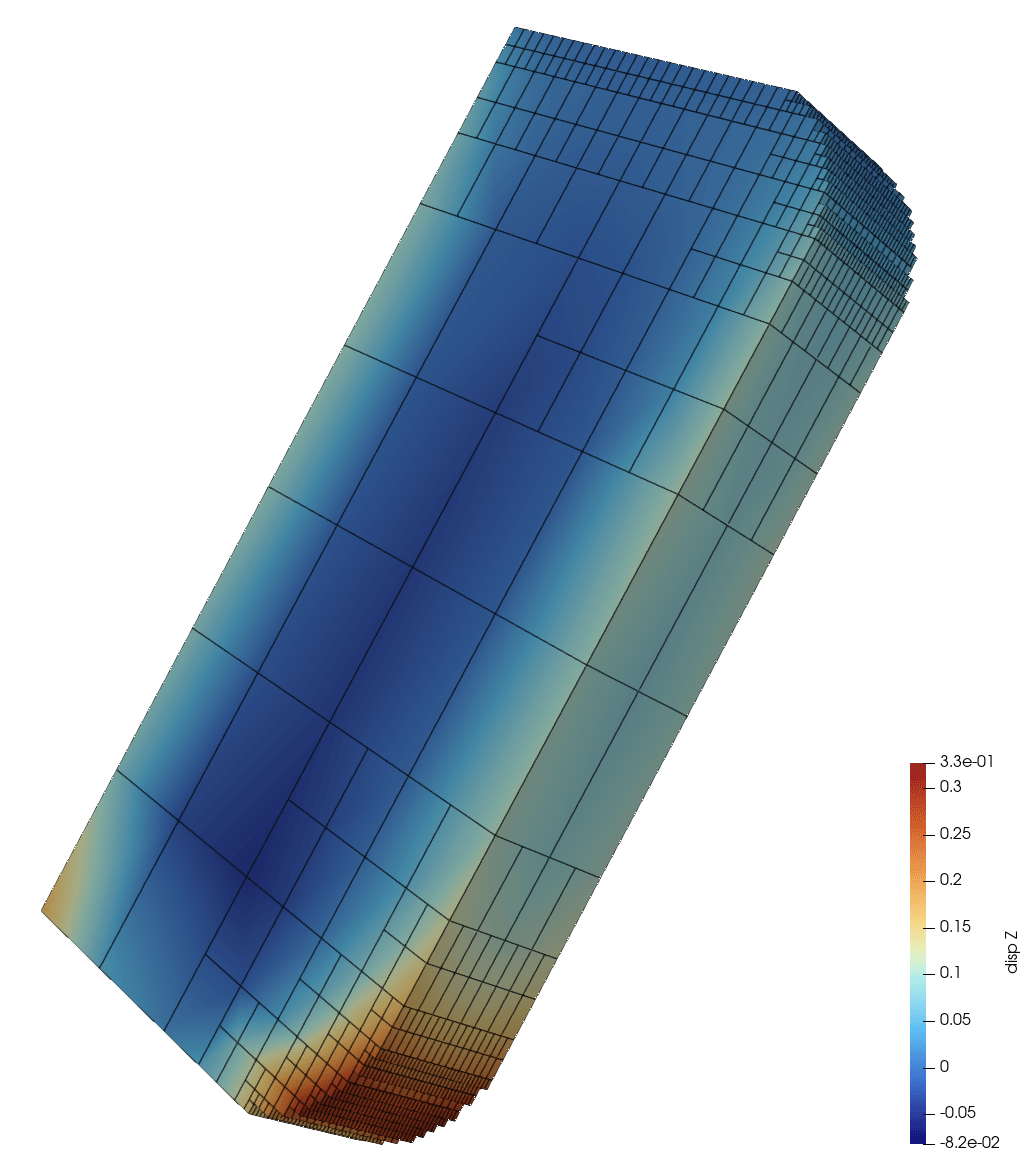
Large training cost is amortized over several evaluations
Model learns to predict \(\boldsymbol{u}\) over a distribution of \(\boldsymbol{\mu}\)
Transformers [1] are state-of-the-art surrogate models
16
Message-passing on a dynamic all-to-all graph.
[1] Vaswani et al. — “Attention Is All You Need”, NeurIPS 2017
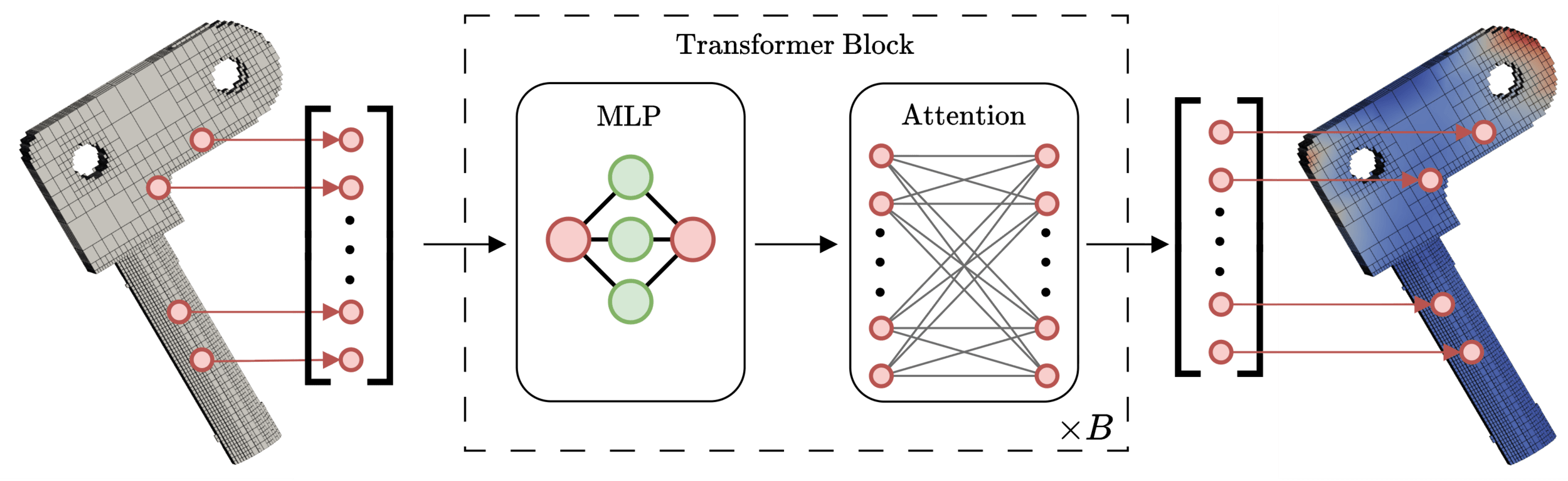
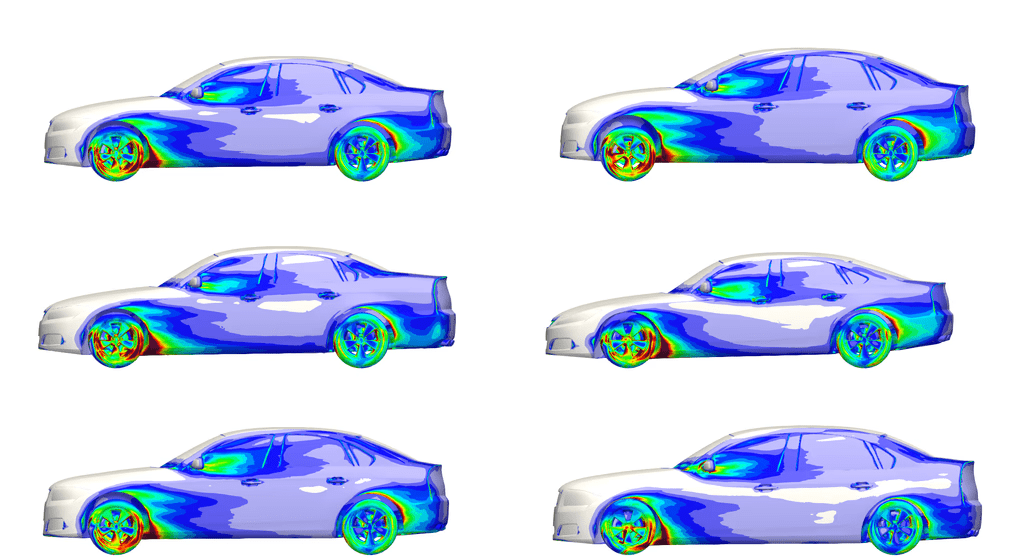
Quadratic (\(\mathcal{O}(N^2)\)) cost limits scalability
Quadratic \((\mathcal{O}(N^2))\) cost in transformers limit scalability
17
Over \(20~\text{s}\) per gradient step on a mesh of 1m poins!
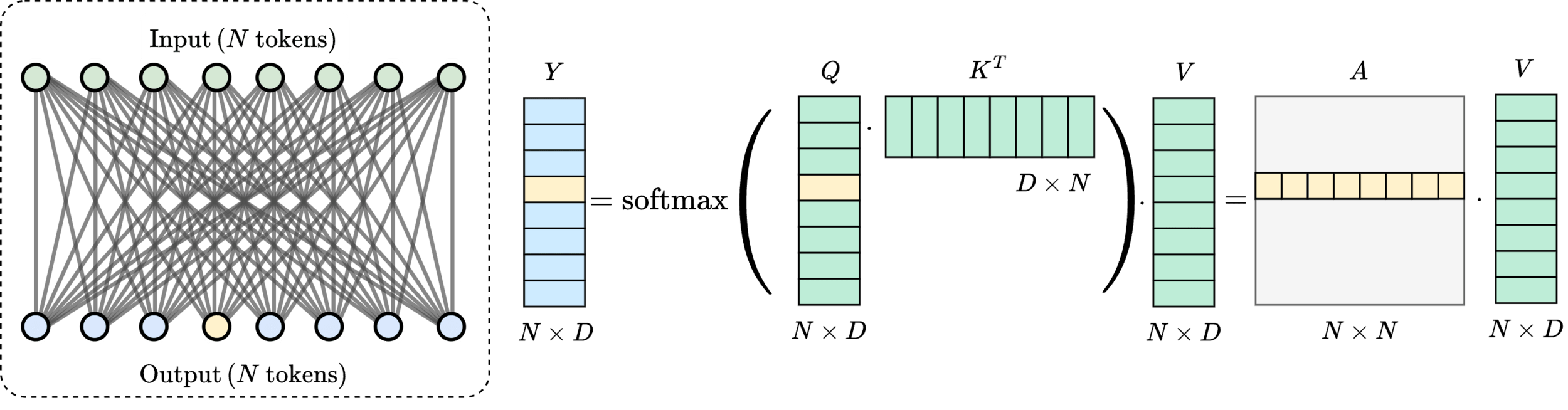
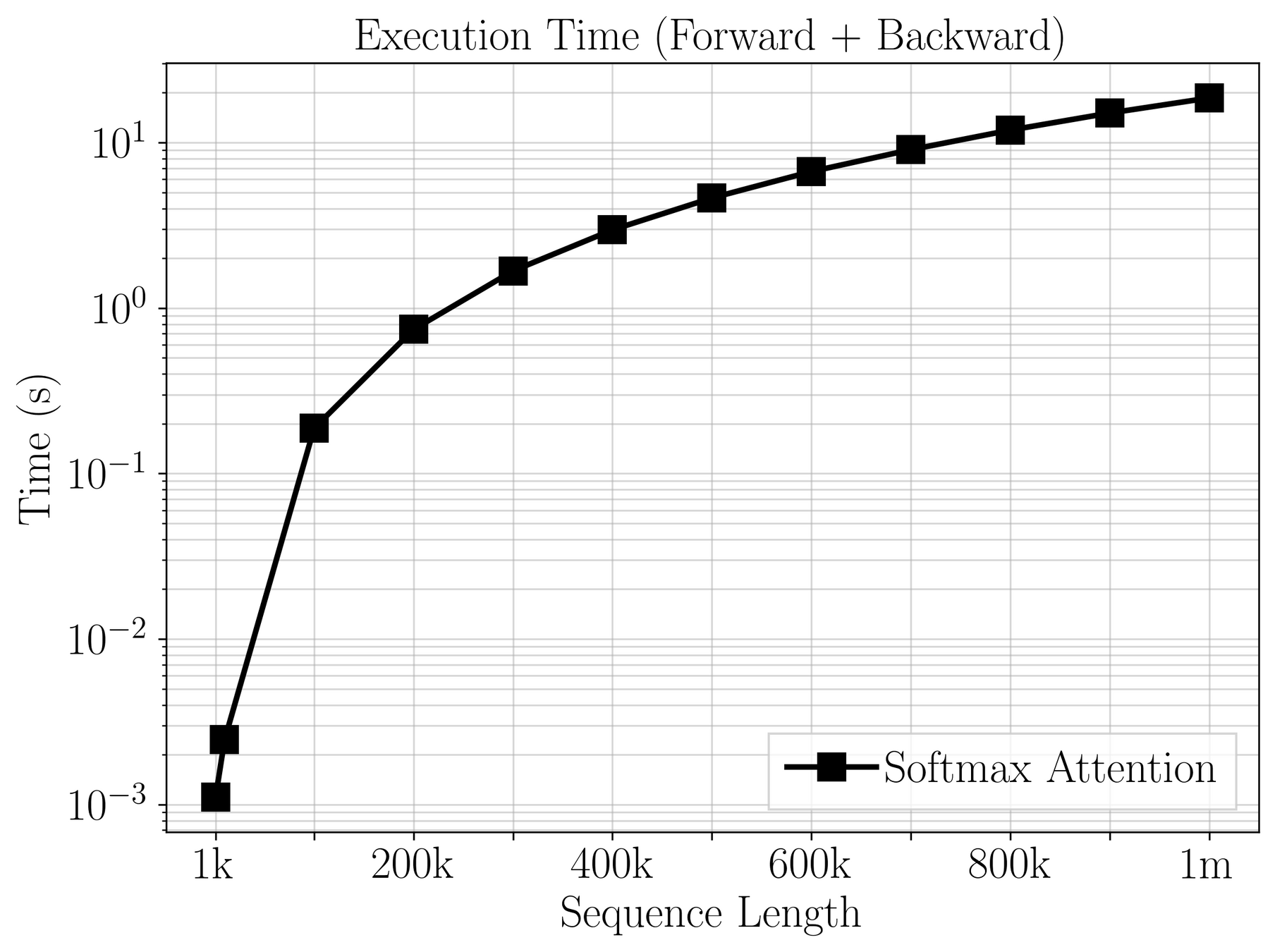
Goal: enable transformer models on large meshes.
[1] Vaswani et al. — “Attention Is All You Need”, NeurIPS 2017
\([1]\)
What are the limitations on communication patterns?
18
Solution operator requires global communication.
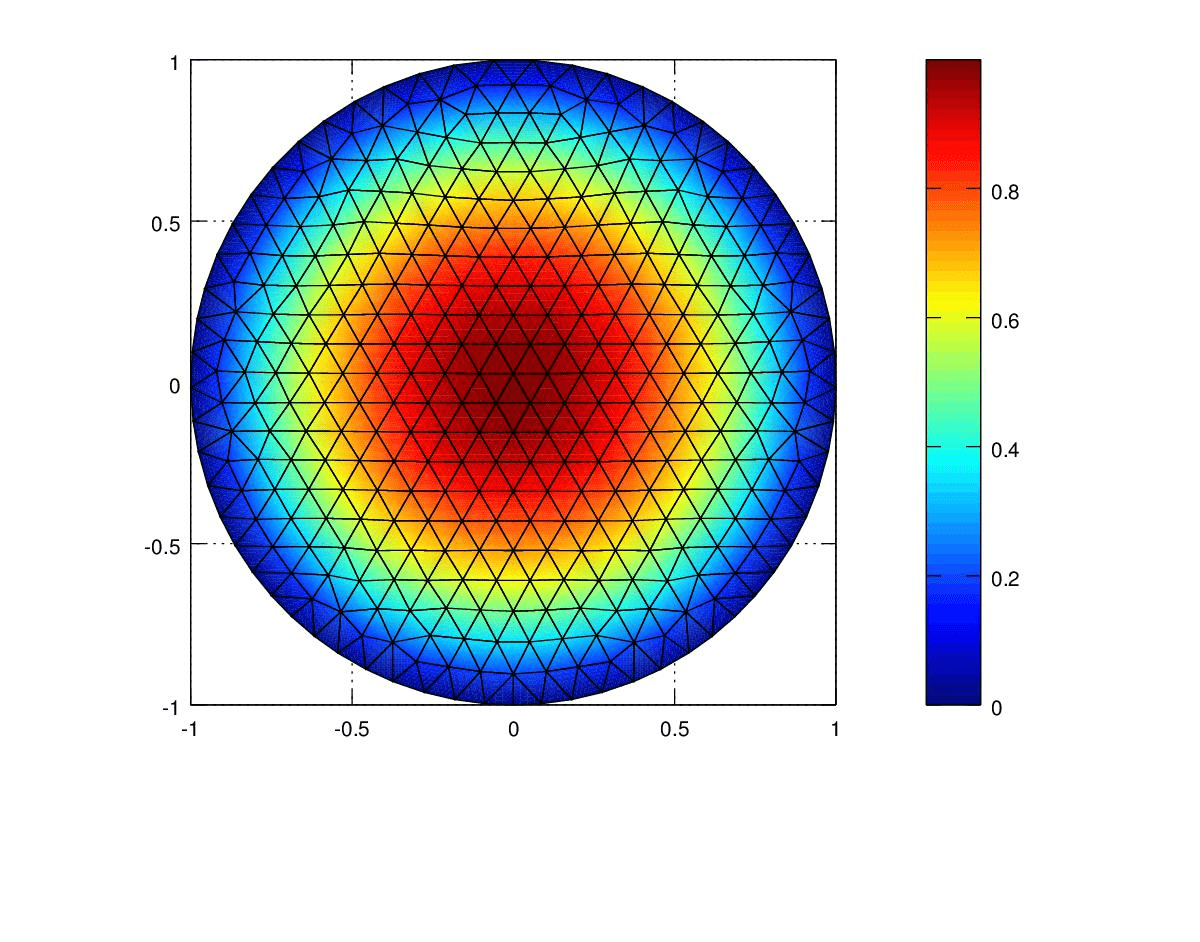
Forward operator is implemented with sparse, structured communication.
Need principled strategy for reducing communication cost.
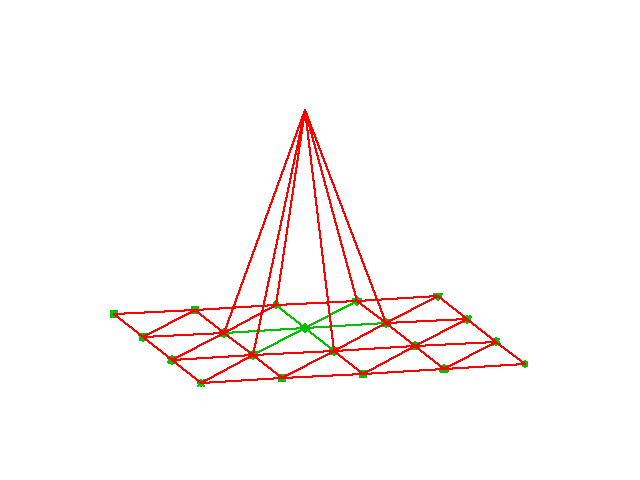
Detour: finite elements
[1] ParticleInCell.com — “Finite Element Experiments in MATLAB” (2012)
[1]
Are \(N \times N\) messages really necessary?
19
Smoothness implies redundancy in communication.
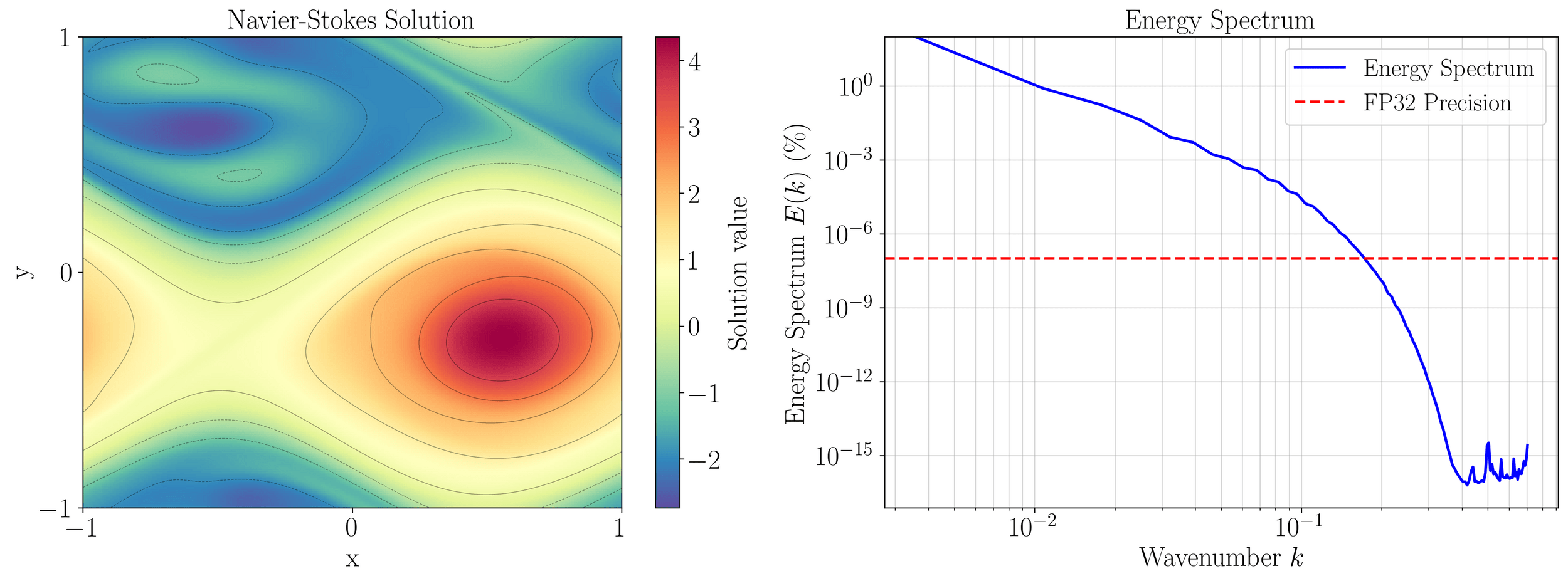
Are \(N \times N\) messages really necessary?
19
Smoothness implies redundancy in communication.
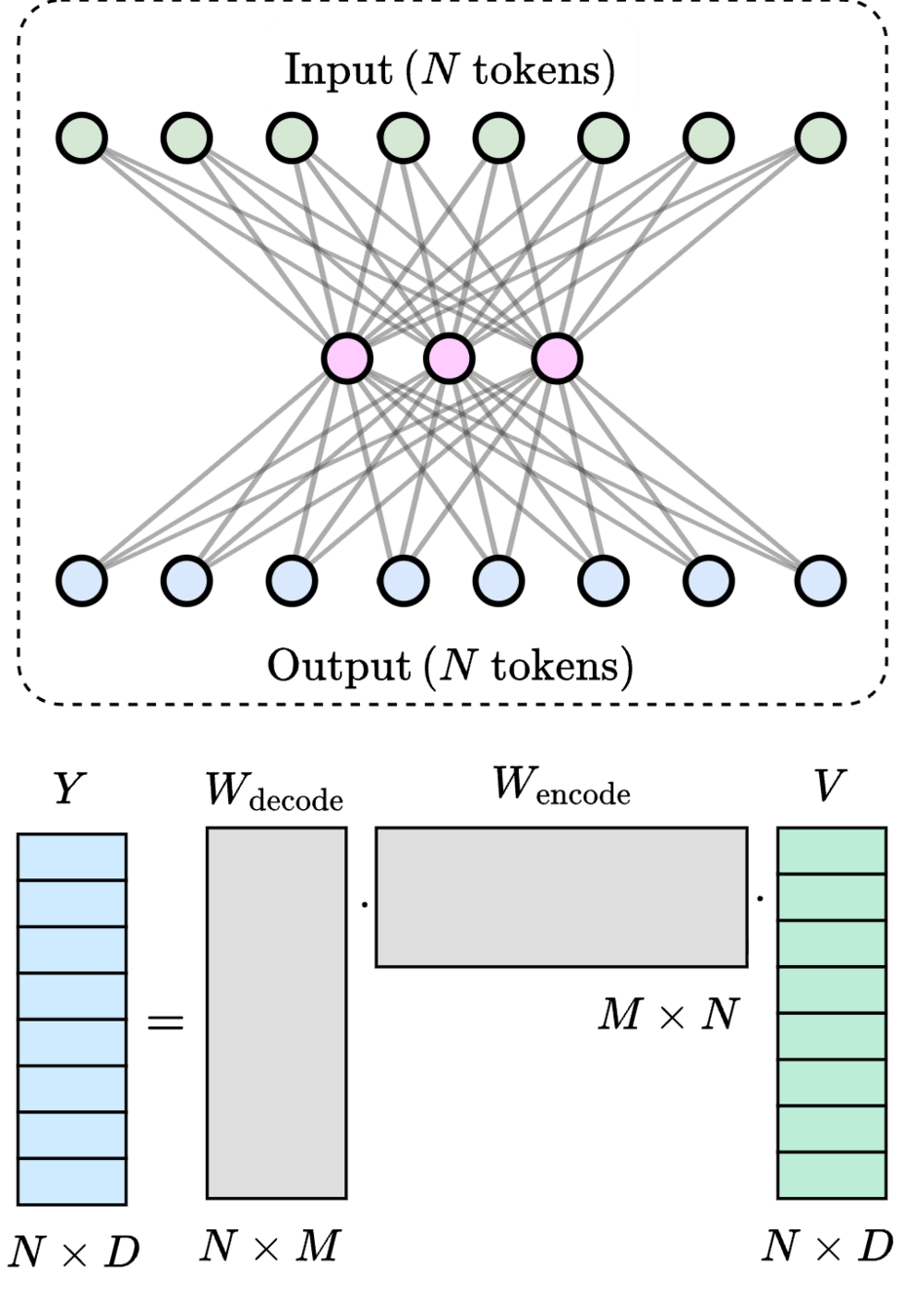
Method: club matching points to one cluster and communicate together.
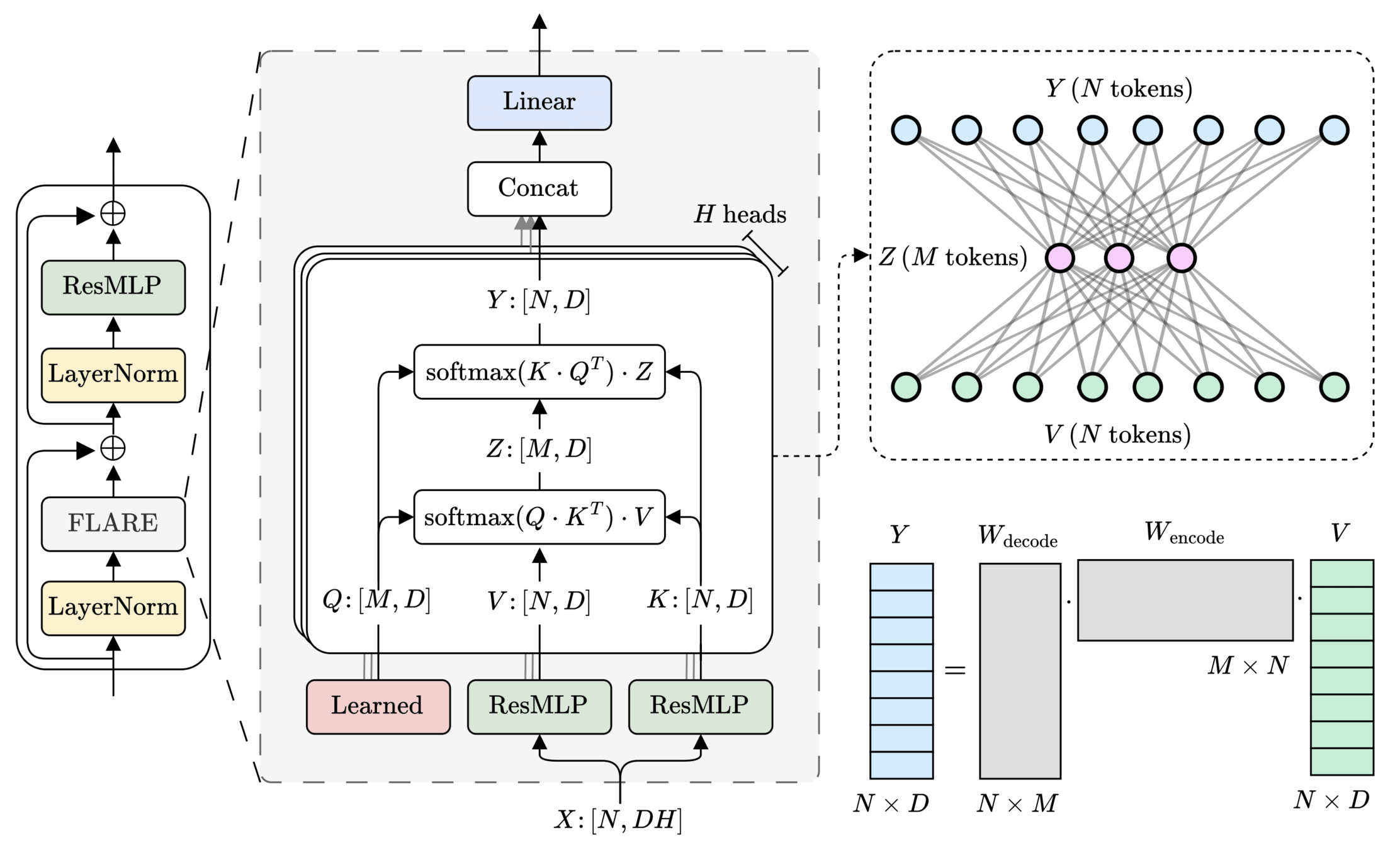
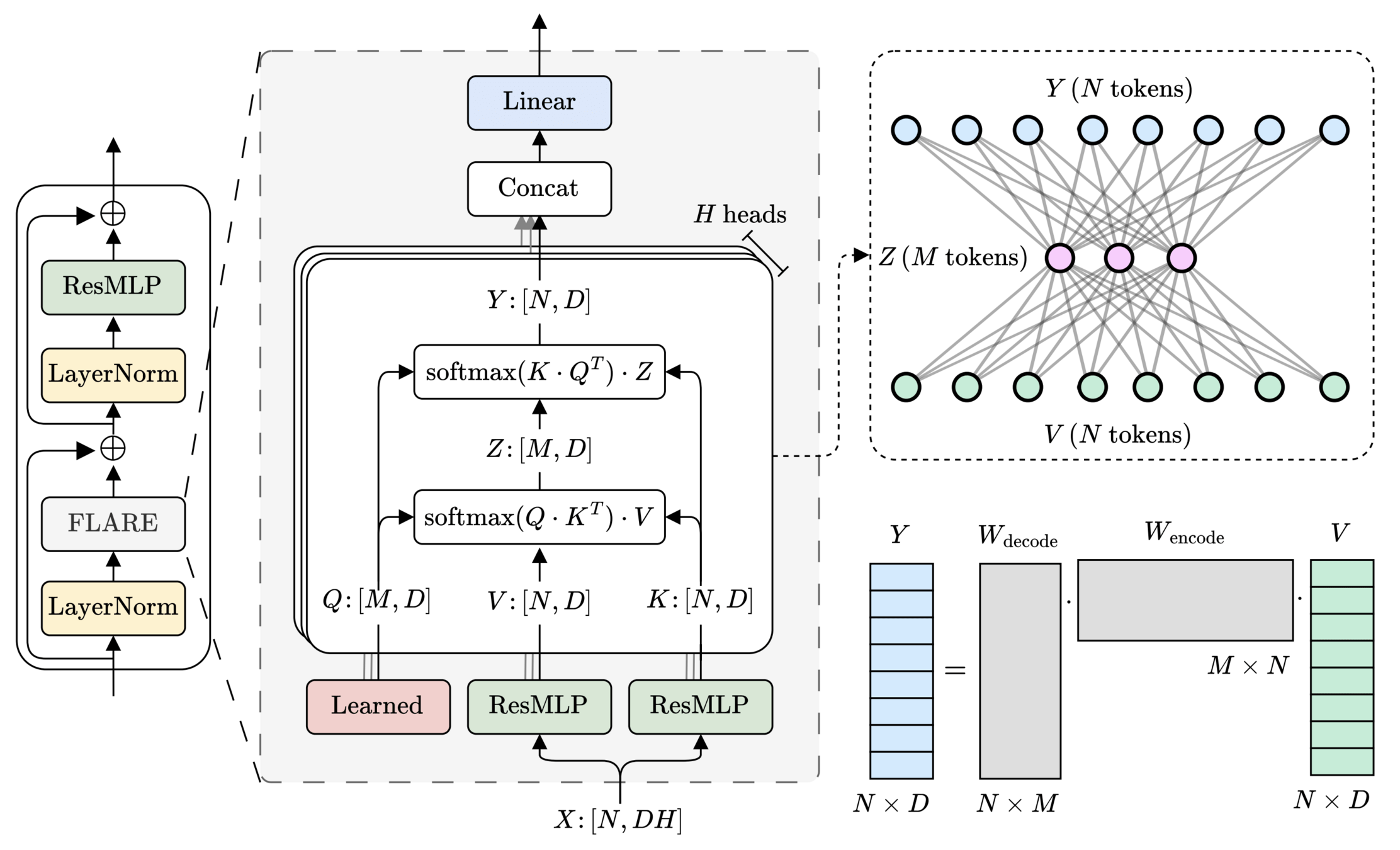
FLARE: Fast Low-rank Attention Routing Engine
20
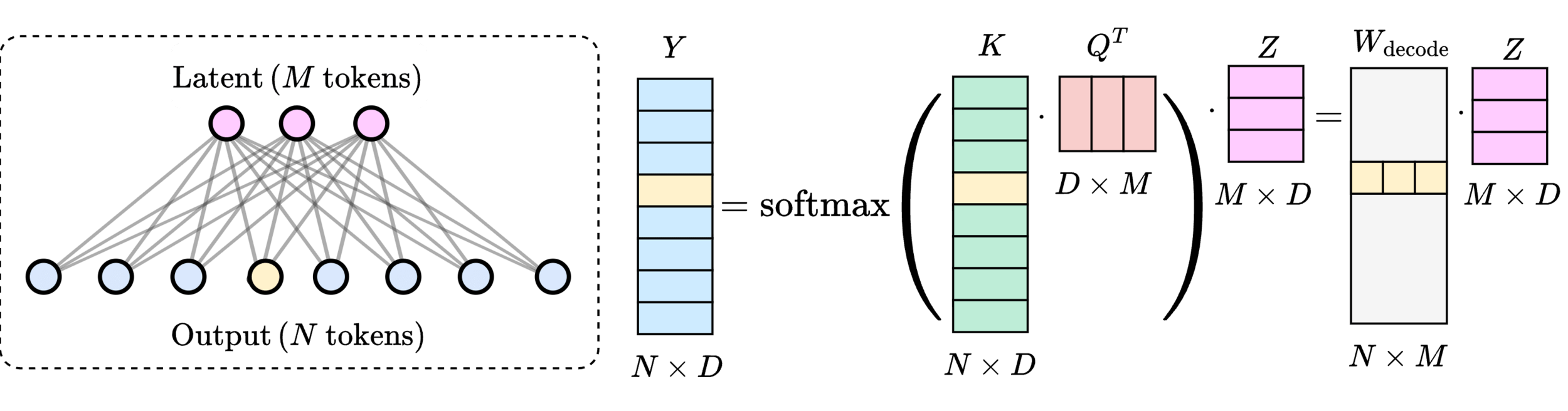
Encoding: introduce \(M\) latent clusters to pool messages from matching tokens
\(M\) learned queries
Decoding: map pooled messages to matching output tokens
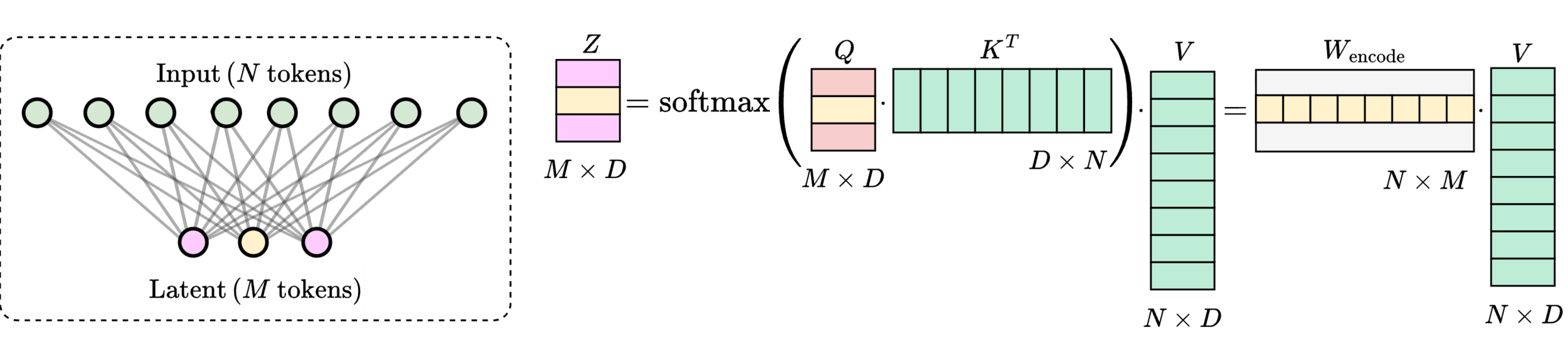
FLARE: Fast Low-rank Attention Routing Engine
21
\(\mathcal{O}(2MN) \ll \mathcal{O}(N^2)\)
\(\text{rank}(W_\text{encode}\cdot W_\text{decode}) \leq M\)
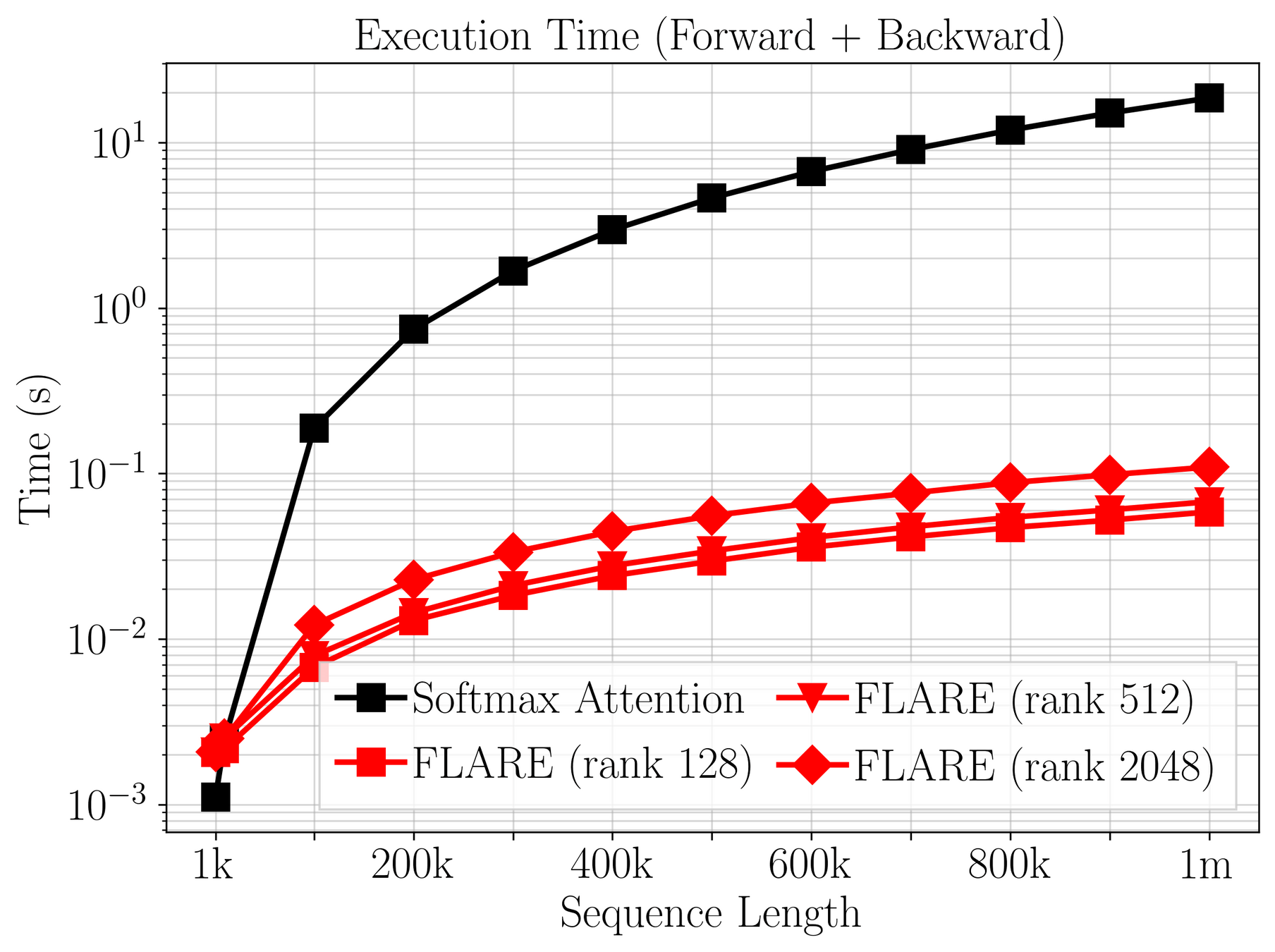
\(>200\times\) speedup
\(\text{(} M \text{ tokens)}\)
\(\text{Latent}\)
[1] Vaswani et al. — “Attention Is All You Need”, NeurIPS 2017
\([1]\)
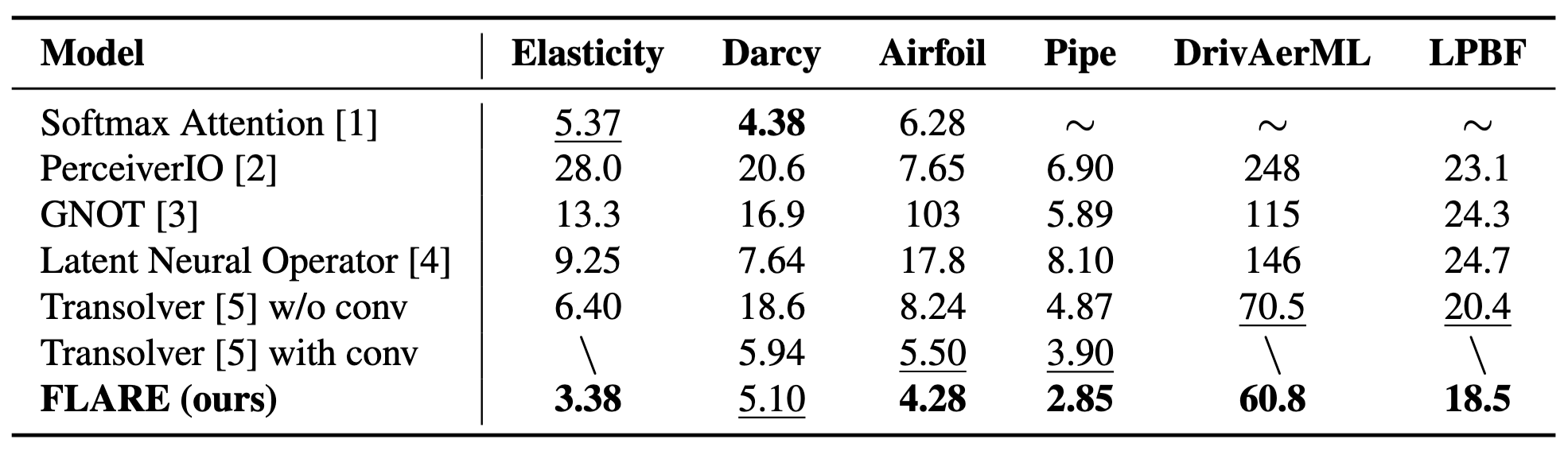
PDE surrogate benchmark problems
Relative \(L_2\) error \( (\times 10^{-3})\) (lower is better)
22
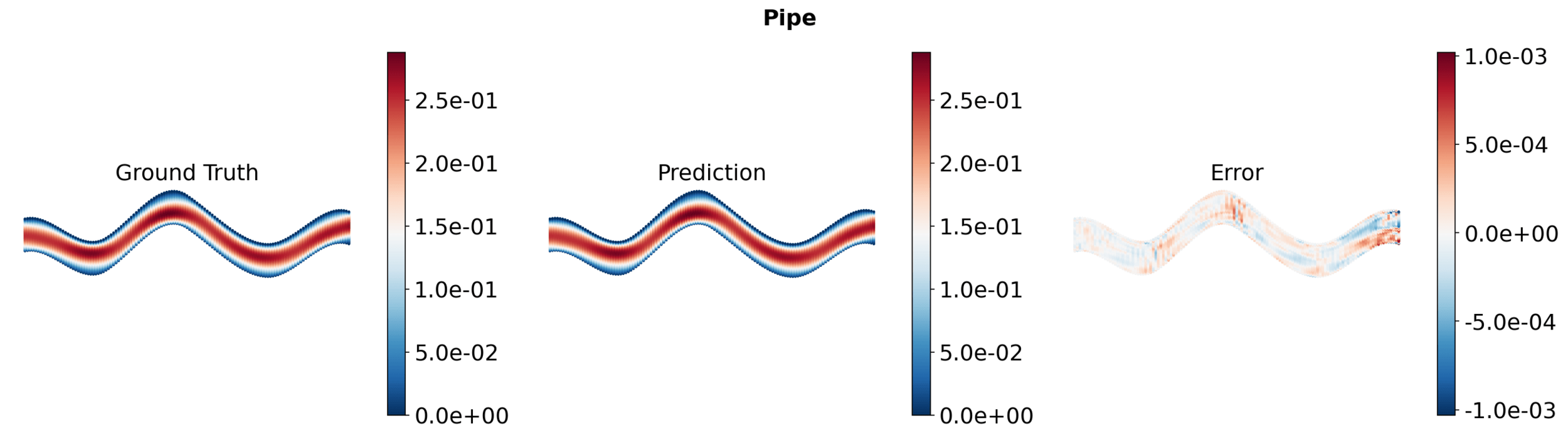
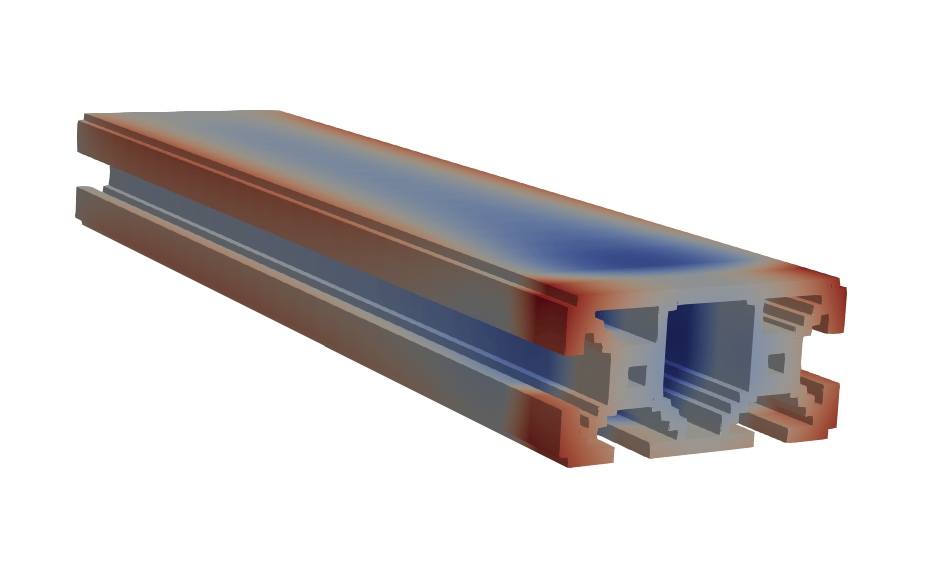
Pipe
Darcy
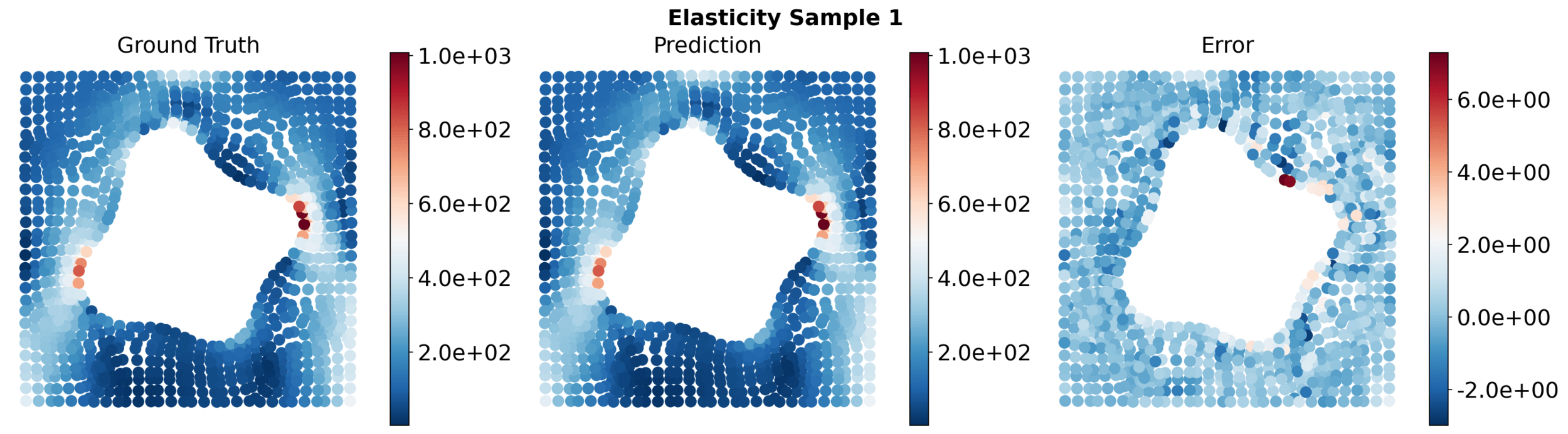
Elasticity
LPBF
DrivAerML
[1] Vaswani et al. — “Attention Is All You Need”, NeurIPS 2017
[2] Jaegle et al. — "PercieverIO: A General Architecture for Structured Inputs & Outputs", ICLR 2022
[3] Hao et al., — "GNOT: A General Neural Operator Transformer for Operator Learning", PMLR 2023
[4] Wang et al. —"Latent Neural Operator", NeurIPS 2024
[5] We et al. — "Transolver: A Fast Transformer Solver for PDEs on General Geometries", ICML 2024
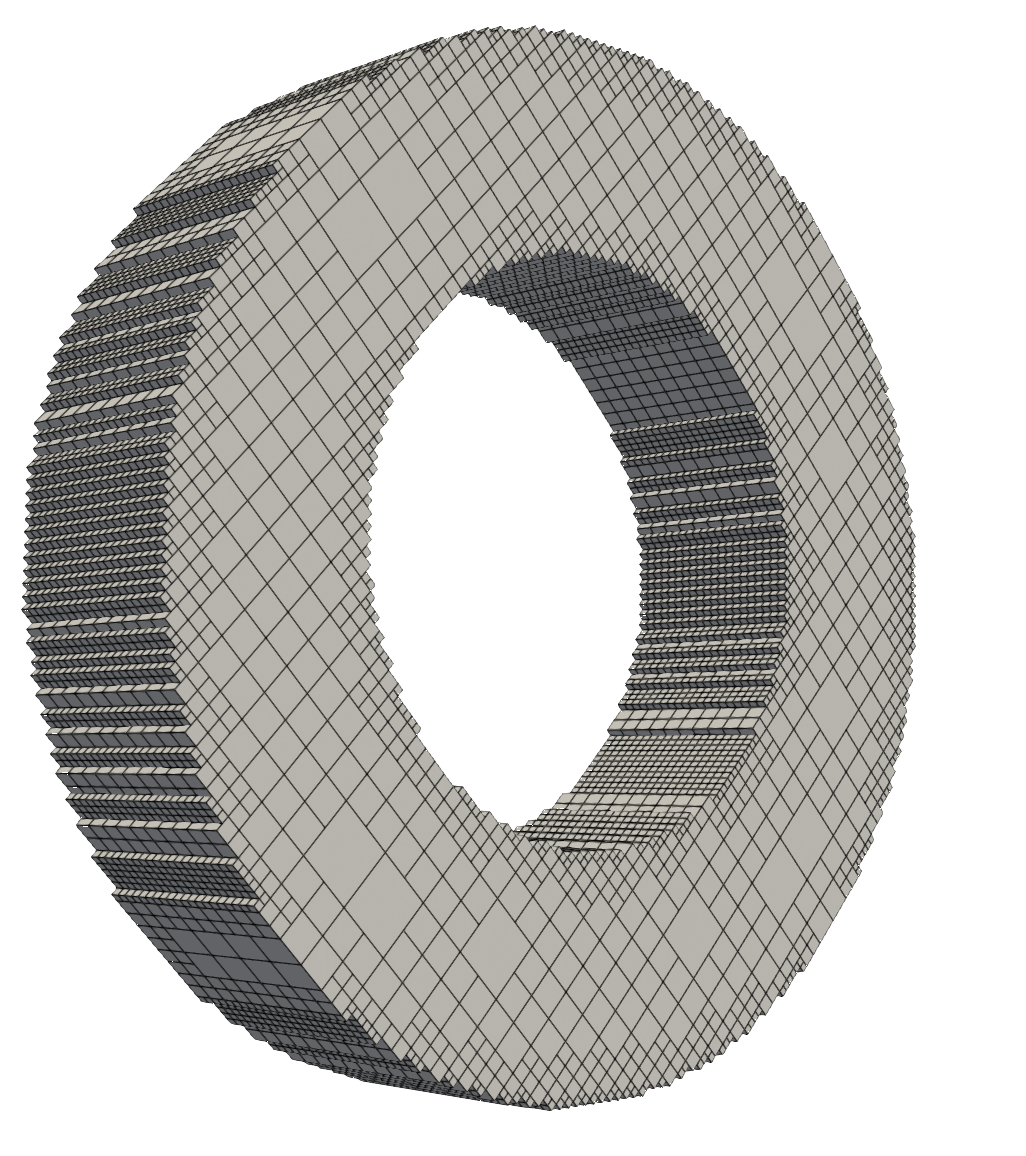
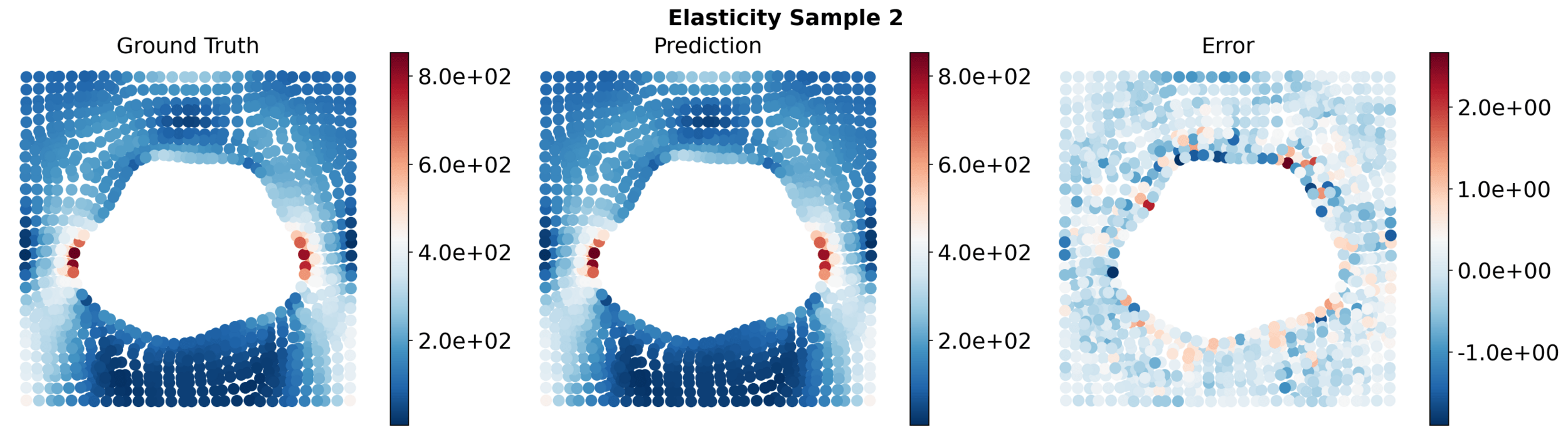
Elasticity benchmark problem
23
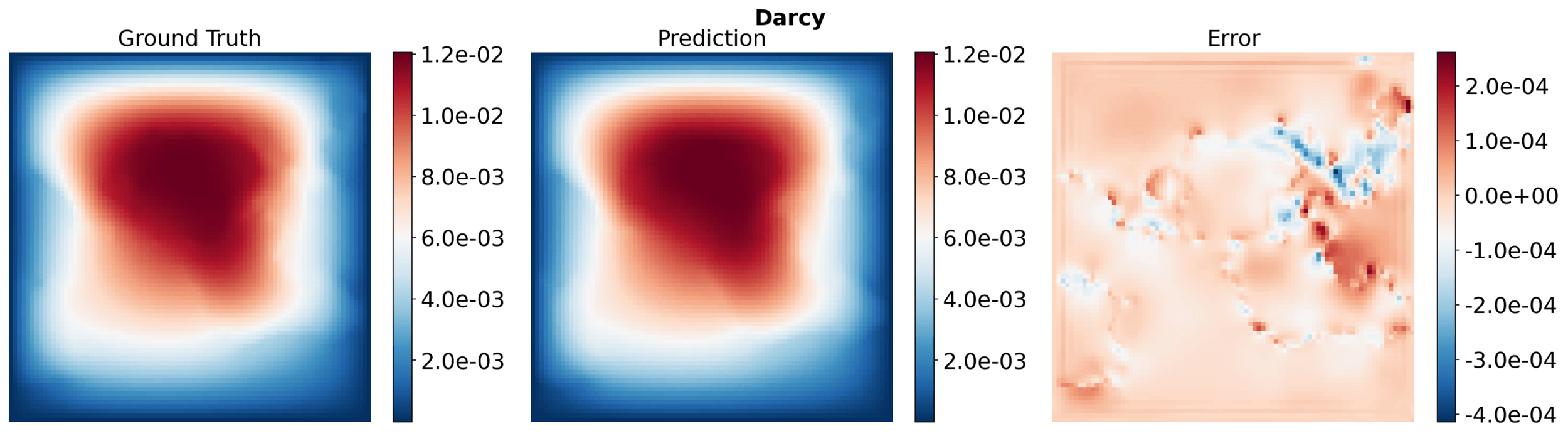
Pipe flow, Darcy flow benchmark problems
24
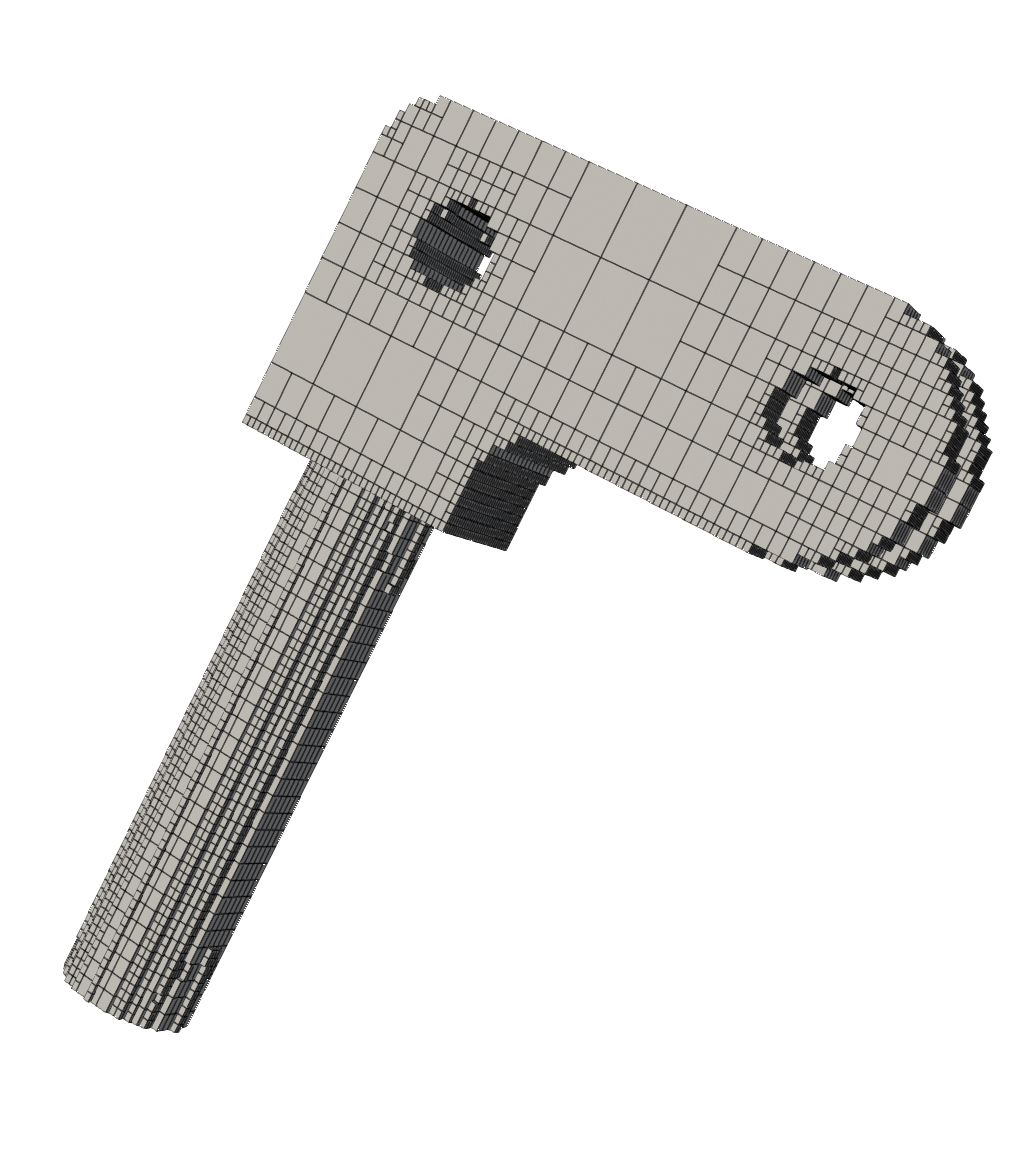
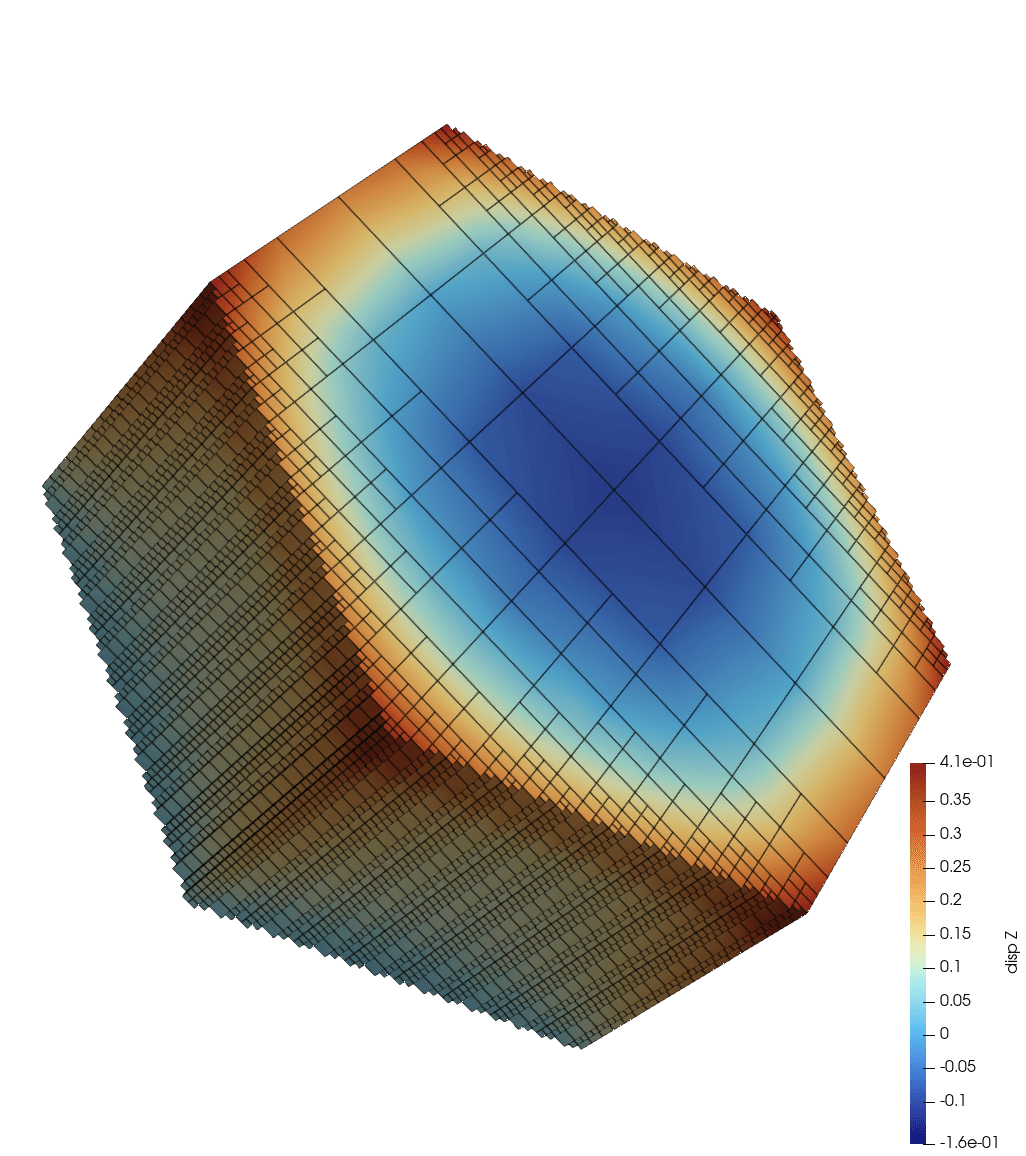
Laser powder bed fusion benchmark problem
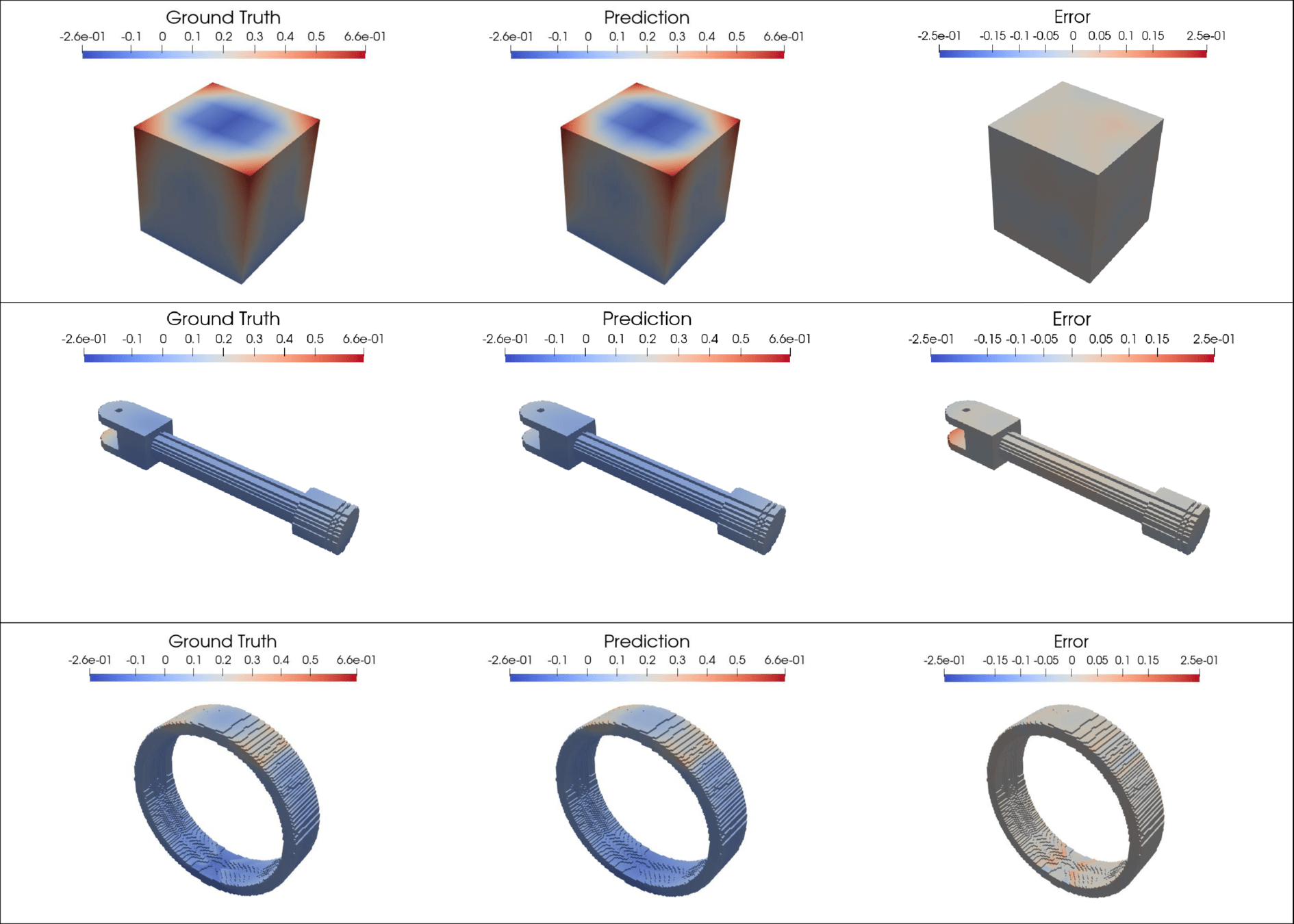
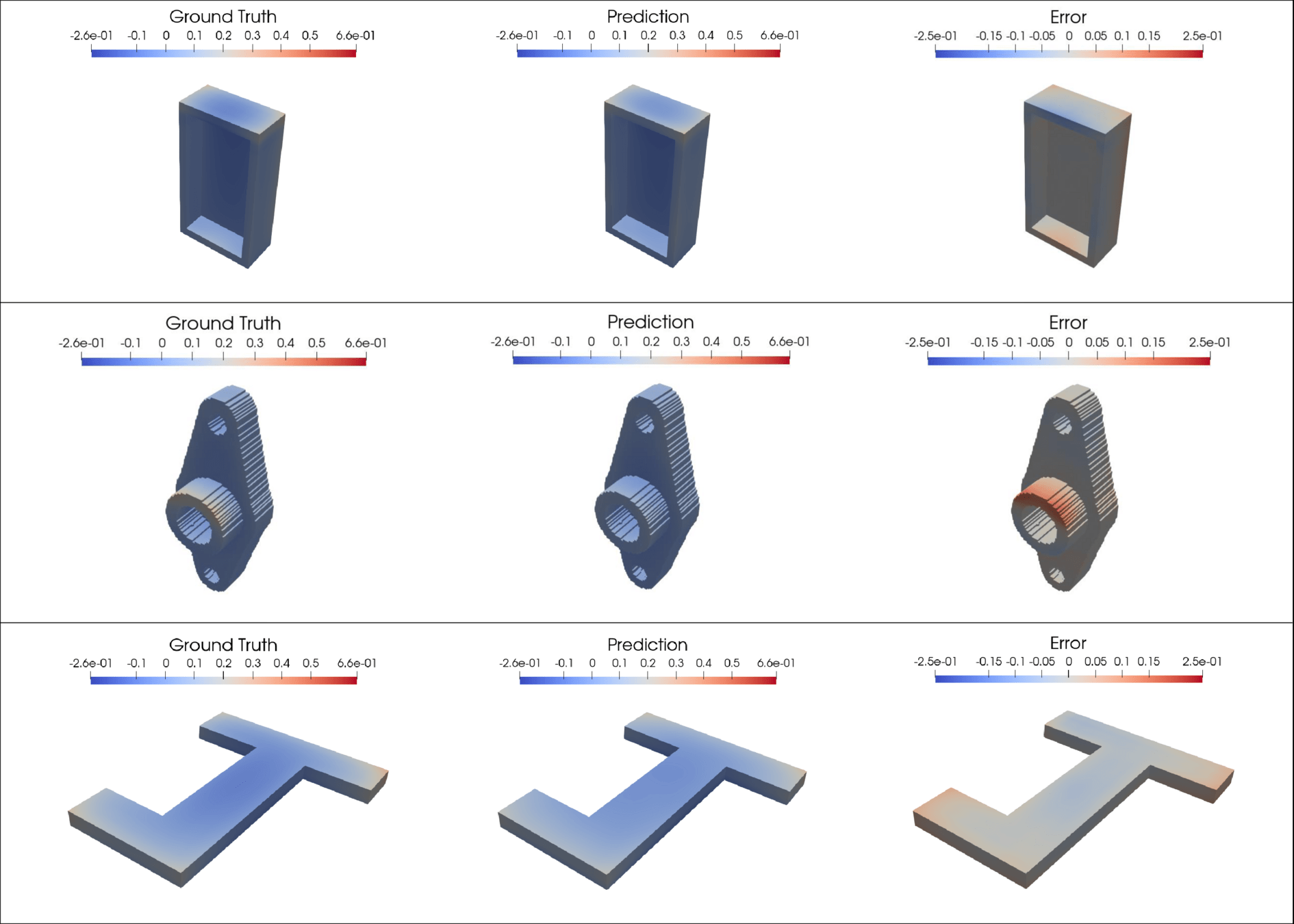
25
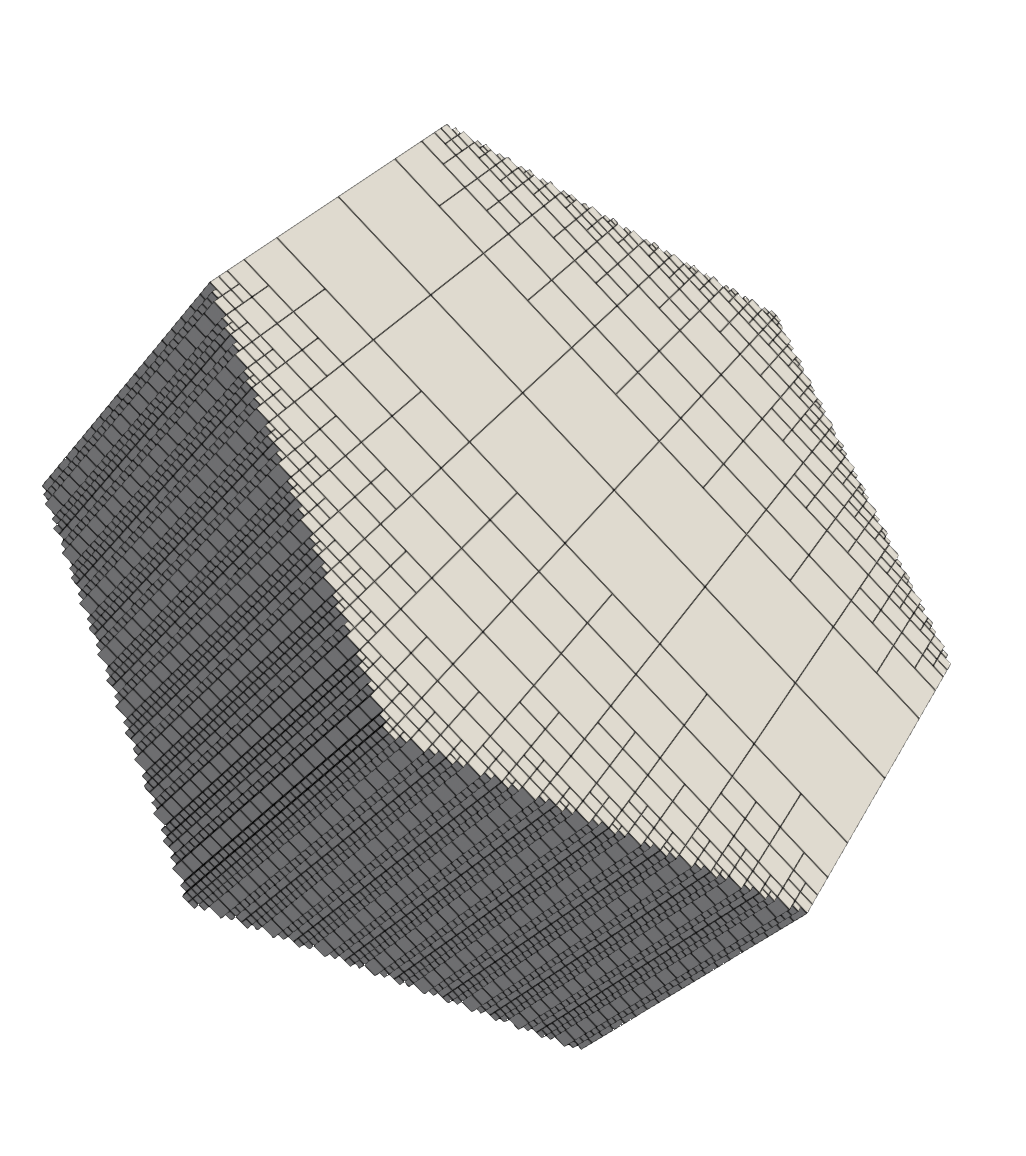
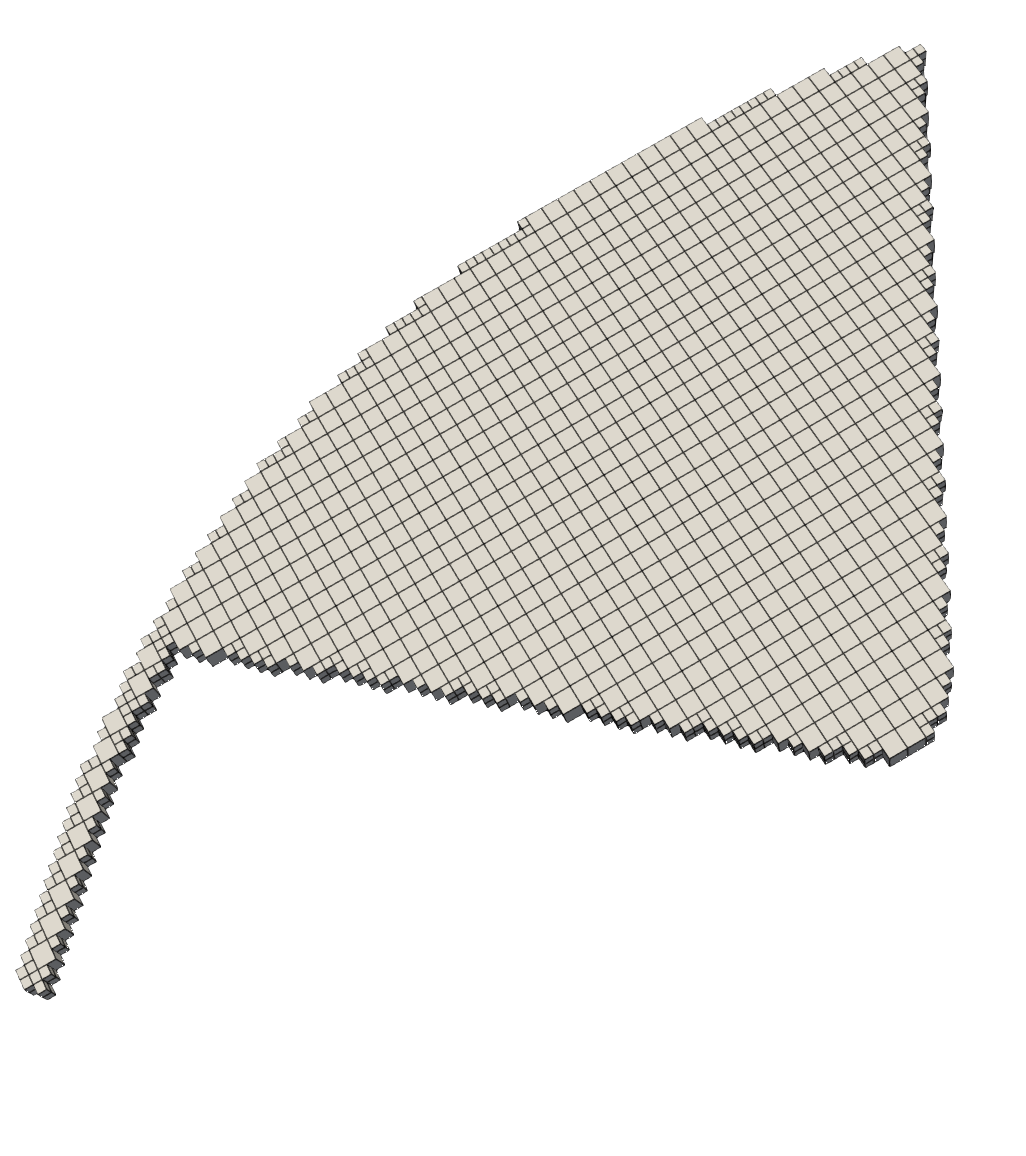
FLARE learns surrogate on a million-point mesh!
Largest experiment on a single GPU!
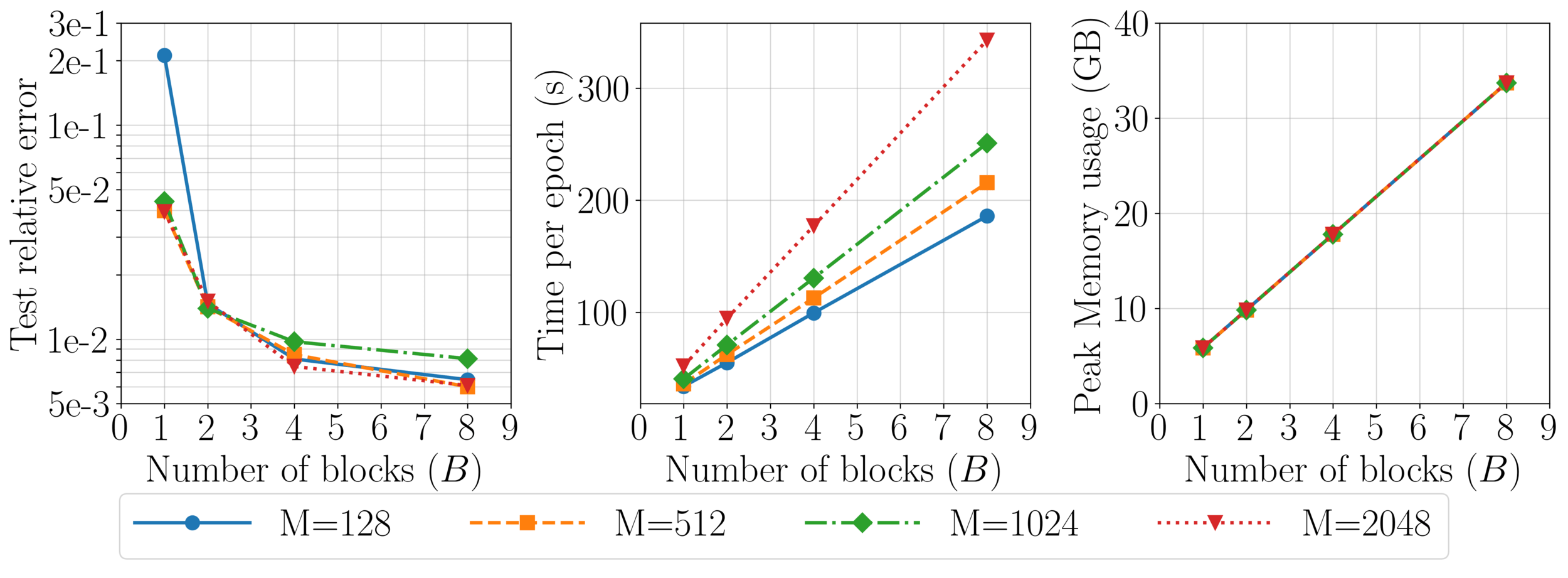
26
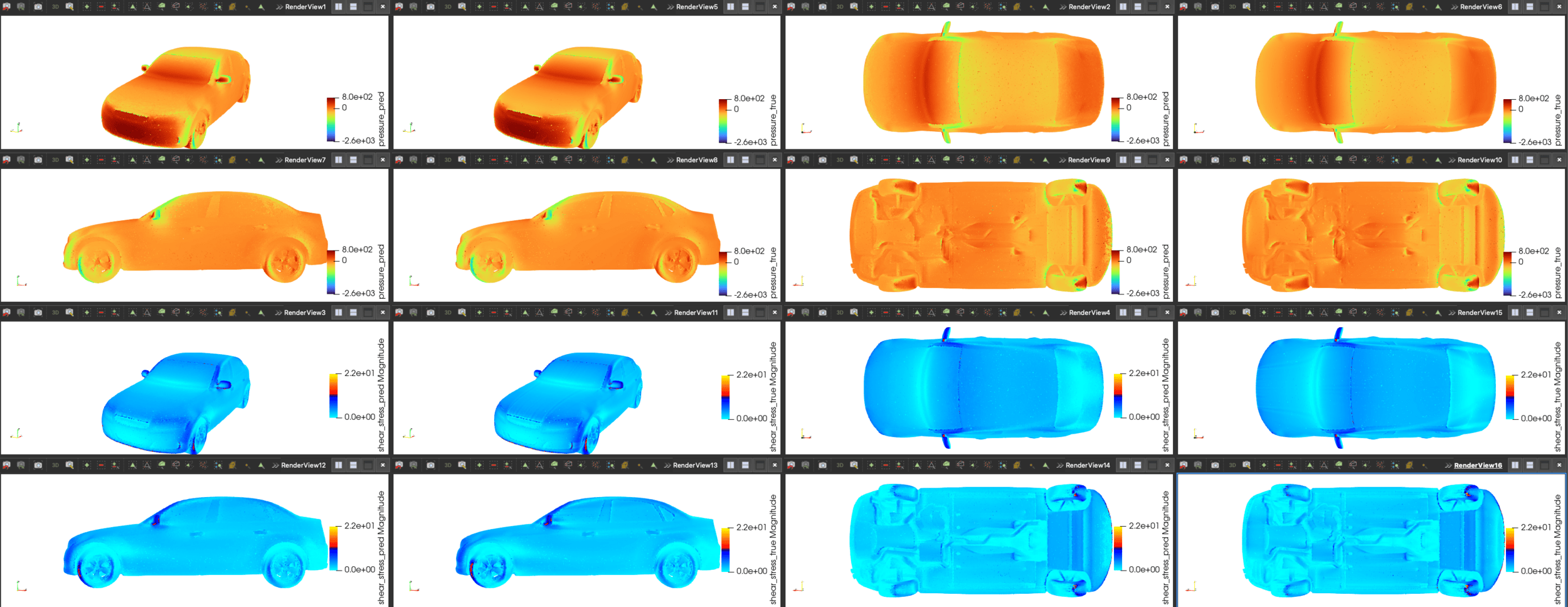
[1]
[1] Ashton et al. — “DrivAerML: High-Fidelity CFD Dataset for Road-Car Aerodynamics” (arXiv:2408.11969, 2024)
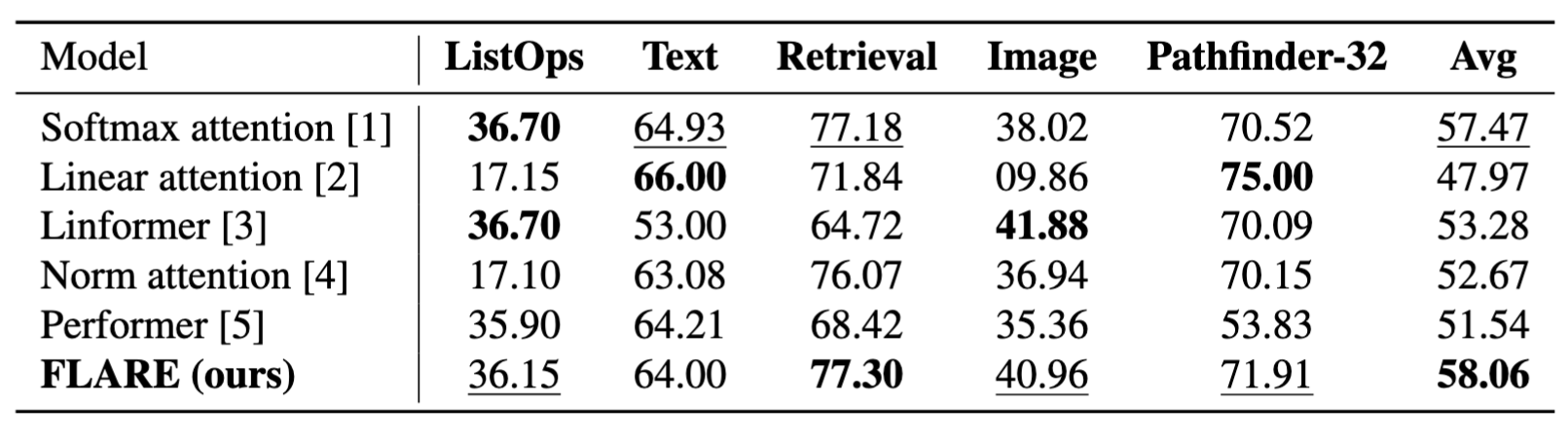
FLARE generalizes beyond PDE tasks
27
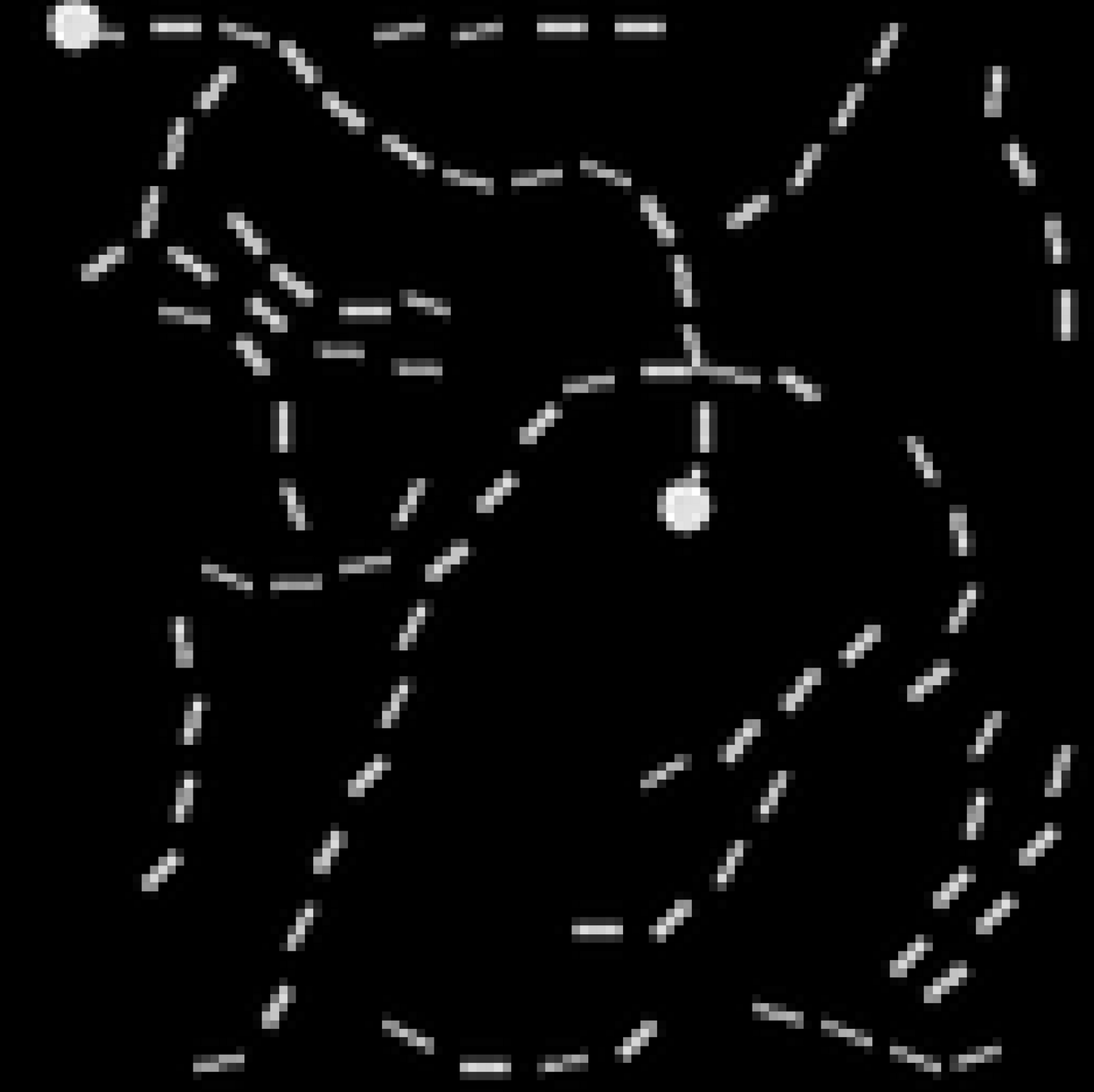
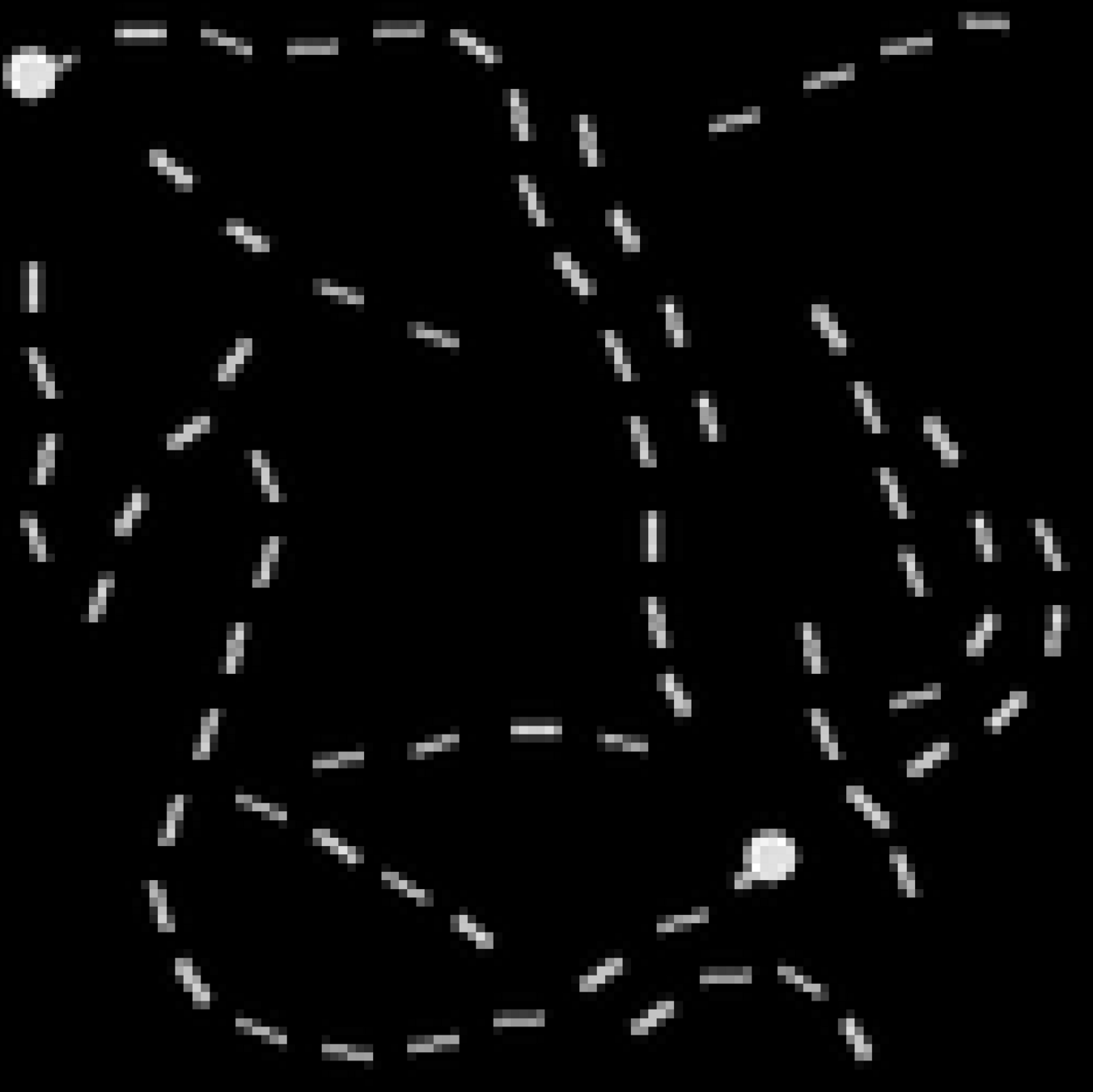
Pathfinder
Listops
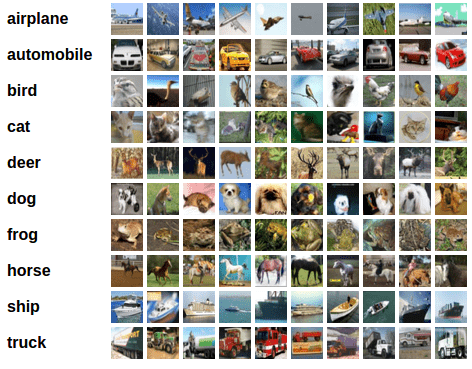
Image classification
Text sentiment analysis

[7]
[8]
[1]
[5]Choromanski et al. — "Rethinking Attention with Performers", ICLR 2021
[6] Tay, Y. et al. — “Long Range Arena: A Benchmark for Efficient Transformers” (arXiv 2020)
[7] Centric Consulting — “Sentiment Analysis: Way Beyond Polarity” (blog)
[8] Krizhevsky — CIFAR dataset homepage
[6]
Accuracy \((\%)\) (higher is better)
[1] Vaswani et al. — “Attention Is All You Need”, NeurIPS 2017
[2] Katharopoulos et al. — "Transformers are RNNs: Fast Autoregressive Transformers with Linear Attention", ICML 2020
[3] Wang et al. — "Linformer: Self-attention with linear complexity", arXiv:2006.04768 2020
[4] Qin et al. — "The devil in linear transformer", arXiv:2210.10340 2022
Proposed Work
Extend FLARE to transient problems
Motivation: preempt build failures in metal additive manufacturing
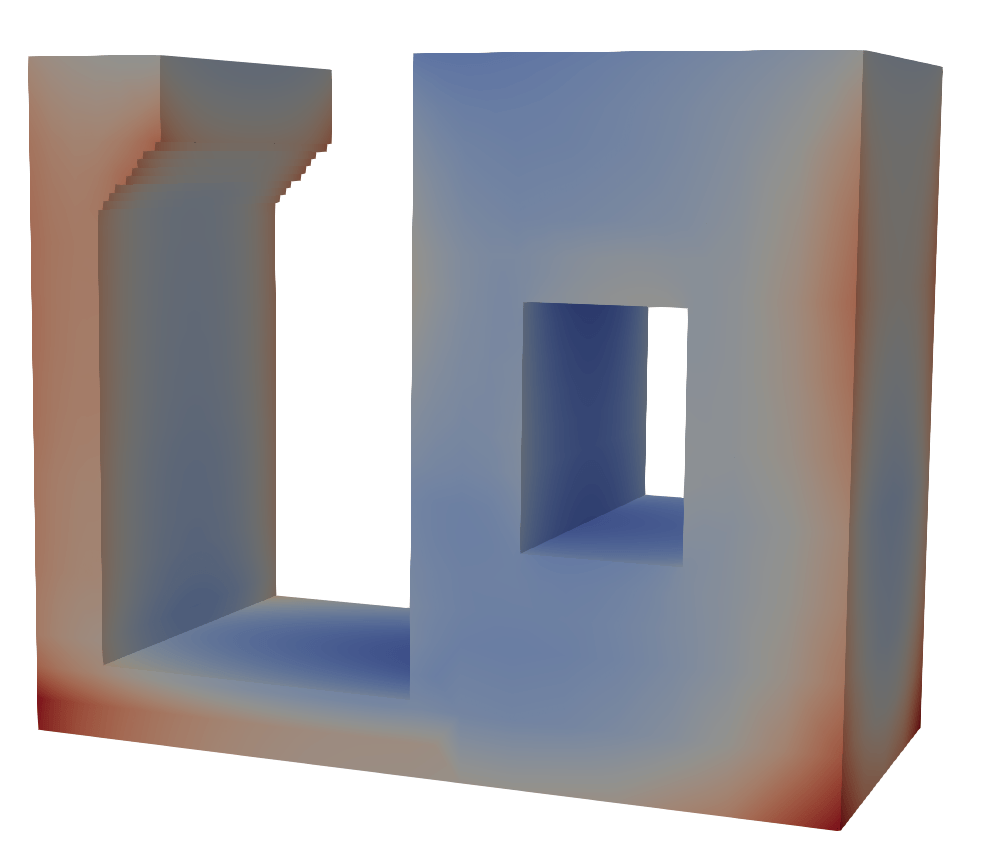
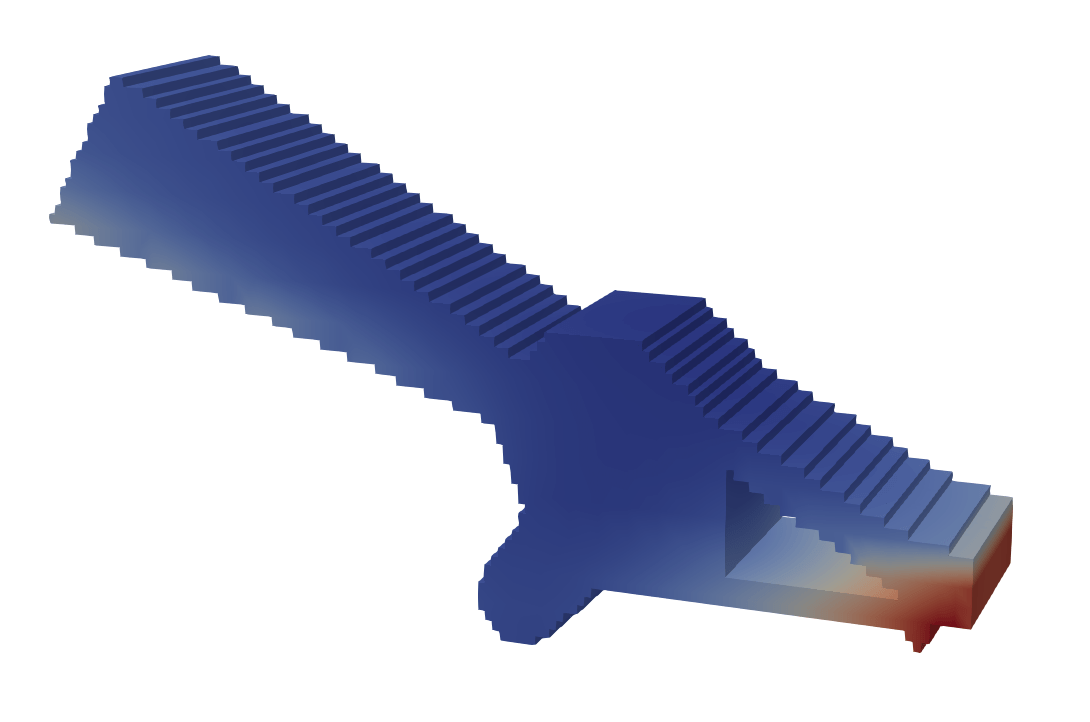
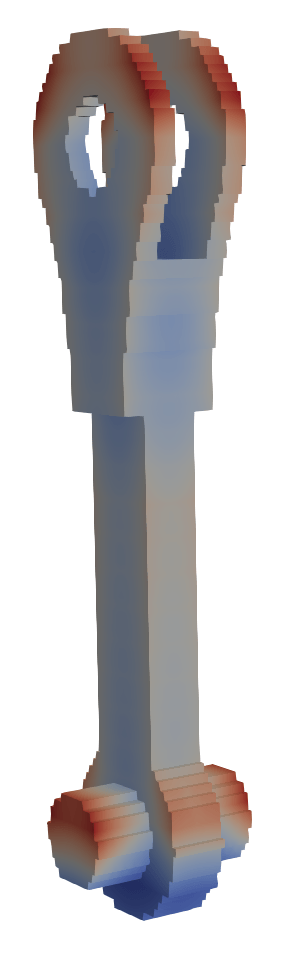
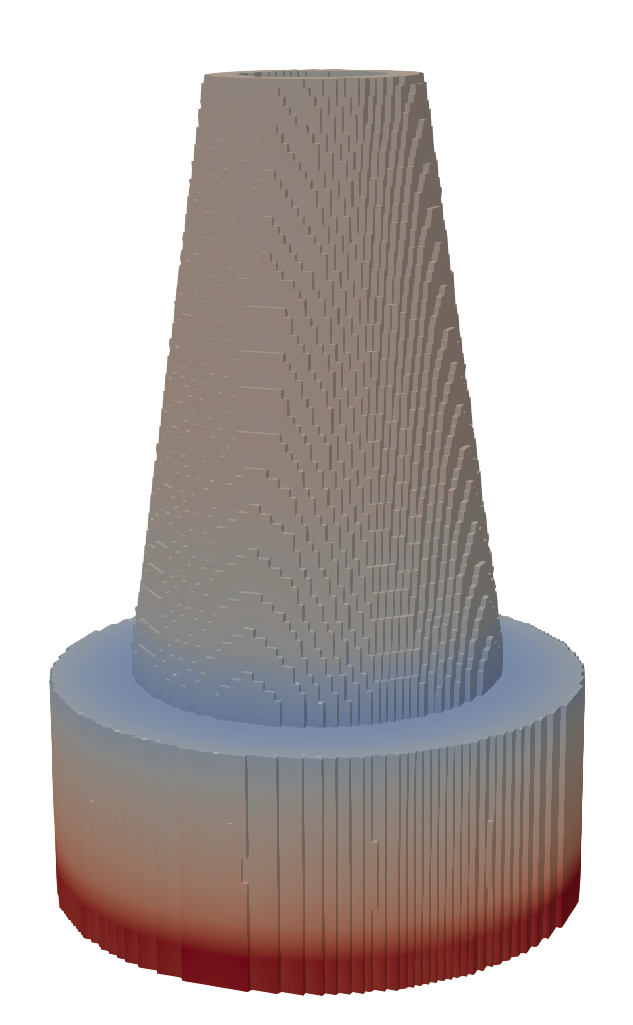
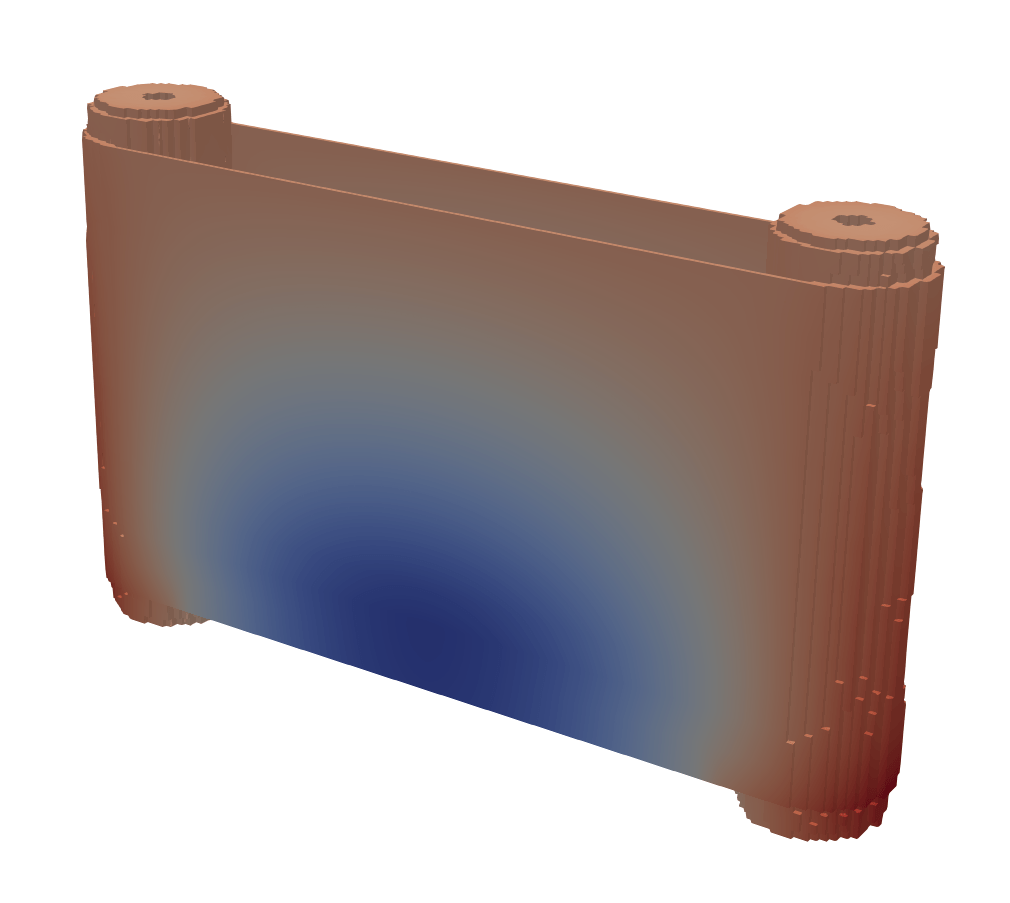
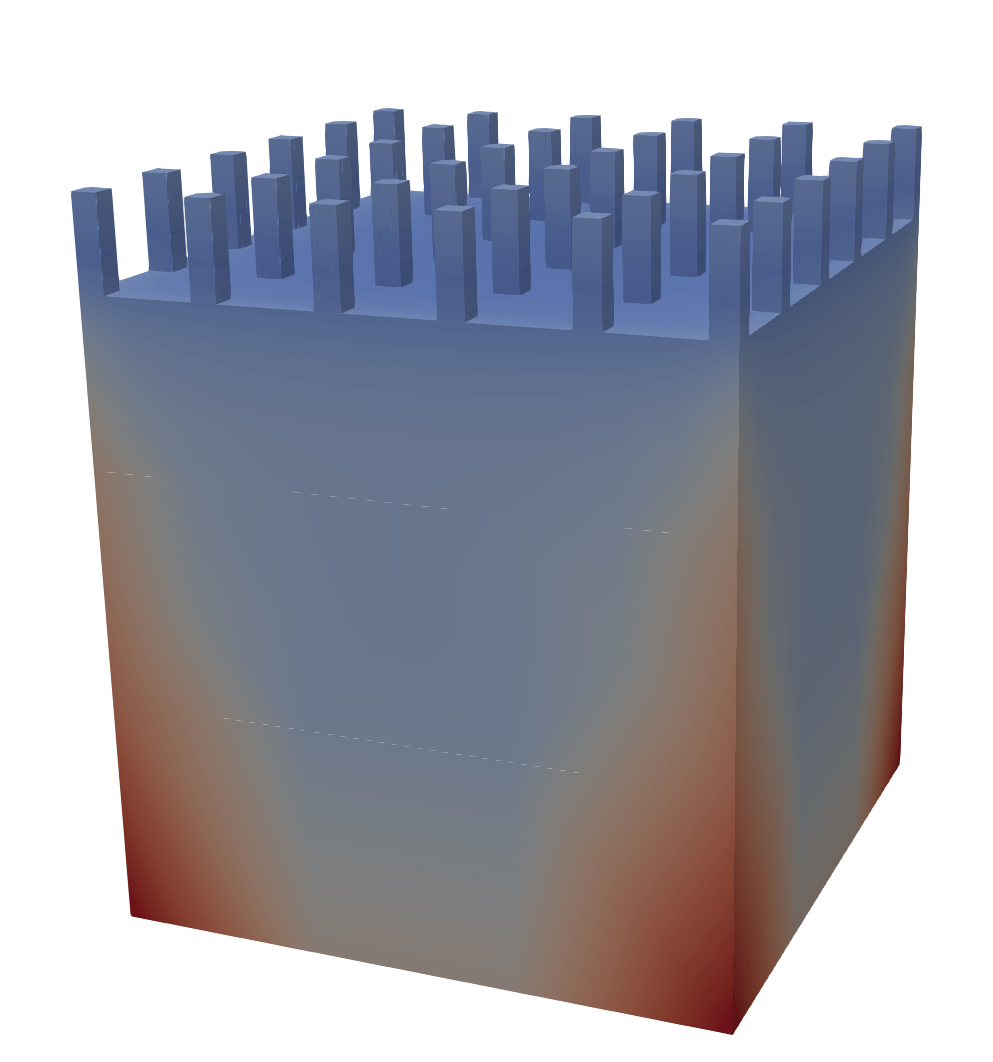
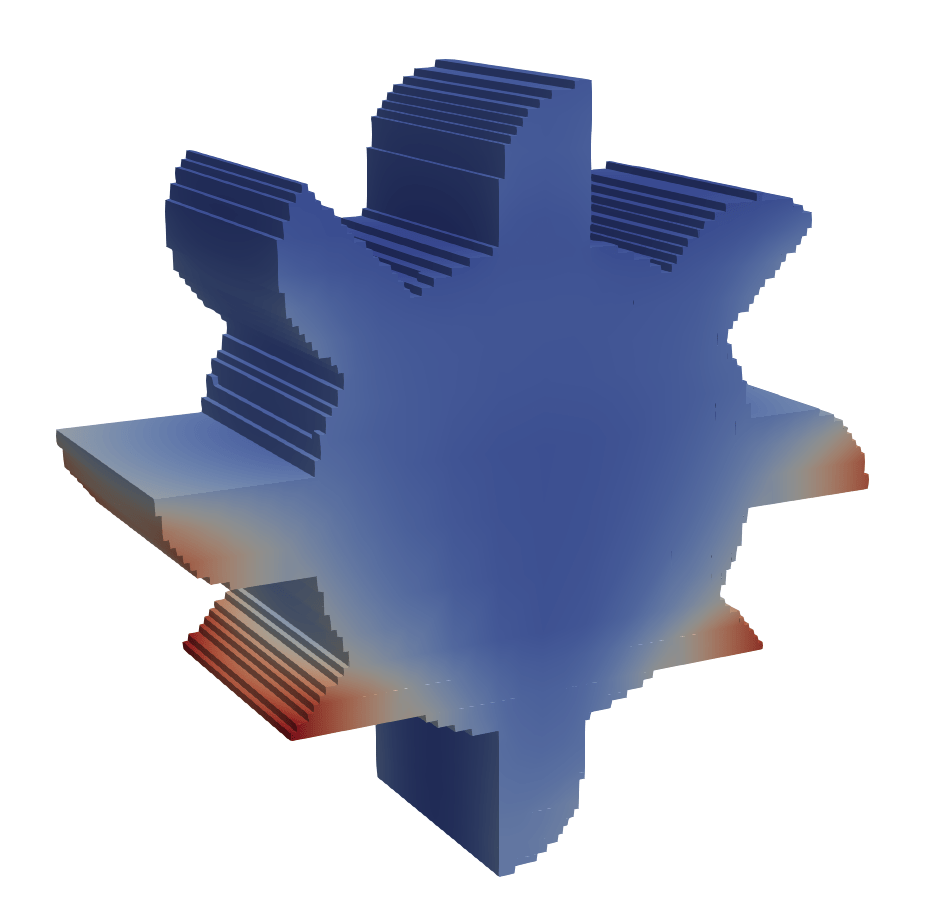
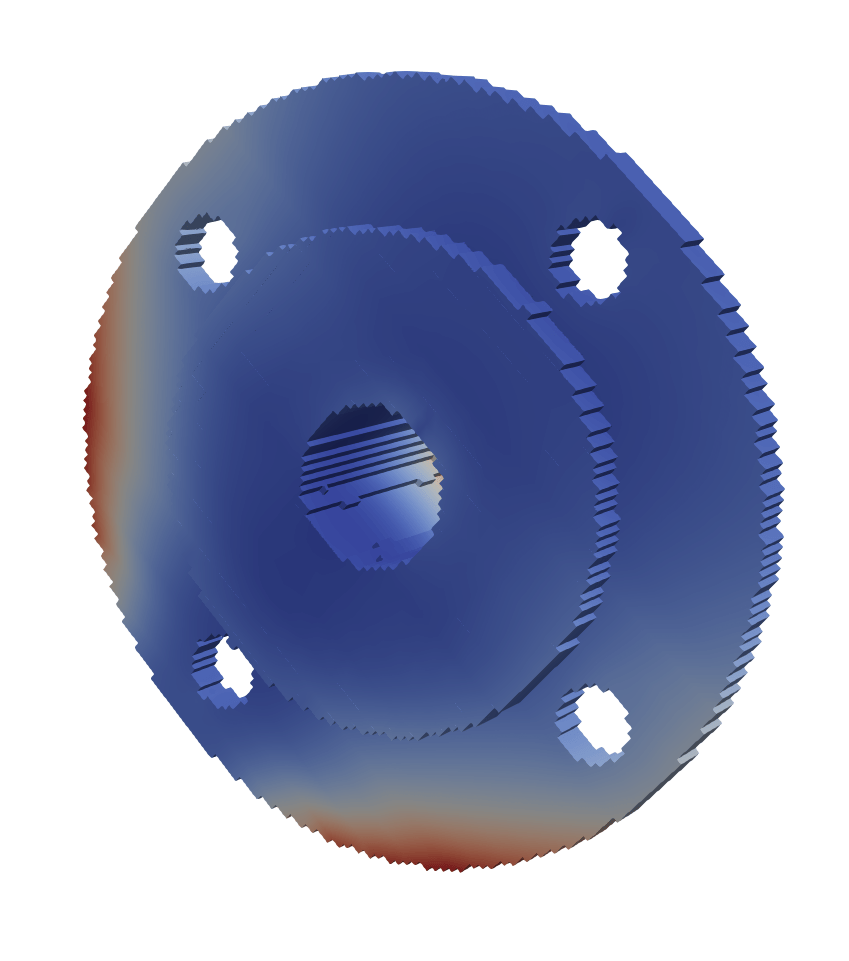
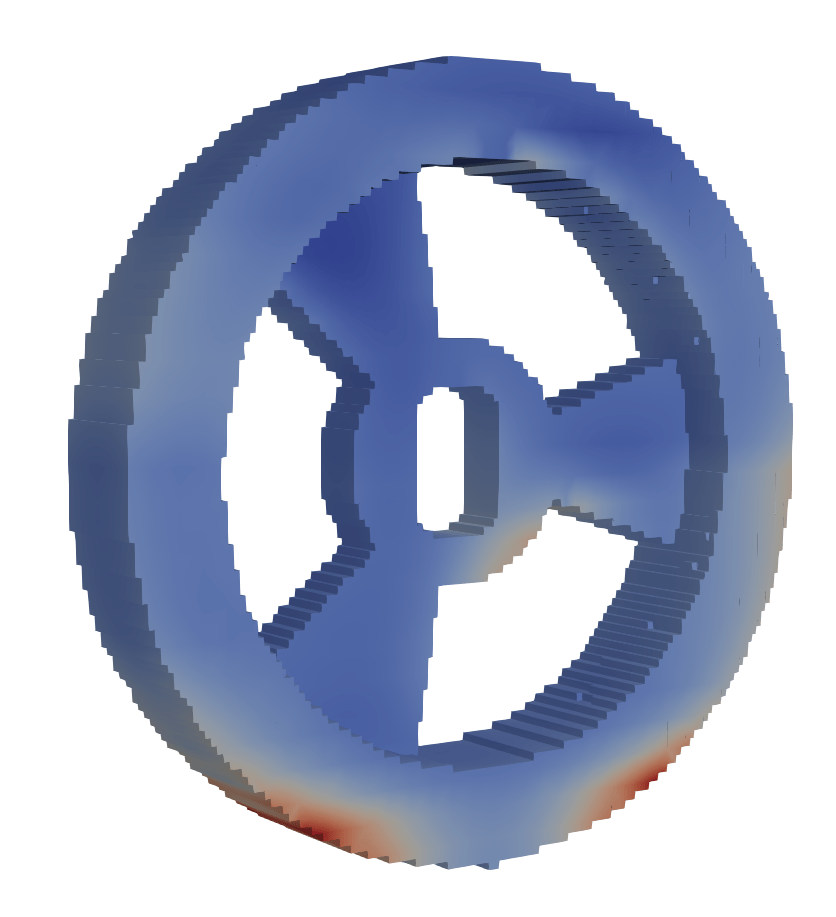
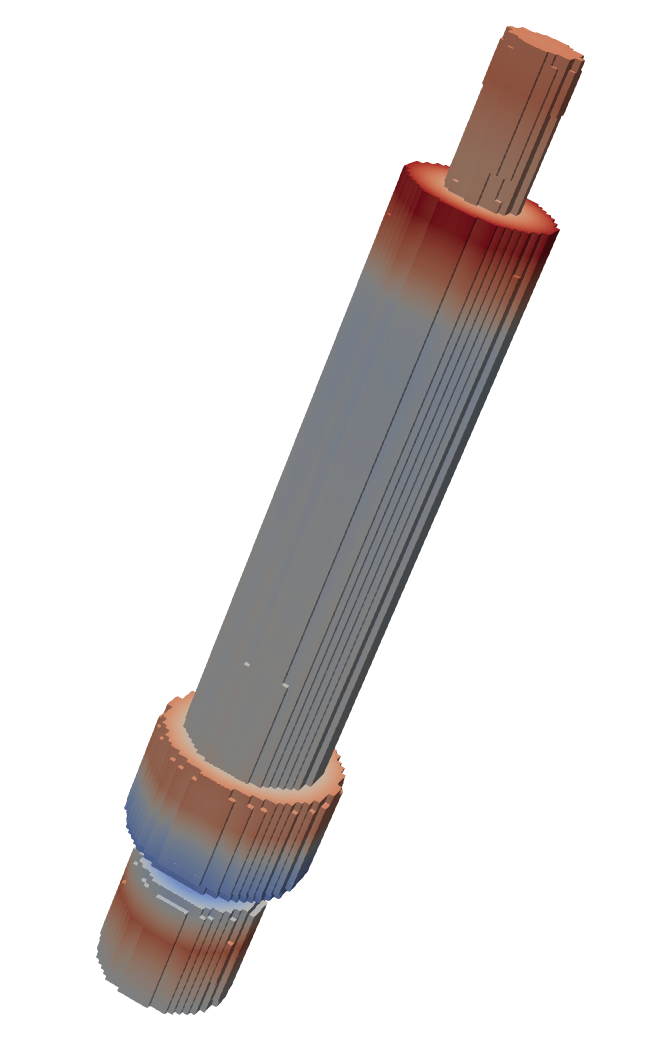
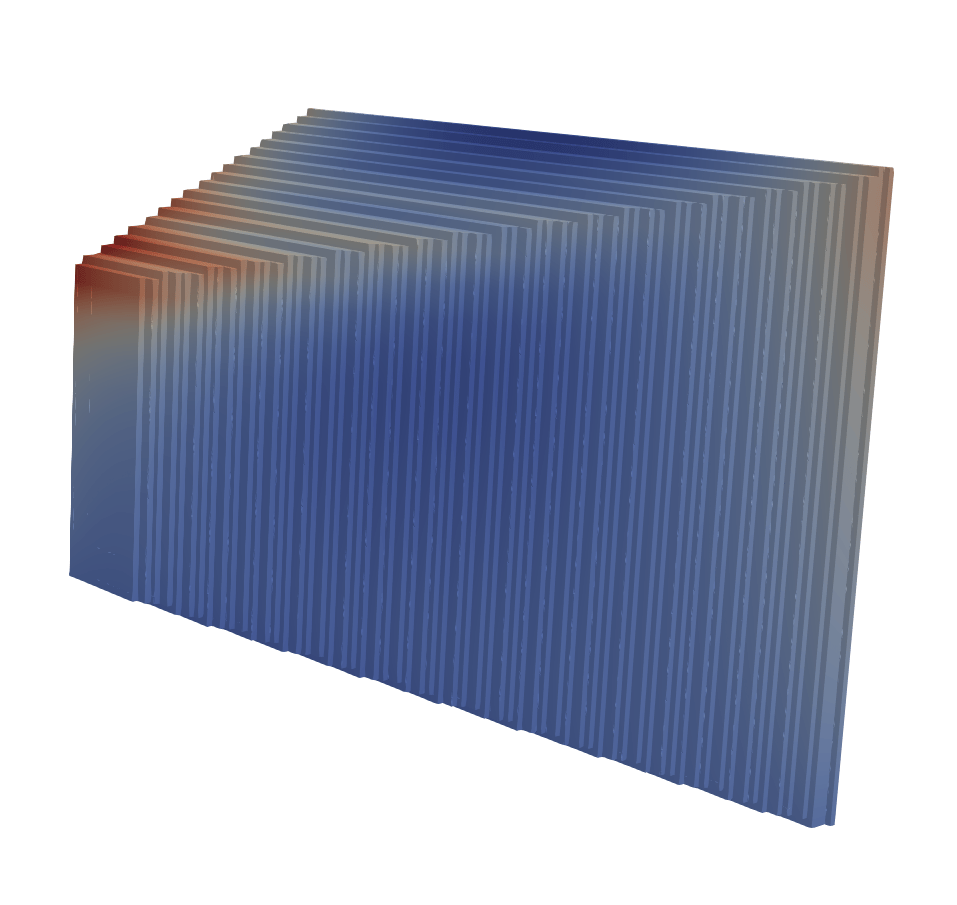
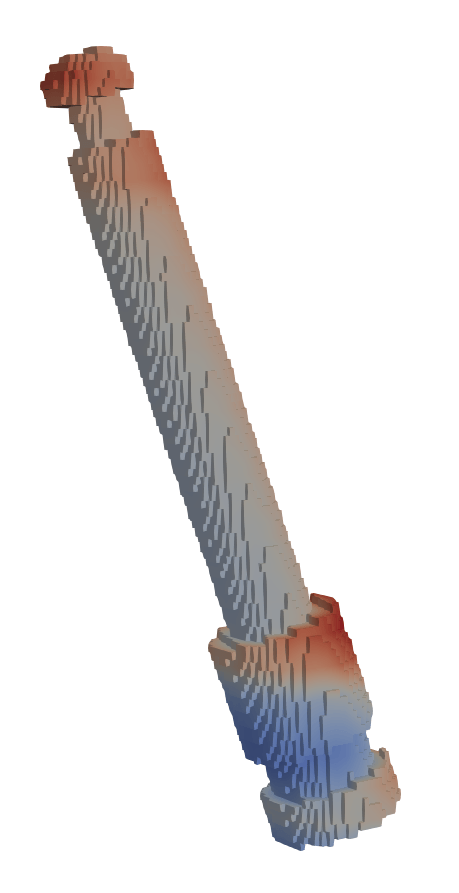
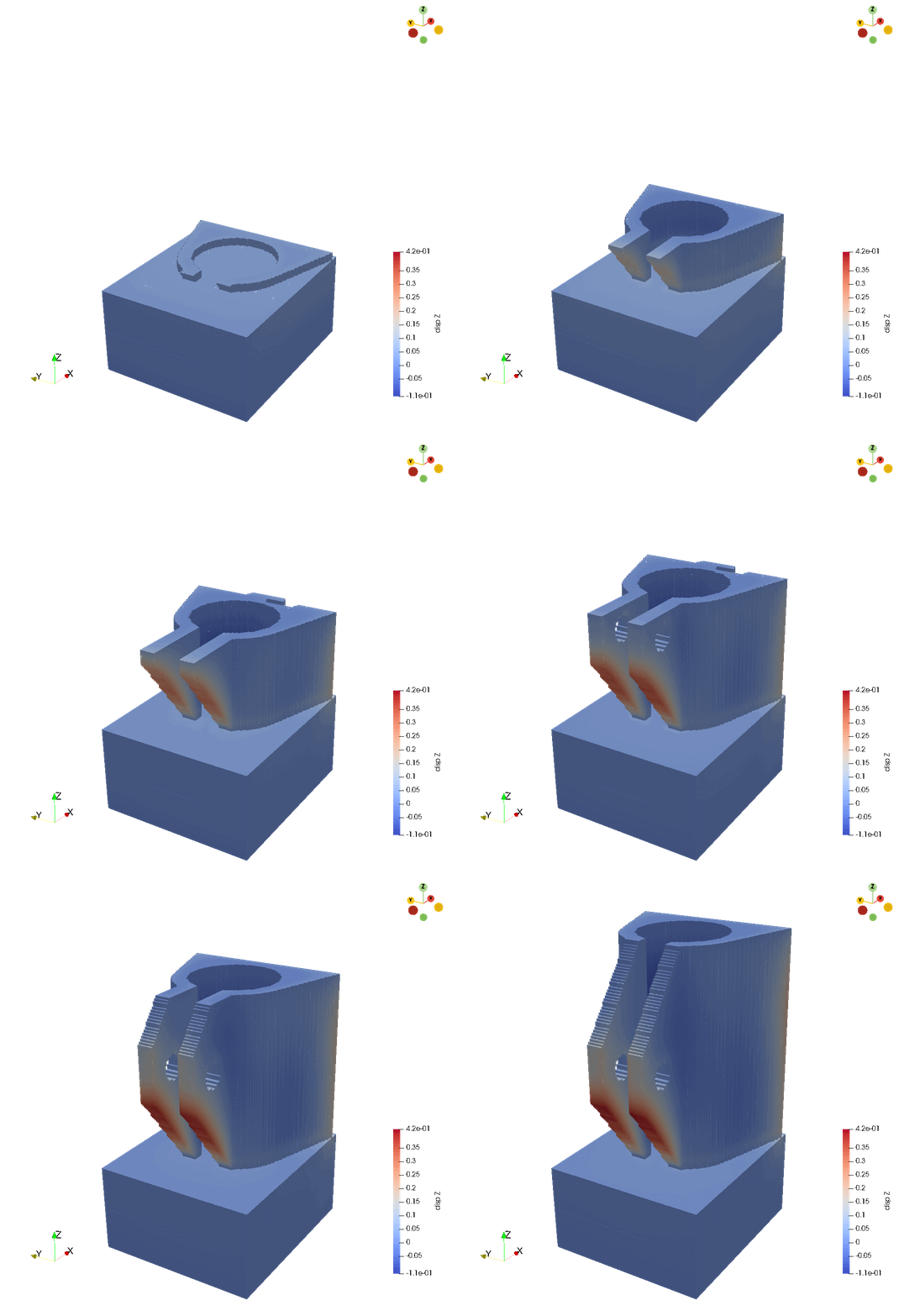
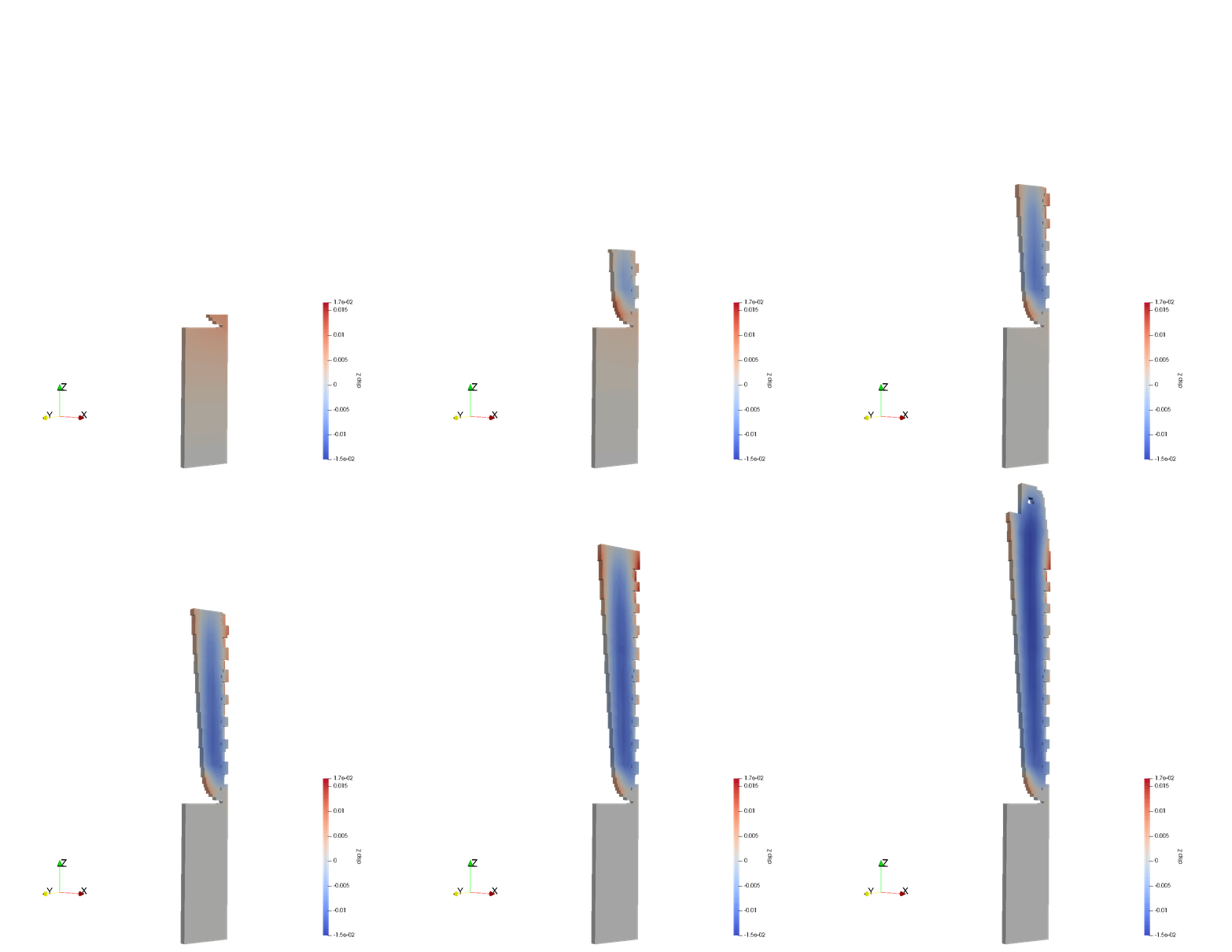
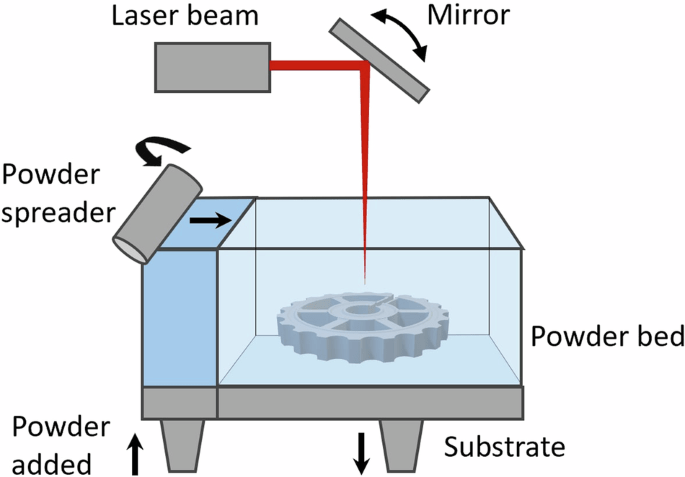
Laser Powder Bed Fusion (LPBF)
Dataset of 20k LPBF calculations
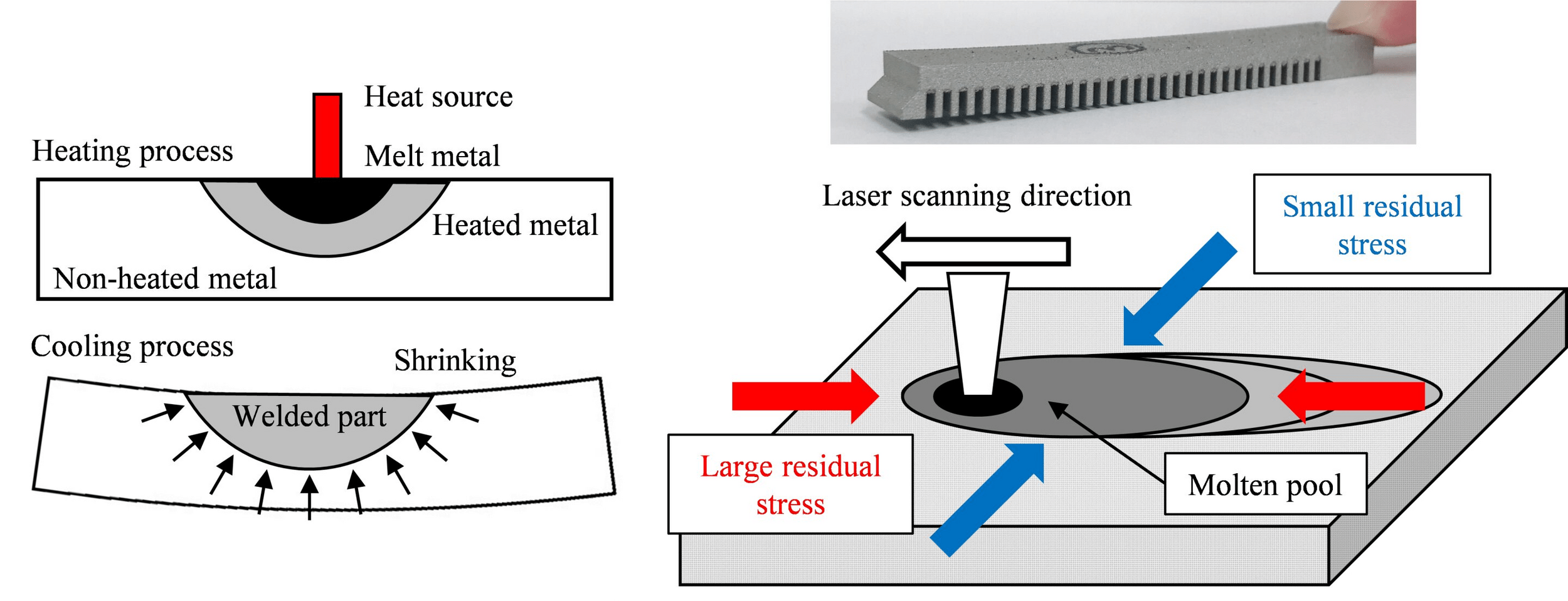
Goal: develop fast surrogate model to predict warpage during build
Governing equations
End results could be deployed as a valuable design tool for metal AM.
28
[1]
[2]
[1] Nature Scientific Data — High-resolution dataset (2025)
[2] TechXplore — “Synergetic optimization reduces residual warpage in LPBF” (2022)
Proposed aims
Aim 1: Advance FLARE for enhanced surrogate modeling
29
Aim 2: Develop decoder version of FLARE
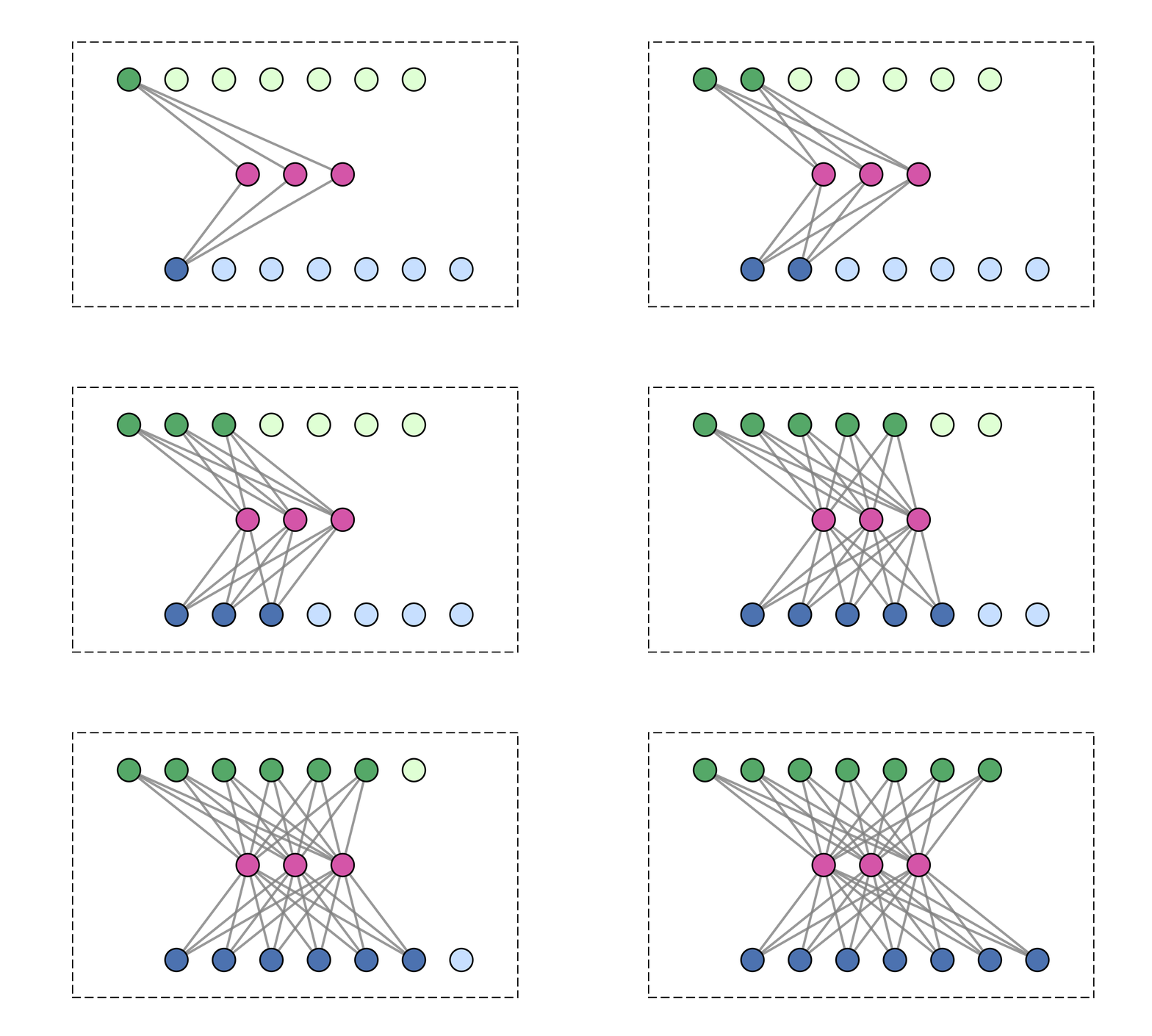
AIM 1(a): rank-adaptive FLARE
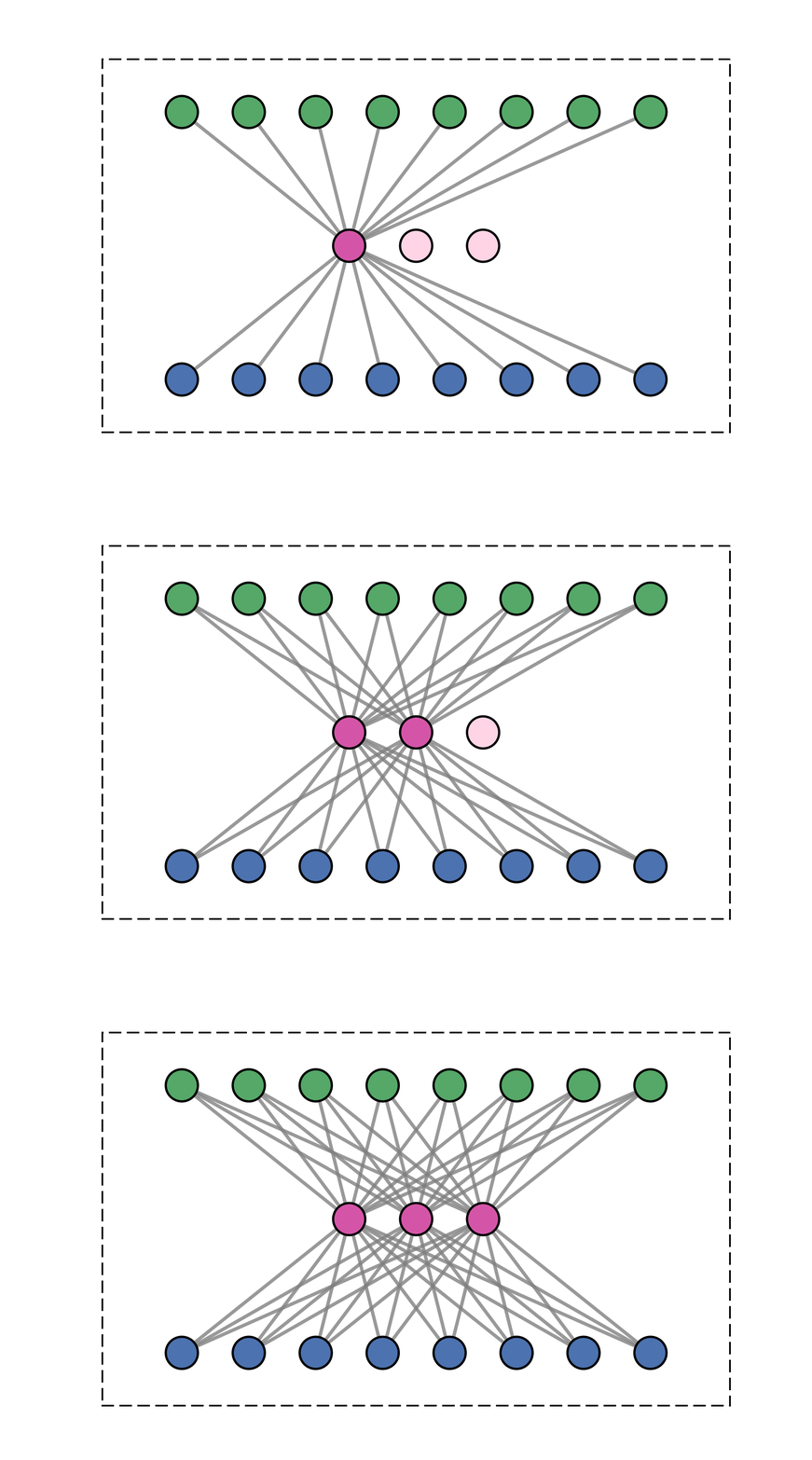
AIM 1(b): conditioning mechanism for FLARE
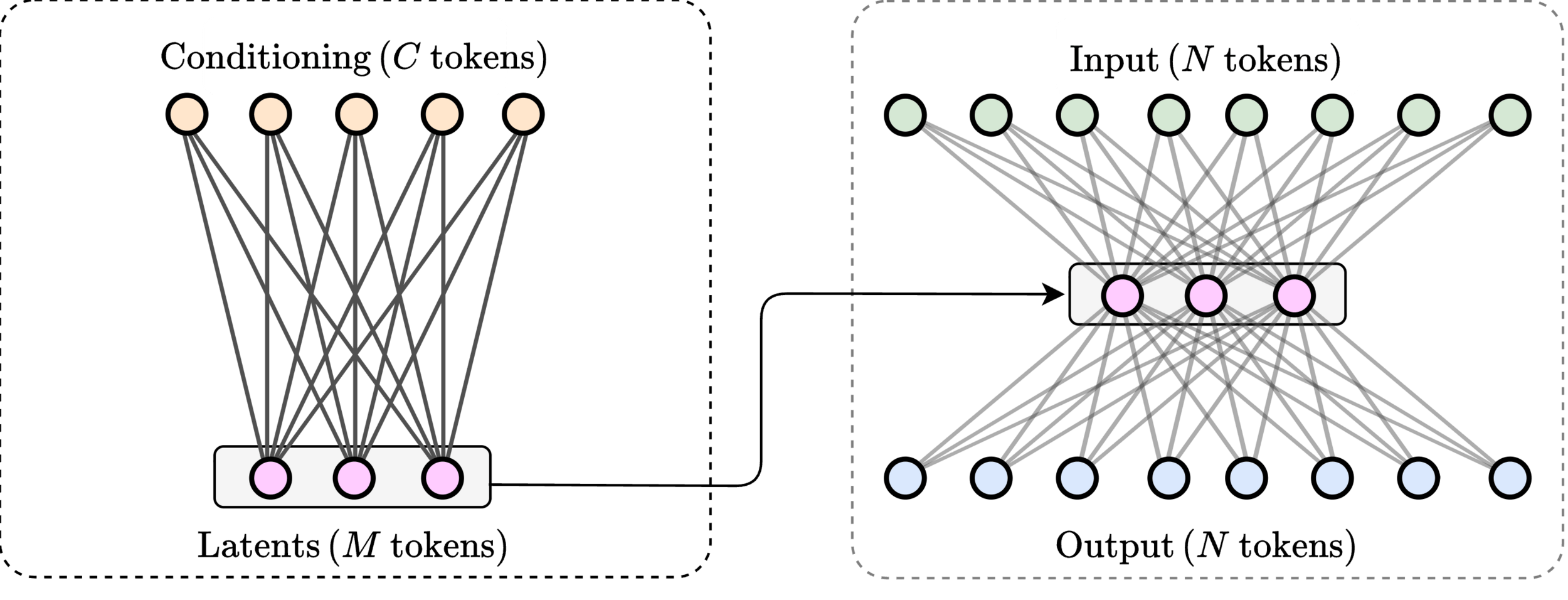
AIM 1: advance FLARE for enhanced surrogate learning
AIM 1(a): rank-adaptive FLARE for faster training
30
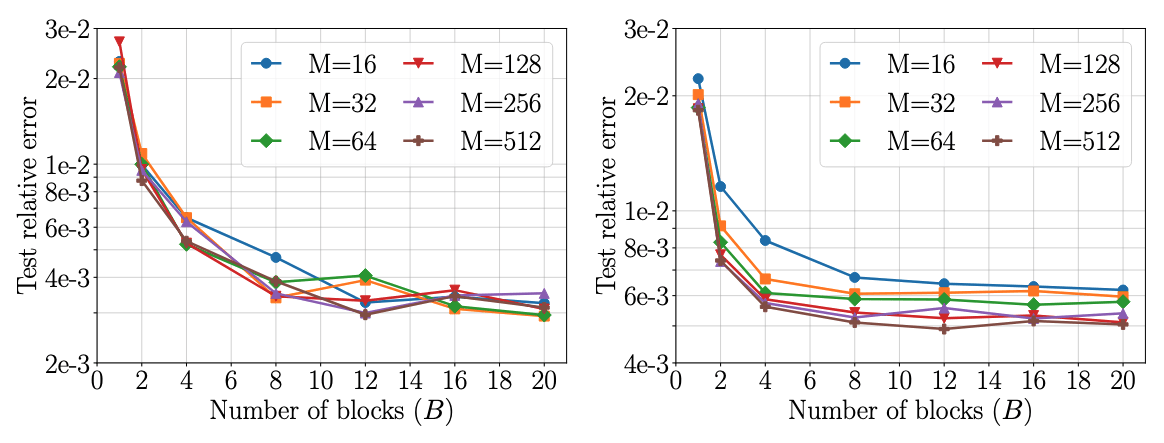
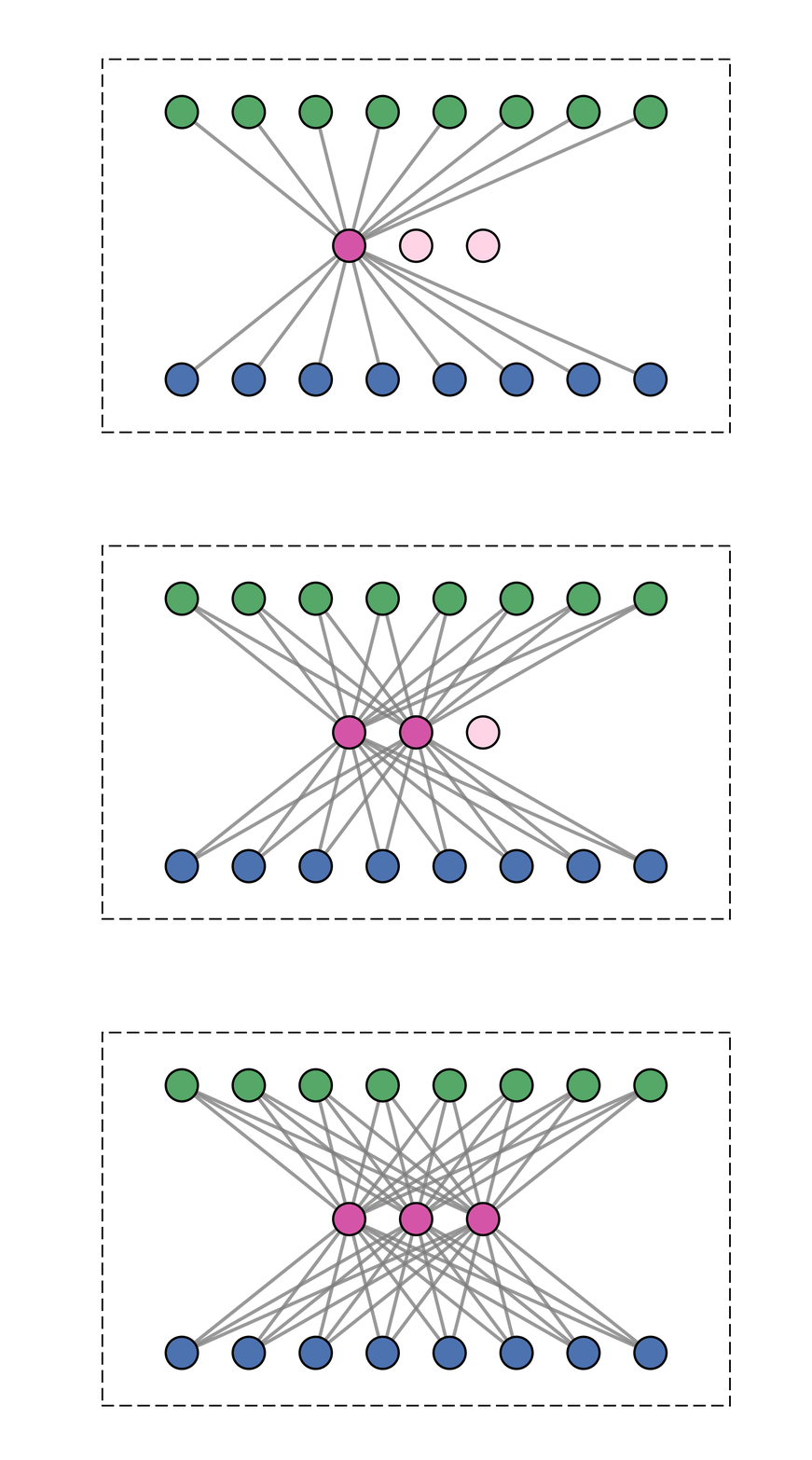
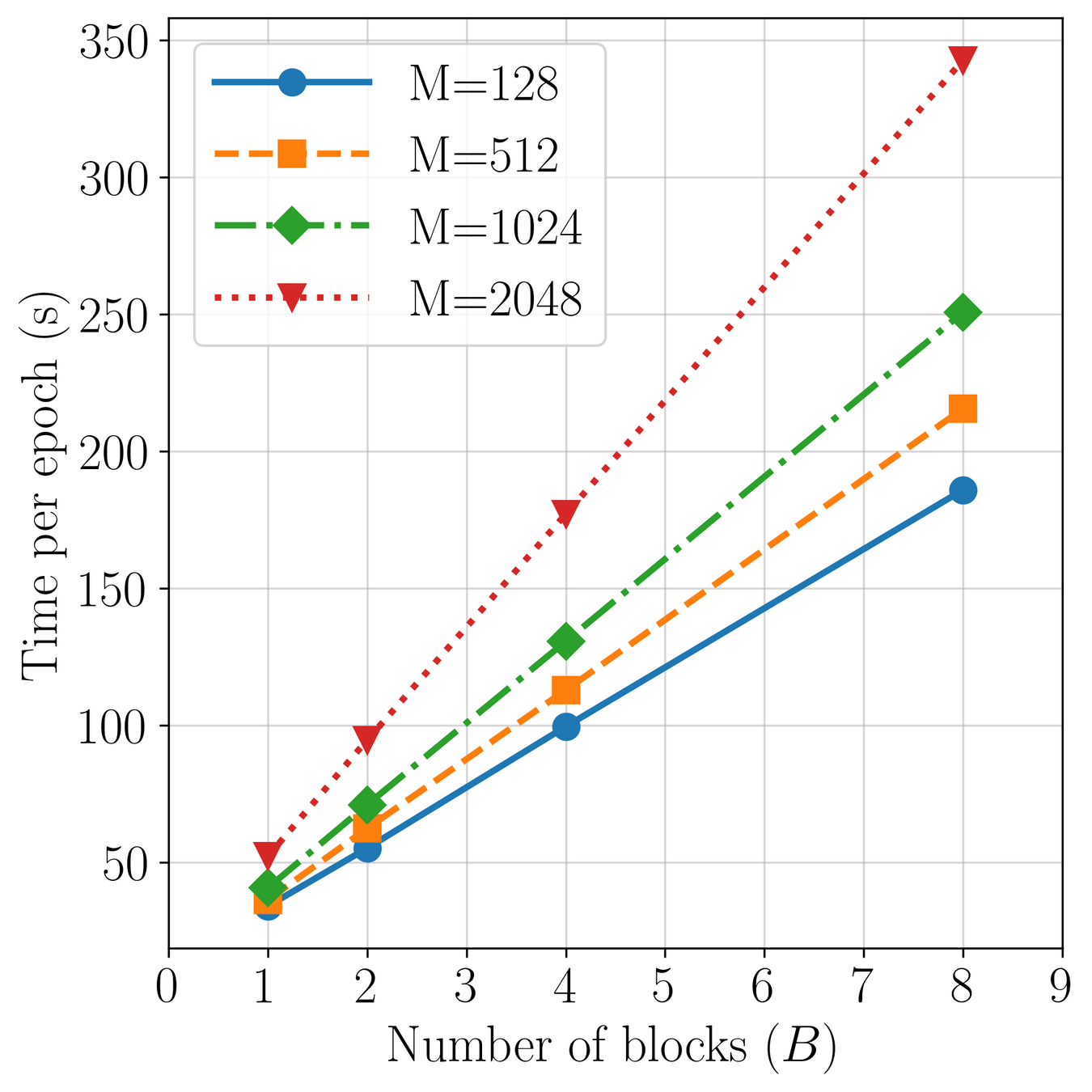
Complexity scales with latents (\(M\)): \(\mathcal{O}(2MN)\)
Accuracy increases with \(M\)
Method: progressively increase latents (\(M\)) through training.
Challenge: Minimize loss spikes, training instabilities.
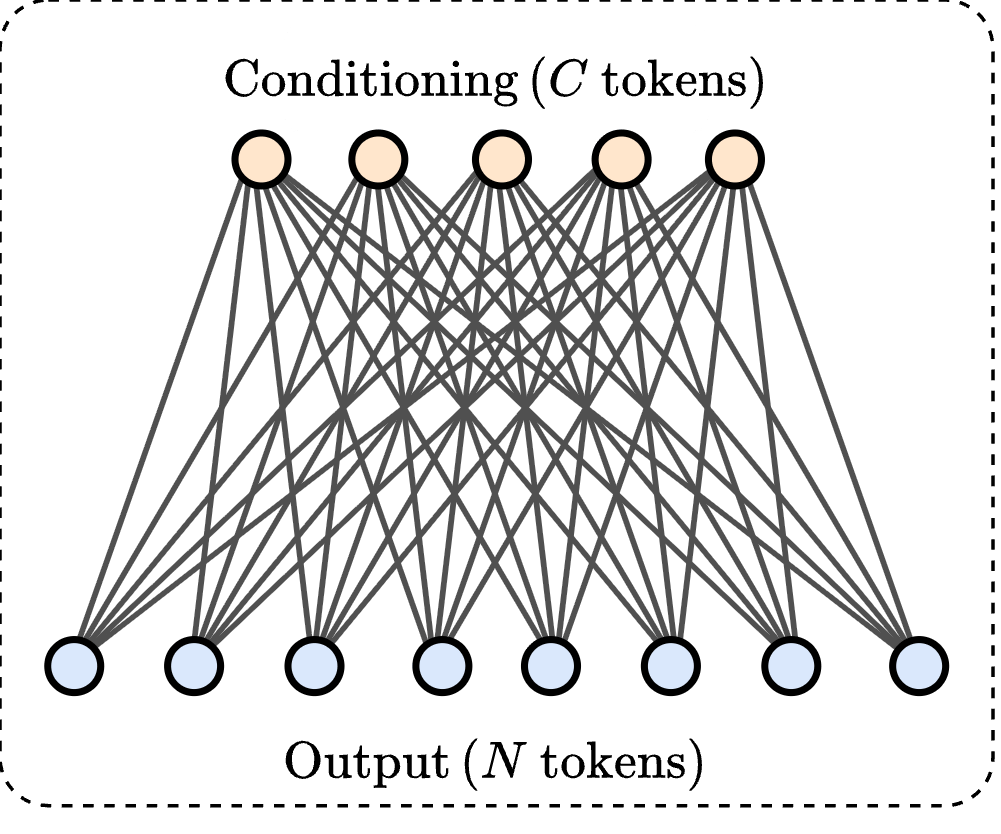
Aim 1(b) background on conditioning in transformers
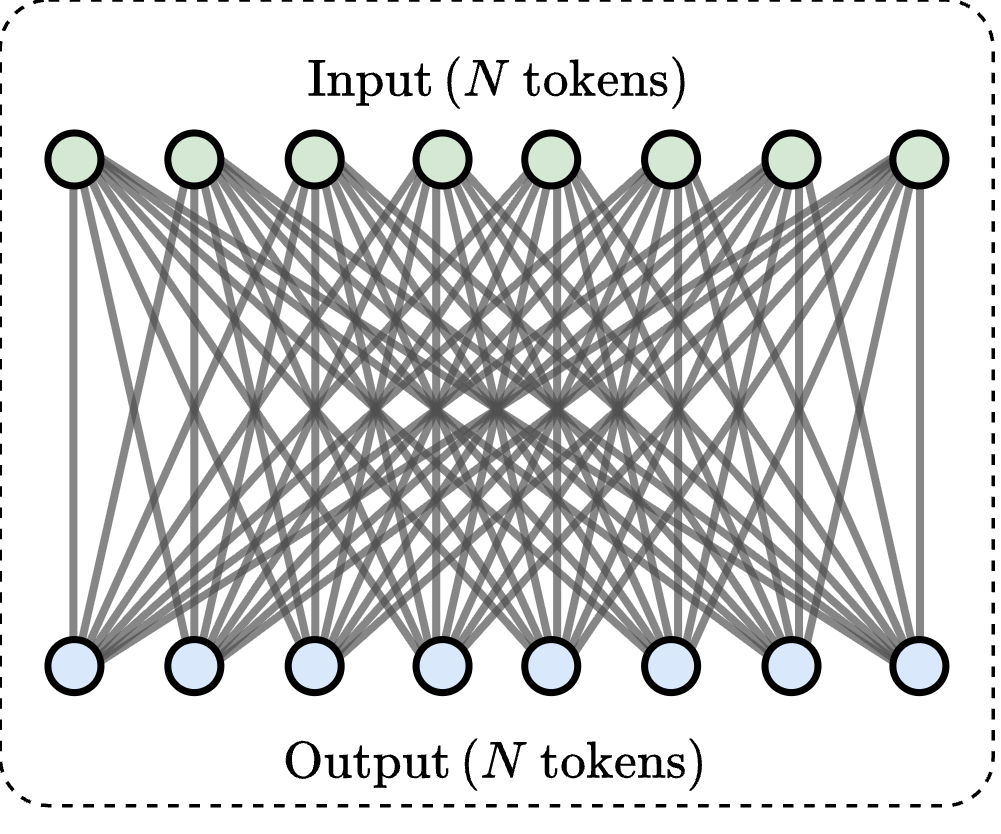
Token mixing [1] (\(\mathcal{O}(N^2)\))
Conditioning [1] (\(\mathcal{O}(N\cdot C)\))
Token mixing
Token mixing
Conditioning
31
[1] Vaswani et al. — “Attention Is All You Need”, NeurIPS 2017
Key idea: Modulate token-mixing with conditioning tokens
Cross FLARE
32
Aim 1(b) conditioning mechanism for FLARE
We propose to handle token mixing and conditioning in one unified block
\(\mathcal{O}(2MN + MC) \) complexity
Aim 2: background on next-token prediction transformers [1]
All previous key/value \(\{k_\tau, v_\tau \}_{\tau \leq t}\) must be cached on the GPU.
Major memory and latency bottleneck!
33
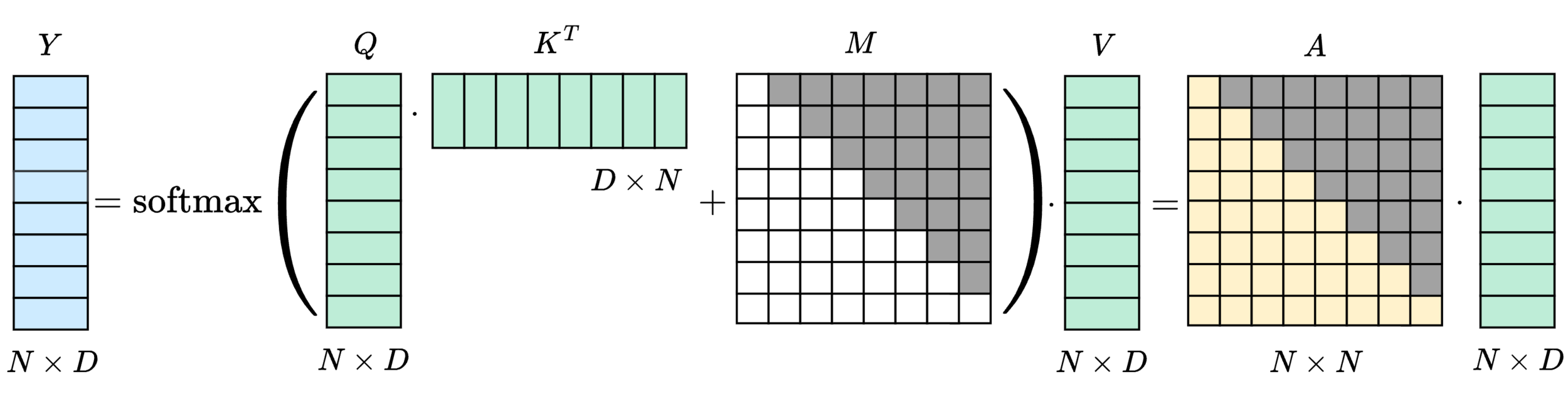
[1] Vaswani et al. — “Attention Is All You Need”, NeurIPS 2017
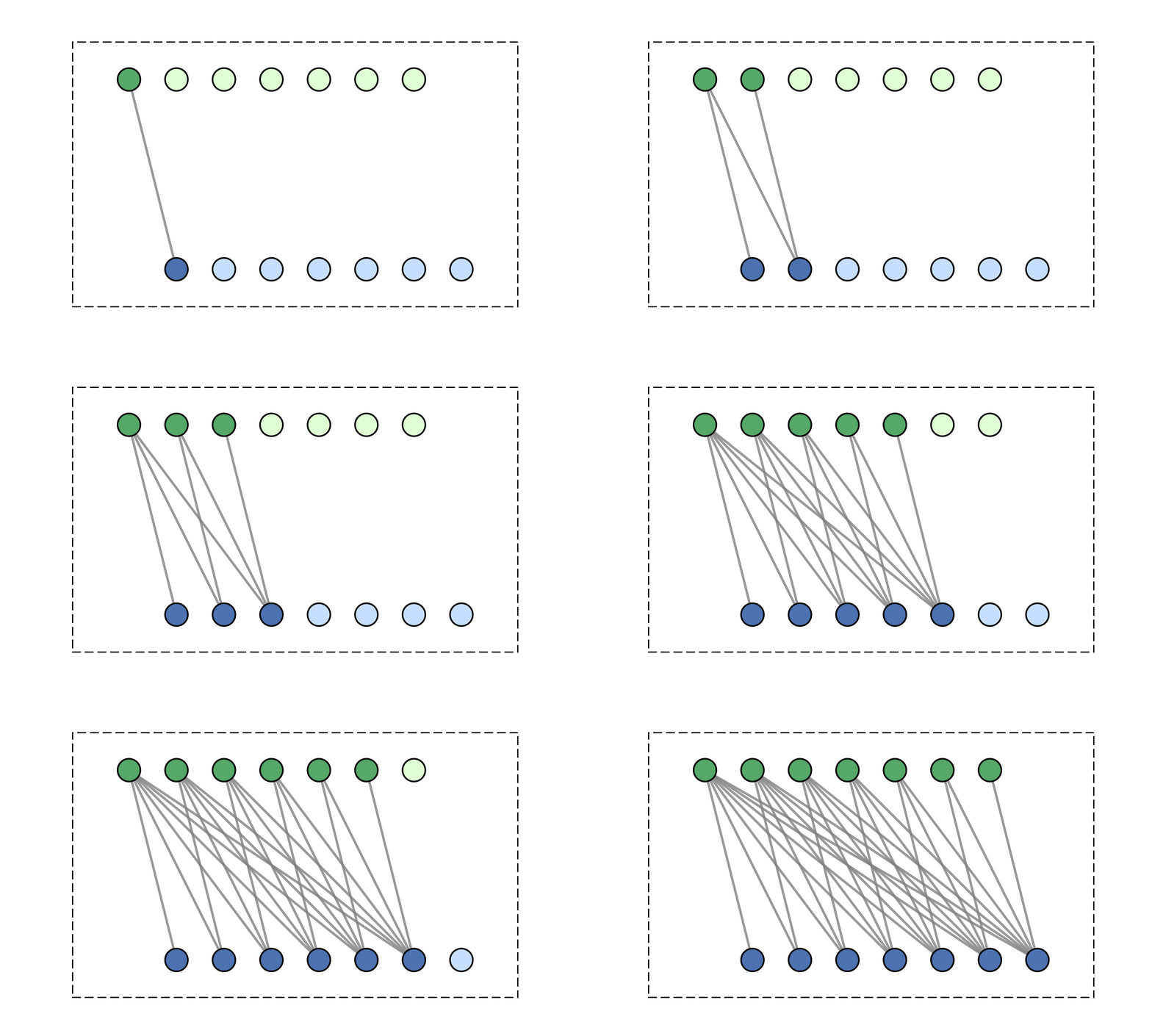
Training algorithm (causal masking)
Inference algorithm (recurrence relation)
Dot-products need to be recomputed for every \(q_t\).
\(\mathcal{O}(N^2)\) complexity.
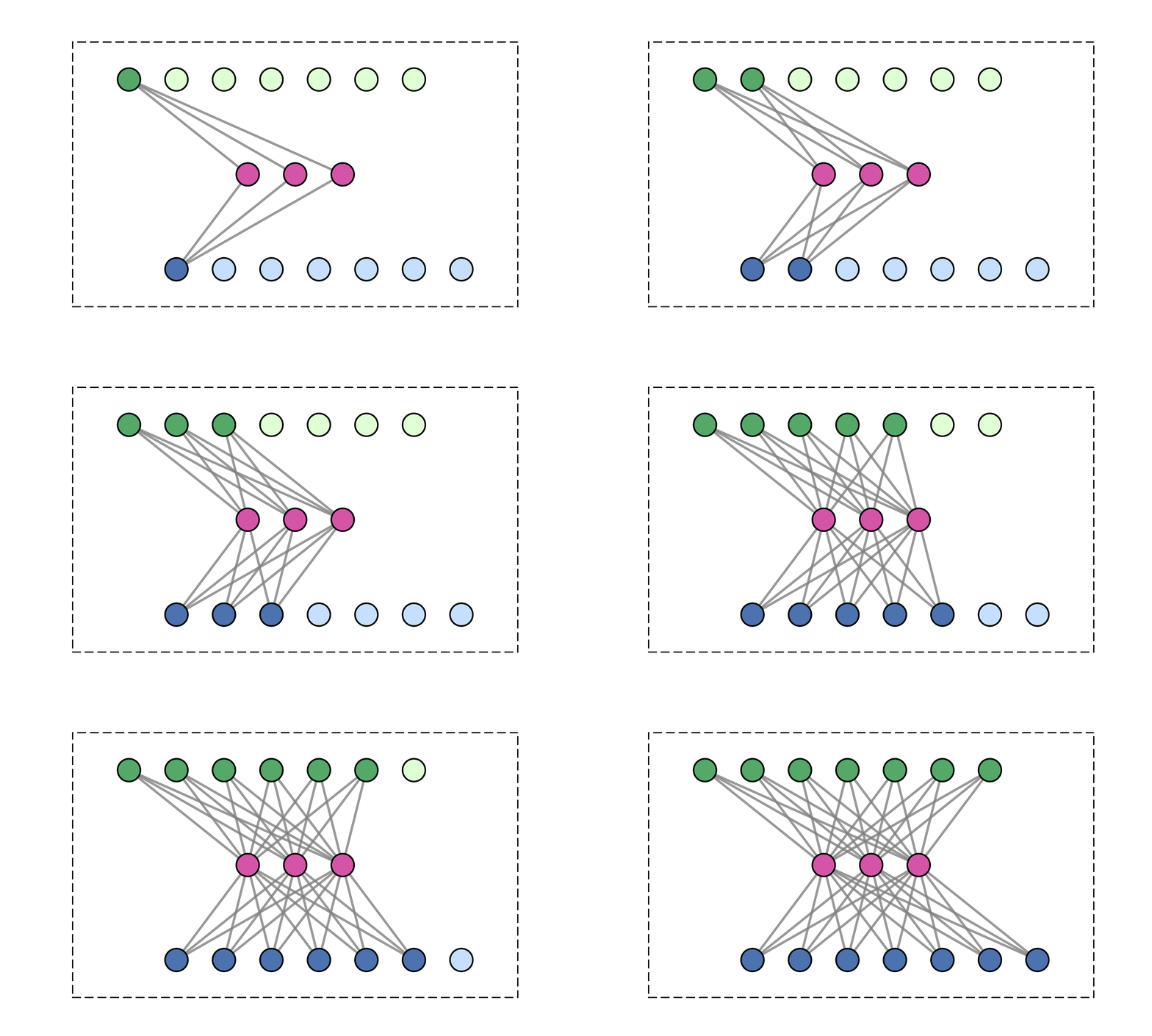
Aim 2: Develop decoder version of FLARE
Linear time auto-regressive attention.
Fixed memory footprint (only store \(\mathcal{O}(M)\) cache).
Flexible latent capacity.
Advantages
Required components
Fused GPU kernels for training and inference.
Bespoke training algorithm for causal FLARE.
Extensive benchmarking and evaluation.
34
Inference algorithm (recurrence rule)
Next-token prediction with FLARE
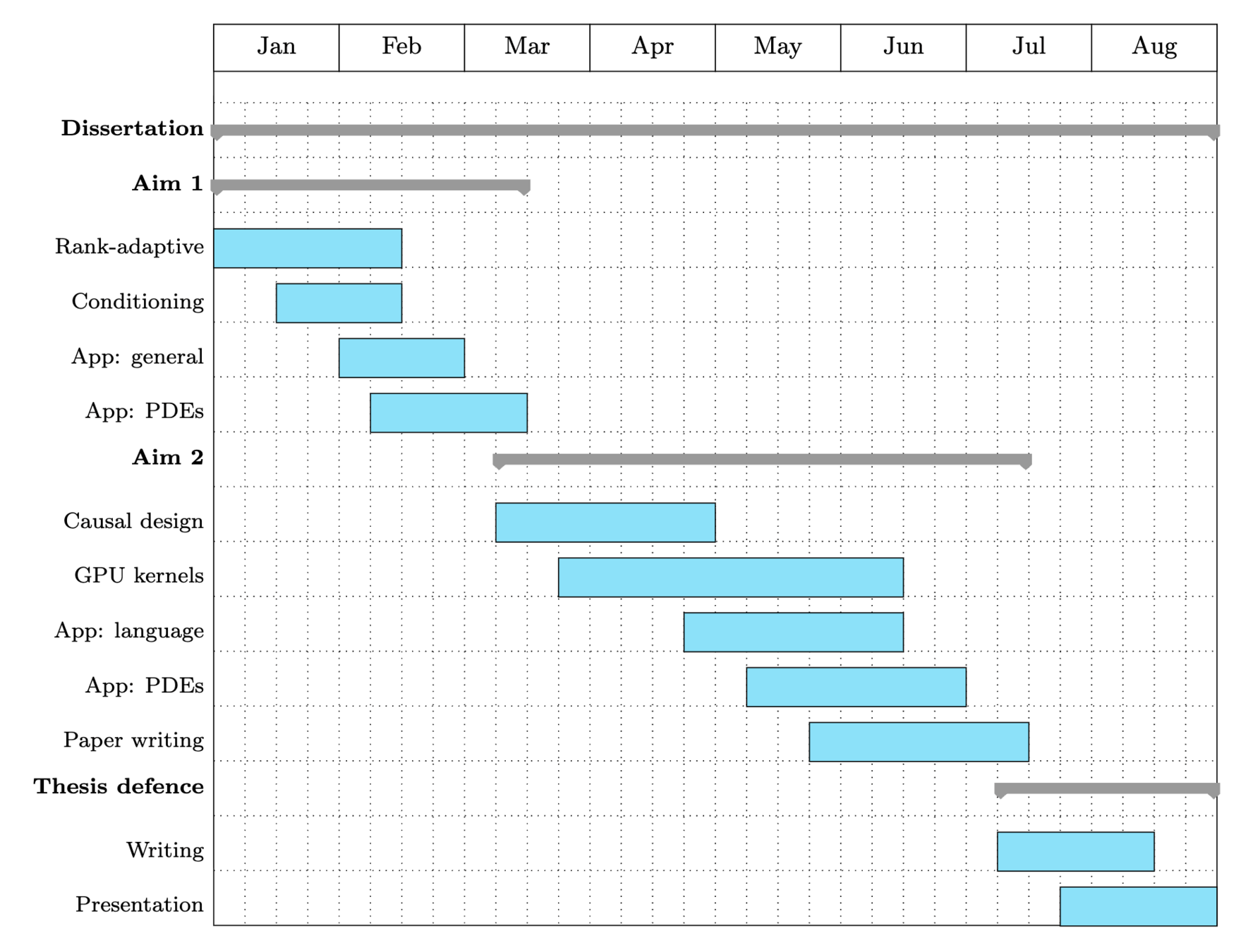
Proposed timeline
Expected graduation: Summer 2026
35
Summary of this dissertation
PDE Surrogates
Fast and accurate latent space traversal in neural ROMs
Scalable and accurate self attention mechanism
Neural ROMs
(Planned) Transient PDE surrogates
Flexible and scalable cross-attention mechanism
Efficient and flexible decoder model.
36
Publications
- Shankar, Varun, Vedant Puri, Ramesh Balakrishnan, Romit Maulik, and Venkatasubramanian Viswanathan. "Differentiable physics-enabled closure modeling for Burgers’ turbulence." Machine Learning: Science and Technology 4, no. 1 (2023): 015017.
-
Puri, Vedant, Aviral Prakash, Levent Burak Kara, and Yongjie Jessica Zhang. "SNF-ROM: Projection-based nonlinear reduced order modeling with smooth neural fields." Journal of Computational Physics 532 (2025): 113957.
-
Puri, Vedant, Aditya Joglekar, Kevin Ferguson, Yu-hsuan Chen, Yongjie Jessica Zhang, and Levent Burak Kara. "FLARE: Fast Low-rank Attention Routing Engine." arXiv preprint arXiv:2508.12594 (2025).
-
(In preparation)
37
Thank you
Questions?
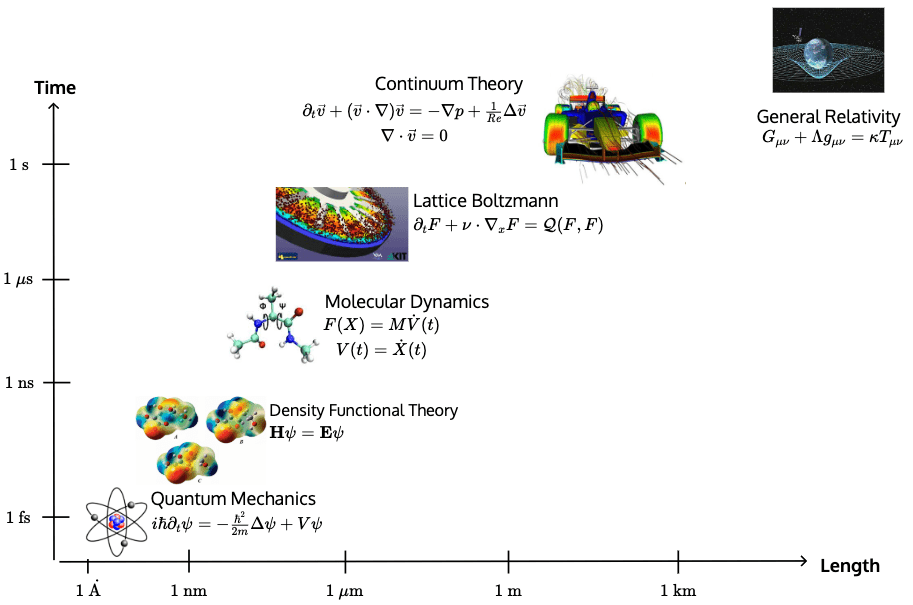
Machine learning dominates several fields of scientific discovery
Enhancing PDE solvers with ML
Landscape of ML for PDEs
Mesh ansatz
PDE-Based
Neural Ansatz
Data-driven
FEM, FVM, IGA, Spectral
Fourier Neural Operator
Neural Field
DeepONet
Physics Informed NNs
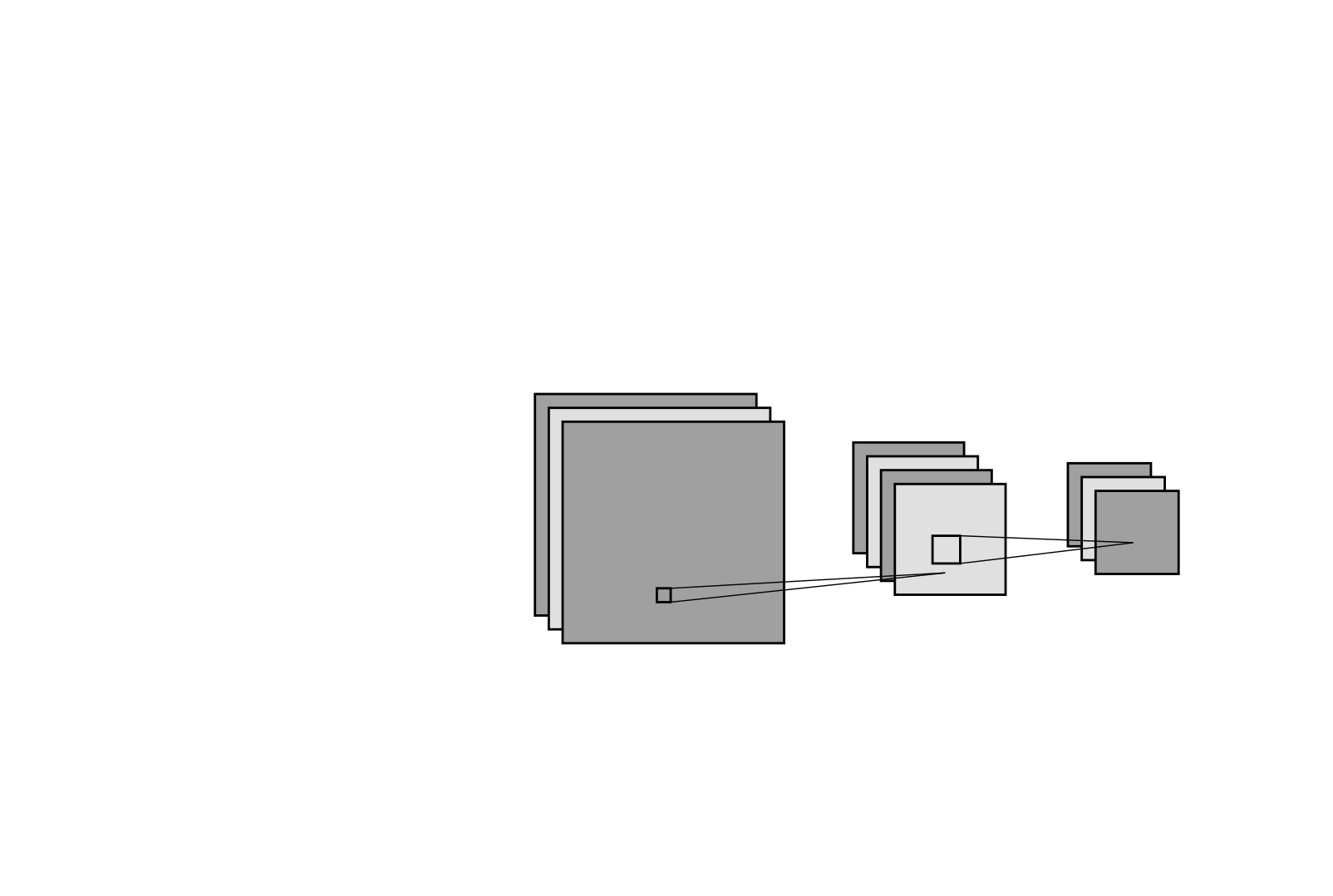
Convolution NNs
Graph NNs
Adapted from Núñez, CEMRACS 2023
Neural ODEs
Universal Diff Eq
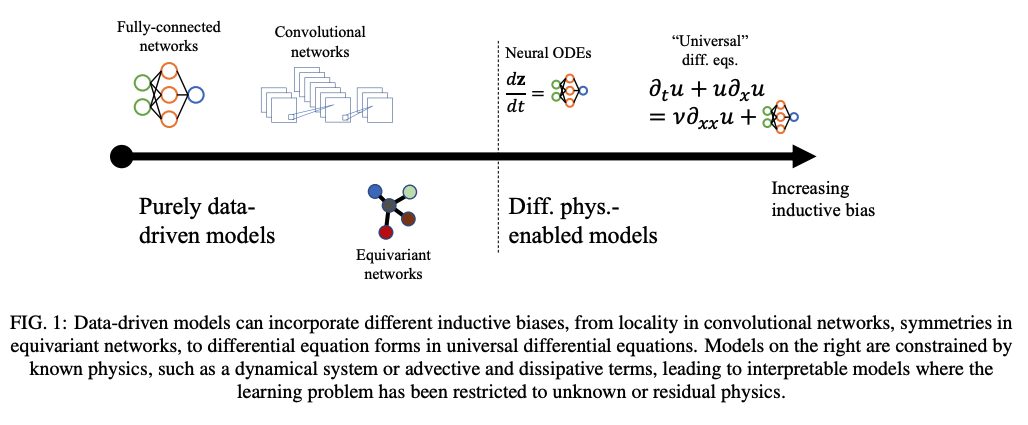
Reduced Order Modeling
Enhancing PDE solvers with ML
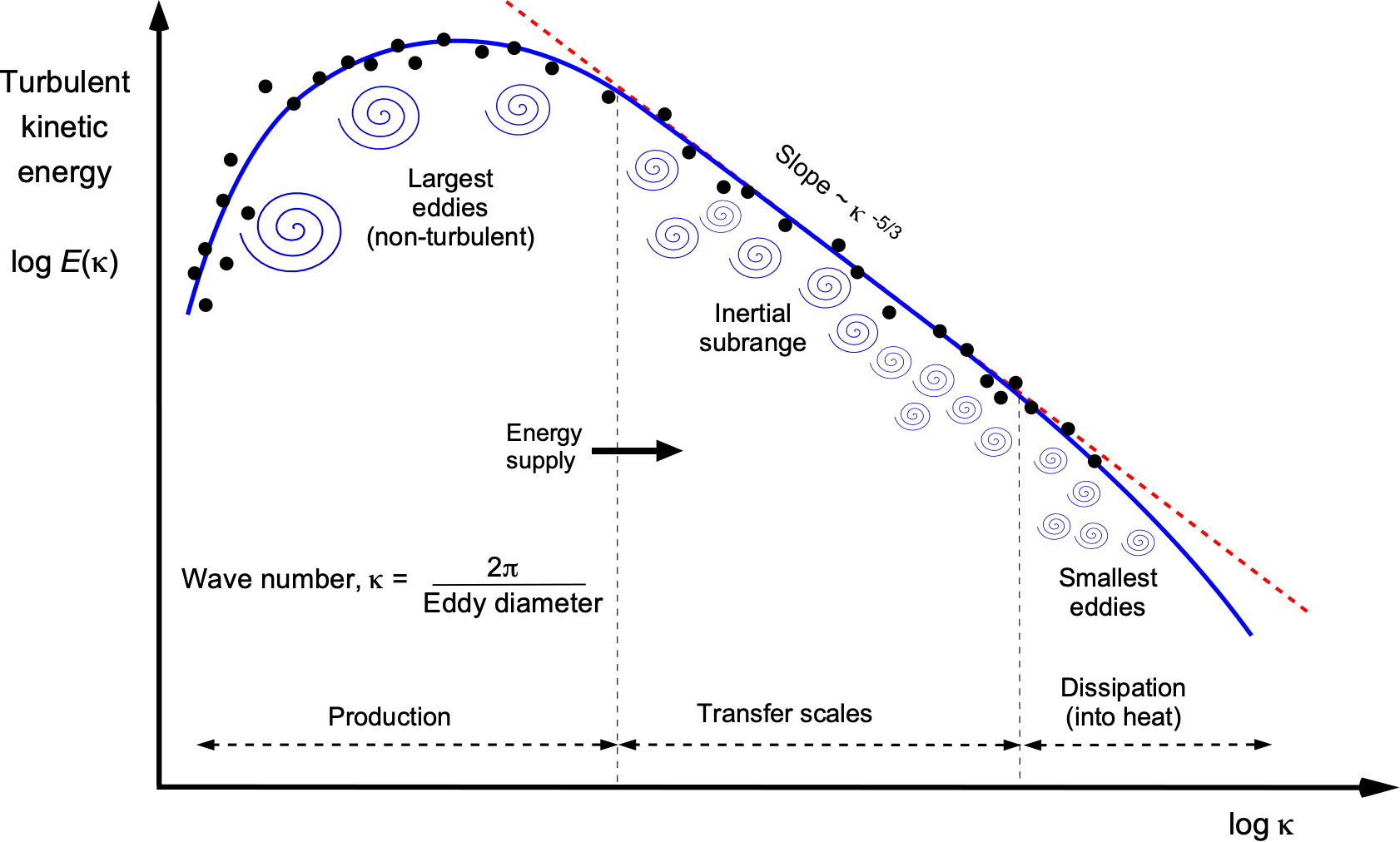
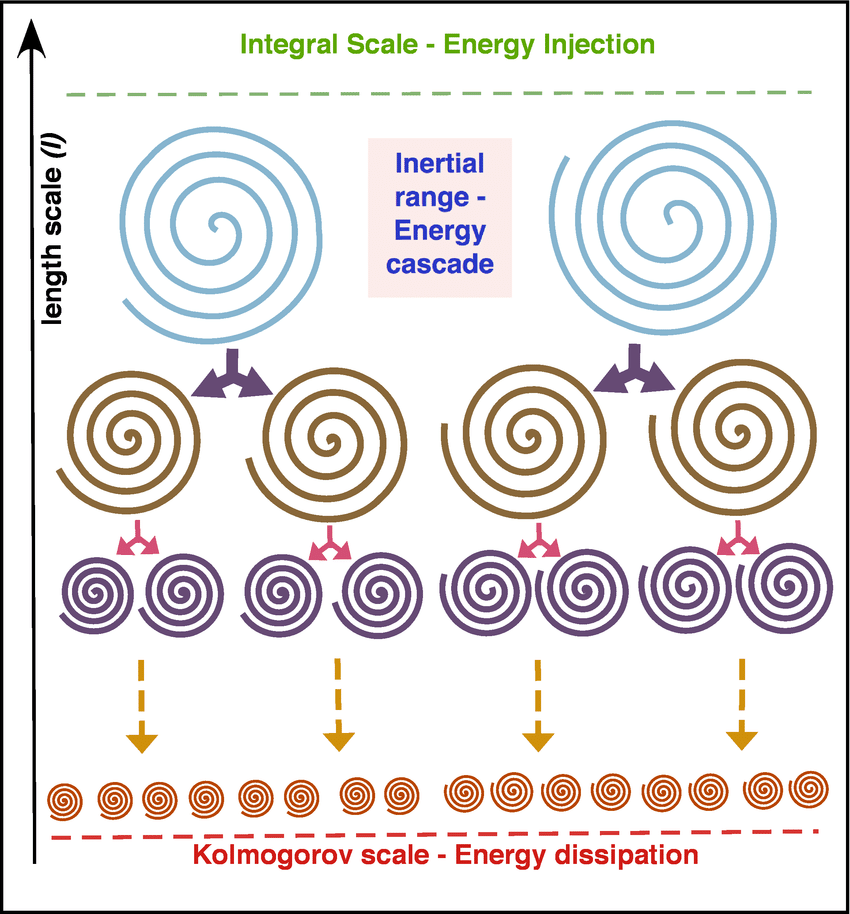
Newsflash: Neural signal representations beats the curse of dimensionality-ish
| Orthogonal Functions | Deep Neural Networks |
|---|---|
|
|
|
|
|
|
|
|
\( N \) parameters, \(M\) points
\( h \sim 1 / N \) (for shallow networks)
\( N \) points
\( \dfrac{d}{dx} \tilde{f}\sim \mathcal{O}(N^2) \) (exact)
\( \dfrac{d}{dx} \tilde{f} \sim \mathcal{O}(N) \) (exact, AD)
\( \int_\Omega \tilde{f} dx \sim \mathcal{O}(N) \) (exact)
(Weinan, 2020)
\( \int_\Omega \tilde{f} dx \sim \mathcal{O}(M) \) (approx)
Model size scales with signal complexity
Model size scales exponentially with dimension
\( N \sim h^{-d/c} \)
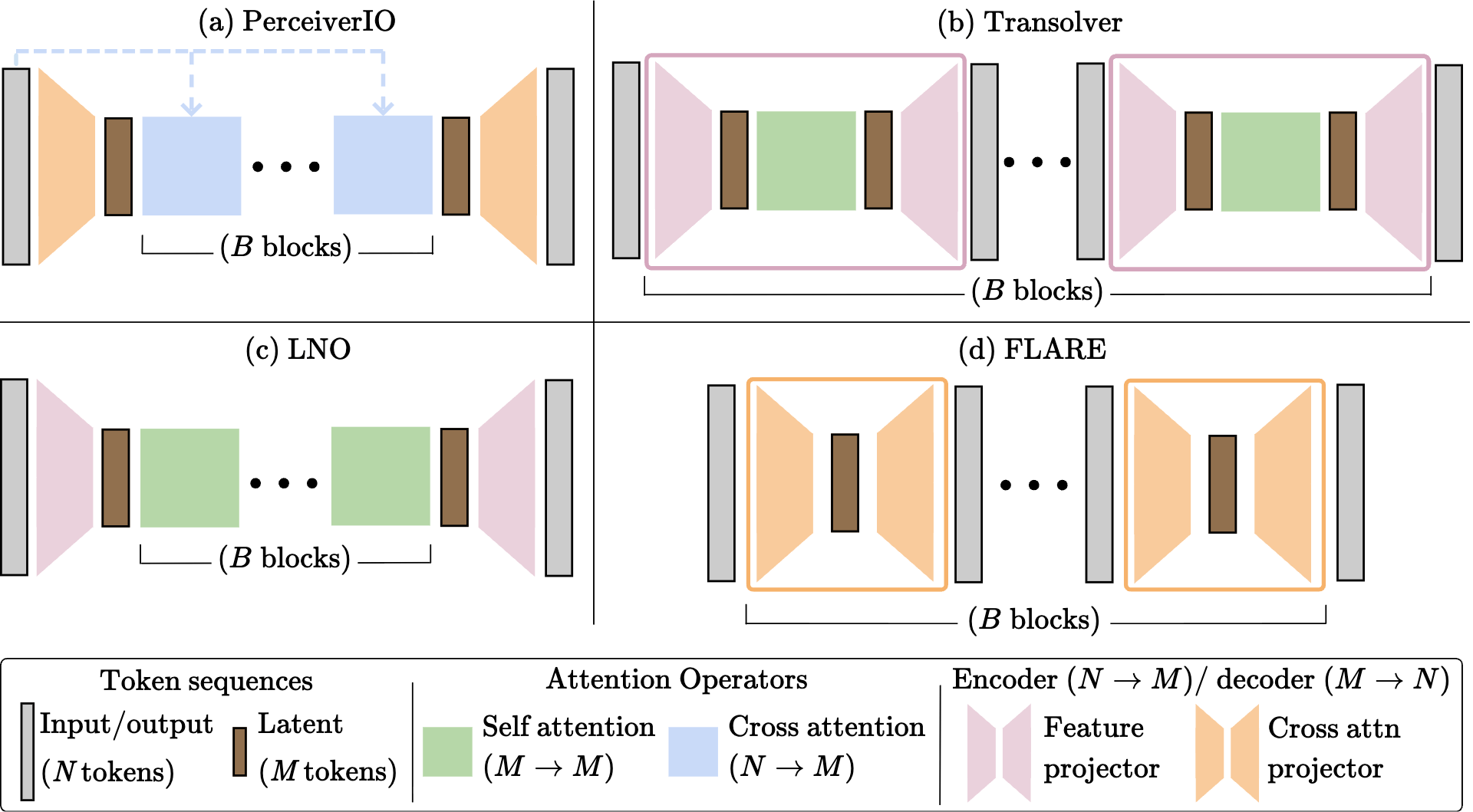
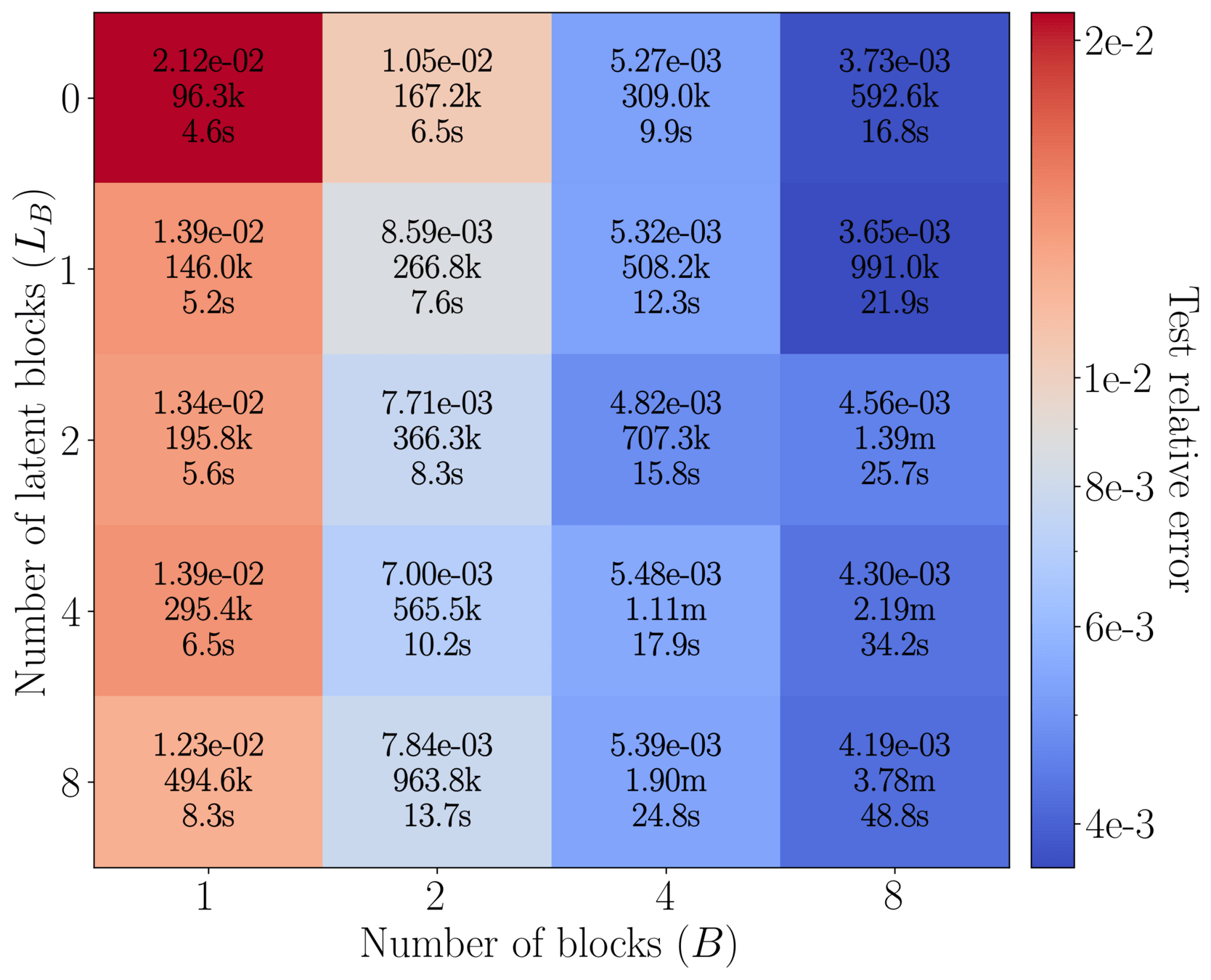
Efficient transformers models
Triple Attention or Multi-linear attention
FEATURES
- Considers N-tuples of tokens at a time.
- More expressive than standard attention, linear attention
- Easily parallelizable across multiple GPUs
- Kernel-based interpretation
- As efficient and accurate as FLARE (SOTA)
DEMONSTRATIONS
- Encoder transformer
- PDE Surrogate modeling, Long-range arena
- Decoder transformer
- Next-token prediction/ language modeling
Triple Attention Scaling Study
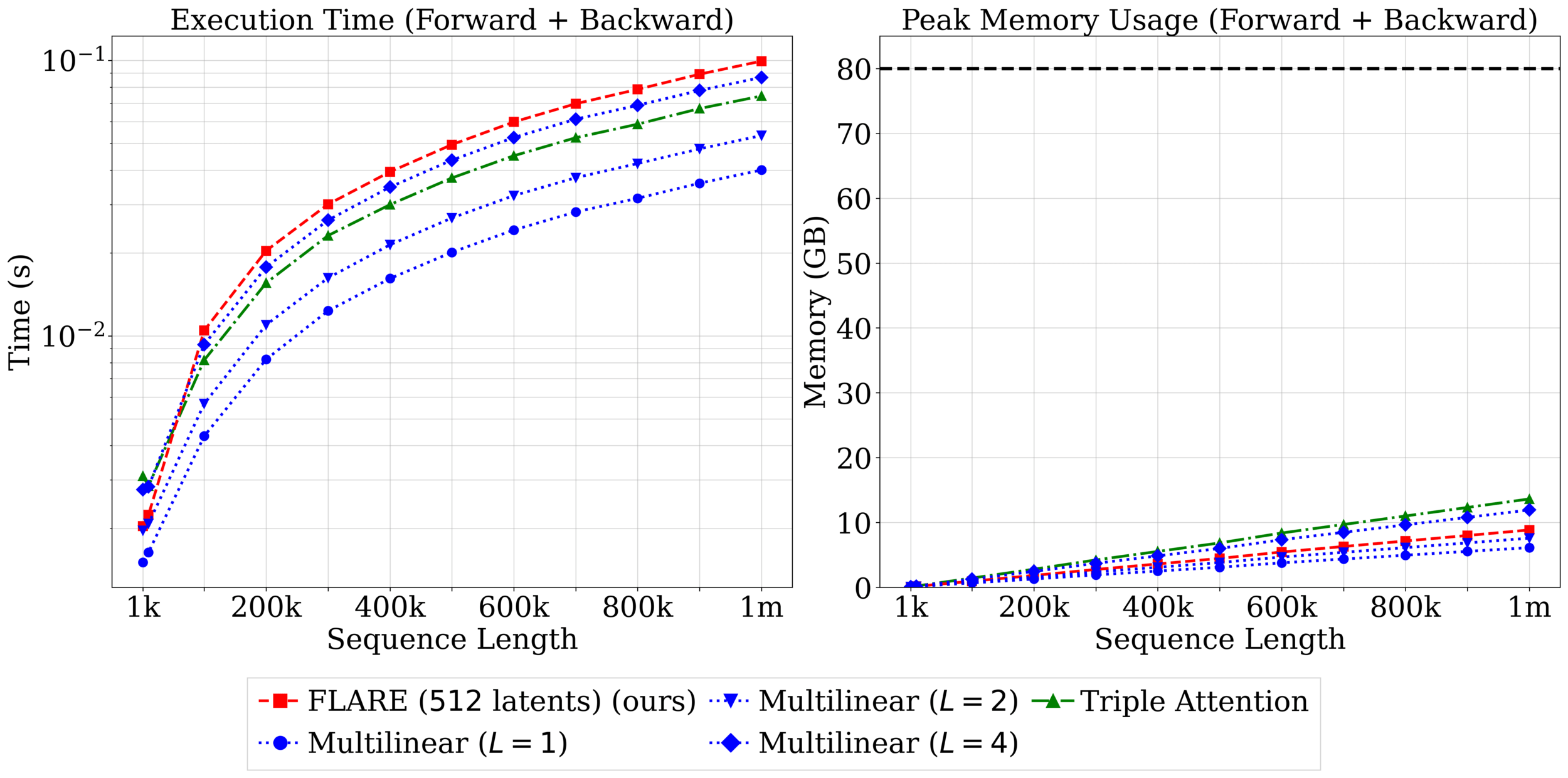
Challenge: Learn PDE surrogate on 5-10 m points on multiGPU cluster
Adaptive Layer Norm in Diffusion Transformer allows for token mixing + time-conditioning in one go
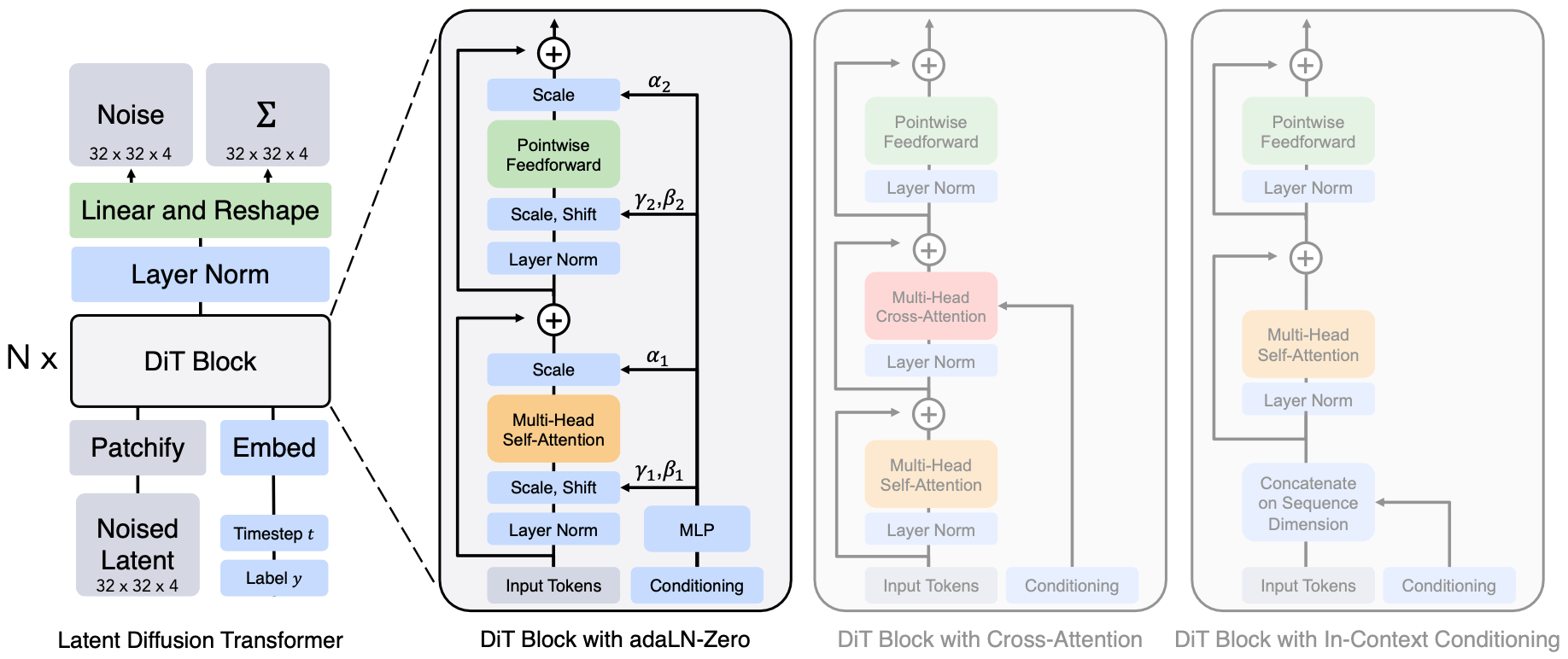
This is only possible with a single token as conditioning vector, and won't work when you want to condition on a sequence.
Linear transformers only store state \( S \in \mathbb{R}^{D \times D} \) but their performance is not on par with softmax attention
Linear transformers replace the softmax kernel with a feature map \(\phi(\cdot)\) such that
This factorization allows causal attention to be computed recurrently:
Chunkwise training for linear transformers
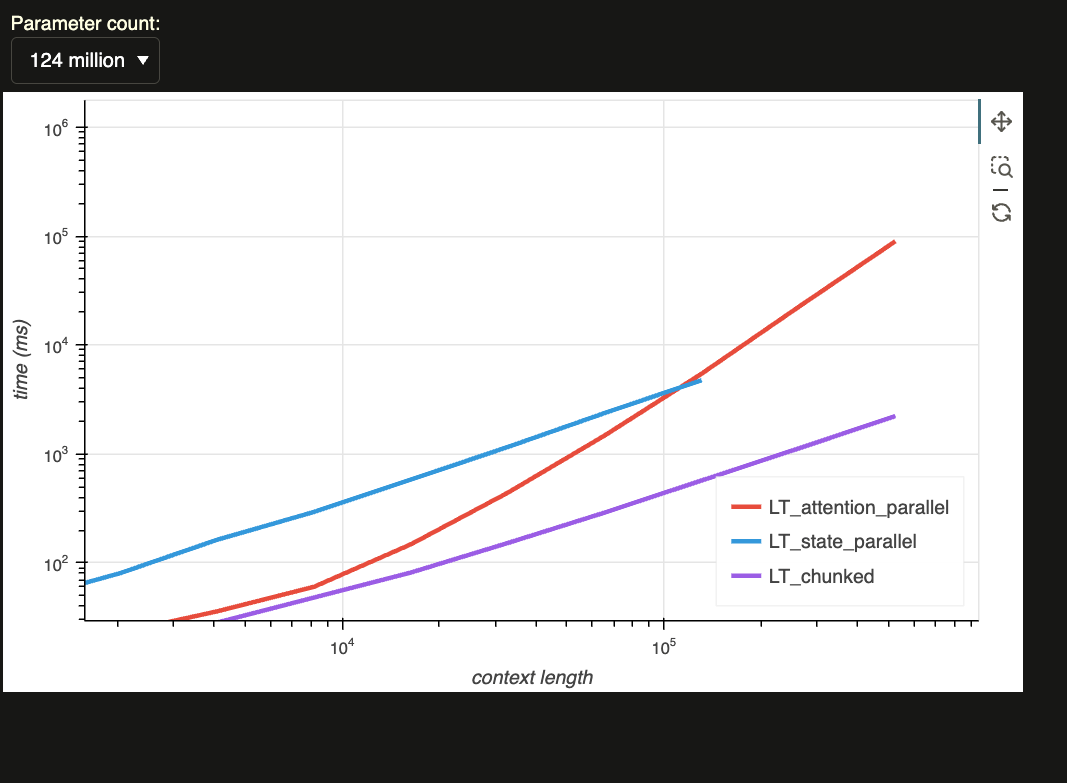
https://manifestai.com/articles/linear-transformers-are-faster/
Premise: strong encoder model --> strong LLM
- Next-token prediction model
- FLARE, Triple Attention
- Write CUDA kernels --> get scaling plots
- Test on language tasks
- Extend FLARE
- Allow model to increase/ decrease \(M\) during training
- Create efficient conditioning mechanism (time-series PDE problems)
- FOCUS ON NEW CONTRIBUTIONS and how we can differentiate ourselves from SOTA
- explain novelty compared to SOTA
Computer simulations are critical for industrial applications
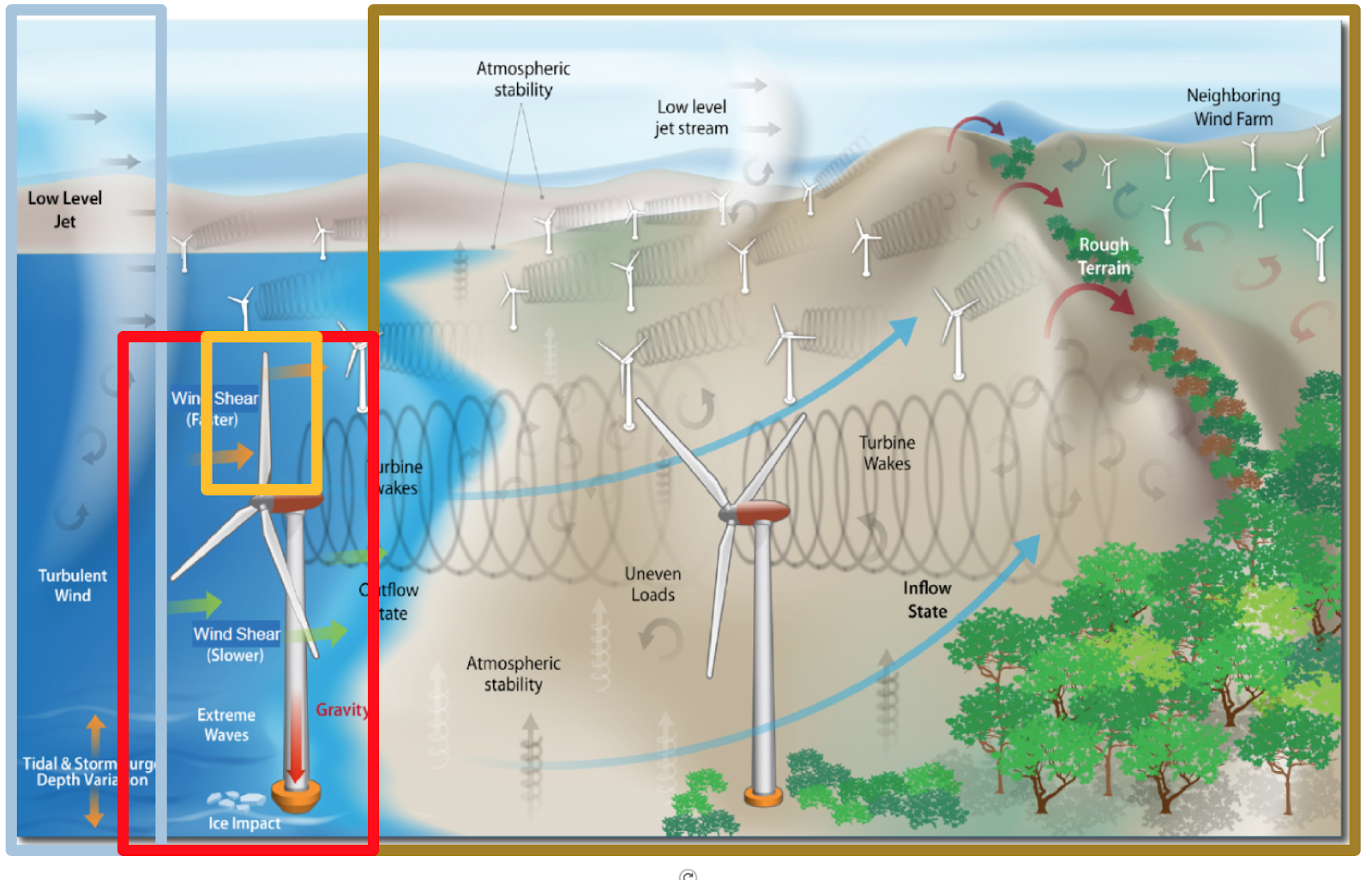
Mesosphere
Wind farm
Turbine
Blade
1
Modern engineering is reliant on computer simulations
Design space exploration
Predictive maintenance
[1]
[2]
FLARE decoder recurrence
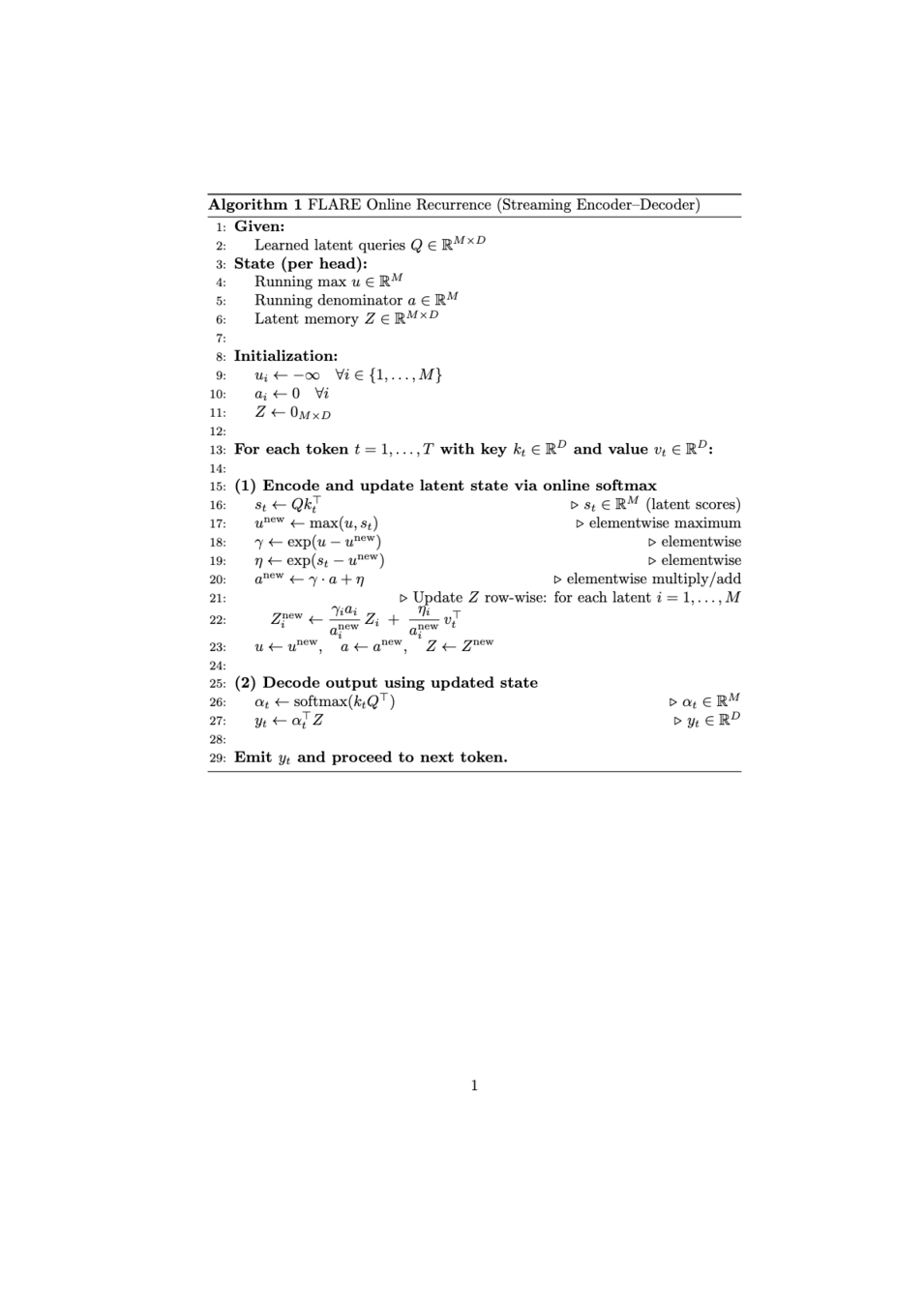
Takeaways from FLARE
Under review at Int'l Conf. Learning Representations
Contributions
Scalable and accurate self attention mechanism
Challenges in learning transient dynamics
Model must capture spatial structure and temporal evolution.
Increases training data by an order of magnitude.
Time-stepping logic may cause drift from ground truth.
FLARE allows for tradeoff between accuracy and compute
Elasticity problem
Darcy problem
24
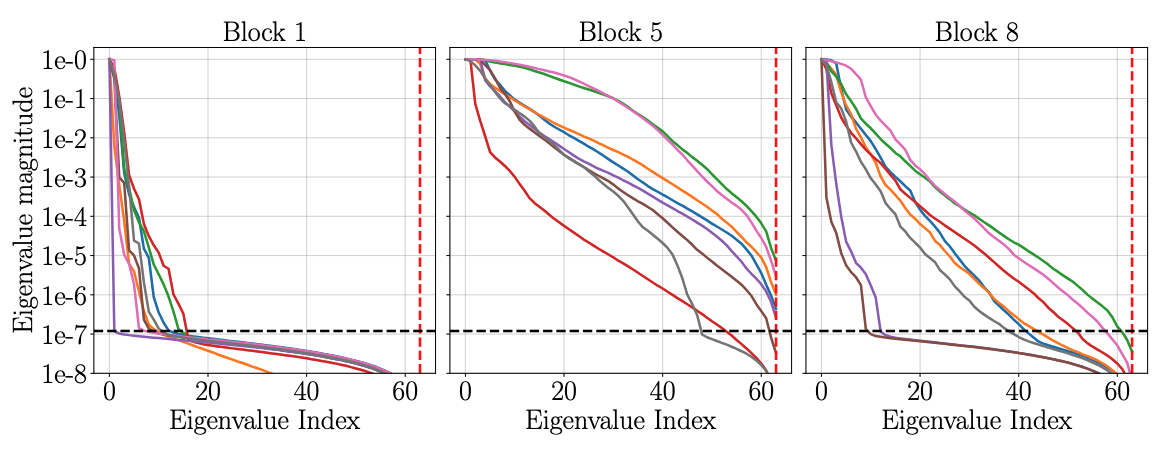
Low-rank structure allows for efficient eigenanalysis
Message-passing is fundamentally low-rank
25
SNF-ROM: Smooth Neural Field ROM
8
2D Viscous Burgers problem \( (\mathit{Re} = 1\text{k})\)
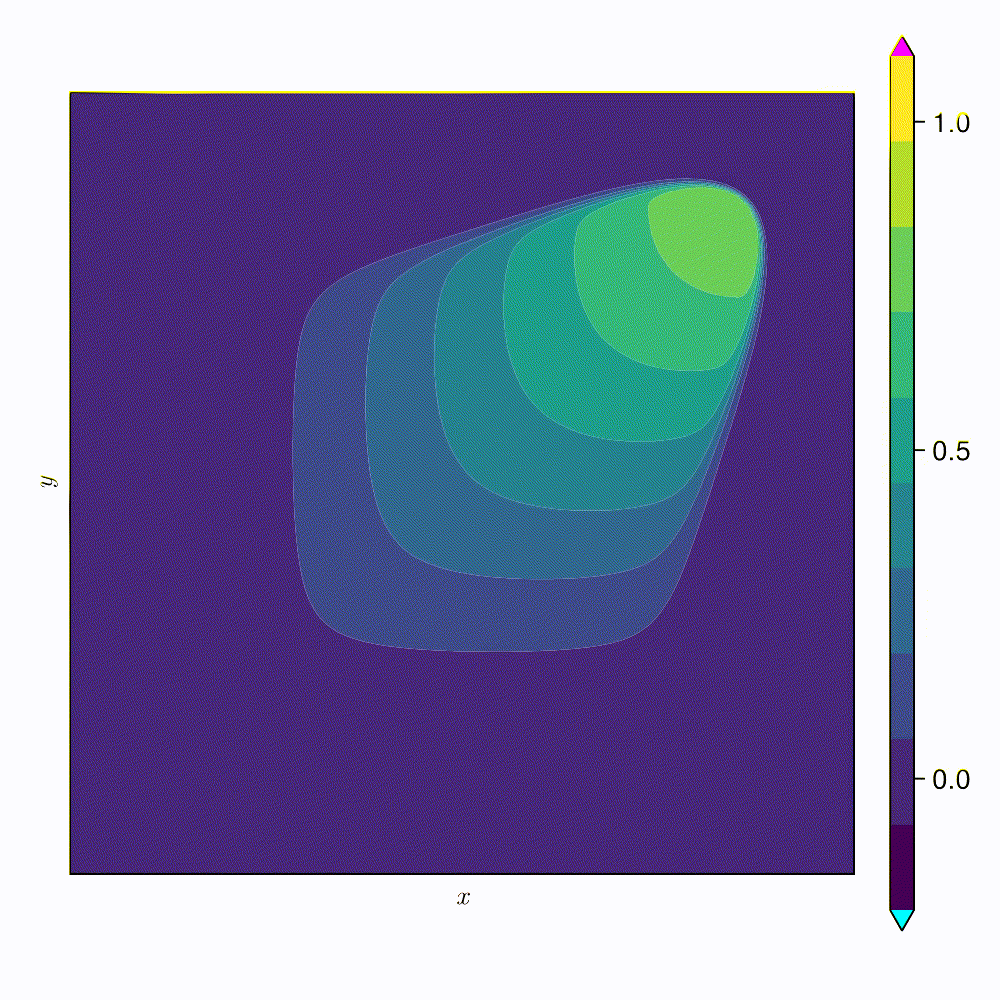
\(199\times\) speed-up
High freq. noise
Non-differentiable!
Accurately capture of dynamics with smooth neural fields
Large deviations!
Learning smooth latent space trajectories
\(\text{Autoencoder ROM}\)
\(\text{SNF-ROM (ours)}\)
Evolution of ROM states
No deviation
Accurate capture of dynamics
\(\text{DoFs: }524~k \to 2\)
Primer on model order reduction
2
Full order model (FOM)
Linear POD-ROM
Nonlinear ROM
Learn low-order spatial representations
Time-evolution of reduced representation with Galerkin projection

Experiment: 2D Viscous Burgers problem \( (\mathit{Re} = 1~{k})\)
13
\(\text{CAE-ROM}\) [1]
\(\text{SNFL-ROM (ours)}\)
\(\text{SNFW-ROM (ours)}\)
\(\text{Relative error }\)
[1] Lee & Carlberg — Nonlinear manifold ROM via CNN autoencoders (JCP 2020)
\([1]\)