Efficient and Optimal Fixed-Time Regret with Two Experts
Laura Greenstreet, Nick Harvey, Victor Sanches Portella

The Two-Experts' Problem
Prediction with Expert Advice
Player
Adversary
\(n\) Experts
0.5
0.1
0.3
0.1
Probabilities
1
0
0.5
0.3
Costs
Player's loss:
Loss of Best Expert
Player's Loss
Knows \(T\) (fixed-time)
Known and New Results
Multiplicative Weights Update method:
Optimal for \(n,T \to \infty\) !
If \(n\) is fixed, we can do better
Worst-case regret for 2 experts:
Cover's Algorithm
\(O(T)\) time per round
Dynamic Programming
\(\{0,1\}\) costs
\(O(1)\) time per round
Stochastic Calculus
\([0,1]\) costs
[Cover '67]
Our Algorithm
Technique:
Discretize a solution to a stochastic calculus problem
[HLPR - FOCS '20]
How to exploit the knowledge of \(T\)?
We need to analyze the discretization error!
!
!
Online Learning
🤝
Stochastic Calculus
Gaps and Cover's Algorithm
Simplifying Assumptions
We will look only at \(\{0,1\}\) costs
1
0
0
1
0
0
1
1
Equal costs do not affect the regret
Cover's algorithm relies on these assumptions by construction
Our alg. and analysis extends to fractional costs
Gap between experts
Thought experiment: how much probability mass to put on each expert?
Cumulative Loss on round \(t\)
\(\frac{1}{2}\) is both cases seems reasonable!
Takeaway: player's decision may depend only on the gap between experts's losses
Gap = |42 - 20| = 22
Worst Expert
Best Expert
42
20
2
2
42
42
(and maybe on \(t\))
Cover's Dynamic Program
Player strategy based on gaps:
Choice doesn't depend on the specific past costs
on the Worst expert
on the Best expert
We can compute \(V^*\) backwards in time via DP!
Max regret to be suffered at time \(t\) with gap \(g\)
\(O(T^2)\) time to compute \(V^*\)
At round \(t\) with gap \(g\)
Max. regret for a game with \(T\) rounds
Computing the optimal strategy \(p^*\) from \(V^*\) is easy!
Cover's DP Table
(w/ player playing optimally)
Continuous Regret
A Probabilistic View of Regret Bounds
Formula for the regret based on the gaps
Discrete stochastic integral
Moving to continuous time:

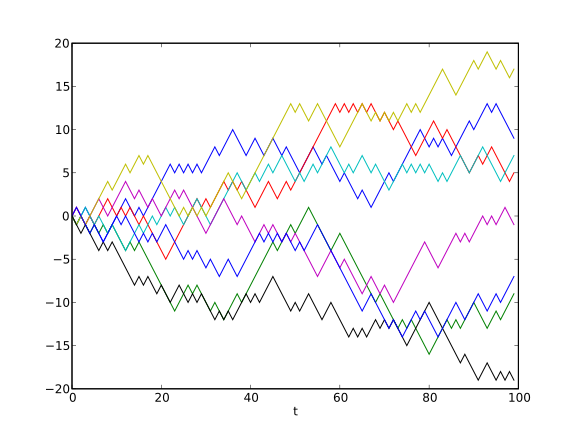
Random walk \(\longrightarrow\) Brownian Motion
\(g_0, \dotsc, g_t\) are a realization of a random walk
Useful Perspective:
Deterministic bound = Bound with probability 1
A Probabilistic View of Regret Bounds
Formula for the regret based on the gaps
Random walk \(\longrightarrow\) Brownian Motion
Reflected Brownian motion (gaps)
Conditions on the continuous player \(p\)
Continuous on \([0,T) \times \mathbb{R}\)
for all \(t \geq 0\)
Stochastic Integrals and Itô's Formula
How to work with stochastic integrals?
Itô's Formula:
\(\overset{*}{\Delta} R(t, g) = 0\) everywhere
ContRegret \( = R(T, |B_T|) - R(0,0)\)
Goal:
Find a "potential function" \(R\) such that
(1) \(\partial_g R\) is a valid continuous player
(2) \(R\) satisfies the Backwards Heat Equation
Different from classic FTC!
Backwards Heat Equation
Stochastic Integrals and Itô's Formula
Goal:
Find a "potential function" \(R\) such that
(1) \(\partial_g R\) is a valid continuous player
(2) \(R\) satisfies the Backwards Heat Equation
How to find a good \(R\)?
?
Suffices to find a player \(p\) satisfying the BHE
\(\approx\) Cover's solution!
Also a solution to an ODE
Then setting
preserves BHE and
Discretization
Discrete Itô's Formula
How to analyze a discrete algorithm coming from stochastic calculus?
Discrete Itô's Formula!
Discrete Derivatives
Surprisingly, we can analyze Cover's algorithm with discrete Itô's formula
Itô's Formula
Discrete Itô's Formula
Discrete Algorithms
\(V^*\) satisfies the "discrete" Backwards Heat Equation!
Not Efficient
Efficient
Discrete Itô \(\implies\)
Regret of \(p^* \leq V^*[0,0]\)
BHE = Optimal?
Hopefully, \(R\) satisfies the discrete BHE
Discretized player:
We show the total is \(\leq 1\)
Cover's strategy
Our Results
An Efficient and Optimal Algorithm in Fixed-Time with Two Experts
Technique:
Solve an analogous continuous-time problem, and discretize it
[HLPR '20]
How to exploit the knowledge of \(T\)?
Discretization error needs to be analyzed carefully.
BHE seems to play a role in other problems in OL as well!
Solution based on Cover's alg
Or inverting time in an ODE!
We show \(\leq 1\)
\(V^*\) and \(p^*\) satisfy the discrete BHE!
Insight:
Cover's algorithm has connections to stochastic calculus!