UNIT 4
War, Depression, and War Again: 1914–1946
Presented by: Victoria Maenner
The Great Depression lasted from 1929 to 1939, and was the worst economic downturn in the history of the industrialized world (History.com Staff, par 1).
Great Depression: What was it?
By early 1933, more than 12 million people, or 25 percent of eligible Americans, were unemployed (History.com Staff, par 1).
Local charities or groups organized many early soup kitchens, but the enormous need for relief prompted increased involvement from state and federal officials.
Nearly 11,000 banks had failed, destroying the life savings of millions of Americans (History.com Staff, par 5).
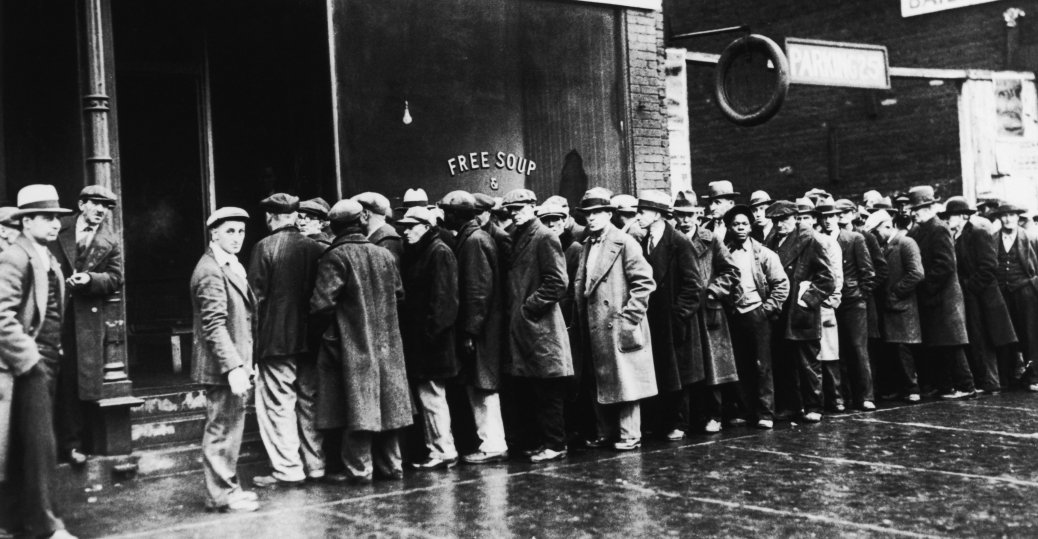
Image courtesy of History.com Staff
Breadlines and soup kitchens were established as charitable organizations giving free bread and soup to the impoverished. Soup was economical because water could be added to serve more people, if necessary.
Because the circulation of money was so low, the U.S. didn't mint nickels in 1932 or 1933 ("Great Depression", par 2).
Great Depression:
Impact/Importance on US Economy
The average income of the American family dropped by 40 percent from 1929 to 1932. Income fell from $2,300 to $1,500 per year (“Great Depression”, par 3).
In 1934, almost one out of every two American households directly experienced unemployment or underemployment (History.com Staff, par 4).
Consumer spending and investment dropped, causing steep declines in industrial output and employment as failing companies laid off workers (History.com Staff, par 1).
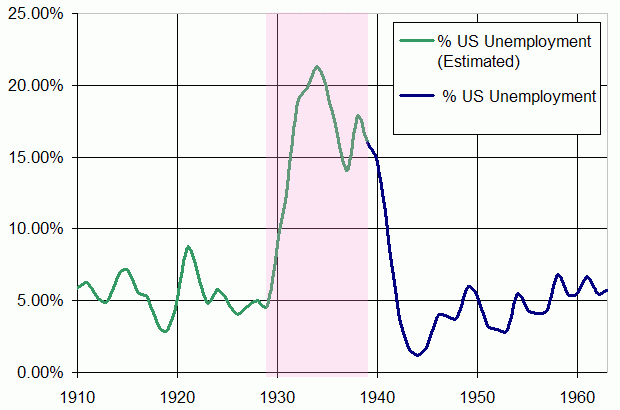
Unemployment rate in the US 1910–1960, with the years of the Great Depression (1929–1939) highlighted.
Image courtesy of “Depression.”
Great Depression: Impact/Importance on US Economy cont'd...
The stock market underwent rapid expansion, reaching its peak in August 1929 (History.com Staff, par 3).
Wages were low, consumer debt was proliferating, the agricultural sector of the economy was struggling due to drought and falling food prices, and banks had an excess of large loans that could not be liquidated (History.com Staff, par 4).
Consumer spending slowed and unsold goods began to pile up, which in turn slowed factory production (History.com Staff, par 4).
The stock market didn't return to pre-depression levels until 1954 ("Great Depression", par 4).
The 1930s will always summon up images of breadlines, apple sellers on street corners, shuttered factories, rural poverty, and so-called Hoovervilles, where homeless families sought refuge in shelters cobbled together from salvaged wood, cardboard, and tin (Romer and Pells, par 7).

Image courtesy of Romer and Pells
● UNEMPLOYMENT
Great Depression: How did the historical events bring us to today?
Today: The average man first has months of unemployment insurance; after that, he can go on welfare if he can't find "suitable work." (Casey, par 13).
1930's: If a man lost his job, he had to find another one as quickly as possible simply to keep from going hungry.
● TAXES
1930's: Average income was $2,335, putting families in the 1/10th of 1% bracket. No Social Security tax, no state income tax, no sales tax, and no estate tax.
Today: The average man first has months of unemployment insurance; after that, he can go on welfare if he can't find "suitable work." (Casey, par 19).
1930's: Prices dropped radically because billions of dollars of inflationary currency were wiped out through the stock market crash, bond defaults, and bank failures.
● PRICES
Today: Instead of letting the economy cleanse itself by allowing the financial markets to collapse, governments will bail out insolvent banks, create mortgages wholesale to prop up real estate, and central banks will buy bonds to keep their prices from plummeting (Casey, par 22).

Images courtesy of Slavo, Mac

New Deal: What was it?
Relief, Recovery, Reform
●The New Deal was the set of federal programs launched by President Franklin D. Roosevelt after taking office in 1933 in response to the calamity of the Great Depression (“The New Deal”, par 1).
●It took action to bring about immediate economic relief as well as reforms in industry, agriculture, finance, waterpower, labour, and housing, vastly increasing the scope of the federal government’s activities (The Editors of Encyclopædia Britannica, par 1).
Pass laws and introduce federal programs aimed at providing RELIEF to the needy during the Great Depression
RECOVERY of the economy and industries
REFORM the financial system (banks and Stock Market) (The Editors of Encyclopædia Britannica, par 2).
●Forty-three "alphabet agencies" were created during the New Deal (“Great Depression”, par 4).

Image courtesy of "Between the Wars timeline" Image courtesy of "On the Bank Crisis"

●Goals of the New Deal:
New Deal spending boosted GDP growth 10.8 percent in 1934. It grew another 8.9 percent in 1935, a whopping 12.9 percent in 1936 and 5.1 percent in 1937 ("The Effects of the New Deal", par 6).
New Deal: Impact/Importance on US Economy
The banking system was stabilized and the Stock Market and banks were regulated (Alchin, par 3).
The New Deal programs created millions of jobs and government sponsored public works projects rebuilt the infrastructure of the US (Alchin, par 4).
Restored confidence in banks (FDIC guaranteed money deposited in banks) (Alchin, par 5).
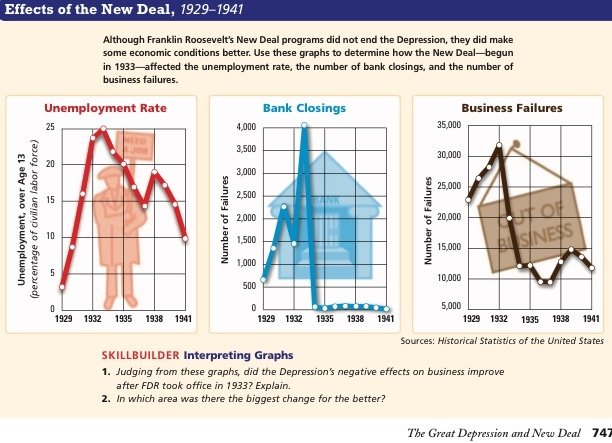
Image courtesy of "The Effects of the New Deal".
An overview of the improved economic conditions
New Deal: How did the historical events bring us to today?
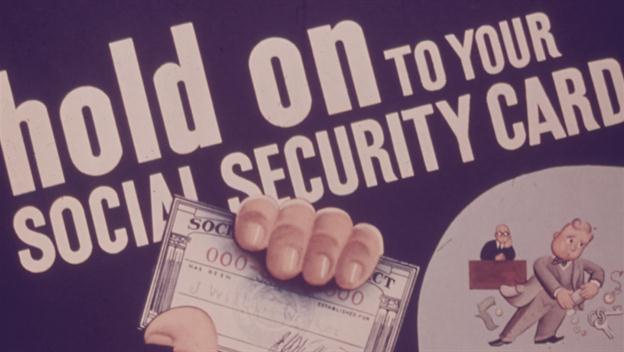
The Social Security Act was a reform measure enacted in 1935 in which the federal government would provide pensions for the aged, inform, insurance for the unemployed and benefits for single mothers and children (History.com Staff, par 24).
Image courtesy of History.com Staff
Regulation of the Stock Market: A federal agency called the Securities and Exchange Commission watches the stock market. It makes sure companies follow fair practices for trading stocks ("The Effects of the New Deal", 748).
Agricultural Price Supports. This program pays farmers to raise crops for domestic use rather than export. To receive payments, farmers must agree to limit the space they devote to certain crops ("The Effects of the New Deal", 748).

Image courtesy of Matthew Engel
WWII: What was it?
- World War II, also known as the Second World War, was a global war that lasted from 1939 to 1945, although related conflicts began earlier.
- World War II was the most destructive conflict in history. It cost more money, damaged more property, killed more people, and caused more far-reaching changes than any other war in history (Laub, par 1).
- The principal belligerents were the Axis powers—Germany, Italy, and Japan—and the Allies—France, Great Britain, the United States, the Soviet Union, and, to a lesser extent, China (Royde-Smith, John Graham).
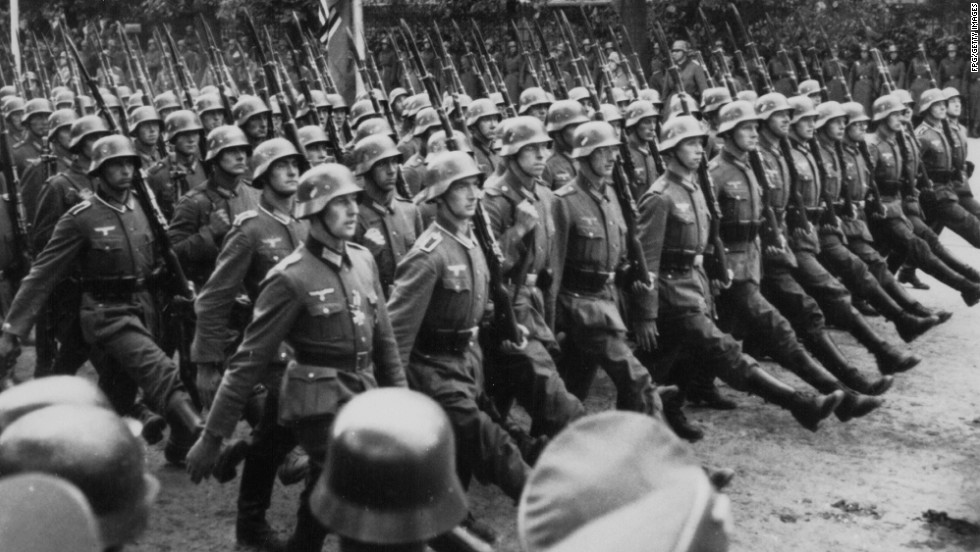
WWII troops march through occupied Warsaw, Poland after invading the nation on Sept. 1, 1939, and igniting WWII
Image courtesy of "World War II Fast Facts"
- The United States entered WW2 on December 8, 1941 when it declared war on Japan following the Japanese bombing of Pearl Harbor (“US Mobilization for WW2 Facts”, par 2).
- The Nazis used "concentration camps" to hold millions of Jewish people where they would work and starve until they where "exterminated" in gas showers using a pesticide called Zyklon-B. Auschwitz Concentration Camp is responsible for the killing of over 2 million Jews (Laub, par 10).
Labor Force during WWII: Impact/Importance on US Economy
●American factories were retooled to produce goods to support the war effort and almost overnight the unemployment rate dropped to around 10% (Shmoop Editorial Team, par 8).
●The female labor force grew by 6.5 million. In 1944, 37% of all adult women were employed. In 1944, women comprised 35.4% of the civilian labor force (“Women & World War II”, par 1).
●War mobilization—the rapid production of military equipment, vehicles, weapons, and ammunition, along with the fortification of American borders and military bases abroad—coupled with the military draft to create a vast labor shortage (Shmoop Editorial Team, par 9).
●Car manufacturers were ordered to cease normal operations and, instead, to assemble armored vehicles to be used on the battlefield (Shmoop Editorial Team, par 11).
●“Real wages rose during the war, at least when official price indexes are used to deflate wages, but the rise was not uniform. The gaps between the wages earned by managers and workers and between the wages earned by skilled and unskilled workers narrowed” (Walton 2014, 478).

Rosie the Riveter is still a powerful image in American culture
Images courtesy of Zimmerman, Dwight

Women war workers build assault boats for the U.S. Marine Corps, Dec. 1941.
Labor Force during WWII: How did the historical events bring us to today?
●In World War II, news was broadcasted through the radio. Today, we get news from the TV and social media. In today's world, propaganda is easily exploited because of the connections all around the world.
●Guaranteed low interest loans and paid training opportunities for returning war veterans along with maturing government war bonds and savings built during war-time rationing meant the fast-growing (white) middle classes in America had plenty of disposable income with which to enjoy their post-war optimism (Davis, par 10).
●Fertile ground for a baby boom and a leap in demand for new American consumer products (Davis, par 10).
A sailor kisses a nurse passionately in Manhattan's Times Square as New York City celebrates the surrender of Japan on August 14, 1945. Kissing strangers was a common elated reaction to the news in Times Square.
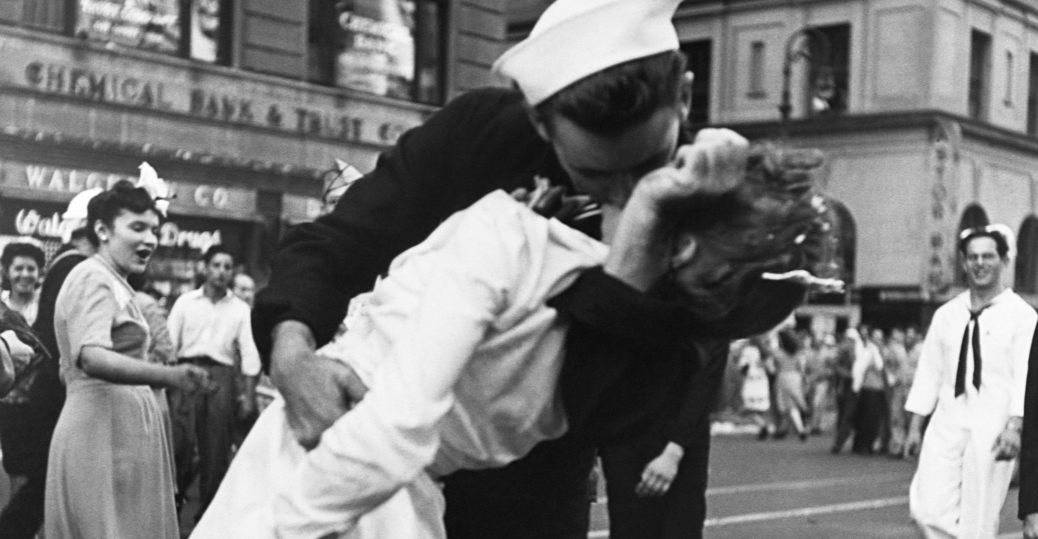
Image courtesy of History.com Staff
●World War II ended with the unconditional surrender of the Axis powers. On 8 May 1945, the Allies accepted Germany's surrender, about a week after Adolf Hitler had committed suicide. VE Day – Victory in Europe celebrates the end of the Second World War on 8 May 1945. (Davis, par 12).
Works Cited
Alchin, Linda. “New Deal.” New Deal Summary and Facts for Kids ***, www.american-historama.org/1929-1945-depression-ww2-era/new-deal.htm.
Amadeo, Kimberly. “What Happened During the Great Depression?” The Balance, www.thebalance.com/the-great-depression-of-1929-3306033.
“Bank Holiday.” New Deal-Renfrow, newdeal-renfrow.wikispaces.com/Bank Holiday.
“Between the Wars timeline.” Timetoast, www.timetoast.com/timelines/5-between-the-wars.
Casey, Doug. “Comparing the 1930s and Today.” International Man, 24 Jan. 2017, www.internationalman.com/articles/comparing-the-1930s-and-today.“Depression.” The History of our World, thehistoryofourworld.weebly.com/depression.html.
Davis, Mark. “How World War II shaped modern America.” Euronews, 8 May 2015, www.euronews.com/2015/05/05/how-world-war-ii-shaped-modern-america.
The Editors of Encyclopædia Britannica. “New Deal, United States History.” Encyclopædia Britannica, Encyclopædia Britannica, inc., 20 July 2017, www.britannica.com/event/New-Deal.
"The Effects of the New Deal." The Great Depressions and The New Deal.
https://www.quia.com/files/quia/users/nygardgeo/TheGreatDepression/Effects-of-the-New-Deal
Engel, Matthew. “New Deal.” LinkedIn SlideShare, 20 Mar. 2008, www.slideshare.net/matthewengel/new-deal.
“Great Depression.” Facts about the depression, 28 Oct. 2012, great-depression-facts.com/.
Works Cited cont'd...
History.com Staff. “The Great Depression.” History.com, A&E Television Networks, 2009, www.history.com/topics/great-depression.
Laub, Zachary. World War 2 Facts, www2.bc.edu/zachary-s-laub/Facts.html.
“The New Deal.” Living New Deal, livingnewdeal.org/what-was-the-new-deal/.
“On the Bank Crisis.” New Deal Progressives, 27 May 2014, newdealprogressives.org/blog/2014/05/27/fdr-fireside-chat-on-the-bank-crisis/.
Romer, Christina D., and Richard H. Pells. “Economic impact.” Encyclopædia Britannica, Encyclopædia Britannica, inc., 27 Oct. 2017, www.britannica.com/event/Great-Depression/Economic-impact.
Royde-Smith, John Graham. “World War II.” Encyclopædia Britannica, Encyclopædia Britannica, inc., 18 July 2017, www.britannica.com/event/World-War-II.
Shmoop Editorial Team. “Economy in World War II: Home Front.” Shmoop, Shmoop University, 11 Nov. 2008, www.shmoop.com/wwii-home-front/economy.html.
Saini, Navdeep. “WW2 VS Today Continuity and Change by Navdeep Saini - Infogram.” Create Infographics, Charts and Maps - Infogram, infogram.com/ww2-vs-today-continuity-and-change-1gg4qpzxg5o521y.
Works Cited cont'd...
Slavo, Mac. “The Shocking Reality: This Chart Shows Just How Bad Unemployment Is Today Compared to The Great Depression.” Dcclothesline.com, 3 Oct. 2015, www.dcclothesline.com/2015/10/03/the-shocking-reality-this-chart-shows-just-how-bad-unemployment-is-today-compared-to-the-great-depression/.
“US Mobilization for WW2 Facts.” US Mobilization for WW2 Facts: US History for Kids ***, www.american-historama.org/1929-1945-depression-ww2-era/us-mobilization-ww2.htm.
Walton, Gary M., and Hugh Rockoff. History of the American Economy. Mason, OH, South-Western Cengage Learning, 2014.
“Women & World War II.” Women & WWII | Camp Hale | MSU Denver, msudenver.edu/camphale/thewomensarmycorps/womenwwii/.
“World War II Fast Facts.” CNN, Cable News Network, 17 Aug. 2017, www.cnn.com/2013/07/09/world/world-war-ii-fast-facts/index.html.
Zimmerman, Dwight. “Women in America's World War II Workforce.” Defense Media Network, 3 Sept. 2012, www.defensemedianetwork.com/stories/women-in-americas-world-war-ii-workforce/.