Blocs sample pack store
Lean Delivery
- Get to market quickly with an MVP.
- Learn from users to improve and expand the platform.
- Reduce waste, don't build unnecessary stuff.
Managed Services
- Administering servers is expensive and time consuming.
- Focus on building the product.
- Make use of cloud services to handle up time and availability.
Authentication
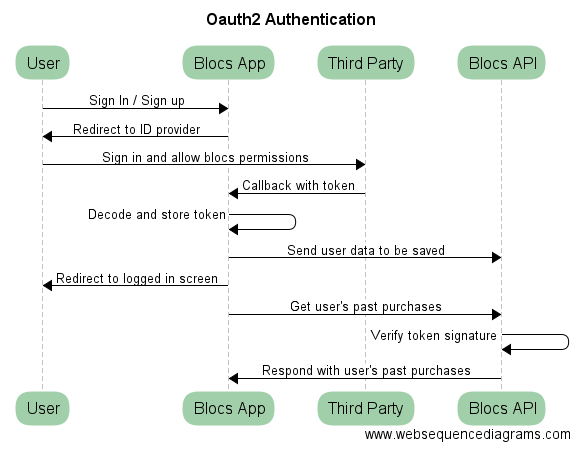
Oauth2 / OpenID
Phase 1
Use existing identity providers. This removes the need to call a database to store user passwords.
Phase 2
Implement Blocs user management, storing passwords and generating tokens ourselves if needed.


Blocs API



AWS API gateway
AWS lambda
Dynamo DB
curl -X POST \
    -d '{"name": "Will Munn", email: "will.munn@focusrite.com"}' \
    -H "Authorization: Bearer $TOKEN" \
    "https://api.focusrite.com/user"
Create a new user
Store the user in dynamo db. User data can then be used at a later date.
curl -X GET \
    -H "Authorization: Bearer $TOKEN" \
    'https://api.focusrite.com/user/{userId}/purchases'
Retrieve the user's previous purchases from dynamo.
Example flow: getting a new user's purchases
Downloading Content
Blocs API Downloads
Cloud front
S3


curl -X GET \
    -H "Authorization: Bearer $TOKEN" \
    "https://api.focusrite.com/pack/{packId}/token"

# 302 Redirect
# Location: https://downloads.focusrite.com/pack/{packId}?token=cGFja0lkPTIzNDU1NTUzNDQ0Cg==
Get a download token for the pack
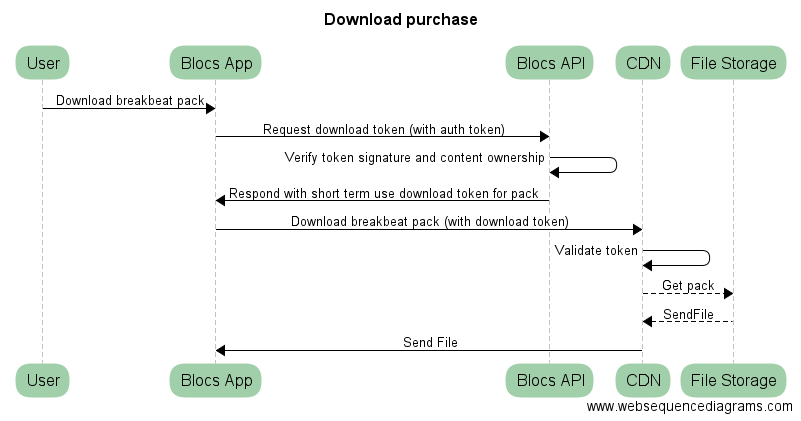
This endpoint checks whether the user has purchased the pack and returns a redirect to the download endpoint with a token containing the pack ID and an expiry time. This token is signed using a private key.
Example flow: downloading a purchased pack
curl "https://downloads.focusrite.com?token=cGFja0lkPTIzNDU1NTUzNDQ0Cg=="Download the pack
Token is checked on the CDN, if valid, it tries to deliver the content from one of its cached nodes, otherwise, it streams it from S3 into its cache for use next time and out the the user.
Example flow: downloading a purchased pack 2
Payments


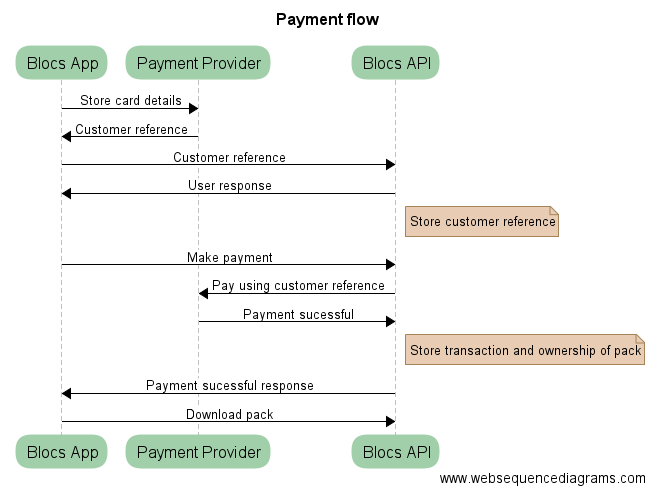
Integrate with a payment provider
- PCI compliant
- Support multiple payment methods
- Faster integration time
Ingestion
Build tools for submitting content
- Automate validation
- Convert samples to all necessary formats
- Add consistent metadata
- Automate uploading