修飾子
2022 / 4 /16
- short 、long
- unsigned
- const
改變所佔的記憶體空間
int
short int
long int
2 byte
4 byte
4 byte
-32678 ~ 32767
-2147483648 ~ 2147483647
-2147483648 ~ 2147483647
long long int
8 byte
-9223372036854775808 ~ 9223372036854775807
2^{31} - 1
2^{63} - 1
約
2*10^9
約
9*10^{18}
<limits.h>
- 定義了整數型別的上下限
- 不同的作業系統,上下限不同
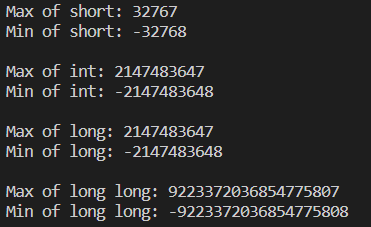
檢查自己作業系統的整數上下限!
#include <limits.h>
#include <iostream>

int main(void)
{

    std::cout << "Max of short: "<< SHRT_MAX << std::endl;
    std::cout << "Min of short: "<< SHRT_MIN << std::endl;
    std::cout << std::endl;

    std::cout << "Max of int: "<< INT_MAX << std::endl;
    std::cout << "Min of int: "<< INT_MIN << std::endl;
    std::cout << std::endl;

    std::cout << "Max of long: "<< LONG_MAX << std::endl;
    std::cout << "Min of long: "<< LONG_MIN << std::endl;
    std::cout << std::endl;

    std::cout << "Max of long long: "<< LLONG_MAX << std::endl;
    std::cout << "Min of long long: "<< LLONG_MIN << std::endl;
    std::cout << std::endl;

    return 0;
}
#include <iostream>
#include <limits.h>
using namespace std;
int main(){

    int x = INT_MAX; // x = 2147483647

    cout << x << endl;

    x += 1;

    cout << x << endl; // x = ?

    x += 1;

    cout << x << endl; // x = ?

    return 0;
}
溢位 overflow
數值超過該型態所能表示的範圍
Ex
int 最大值為 2147483647
你把它設為2147483648
short int 最大值為 32767
你把它設為 32800
你應該注意輸入資料的大小
#include<iostream>
using namespace std;
int main(){

    int t;

    cin >> t;

    cout << t*t << endl;

    return 0;
}
假設
0 \leq t \leq 10^5
\leq 10^5*10^5
INT_MAX
溢位
改變數值範圍
改變數值範圍
- 加上關鍵字 unsigned ,變成無號變數
- 表示範圍變為原本的兩倍
- 數值
\geq
0
int
short int
long int
-32678 ~ 32767
-2147483648 ~ 2147483647
-2147483648 ~ 2147483647
long long int
-9223372036854775808 ~ 9223372036854775807
unsigned short int
0 ~ 65535
unsigned int
0 ~ 4294967295
unsigned long int
0 ~ 4294967295
unsigned long long int
0 ~
18446744073709551615
2^{63} - 1
約
9*10^{18}
2^{31} - 1
約
2*10^9
2^{32} - 1
約
4*10^9
2^{64} - 1
約
18*10^{18}
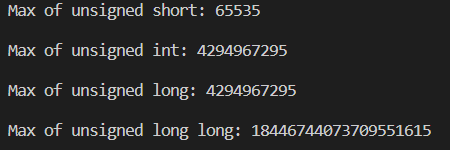
#include <limits.h>
#include <iostream>

int main(void)
{

    std::cout << "Max of unsigned short: "<< USHRT_MAX << std::endl;
    std::cout << std::endl;

    std::cout << "Max of unsigned int: "<< UINT_MAX << std::endl;
    std::cout << std::endl;

    std::cout << "Max of unsigned long: "<< ULONG_MAX << std::endl;
    std::cout << std::endl;

    std::cout << "Max of unsigned long long: "<< ULLONG_MAX << std::endl;
    std::cout << std::endl;

    return 0;
}
不可更動常數
- 宣告時加上關鍵字 const
- 宣告時必須初始化
- const 為常數 constant 的縮寫
不可更動常數
- 值不能被修改
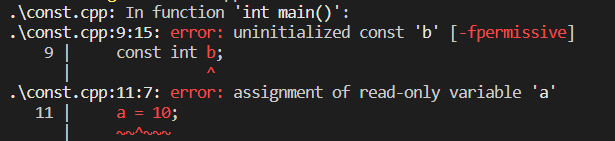
#include <iostream>

int main(){

    const int a = 5;

    const double PI = 3.14;

    const int b; // 沒初始化

    a = 10; // const不可更動,會噴錯

    return 0;
}
適合用在變數值不會被更動的時候
// not good
#include <iostream>
using std::cin;
int main(void){

    int graph[1000][1000] = {};

    int arr[1000] = {};

    for(int i = 0; i < 1000; i++){
        cin >> arr[i];
    }

    return 0;
}
// good
#include <iostream>
using std::cin;
int main(void){
int const N = 1000;
int graph[N][N] = {};
int arr[N] = {};
for(int i = 0; i < N; i++){
cin >> arr[i];
}
return 0;
}修飾子可以用很多個
#include<iostream>
int main(){
    const short int a = 0;
    unsigned long int b = 0;
    const static int c = 0;
    const unsigned long long int d = 0;
}