\mathit{\Pi}(s) = \displaystyle \lim_{K \to \infty} \frac {1 \cdot 2 \cdot 3 \cdots K}{(s+1)(s+2)(s+3) \cdots (s+K)} (K+1)^s
Π(s)=limK→∞1⋅2⋅3⋯K(s+1)(s+2)(s+3)⋯(s+K)(K+1)s\mathit{\Pi}(s) = \displaystyle \lim_{K \to \infty} \frac {1 \cdot 2 \cdot 3 \cdots K}{(s+1)(s+2)(s+3) \cdots (s+K)} (K+1)^s

と定義し, 

\mathit{\Pi}(s)
Π(s)\mathit{\Pi}(s)

を

\displaystyle \frac{x}{e^x-1} = \sum_{k=0}^{\infty}\frac{B_k}{k!}x^k
xex−1=∑k=0∞Bkk!xk\displaystyle \frac{x}{e^x-1} = \sum_{k=0}^{\infty}\frac{B_k}{k!}x^k

に対して,

k>1
k>1k>1
B_k
BkB_k

を定め, 

\overline{B}_k(x) = B_k(x-[x])
B‾k(x)=Bk(x−[x]) \overline{B}_k(x) = B_k(x-[x])

として

\overline{B}_k(x)
B‾k(x) \overline{B}_k(x)

と定義する.

k
kk

次のBernoulli多項式を, 次数

k
kk

の多項式で

\displaystyle \int_x^{x+1} B_k(t)dt = x^k
∫xx+1Bk(t)dt=xk\displaystyle \int_x^{x+1} B_k(t)dt = x^k

という性質を満たす唯一のものとして定義する. そして,

を

としたとき, 

\log\mathit{\Pi}(s) = (s+\frac{1}{2}) \log(s+1) +A -1 - \displaystyle \int_1^{\infty} \frac{\overline{B}_1(x)}{s+x}dx - s
logΠ(s)=(s+12)log(s+1)+A−1−∫1∞B‾1(x)s+xdx−s\log\mathit{\Pi}(s) = (s+\frac{1}{2}) \log(s+1) +A -1 - \displaystyle \int_1^{\infty} \frac{\overline{B}_1(x)}{s+x}dx - s

が成り立つことを確認せよ.

A = 1 + \displaystyle \int_1^{\infty} \frac{\overline{B}_k(x)}{x}dx
A=1+∫1∞B‾k(x)xdxA = 1 + \displaystyle \int_1^{\infty} \frac{\overline{B}_k(x)}{x}dx

ここで, 定数

A
AA

を

d: \mathbb{N} \to \mathbb{N}
d:N→Nd: \mathbb{N} \to \mathbb{N}

を, 自然数の10進表記における桁を返す写像とする.

K=d(y).
K=d(y).K=d(y).

次の方程式は自然数解

(x, y, K)
(x,y,K)(x, y, K)
(1).
(1).(1).

を無数にもつことを示せ.

\displaystyle x^2 + y^2 = x \cdot 10^K + y ~,
x2+y2=x⋅10K+y ,\displaystyle x^2 + y^2 = x \cdot 10^K + y ~,
(2).
(2).(2).
p
pp

を素数とする.

\displaystyle p= x^2 + y^2 = x \cdot 10^K + y ~,
p=x2+y2=x⋅10K+y ,\displaystyle p= x^2 + y^2 = x \cdot 10^K + y ~,
K=d(y)
K=d(y)K=d(y)

となるような

p
pp

は

101
101101

と

5882353
58823535882353

のみであることを示せ.

\displaystyle \psi (x) = \sum_{k=1}^{\infty} \exp (-k^2 \pi x)
ψ(x)=∑k=1∞exp(−k2πx)\displaystyle \psi (x) = \sum_{k=1}^{\infty} \exp (-k^2 \pi x)
\displaystyle \zeta(s) = \sum_{k=1}^{\infty} \frac{1}{k^s}
ζ(s)=∑k=1∞1ks\displaystyle \zeta(s) = \sum_{k=1}^{\infty} \frac{1}{k^s}
\displaystyle \mathit{\Pi}(s) = \displaystyle \lim_{K \to \infty} \frac {1 \cdot 2 \cdot 3 \cdots K}{(s+1)(s+2)(s+3) \cdots (s+K)} (K+1)^s
Π(s)=limK→∞1⋅2⋅3⋯K(s+1)(s+2)(s+3)⋯(s+K)(K+1)s\displaystyle \mathit{\Pi}(s) = \displaystyle \lim_{K \to \infty} \frac {1 \cdot 2 \cdot 3 \cdots K}{(s+1)(s+2)(s+3) \cdots (s+K)} (K+1)^s
\displaystyle \mathit{\xi}(s) = \mathit{\Pi}(\frac{s}{2}) (s-1) \pi^{-\frac{s}{2}} \zeta(s)
ξ(s)=Π(s2)(s−1)π−s2ζ(s)\displaystyle \mathit{\xi}(s) = \mathit{\Pi}(\frac{s}{2}) (s-1) \pi^{-\frac{s}{2}} \zeta(s)

と関数

\displaystyle \zeta(s)
ζ(s)\displaystyle \zeta(s)
\displaystyle \psi(s)
ψ(s)\displaystyle \psi(s)

,

,

\displaystyle \mathit{\xi}(s)
ξ(s)\displaystyle \mathit{\xi}(s)

,

\displaystyle \mathit{\Pi}(s)
Π(s)\displaystyle \mathit{\Pi}(s)

を定義する.

\displaystyle = \frac{1}{2} + \psi(1)- \psi'(1) (-2-2) + \int_1^\infty \frac{d}{dx} (x^\frac{3}{2} \psi'(x)) (-2x^\frac{(s-1)}{2} - 2x^{-\frac{s}{2}}) dx
=12+ψ(1)−ψ′(1)(−2−2)+∫1∞ddx(x32ψ′(x))(−2x(s−1)2−2x−s2)dx\displaystyle = \frac{1}{2} + \psi(1)- \psi'(1) (-2-2) + \int_1^\infty \frac{d}{dx} (x^\frac{3}{2} \psi'(x)) (-2x^\frac{(s-1)}{2} - 2x^{-\frac{s}{2}}) dx
\displaystyle \mathit{\xi}(s)
ξ(s)\displaystyle \mathit{\xi}(s)

が成り立つことを確認せよ.

\displaystyle \int_{+\infty}^{+\infty} \frac {(-x)^s}{e^x-1} \frac{dx}{x} = (e^{i\pi s}-e^{-i\pi s}) \int_{0}^{\infty} \frac{x^{s-1}dx}{e^x-1}
∫+∞+∞(−x)sex−1dxx=(eiπs−e−iπs)∫0∞xs−1dxex−1\displaystyle \int_{+\infty}^{+\infty} \frac {(-x)^s}{e^x-1} \frac{dx}{x} = (e^{i\pi s}-e^{-i\pi s}) \int_{0}^{\infty} \frac{x^{s-1}dx}{e^x-1}

の定義は

\displaystyle (-x)^s
(−x)s\displaystyle (-x)^s
\displaystyle (-x)^s = \exp(s \log(-x))
(−x)s=exp(slog(−x))\displaystyle (-x)^s = \exp(s \log(-x))
\displaystyle \log (-x)
log(−x)\displaystyle \log (-x)
\displaystyle \log z
logz\displaystyle \log z

ここで

であり, 

の通常の定義である. 

の定義は

このとき, 

が成り立つことを確認せよ. ただし

\displaystyle \Re ~ s>1
ℜ s>1\displaystyle \Re ~ s>1

. 

\displaystyle \int_{0}^{\infty i^{\frac{1}{2}}} \biggl( \frac{-1}{1-e^{-2\pi i \nu}} \biggl) \nu ^{-s} d\nu
∫0∞i12(−11−e−2πiν)ν−sdν\displaystyle \int_{0}^{\infty i^{\frac{1}{2}}} \biggl( \frac{-1}{1-e^{-2\pi i \nu}} \biggl) \nu ^{-s} d\nu
\displaystyle \zeta(s) = \sum_{k=1}^{\infty} \frac{1}{k^s}
ζ(s)=∑k=1∞1ks\displaystyle \zeta(s) = \sum_{k=1}^{\infty} \frac{1}{k^s}
\displaystyle \mathit{\Pi}(s) = \displaystyle \lim_{K \to \infty} \frac {1 \cdot 2 \cdot 3 \cdots K}{(s+1)(s+2)(s+3) \cdots (s+K)} (K+1)^s
Π(s)=limK→∞1⋅2⋅3⋯K(s+1)(s+2)(s+3)⋯(s+K)(K+1)s\displaystyle \mathit{\Pi}(s) = \displaystyle \lim_{K \to \infty} \frac {1 \cdot 2 \cdot 3 \cdots K}{(s+1)(s+2)(s+3) \cdots (s+K)} (K+1)^s
\displaystyle = \zeta (1-s) i e^{- \frac{i\pi s}{2}} (2\pi)^{s-1} 1^{s-1} \mathit{\Pi}(-s)
=ζ(1−s)ie−iπs2(2π)s−11s−1Π(−s)\displaystyle = \zeta (1-s) i e^{- \frac{i\pi s}{2}} (2\pi)^{s-1} 1^{s-1} \mathit{\Pi}(-s)

と関数

\displaystyle \zeta(s)
ζ(s)\displaystyle \zeta(s)

,

\displaystyle \mathit{\Pi}(s)
Π(s)\displaystyle \mathit{\Pi}(s)

をそれぞれ定義する. このとき, 

が成り立つことを示せ. 

\displaystyle \zeta
ζ\displaystyle \zeta
\displaystyle \mathrm{Mellin}
Mellin\displaystyle \mathrm{Mellin}
\displaystyle \longleftrightarrow
⟷\displaystyle \longleftrightarrow
\displaystyle \Theta
Θ\displaystyle \Theta
\displaystyle \smile
⌣\displaystyle \smile
\displaystyle \longleftarrow
⟵\displaystyle \longleftarrow
\displaystyle \mathrm{IUTeich}
IUTeich\displaystyle \mathrm{IUTeich}
\displaystyle \mathbb{Z} \longleftrightarrow \mathbb{F}_{q} [\tau]
Z⟷Fq[τ]\displaystyle \mathbb{Z} \longleftrightarrow \mathbb{F}_{q} [\tau]
\displaystyle \longrightarrow
⟶\displaystyle \longrightarrow
\displaystyle \mathbb{Z} ~ \otimes ~ \mathbb{Z}
Z ⊗ Z\displaystyle \mathbb{Z} ~ \otimes ~ \mathbb{Z}
\displaystyle \rightarrow
→\displaystyle \rightarrow
\displaystyle \mathbb{Z} ~~~ \Delta
Z   Δ\displaystyle \mathbb{Z} ~~~ \Delta
\displaystyle \mathrm{IU ~ Fourier}
IU Fourier\displaystyle \mathrm{IU ~ Fourier}
\displaystyle \mathbb{F}_{1}
F1\displaystyle \mathbb{F}_{1}
``
‘‘``
"
""
\displaystyle ``\Delta . \Delta + \varepsilon \Gamma_{\mathrm{Fr}} "
‘‘Δ.Δ+εΓFr"\displaystyle ``\Delta . \Delta + \varepsilon \Gamma_{\mathrm{Fr}} "
\displaystyle = \Delta . \Delta + \varepsilon \Delta . \Gamma_{\mathrm{Fr}}
=Δ.Δ+εΔ.ΓFr\displaystyle = \Delta . \Delta + \varepsilon \Delta . \Gamma_{\mathrm{Fr}}

Main term

Error term

\displaystyle \leadsto
⇝\displaystyle \leadsto

??

\displaystyle \mathrm{Mellin}
Mellin\displaystyle \mathrm{Mellin}
\displaystyle 1 + \varepsilon \Delta . \Gamma_{\mathrm{Fr}} + \frac{1}{2} (\varepsilon \mathrm{Fr})^{2} + \cdots
1+εΔ.ΓFr+12(εFr)2+⋯\displaystyle 1 + \varepsilon \Delta . \Gamma_{\mathrm{Fr}} + \frac{1}{2} (\varepsilon \mathrm{Fr})^{2} + \cdots
\displaystyle \hookrightarrow
↪\displaystyle \hookrightarrow
\displaystyle \mathrm{Fr}
Fr\displaystyle \mathrm{Fr}
\displaystyle \Delta . \Gamma_{\mathrm{Fr}}
Δ.ΓFr\displaystyle \Delta . \Gamma_{\mathrm{Fr}}

Riemann Hypothesis

\displaystyle \longleftarrow
⟵\displaystyle \longleftarrow
\displaystyle \pi (x) = \sum_{p \leqq x} 1
π(x)=∑p≦x1\displaystyle \pi (x) = \sum_{p \leqq x} 1
\displaystyle \vartheta (x) = \sum_{p \leqq x} \log p
ϑ(x)=∑p≦xlogp\displaystyle \vartheta (x) = \sum_{p \leqq x} \log p
\displaystyle \psi (x) = \sum_{p^{m} \leqq x} \log p
ψ(x)=∑pm≦xlogp\displaystyle \psi (x) = \sum_{p^{m} \leqq x} \log p
\displaystyle \psi_{1} (x) = \int_{1}^{x} \psi (t) dt

ψ1(x)=∫1xψ(t)dt\displaystyle \psi_{1} (x) = \int_{1}^{x} \psi (t) dt
\displaystyle \psi_{1} (x) \sim \frac{x^{2}}{2} ~~~ (x \to \infty)
ψ1(x)∼x22   (x→∞)\displaystyle \psi_{1} (x) \sim \frac{x^{2}}{2} ~~~ (x \to \infty)
\displaystyle \psi (x) \sim x ~~~ (x \to \infty)
ψ(x)∼x   (x→∞)\displaystyle \psi (x) \sim x ~~~ (x \to \infty)
\displaystyle \vartheta (x) \sim x ~~~ (x \to \infty)
ϑ(x)∼x   (x→∞)\displaystyle \vartheta (x) \sim x ~~~ (x \to \infty)
\displaystyle \pi (x) \sim \frac{x}{\log x} ~~~ (x \to \infty)
π(x)∼xlogx   (x→∞)\displaystyle \pi (x) \sim \frac{x}{\log x} ~~~ (x \to \infty)
\displaystyle \Uparrow
⇑\displaystyle \Uparrow
\displaystyle \Uparrow
⇑\displaystyle \Uparrow
\displaystyle \Uparrow
⇑\displaystyle \Uparrow

←``重さ

\displaystyle \log x
logx\displaystyle \log x

倍されてる"

\displaystyle p^{m} ~ (m \geqq 2)
pm (m≧2)\displaystyle p^{m} ~ (m \geqq 2)

←

の項は小さい

←

easy

\displaystyle \updownarrow
↕\displaystyle \updownarrow
\displaystyle \zeta (s)
ζ(s)\displaystyle \zeta (s)

Riemann zeta

relation

(i) より,

\displaystyle \sigma > 1
σ>1\displaystyle \sigma > 1

に対し

\displaystyle \left (\sigma - 1) \zeta (\sigma)\right)^{3} \left|\frac{\zeta (\sigma + it)}{\sigma - 1}\right|^{4} \biggl|\zeta (\sigma + 2 it)\biggr| \geqq \frac{1}{\sigma - 1}
(σ−1)ζ(σ))3∣ζ(σ+it)σ−1∣4∣ζ(σ+2it)∣≧1σ−1\displaystyle \left (\sigma - 1) \zeta (\sigma)\right)^{3} \left|\frac{\zeta (\sigma + it)}{\sigma - 1}\right|^{4} \biggl|\zeta (\sigma + 2 it)\biggr| \geqq \frac{1}{\sigma - 1}
\displaystyle \longrightarrow
⟶\displaystyle \longrightarrow
\displaystyle \sigma \to 1 + 0
σ→1+0\displaystyle \sigma \to 1 + 0
\displaystyle \longrightarrow
⟶\displaystyle \longrightarrow
\displaystyle \sigma \to 1 + 0
σ→1+0\displaystyle \sigma \to 1 + 0
\displaystyle \longrightarrow
⟶\displaystyle \longrightarrow
\displaystyle \sigma \to 1 + 0
σ→1+0\displaystyle \sigma \to 1 + 0
\displaystyle \longrightarrow
⟶\displaystyle \longrightarrow
\displaystyle \sigma \to 1 + 0
σ→1+0\displaystyle \sigma \to 1 + 0
\displaystyle 1
1\displaystyle 1
\displaystyle \infty
∞\displaystyle \infty
\displaystyle \infty
∞\displaystyle \infty
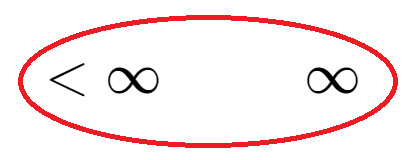
\displaystyle < \infty
<∞\displaystyle < \infty
\displaystyle \Longrightarrow
⟹\displaystyle \Longrightarrow
\displaystyle \zeta (1 + it) \neq 0.
ζ(1+it)≠0.\displaystyle \zeta (1 + it) \neq 0.
\displaystyle \longrightarrow
⟶\displaystyle \longrightarrow
\displaystyle \longleftarrow
⟵\displaystyle \longleftarrow
\displaystyle \bigcirc
◯\displaystyle \bigcirc
Made with Slides.com